Contents:
- Post war life
- Kathleen’s life at home
- Dudley and Kathleen’s living siblings at this time
- Scott Woodhill and Victoria Gaye Westgarth baby boomers
- My parents’ homes at Woollahra and Vaucluse
- Mollie returns from England
- Mollie’s engagement and marriage
- Char and Yaryar go to Europe
- A new home for my grandparents
- Dudley Westgarth and Co in the fifties and sixties
- 1956 Olympics; Sibiriakoffs move to Paris
- 1958 John and Barbara move to Rose Bay
- 1959, Dudley and Kathleen buy a house in Leura, ‘Bringelong’
- 1962, Sibiriakoffs come to live in Leura
- 1966 death of Kathleen
- Kitty Parkman
- 1969 Dudley marries again
- 1969 Dudley writes ‘his epitaph’.
- 1973 Stuart Westgarth joins Dudley Westgarth and Co.
- 1974 Char’s last birthday and death in December
- Kitty’s death in 1978
- Postscript: What happened to Dudley Westgarth and Co?
Post war life
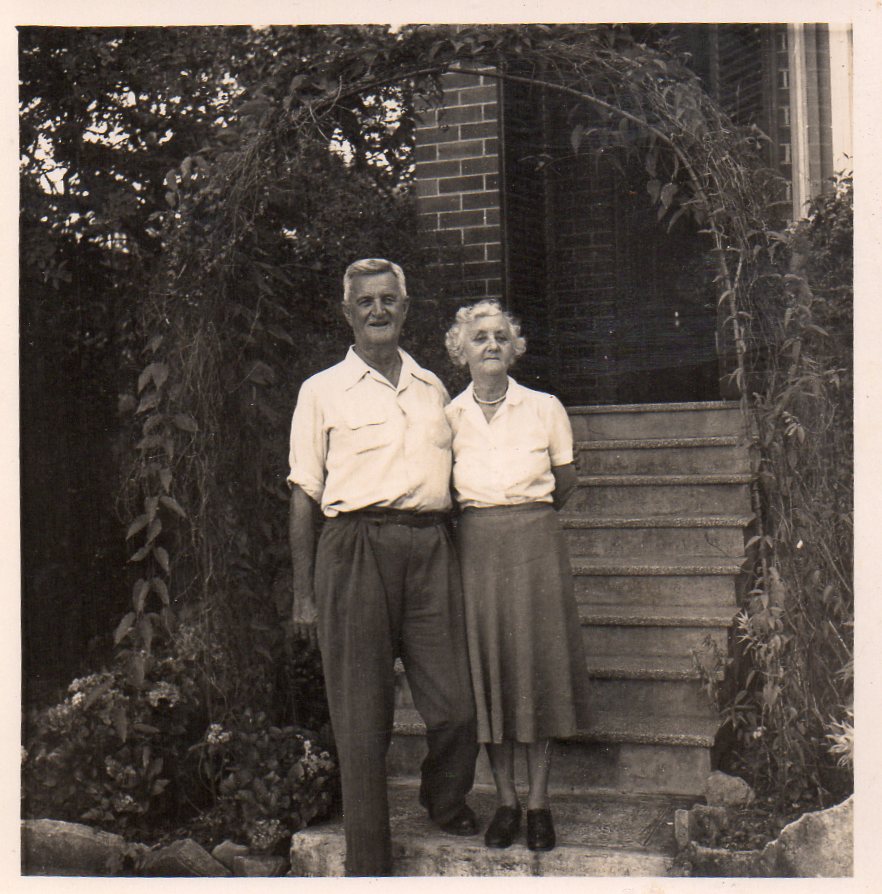
Dudley and Kathleen, or Yaryar and Char, my father’s parents, bought Number Seven, as we called it, probably in 1946. Dudley was still the chief of Dudley Westgarth and Co, at 369 George Street, Sydney city, with its black leather everywhere and marble foyer leading to an impressive staircase. It was above the Bank of New South Wales, which name is now changed to Westpac.
Kathleen’s life at home:
Kathleen was running the house, which included having a sewing day with Mrs Clinch, an English widow who came to the house and could make anything. There were always plenty of Yaryar’s famous rock cakes for Mrs Clinch and perhaps for lunch a bit of John Dory, a fish with a big grey spot on its side.

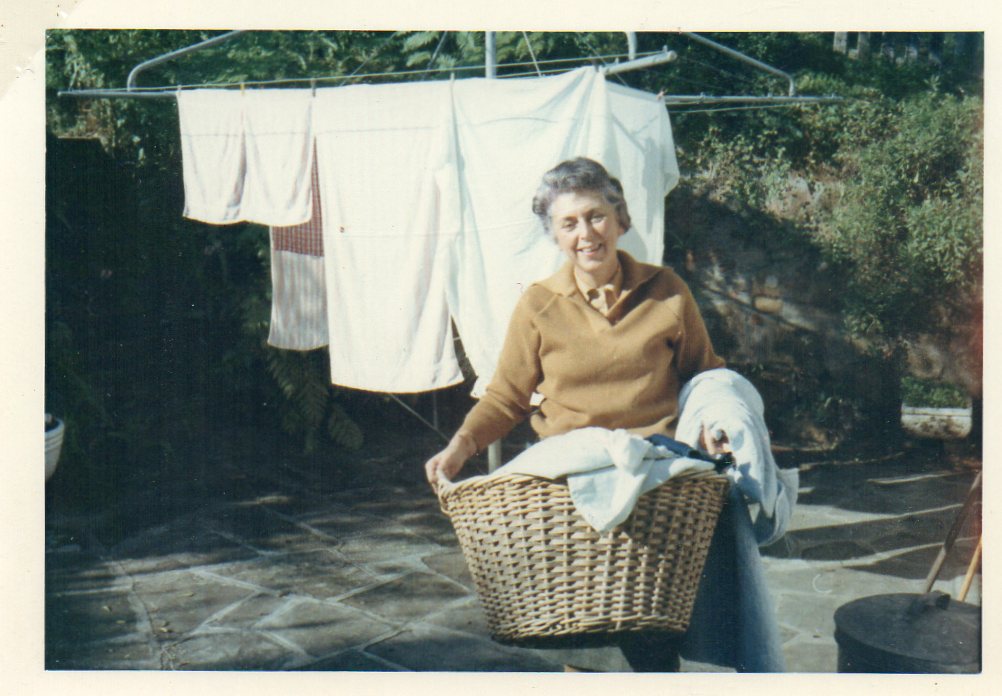
You can see the Megalong Valley behind her.
Yaryar had plenty of washing to do and her hands were deformed from the hot water. All the sheets had to be pulled by two people and folded exactly before going in the cupboard. Driving the big heavy Wolseley to Anthony Hordern’s was also a must. At Anthony Hordern’s you could buy anything and put it on account.
By 1946 Barbara and John had moved to 49 Wallaroy Road, Woolahra, which was much closer to schools and to our Westgarth grandparents. Nancy and Pat were living at Balgowlah on the north shore of the harbour, near Mosman.
Yaryar and Char were soon busy with minding grandchildren. In 1946, Lynne was already at kindergarten, but Anthony and I were three that year. Aunt Nancy had had her second child, Julie Anne, in 1945 and our grandmother took over a lot of the care of Anthony. Whenever I was dropped off to play, he was always there. Sometimes I was allowed to stay the night and Anthony was always there too. One time I even had a bath with him, which was a first and last in my childhood of three girls!
Dudley and Kathleen’s living siblings in 1948.
Dudley and Kathleen were both from families of 9 children, so they had plenty of relatives, but by 1948 Kathleen had far more living siblings than Dudley. As I have related in the blog, John and Mervyn Westgarth died in 1918 and Doreen, the youngest, in 1920. Ella died in 1934, George Mansfield in 1947 and Gwendoline in 1948, leaving just Ronald and Violet still alive when I was 5.
I remember Ronald (d. 1958) and especially Violet, (d. 1980) who had a long life and was called Auntie Poppy. She had a daughter, Roslyn and two lovely stepdaughters. One of them, Zoe Kemmis, married Winston Westgarth. In order to see how the Kemmis and Westgarth families interacted, read the diary of Lorna Kemmis. Lorna even had Mrs Clinch for her sewing woman and her will was made by Dudley Westgarth and Co.
Kathleen
Kathleen had lost her favourite brother, Donald, in the Great War. All the other siblings, Claude, Eric, Ruth, Richard, Robert, Keith and Joyce were in contact with her. Most of them had remained in the country, but Ruth and Eric lived in Sydney. Ruth had married Gordon Phillips, who, it was rumoured, was an alcoholic and violent. Anthony remembers someone, probably Ruth, living at Number Seven for a while.
One day, Gordon backed his car over his infant son, Hugh, who lost his arm. I remember him well. They also had a daughter, called Posy (but I am not sure if this was her real name). I visited her, her husband and family in Walcha in 1965.
Joyce married Ronald Mackay, a stock and station agent at Coonabarrabran. They had two sons and a daughter. Ian was an architect and had some fame for his work. He also had five children and then left his wife.
Richard, or Uncle Dick, lived at Currabubula on a big property. He had three daughters, Jennifer, Jill and Virginia. We had Virginia to stay when she came to work in Sydney. She married James Gavel and has three daughters.
Uncle Keith had a large property near Inverell and four sons. I was friends with Donald. His father told him that I was too close a relation and thus not a good prospect for marriage!
Robert, or Uncle Bob, was a doctor at Bathurst. I don’t remember him. We met his son, Martin, when he was studying Medicine at Sydney University. Martin has a twin sister. Robert died in 1954.
Uncle Eric was a strange character, with twinkling eyes which stared at you. He had two wives and no children. He was living in Rose Bay during his mother’s last years. I remember his second wife. He ended his life in a cottage at Leura, being looked after by our Aunt Mollie, who also lived in Leura at St Anne’s on Gladstone Road. When Uncle Eric died at about age 88, he left his little house to Ina, Moliie’s daughter.
Uncle Claude was deaf owing to is war service. He and his wife Val lived at Trevellyan on his return from combat. Later, they moved to Bathurst and Val opened a gift shop, called the Pink Door. I have some lovely cups and saucers from her shop. Their son, John, was a doctor. Their daughter, June, married Austin Ellerman, a descendant of the other William Westgarth. Small world!
Woodhills move from Balgowlah.
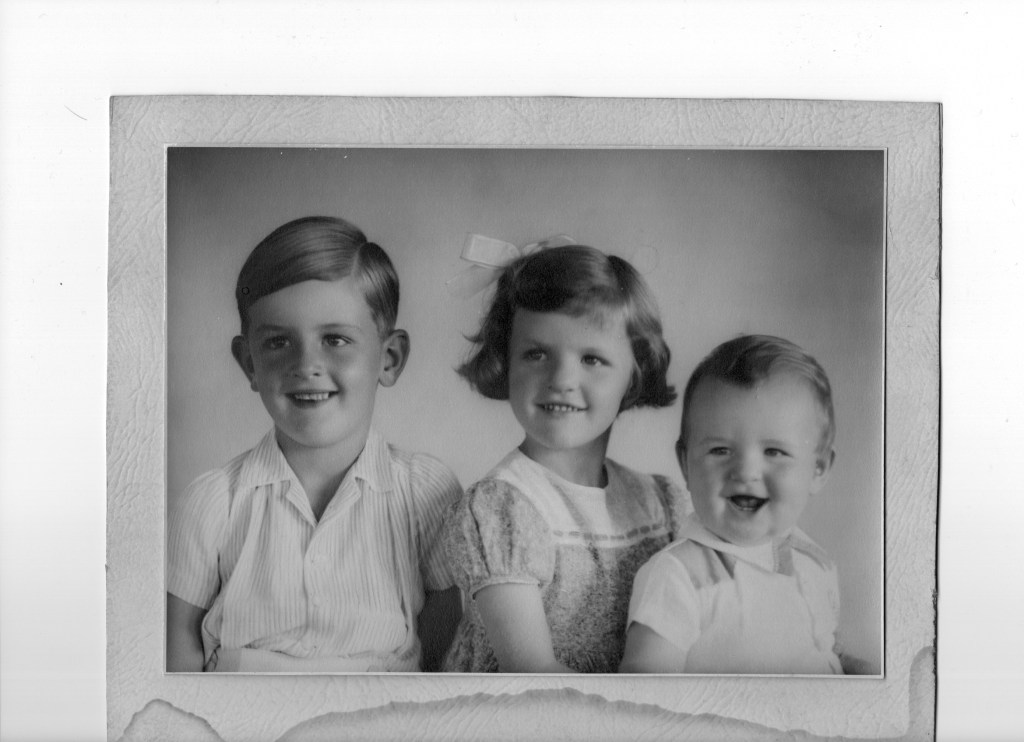
In 1948, Scott was born to Nancy and Pat. They now had three children. Nancy needed a lot of support from her mother, but Balgowlah was so far away across the harbour bridge. Dudley had a house on his books at 27 Dover Road, Rose Bay (which was just down the hill from Vaucluse) and the Woodhill family moved there. Nancy remained in this house for the rest of her life!
Victoria born in 1949.
The war was over and it was time to make a new life in peacetime when John and Barbara bought the house at 49 Wallaroy Road, Woollahra around 1946. It is still there, but much renovated. There is no longer the big blue gum which harboured thousands of gold christmas beetles every summer. Lynne and I used to drown them in a bucket of water. Probably there are no longer the swathes of nasturtiums running down to the creek next door, nor all the butterflies which fed on them. I remember my mother and the neighbour, Mrs France, talking about the change in the weather since the atom bomb was dropped on Hiroshima. I must have been 3 or 4.
We had a ‘dinky’ which was a primitiive sort of three wheeler cycle and a horse on wheels which our mother called faithful Dobbin. That seemed to be quite a common name for a horse, but if you have read Vanity Fair by W.M.Thackeray, you will know that Dobbin is the name of the faithful hero of the story and not a horse at all. You can see our picture on these ‘steeds’ in the previous blog. (Our grandson has a dinky now and it still can go!)
I am 5!
When I was 5, September 24th 1948, I was treated to the most wonderful birthday party at Chiswick Gardens, which are at 63 Ocean Street, Woollahra, quite close. There were lots of little friends, games and a wonderful birthday cake which had a sugar basket of violets on top. I took it home and have never forgotten it. That must have been my best present!
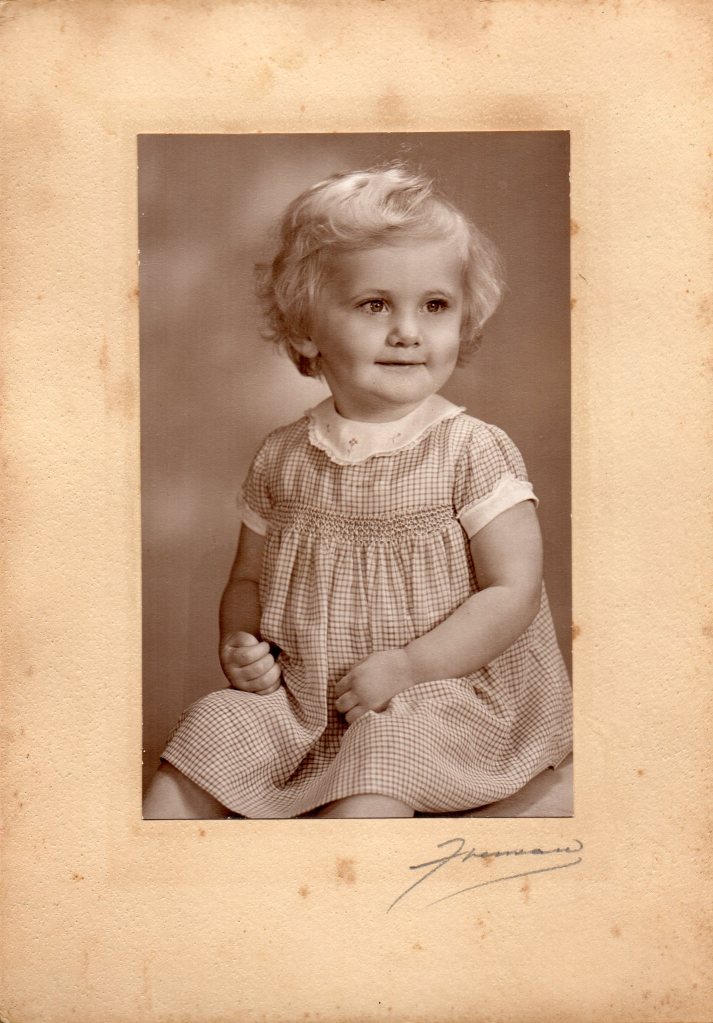
The next year, 1949, I started school at Ascham, where I remained for 12 years. Lynne was already there, four years ahead. On August 17th, my sister Victoria Gaye was born. Probably our parents were hoping for a son as my mother was already 35 and would not have another child. Instead they had a beautiful blonde baby with big blue eyes
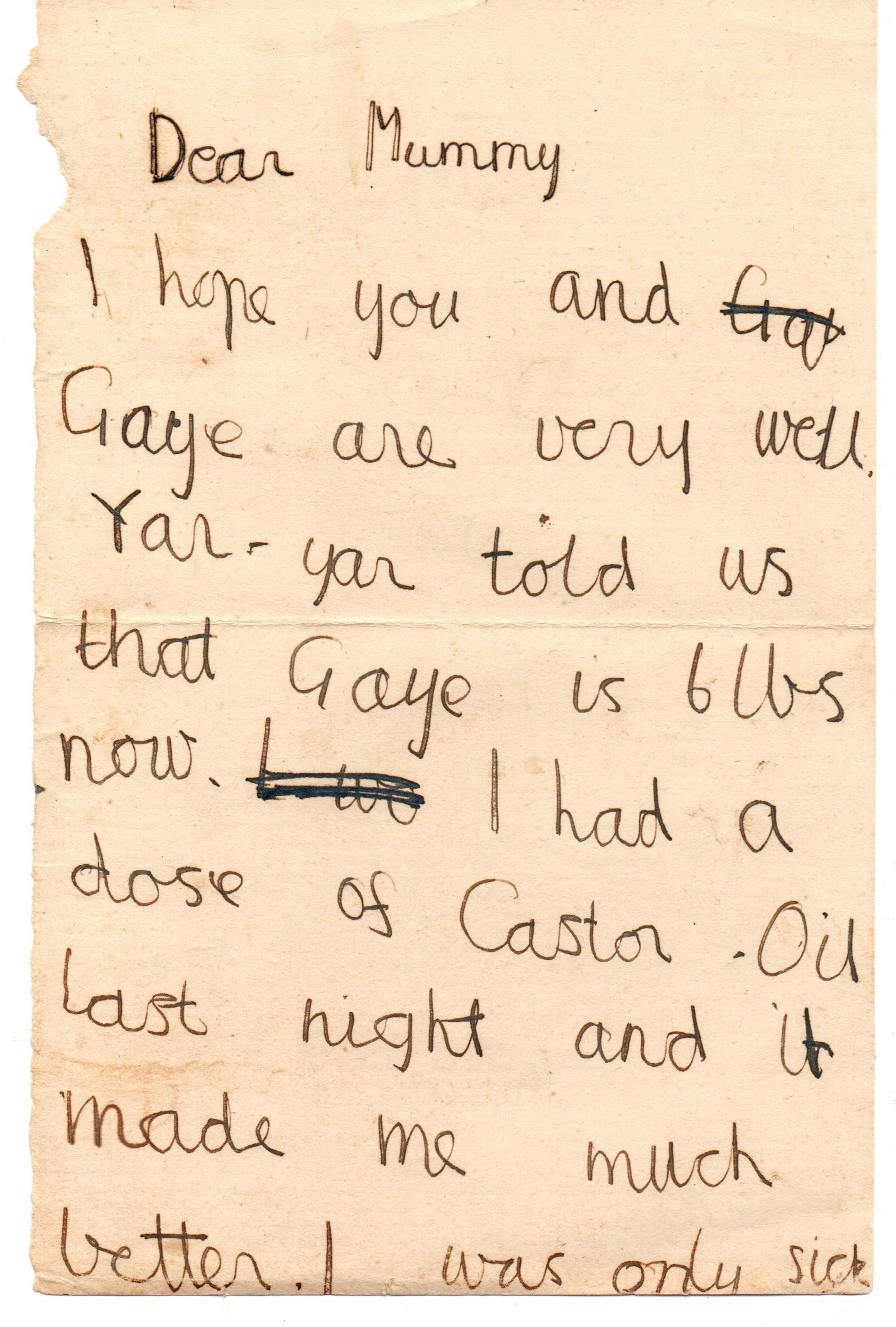
I wrote this letter when I was 5, probably after a draft. I had aready been at school for nearly 2 years and in those days they did not muck around with letting you have fun; it was reading and arithmetic for the 4 year olds at St Mark’s Kindergarten.
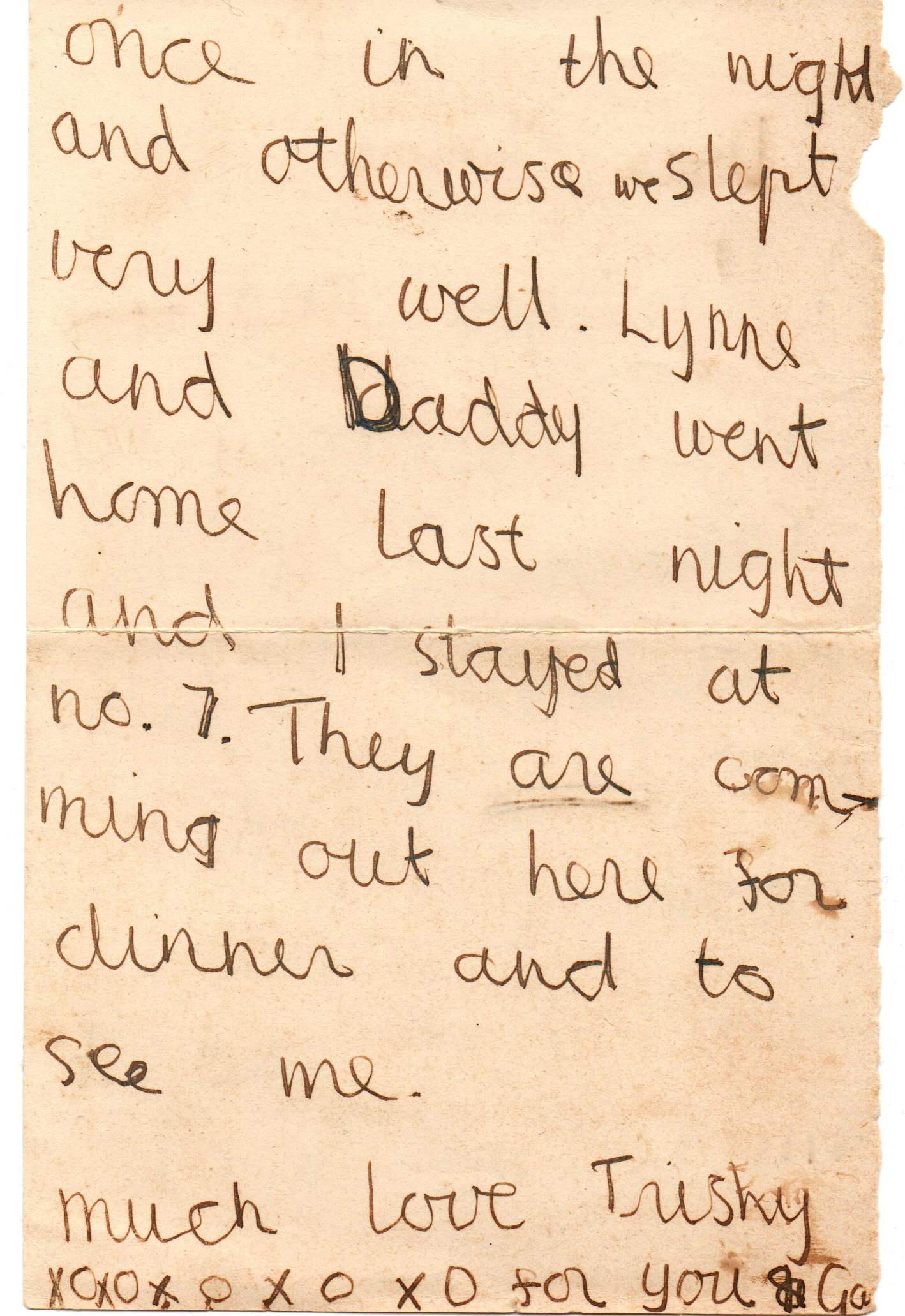
Even though I was nearly 6 and at school, my grandmother let me stay the night, perhaps with Anthony. And more cooking for Yaryar, but a joyous occasion!
The house at Wallaroy Road had three bedrooms. Lynne had asthma and had her own bedroom with an array of asthma cures, one of which I remember was a little lamp. I had the other bedroom looking over the blue gum tree on the left of the photo. The walls were kalsomined, a process quite common then. You could lick your finger and get some of the paint off the wall.
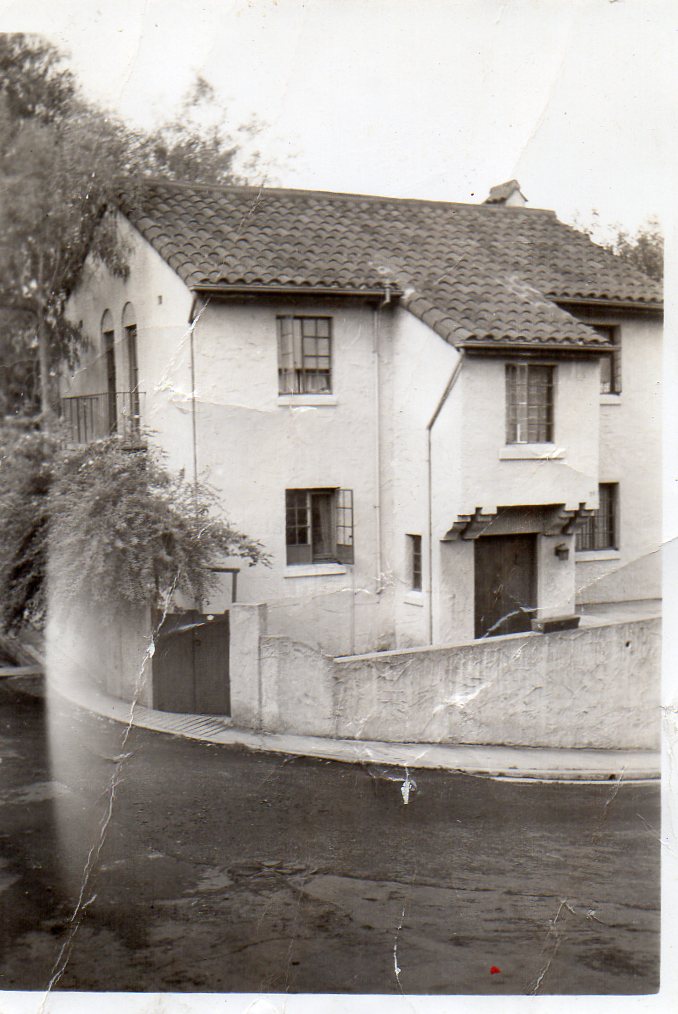
It seemed a big house to me, but when the baby was born my father glassed in the balcony outside their bedroom, to make more room. A big frame arrived and a lot of strong friends came. A pulley system was set up and the men pulled the windows, about 3 or 4 metres long, into place. I was standing watching in the back garden, which was all paved with stone.
I was considered too young to be allowed to hold the baby and this set a barrier between me and the baby and a new attitude towards my mother. She told me that I had changed because I went to school, but it was not the reason.
We move to a new home in 1950
When I was 6, two big things happened to me. The first was a wonderful revelation of a farmstay and the second was moving to Vaucluse. Let’s start with the farm….
I understand now that Lynne and I went to the farm whilst our parents and baby moved house to 32 The Crescent, Vaucluse, a run down large house on the waterfront.
The farm was owned by Colonel McEwen, who had been dad’s colonel in the Matilda Tank Batallion. Since they never had to fight, the crew probably had plenty of time to get to know each other and my parents were very fond of the McEwens.
Lynne and I arrived at the end of a very long red driveway, roughly bulldozed out of the bush at Kurrajong Heights. In my 6 years in the suburbs, I had never done much walking, especially as I had (an undetected) clicky hip from my breach birth. I struggled up the drive and arrived at two old cottages, joined together by a walkway. Two big red setters, Rufus and Clare, came running out. A huge camellia and rows of passionfruit and beans stood in front of the houses. Mrs McEwen took one look at me and said ‘puppy fat’, but I was used to that.
The McEwens had chickens to feed and a poddy calf who had a bucket of milk a day. The dogs were fed on a stew cooked up on on the stove. All hands were mobilized to pick camellias, passionfruit and beans for market, but I think I was all thumbs and probably fell over. When the rubbish built up (no plastic in those days), the draught horse was harnessed and Lynne drove him, pulling a sled, to the rubbish heap. Near the rubbish heap, but I hope not too near, was a swimming hole. I had been learning to swim since I was 4 at Bondi Pool, so I enjoyed the swim very much.
One day a boy came to stay. He was about 10 years old and I can’t remember his name. We had had no experience of brothers so I was not prepared when he ducked me. In fact, I had never been ducked and I was totally indignant that someone would treat me like that. The next time we went for a swim with him, I ducked him. I was smaller but heavy and I did not get off. Lynne managed to get me off before I drowned him. That was the end of the ducking business.
The cat had kittens just before we arrived. Yes, you guessed it, I would not be refused! I had to take one home. She was tabby and white and I was sure she would sleep on my bed every night – but she never did. Mum called her Ping like the duck in the Chinese story.
The last lovely memory is a bushwalk with Mrs McEwen through the virgin bush full of song – bellbirds, whipbirds and others. We came to a Nissan hut set in the bush, covered in with flyscreens against the mosquitoes. And there were big kids inside, having a party and camping out. I watched them with awe. They were the McEwen girls, who were teenagers.
32 The Crescent
When we came home, it was to the new house at Vaucluse. Victoria (Torie) was around 1 year old and she had a nanny called Miss Cavey, who lived in the bedroom next to us. The upstairs was meant for servants, so it had fibro walls and a very steep staircase down to the kitchen area, but the view over the harbour was amazing.
Mum must have got her inheritance to buy this house. Her father had died before I was born. After the war, her mother, Katharine Boydell, went to live with Bob, her eldest child, at Killara. There, she died in her sleep. I do not remember ever seeing her, but in photos she looks like mum.
Grandmother Boydell’s maiden name was Gill. The Gills were free settlers around 1845 and acquired large sheep runs in northern New South Wales, around Walcha. They prospered with the wool industry and Grandmother’s father became an M.P. Grandmother had her own income from the fine wool sales and her four children inherited shares of it. Mum had her own income all her life.
So mum began to renovate the old house. The top floor became four bedrooms and a bathroom, with a cedar staircase leading down to the lounge rooms downstairs. A lot of money was spent on their decor and on a baby grand piano, however most of the life of the house was in the area adjoining the kitchen where we usually had meals. My bedroom had a lovely wallpaper, depicting posies in paper doilies, but the decor was spoiled by putting up curtains with a contrasting floral pattern. I hated those curtains.
Because Torie had a nanny, we were really kept away from her. Also, I missed my friends who lived across the road from our old house. I found that Vaucluse people were not quite as ‘uniform’ as those in Woollahra and I never made a good friend of a neighbour.
Scott and Torie
Scott was born on July 5th 1948 and the Woodhills moved to Rose Bay.
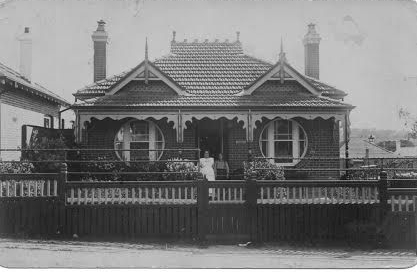
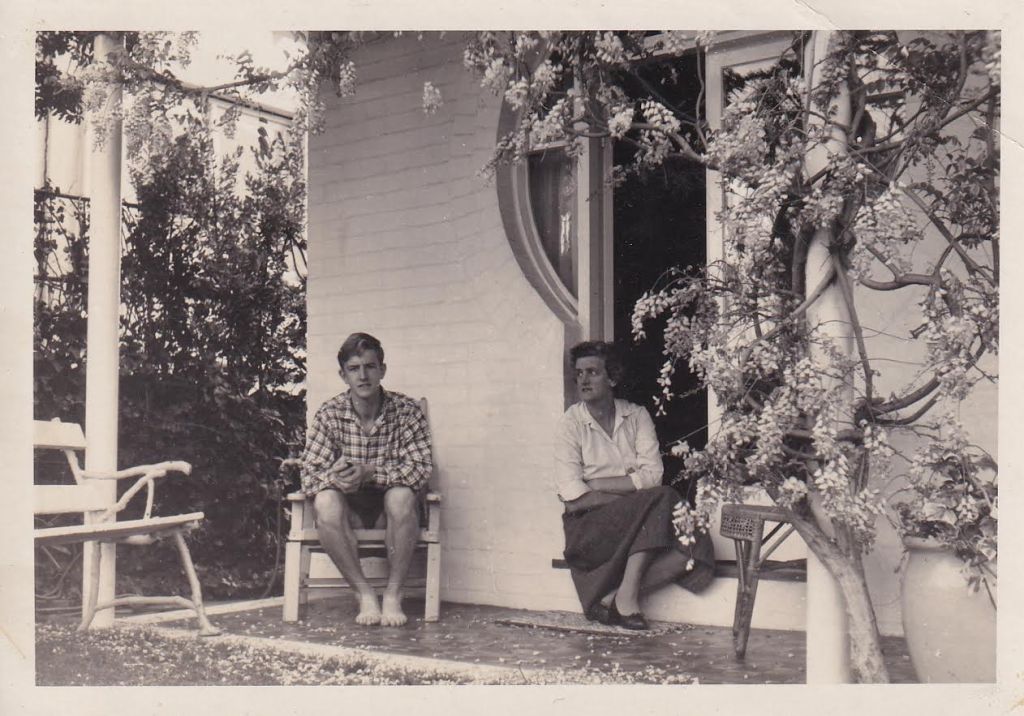
This was how the house originally looked around 1900. When the Woodhills were there it was painted white and had wisteria along the front.
That year, Ant and I went to St Mark’s Kindergarten at Darling Point. We had lunch and slept on mats like modern children, but we had to do arithmetic and learn to read when we were awake. I loved reading and found I could read books at home. ‘Shadow the Sheepdog’ by Enid Blyton was my first effort, skipping the hard words.
The Woodhills’ move to Dover Road gave Yaryar more time to help Nancy with the baby and Julie, who was only 3. Luckily for Yaryar, Torie had a nanny. When Miss Cavey left, Torie was sent to Miss Louie, who was the local ‘Angel’ and ran a childcare centre from her own home on Hopetoun Avenue. She also ran children’s games after school and put on plays in the Congregational church hall.
School
We girls, Lynne, me, Julie and Victoria went to Ascham as our grandmother and aunts had done. Anthony and Scott went to Cranbrook where our father and uncles were educated. When Torie was 10, she was sent to boarding school at Frensham, a fate which alienated her even more from family.
Mollie
After Aunt Mollie arrived from London in 1950, she settled into her bedroom at number 7 and we got to know her. Her bedroom had a lovely floral bedspread and matching curtains and a little balcony from which you could see straight up the harbour to the bridge (but not the Opera House as it was not built).
About 1951, Aunt Mollie started working again at Dudley Westgarth and Co., probably doing work to do with wills and conveyancing, because women in the legal profession were unusual at that time. She also helped around the house and I remember stringing beans and weeding the garden with her.
1953
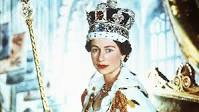
In 1953, Queen Elizabeth was crowned in Westminster Abbey and Australians went mad celebrating. All the main streets of Sydney had arches of flowers over them and the harbour was full of decorated ships. When night came, all the decorations were lit up. On the night of the coronation (it was morning in London), we all assembled on Mollie’s balcony and looked at the lights and fireworks whilst listening to the procedure on the radio. Torie was too young to remember but it was unforgettable for me. I still have the commemoration books.
The other memorable thing in 1953 was a telephone call in the middle of the night. My father answered it and let out an astonished shout. Aunt Mollie was ringing to say she was engaged to a Russian engineer called Inokenty Andreiovitch Sibiriakoff, who was one of her clients at work. This was the time of the White Australia Policy. He was white, but……… not British!
A bit of background……
Australia was a country closely tied to Britain when I was a child. For Mollie, a woman, to have gone alone overseas to London in 1948 was quite unusual, but the Australian legal system was based on British law, so there was experience to be gained. Many ships still sailed back and forth between Britain and Australia, bringing manufactured goods here and returning with wool and wheat and such products. People still travelled by ship in those days, the journey taking about 6 weeks.
Britain in 1948 was an exhausted country with food rationing everywhere and little access to the good produce we had. Mollie would have gone to a London full of bomb sites and poor nutrition, but she would have had contemporaries to see and contacts from friends in Australia to meet. One of her contemporaries over there was Doctor Rodney Seaborn, John’s lifelong school friend, who was doing further study in Psychiatry. British medicine was the standard in Australia. If you wanted to be a surgeon, you sailed to England to do your Fellow of the Royal College of Surgeons (FRCS) training and examinations.
Here is an article which describes the sort of England that Mollie and contemporaries arrived in and lived in. You can read more on the website below:
Grey Britain: Rationing and Shortages
https://www.histclo.com/essay/war/ww2/cou/eng/w2e-ar.html
Britain was a grey place after the War. Many of the children returning home from overseas evacuations, most America, were shocked. The war damage was a fraction of what Germany suffered, but the Luftwaffe’s bombing was still substantial and it would take years to be replaced with new construction. Rationing had for 6 years affected British life afecting the dinner table and how people dressed. It not only crimped the way the British celebrated, but normal every day life. People did not go hungry, but the foods people most wanted (suggar, milk, butter, eggs, and meat), itens needed to make tasty meals were hard to get. Basic commodities like butter, meat, tea and coal were still rationed in 1950. Bread was other wheat products now freely available, but the de-rationing of sweets and chocolates in 1949 had to be reversed because demand could not be met. The continuance of rationing encouraged people to produce their own food in back gardens and allotments as they had done during the War. The ratiining also affected nutrition. You see incidents like Switerland taking in ‘delicate’ children to improve their health with good food anf fresh air. Clothing was also rationed making fashionable dressing impossible. Princess Elizabeth even had to get creative for her wedding dress (1947). Despite the rationing, there were severe shortages of most popular consumer products. This meant the continution of the wartime ‘make-do-and-mend’ culture. The austerity and bureaucracy of British post-war found its way into George Orwell’s classic novel Nineteen Eighty-Four (1949).
Housing
Housing was another serious problem Britain faced after the War. Many workers beefore the War lived in substandard housing without running water.The Luftwaffe had not seriously damaged British war industries during the War, they had destroyed large numbers of homes in London and other major cities. During the War, labor and materil shortages made it impossible to address the problem. The new Labour Government’s answer to the problem not just to build new housing, but to tear down slum housing and move people to newly counstructed urban council flats or out of the cities entirely. To accomplish its goals, Labour passed the New Towns Act (1946). The result was expanding towns around London. A good example was Harlow. They were to take London’s overspill population. They also began to create new industrial centres. Peterlee in the north (county Durham) is a good example. The new towns effort was just beginning by 1950 and it was not going well. The local authorities lacked the needed resources to deal with the housing shortage. Nearly half the population living in these new cities had to be accomodated in private rental housing. One source described these accomodations as commonly ‘dingy rooms or bedsits with little privacy, comfort or warmth’. Less than a third of the houses in these new citiues were owner occupied. The vast majority of buildings were unmodernized designs and construction, built of brick or stone. There were almost no high rise buildings. Concrete tended to be used mostly for military structures. This only began changing rapidly in the late 1950s and 1960s.
Environmental Issues
Britain was the world’s most most urbanised and industrialised country in the world. America of course had a larger industrial base, but it was more spread out than in Britain where infustry was largely concentrated in the industrial Midlands. And British cities where coal was used not only for indutry, but home heating had a serious air quality problem. Britain was as a result one of the most polluted–especially English cities. The heavy use of coal for both residential heating and energy resulted in terrible air quality, unhealty condiutions. It was harmful both to people and to buildings. This was not a problem with suddenly appeared. The London fog/smog was notable even at the turn-of-the 20th century. It even figured in the history of the American Boy Scouts–the story of the Unknown Scout. But conditions only worsened as industry expanded and population grew. The killer London smog of 1952 lasted 5 entire daysfive days and killed more than 4,000 people from varius heart and lung disorders. In industrial cities, factory smoke stacks not only billowed out exausts and polluted the air but also the effluent of untreated duscharge polluted the water. Mines and spoil tips scarred the landscape. Pollution was the result of Britain’s industrial success. The Labour Government did not attach any great importance to pollutiin and ebvironmental quality. This was not particulary unique at the gime. What was unique was the cale of Britain’s pollution problem. Labour’s priority was jobs, especially industrial jobs, and manuctcuring. Britain un 1950 accounted for a quarter of world trade in manufactures. This was a gighest level in many years. This was the result of the World War II destruction on the continent, Britain’s traditional competitors. They were beginning to recover, but un 1950 wre still just beginning what would become an economic miracle. Another reason was Labour’s policy of prioritising export manufacturing toi generate foreihgn exchange earings. One positive feature was that birds and other wildlife were more abundant than today because there were still far more hedgerows and much less use of chemicals.
Mollie’s Engagement
Kena or ‘Sibi’ as he was called in his working life, had been in the colony of Malaya with a French company, Societe Congolaise Financiere, or ‘Socfin’, which had rubber and palm oil plantations, as Manager of their technical department. When the Japanese overran Malaya in 1942, Sibi was taken prisoner and forced to serve on a small Japanese naval craft. He was then interned in Changi, the prison in Singapore where 3000 civilians were jailed. Also, 50,000 Allied soldiers were imprisoned in the Selarang Barracks near Changi after surrender, February 1942.
In Changi, Sibi got to know David Griffin, who became a partner in Dudley Westgarth and Co after the war. David was well known for his work in keeping the troops entertained. He is known for his creative writing too.
After the war, Sibi went back to his work in Malaya, but by 1948 the Malayan independence movement, called the ‘Emergency’, was gaining force. The Emergency continued until 1953 and an independent Malaysia was created on 31st August 1957.
Around 1950, needing a new focus outside his difficulties in Malaya, Sibi decided to buy a house in Australia for recreation. He contacted David Griffin, who found him a beautiful waterside property called ‘Glendalough’, at Church Point on the Hawkesbury River. David and his sons went boating with Sibi on Pittwater. Of course David was Sibi’s solicitor at Dudley Westgarth and Co.
In 1953, when Mollie returned to the firm, David handed over Sibi’s affairs to Mollie. By the end of 1953, Mollie and Sibi were in love although she was 34 and he 52. She rang him from Melbourne on Boxing Day and he proposed on the phone. This must have been the day we received the midnight phone call!
Sibi, born 27th December, 1901, was a man of experience and achievement. He had been married before and had a son called Vladimir Andrei who was born on 18th February 1935. As a youth, in 1920, he had escaped from Communist Russia and made his way to Europe, first studying Philosophy in Vienna and then engineering in Belgium.
At Changi, Sibi had made his own chess set and had played many games. Before Mollie got back from Melbourne, Sibi went to ask Dudley for her hand. They played four games of chess and Sibi won them all. That would have impressed Dudley!
Kena
It must have been around this time that a decision was made, by Mollie, that her husband would be known as ‘Kena’. His grown son became ‘Andy’, as he was probably known in America where he lived.
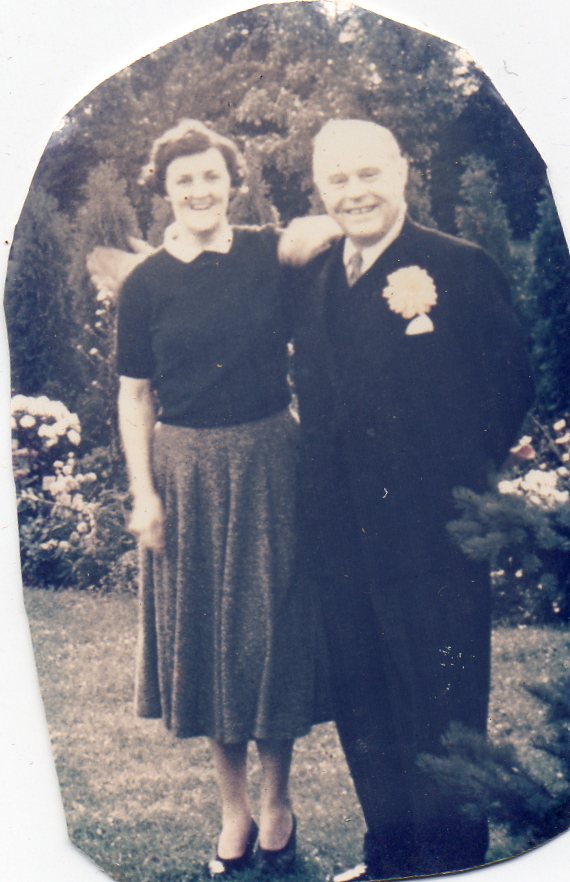
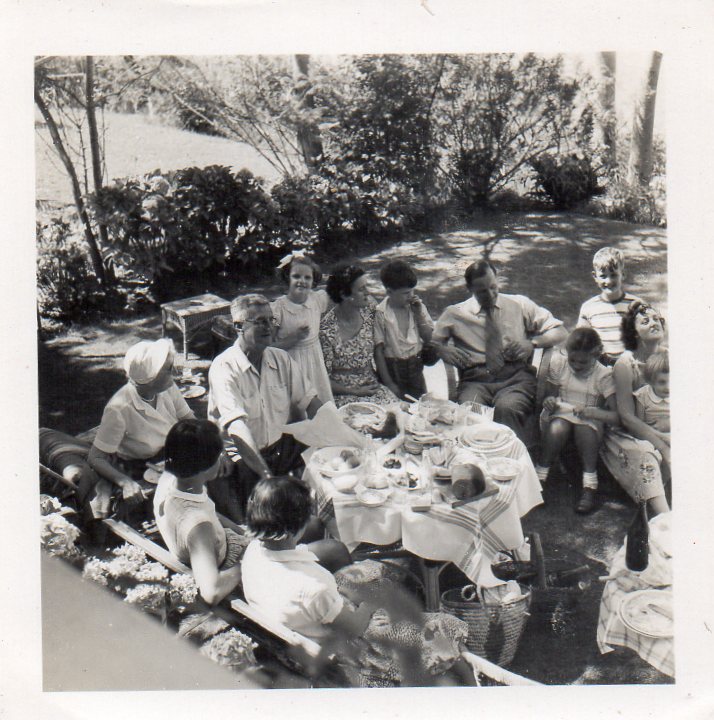
In January the family was all invited to Church Point for an engagement afternoon tea. We have many photos of that occasion. Here is the engagement photo of Moll and Kena.
Here she is with all the grandchildren at Church Point in the garden. She was kindness itself to us all until her sudden death in her seventies.
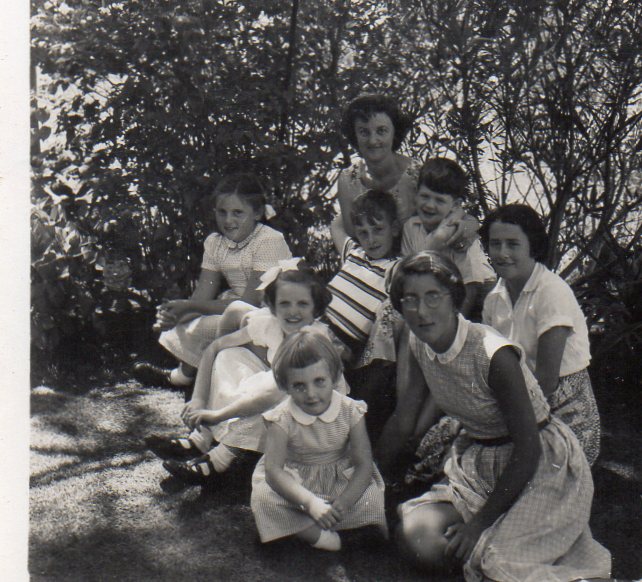
Front: Torie and Lynne; Behind: Julie, Anthony, Scott and Robbie; Back: me and Mollie.
For Char and Yaryar, Mollie’s engagement was a blow. They had lost two sons in the war and had believed that Mollie would be their support, as many unmarried daughters were at the time. In 1950 Mollie had come back from overseas and now, in 1953, the prospect of saying goodbye again was real. Kena’s prospects were overseas and his wife would go with him.
1953 operation for me
When I was 10 a GP finally noticed that I had torticollis, which means my head was growing down on one side. I had to have the tendons in my neck moved to allow my head to grow straighter, a process which was repeated in 1955. I still have the books which my grandmother brought me whilst I was stuck in my hospital bed for days, as was the rule in those days.
1954
The next excitement was to be the wedding on 10th April,1954, in Kuala Lumpur, Malaya, as it then was. This was Dudley and Kathleen’s wedding day too! It was a convenient time, because Dudley had to attend the Privy Council in London at the end of April.
Of course in those days, only Yaryar and Char went to the wedding. Cheap and frequent plane travel was not yet invented!
Mollie and Kena would go to live in Kuala Lumpur after their honeymoon in Penang. Here they are cutting the cake. You can see Char in the background, smoking as usual.
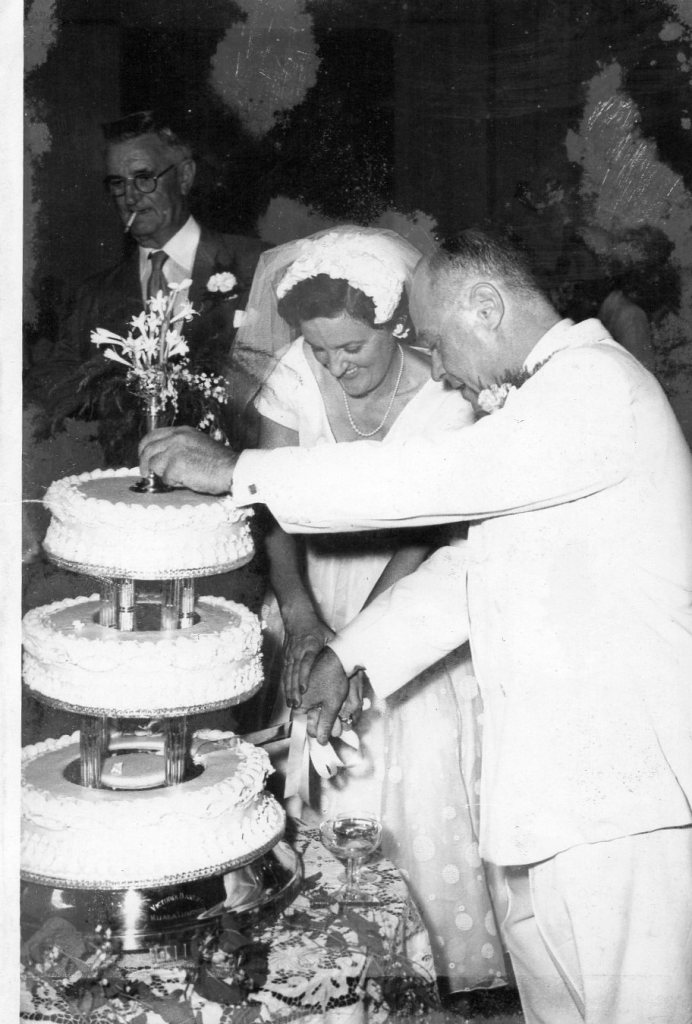
Last Thoughts Before Saying ‘I do’
Mollie had lived overseas, probably travelling across the Channel to Europe whilst there. Now she was excited to start a new adventure with Kena, but her parents were hoping she would change her mind. I was told that they spoke to her the day before the wedding, saying that she could still back out if she wished. She did not want to back out, of course!
After the wedding Char and Yaryar went sightseeing in Kuala Lumpur. Here they are in rickshaws with their new son-in-law, Kena. Not much traffic in those days! You can see Kena is at the most at ease in this environment.
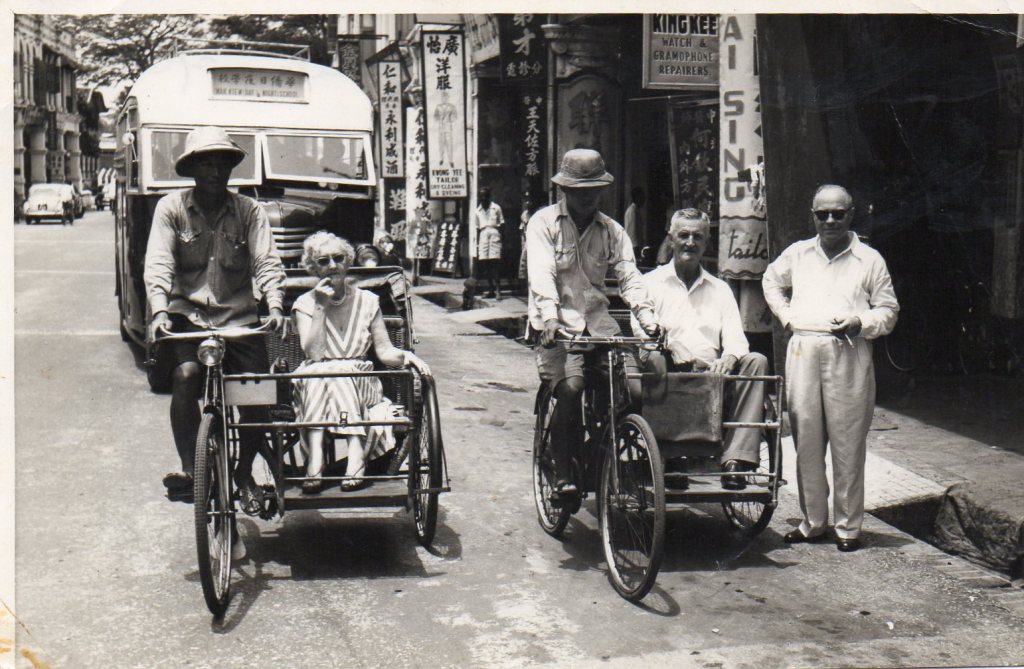
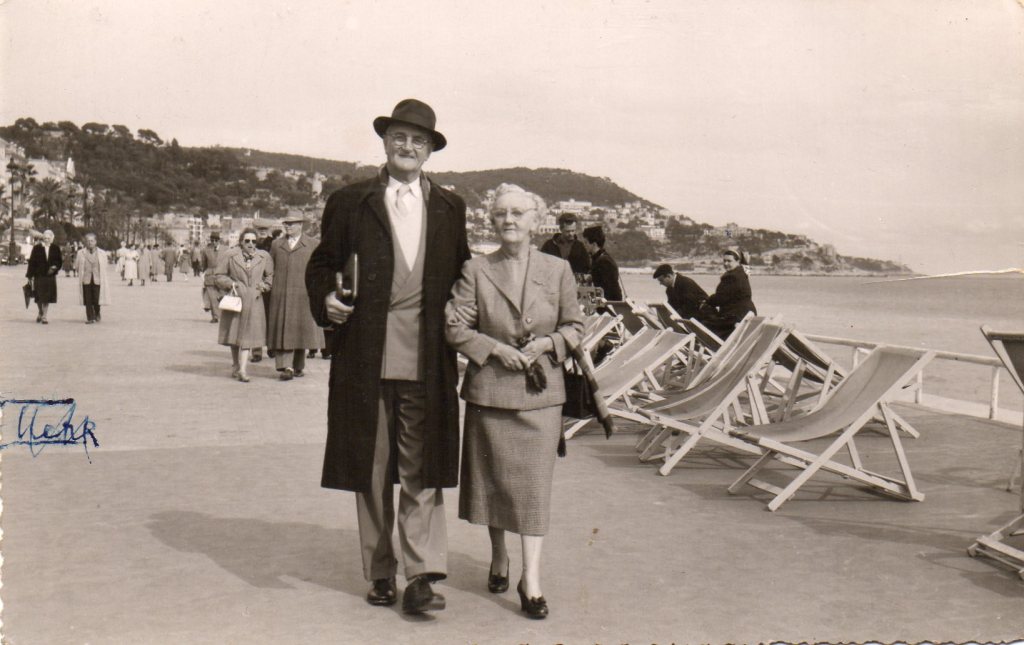
From Kuala Lumpur, they flew to France and were staying at a hotel on the Promenade des Anglais, Nice, on 21st April.
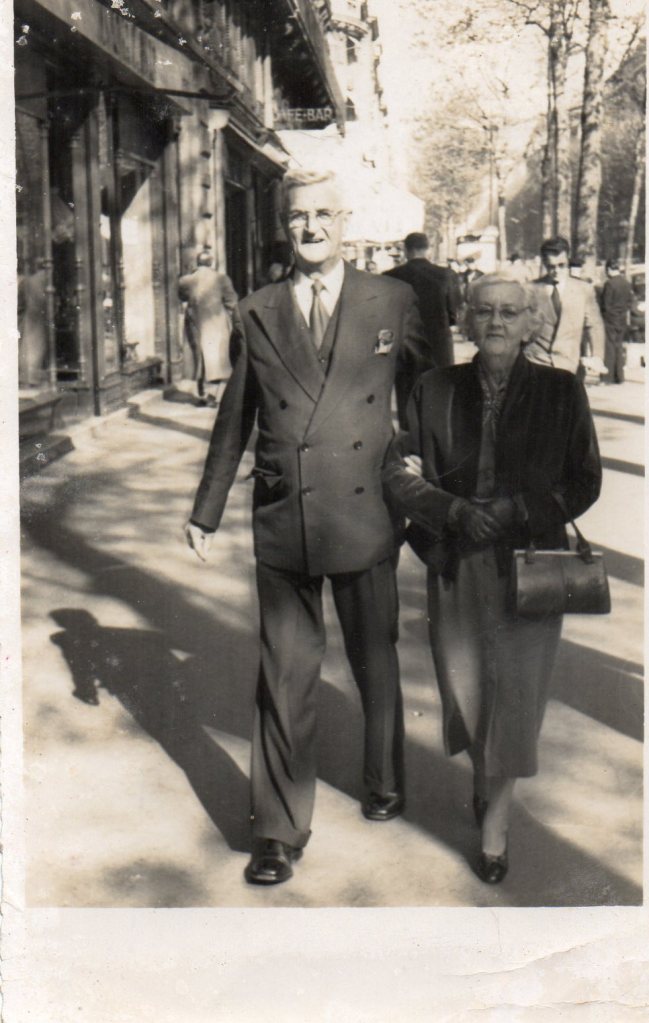
Here they are outside the Galeries Lafayette, in Paris. They bought quite a few pictures from the artists on the Seine.
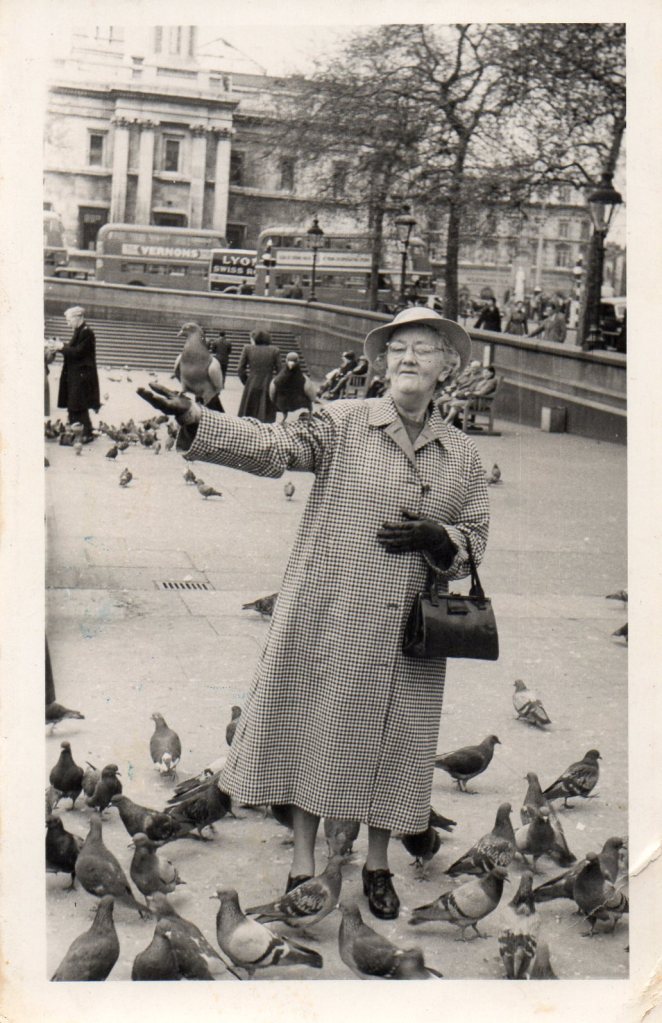
And now, by the end of April, in London, Trafalgar Square with the pigeons. Dudley’s photo is on the first blog about him.
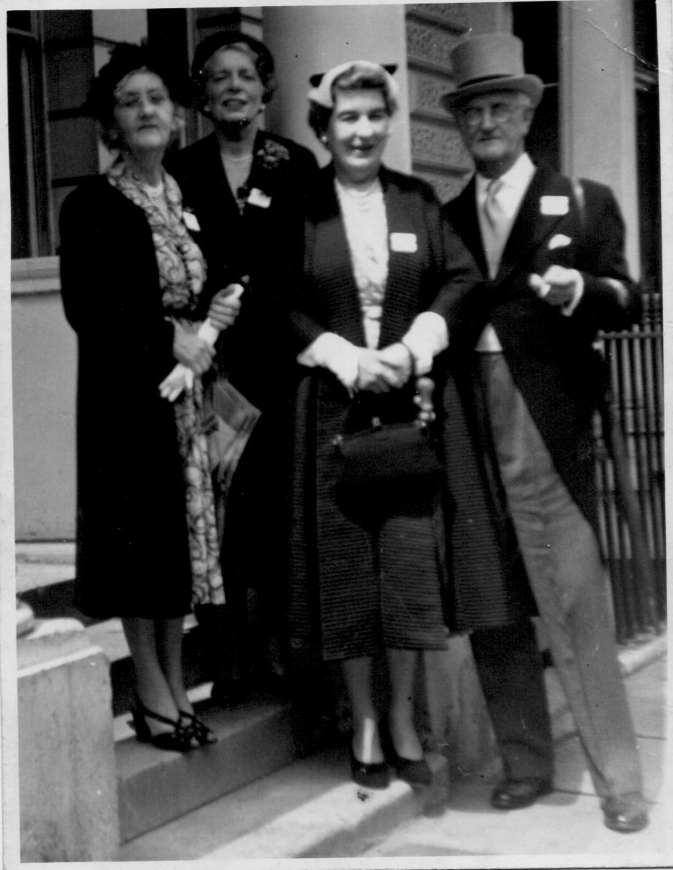
I also have a photo of them with friends, dressed up for Ascot, the famous racecourse.
1955
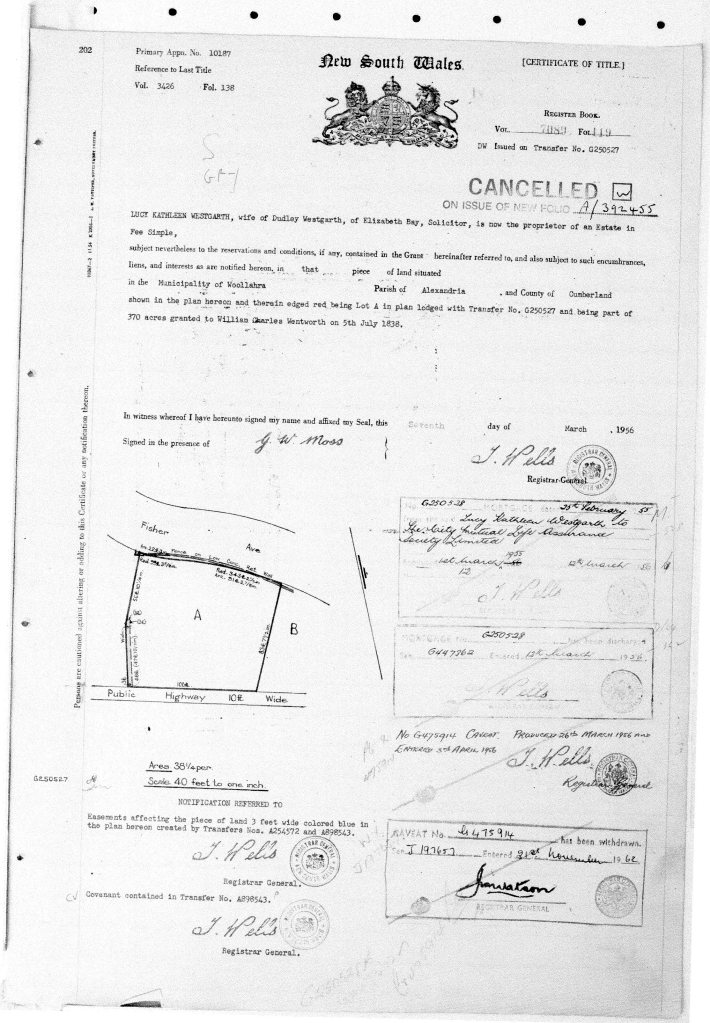
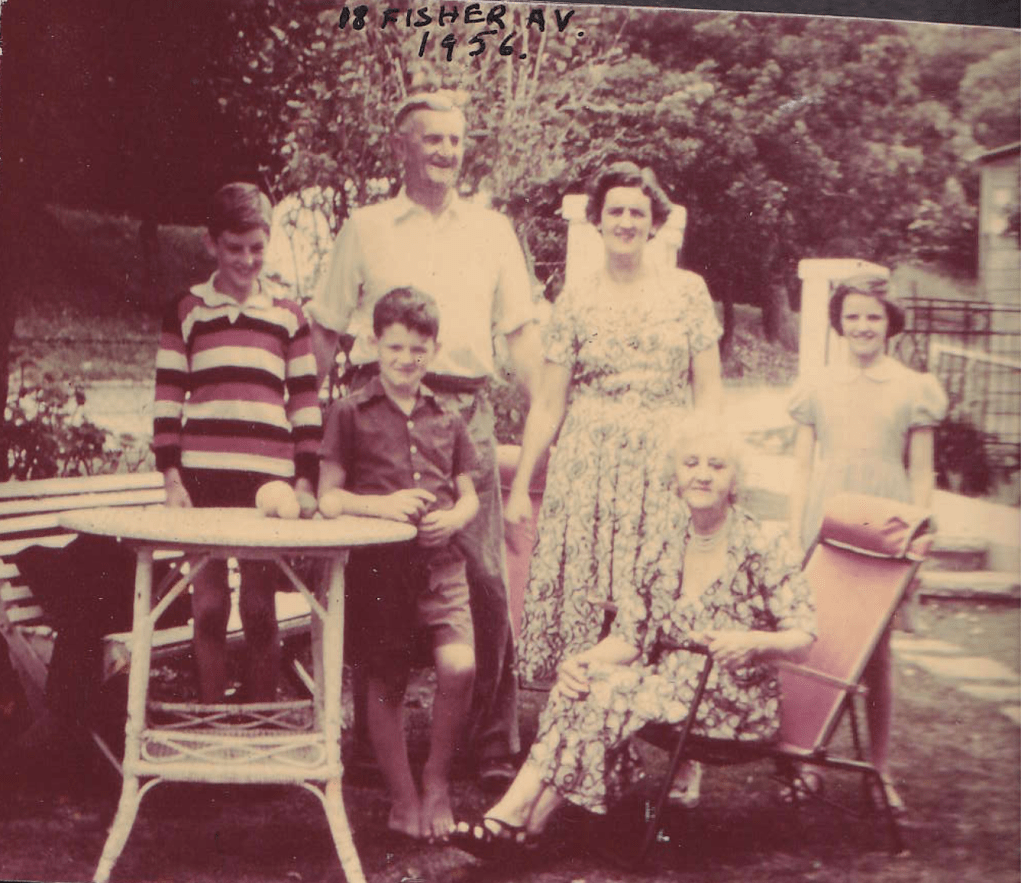
Dudley and Kathleen came back from their world touring and life changed for them. On 25th February, 1955, Dudley took out a mortgage in Kathleen’s name for the purchase of 18 Fisher Avenue, Vaucluse. This had been part of a post war subdivision of the original grant of land to William Charles Wentworth in 1838!
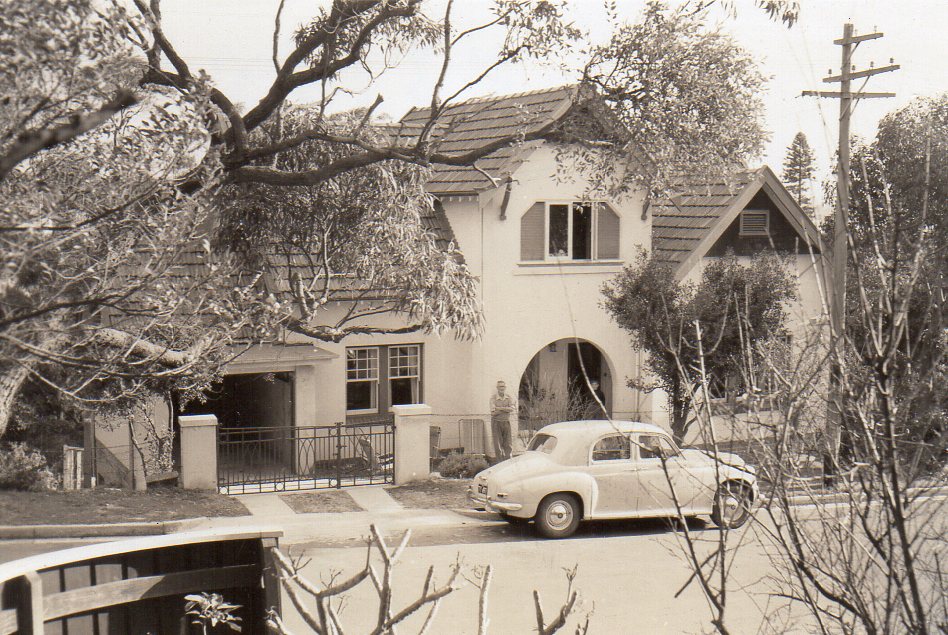
Dudley was already 67 years old and Kathleen was 65. 18 Fisher Avenue, was a smaller house on one level with a creek at the back.
Mollie and Kena left Malaya for good in May. 1955. Kena was to start work as the general manager of Selatex and would be based in Paris, but spending much time in Africa.
Whilst he was reorganising his life in Paris, Mollie came to stay for six months with her parents at their new house. Then she was off overseas again, to live in Paris.
During the time that Kathleen owned Fisher Avenue, she was becoming more and more disoriented as dementia developed. In Europe, Char had bought her a sapphire and diamond ring which she lost in the house. Years later, when they left Fisher Avenue, the ring was found under the carpet. It was given to my mother and I now have it.
Dudley Westgarth and Co. in the fifties and sixties:
Dudley Westgarth and Co continued working at 369 George Street, under the leadership of John and his associates, including David Griffin, Tori Kitamura, David Mander Jones, Fred Osborne, John Michael Bennett and John Peter Wood.
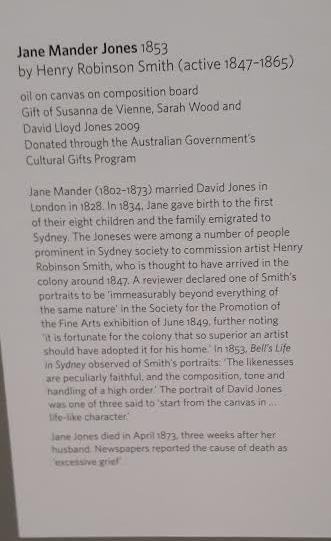
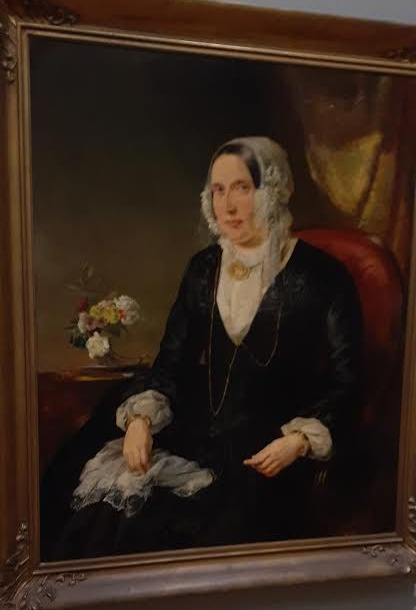
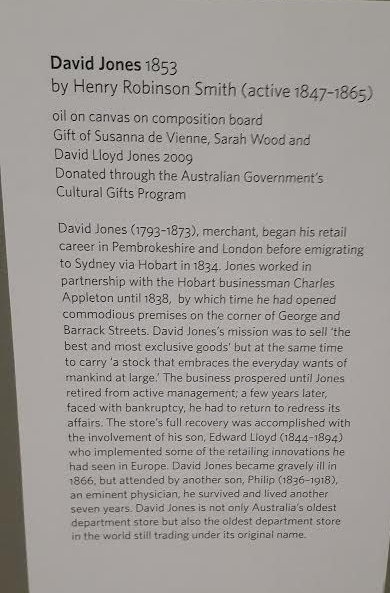
David Mander Jones was unknown to me until I recently went to the Portrait Gallery. There in a prominent place were his forebears, Jane Mander and David Jones, who emigrated from London in 1834 with the first of their eight children. David Jones established the famous department store, David Jones, which is the oldest department store in the world!
John Peter Wood was a war hero, who suffered from PTSD, according to his son, James, in an interview with Rick Feneley in 2015:
“My mother had not been well and my father didn’t really recover from the war,” he explains. “While my father was in the air force, just after I was born, my mother developed a strange, very complicated neurological spinal problem that left her paraplegic.”
In World War II, Wood’s father piloted Catalina flying boats out of Darwin and from Morotai Island in the Dutch East Indies. He was among the RAAF pilots famed for daring mine-laying missions and rescue sorties, though Wood admits: “I very much regret that I didn’t hear enough about his experiences. All I have left are a few photographs, a few snippets here and there.”
His father returned to civilian life to work as a solicitor but endured what might now be diagnosed as post-traumatic stress disorder. James left the office to become a barrister, and later became a Supreme Court Judge.
John Michael Bennett became a legal historian. Here is his Sydney University citation for the honorary degree of Doctor of Letters, 2007:
Dr John Michael Bennett AM
The honorary degree of Doctor of Letters was conferred upon Dr John Michael Bennett AM by ProChancellor John McCarthy QC at the Faculty of Arts graduation ceremony held at 11.30am on 1 June 2007.
Citation
Pro-Chancellor, I have the honour to present Dr John Bennett AM for admission to the degree of Doctor of Letters, honoris causa.
‘One of the purposes served by the study of history is the understanding of the development of our separate national character and our constitutional and government institutions. The contribution of Dr Bennett to an understanding of the development of legal institutions, the courts of law and the personalities prominent in that evolution is unparalleled in Australia.
John Bennett matriculated to the University of Sydney in 1953, and graduated with the degrees of Bachelor of Arts and Bachelor of Laws. Whilst still a student he contributed to the Sydney Law Review, the University’s principal legal journal. The Sydney Law Review was the beneficiary of at least eight further items of his original research. He became a contributor to many legal and historical journals, including the Australian Law
Journal, as well as the Journal of the Royal Australian Historical Society.
John Bennett’s interest in original historical research led to a Master of Laws in this University and in 1990 the rarely conferred degree of Doctor of Laws. He was awarded a Master of Arts by Macquarie University for his thesis on Sir Frederick Darley, the 6th Chief Justice of New South Wales.
Dr. Bennett has served as Editor-in-Chief of the Australian Law Journal Reports and Editor-in-Chief of the2nd and 3rd editions of the major encyclopaedic work ‘The Australian Digest’. In 1970 he became Director of Research of the Law Reform Commission and later Executive Member. He also held a number of University appointments. For many years he was a part-time lecturer in Australian
Legal History in this University and at the University of Technology, Sydney. He was Senior Research Fellow in the Research School for Social Sciences of the Australian National University and from 1970 an occasional Visiting Fellow at that University. In 2002, he was appointed Adjunct-Professor in Law at Macquarie University.
Dr Bennett has held various senior offices in the Royal Australian Historical Society, including that of President. He served on Supreme Court historical committees, particularly the Charter of Justice Sesquicentenary Committee and the Heritage Committee. As recently as 2005, the Heritage Committee published Dr. Bennett’s ‘Colonial Law Lords’, which examined the difficult early relationship between the
legislature and judiciary in New South Wales, a relationship which to some extent has modern parallels. Dr Bennett has also been a significant contributor to the Australian Dictionary of Biography.
His major works included a History of the New South Wales Bar, a History of the Supreme Court of New South Wales, Portraits of Chief Justices of New South Wales, Keystone of the Federal Arch (a History of the High Court of Australia), and a History of the Solicitors of New South Wales. Between 1969 and 2007 he published numerous books and articles, including contributions for the New South Wales Parliament and the Committee for the Sesquicentenary of Responsible Government in New
South Wales, most recently to the biographies of New South Wales Premiers.
In 2001 Bennett commenced his ‘Lives of the Australian Chief Justices’, a 20 volume series of which eleven have appeared to date, with the twelfth due at the end of 2007. All twenty biographies involve original research into the lives of the Chief Justices of the Colonies of Australia to the end of the 19th century.
These writings have involved Dr Bennett in painstaking research into original sources and rare secondary sources, many located overseas. They are not mere chronicles of lives but analytical portraits set in a background of newly researched social history.
The late Professor Alex Castles of the University of Adelaide, himself an eminent legal historian, described John Bennett’s works as portraying an ‘unparalleled knowledge of the judicial condition of the Australian colonies in the 19th Century.’
For his contribution to history and to law, Bennett was made a Member of the Order of Australia in 2005. In 2000, he was awarded a Churchill Fellowship and, on two occasions, the C.H. Currey Memorial Fellowship in History by the State Library of New South Wales. In 2006 he was awarded the New South Wales History Fellowship by the State Government……….etc’
David Griffin
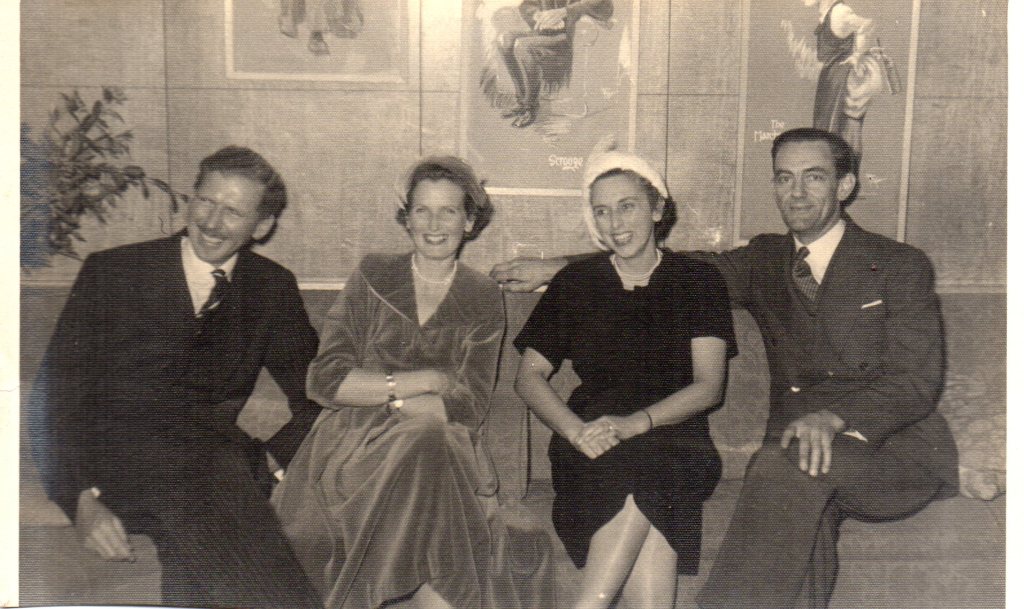
Whilst my father was shy, David was very popular and outgoing and brought business to the firm.
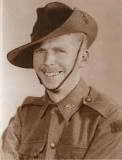
Sir Charles David Griffin CBE was an Australian lawyer and businessman, and the Lord Mayor of Sydney from 1972 to 1973. He was a prisoner of war at Changi in Singapore during World War II, an author and a poet. Always known as David, Griffin was born in Leura in the Blue Mountains and was educated at Cranbrook. Wikipedia
Died: 25 March 2004, Mittagong
Books The Happiness Box, Changi Days, When Gentlemen were Gentlemen.
David married Jean Whyte, who lived at St Anne’s, 104 Gladstone Road, Leura New South Wales. He was instrumental in the lives of Mollie and Kena!
Fred Osborne
My father said that Fred Osborne added a lot of cachet to the practice and attracted many clients. You will know why if you read this Wikipedia account of his life.
https://en.wikipedia.org/wiki/Frederick_Osborne
Frederick Meares Osborne CMG, DSC & Bar, VRD (20 January 1909 – 23 July 1996) was an Australian politician and government minister. He was born in Orange, New South Wales, and educated at North Sydney High School and Sydney Church of England Grammar School. He graduated with a degree in law from the University of Sydney. He joined the Royal Australian Naval Volunteer Reserve in 1938, and with the outbreak of the Second World War, he was seconded to the Royal Navy in 1940. He was awarded a Distinguished Service Cross in 1940 for “bravery and devotion to duty” while assisting the evacuation of forces from Norway as a sub-lieutenant on the St Loman, an armed trawler.
He then successively commanded HMS Gentian, HMS Vanquisher and HMS Peacock, escorting ships between the United States and Canada and the United Kingdom in the Battle of the Atlantic. He crossed the Atlantic 22 times and was the only Australian to rise to the command of a Royal Navy destroyer during the war. In 1945 a Bar was added to his DSC for sinking of a German U-boat.
Osborne was elected as the member for Evans at the December 1949 election as a Liberal. He was Minister for Customs and Excise from January to October 1956, Minister for Air from October 1956 to December 1960 and Minister for Repatriation from December 1960 to his defeat at the December 1961 election.
Following his defeat he returned to his legal practice, but continued to play a major role in the New South Wales branch of the Liberal Party and was its president from 1967 to 1970. He supported a change in Liberal Party policy in favour of support for state aid for independent schools, a policy adopted by the three major national political parties by the 1972 election. He was invested as a Companion of the Order of St Michael and St George for distinguished services to government and the community.[1][2]
Osborne was survived by his wife, Elizabeth and four children, Alick, Michael, Imogen and Penelope.[5]
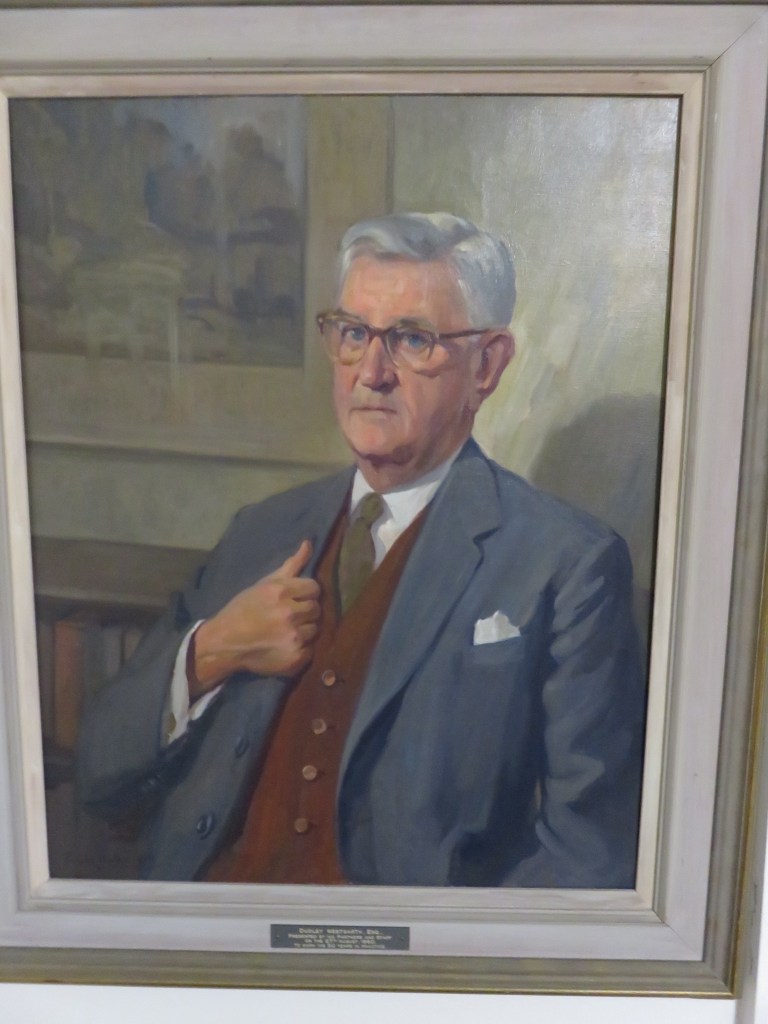
Here is Dudley’s portrait which he never liked, painted around 1957, when he turned 70.
Stuart Westgarth
In 1973, Stuart Westgarth, newly graduated from Law at Sydney University, joined the firm as an articled clerk. Partners then were Walter Raine, John Wallace, Richard Bore, Tori Kitamura, Andrew Stevenson and Henry Herron. Stuart was the eldest son of David Westgarth and grandson of George Mansfield Westgarth, who was Char’s elder brother and had been a lawyer in Scone. You can read about George Mansfield in another blog and in the story of George Charles.
Stuart gave me these reminiscences of Dudley at work:
‘Within the firm Dudley was known as “Mr Dudley “. Then there was “ Mr John” and I became “Mr Stuart’ ! That practice died out a few years later.
I recall seeing him (Dudley) at Leura in the 1960s ( approximately 1966 or 67 ) and he showed us a cabinet containing files he was working on. I think he had left the Sydney office and had retired as a partner years earlier. In 1957 he was 70 years of age and I suspect he had “retired” around that period, but continued legal work from Leura in a limited way.
When I joined the firm in 1973 I remember working on a file involving litigation in the Katoomba Court for a client Dudley had introduced.’
In fact, when I looked up the Law Almanac for 1975, which is all online now, Dudley was still registered to practise as a solicitor, the year after his death.
1956
1956 was the year that the Olympic Games came to Melbourne and also for the first time to the Southern Hemisphere. My parents went to the games. Lynne and I were left with Mrs Pace, who like her name, was heavy and slow. Torie was sent to a children’s home which she hated. Lynne got me in a corner and tormented me one day, so when we were helping with the drying up,, i kicked her. Mrs Pace saw it and thought I was a vile child. She reported me to my parents who agreed with her. Childhood memories….
Orsay
By 1956 Kena had bought a house with a high walled garden about 8 miles from Versailles. Here is a photo, probably with Mollie on the step.
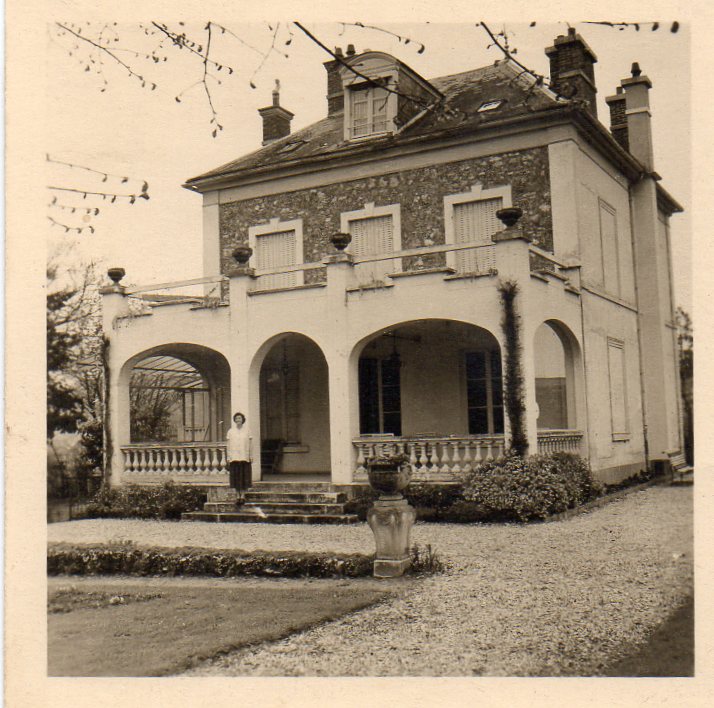
Michael was born on 5/6/56. His mother was born on 19/9/19. Interesting!
In 1957, Yaryar and Char made a trip to Paris.
Michael told me that Dudley said Yaryar fell and hit her head on a pillar, whilst travelling on a ship. She suffered from this blow to her head, probably incurring concussion. This fall might explain the onset of dementia around this time.
Here is a photo in the garden at Orsay. It must be Summer.
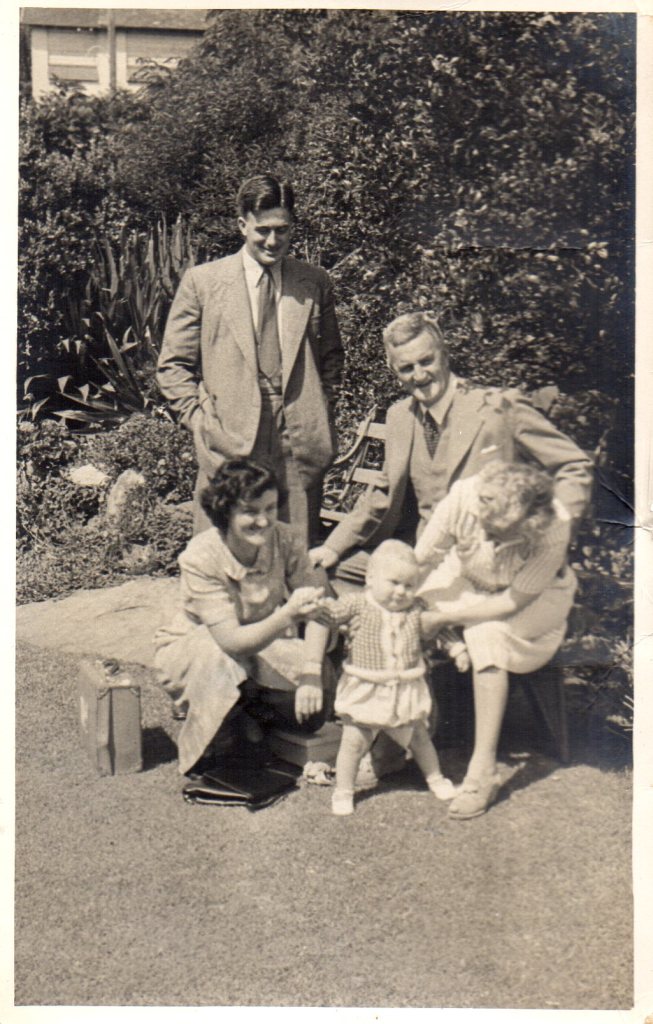
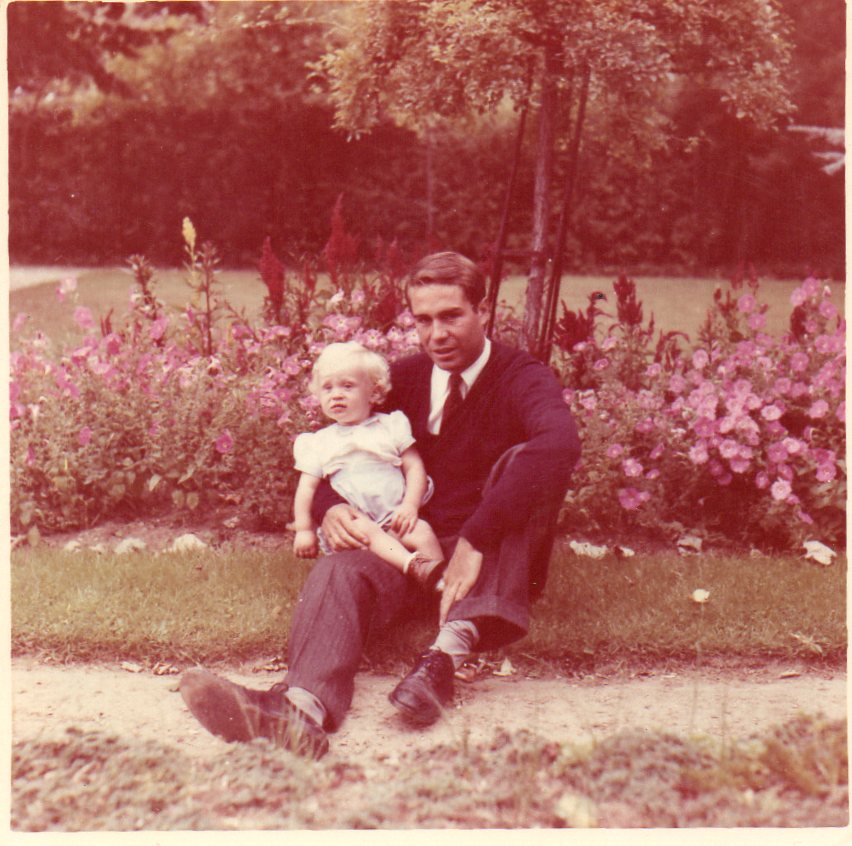
Mollie, Kena and Michael visited from Paris, 1957
Michael was just a toddler when they arrived. We are in summer clothes, so it must have been at the end of the year. There is a photo below, taken by Kena, of their visit to our family at The Crescent. We used to take photographs on the steps on the harbour side of the house, leading down to a lawn. You can see most of the family there:
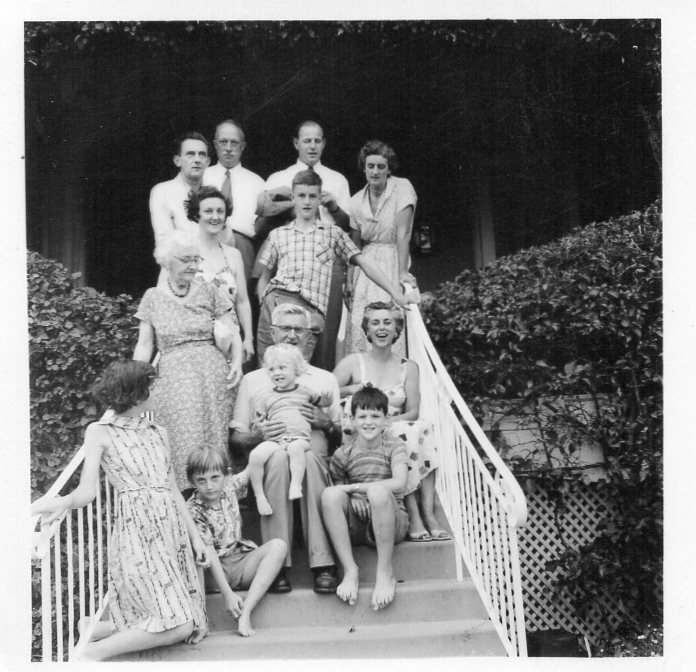
1958
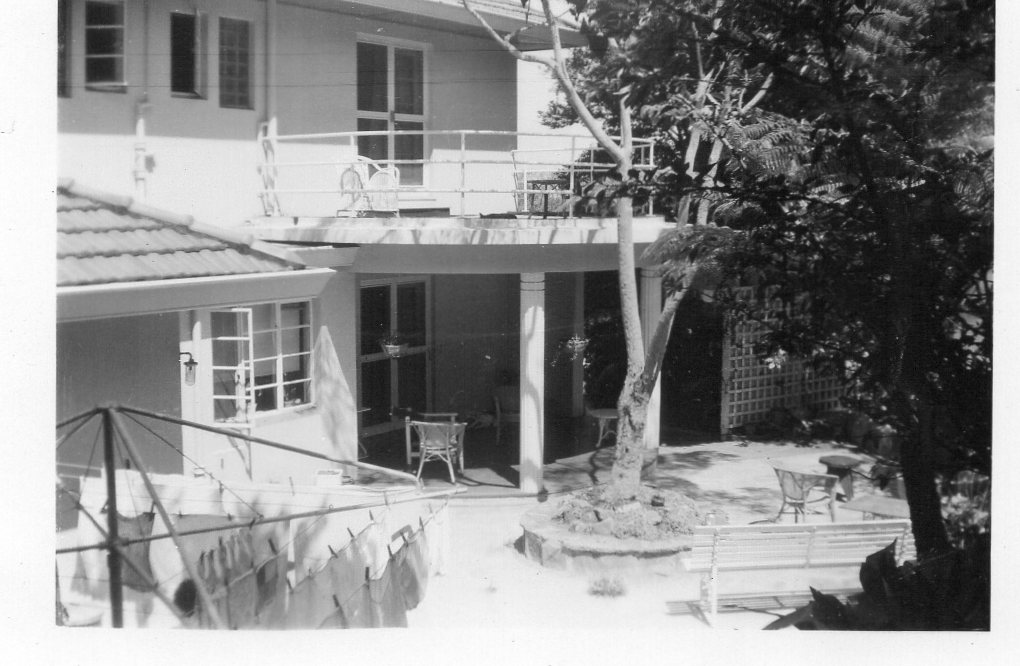
In 1958, we moved from The Crescent, Vaucluse to 17 Ian Street, Rose Bay. It was also on a steep slope! There was a terraced rockery up to Conway Avenue behind. The house also had a magnificent harbour view, up to the bridge.
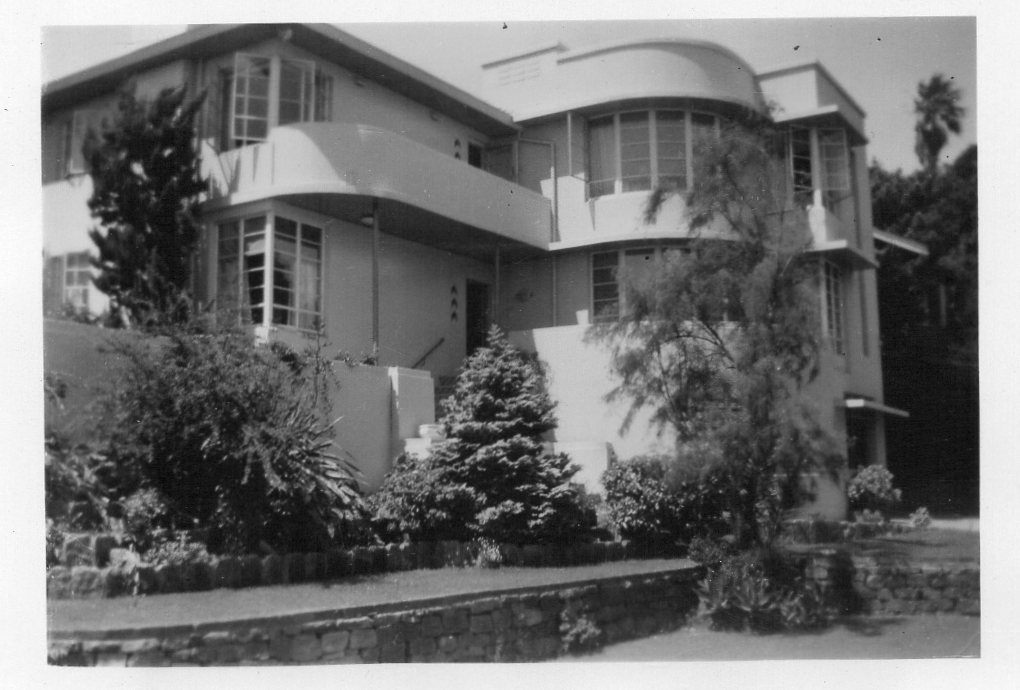
Mum said she could not physically cope with the steps at Vaucluse. The new house had a flat area outside the kitchen with the clothes line in handy reach. It was paved and very accessible.
Lynne was 18, I was 14 and Torie 8. Lynne had a big bedroom with a balcony which she hardly used as she had already left school. I had a lovely bedroom which looked up to the harbour bridge and Torie had one looking over the back paved area and rockeries.
1959
Torie came with me to Ascham for some time, but in 1960 she was sent to boarding school at Gib Gate, then she boarded at Frensham.
Ina Lucy Sibiriakoff was born in Orsay on September 13th, 1959. Mollie and Kena had a pigeon pair: a boy and a girl. Michael was 3, Mollie turned 40 later that month and Kena was 58. Ina’s name was significant, because it was like her father’s name, but also the name of Moll’s benefactor, Ina Campbell. Her middle name, Lucy, was Kathleen’s name which she never used.
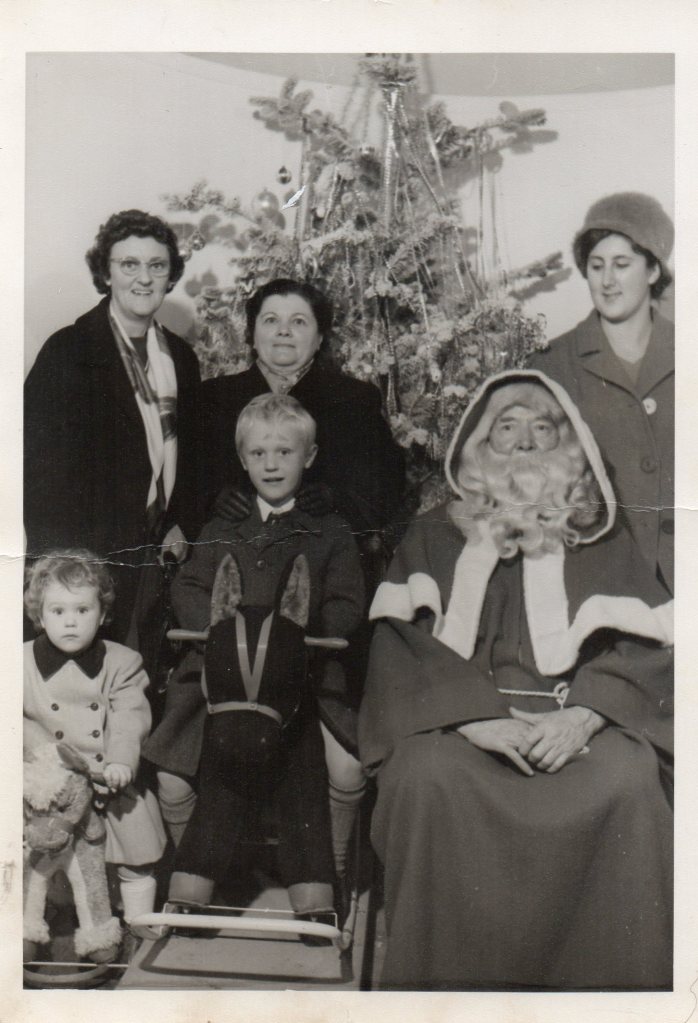
Michael told me that he was sent to the Catholic School down the road in Orsay and he came to speak nothing but French. He could walk to school and remembers it well as he was 6 when he left. Ina was only 3 when the family left France, so did not have the same exposure to French culture.
The Second Bringelong
On 15th January 1959 Lucy Kathleen Westgarth again was the mortgagee when our grandparents bought a house in the Blue Mountains west of Sydney.
Yaryar was nearly 70 and was developing dementia. She was always looking for things which she said “THEY” had taken, probably remembering the servants of her youth at Blayney.
They bought an old weatherboard house at 96 Gladstone Road, Leura, which fronted the Leura Golf Course. The road was named after the Gladstone Coal Company which intended to sell off land for a township in 1885. The coal company did not sell enough coal and the sale of land mainly fell through.
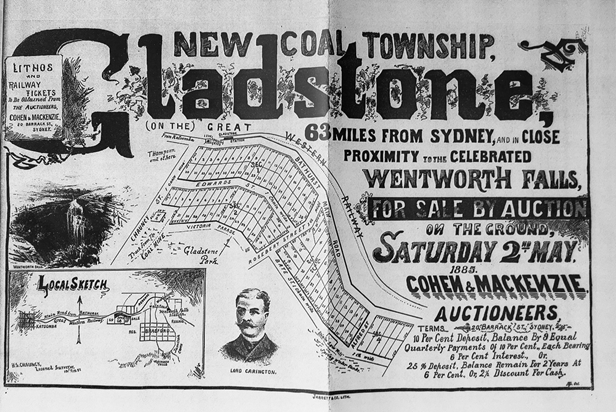
Then, in 1905, some blocks along Gladstone Road were cut off the golf links. Bringelong, first called ‘The Golfers’, is outlined in the Certificate of Title below. The first owner purchased the site in 1917.
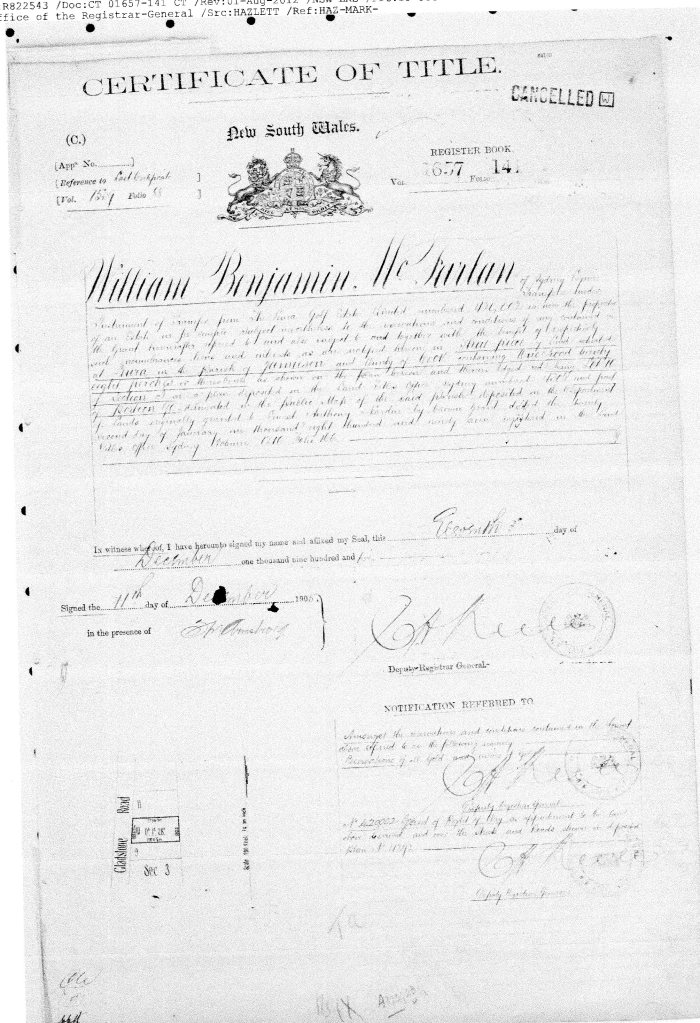
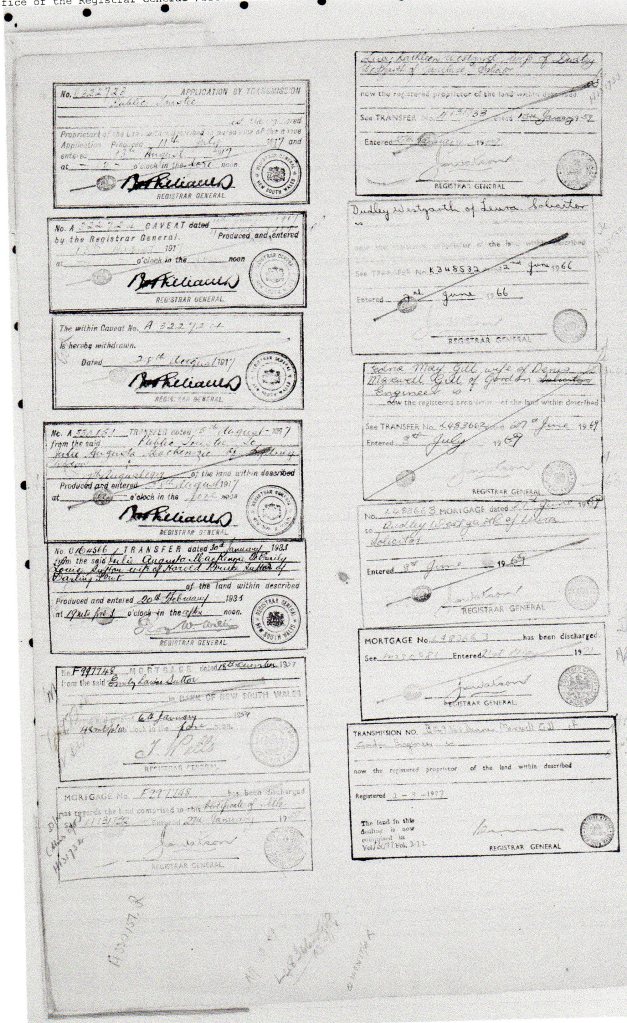
You can see the mortgage stamp for Lucy Kathleen Westgarth on the top right. Dudley discharged the mortgage on 2nd June, 1966 when he was 79. He sold to Max Gill on 27th June 1969.
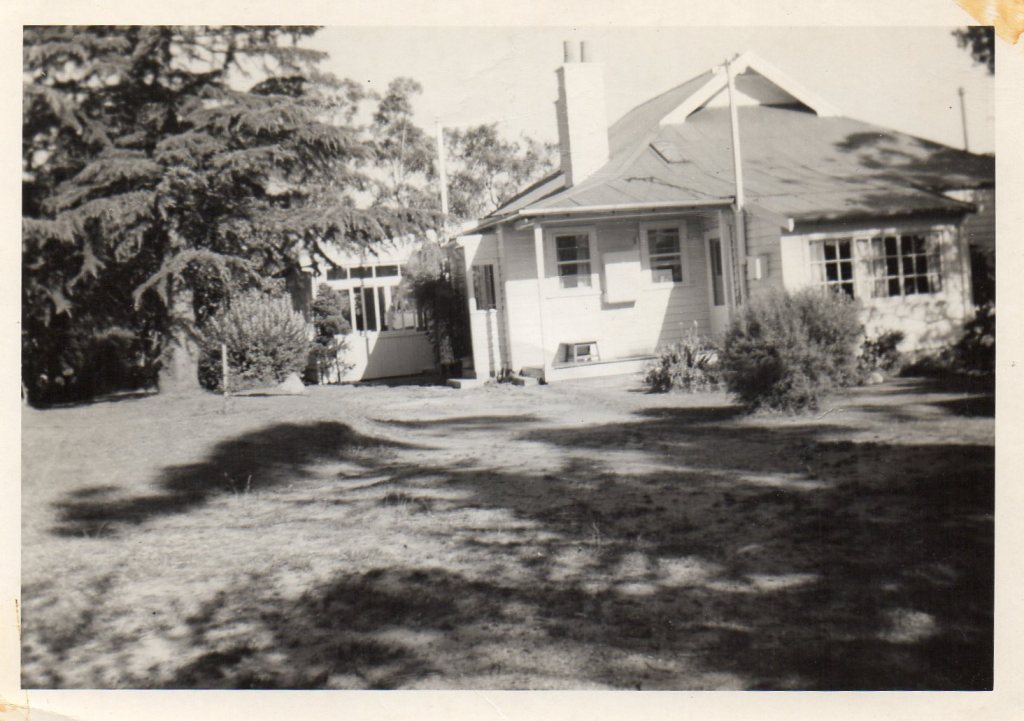
Char had this weatherboard house renovated to become their last home. He made a section of the side verandah into a billiard room big enough for a full size table. He named the house ‘Bringelong’ after the holiday house in Wentworth Falls which had brought the family so much pleasure.
Dudley and Kathleen went to live in Leura whilst still owning Fisher Avenue. The rental of a Vaucluse property would have helped with expenses in their retirement.
In the picture below you can see the billiard room on the left, the kitchen in the middle and a sleepout where I used to stay, on the right.
The neighbouring house, ‘Nurung’, at number 92-94, just to the left of the picture, was the home of Kitty Parkman. She was an ace golfer and gardener and had never married. She was in her sixties when she met the Westgarths. She became a great friend and a help with Kathleen as she became more needy.
Char taught Anthony, Scott and Michael (and Ina?) to play billiards and chess. I think we girls were not encouraged but also not so interested. Chess has become a lifelong interest for Scott, as has billiards for Michael. Torie told me that Char sent jokes and puzzles to her at boarding school. Our grandparents cared for us all.
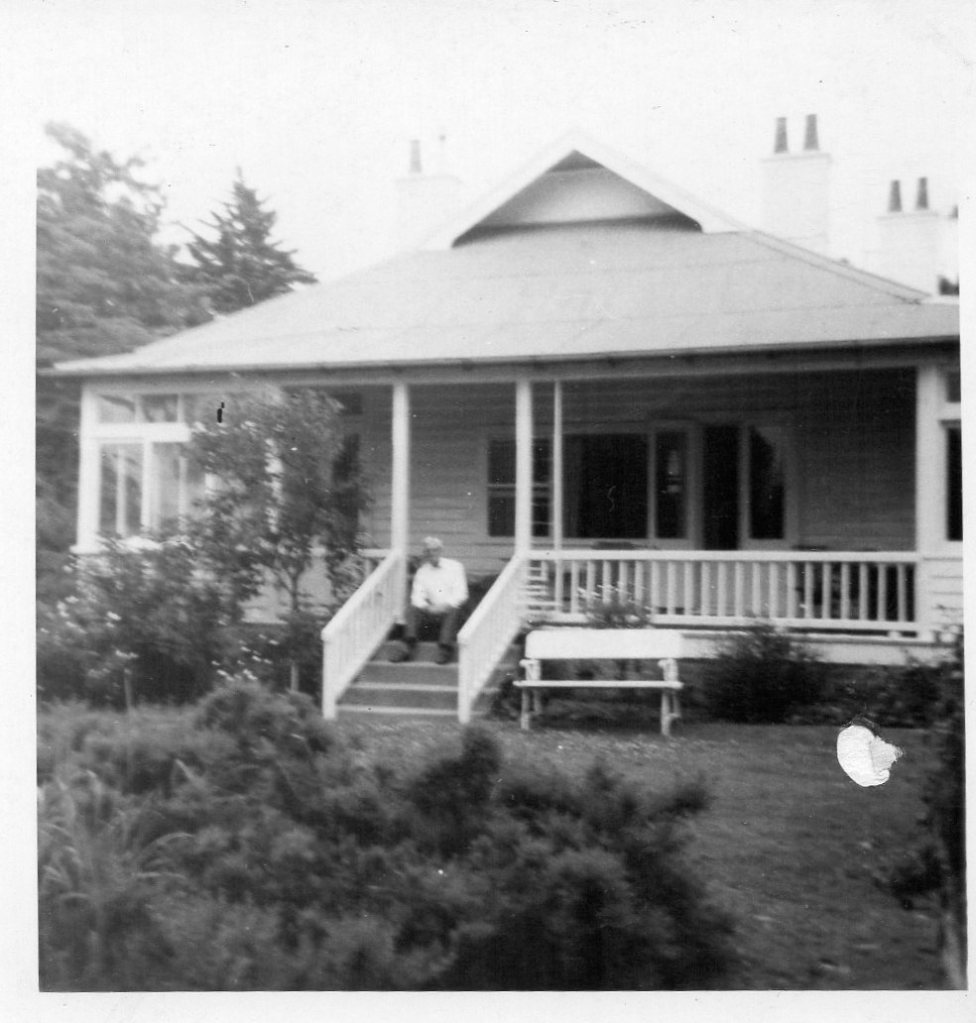
Here is Char on the verandah at Bringelong.
Lynne told me that Yaryar and Char made one more trip to see Mollie and the new baby, Ina Lucy. It must have been in 1961, in the European summer. The next year, in our summer, the family arrived in Leura.
Mollie and Kena and family come to Leura, 1962
Thanks to Gary Sturgess for a lot of this information. He is the present owner of St Anne’s.
On 13th August, 1961, Soviet control of east Berlin was confirmed by the building of a dividing wall. Germany was now divided into East and West. Kena had escaped from Communism as a youth and been imprisoned by the Japanese. He decided it was time to retire and move to the security of Australia. There was to be no return to Russia for him!
Mollie wished to return to her family in Australia. An urgent reason was that Kathleen had dementia. She also had to consider the safety and future lives of her two children.
The family came to Australia in September 1962, on the Orsay, one of the P and O liners which were so popular for travel in the age before cheap air fares. Lynne came back from her Europe travels on the same ship.
Kena would have liked to move to the seaside, such as back at Church Point, but he acquiesced to the needs of family and came to love the mountains.
Background to St Anne’s
January 1927 – George Blackstock Whyte negotiated the purchase of the property that would become ‘St Annes’ from James Paterson. His wife was Mary and he had two daughters.
David Griffin’s wife, Jean Whyte, grew up at St Anne’s, 104 Gladstone Road, in a weatherboard house around which Mr Whyte had created a lovely garden. There was much stonework, European trees, including a massive conifer hedge and a small Japanese garden. The house fronted the golf course, as Bringelong did.
At the time that Mollie and Kena were thinking about moving to Australia, Mrs Griffin had died and Mr Whyte had his beloved house for sale. David Griffin suggested the Sibiriakoffs should buy it. They did so and moved to Leura. Michael was 6 and Ina was 3 years old. Michael told me that he only spoke French when he arrived, but he was soon at Blue Mountains Grammar doing a crash course in English!
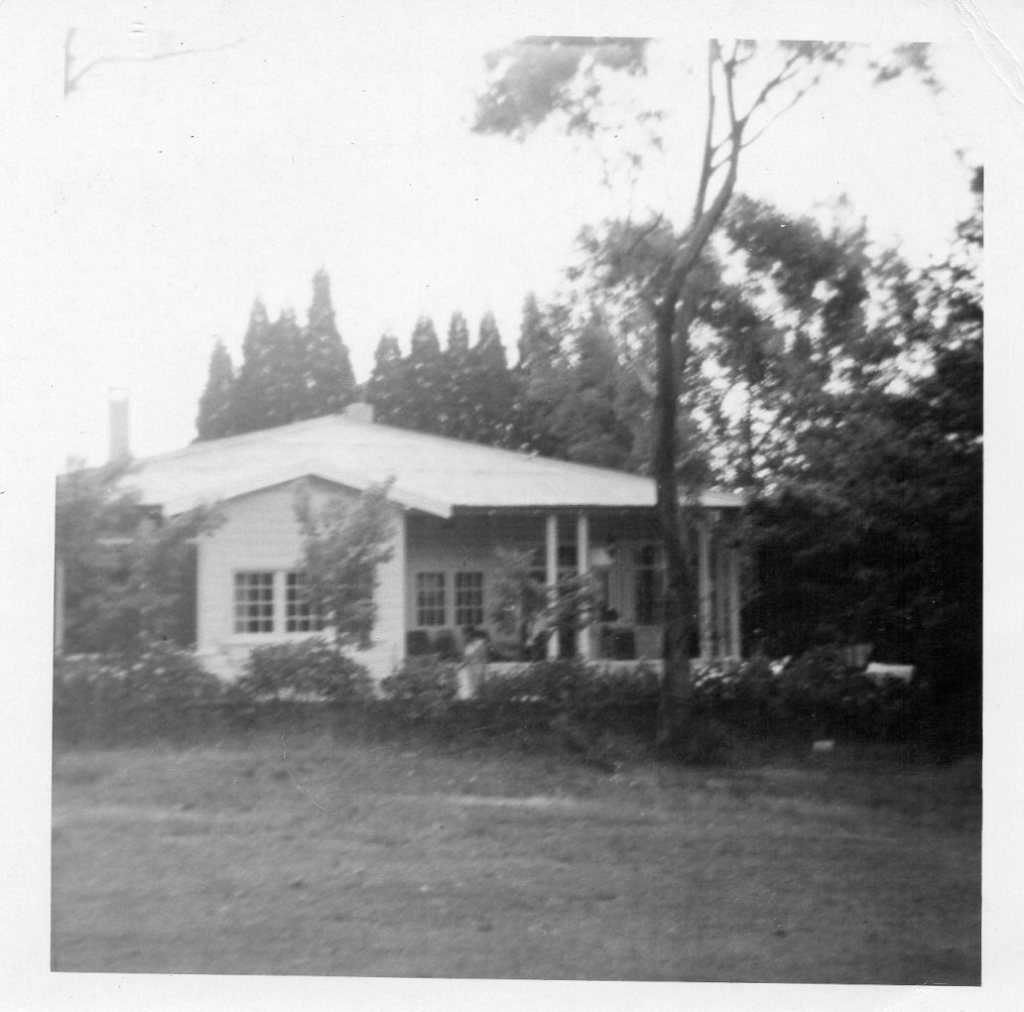
The house needed some renovations including a French-style bathroom with a bidet, a gadget that Aussies did not use at all! There was also a beautiful sitting room looking over the garden and a study adjoining it where Kena wrote his memoirs. Over the door was the famous elephant’s tail.
Whilst the renovations were in progress, Char and Yaryar returned to Fisher Avenue and the Sibiriakoffs lived at Bringelong. Fisher Avenue was sold on 9th January 1963 and Dudley and Kathleen returned to Leura.
This family snap in the garden, with the golf course in the background, is labelled 13th September 1964, which was Ina’s 5th birthday. Michael is in his uniform for Blue Mountains Grammar School.
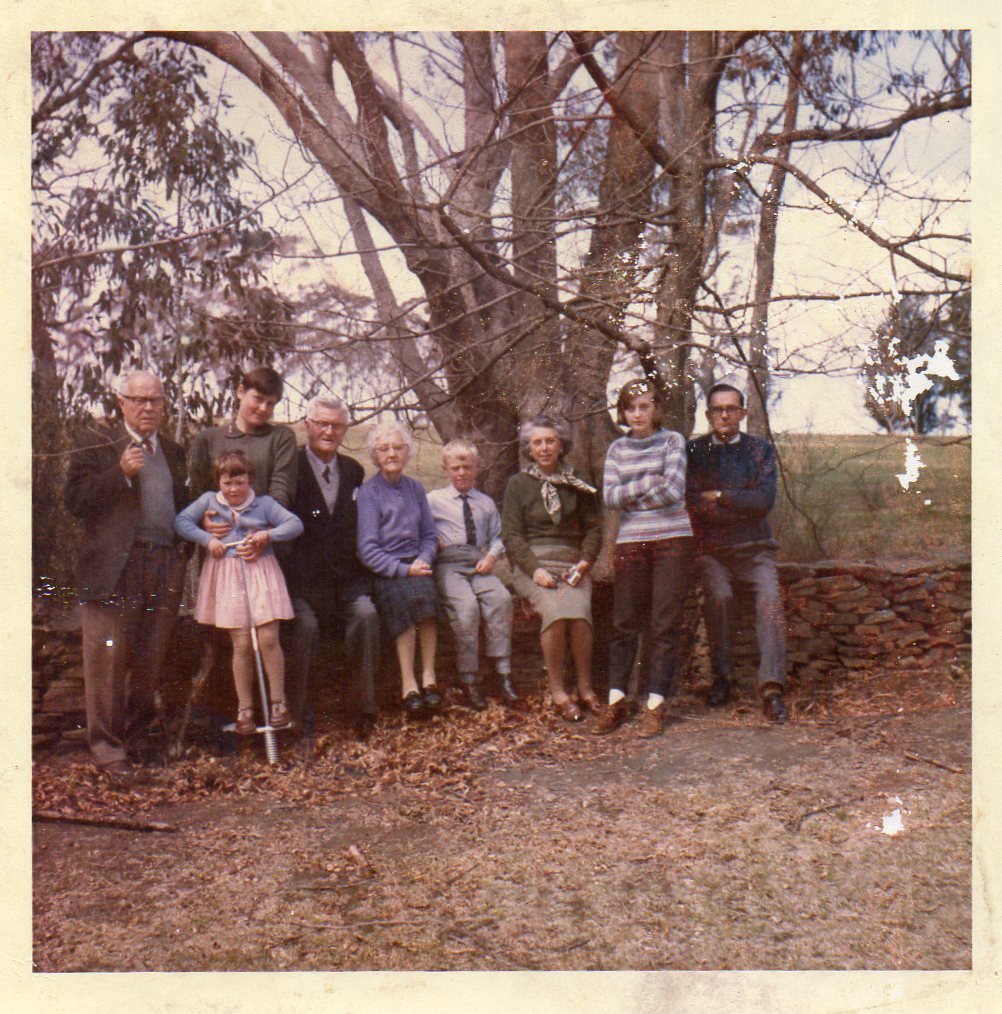
Michael loved the Blue Mountains Grammar School, even though he found writing and spelling difficult. Mollie spent much time helping him with homework. Ina also went to the Grammar School and they both made a bunch of lifetime friends
From the time the Sibiriakoffs moved into St Anne’s, Aunt Mollie visited her parents every day. She also welcomed all her nephews and nieces to come and stay, so we all watched Michael and Ina grow up.
Kena used to do the shopping and he spent a long time writing his memoirs in the study adjacent to the sitting room. They are now in the possession of Michael.
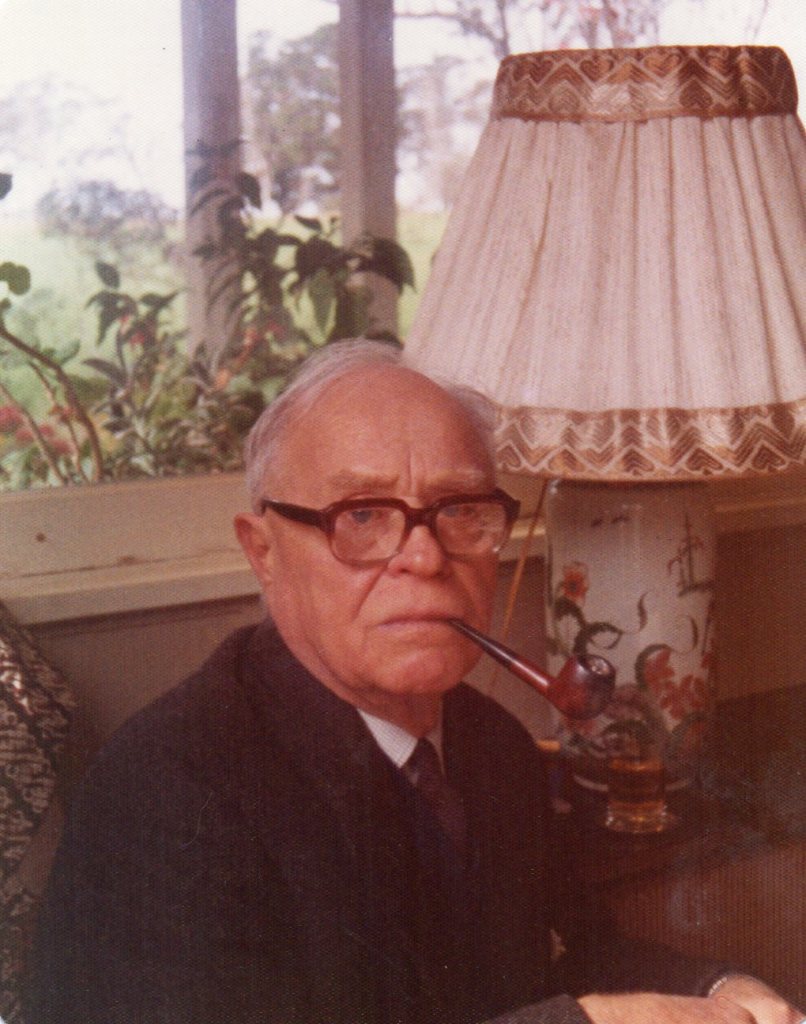
1965
Mabel
As Kathleen’s dementia progressed, Char found a lady to come and cook the main meal of the day, at lunch time. Miss Mabel Harrison was a resident of Leura, who lived in a cute little house called The Dingle. Ina told me:
‘She was a wonderful woman and taught Michael and me elocution lessons when we were little, to help Michael with his accent. She also babysat for us.‘
I liked talking to her. I was single and perhaps that caused her to tell me about her failed love affair. When young, she was being courted by Mr Cameron of Orbost, who played the violin. They had had a falling out and she had not seen him again for thirty years. The happy end to this story is that, a couple of years later, Mr Cameron contacted her and she became Mrs Cameron of Orbost. When her husband died, Mrs Cameron gave my son, Andrew, her husband’s violin, made in 1907. He still has it.
Scott in the Sixties
I asked Scott about his relationship with Char. One thing he admired was Char’s retentive memory and the way he made a note of names and other things he did not want to forget the next day. Scott has also enjoyed playing snooker all his life, using the techniques Char taught him.
When Scott was at Cranbrook school in the sixties, he was a very unconfident boy with a love of Maths. Char tried to help him study and also went to Cranbrook and alerted the teachers to Scott’s needs. Scott was placed in the advanced Maths class. Since then, Scott has finished a degree in Mathematics in Perth, where he lives.
It was Char who encouraged Scott to move to Perth when he was at a very low point emotionally, unable to relate to family. Anthony, his brother, who is a geologist, was living in Perth. Char paid Scott’s fare across the continent by train to a new beginning in Perth. He has remained there ever since.
Ina starts at school
Ina went to Blue Mountains Grammar in 1965. Michael was 8. I was 21 and had gone to Armidale for a teaching job. Whilst I was there I knitted Yaryar a red mohair cardigan. Aunt Moll changed the buttons and the cardigan was much worn and loved.
1966
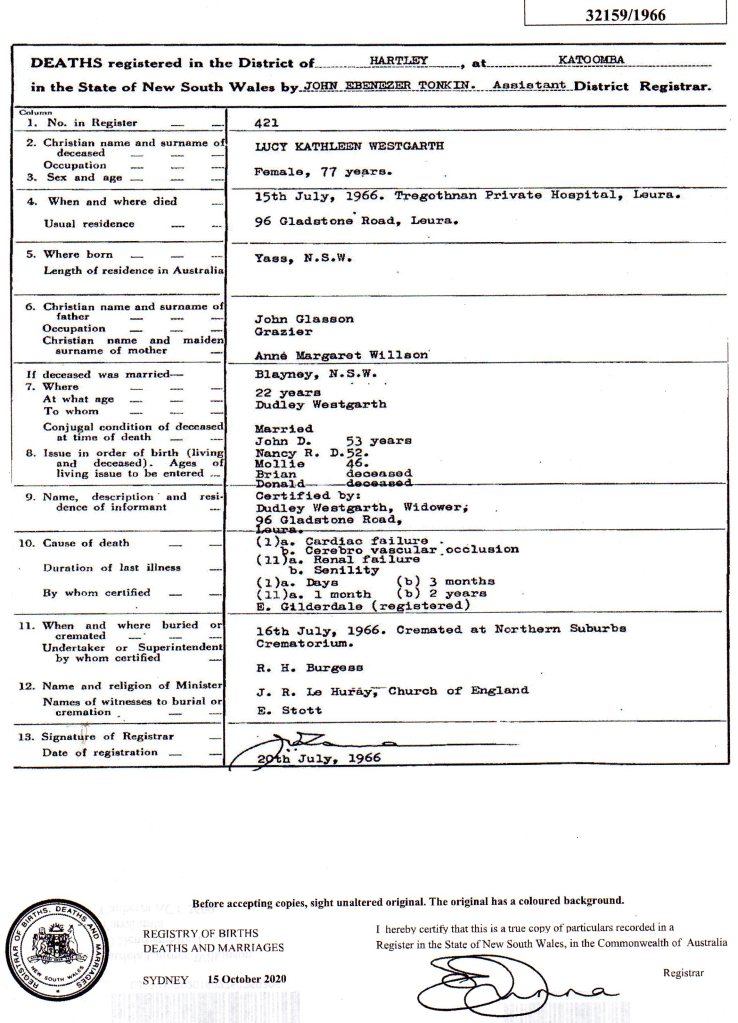
In that year Yaryar had a stroke. She was put into Tregothnan, the private hospital down the road in Leura, but she was paralysed down one side and died of cardiac failure on July 15th. The death certificate records 2 years of Senility, or loss of memory. This was a great sadness for the family, who could all remember all the kindness given to each of us.
Our poor little grandmother was totally worn out! She was only 4 feet 11 inches high (147cms) and had size 2 shoes, which were very hard to find for adults! When I went to Cornwall to see Tremayne and Ledgereth, the family homes, I knocked on a door for directions and a little old lady the image of my grandmother appeared! She was built for a Cornish life, not the harsh life of Australia.
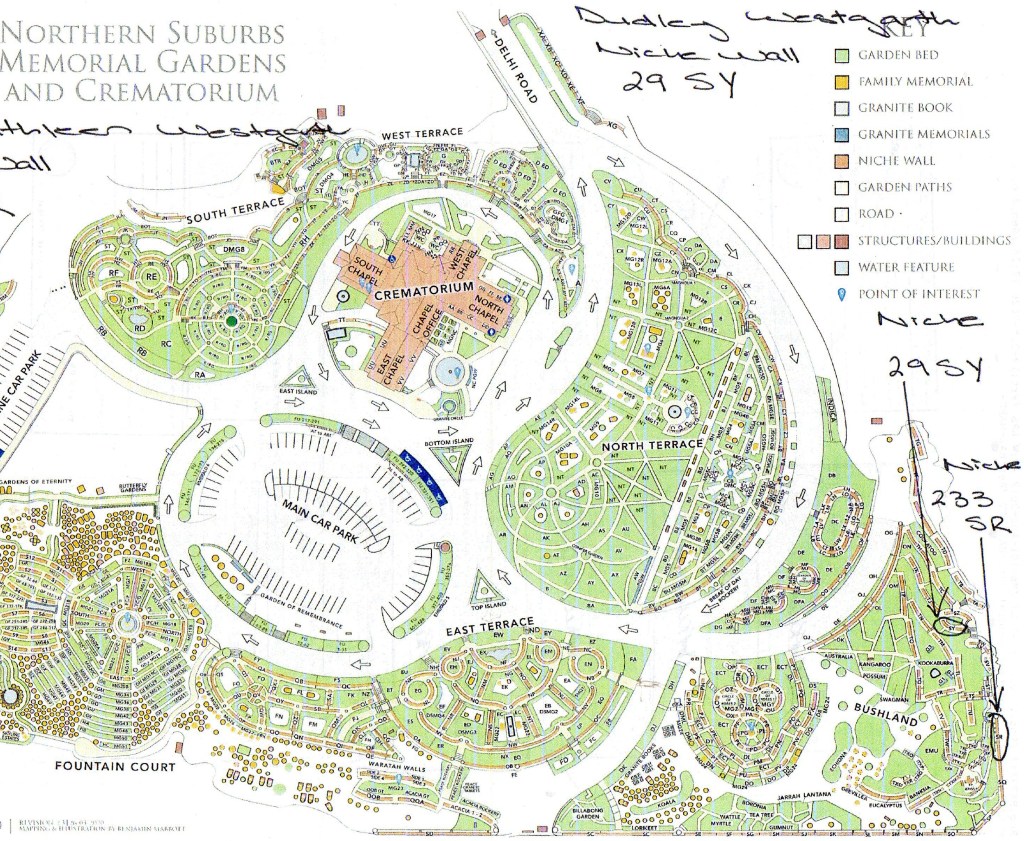
Yaryar was cremated at the Northern Suburbs Crematorium the next day. There is a plaque in her memory at Niche 233 SR. Here is the map:
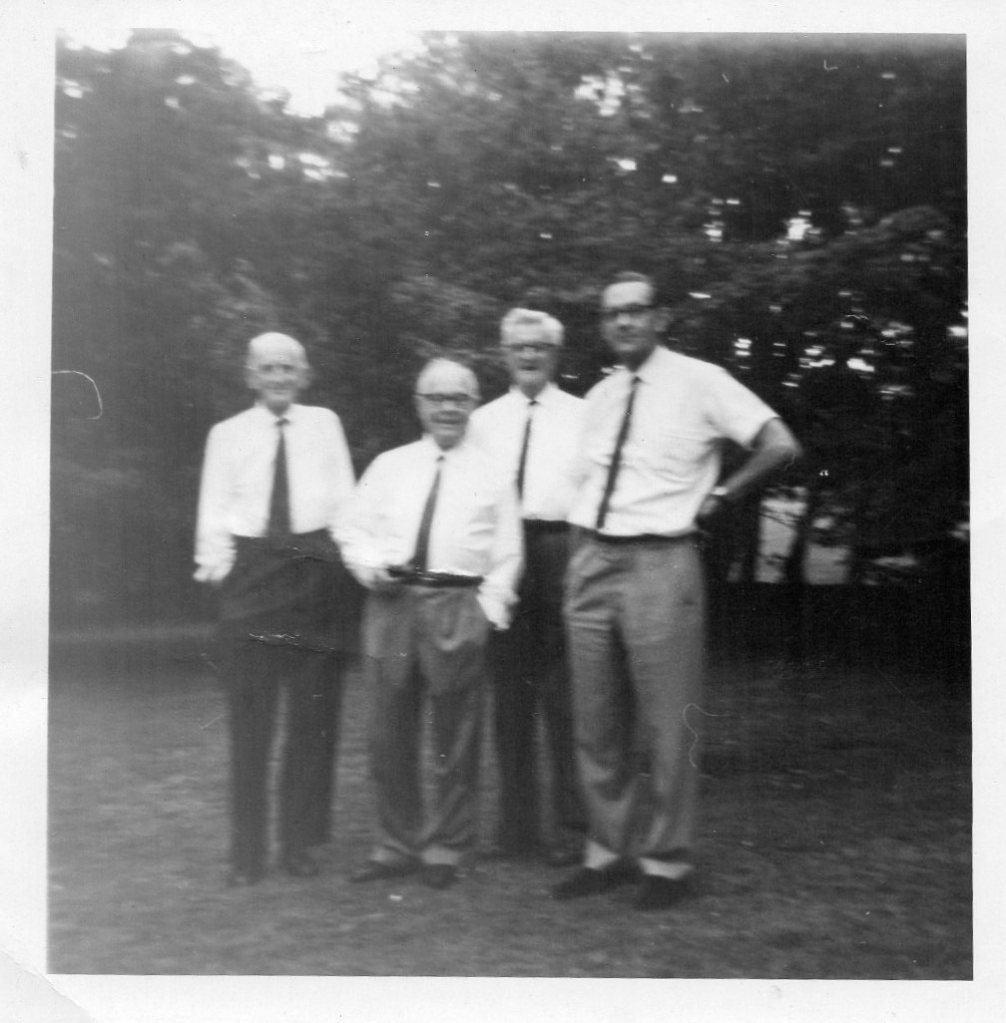
Char, Widower
Dudley continued to live at Bringelong after Kathleen died. He continued with his legal work and had the support of the Sibiriakoff family down the road.
Aunt Mollie went down to see him, along the golf links, every day after school. The children had no television at St Anne’s, so they were taken down to Bringelong and watched television whilst Mollie attended to her father. On weekends he would come up to St Anne’s for a meal or afternoon tea quite often.
Kitty (Kathleen Harriet Parkman)
Kitty Parkman, next door, was also very helpful neighbour. Her father, William Robert Parkman, had been a grazier in Boorowa in the boom time of wool.
Kitty’s mother was Harriett Mary Tout. There are many Parkmans and Touts remaining in the Murringo and Boorowa area of New South Wales. https://sites.google.com/site/murringo/history This link is to the history of Murringo, where there is a Parkman Road and a Parkman Pastoral Company Ltd. today.
In his retirement, in 1926, William Parkman built a magnificent home on two blocks at 92-94 Gladstone Road. The house was called, ‘Nurung’. It bordered the Leura Golf Club and had a large landscaped garden including greenhouses for frost tender plants. The cutlery was solid silver and a bronze statuette of a horse stood on the mantelpiece.
The Sun, 31 October 1926, p 24. ‘Mrs Parkman of ‘Nurung’ called a meeting at her residence with the view of forming a Leura branch of the CWA.[i] The construction of ‘Nurung’ has just been completed’.
In 1954, Mr Parkman died:
Government Gazette of the State of New South Wales (Sydney, NSW : 1901 – 2001), Friday 10 September 1954 (No.146), page 2809 Kitty is an executor of her father’s will.

Kitty was the eldest of three girls and somehow had the sole right to live in Nurung. One of her sisters was married, but the other was single.
1968
Dudley was now 81 years old. He was developing emphysema which is an incurable hardening of the lungs. His constant smoking had caused this ailment.
He was also starting to suffer from skin cancer on his nose. He told me that his skin specialist, Doctor Belisario, had given him some cream which ‘fed’ the cancer. Of course in those days there were no modern treatments, so ointments or surgery were the only cures.
In either 1967 or 68 I took Char on a last visit to Kathleen’s country brothers and sister. I drove the Rover and we stayed in motels. We visited Ron and Joyce Mackay at Coonabarrabran and some of Yaryar’s brothers. I wish now I had made him talk more about his family.
1969 Married Again
In early 1969, the Sibiriakoffs were invited up to Bringelong for lunch. At the table, Char and Kitty announced that they were getting married that afternoon! So after lunch, the family all went up to St Alban’s Anglican Church in Leura and the marriage was conducted!
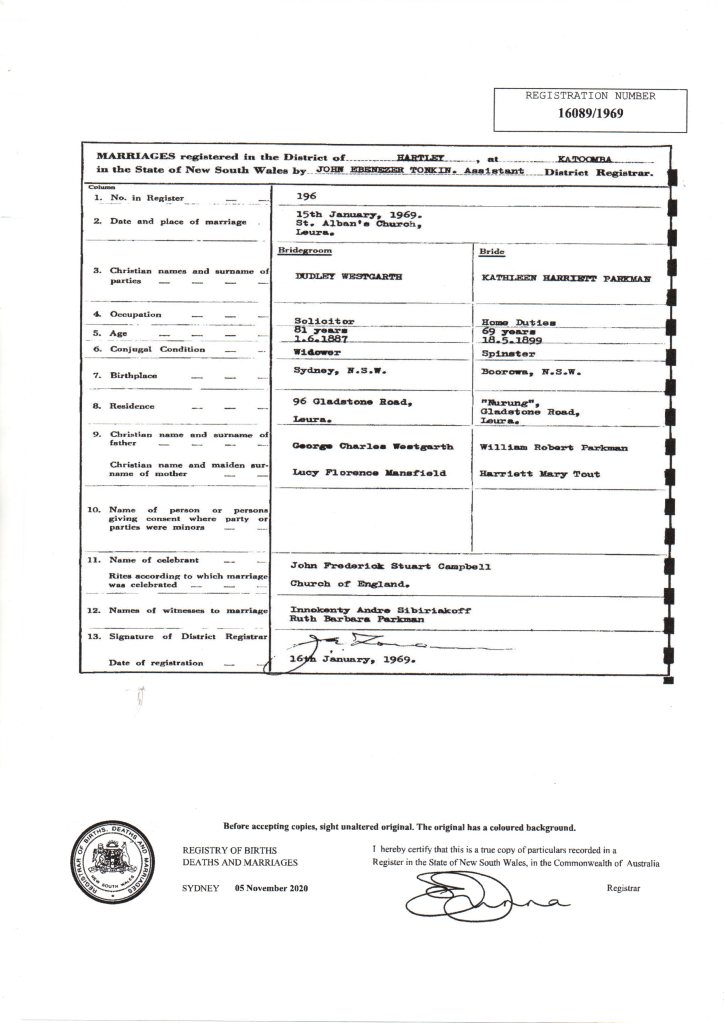
I have no photo of that day, 15th January 1969, but here they are celebrating my wedding on March 8th 1969. They had been married for less than 2 months.
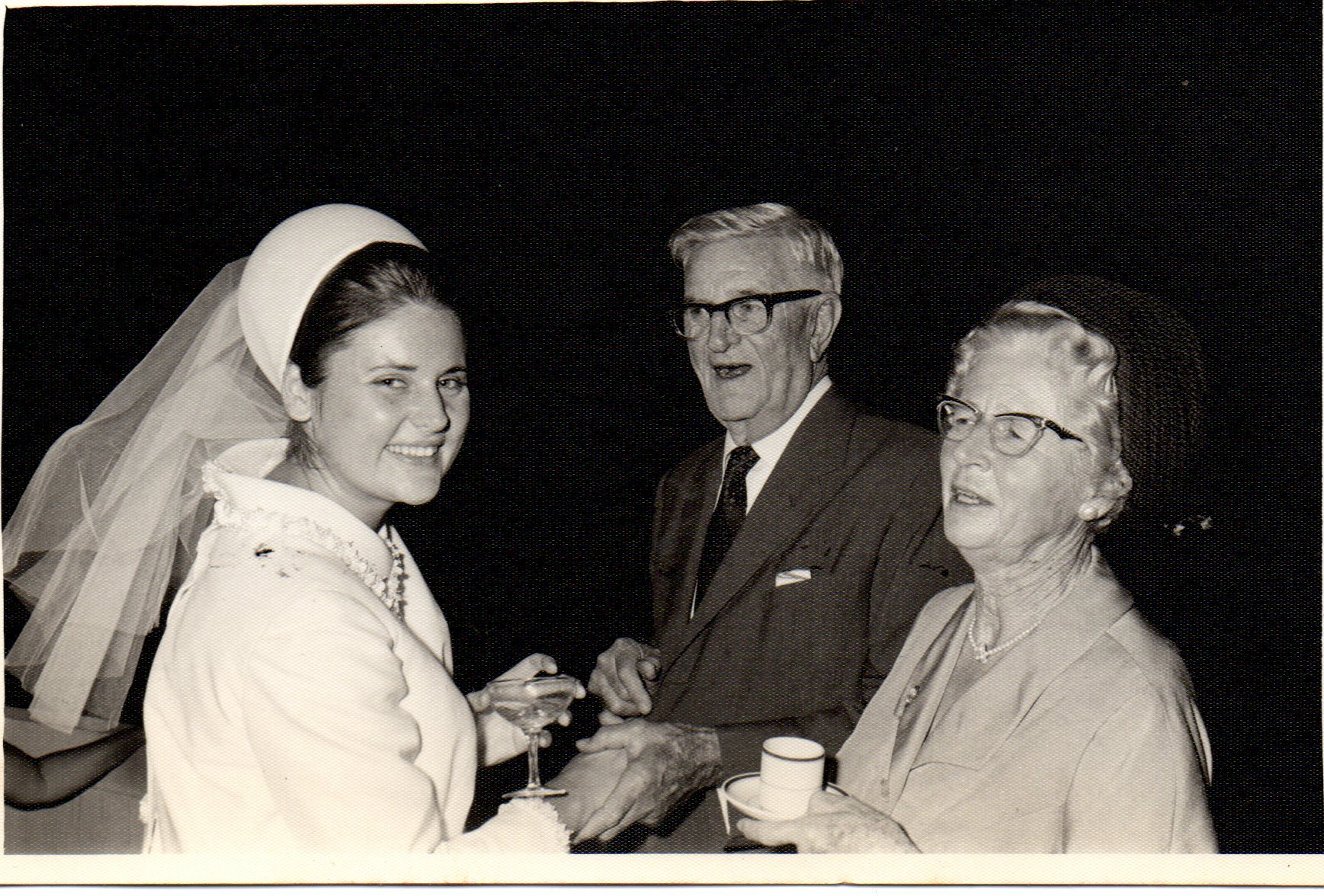
On 27th June, 1969, Bringelong was sold to Max Gill and his wife, who was a friend of Aunt Mollie’s. Dudley would have had time to settle into life at Nurung, which was fully furnished with quality things. However, he did not dispose of the contents of Bringelong because it is itemised in the execution of his will. He must have put the contents of Bringelong into storage.
Actually, because I was married soon after, I was a beneficiary of some of the contents. I went to see him when I was engaged and we went around the house deciding what I would take.
I have these still :
- the George Charles Westgarth silver plate cutlery,
- two small armchairs,
- the round cedar table which was bought by my parents on their honeymoon in Tassie,
- the loving chair which was broken into two pieces by heavy grandchildren (and which I have restored),
- Two cedar single beds.
- a wooden chest which used to have metal corners, probably for travel, and
- another table which Char had cobbled together from two broken tables and which he had used for lunches in the sunroom (and is the dining table at the farm).
Char also made me a present. It was a copy of Auntie Mollie’s French work basket. Char made the frame and Mollie made a blue bag which hangs within it. I still have it for my sewing and mending needs.
Char took the billiard table to Nurung and this later became the property of Michael Sibiriakoff. The beloved Rover car went to Michael in Dudley’s will.
1969
Char and Kitty settled into life at Nurung. Char had an oxygen cylinder in the bedroom, owing to his developing emphysema. His skin cancer had penetrated deep into his nose and in 1969, surgery had been considered essential. You can see in the photo below that his face is disfigured. A large portion of skin from his thigh had to be grafted to his face.
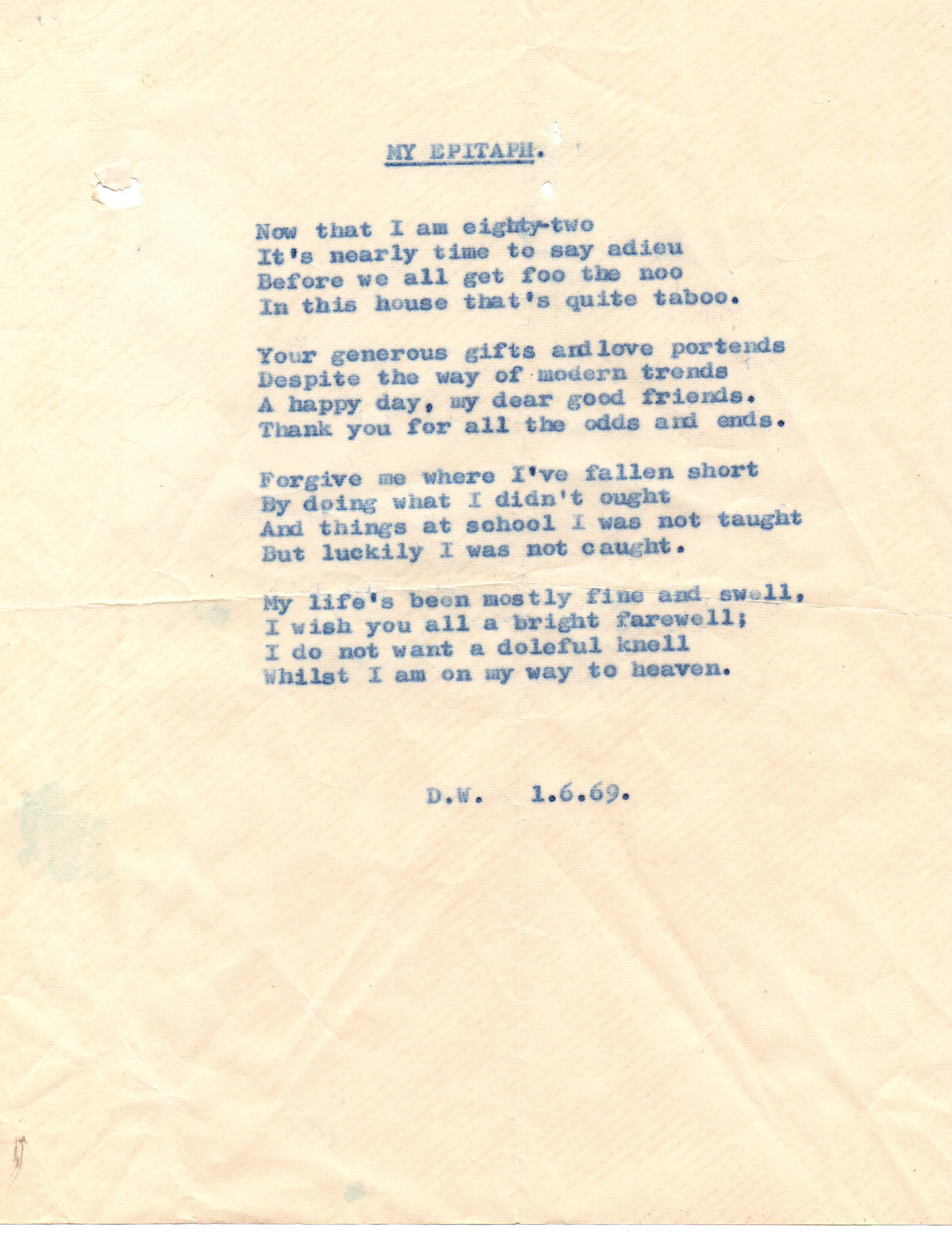
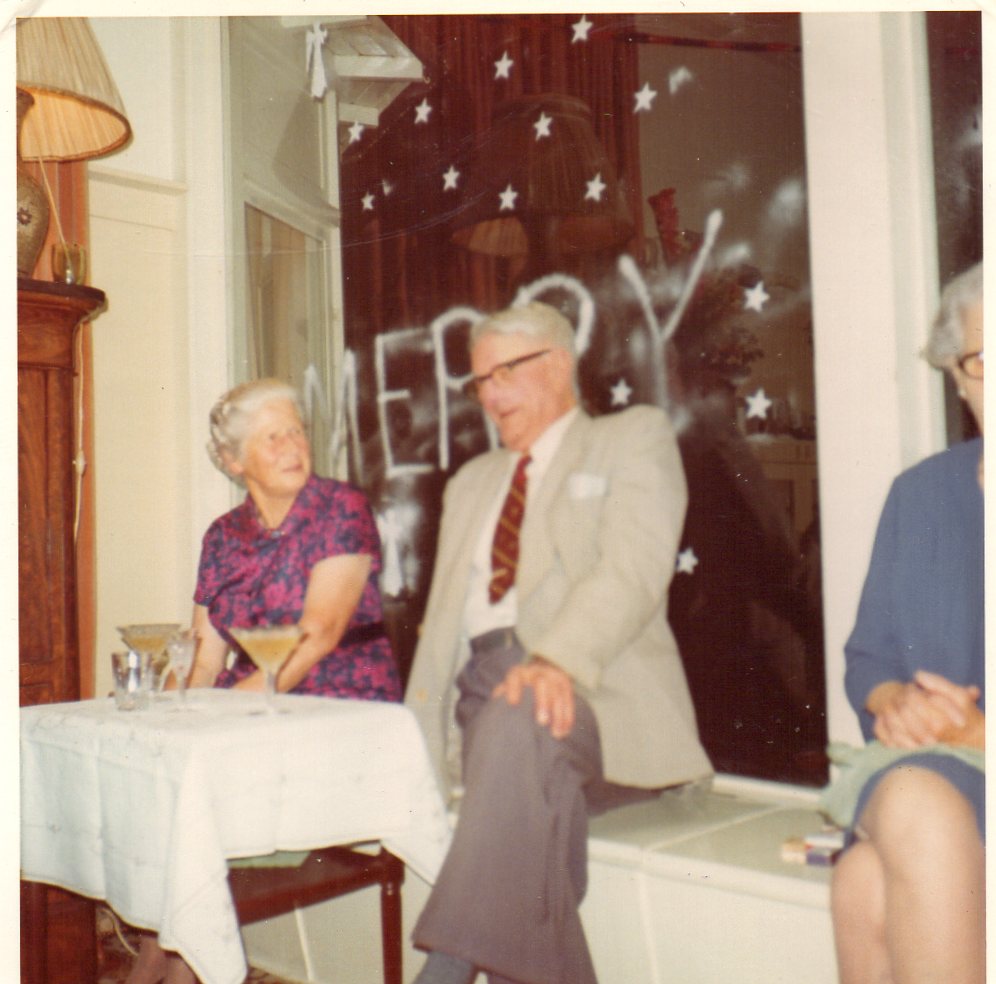
That year, on his birthday, we had a family gathering at Mollie’s place, in the big front room you can see in the picture below. Dudley, in his usual way, had a little ditty to lighten the occasion of his 82nd birthday with a disfigured face. Somehow I still have a copy of the poem and here it is:
1970
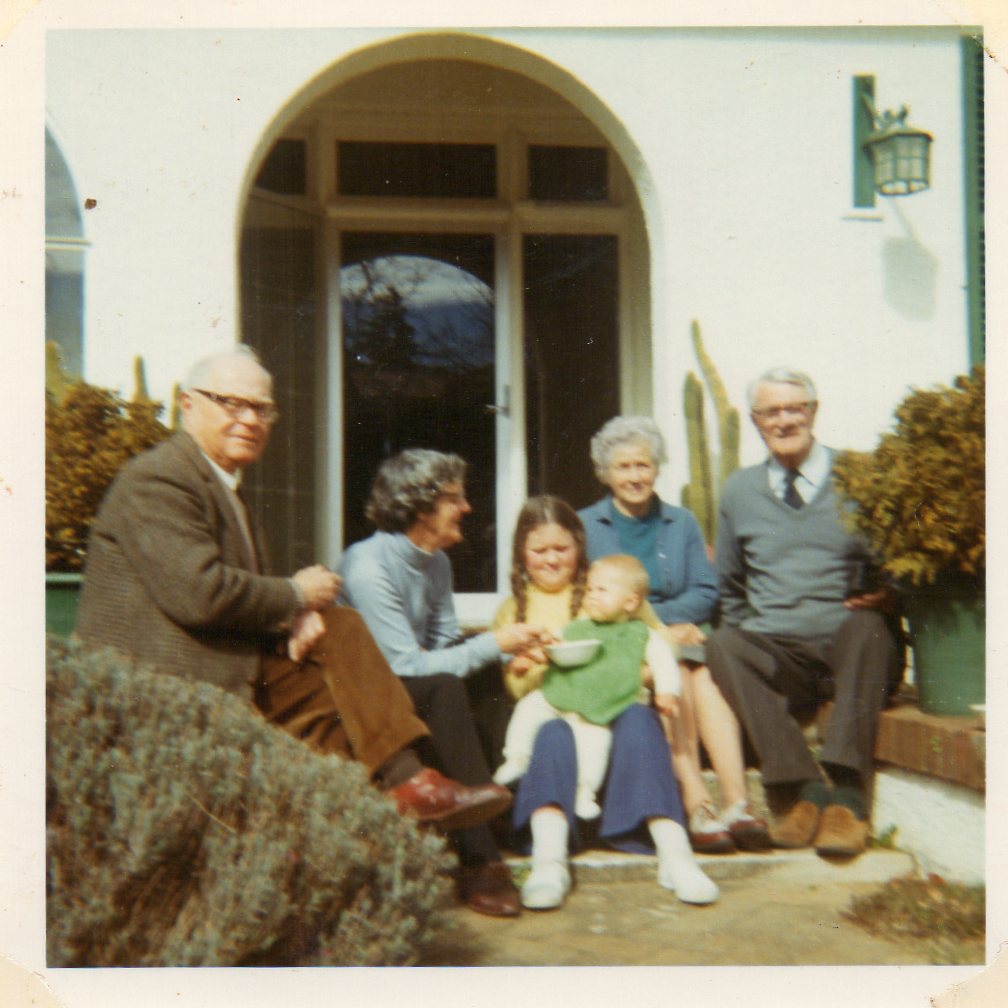
Here are Char and Kitty at home at Nurung in 1970. They are at the front door, with Kena and Mollie. Ina is holding my baby, Joanna, born 14/12/1969.
Last years
The last years of Char’s life were difficult owing to his failing health. Kitty was a strong and reliable partner, but could not replace a lifetime of marriage to Kathleen, but Mollie and Kena and the children were constant in their lives and my father made a point of going to see Char regularly, especially for birthdays and Christmas.
A note from a Leura friend:
In 2020, I received a note from Greg Amos, who knew Char at this time:
I met Dudley in the early 70’s when he was living in Gladstone Road Leura and still doing conveyancing work from home. I’d started in real estate with Theo Poulos a Katoomba estate agent and who was a good friend of your grandfather’s. I would regularly be taking documents to ‘Mr Westgarth’ and we’d sit in his study and chat. A very friendly and personable man who was interested in what I was doing and yes, a great sense of humour. At the age he was .. a sharp mind!
Great work in bringing all this together!
Kind regards,
Greg.
Christmas 1971
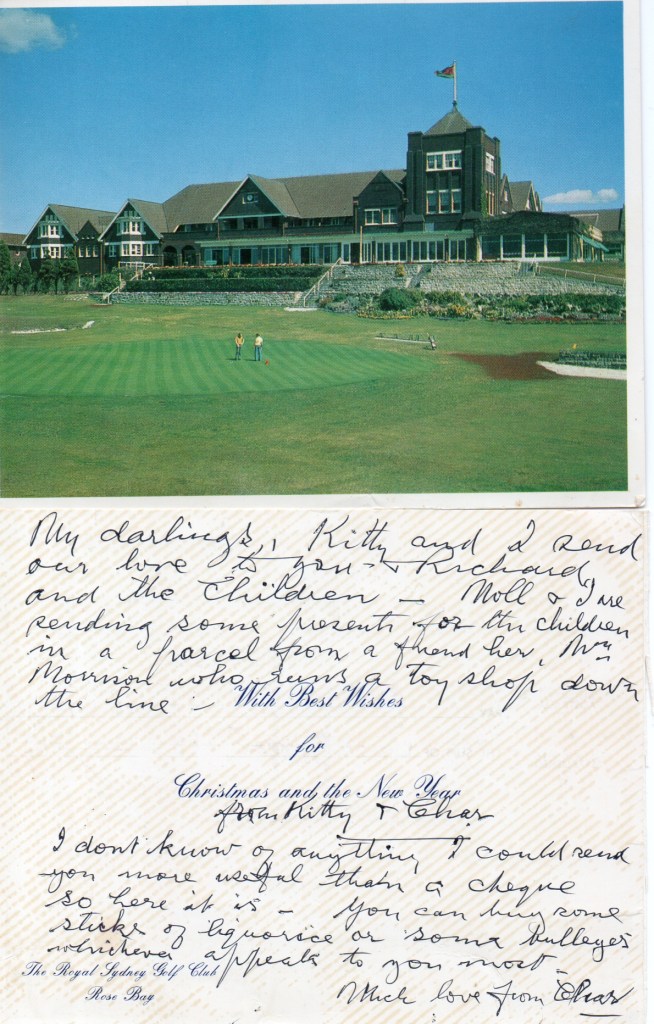
I think it must be 1971, but it could be 1972, that we received this very kind Christmas card from Char and Kitty. The Royal Sydney Golf Club has played a part in the recreation of our family from at least the time in 1925 when Dudley and Kathleen moved to Kent Street, Rose Bay. I think Char was probably using the cards from home, rather than being at the club, but I was in Canberra with a new baby, James, so I cannot verify that.
1973
Michael turned 17 in 1973. He learned to drive and was given the Rover. He went to Technical School in Katoomba to become a builder. Supported by Char, his father and mother, he achieved his goal and has been at work ever since! At this time of writing, Michael is 64 years old and lives in Medlow Bath.
Ina was only 14 in 1973.
Stuart Westgarth, the grandson of Char’s brother, George Mansfield (see blog), started at Dudley Westgarth and Co as an articled clerk. Here is the report of an interview he did at a much later time.
‘In Conversation with Stuart Westgarth’: Click here to watch our video interview with the NSW Law Society President, as he discusses working overseas, his legal mentors, and tips for legal leadership.
‘Like many aspiring young lawyers, Stuart Westgarth moved away from his country hometown to study law in the city. Unlike many, however, the conclusion of studies did not coincide with interview after interview for a highly sought-after graduate position; he knocked on his great uncle Dudley’s law firm door instead.
“I knocked on the door and said, ‘I’m your country cousin. Can I have a job?” recounts Westgarth. Having never met the firm’s senior partner (his cousin John Westgarth), nepotism nonetheless prevailed and he was given a position at Dudley Westgarth and Co (DWS) in Sydney, where he stayed from 1973 to 2008. “That’s more than the lifespan of most people I know these days,” he says.
A great grandson of the founding solicitor of the NSW Law Society, George Charles Westgarth, and a grandson of Scone solicitor George Mansfield Westgarth, he was certainly not the first in his family to follow a path in law. Growing up in Bathurst, Westgarth relished his city role and says he was well mentored by a number of senior partners throughout his career, including his cousin John, who he remembers as a “very solid and sensible person”. “He didn’t engage in emotional outbursts, he was very controlled and he had the most brilliant, economical writing style. He could express complex ideas in a paragraph,” says Westgarth.
Starting out in commercial advisory work and later moving into banking and finance litigation, Westgarth says he admired such skills and strove to emulate it in work he describes as “complex and analytical, involving a lot of technical issues and not too much emotion”.
He must have learned something from his cousin, as Westgarth is recognised amongst his peers as being a very calm, calculated and considered character. “People are different, you can’t be a personality that’s not natural to you,” says Westgarth. “I tried to observe people and pick up what I thought I could take on myself.” While experiences amongst family were valuable, Westgarth says it was on various international sojourns where he was taught a thing or two about the law and life.’
Char Turns 87, June 1st 1974
I don’t remember his 87th birthday, which was held at St Anne’s and was his last. It is true that he had well outlived all his brothers and had reached a greater age than either his father or mother. His sister, Violet (Poppy) outlived him.
The last time I visited Char and Kitty at Nurung, it must have been 1973. He told me that he was ‘no good dear’ and he repeated his lament for his brother and playmate, Mervyn, who ‘died of a fever’ and was ‘the best horseman in the Light Horse. These little pieces of information have probably prompted me to find out all about a family I did not know at all.
The end of the story
Char died in 1974 on 5th December. He had been admitted to Bodington Red Cross Hospital, where he had used to go and play chess with the inmates. I was in Canberra, at least 5 hours drive away in those days. I had two little children and was delivered of a third child, Katherine, 6 days later! So I did not see him in hospital nor go to his funeral.
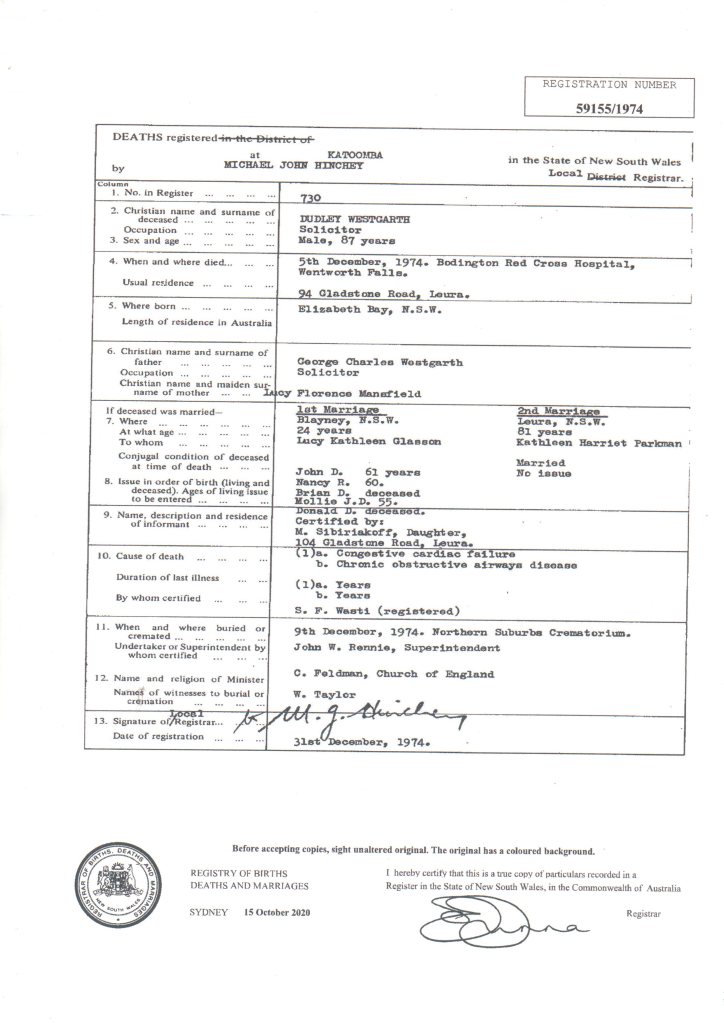
He was cremated at the Northern Suburbs Crematorium, but he had not planned ahead and his niche is not next to Kathleen’s. Here is the map again:
Kitty
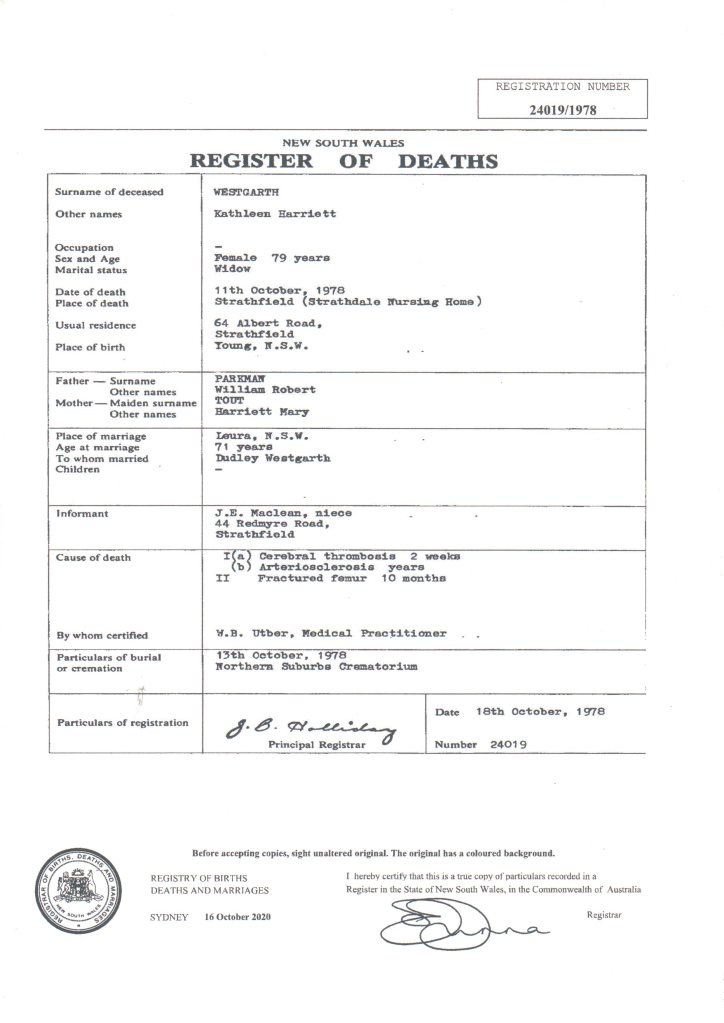
Kitty, after Char died, seems to have developed dementia and moved to Strathdale Nursing Home, 64 Albert Road, Strathfield. Her niece, J.E.Maclean, was living at 44 Redmyre Road, Strathfield, so she had family there.
It seems she had fractured her hip 10 months before her death, so she must have been in the nursing home for a while. Kitty was a strong and healthy woman when she was married to Char, so it is sad to see she died so soon after.
Epilogue
There is little more to say. Char left a will in plain English – after all he had had plenty of practice! All the family were included, with some special bequests and the rest divided equally amongst us. I have many little things which were waiting for a family member to love them and keep them: a silver Chinese tray; Yaryar’s cake plate with violets; a hand painted bowl with lid; two chairs which are impossible to sit on; Little Granny’s low armchair, and now, some Crown Derby plates, which I never use.
………………………………………………………………………………………………………………………………….
Postscript: What happened to Dudley Westgarth and Co?
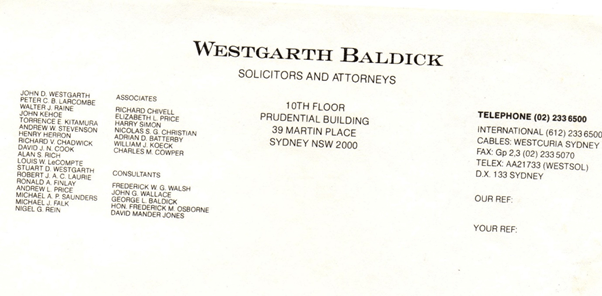
Dudley Westgarth and Co was at 369 George St for many years, perhaps since 1937. According to the Law Almanac for 1972, the firm had moved, most likely the year before, to the newly built Prudential Building at 39 Martin Place.
After my grandfather died in 1974, my father was the senior partner in the firm. He was at that time 61 years old.
In 1981, the firm changed its name when it merged with Baldick MacPherson and Walsh, who were in the same building, at 14 Martin Place.
My father retires
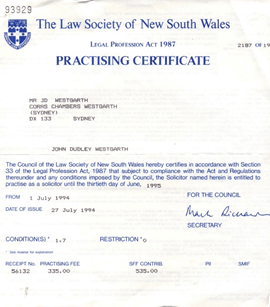
The photograph below shows my father in front of his and Dudley’s portraits, being given the brass plate for 369 George Street as a farewell present on his retirement as a partner, in 1982. Walter Raine and Henry Herron are in the photo.
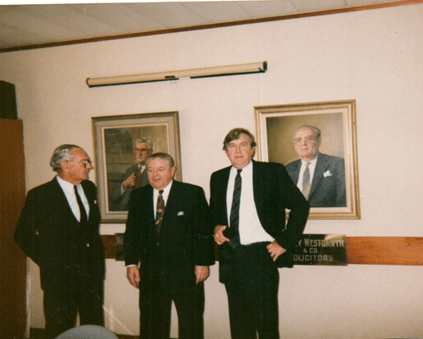
Stuart Westgarth, who was with the firm through its transitions from 1973 to 2008, sent me this email about the above photograph:
Hi Trish,
I think it might mark an important occasion (e.g. John’s birthday or retirement as a partner in the early 1980s). I have a recollection that he was presented with the brass plate in the background which someone had taken from the previous building which the firm occupied (369 George St), but I don’t remember the particular occasion.
Stuart
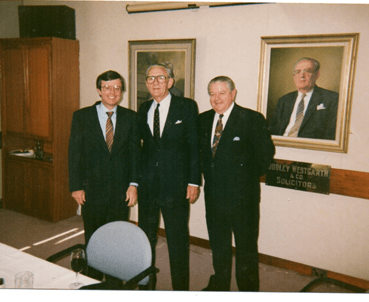
Law Society Certificate to Practise Law
Dad kept his practising certificate until 1995, two years before his death from dementia.
A Death and a Retirement
By 1978, my mother was not well, with a variety of health issues. By 1979, my parents had bought a beach cottage at Salamander Bay, which brought them both, but dad, especially, a lot of pleasure.
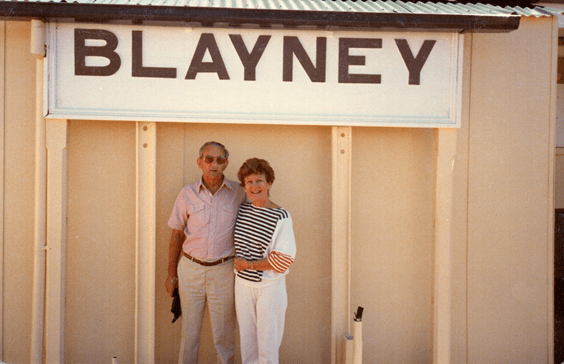
My mother, Barbara, died in 1982. That same year, dad retired from the firm and married Yvonne Lyneham. They were very happy together and went back to Blayney to see where it all began. Here they are at the Railway Station, (I think).
The firm becomes Westgarth Middletons
The firm continued to evolve to compete in the market. In 1988, Westgarth Baldick merged with Middletons Oswald Burt of Melbourne. See below:https://www.afr.com/companies/century-old-firms-merge-19881031-k32bh
CENTURY-OLD FIRMS MERGE By BRONWYN YOUNG
Oct 31, 1988 – 11.00am
‘Two medium-sized law firms – Westgarth Baldick, of Sydney, and Middletons Oswald Burt, of Melbourne – have merged to form a firm which will rank in the top 10 in Australia. The new firm, with 60 partners and associates and a total staff of more than 280, will be called Westgarth Middletons. The chief executive, Mr John Meehan, said the driving force behind the merger was improved client service.” Neither firm is interested in a merger for the sake of increased size alone, since each already offers full commercial service to its client,” he said. “However, we have found that with the increasing interstate activities of clients, closer interstate ties with a compatible ‘service’ culture was needed. “Both firms have had a long association and the merger is a logical extension of that relationship.”
Mr Meehan said Westgarth’s had begun looking for a suitable partner in Melbourne in October last year. Negotiations with Middletons had taken between four and six months.Both firms were established in the 1870s. Westgarth was best known for its work in the building and construction area, Middletons for its work in the transport industry, with a heavy emphasis on shipping. The new firm’s client base includes Concrete Constructions, Kumagai, James Hardie, Readymix group, BHP Petroleum, AMP Society, Westpac Banking Corporation, Royal Assurance, Esso and Prime Computers.‘
Merger with Corrs:
In 1991, the firm merged again to become Corrs, Chambers, Westgarth. You can see that the Westgarth name has been retained because of its early history in the Law, through Dudley’s father, George Charles. https://en.wikipedia.org/wiki/Corrs_Chambers_Westgarth
‘Corrs Chambers Westgarth has its roots in the pre-gold rush days of Melbourne, dating back to when law firm Whiting and Byrne was formed in 1841.[2] In 1883, Norton Smith Westgarth and Sanders was established in Sydney, followed two years later by Brisbane’s Chambers McNab and Co.[3]
These three firms are the foundations of Corrs Chambers Westgarth, which was formed in 1991 by the merger of Corrs Australian Solicitors, Westgarth Middletons (Sydney) and Chambers McNab Tully and Wilson (Brisbane and Gold Coast). Corrs Australian Solicitors was formed two years earlier (initially with the name Corrs) via the merger of Corrs Pavey Whiting and Byrne, Adelaide’s Mollison Litchfield and Perth’s Keall Brinsden (founded in 1910).[4]
Today Corrs has offices in Sydney, Melbourne, Brisbane, Perth, and Port Moresby.’
Sydney Offices of Corrs Chambers Westgarth
The firm moved from 39 Martin Place to Governor Phillip Tower in 1993 and then moved again, around 2012, to Chifley Square.
Today, times have changed for females in the Law and the Partner in Charge in Sydney is a woman.
The portrait story
The portraits in the photo above must have travelled to Westgarth Middletons, but somewhere after that they were thrown out.
Stuart believes they were still there when he left in 2008. He is sure Johns portrait was in the library but cannot remember whether Dudley’s was still hanging, or in storage
Dudley’s portrait:
A few years ago, in 2014, Dudley’s portrait was for sale at Lawsons’ Auctioneers in Sydney. Julie Woodhill and her brother, Anthony, bought the portrait which now hangs in Julie’s living room.
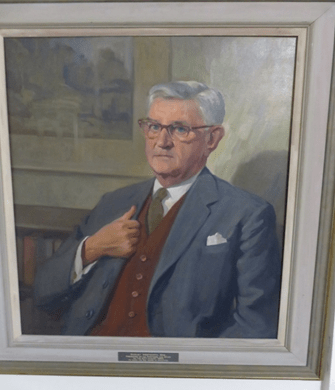
John’s portrait.
Later, in 2018, my father, John’s, portrait turned up on Ebay! My son, James, told me and I rang Corrs to ask why the portrait was for sale. I learned that the portraits had been discarded, but no reason for this action was given.
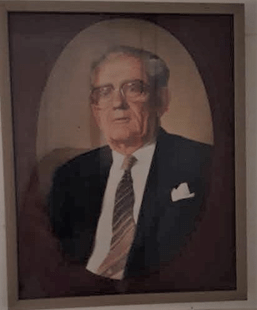
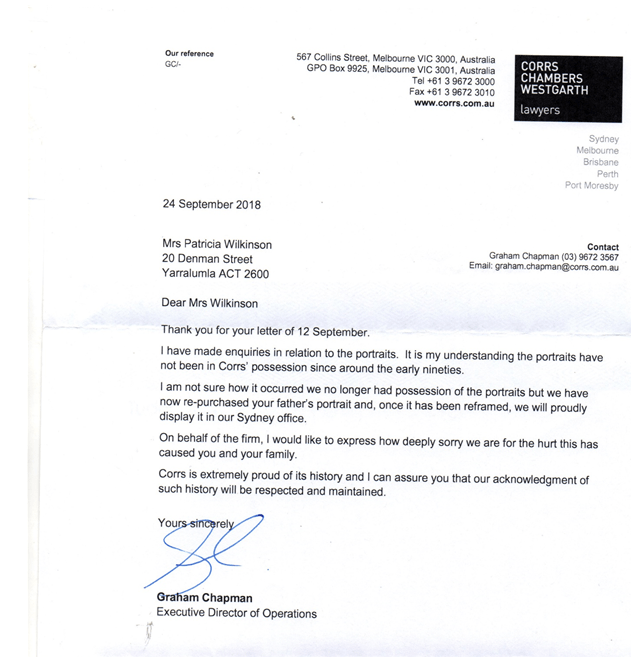
I did not know the history of the movement of the portraits, but thought that they should be displayed at the firm which still incorporates the Westgarth surname. After some research, my son, Andrew, a public servant, emailed the CEO of Corrs, who agreed to purchase and display dad’s portrait. A happy ending.
I received this letter from Graham Chapman. If I go to Sydney, perhaps I will go and have a look at the portrait.
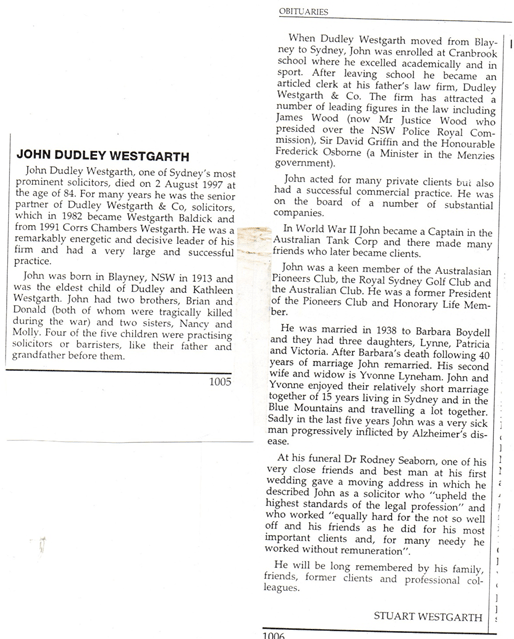
And finally here is the obituary of my father, written by Stuart Westgarth. It is in the Australian Law Journal, Volume 71, 1997.
(No such obituary was written for my grandfather. I know, because I went and checked.)
 westgarth and glassons