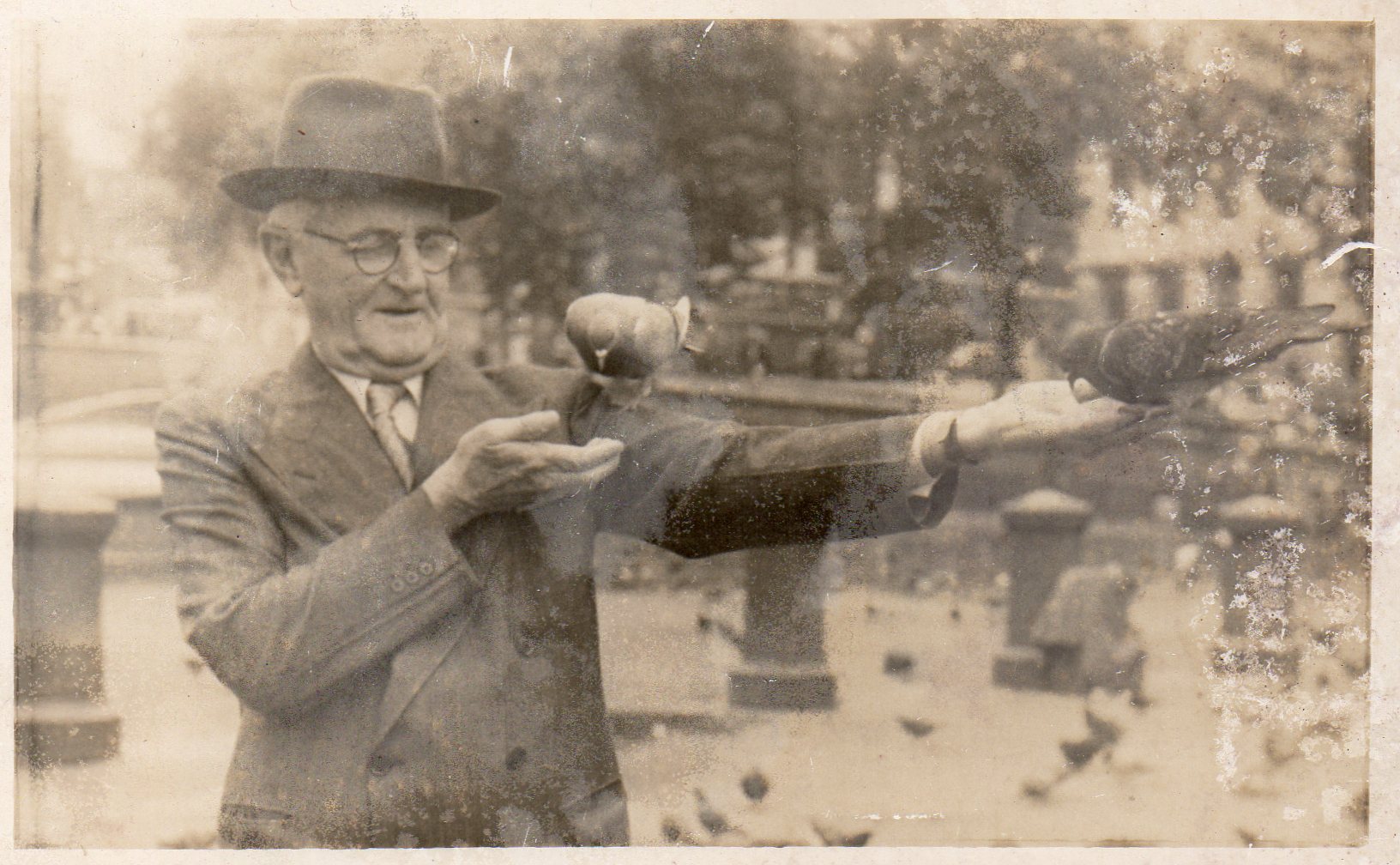
Introduction:
At last I get into family history which is also part of my own history. I hope I can make an interesting account of my grandfather, Dudley, who had a long life, outliving all his brothers and sisters except Poppy, the youngest. However it is impossible for me to write about Dudley without also writing about the family of John Glasson, (born 16th May 1847) and Anne Margaret Wilson. My grandmother, Lucy Kathleen Glasson, was the eldest daughter of their family of nine children, nearly all of whom I met and some of whom I visited at their homes.
Our John Glasson was the nephew of John Glasson whose letters I have put online. John, Kathleen’s father, was the fifth of eight children of William, one of the brothers of pioneer John Glasson who arrived in NSW in 1830. William and Susan Glasson (nee Susan Russell), arrived in 1852 because farming in Cornwall has become uneconomic. William followed his brothers John, Joseph and Richard Glasson to a new life in Blayney. Later, Henry Glasson joined them, as well as sisters Mary, Elizabeth and Susan.
You can read all the background to the Cornish Glassons and their letters in the previous post.
Coincidentally, Dudley’s grandfather, also called William, had decided the same year to give up farming in Lancashire and emigrate to Australia, arriving in Melbourne in January 1853. Another coincidence is that George Charles and John Glasson we each 5 years old when they left England, taking with them many memories of the ‘Old Country’.
Another difficulty with family history is the tradition of calling the eldest son ‘John’. Dudley’s eldest brother was John, Kathleen’s eldest brother (who died as a baby) was John and my father, the eldest, was called John too. You can see in the Glasson letters how difficult it is to distinguish the generations when they have all been called John!
Writing about Dudley whom I knew so well makes me understand the continuity of culture and language which is unconscious in everything we say and do. Dudley was in contact with his English grandfather, William, who was born in 1826, before the Victorian era and died in Glebe in 1899. He also knew his architect grandfather, George Allen Mansfield (d.1908) and the Mansfield and Allen families of Glebe, strong Methodists and early free settlers from Britain. Now, in 2019, 132 years since Dudley was born, I am passing on my thoughts about the past and unconsciously my British heritage to those who read this blog, perhaps my grandchildren!
Contents of this blog:
- Dudley’s early life
- Life in the horse era
- Blayney and Lucy Kathleen Glasson
- Engagement and marriage
- Children and married life
- The Great War
- Move to Sydney and schooling at Cranbrook and Ascham
- Bringelong, Wentworth Falls
- Second World War and deaths of Brian and Donald
- Marriages of John and Nancy
- Mollie’s law career begins; working in London
- Grandchildren and Number 7 Vaucluse Road
A boy called Dudley 1887!
I was wondering why on Earth George Charles called his son ‘Dudley’ (and of course he acquired the nickname ‘Dud’ ) and I have found that this name is another symptom of George Charles’ obsession with English social class! I looked up “the Earl of Dudley, 1887” in Wikipedia and this is what I found:
(Lord) Dudley was born in London, the son of William Ward, 1st Earl of Dudley, and Georgina, daughter of Sir Thomas Moncrieff, 7th Baronet. He was educated at Eton. His father died in 1885 and he inherited nearly 30,000 acres (120 km2) of mineral deposits in Staffordshire and Worcestershire, two hundred coal and iron mines, several iron works (including the Round Oak Steelworks) and a substantial fortune, as well as the Earldom. He visited Australia in 1886–87 as part of a yachting cruise. Dudley became part of the social circle of the Prince of Wales (later King Edward VII), who attended his wedding to Rachel Gurney in 1891. From 1895 to 1896 he was Mayor of Dudley and became Governor-General of Australia! https://en.wikipedia.org/wiki/William_Ward,_2nd_Earl_of_Dudley
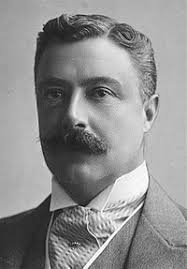
Yes, the second Earl of Dudley was visiting Australia when my unsuspecting grandfather was born, so that is how he got his name. The Earl of Dudley’s domain was not in Lancashire, but it was in the Worcestershire where the Rodds originated. Lord Dudley was also close to the Prince of Wales, heir to the Throne. Lucky Dudley Westgarth!
Birth, June 1st 1887
I have already documented his birth on June 1st 1887 at Tresco, whilst St Helens was being built. He was the fourth child of Lucy Florence, who would have another boy, Mervyn, in October the next year. Dudley was the sixth child of George Charles, who was married before. His half brother John (Jack) was 10 and his half sister, Ella, was 14. His eldest brother, George Mansfield, was 6 and Ronald 5 and Gwendoline 3.
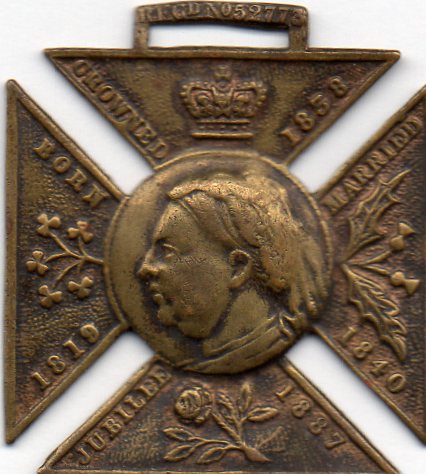
20th June 1887 was the date of Queen Victoria’s Golden Jubilee celebrations. A jubilee is a celebration of 50 years; Victoria had reigned from 1837 to 1887 and would continue to reign until 1901. As the colonies of New South Wales, Victoria, Queensland, Western Australia , South Australia and Tasmania were part of the British Empire, many towns struck a commemorative medal. This one is bronze, washed gold, in the shape of a Maltese Cross.
Early Life:
Dudley would not have remembered much about Tresco, because in 1891 his father leased the house and the family went to St Helens. That must have been a happy time for him on the farm and in the beautiful house with his best friend, his little brother, Mervyn. Dudley was 4 and Mervyn 3 that year. There was also the baby, Violet (known as Poppy), born in England in 1890 when George Charles and Lucy Florence attended the wedding of George Charles’ youngest sibling, Violet.
The year he turned 7, 1894, St Helens was leased and the Westgarths went to live at Kirribilli Point because George Mansfield and Ronald had to go to school. They went to Shore (North Shore Grammar School). The last baby, Doreen, was born there in 1896.
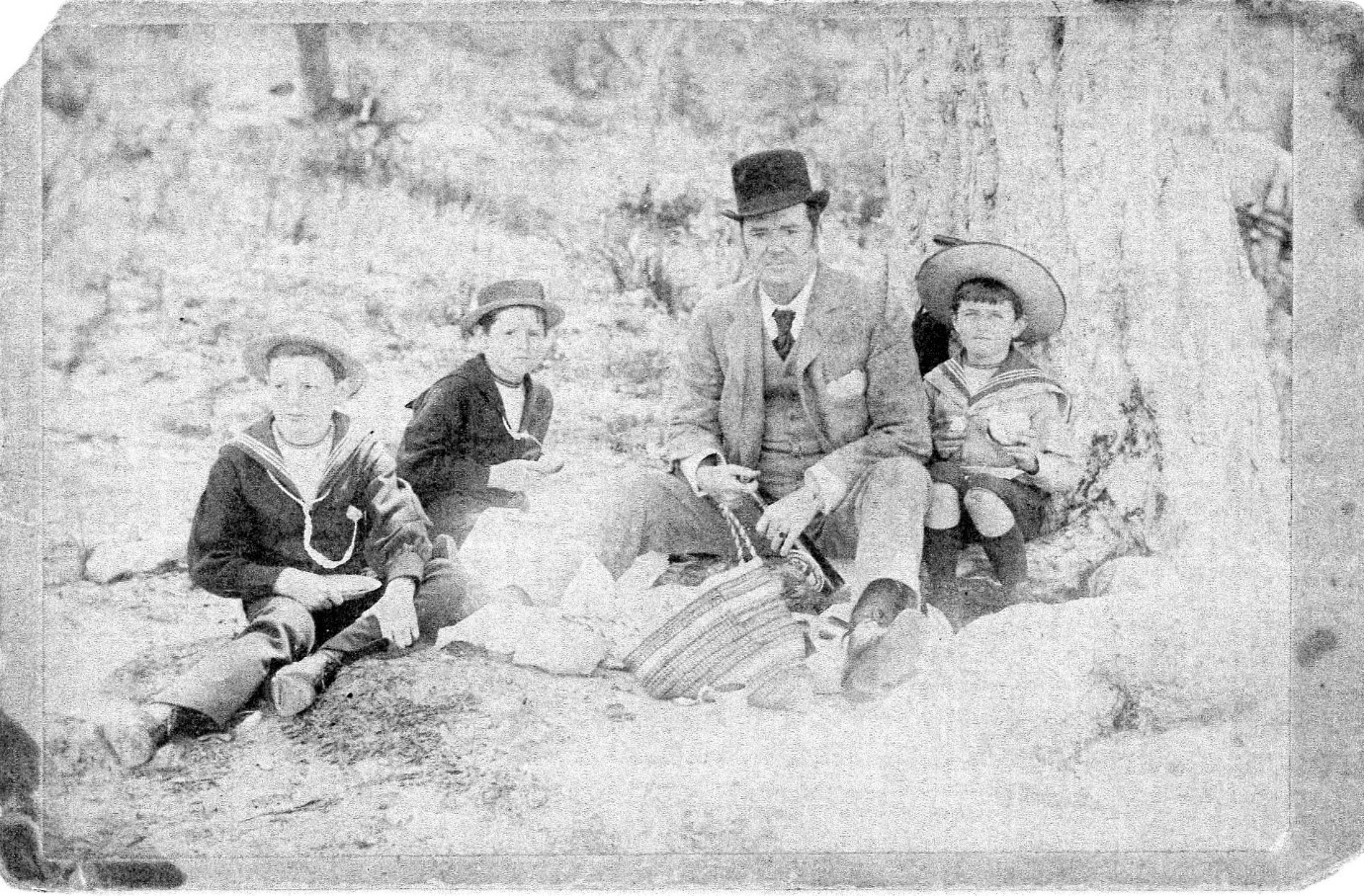
In 1897, when he was turning 10, it was time for Dudley and Mervyn to go to school. The family moved to The Pines, Avoca Street Randwick (now demolished) and all the boys went to Sydney Grammar School in College Street, the two older boys transferring from Shore.
Horses:
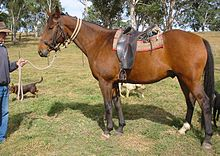
Dudley was born in the era of horse transport. His half-brother, Jack, lived his whole short life (1877-1918) in the era of horses. In the British Army Jack was trained in Artillery, which were all pulled by horses!
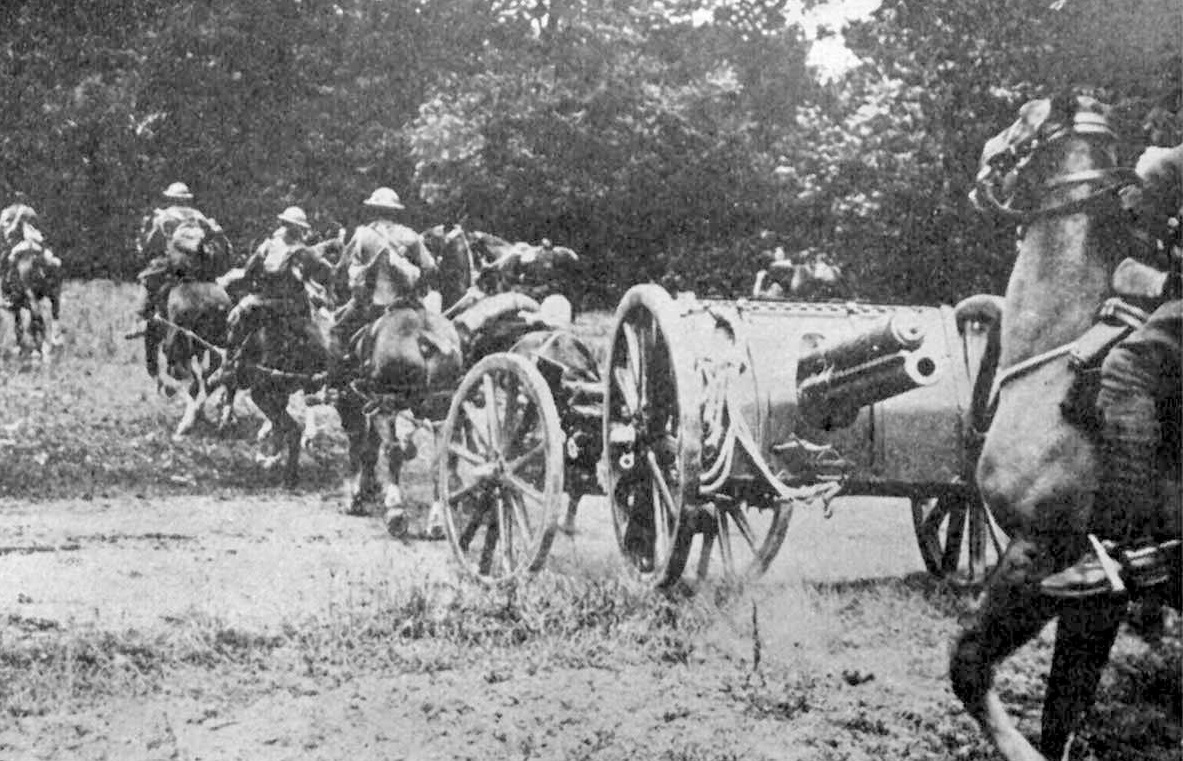
Jack was a very skilled rider of course.
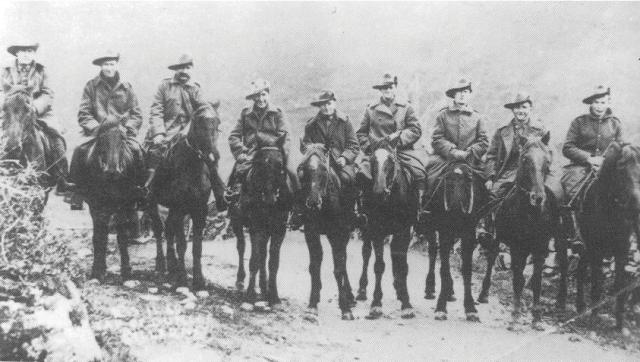
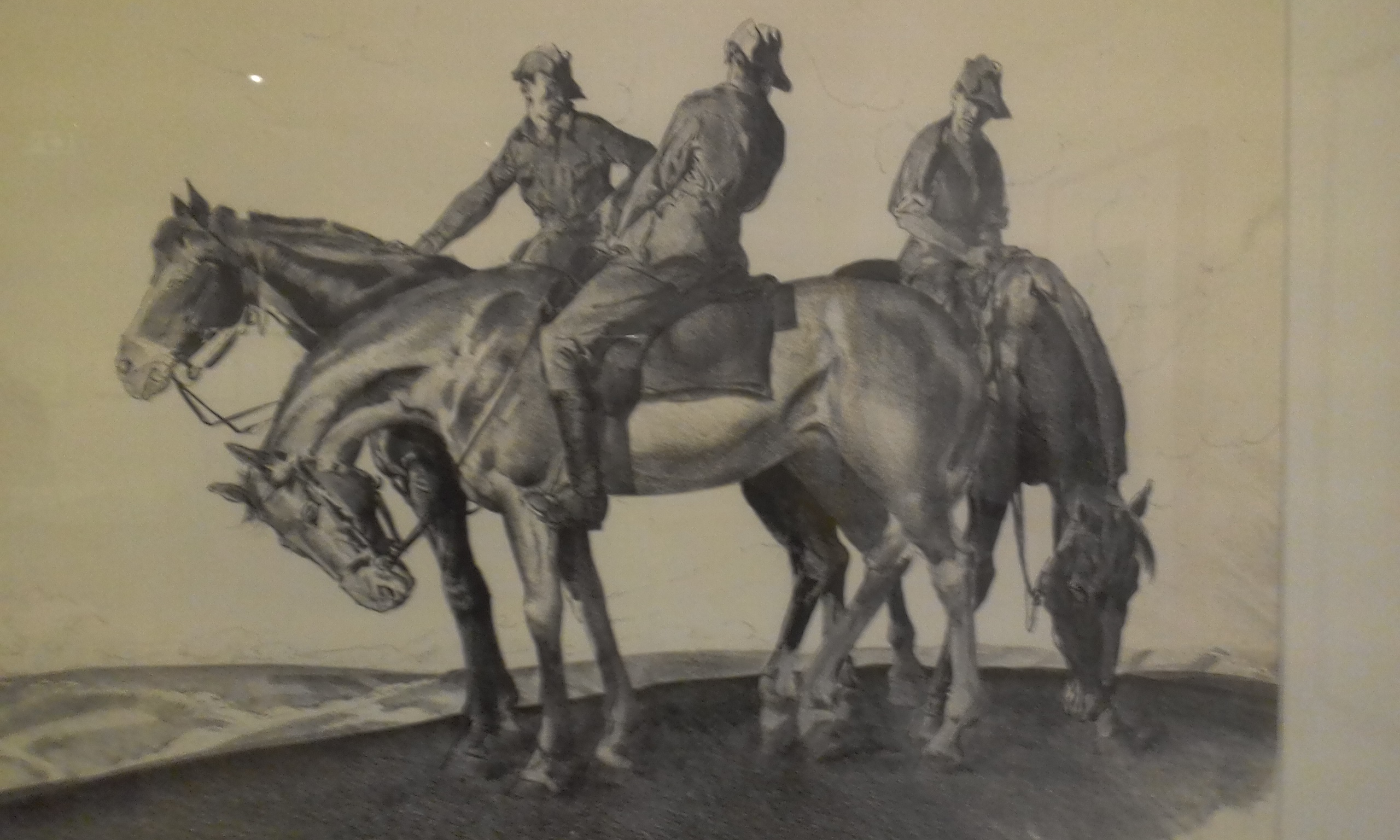
Mervyn was in the 12th Ligh Horse, as well as Claude Glasson. Here is a picture of three Light Horsemen off duty, drawn by Will Dyson, one of the First World War artists.
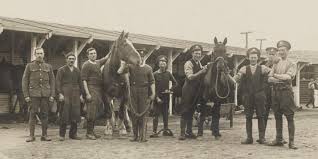
Dudley lived to be 87, so more than half his life was spent with motor cars, but he would have well remembered the era of horses. Researching the internet, I found this wonderful article on the era of horse transport in Melbourne. It must have been the same in New South Wales:
The Era of Horse transport in Victoria. (abridged) http://www.emelbourne.net.au/biogs/EM00723b.htm
The pace, smell and sound of the horse-drawn age have long faded from the memories of Melburnians. From the 1830s horse manure had been the ever-present and ubiquitous urban smell that, however unpleasant, was generally not regarded as remarkable or pathological until the early 20th century. A special brigade of juvenile workers, known as orderly or scoop boys, was employed to clear the streets of horse litter, a sometimes risky enterprise as they dodged the city’s traffic. The erection of orderly bins in the 1880s facilitated city cleanliness, and loads of street gleanings sent to the manure depot were often requested by private citizens or institutions for land-fill or for top-dressing gardens. In 1885 the ‘crossing-sweeper nuisance’ had many streets ‘infested by boys alternately playing pitch & toss and begging off ladies & gentlemen as they pass up and down the footpath’.
The nuisance of horse feed blowing from loose bags and boxes about the streets and into shops had also become serious enough by the 1910s for a by-law prohibiting the feeding of horses in the street except from nosebags.
The requirements of the horse-drawn age were stitched into the city’s urban fabric, and can still be traced in its built heritage. Mac’s Hotel accommodated the gold escort and had stabling for a hundred horses……Stables were located at Government House (the largest domestic stables complex in Victoria), and Victoria Barracks on St Kilda Road. The former Victoria Police Depot in Southbank (1912) includes one of the largest stables complexes in metropolitan Melbourne.
Horse numbers are difficult to estimate at a metropolitan level; in the 1880s there were perhaps 20 000 animals stabled in the city. Victoria-wide figures show a steady rise through the 19th century: 21 000 (1851), 77 000 (1861), 167 000 (1871), 276 000 (1881), 436 000 (1891). Depression and drought in the 1890s reduced numbers, which peaked again by 1921 at 488 000 before declining rapidly to 318 000 (1941), 186 000 (1951), and 64 000 (1961).
As early as the 1880s the city’s horsepower system was running into difficulties due to the economics and logistics of bringing horse feed into the city. In Australians 1888 (published in 1987) Graeme Davison has calculated that a working horse consumed around 14 kg of fodder a day or 5 tonnes annually. With city growth, the expanding hinterland was increasingly devoted to the cultivation of oats and hay, and fodder prices at the markets reflected rising transport costs. In the late 1870s the Melbourne Omnibus Co. was already spending more on fodder than on wages.
By the 1920s the days of the horse-drawn age were numbered. Horses were increasingly blamed for traffic congestion and viewed as a menace to the health and cleanliness of the city. The Metropolitan Fire Brigade had fully motorised by 1919, and many organisations were turning to motor vehicles for their transport needs. In 1928 the Lord Mayor of Melbourne, opening the annual conference of the Royal Automobile Club (RACV), announced that the MCC was considering the diversion of horse-drawn traffic from certain parts of the city at peak hour. In the same year the post and telegraph services stopped using horses. In 1929 there was only one horse-drawn hearse in Melbourne. From 1930 no horses were allowed to stand in the retail section of the Queen Victoria Market, horse-drawn vehicles being required to stand in a separate reserved area. By the 1930s stabling accommodation was estimated to require eight times the area of garaging a motor car.
The other side of the horse era: RACING:
Who Went Racing? The simple answer is, everyone. As early racing went hand-in-glove with tavern and hoteliers, it is not surprising that most of the population was interested in racing in one form or another. There is a unique Australian slang term, wowser, which is defined as a prudish teetotaller. Whilst there were such objectors to racing and betting in earlier Australia, by the mid-twentieth century this had disappeared. Non-bettors and non-drinkers have always had an interest in racing in Australia. It is the one of two areas of Australian society that is egalitarian. High Court judges mingle with workaday tipsters on a racecourse. The other place where egalitarianism is found is at the Australian form of football called Aussie Rules. It is no coincidence that these two fields of sport found popularity on the goldfields and amongst the working classes. With the popularity today of syndicating the ownership of horses, people with limited funds can still be involved in trying to lead in the ‘big winner’.
Where Does Racing Take Place? “Wherever a few are gathered…” From the beginning of the development of the land, an annual race meeting could be found in countless country hamlets, towns and cities. In the early mining camps and in the huge station (ranch) areas, meetings were held. There is no difference today.
Dudley’s Education:
Dudley went to Sydney Grammar School and told me that at age 13 he was his full height of six feet two inches (186cms). When he ran on the field for the 13 year old football match, the crowd booed him, thinking he was too old! He was also a handy sprinter, according to Neil Thornton, coming first in the 1901 under fifteen 220 yard (200 m)handicap race, in a time of 27.15 seconds, from a handicap of 8 yards. This was reported in the Australian Town and Country Journal of 10th August 1901. Perhaps his size helped him here again!
VOL01 380 4916 WESTGARTH DUDLEY 10 G C WESTGARTH BOND ST FEB 1898. Here is the record of Dudley starting at Sydney Grammar the year he would have turned 11 years old. It is not recorded when he left school, but if it was the year he turned 17, it would have been the end of 1904. He then entered Sydney Undiversity to study Law and completed his examinations in the first part of 1910. His studies may have been interrupted in October 1908, when his father died suddenly.
Dudley was at home at St Helens when his father had an obstruction of the larynx and passed away in half an hour. Being the eldest male at home, Dudley had to sign the death certificate, which you can see in the blog about his father, George Charles. After this, the family had a readjustment, which included his mother selling St Helens and opening a school for girls in Lane Cove in 1910.
Of course there was a need for Dudley to finish his studies and begin work. He was admitted as a solicitor on Monday, 29th August, 1910, when he was 23 years old and soon after he achieved a country post at Blayney New South Wales, near Bathurst, west of the Blue Mountains. Westgarth, Dudley (60) 27 Aug., 1910 Blayney, Agent: Weaver and Allworth.
It seems that George Mansfield and Dudley were the two sons of George Charles who were disposed to have a career in the Law. John abandoned it for a military career, Ronald went into the merchant trade and Mervyn was interested in pastoral pursuits.
Why go to Scone and Blayney?
I can’t speak for the whole of Australia, but I have been to a lot of country towns in New South Wales. In the main street, there are always imposing buildings with the dates around 1900, buildings such as general stores, post offices and banks. Country towns were thriving around the time of Federation, because wool, wheat and minerals were fetching great prices overseas. There were plenty of people in country towns too. Many people had large families and the children grew up and stayed in the country where many hands made light work. A busy country town had need for bank managers, shopkeepers, doctors and solicitors!
When George Mansfield had been admitted as a solicitor, the obvious country town post for him was Scone where the Robertsons, his wife’s family, lived (see previous blog).
When Dudley was admitted he obtained a post in Blayney, where there were links to the Allen family. As you know, Lucy Florence, Dudley’s mother, was the daughter of Lucy Emma Allen.
George Allen, the grandfather of Lucy Florence, who was a very prominent Methodist, had been a friend and adviser of the original John Glasson, a staunch Methodist. In 1834, John Glasson had helped with farming Allen’s Toxteth Park estate, 96 acres in Glebe. There, he met his wife, Ann Evans, who was the governess to the Allen children. (See the Letters blog) The Glassons of Blayney even built their own Methodist chapel in the nearby village of Byng, which became known as the ‘Cornish Settlement’.
Unfortunately for these religious Glassons, Dudley really had no interest in religion.
Life in Blayney:
In talking about Dudley’s new adult independence in Blayney, we must remember that his father had aspired to become a wealthy gentleman and part of Sydney society. Newspaper reports show that George Charles was very successful in his profession. So Dudley, in his youth, probably was quite an ambitious and arrogant young man, tall, well built and clever.
Neil Thornton provides the following information about Dudley’s work in Blayney: Dudley joined the practice of George Pile in Blayney and immediately began networking. He joined the Freemansons and was already assistant secretary of the Blayney Branch of the Freemasons in 1910. Then, in March 1911 he became secretary of the Blayney Show Society (Bathurst Times, Saturday 11th March 1911). He had really settled into Blayney socially. Then, on 12th July the same year, 1911, Dudley and George Pile, his business partner, registered a legal partnership, ‘Pile and Westgarth, Solicitors’, a partnership that would last until 1925.

Romance:
In 1910, Lucy Kathleen Glasson was 21 years old, a fun loving and dutiful eldest daughter. Her parents were John and Anne Margaret Glasson, nee Willson, who married on 9th December1885 at Blayney.
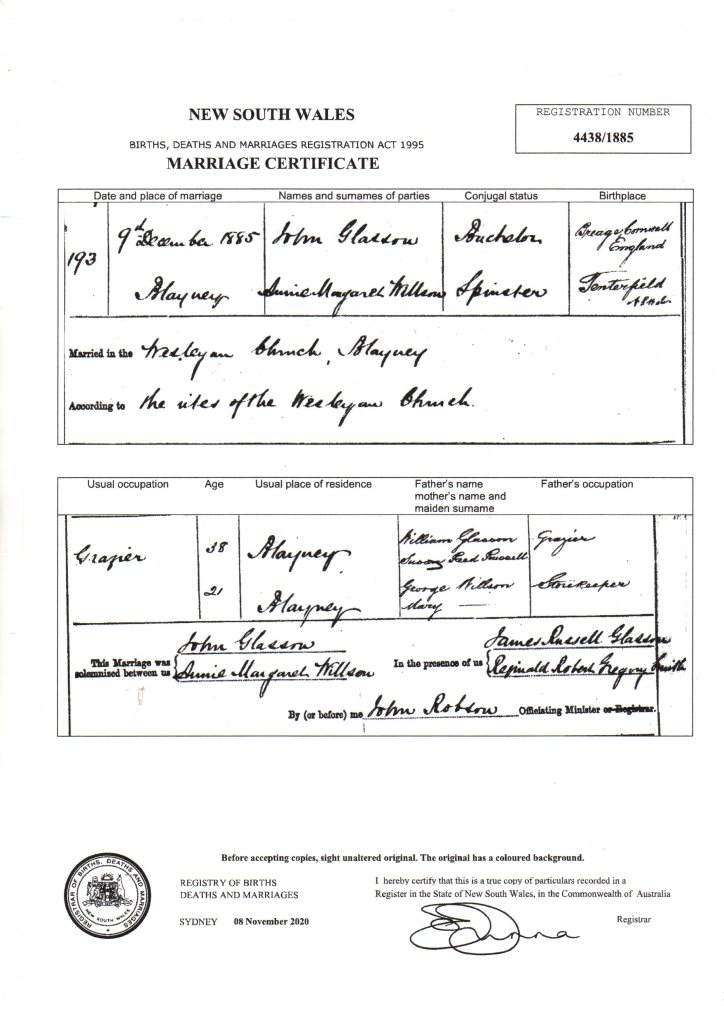
John (b.1847), was born in Cornwall, the son of William and Susan Glasson. William could not support a large family of 8 children on a farm in Cornwall, so he followed his brother, John, to Blayney in 1852. William was the second son of the six sons of John Glasson of Breage, Cornwall. The eldest, John, whose letters are on this blog, was the pioneer of the family in 1830, taking up a land grant of 640 acres in the Bathurst district.
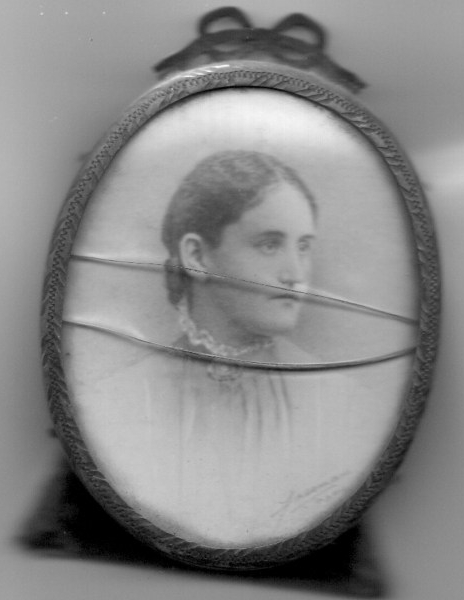
Anne Margaret Willson was born in Tenterfield, New South Wales. Her parents, George and Mary, were shopkeepers in Blayney. I imagine the couple met through the Methodist Church, in which they were married. John Glasson had established himself on the land by 1885 and would have been looking for a wife. He was 38 and she was 21.
Note: My reference for information about the Glassons, is from The Glasson Saga by Mary Glasson, published in 1980.
Lucy Kathleen was the eldest of three girls in the family. There were also six boys, Donald, Claude, Eric, Keith, Richard and Robert, making nine children in the family, on top of which three more died in infancy. Funnily enough, Dudley was also one of nine children, with two more dying in infancy.
Here they all are. The eldest son was traditionally called John, but it was an unlucky name for this firstborn.
John Cyprian Bridge, b. 27.8.1886 d. 11.1.1887
Donald Havelock b.29.2.1888 d. 12.3.1917
Lucy Kathleen b. 3.8.1889 d.16.7.1966
Claude Russell b. 7.9.1890 d. 30.4.1973
Eric Gordon b. 1.9.1891 d. 8.2.1978
Dorothy Margaret b. 27.12.1892 d. 12.1.1893
Mary Ruth b. 1.7.1894 d. 8.12.1964
Richard b. 25.5.1896 d. 7.7.1967
William Allen b. 8.10.1897 d. 19.4.1898
Robert Malcomb b. 13.2.1901 d. 16.10.1954
Keith John b. 23.5.1903 d. 14.9.1970
Susan Joyce b. 30.3.1905
Anne Glasson had a child practically every year from 1886 to 1897. I hope she had plenty of help with the children, who must have been a happy bunch of kids with plenty of playmates. Here is an extract from The Glasson Saga:
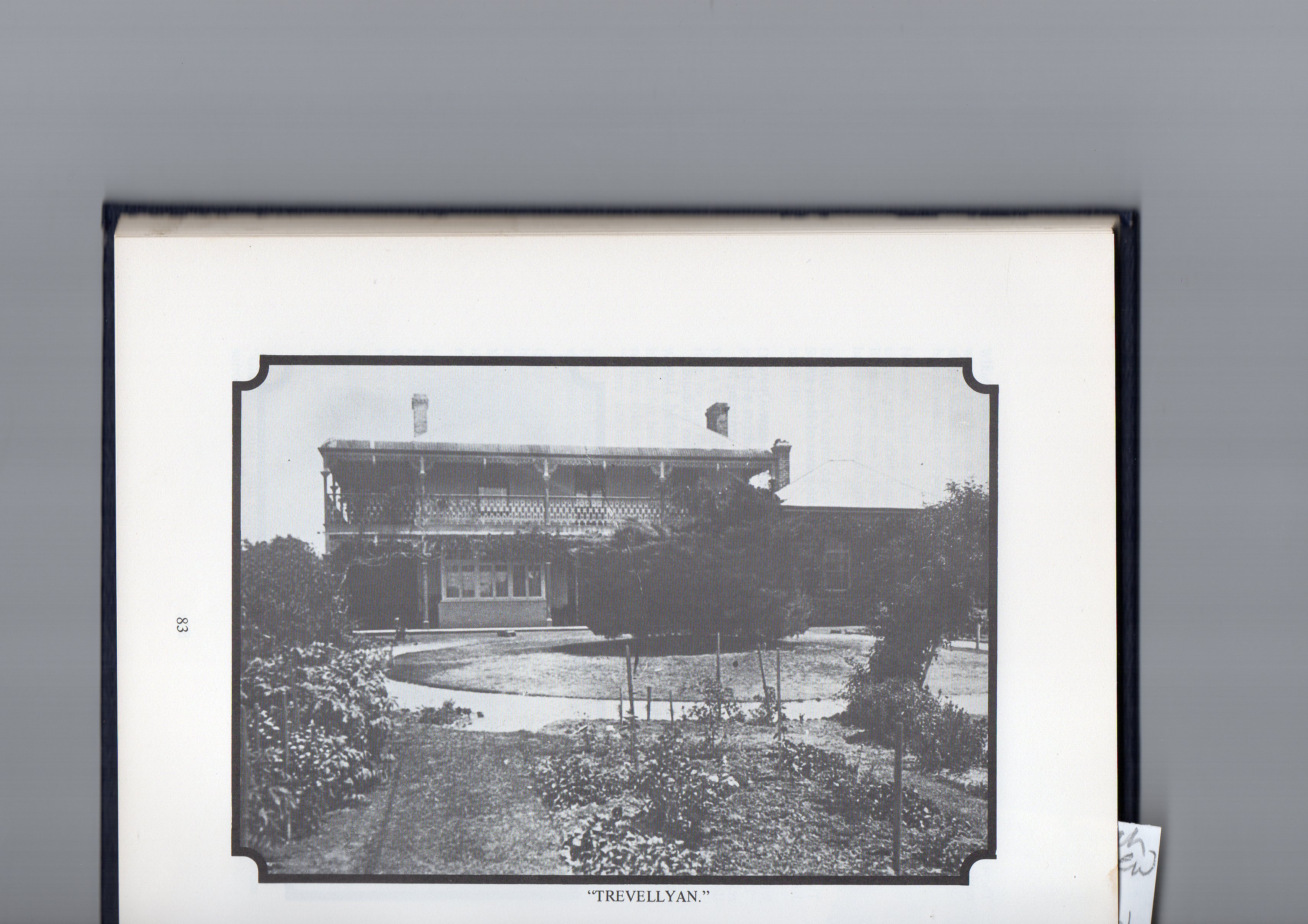
‘John Glasson prospered on the land. ‘John owned ‘Slap Dash’. a 22,000 acre property 9 miles from Gulgong, ‘Gresham’, between Bathurst and Blayney and Harwood Estate near Yass. ‘Trevellyan’, beautifully situated overlooking the Belabula River near Blayney, was the family headquarters. The young people gathered for croquet and tennis. People living today remember the happy days at Trevellyan and John’s kindness.
There is a story which shows his love of children. When quite an elderly man, he took the train to see his property, then took the train home. He rarely made the journey without a number of children, some of his own and some of their friends. On the train the children were allowed to run in the corridors, get up on the baggage racks and have the greatest fun while John read the paper, oblivious to the situation. His tolerance was rare in those days. He set a fine example and was loved and admired.
In January, 1916, John owned 9 properties and ran 39,000 sheep and some cattle.
John’s son, Claude and his family lived at Trevellyan after John’s death in 1920. The pine tree Claude planted the day World War 2 ended still stands. Not so the house. Trevellyan was sold and the house demolished, the iron lace selling for $5000. How sad it is that these beautiful old houses are not restored! The tree lined drive and one small shed is all that remains. Trevellyan was lived in and enjoyed by three generations of Glassons.‘
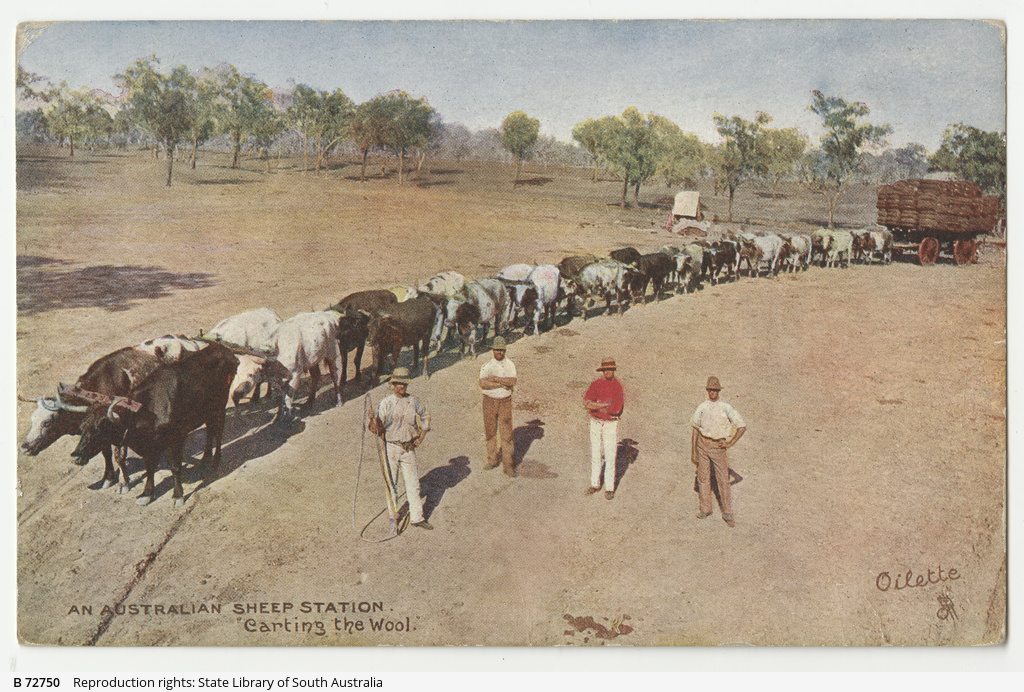
The property, Slapdash, in the article below, was purchased for CASH.
A Blayney Purchase National Advocate (Bathurst, NSW : 1889 – 1954) Monday 27 April 1908 p 2
Mr. H. R. M. Pigott stock and station agent, Blayney, reports having sold, in conjunction with a Sydney firm, to Mr. John Glasson, of ‘ Trevellyan,’ Blayney, on account of the executors of the late Vincent Dowling, ‘ Slap Dash ‘ station, near Gulgong, comprising 22,168 acres of freehold, c.p. (crown) and o.l. (lease) land, together with 10,500 sheep, 800 head of cattle and working plant, for a satisfactory price for cash.
Life on a country property at the turn of the 19th century.
Although in 1904, Sydney acquired electric light, children in the country still grew up with candles and kerosene lamps, as their forebears had lived for generations. Housework occupied all the women of the family (and their maids if they had them) with jobs such as making candles, making clothes, washing clothes and of course cooking all the food which was consumed, using a wood stove. My grandmother, Kathleen, was a wonderful cook and loved to cook for family.
There would have been an outdoor pit toilet or two, but chamber pots under the bed were standard at night. Of course they all had to be emptied every morning. My grandmother still had chamber pots when I was a little girl, but I thought they were quite unnecessary – and why not use the flush toilet?
Here is an article, called Power for the People, which describes the first time electiricty was switched on in Sydney; https://www.onlineopinion.com.au/view.asp?article=2485&page=0
‘Thursday, July 8, 2004, marked the 100th anniversary of public electricity in Sydney, when the electric streetlights of the inner city were turned on for the first time.
All over Sydney that morning of July 8, 1904, people were waking up, lighting bedroom oil lamps, and stirring last night’s coal grate to spark up some hopefully latent warmth.
In those households which didn’t have the new-fangled gas water-heaters in their bathrooms, water would be put on to heat in kettles over gas cookers or fuel stoves, partly for the morning wash, partly for the breakfast tea and porridge. Then the working adults would set off to the local stop or station to catch the steam train or the new electric tram into work in the city or nearby suburbs.
The housewives would begin their arduous day, packing children off to school, lighting gas or chip-burning “coppers” to start boiling up the washing, cleaning grates, and getting in the day’s coal or wood; then thinking about what provisions were needed from the corner store for the evening’s meal.
The ceremony 8/7/1904:
Due to the inclement conditions, few turned up at a ceremony at the new power house building in Pyrmont, under the tall brick chimney from which smoke had been wisping for most of the dingy afternoon. The party consisted of the Lord Mayor and his group, aldermen of the City Council, the Town Clerk, some senior officials and some engineers.
At 5pm sharp, the Lord Mayor, the Right Worshipful Samuel E. Lees, pulled the lever that released the steam from the station’s boilers and set the generators in motion. Then the Lady Mayoress, Mrs Lees, turned a golden key that switched on the electric current. And so, much to everyone’s surprise, the lights first came on all over what is now the CBD. People scurrying through the rain at first thought it was a particularly bright flash of lightning. But it stayed on. Sydney would never be the same again.‘
Getting together country style:
Apart from the lack of modern amenities and the weight of home duties, life in the country was busy and interesting. Families were big, there was plenty of work and plenty of enjoyment of leisure times too. Homesteads had a tennis court and tennis parties were regularly held, when young people could get together and the host family provided lots of home made cakes and biscuits. Kathleen was a whiz at cakes, especially rock cakes, sponge cakes and Swiss rolls.
Country dances and agricultural shows were also part of the calendar. Swimming in the river would have been the substitute for summer swimming pools….
Schooling
All the children boarded at private secondary schools. The girls went to Ascham, Edgecliff, the three older boys went to Newington, a Methodist college in Stanmore (now Uniting Church), where their father had been a student and the three younger ones went to The King’s School, Parramatta.
Kathleen hated the name ‘Lucy’, which was such a popular one for the older generation, and insisted on being called Kathleen. She arrived at Ascham, aged 14 years and 5 months at the start of Term 2, 1904 and left in June 1907 (which was when the academic year ended in that era). She would turn 18 in August 1907. She is on the Honour Board for German at Ascham. Before the Great War, German was much taught in schools. (Out of 5 granddaughters, three studied foreign languages at university level!) Kathleen would have been at Ascham for the switching-on of the electricity!
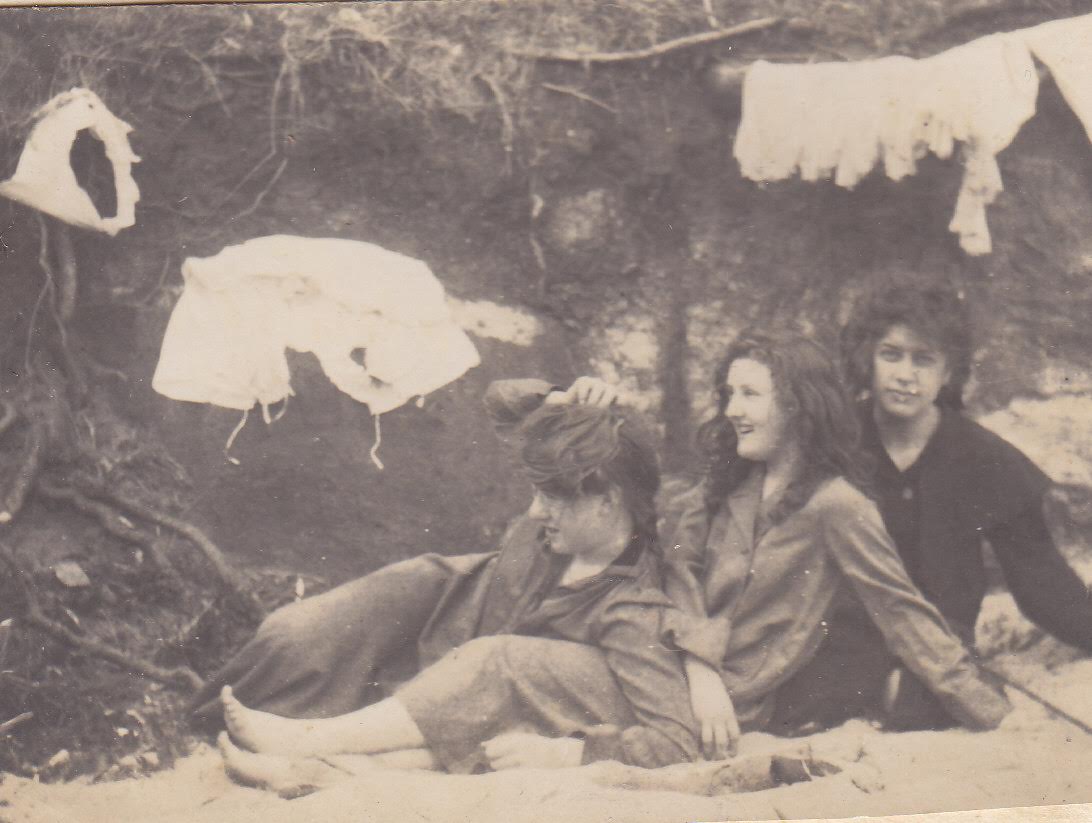
The photo of three girls at the river was taken on the occasion of the boarders’ picnic to Stanwell Park, November 11, 1905.
Rania McPhillamy is credited in the school photographs because her work in establishing a canteen with Dame Alison Chisholm for the AIF (Australian Infantry Forces) and other soldiers in Kantara in Egypt, This work won her an MBE (Member of the British Empire) and OBE (Order of the British Empire). It seems that she was a close friend of Kathleen’s at school and that is why the photos include Kathleen! They are held in an album donated to the school by Mrs Antoinette Carter, wife of the second Principal of Ascham, Mr Herbert J Carter, held at Series 182, Ascham School Archives, Mrs Antoinette Carter Collection.
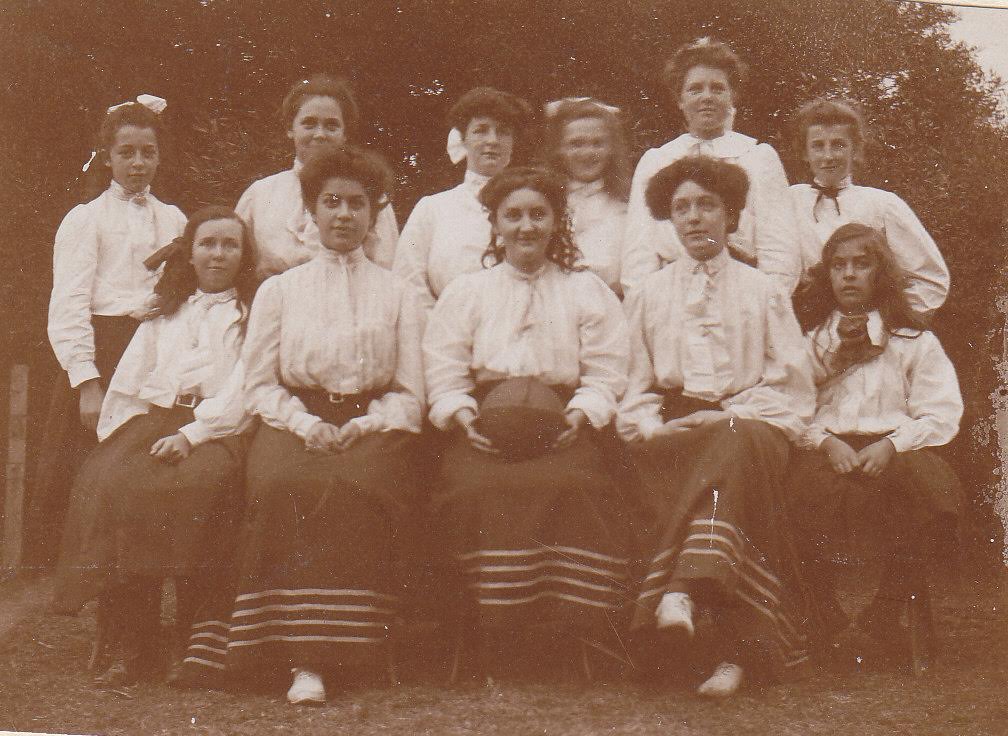
i think it is obvious from the photographs that my grandmother was a fun-loving girl, popular with the other students. The girls on each side of her look like young ladies, whilst Kathleen looks a bit like a happy tomboy. She was only 4 feet 11 inches tall and wore size 2 shoes. You can see that her feet are not touching the ground!
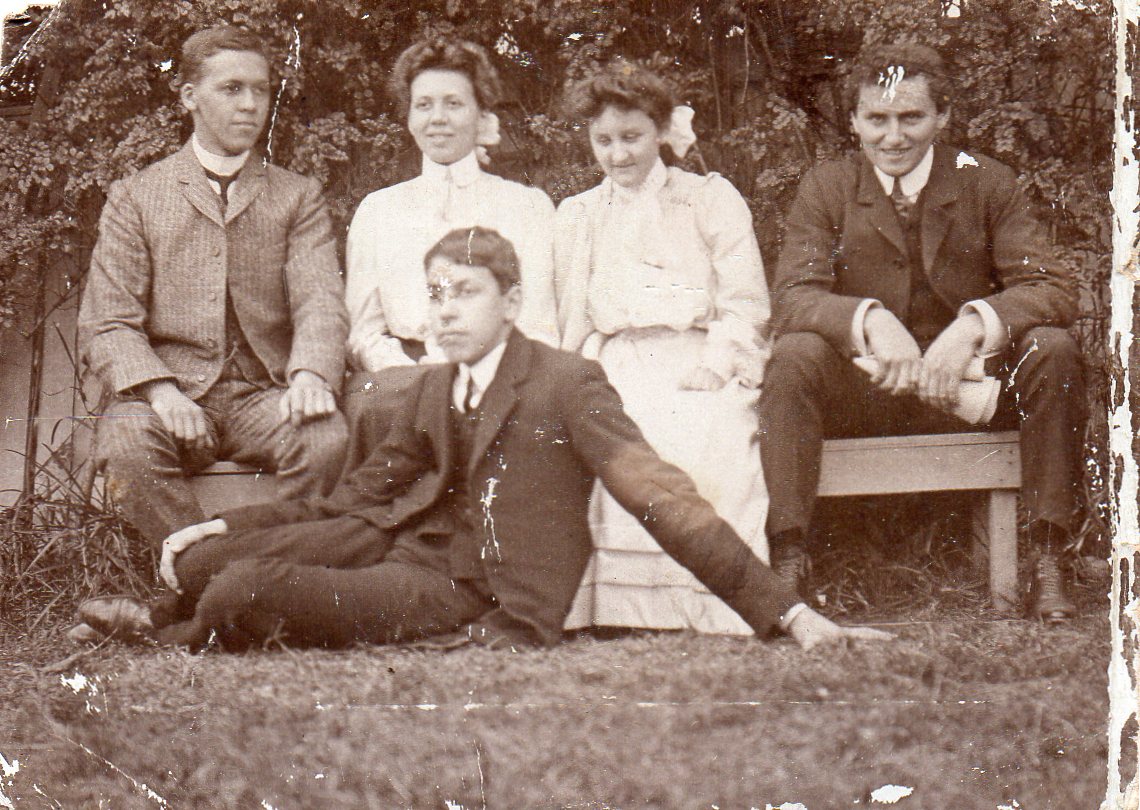
At home, although she must have had responsibilities as the eldest daughter, she also had three brothers close in age as well as other siblings to play with. Her favourite brother was Donald, a year older, whom she talked about all her life. In photos he is always present.
Here is Donald (on the right) with Kathleen visiting with her friend Rania McPhillamy (and her brothers?). The girls have their hair down, so they are probably not twenty-one yet, making it about 1909.
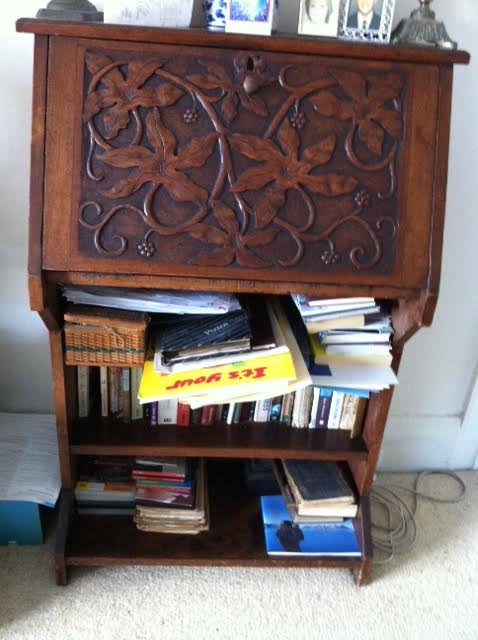
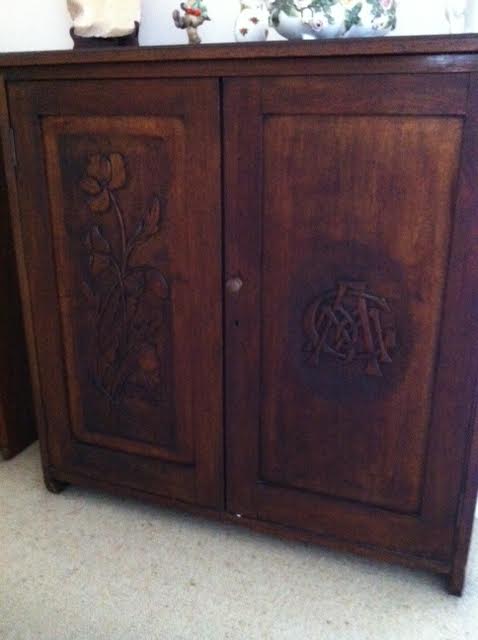
Kathleen did woodcarving, perhaps at home, as her mother also did woodcarving.
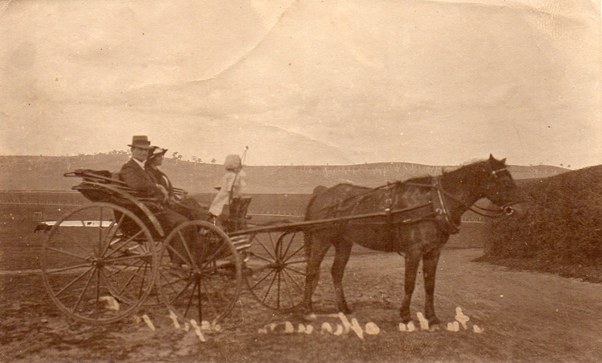
When Kathleen left school just before her 18th birthday in 1907, she would have gone home to a busy family life. Joyce was 2 years old, Keith was 4 and Robert 6. Kathleen became an excellent cook, would have made clothes and helped with the little ones. As well as the chores, she had plenty of time for fun with siblings and cousins and of course tennis parties. She had a sulky which she drove herself, probably with a brother or two. Here is a photo of Dudley and Kathleen in a sulky.
Kathleen turned 21, which was adulthood in those days, on 3rd August 1910. The same month, on 27th August, Dudley was appointed to the solicitor’s office in Blayney. Here is a copy of a miniature of my grandmother, Kathleen, probably done for her 21st birthday.
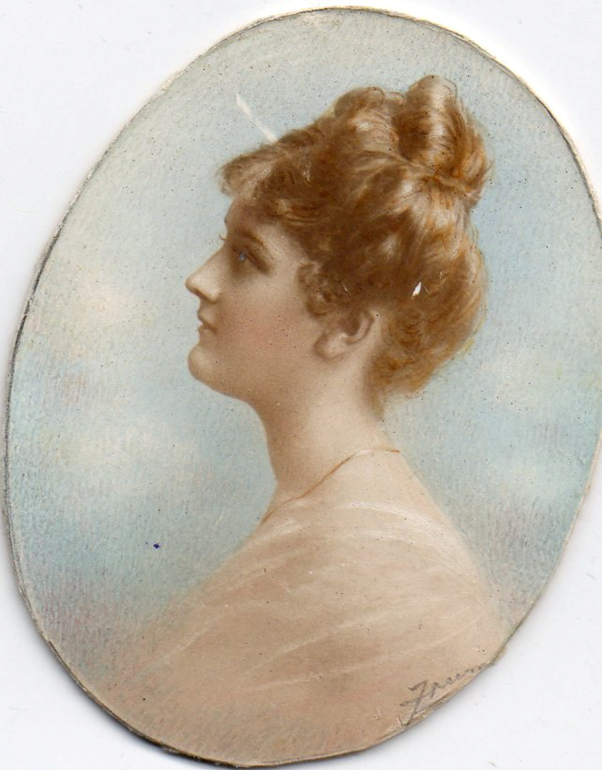
Dudley, who would have had introductions to the Glassons through the Allens, was attending tennis parties and dances and getting to know Donald, Claude and Eric who were not much younger. He also courted Kathleen.
Dudley is not suitable to marry Kathleen.
When Kathleen’s father, John, realised that his daughter had fallen for the charming Dudley, he was not impressed. Dudley was socially ambitious and did not abstain from cigarettes and alcohol as was part of Methodism. If he attended church, he probably did not show a deep faith either! However, it was 1911 and Kathleen would soon be 22 years old, a marriageable age.
Trip to Java 1911.
John’s solution was to send Kathleen on a cruise to Java and give her time to ‘come to her senses’. She must have gone with a chaperone or members of her family. In Java they would have seen and experienced a land and a culture richer than they could have ever imagined in rural Australia.

I remember batik bedspreads which intrigued me at age 4. I had never seen material like that before. I have a strange brass vase with enamelling on it, which must have been a souvenir of Java. And an ancient coolie hat! Now an antique.
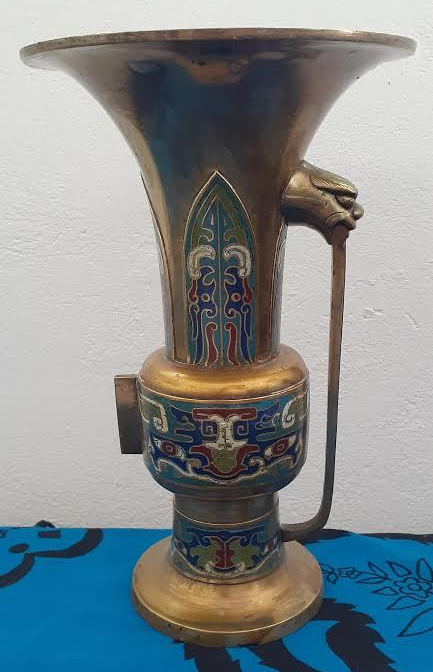
Quarantine!
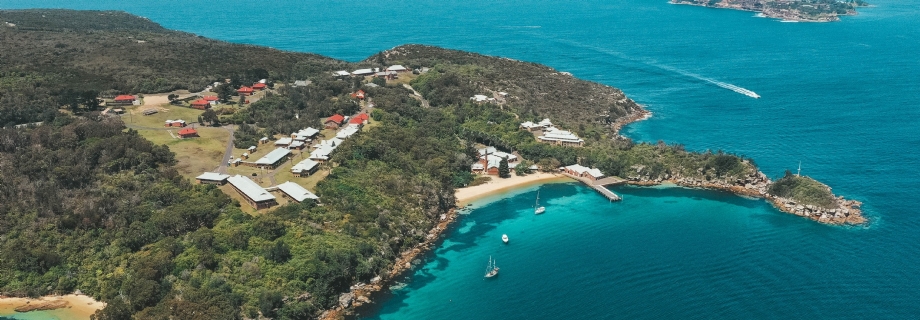
Unfortunately whilst she was holidaying, smallpox broke out in Java. The Dutch colony had already suffered from the plague and other fatal illnesses in recent years. For fear of contagion amongst the citizens of Sydney, Kathleen and the rest of the passengers were quarantined on the North Head of the harbour.
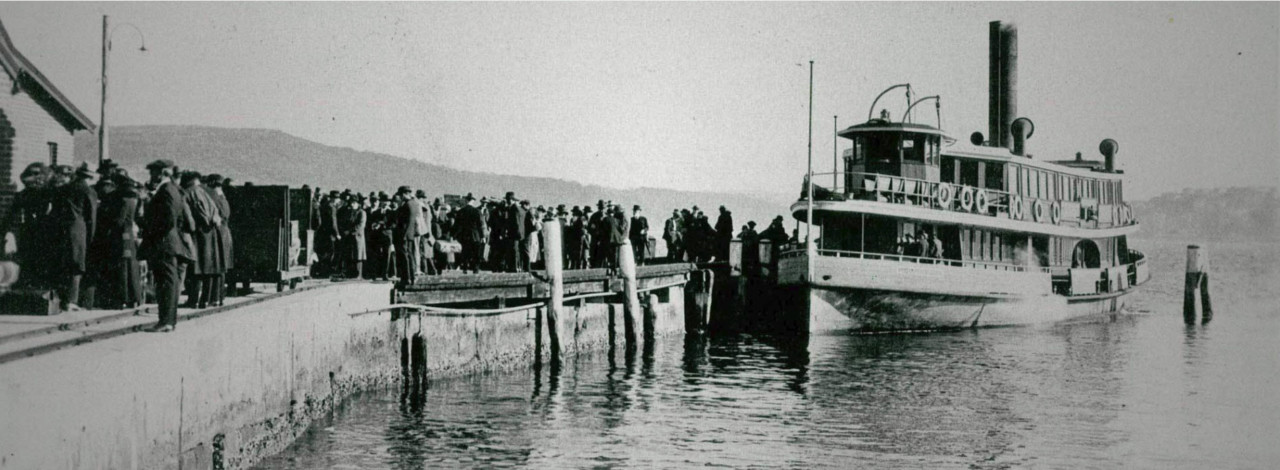
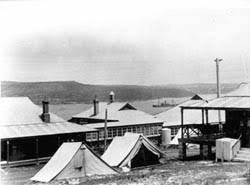

This article from July 15 1913 expresses the fear of smallpox and the limited treatment available even two years later: https://trove.nla.gov.au/newspaper/article/66661170?searchTerm=smallpox%20in%20Java%201911&searchLimits=
SYDNEY’S PROBLEM. ‘No abatement of the small pox epidemic in Sydney can yet be reported. On Saturday and Sunday 25 sufferers were discovered. They were sent to the quarantine station, where there were an Sunday night 200 persons, including 65 patients, 112 convalescents, and 23 contacts. In other cases the contacts are simply vaccinated. No fewer than 15,881 persons submitted themselves for treatment on Saturday and Sunday at the free public vaccination depots in the city and suburbs. This does not include those who were vaccinated elsewhere. Amongst the number are employees of business places and factories, where wholesale vaccination is the order of the day. So far no person seems to have died of small pox since the beginning of the outbreak. It was reported on Sunday that, there had been a couple of fatal cases, but inquiries at the Public Health Department elicited the statement that the reports were incorrect.
The outbreak of small pox in Sydney has aroused the Governments of the other States, to the necessity of taking, precautions against the danger of the disease being introduced into their States, and the Dominion of New Zealand has taken the drastic step of declining to allow any more lymph being sent to Sydney. The matter is an important one, and the necessity of being prepared for any contingency is apparent. Under the present circumstances it is the duty of the Government to seriously consider the possibility of establishing a lymph farm in West Australia, for if anything in the nature of an outbreak occurred, the stock of lymph on hand would be speedily exhausted.
Apart from the terrible disfigurement which is always the sequel to an attack of small pox when the patients recover, it is as well that people should realise what a high percentage of deaths occur. In Java from August 29, 1911, to December1st 1912, there were 362 deaths out of 871 cases. In the Straits Settlement between October 8th and November 11, there were four cases, of which one proved fatal, whilst between November 11th and December 9th, the single case that occurred terminated fatally.’
Whilst Kathleen was quarantined on the shores of Sydney Harbour, my grandfather swam from Manly to North Head to visit her. As you can imagine, this was forbidden, but he told me himself that they met on the beach during her time in quarantine.
Engagement:
When Kathleen returned, Dudley was still in Blayney and the relationship did not end. Kathleen was 22 years old and in love with Dudley, so her father allowed the engagement around the end of 1911.
The Broken Pledge
John Glasson was not happy, as I have explained, about Kathleen marrying a man who smoked and drank and did not seem to fit in with the Glasson values. He made a condition of the engagement that Dudley should ‘Take the Pledge’. (I have already written about the Pledge, which was taken up by the churches because from from the second half of the nineteenth century alcoholism became a family problem. Taking the Pledge meant a lifetime commitment to teetotalism.) Dudley took the Pledge, as he told me himself, but he did not keep it and continued his lifestyle. Perhaps he crossed his fingers behind his back?? Anyway it would have been better for him to take the advice of John Glasson as this duplicity had consequences for his health later.
Marriage:
On April 10th, 1912, Dudley and Kathleen became man and wife. It was recorded in the Family Notices of the Sydney Morning Herald on 27th April 1912, page 14.
WESTGARTH – GLASSON
On April 10th 1912 at Wesleyan Chapel, Blayney, by Reveren William M Woodhouse, Dudley, fourth son of the late George Charles Westgarth, of Sydney, solicitor, to Lucy Kathleen, eldest daughter of John Glasson of Trevellyan, Blayney.
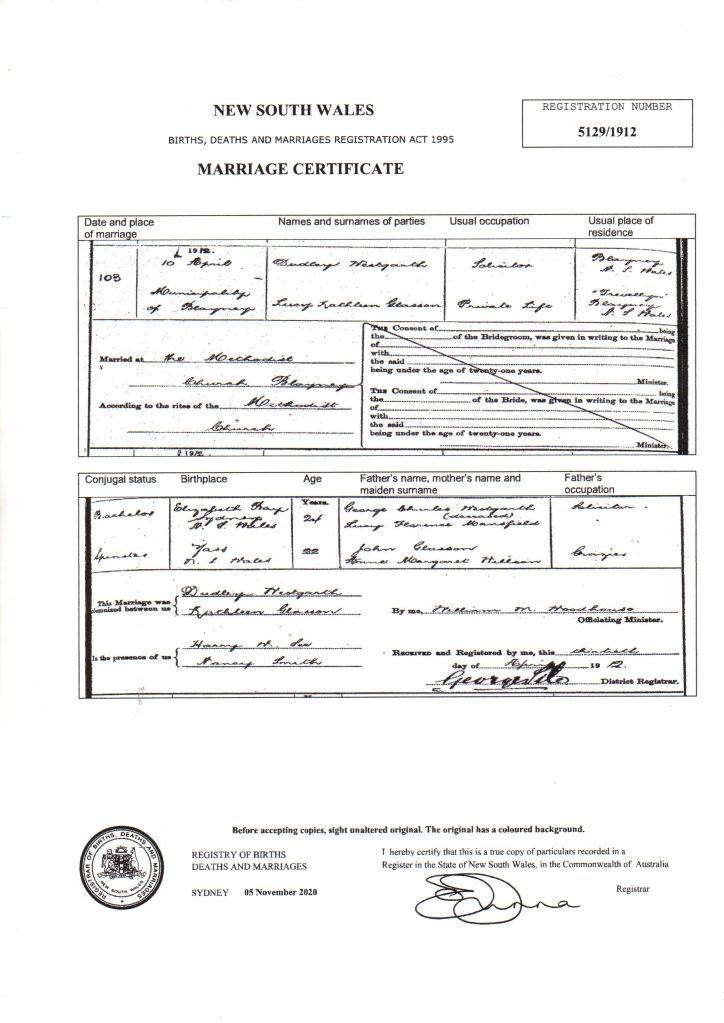
It was 1912, the Edwardian Era, when Australia was ‘riding on the sheep’s back’ and in every country town new buildings were being erected to display the new prosperity hard-won by colonists over the previous century. King Edward VII was Emperor of a vast empire which had brought wealth and power to Britain. Australia was a member of the British Commonwealth of Nations, after Federation in 1901, but still fiercely loyal to Britain and with a ‘White Australia Policy’.
Only two years later, in August, the Great War took away so many, who rushed to enlist or were bullied into it. Donald and Claude Glasson would both go to war. ‘Out of a population of fewer than five million, 416,809 men enlisted, of which 62,000 were killed and 156,000 wounded, gassed, or taken prisoner’. https://guides.slv.vic.gov.au/wwone_soldiers/casualties
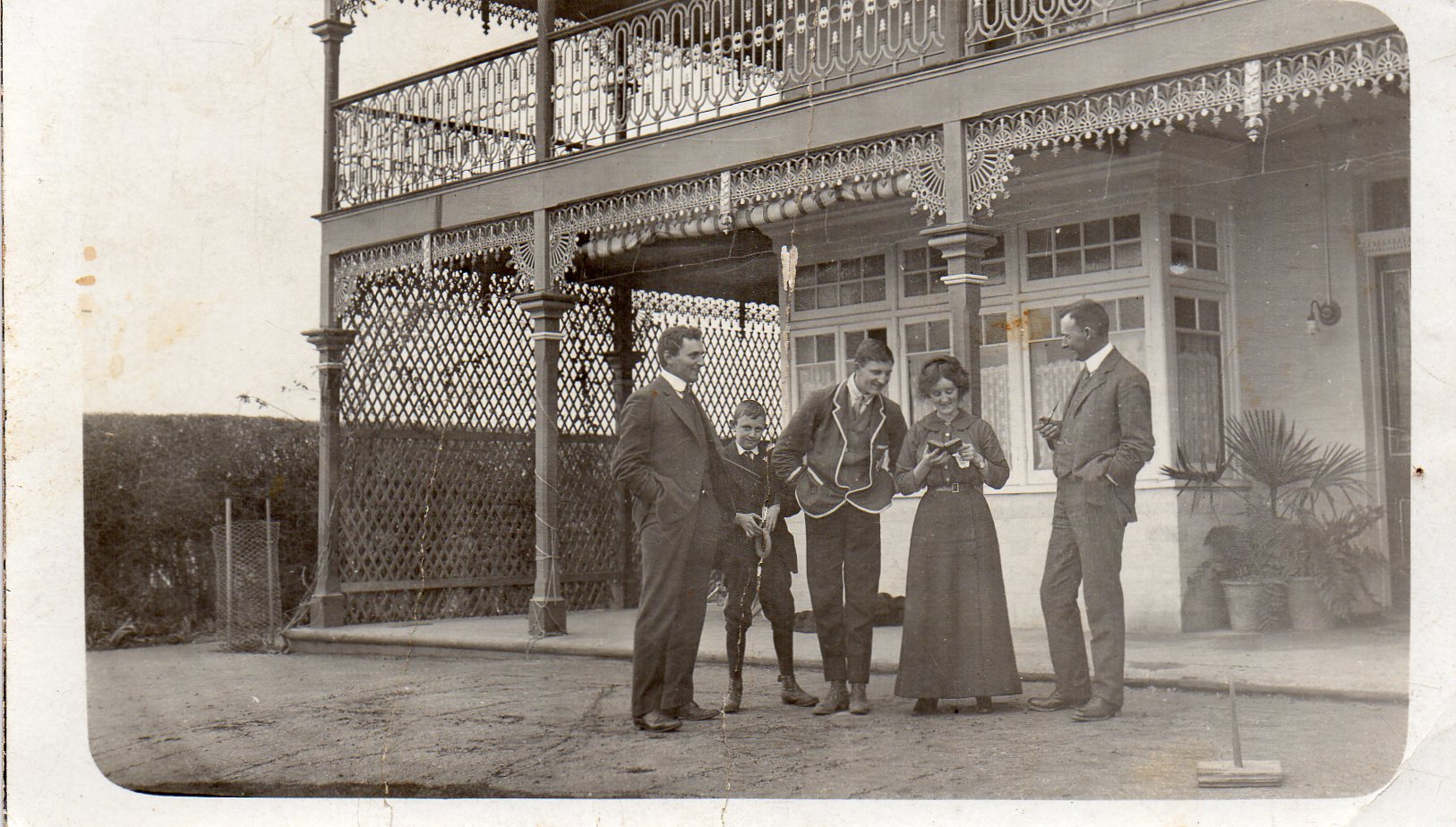
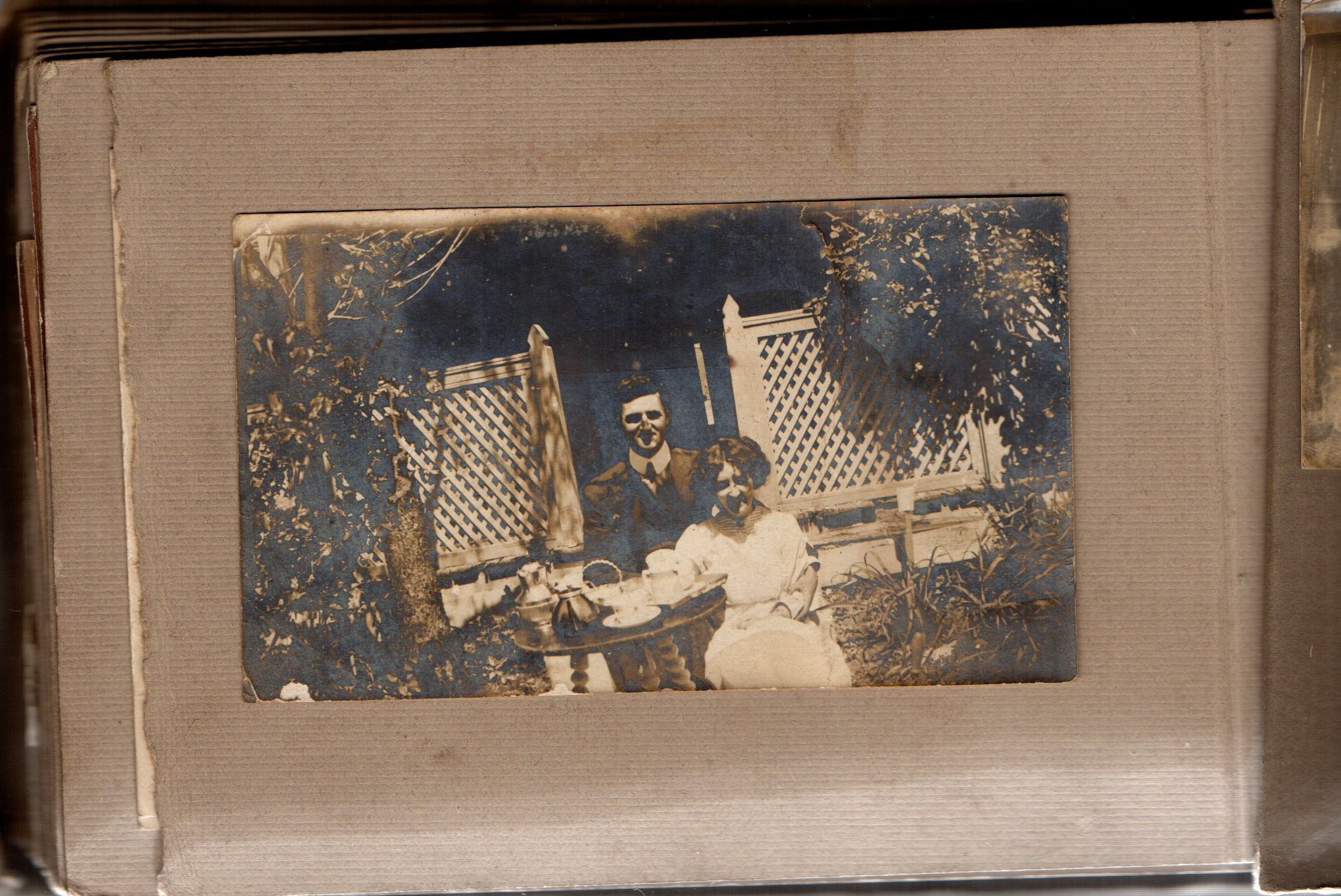
However, in 1912, Dudley and Kathleen began their happiness at their home in Blayney, called ‘Laramie’. This definitely looks like the newlyweds at their first home.
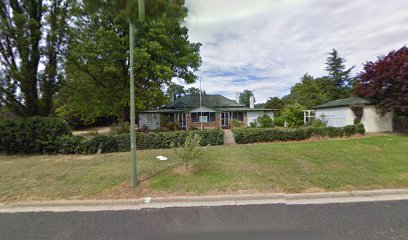
Here is a recent photo from Realestate.com which show that some of the home is in original condition a hundred years later! The front steps and lattice are gone.
| Blayney | “Laramie”, house and garden | 24 Martha Street | Lot 1, DP 526906 | Local 17 |
The house is registered on the list of Blayney historic buildings in the Blayney Local Environmental Plan 2012 https://legislation.nsw.gov.au/~/view/EPI/2012/573/historical2015-11-13/sch5
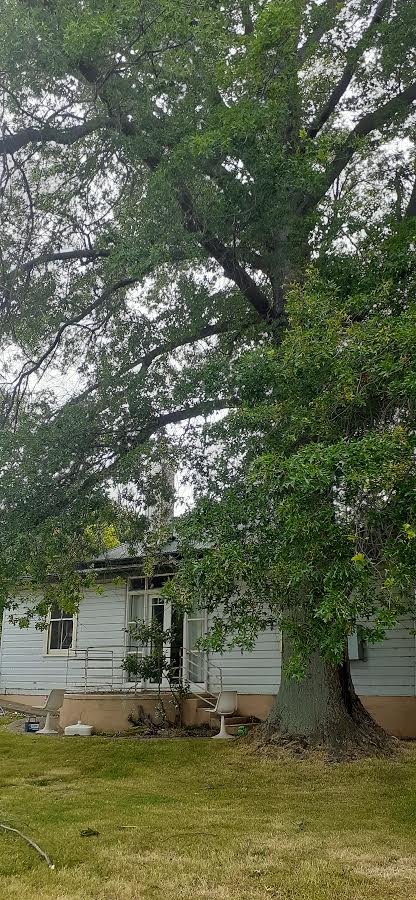
2020 view of Laramie
I visited the house in November and found that it is really a wreck, with a leaking roof. Being on the busy main road through Blayney and being only of weatherboard construction, it is very unlikely that anyone would wish to restore it. There is a protection order on the tree in the picture which must have been there when the Westgarths lived there 100 years ago.
Married Life for Kathleen and Dudley
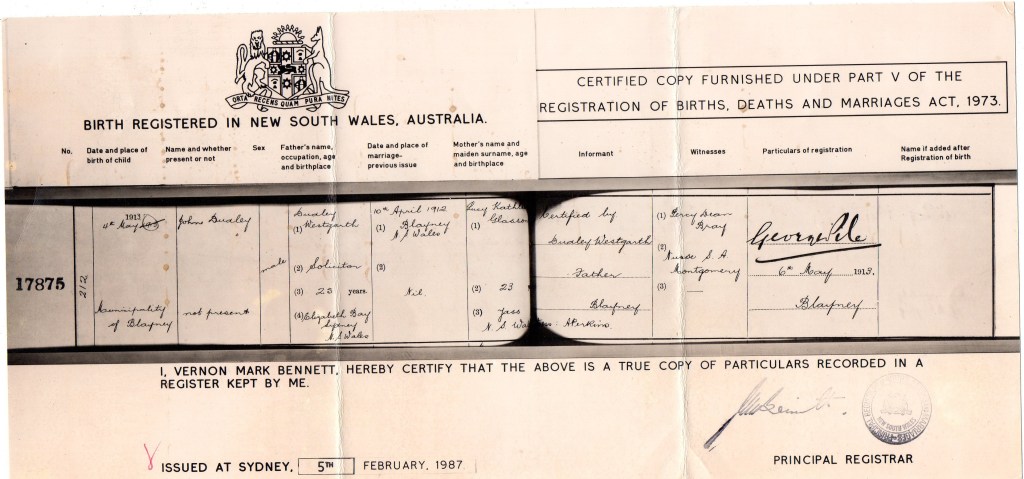
After a year, on May 4th 1913, Kathleen gave birth to a son, who was of course called ‘John’ and also ‘Dudley’, viz: John Dudley Westgarth.
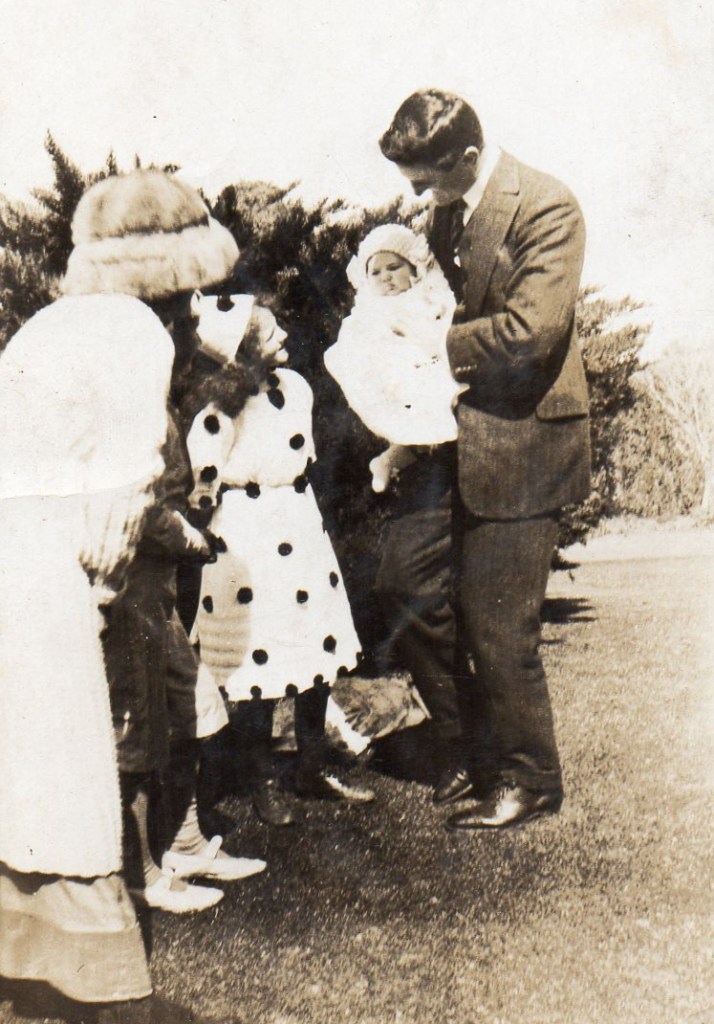
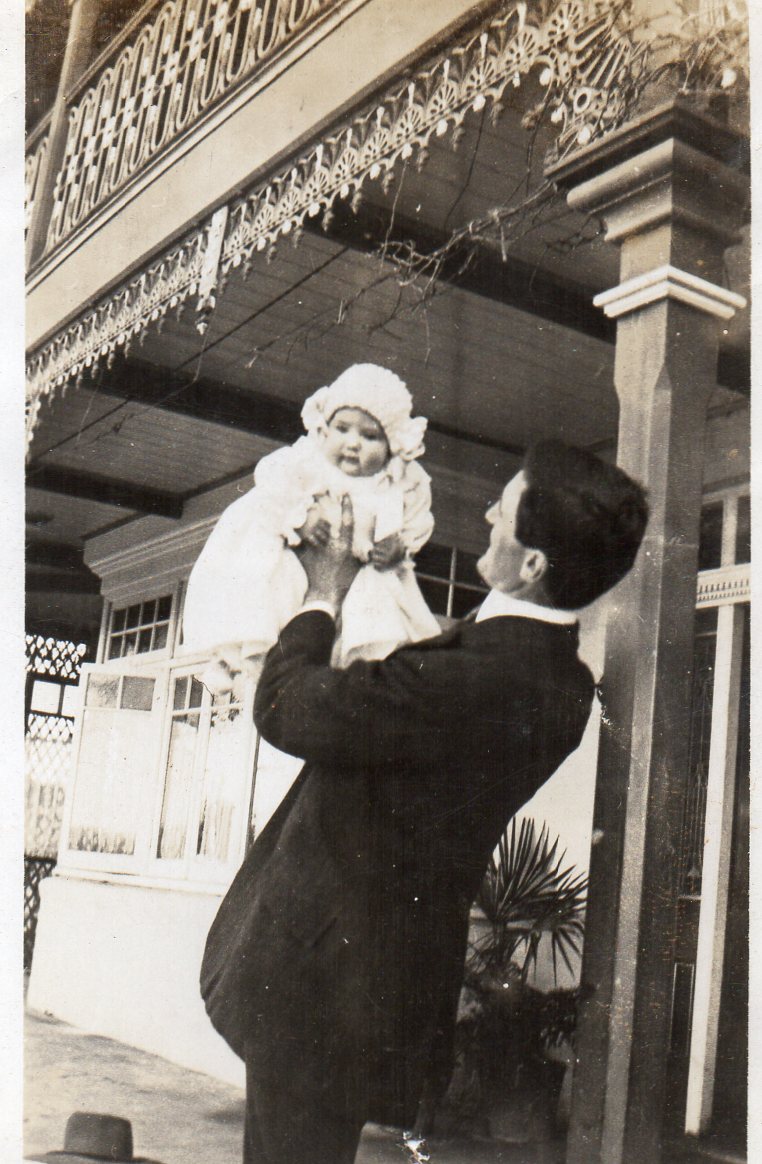
This must have been such a happy time for Kathleen, with her own home, a son and the support of Kathleen’s large family including the Cornish Settlement no doubt. On the other hand, Dudley must have been very busy with his partnership with George Pile, his work for the Show Society and his membership of the Freemasons. In 1918 he and George Pile registered sheep brands in the Pastures Protection Act of 1912, for a property called ‘Fernhill’ at Marengo New South Wales.
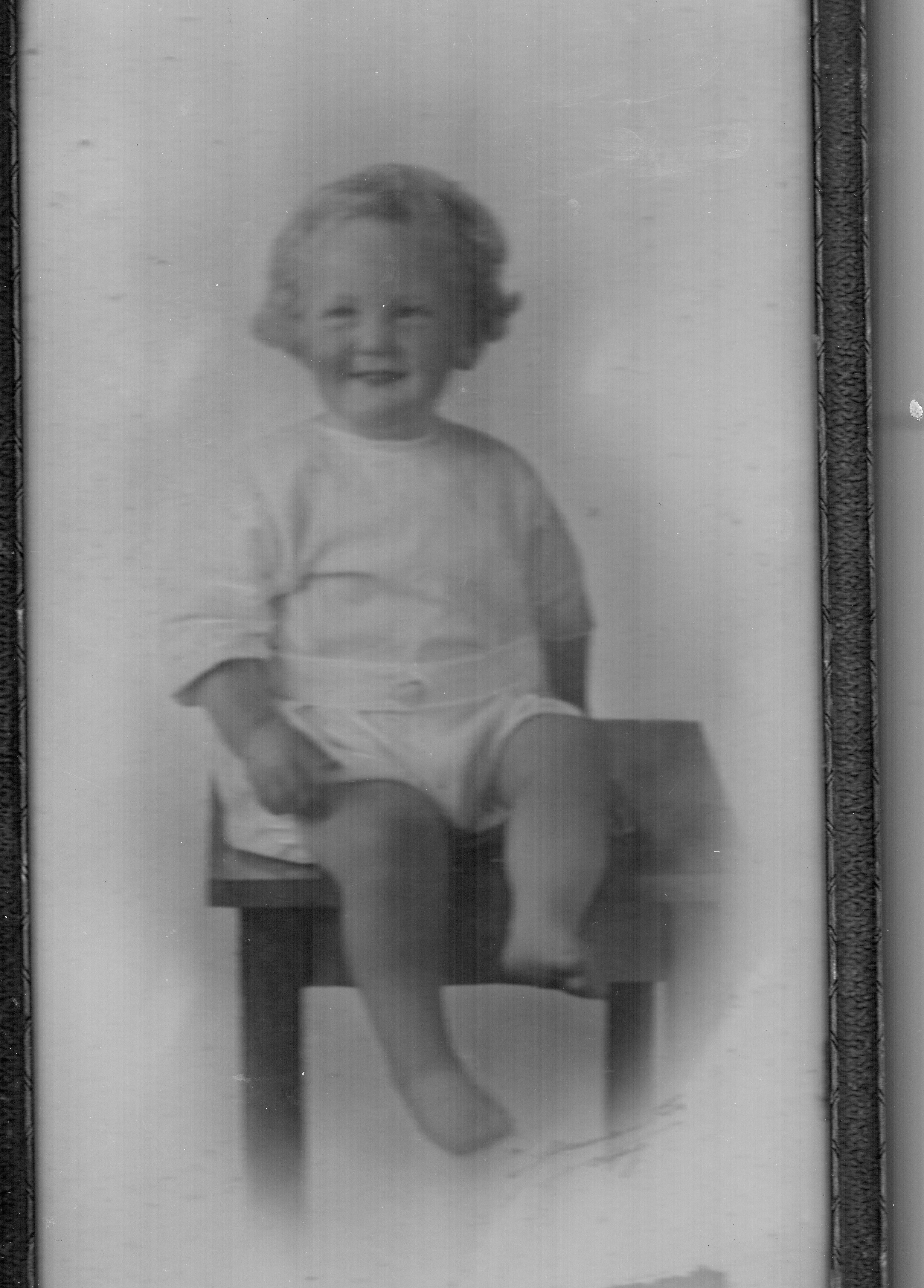
Dudley was so busy outside the home from the time of their marriage, but soon after John was born, Kathleen found herself pregnant again. A baby girl was born on May 24th, 1914, just over a year from the birth of John, Nancy Ruth Dudley Westgarth.
The second baby was not an easy one. I am sure many mothers would understand what is meant by that remark. It means little sleep, lots of worry and constant busyness at a time when meals were all home cooked, clothes were sewn at home and washing took a whole day! Kathleen would have had a cook and a maid or two, but the effort of the two babies sent her into a depression.
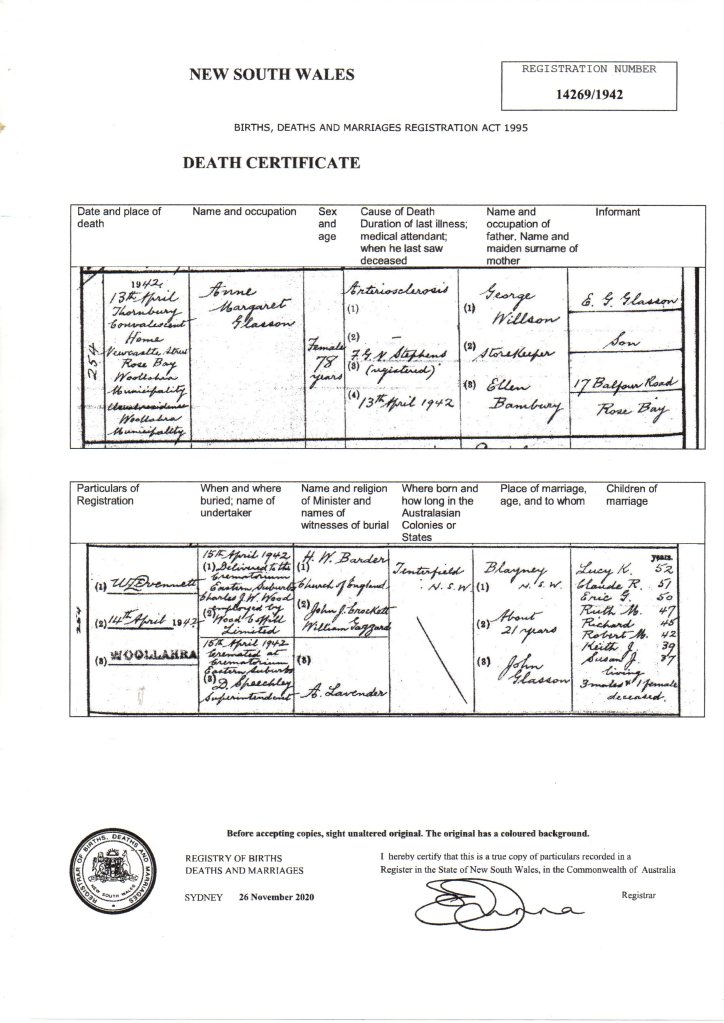
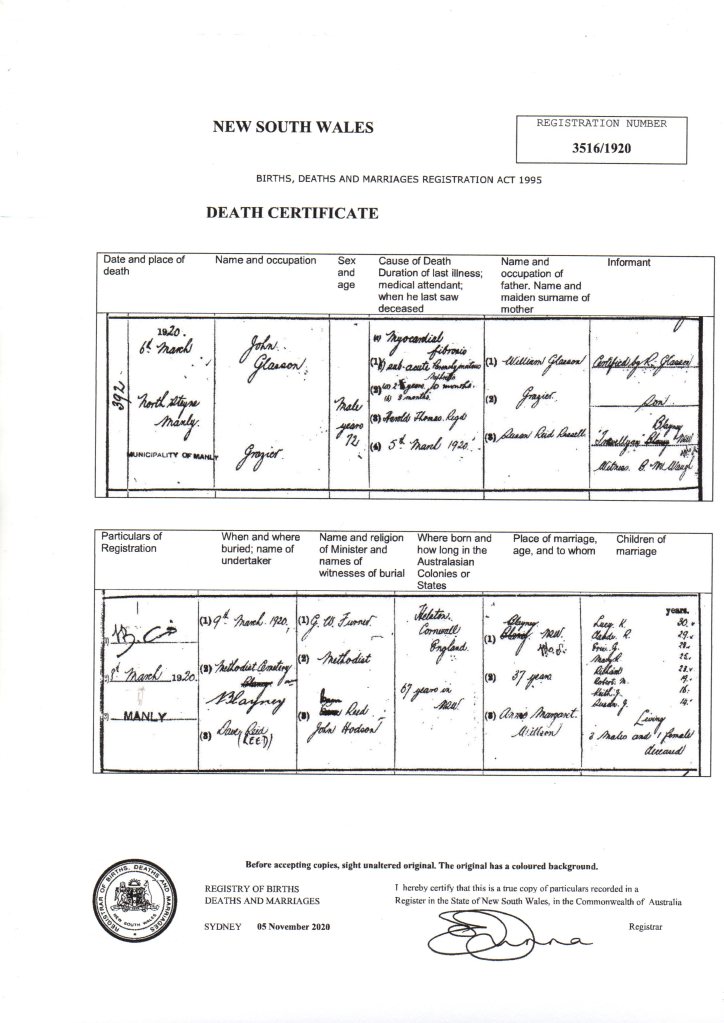
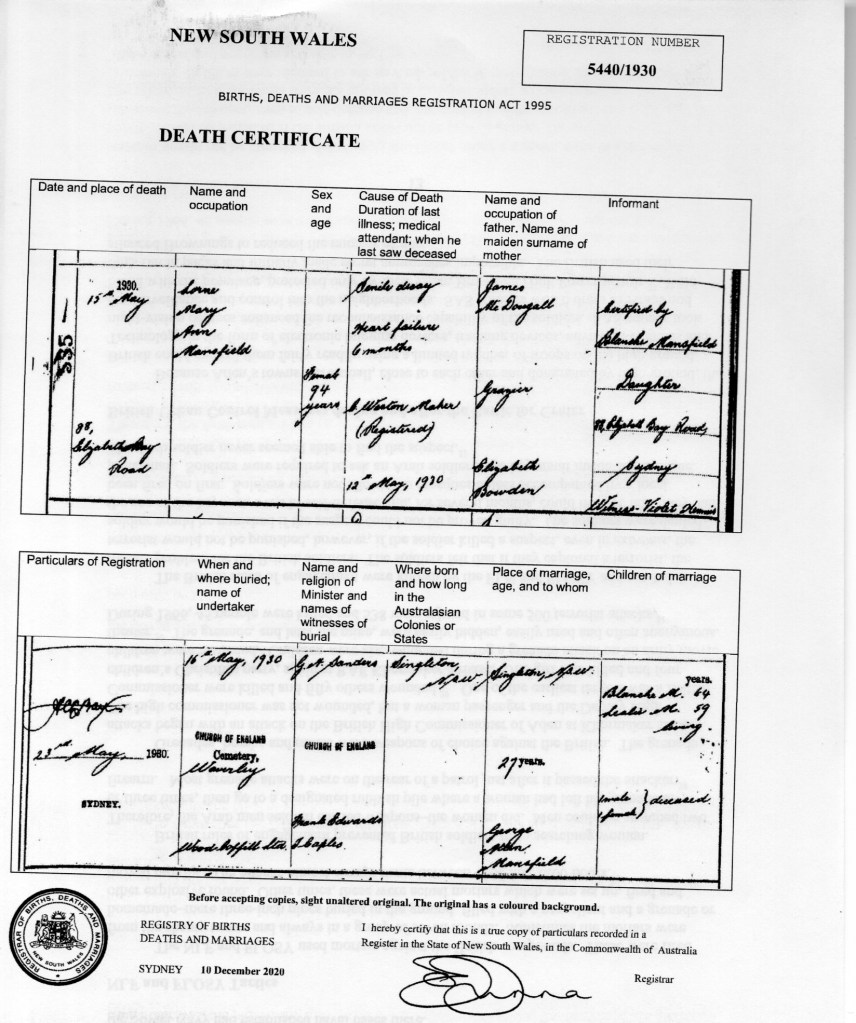
At least the children had three grandmothers, but two of them lived in Sydney. Anne Margaret Glasson, called Little Granny, lived until 1942, by which time my father was married! Here is her death certificate, signed by Uncle Eric:
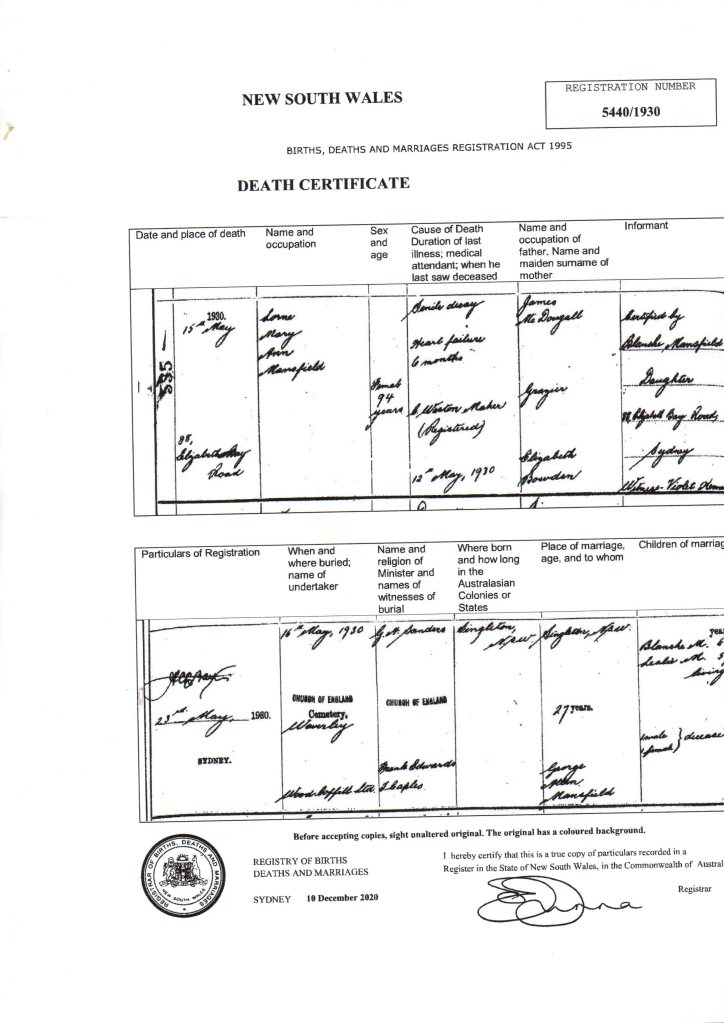
Char’s step grandmother, Lorne Mary Ann Mansfield, lived until 1930, so the children would have known her well. She was known as Granny Mansfield.
MAYOR OF BLAYNEY
Dudley was obviously an ambitious young man. He was a country town solicitor who took part in many town activities and belonged to influential societies.
Dudley was very well connected socially through the marriages of his father and his siblings. On top of this, George Charles had known many influential people in the legal fraternity and politics, such as Sir Edmund Barton, Sir Garfield Barwick, Sir Samuel Griffiths, Sir Arthur Wigram Allen and Sir John Robertson. It is nice to see that Dudley used his social position and his connections to do many helpful things for family and friends. Stephen said: ” I got the impression Dudley was frequently called upon“.
Dudley helps out.
Stephen told me that, being a country boy, he had a scholarship to All Saints College in Bathurst. “It was an academic scholarship… only 4 sat it ! My brothers went to All Saints courtesy of church choir scholarships, but I was able to ungraciously ditch the choir immediately….. “
One year, perhaps after a mediocre report, the school decided to reduce his scholarship to a half scholarship. Judy and David asked Dudley for help. He was able to get Sir Garfield Barwick to write a letter, whereupon the school dropped the plan to reduce the scholarship!
Sir Garfield Edward John Barwick, AK GCMG QC was an Australian judge who was the seventh and longest serving Chief Justice of Australia, in office from 1964 to 1981. He had earlier been a Liberal Party politician, serving as a minister in the Menzies Government from 1958 to 1964. Wikipedia
The Great War:
On 4th August war with Germany was declared in Britain and soon after in Australia and many of the young men of the Blayney joined up.
Dudley had two children and Kathleen was not coping at home. He stayed behind in an “essential industry” and in 1915, on 9th November, he was elected Mayor of Blayney. He was soon involved in the war effort. Here is a notice from The Bathurst Times, Saturday 20th November 1915, page 5:
AT the request of the STATE WAR COUNCIL, we the undersigned hereby convene
A PUBLIC MEETING
To be held at the TOWN HALL, BLAYNEY On MONDAY, 22nd Inst., at 8 p.m.
For the purpose of forming a WAR SERVICE COMMITTEE .
For the Shire of Lyndhurst.
To act in conjunction with the STATE WAR COUNCIL.
JOSHUA KELLY, President, Lyndhurst Shire Council.
DUDLEY WESTGARTH, Mayor of Blayney.
L. L. DAVIS, Mayor of Carcoar.
The decision not to join up must have been a hard one for young men, who had to find an excuse or be given a white feather as a coward. Dudley’s own brother, Mervyn, only a year younger, signed up in the Light Horse. Dudley had the excuse of his family, his employment and his role in the community. Post war, he was responsible for many Aussie war graves.
Problems at home: My aunt Mollie told me that in 1915, Kathleen asked Dudley to sleep separately because she was so afraid of getting pregnant a third time. Dudley probably did not like the idea and Kathleen’s mother heard of the plan. She, of course, had 8 children between 1886 and 1897 and 3 more after that, but her husband was a grazier and a home loving man. He was also very wealthy and probably employed a lot of servants.
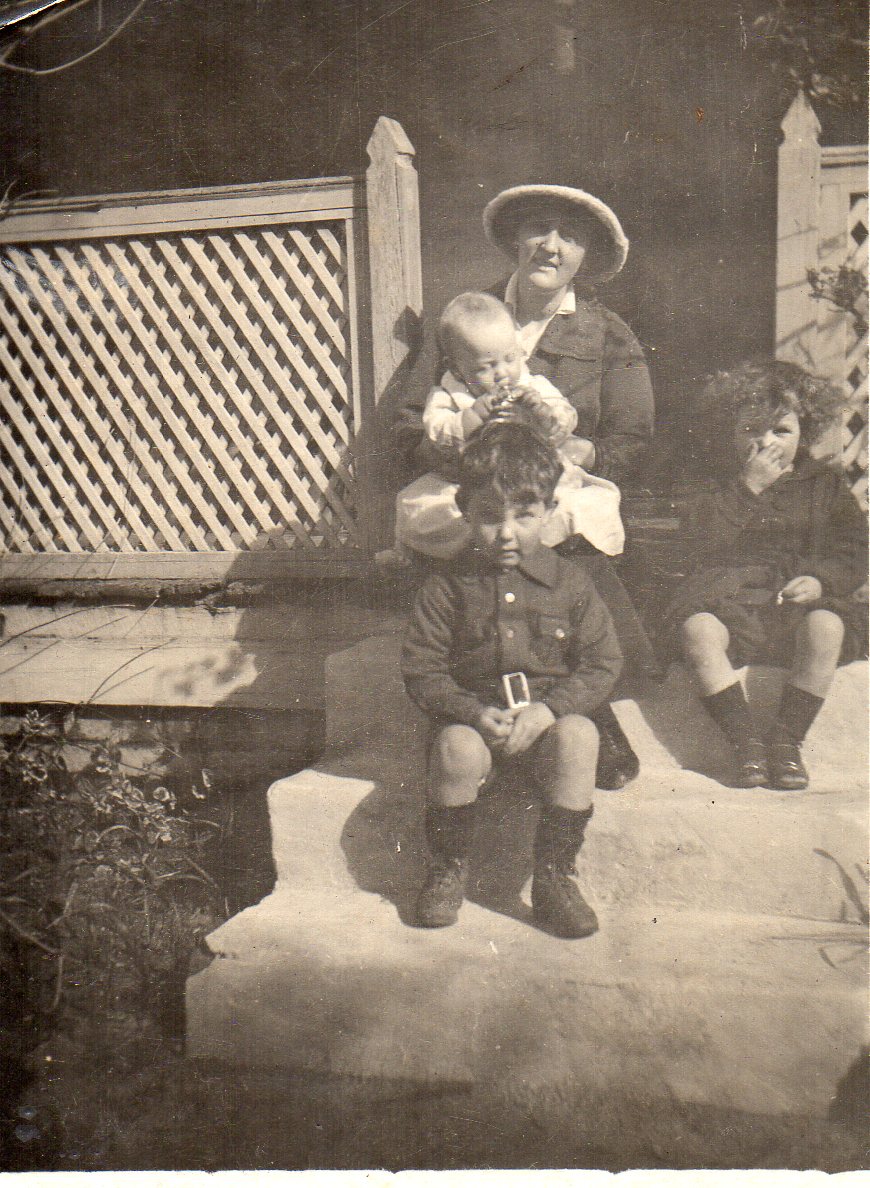
Kathleen’s mother instructed her daughter that ‘a wife must not deny her husband‘. Kathleen obeyed and the dreaded event happened – she was pregnant again! The baby was a lovely boy, Brian Dudley Westgarth, born on New Year’s Day 1917. John was 3, Nancy was 2 and there was so much washing!! And Dudley often away from home.
“On a Tired Housewife” is an anonymous poem about the housewife’s lot https://en.wikipedia.org/wiki/Housewife
Here lies a poor woman who was always tired,
She lived in a house where help wasn’t hired:
Her last words on earth were: “Dear friends, I am going
To where there’s no cooking, or washing, or sewing,
For everything there is exact to my wishes,
For where they don’t eat there’s no washing of dishes.
I’ll be where loud anthems will always be ringing,
But having no voice I’ll be quit of the singing.
Don’t mourn for me now, don’t mourn for me never,
I am going to do nothing for ever and ever.”[28]
Brian’s Birthday?
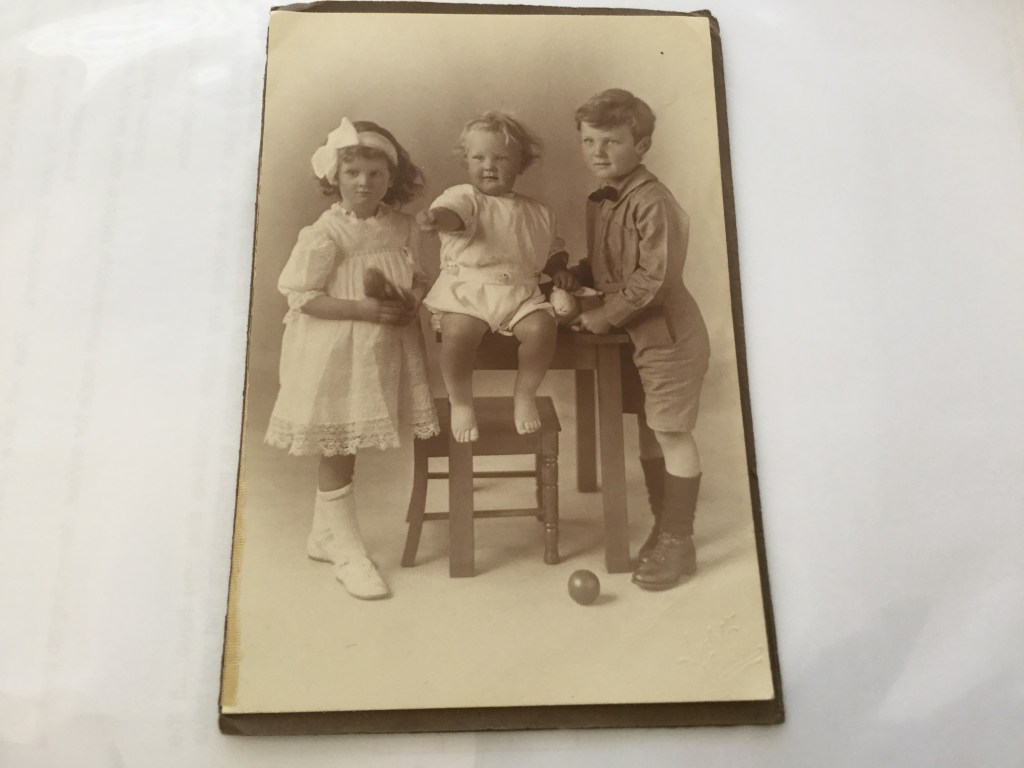
TEETH
Kathleen also had false teeth since before her marriage. The Glasson family must have had bad teeth (as my father did and I have, in spite of trying to take care of them). The familiy had decided that she was better off to have all her teeth taken out! Dentistry at the time was something to be endured, as it was for me in the 1940s.
Here is a website about British dentistry, which was of course the same in Australia, though perhaps with a time lag of a few years. Click on the title below:
How Britain’s dental industry improved in the 20th Century
But it wasn’t until 1921 that the practice of dentistry was limited to those who were professionally qualified.
Even so, twentieth century dentistry was still so costly that some people opted to have all their teeth pulled out to spare themselves a lifetime of pain.
THE FIRST WORLD WAR 1914-1918
(called The Great War until it happened again)
At the outbreak of the war Dudley made a will for his brother Mervyn, who was a year younger and his special friend amongst his siblings. (You can read all about Mervyn in the blog about Lucy Florence). Tragically Mervyn died of pneumonia on 19th February 1918 in Cairo and Dudley had the management of his estate. He became responsible for the upkeep of the war grave of Mervyn and other First World War soldiers who did not return. Dudley never got over the loss and always talked about his brother Mervyn.
It was not only Mervyn and John Ellesmere Westgarth who joined up to fight in 1914. The eldest Glasson boys also ‘answered the call’. Donald went to England and joined the Royal Flying Corps and Claude joined the Light Horse. Like the two Westgarths, Claude was sent to Gallipoli.
Donald Glasson travelled to England and joined the RFC.
Here is some information from the Forces War Records in the UK:
Donald Havelock Glasson
Rank:Second Lieutenant
Regiment:Royal Flying Corps
Archive Reference: WO 372/8/31890
(Can be found at The National Archives in Kew, and contains First World War, War Office: Service Medal and Award Rolls Index)
Royal Flying Corps during World War 1. Formed: 1912
The Royal Flying Corps (RFC) was the over-land air arm of the British military during most of the First World War. During the early part of the war, the RFC’s responsibilities were centred on support of the British Army, via artillery co-operation and photographic reconnaissance. This work gradually led RFC pilots into aerial battles with German pilots and later in the war included the strafing of enemy infantry and emplacements, the bombing of German military airfields and later the strategic bombing of German industrial and transportation facilities. At the start of World War I the RFC, commanded by David Henderson, consisted of five squadrons – one observation balloon squadron (RFC No 1 Squadron) and four aeroplane squadrons (RFC No 2 and No 3 Squadrons were the first fixed-wing flying squadrons in the world). These were first used for aerial spotting on 13 September 1914, but only became efficient when they perfected the use of wireless communication at Aubers Ridge on 9 May 1915. Aerial photography was attempted during 1914, but again only became effective the next year. By 1918, photographic images could be taken from 15,000 feet, and interpreted by over 3,000 personnel. Parachutes were not available to pilots of the RFC’s heavier-than-air craft – nor were they used by the RAF during the First World War – although the Calthrop Guardian Angel parachute (1916 model) was officially adopted just as the war ended. By this time parachutes had been used by balloonists for three years. On 17 August 1917, South African General Jan Smuts presented a report to the War Council on the future of air power. Because of its potential for the ‘devastation of enemy lands and the destruction of industrial and populous centres on a vast scale’, he recommended a new air service be formed that would be on a level with the Army and Royal Navy. The formation of the new service would, however, make the under-utilised men and machines of the Royal Naval Air Service (RNAS) available for action across the Western Front, as well as ending the inter-service rivalries that at times had adversely affected aircraft procurement. On 1 April 1918, the RFC and the RNAS were amalgamated to form a new service, the Royal Air Force (RAF). The RAF was under the control of the new Air Ministry. After starting in 1914 with some 2,073 personnel, by the start of 1919 the RAF had 4,000 combat aircraft and 114,000 personnel. Disbanded: 1918
This information is contained in the Nominal index of all service personnel serving in a theatre of war 1914-1919
Tragic Death of Donald:
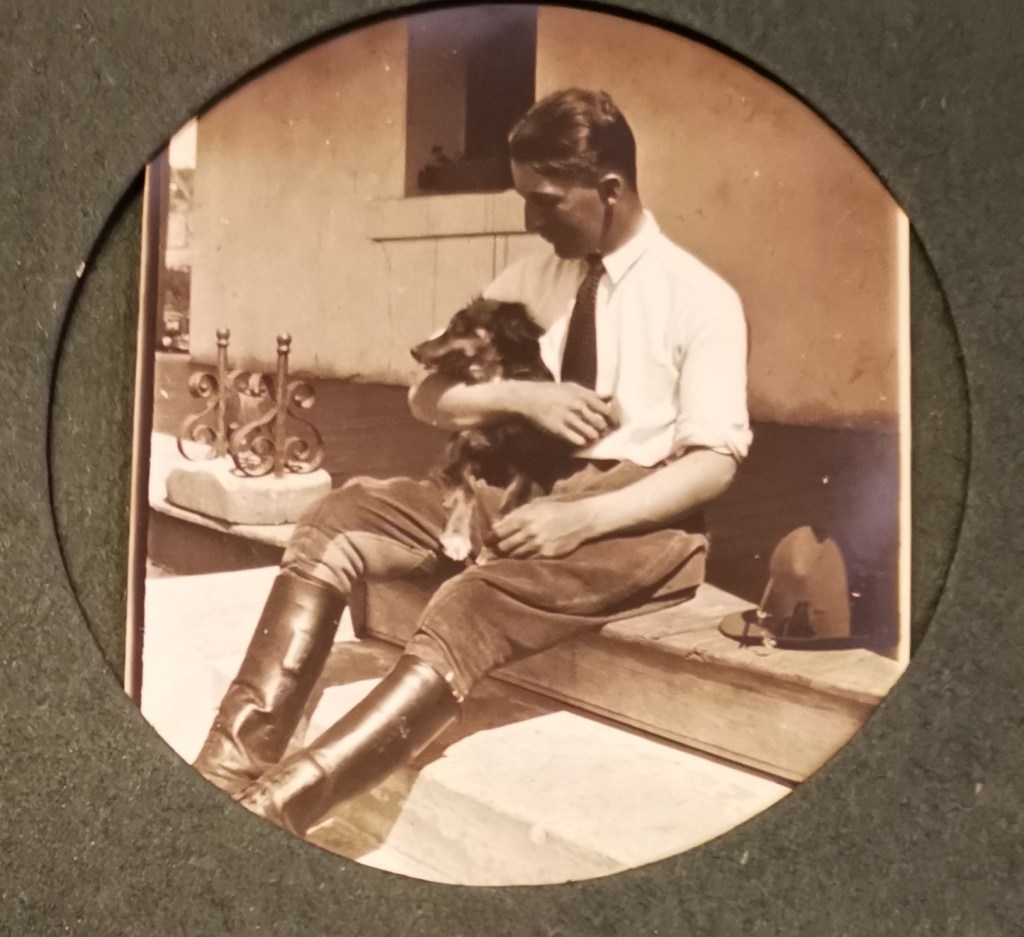
In 1917, Donald was killled in Thessalonika, northern Greece, which was then part of Turkey. Kathleen never got over the death of her favourite brother, which came two months after Brian was born. My grandmother often talked to me about her brother Donald.
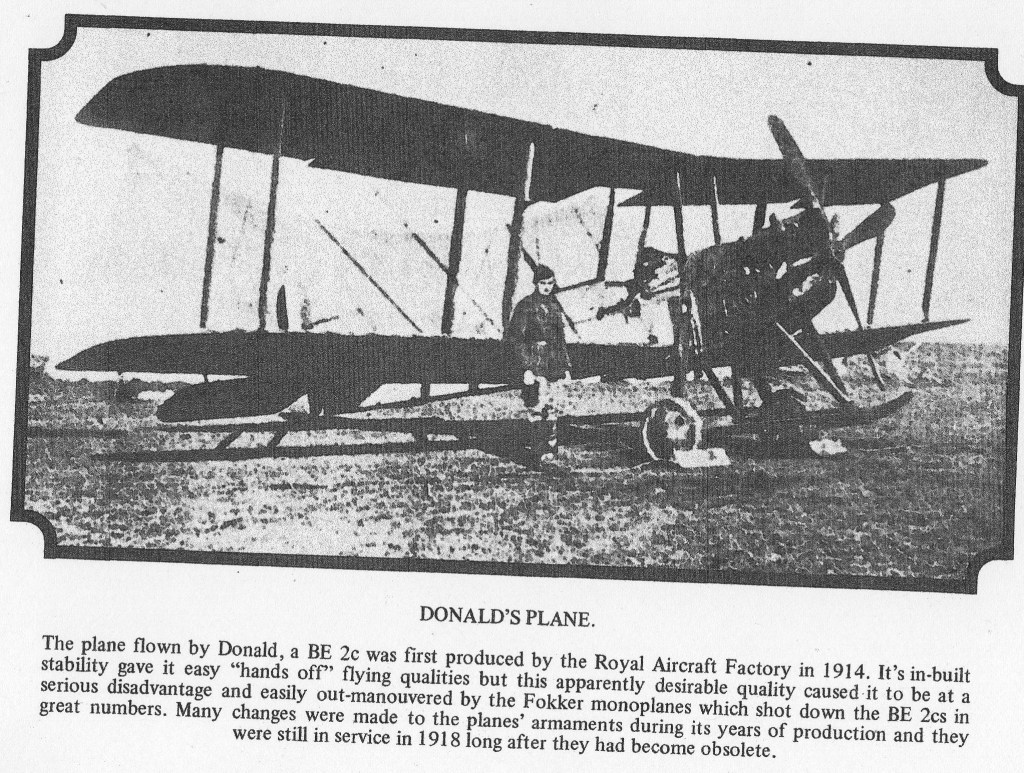
Quote from page 121 of The Glasson Saga by Mary Glasson, 1980
"Some years ago we consulted Dr Buckingham in Orange professionally. As soon as he heard the name Glasson, he took down the photo from his mantlepiece of his Air Force Unit. He pointed to one man and said: "This was my friend Donald Glasson who saved my life." He then told us with some emotion how he and Donald were in a dog fight. "Donald shot down a plane off my tail and in doing so was shot down himself."
Donald was flying solo when he was shot down. He was on a bombing raid and the weight of the bombs had to replace the rear gunner, so he was vulnerable to an enemy plane to the rear of his plane. That is what happened.
In the 47 Squadron History Over the Balkans and South Russia, H A Jones wrote:
“It might be well to explain here what it meant to bomb in an A.W. (Armstrong Whitworth FK3). This machine was designed chiefly for reconnaissance. A medium-sized two-seater biplane fitted with a 90 h.p. R.A.F. engine, it took about 40 minutes to reach 10,000 feet with a service load. At this height the machine had a speed of about 65 m.p.h. It was naturally a rather heavy machine on the controls, and although it was possible to do “aerobatics,” all manoeuvring took time. With an observer in the rear seat the A.W. could always be expected to give a good account of itself. When used for bombing, an observer could not be taken owing to the weight of the bombs, and consequently the pilot of the A.W. felt a little uneasy as to the protection for his “tail.” However, bombing had to be done, and these were the only machines (with which) to do it.”
Dr Reginald Buckingham went to England to volunteer for the Royal Flying Corps at the same time as Donald. Reginald’s brother, William also made the trip. Reginald was younger, being born in 1896. He survived the war and came home to be awarded a medal and to marry his sweetheart, who was also a doctor.
Here is an article from the Pittwater online news: It begins: “Dr Reeginald Buckingham, a General Practitioner..
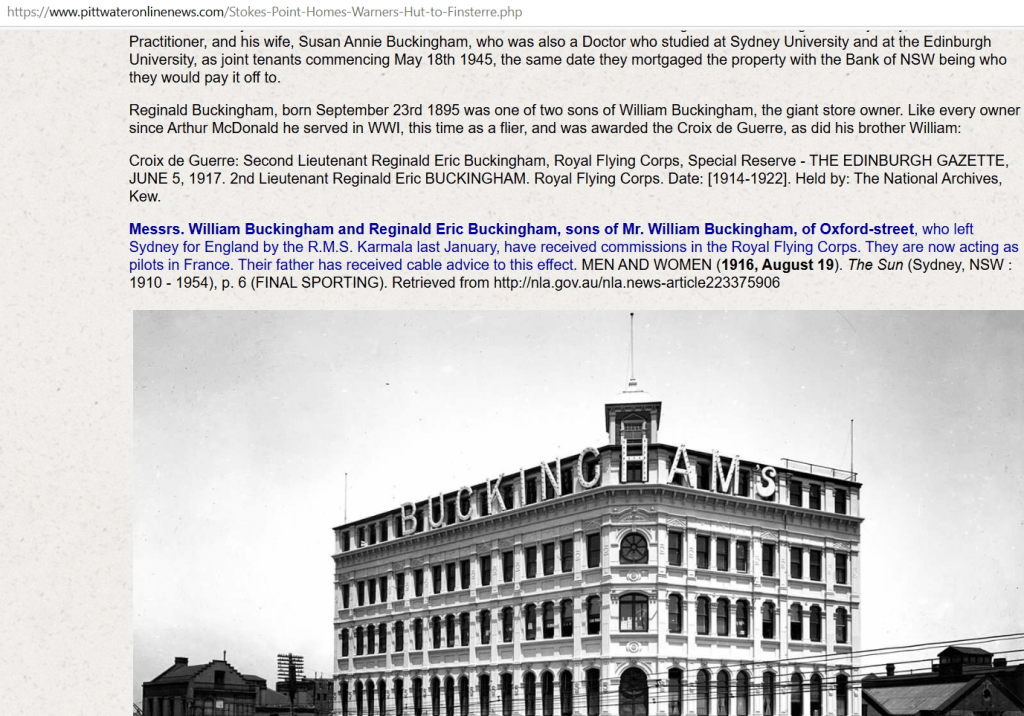
From The Glasson Saga, page 121:
‘Donald was greatly loved by his large family of brothers and sisters and his parents. The last entry in his father’s diary was: “Our dear son, Donald, was shot down from his Flying Machine on 12th March, 1917 and from information must have died almost immediately. Age 29. Our prayer is that Almighty God has received his soul into Heaven.”
Campaign Medals:
Victory Medal With the information in Donald Havelock Glasson’s record, it is likely that he was entitled to the Victory medal, also called the Inter Allied Victory Medal. This medal was awarded to all who received the 1914 Star or 1914-15 Star and, with certain exceptions, to those who received the British War Medal. It was never awarded alone. These three medals were sometimes irreverently referred to as Pip, Squeak and Wilfred.
British War Medal With the information in Donald Havelock Glasson’s record, it is likely that he was entitled to the British War Medal for service in World War One. This British Empire campaign medal was issued for services between 5th August 1914 and 11th November 1918.The medal was automatically awarded in the event of death on active service before the completion of this period.
Donald’s schooling at Newington:
I wrote to the Archivist at Newington whom I found to be worth every dollar of his salary. This is what I received:
‘Donald Havelock Glasson entered the College in 1902. He passed the Junior Examination, a public examination administered by the University of Sydney, in 1904, also playing rugby in the 1st XV that year. He likely left at the end of 1904 or thereabouts. I have attached a photograph of the team’.
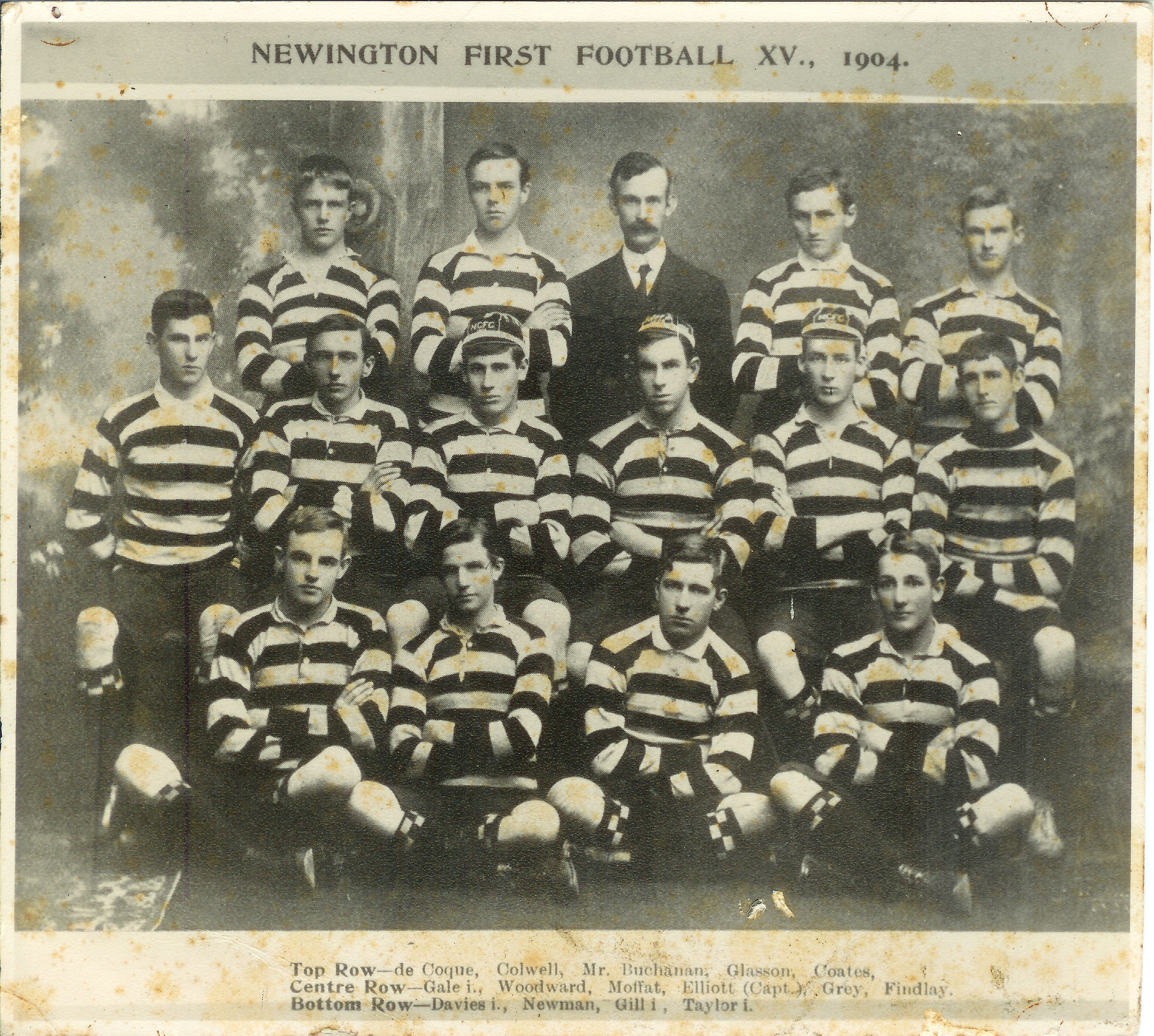
The archivist at Newington sent this information: ‘Donald was killed on the Macedonian Front while serving with the Royal Flying Corps on 12 March 1917. His name appears on our First World War Honour Roll. Here is his obituary, which appeared in the June 1917 issue of The Newingtonian‘:
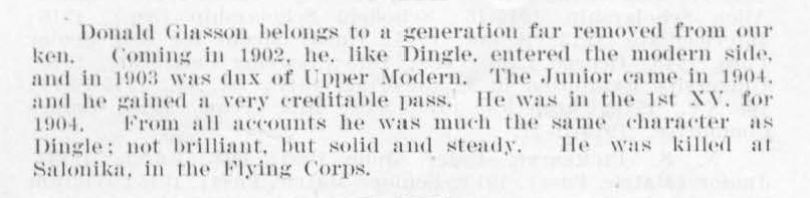
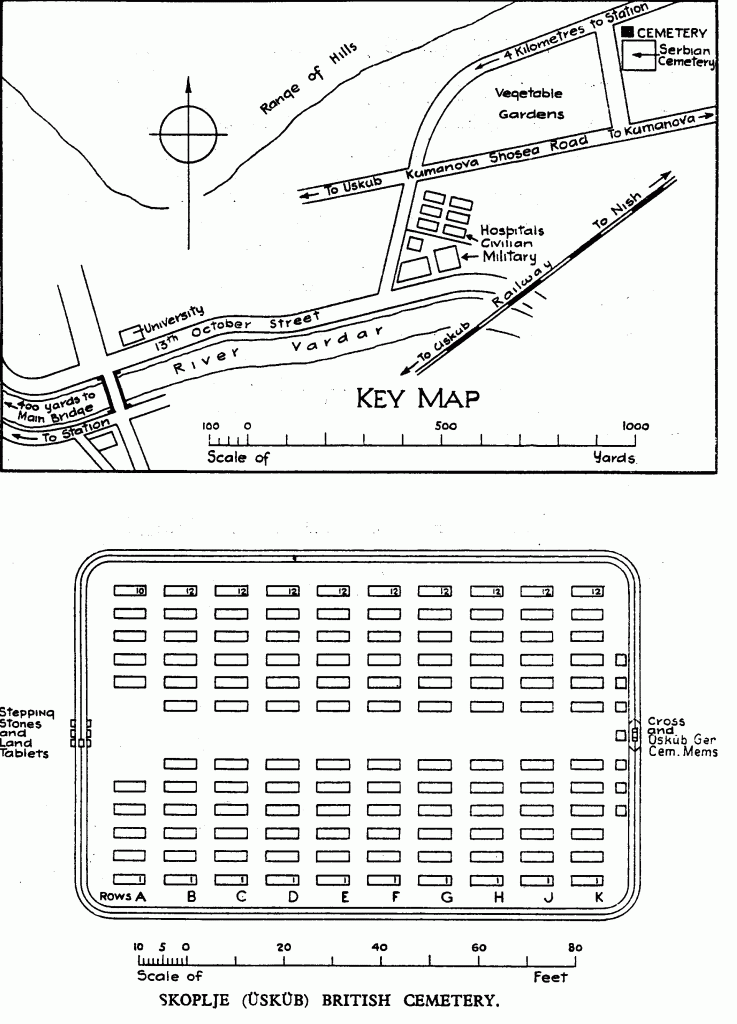
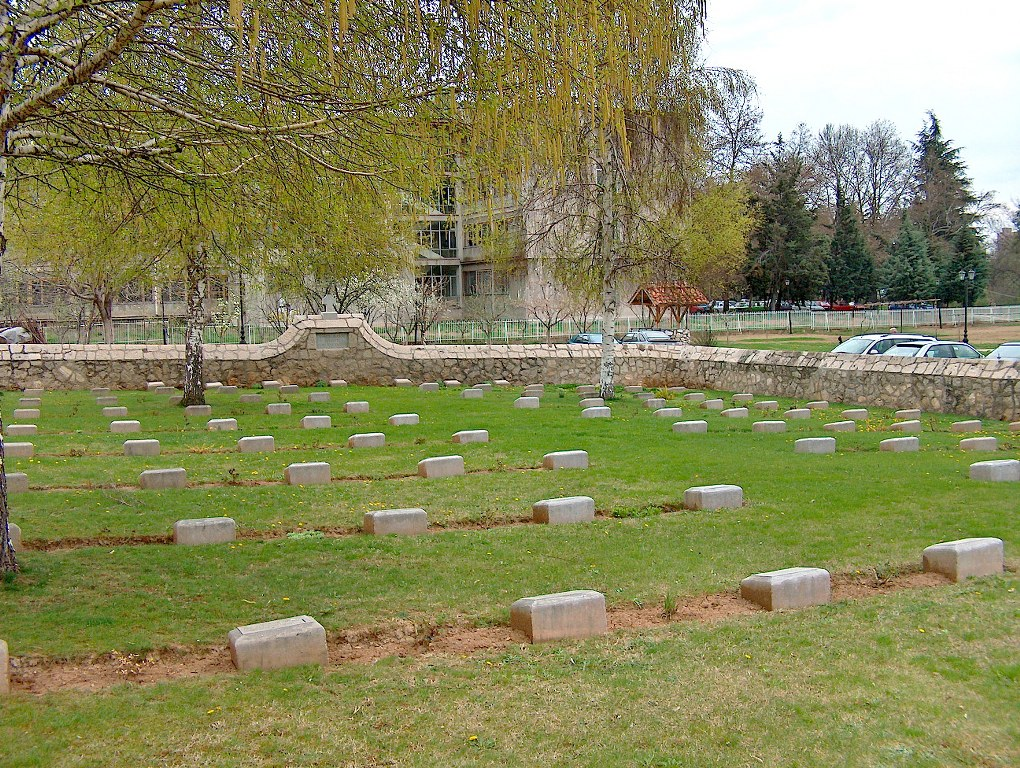
Donald is buried in Skopje, Macedonia, in the British War Cemetery, Grave B6. https://en.wikipedia.org/wiki/Macedonian_Front
2021 Breaking News! Donald was engaged to be married!
I have had only a few responses to this blog so far, but the best one has been from Jacquelyn Brown, nee Bray, who, during Covid lockdown in Bath, UK, decided to look at her grandmother’s souvenirs. Finding evidence of a fiance, called Donald Glasson, Jacquelyn followed the fashion and went online to search the name….and she found my blog!
A need-to-know fact: Mudgee is a country town in New South Wales directly north of Bathurst and Blayney. https://www.google.com/maps/place/Mudgee+NSW+2850/@-32.5478508,148.0345382,8z/data=!4m5!3m4!1s0x6b0e896323923b2d:0x40609b490436870!8m2!3d-32.6144566!4d149.5733291
Dear Patricia,
My name is Jacquelyn Brown (nee Bray), and I am the granddaughter of Joan Mary Nickoll, who was born in 1894 and brought up in Mudgee along with her brothers Roger and Oliver, who both went to World War 1. When my mother died, (Joan’s eldest daughter), in 2006, I found my grandmother’s school record from SCEGGS Moss Vale, which showed that she had a fiance, Donald Glasson, who was killed in 1917. It also showed she was clever at school and received the French and German prizes. She then married my grandfather, Alexander Hordern Young.
All the girls in our family went to Ascham (as did Donald’s sisters) and I was head girl in 1963. I now live near Bath in the UK and as we are locked down and we are reading A Fortunate Life by AB Facey, in our book club, I thought about my grandmother and how she never mentioned her engagement and neither did anyone else in the family. I wanted to know more about Donald and his family and found your blog fascinating. I have sent an email to my mother’s sister and my cousins in Sydney asking if they know any of this background. My cousin Primrose’s two sons also went to Newington, but I don’t think she had any idea about the Glassons.
I should be so grateful if you have any information about their relationship and if they were officially engaged. If it was true, it shows how different a life she would have had if Donald had lived. There was so much I wish I had asked my grandmother. I guess most people feel like that.
Best wishes,
Jacquelyn Brown, Wednesday 13th January 2021
Joan’s treasure box
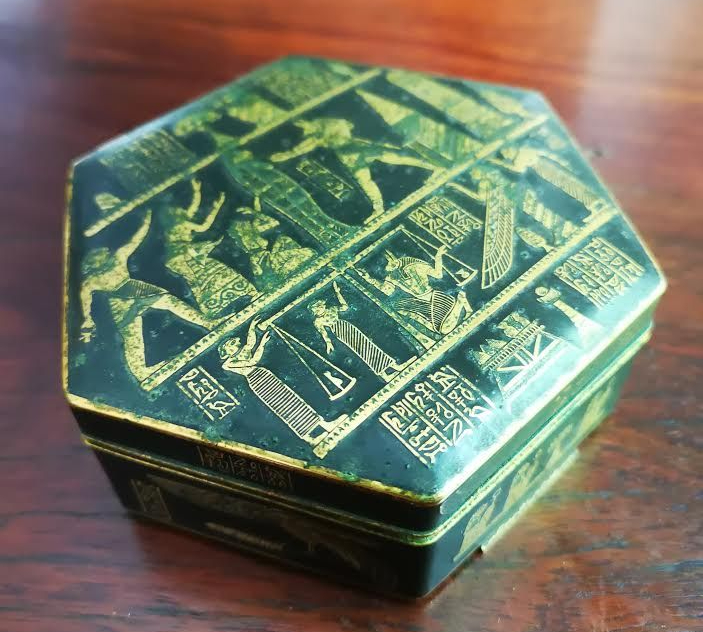
This little box which unmistakably came from Egypt, was sent to her with gifts from Donald, gifts which she treasured all her life.
Here is the box as she kept it, with the collar of her favourite dog and a note from her husband, Alexander Young.
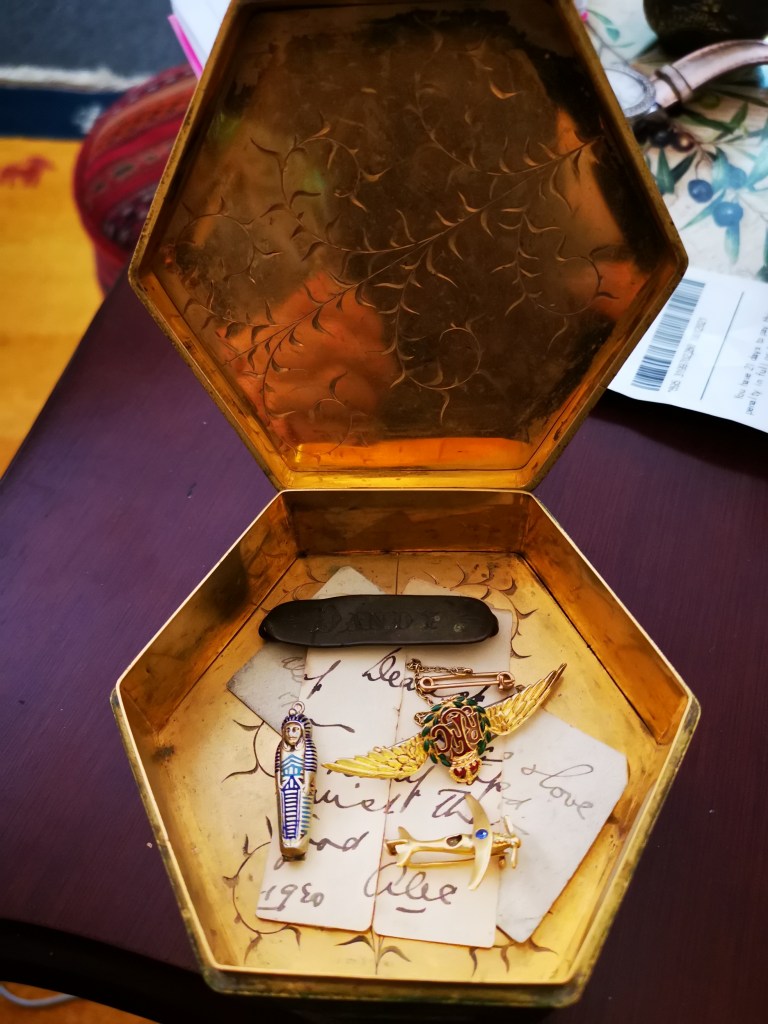
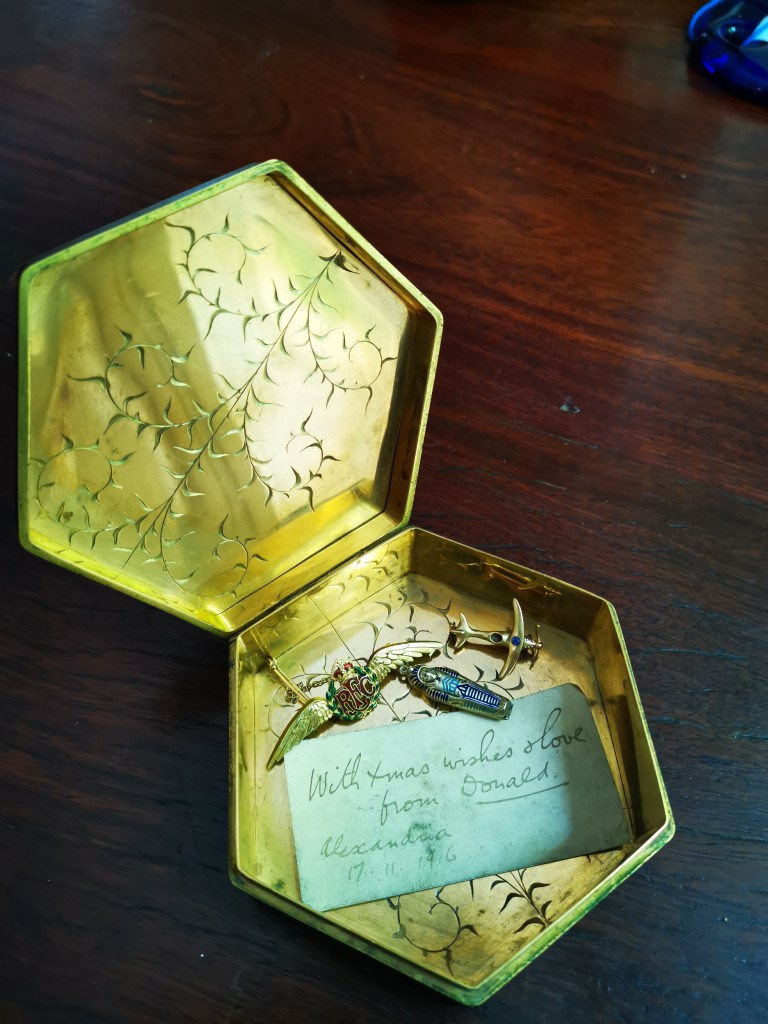
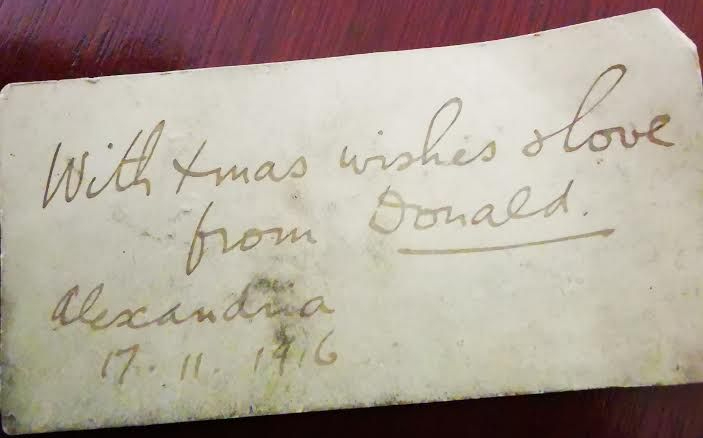
Here is the box as it was originally sent to her by Donald, with his note and three trinkets: a mummy pendant, a gold plane and his Royal Flying Corps badge.
Dear Jacquelyn,
My grandmother often talked about Donald but never said he was engaged. As the family was so upright, he probably promised to marry her after the war, but we will never know. I am so pleased to hear of his romance.
I‘ll write again soon, Trish Westgarth, now Wilkinson
And here is the school record, which made public the engagement.
At the lower end of this record are the Old Girls’ Union entries, recording the beginning and end of the engagement:
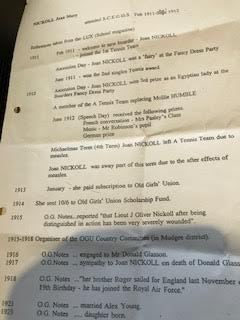
Victoria Hall, Jacquelyn’s cousin, has been asking about Donald. She sent this email about Joan, whom the family called ‘Guggles’:
Hi darling, Donald has always been referred to as Guggle’s fiance, but will grill mum tomorrow, about dates etc. I have seen the photos of Donald and Guggles in old photos (with dates) will look for them !!! Mum remembers well, Donald’s younger sister saying to Guggles, how much the family adored her, but not sure re the formalities of an engagement!?!? So interesting!!!
So I am hoping a photo will turn up, with Victoria in Sydney doing her best for “Guggles”, her grandmother Joan.
Here is a bit more background for Joan and her family:
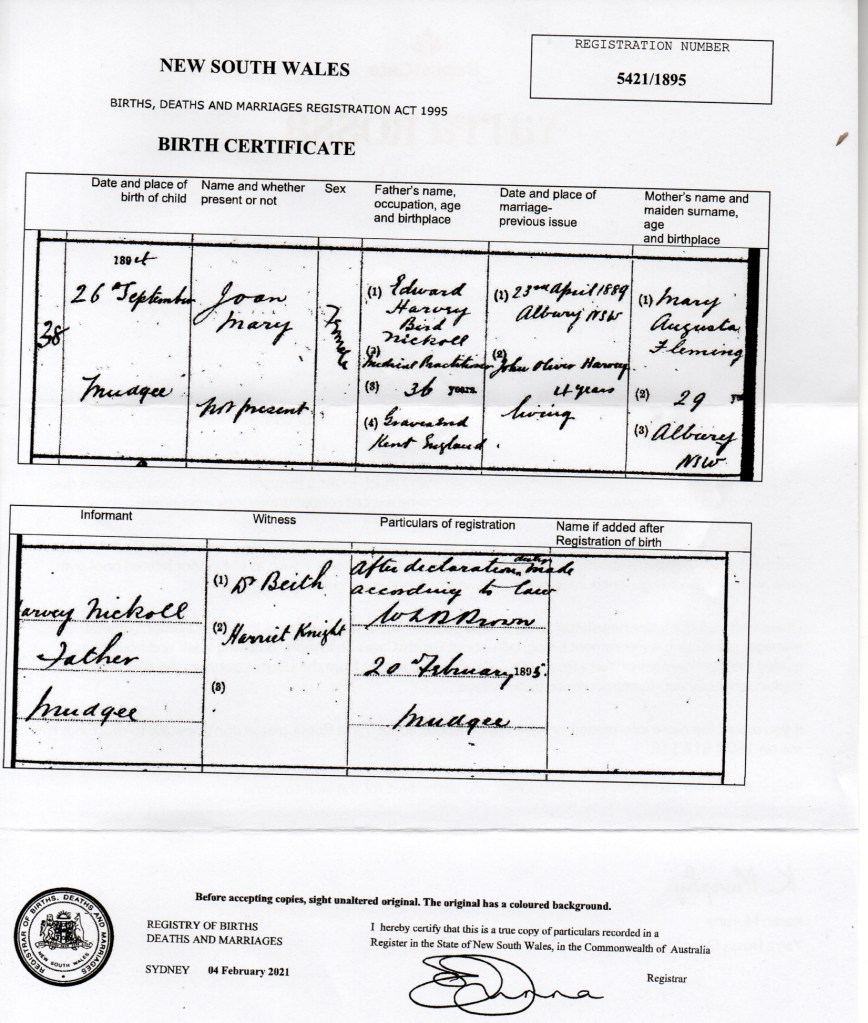
More excitement! The photos are coming! Here is Jacquelyn’s reply:
I have just spoken to Victoria and she will get the photos this week. She is working so doesn’t have a lot of time off. She asked her mother Robin (Joan’s daughter) about the engagement and her mother said that it was unofficial but they had agreed to marry after the War. Apparently Donald told her he didn’t believe in war but felt it his duty to enlist.
My aunt also said that my grandmother simply refused to believe it when told he was dead and didn’t accept it for a very long time. She kept the box on her dressing table all her life. The black thing is actually from the collar of her little dog she had when a teenager.
It’s such a sad story and I wish I had known and could have discussed it with her. My mother (Joan’s elder daughter Diana Young) never even mentioned it to me and I only found out when reading my grandmother’s SCEGGS Old Girls resume.
Victoria also said that when my grandmother met Donald’s youngest sister through Jenny Cudmore she told her that the whole family thought she was “really beautiful’
Photos to follow. I really loved my grandmother and it would be wonderful for her to be recognised in the Glasson family history. Her life could have. been so different if Donald had lived.
Jacquelyn
The Evidence
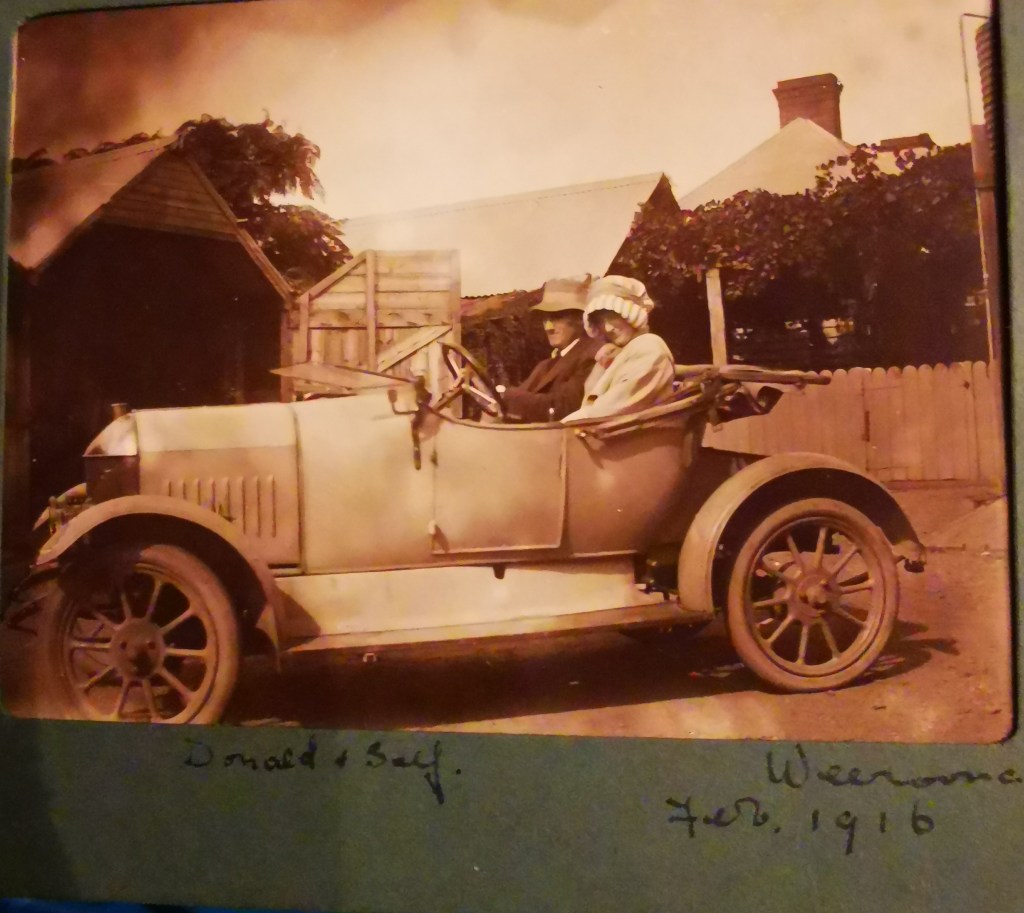
Donald was the eldest son of a wealthy grazier. He had a car to take Joan driving – not the usual thing in 1916. This Morris was first manufactured in the UK in 1913, so it is unlikely that many people had one, or any other type of car.
Morris Oxford bullnose
The “bullnose” Morris Oxford is a series of motor car models produced by Morris of the United Kingdom, from 1913 to 1926. It was named by W R Morris after the city in which he grew up and which his cars were to industrialise. WikipediaManufacturer: Morris MotorsClass: Compact carRelated: Morris Cowley
Jacquelyn and Victoria have photos of Donald and Joan on a ship, called the Medina. Victoria found that it was a troopship at the time:
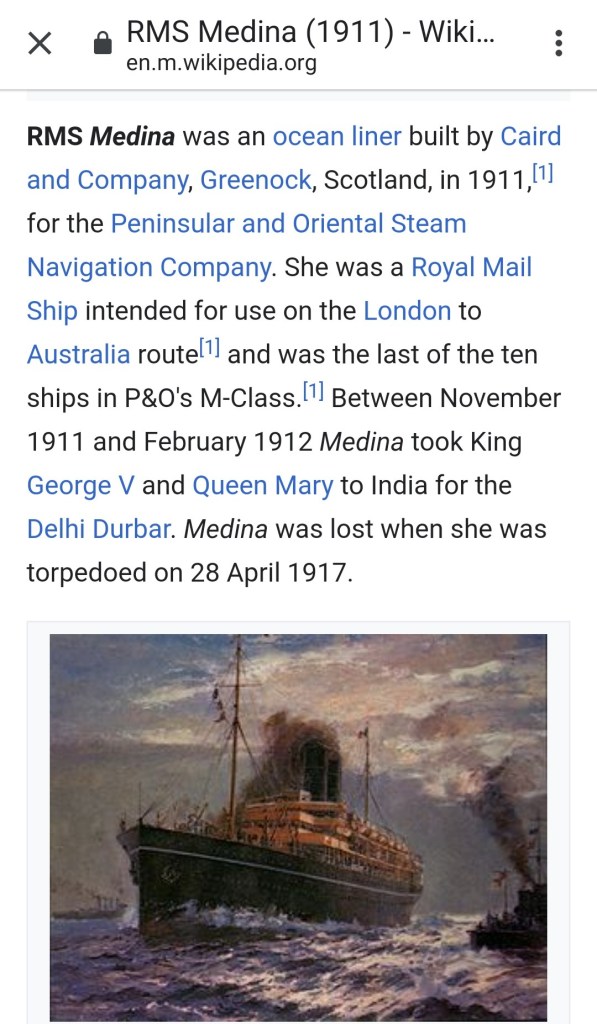
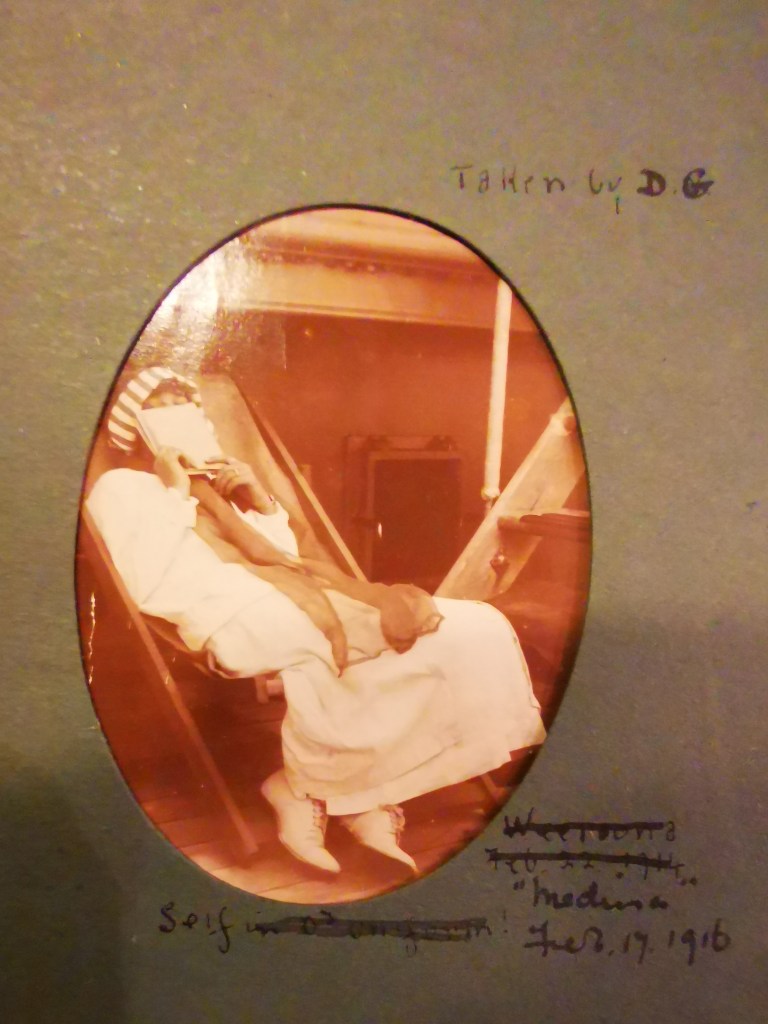
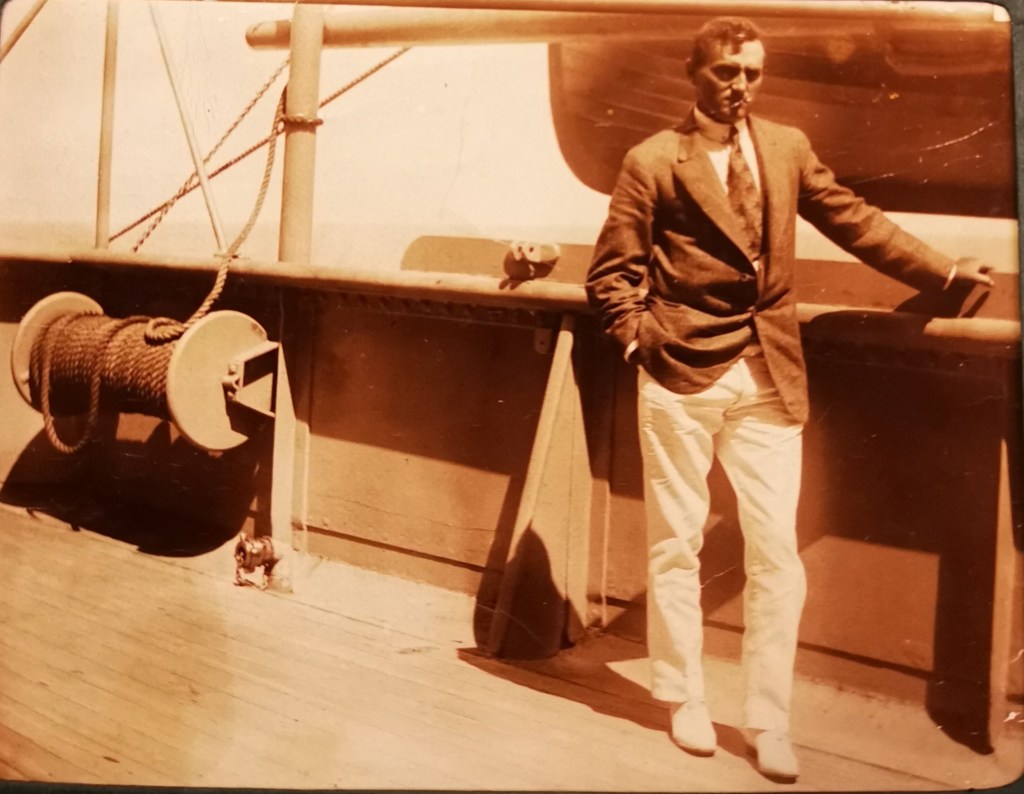
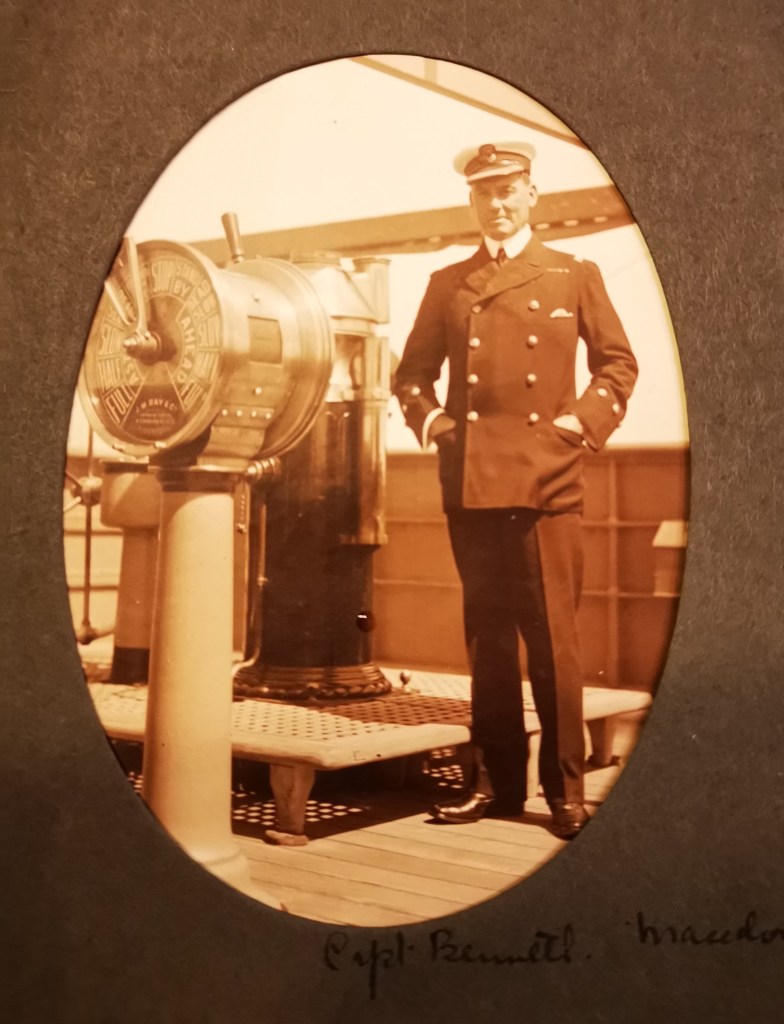
There are many colour pictures on the web of RFC men with jackets the same shade as Donald’s above.
So Donald’s love story is now told. He told his sweetheart that he did not want to fight, but felt obliged. Perhaps, as he loved machines, he chose the Flying Corps. Joan married Alexander Young and lived to be 100 years old!
Joan’s brother, John Oliver Harvey Nickoll, who was in London during the war, wrote to the War Office to find out if Donald had been confirmed dead.
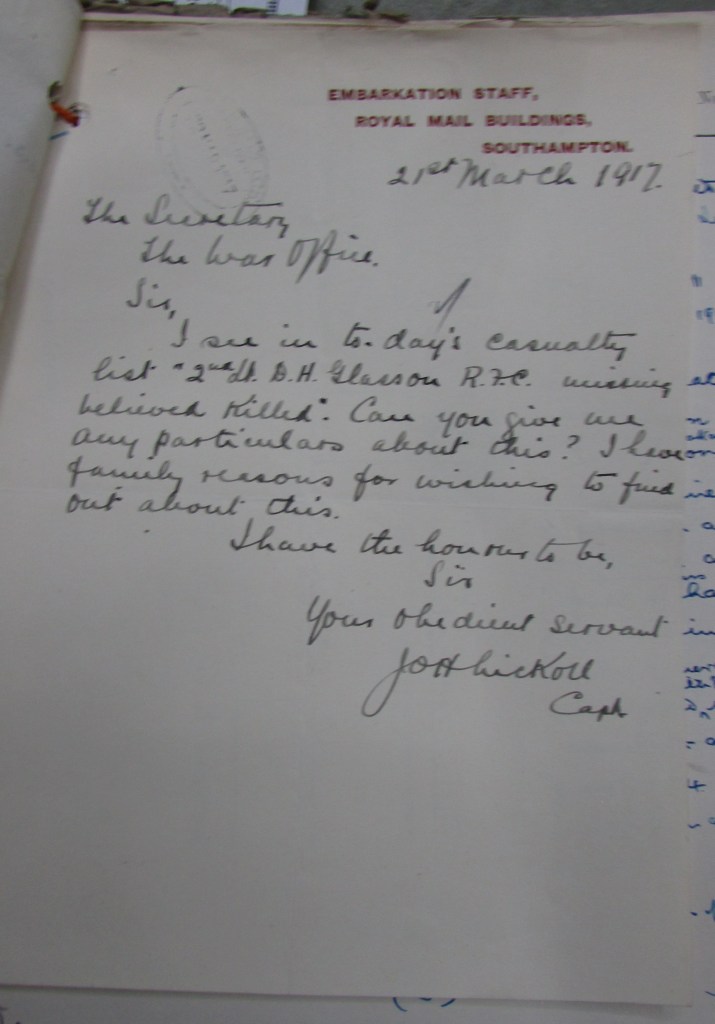
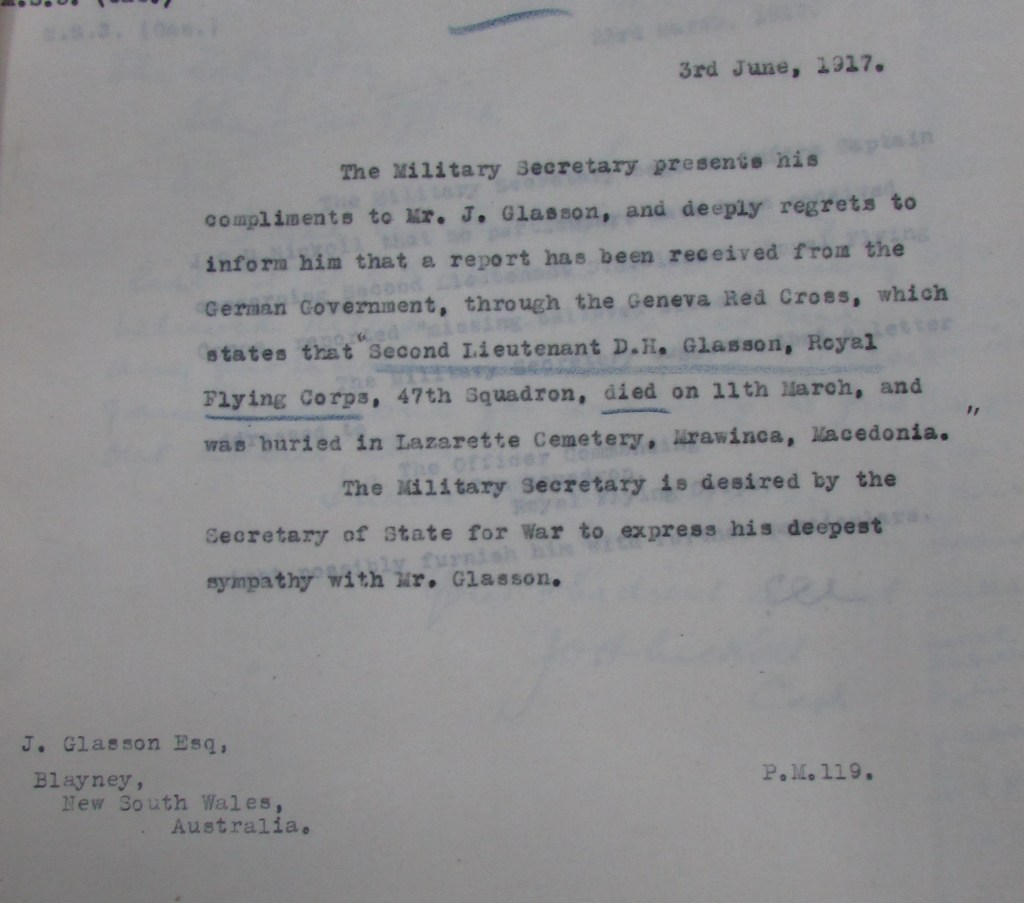
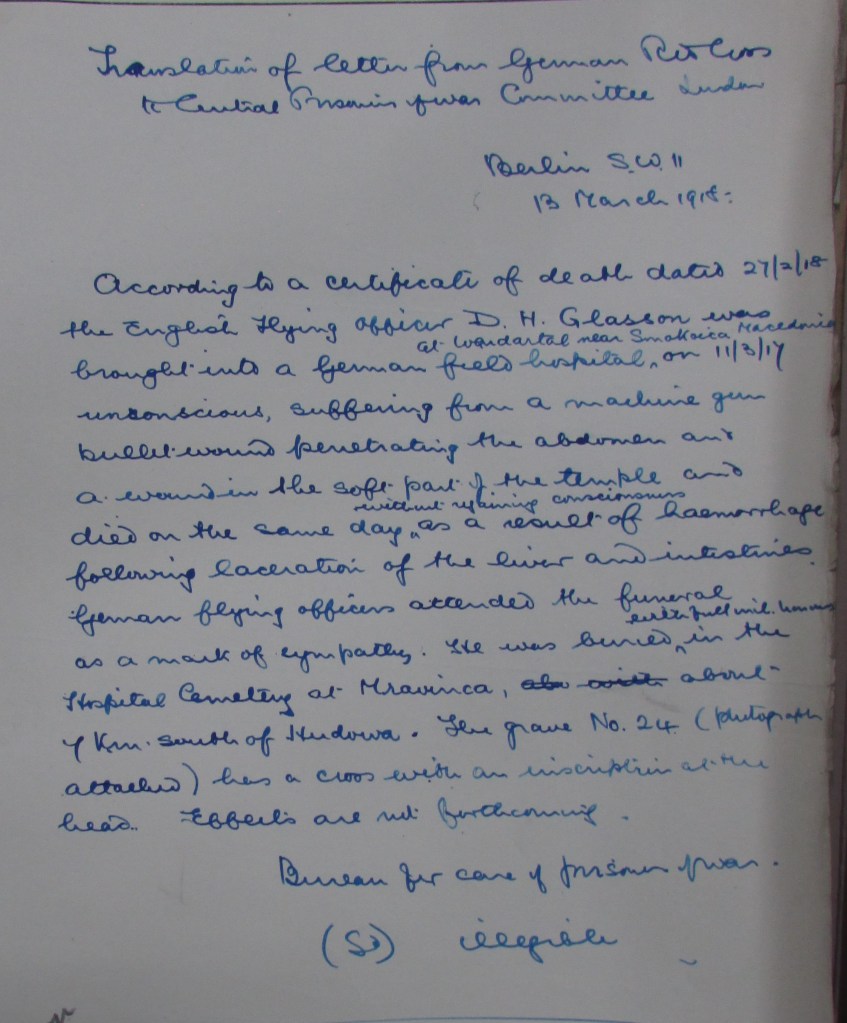
The account below tells the story. Donald wa first buried at the Hospital Cemetery and later transferred to the British War Cemetery.
The Australian War Memorial Canberra:
Donald is on the Honour Roll at the War Memorial. Here are the details if you look for him:
- Lieutenant Donald Havelock Glasson
- Death Date: 12 March 1917
- Service: British Army
- Units: No 47 Squadron Royal Flying Corps and British Army
- Commemorative Roll in the War Memorial courtyard: No 47 Royal Flying Corps
Donald’s Memorial in Blayney Cemetery
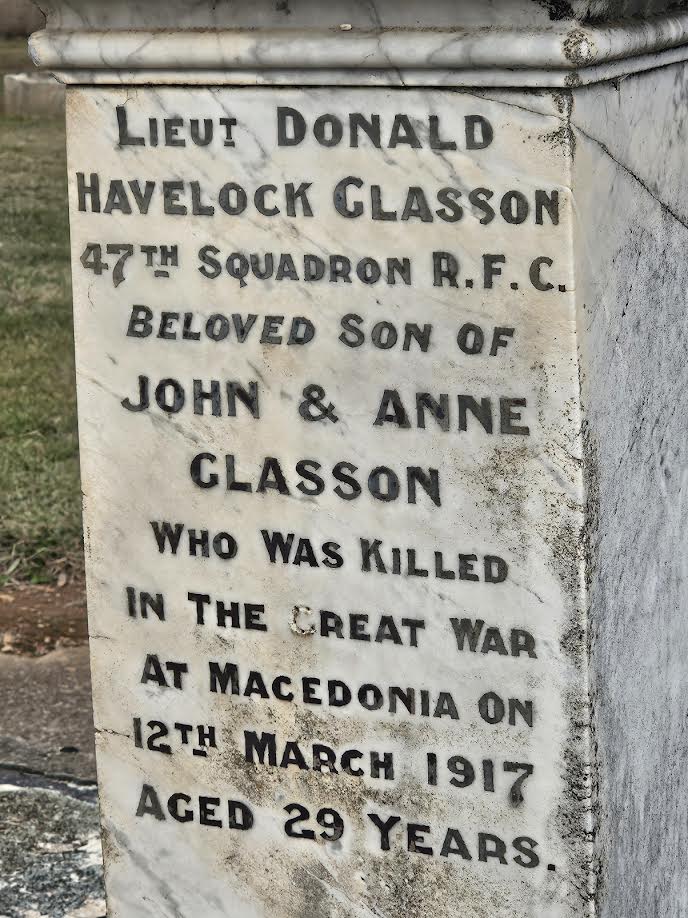
I had never thought to go to the cemetery in Blayney, doing most of my research online. I have told different members of the family about my blog, but the one who has found it interesting is Luke Woodhill, the son of Anthony and grandson of Nancy Westgarth, my aunt. Luke went to othe cemetery and found and photographed some beautiful memorials. Here is a photo he took of the memorials.
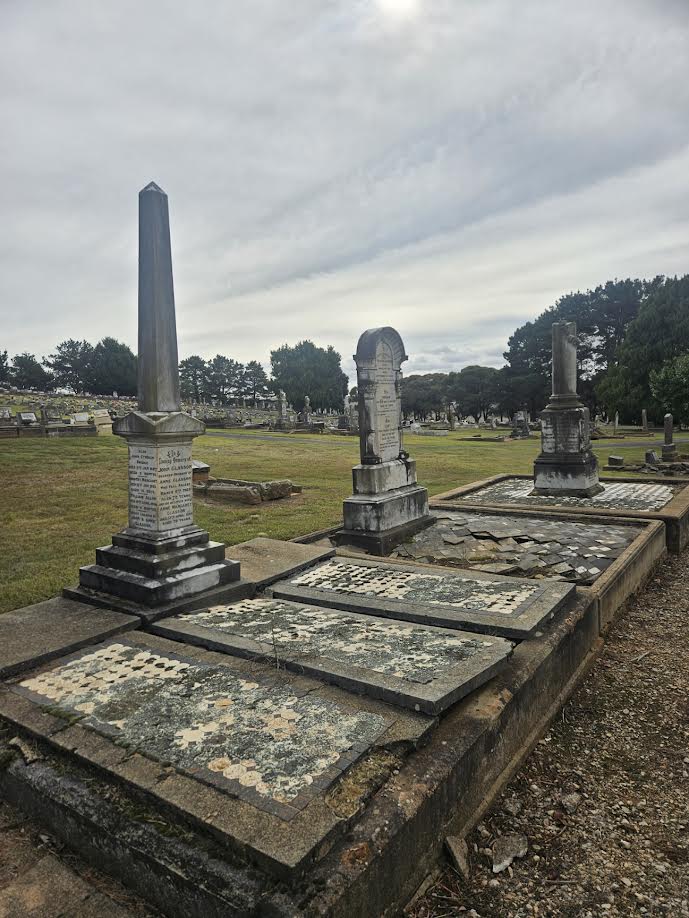
The obelisk has memorials on three sides. One side is for Donald.
Here is the inscription
AFTERWARDS
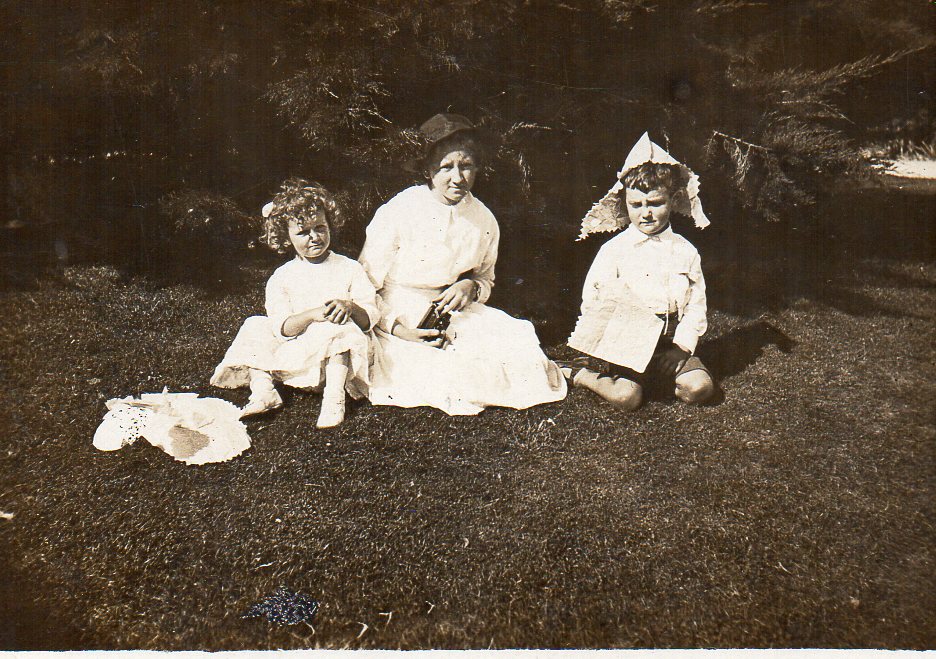
Here is a picture of John and Nancy, perhaps with their Aunt Ruth, who would have been about 22. It may be Summer, 1918. Perhaps it is a sad gathering in memory of Donald Glasson or Mervyn. They are in their best clothes. It could be Armistice Day, November 11 1918, or maybe a birthday party!
Brian would be having a sleep. John looks about 5 and Nancy 4.
While Kathleen struggled on with the three children, Dudley was busy with his practice and with his duties for the war effort. Red Cross and other war charities must have been a constant in everyone’s lives during these years when so many sons and brothers had gone to war.
Mervyn’s death:
This was not the only tragedy of the First World War for Dudley and Kathleen. Dudley’s favourite brother, Mervyn, just one year younger, did of pneumonia at the beginning of 1918. This is all documented in the blog about Lucy Florence. So Dudley and Kathleen had each lost their closest brother to the war. At least it must have created a bond of sympathy.
Jack and Doreen:
Later in 1918, Dudley’s half-brother, Jack (John Ellesmere Westgarth) died of complications of rheumatic fever and malaria. It is all documented on the Lucy Florence blog, or on the Australian Archives website. Dudley, George and Ronald now had all responsibility for their mother, who was living in Double Bay. A further tragedy soon after was the death of Doreen in 1920 from TB.
Poppy and Gwendoline:
Poppy who had a daughter, Roslyn Collins, had left her marriage and was staying with Lucy Florence in Manning Road, Double Bay. Gwendoline had never married. Poppy would in the future marry Gerald Kemmis, a divorcee with two daughters.
Claude:
Kathleen’s second brother, Claude, was in the 12th Light Horse with the two Westgarths! He went to Gallipoli where he was deafened for life by the big guns. Despite this, he continued in the AIF for the duration of the war! According to his records, he spent some time in hospital with gastritis. He returned at the end of 1918.
Claude married Valerie Marshall on 4th May 1921 and lived his life in the Bathurst area, first at Trevellyan and then in town. Val had a gift shop called The Pink Door. Claude’s name has been left off the Honour Roll at his old school, Newington. I must try to get it put on.
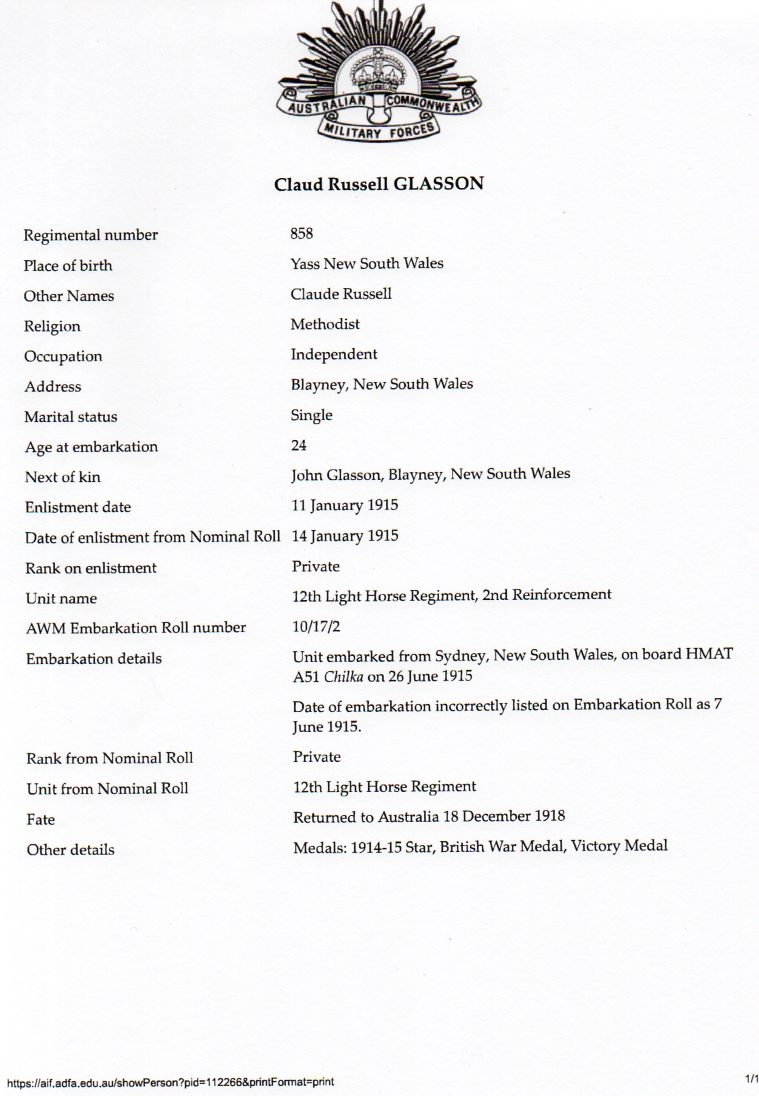
Pile and Westgarth made the Wills of Mervyn and Claude when they joined up. I am not sure about Donald, who was with the British forces.
Country Solicitors
It is interesting to compare the attitudes of Dudley and his brother George to their lives in regional towns. According to reports of George, he also was always ready to help others, but did not have a public image, nor many duties away from home. Dudley seems to have been helpful but also extremely ambitious for prominence in Blayney society.
Dudley makes a connection with Sydney solicitors:
Then, in 1919, after the war was over, Dudley made a connection with Sydney. He may have partly been prompted to do this because of his family troubles in Sydney. John and Mervyn died the year before and Doreen was now terminally ill with TB. His mother had retired from the school and was helping Doreen. Also his sister, Poppy, had left her husband.
He entered into a business partnership with Alexander Joseph McLachlan and Robert Reid McGrechan to create A.J.McLachlan, Westgarth and Company, a firm of solicitors with a registered address at 115, Pitt Street, Sydney. My grandfather told me he was warned about A.J.McLachlan, but took no notice. This was his second decision which was to have serious consequences for him
BIRTHS:
In 1919, Mollie Dudley Westgarth was born on 19/9/19, surely an auspicious date! Mollie had a sunny disposition as well as having a strong intelligence and she was a support to her parents all their lives.
WESTGARTH – September 19, at St. Ronan’s private hospital, Manly, to Mr. and Mrs. Dudley Westgarth – a daughter.
DEATHS:
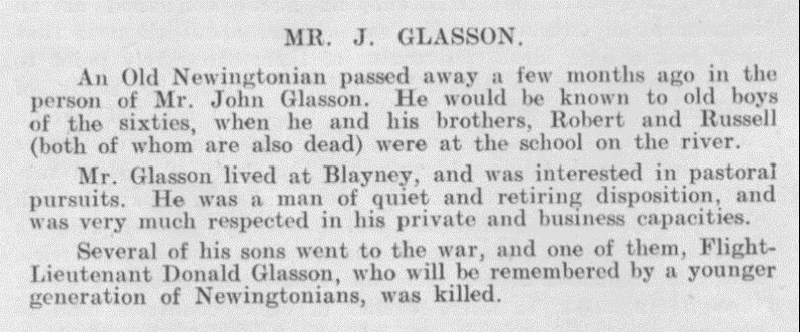
John Glasson died the following year. He had seen Claude return and mourned his son Donald. He had provided handsomely for all the family. His youngest, Joyce, was only 15, but his boys would have finished their schooling. Here is a short obituary from the Newingtonian:
JOHN’S MEMORIAL
Below is the obelisk in Blayney Cemetery. The memorial to John and Anne Margaret is on the side facing us. Donald’s memorial is on the left. On the right are memorials to three babies who died. The first is John Cyprien Bridge, who was their first born. My grandmother always talked about him.
In loving memory of John Glasson, beloved husband of Anne Glasson, who fell asleep on March 6th 1920, aged 72 years.
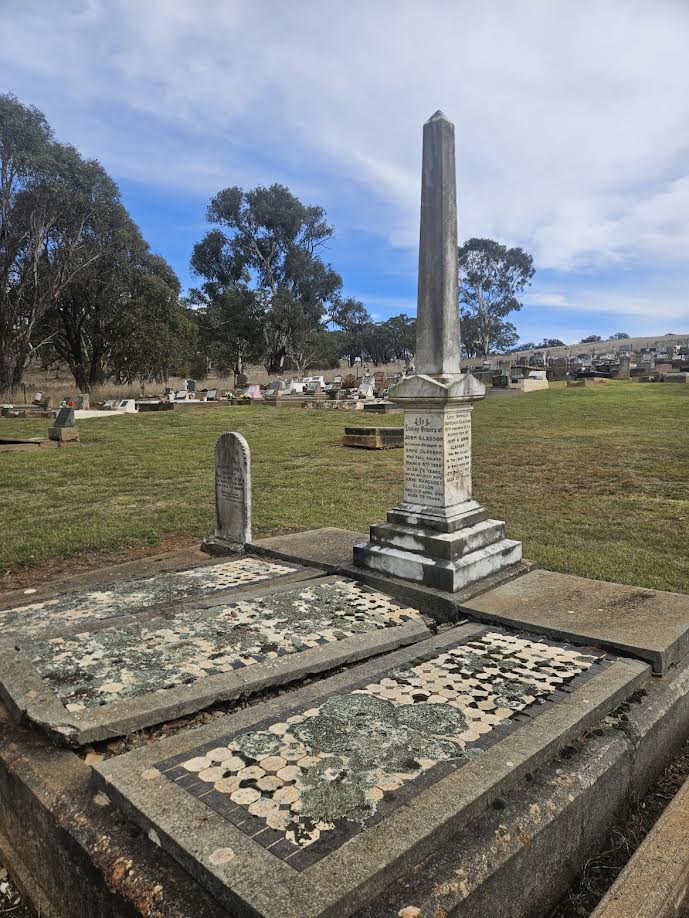
The other high memorial is to John’s father, our ancestor in Australia, William Glasson. Our family are the Russell Glassons, because William’s wife was Susan Russell. Here is the memorial to them. William was born on April 16, 1811 and died on September 6, 1889. Susan died on August 6th, 1907.
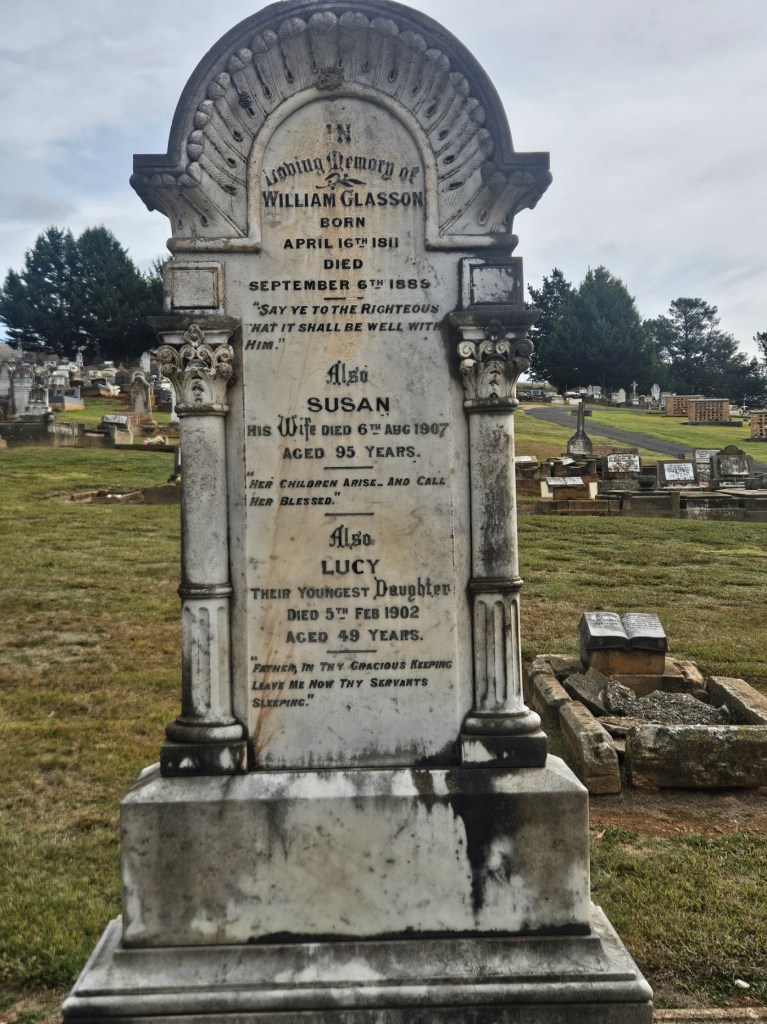
My father was 7 in 1920, so he may have remembered his grandfather John Glasson. He definitely remembered his grandmother, Anne Margaret Glasson, who was called Little Granny by the children and lived until 1942!
Birth of Donald Dudley Westgarth
In 1921, Kathleen’s last child was born. He was given the name, Donald, in memory of her lost beloved brother. It was not going to be an auspicious name for the baby.
WESTGARTH.- October 13, at Laramie, Blayney, to Mr. and Mrs. Dudley Westgarth – a son.
Kathleen must not have had time to go to hospital for this birth. Mollie had been born in hospital. The consequence of this home birth was that, according to Mollie, her mother contracted septicaemia, a poisoning of the blood which is often fatal. Kathleen recovered, perhaps due to sulphur drugs, which were widely used before the development of penicillin in 1943. Kathleen had no more children, which she probably thought was a silver lining to the cloud!
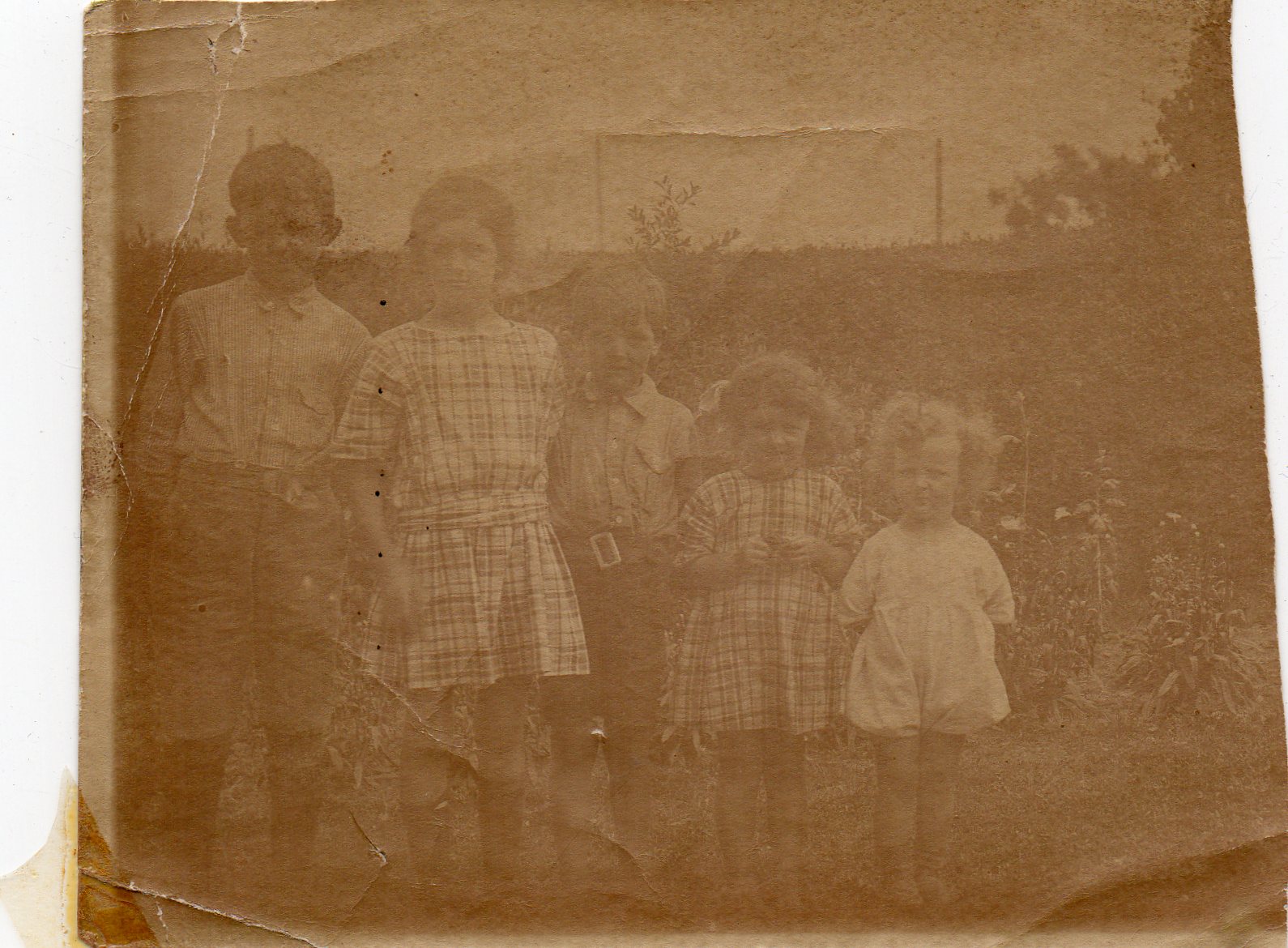
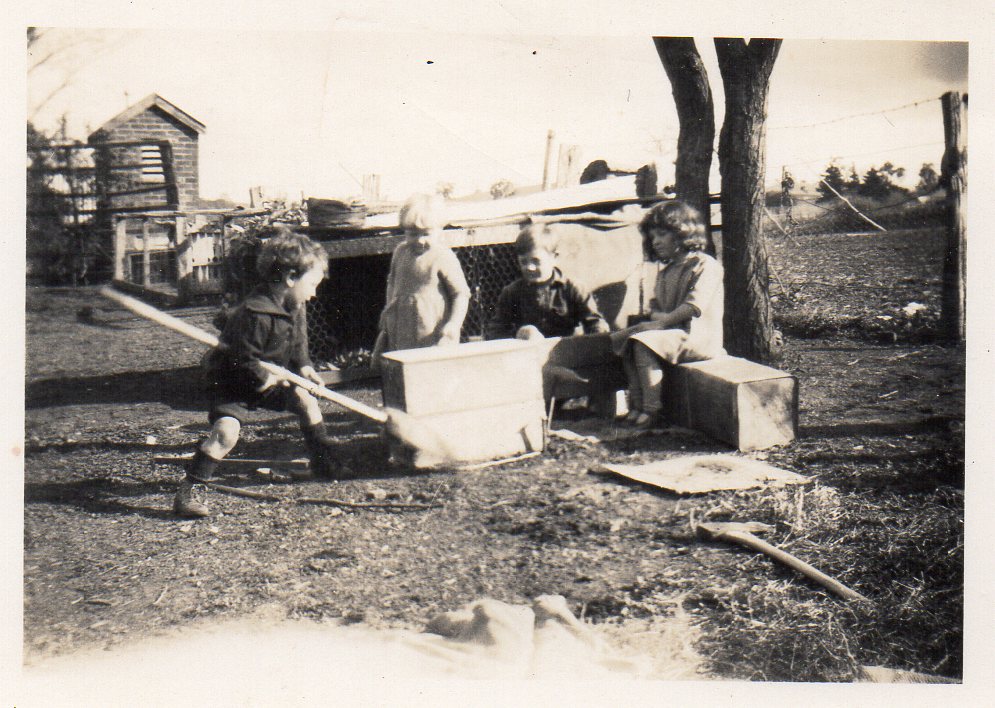
The Westgarths in 1921 had 5 children, three boys and two girls and Kathleen had to recover her health and strength. Here are some photographs of the children at play at Laramie:
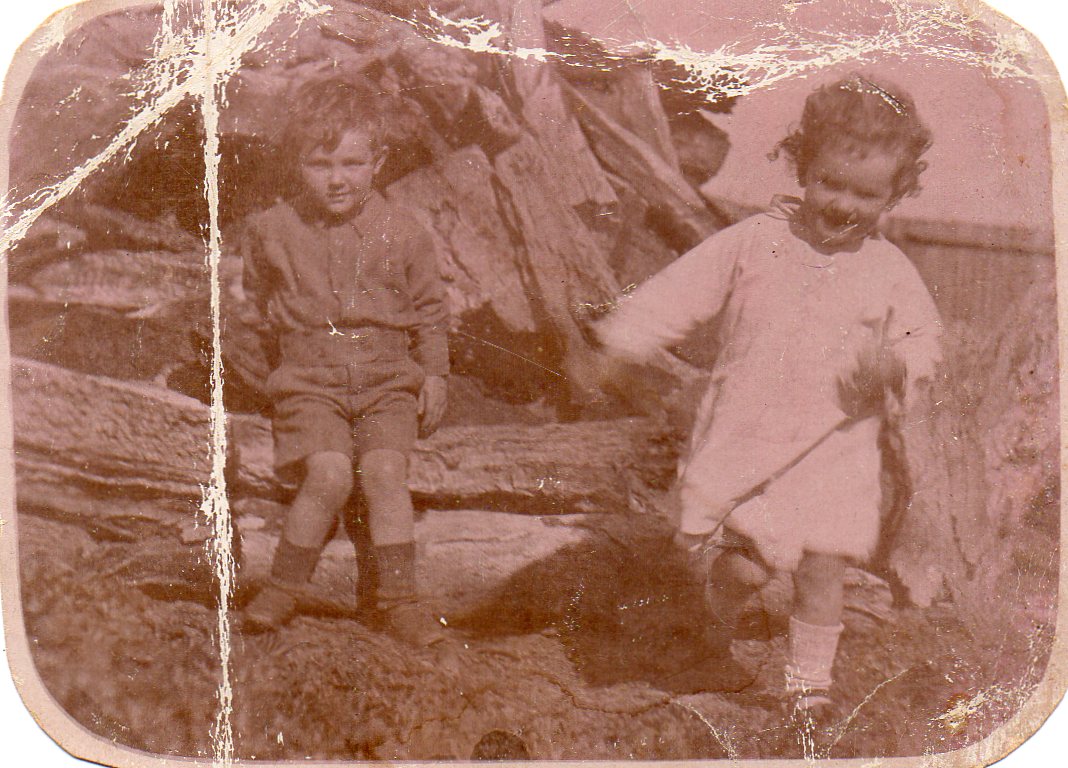
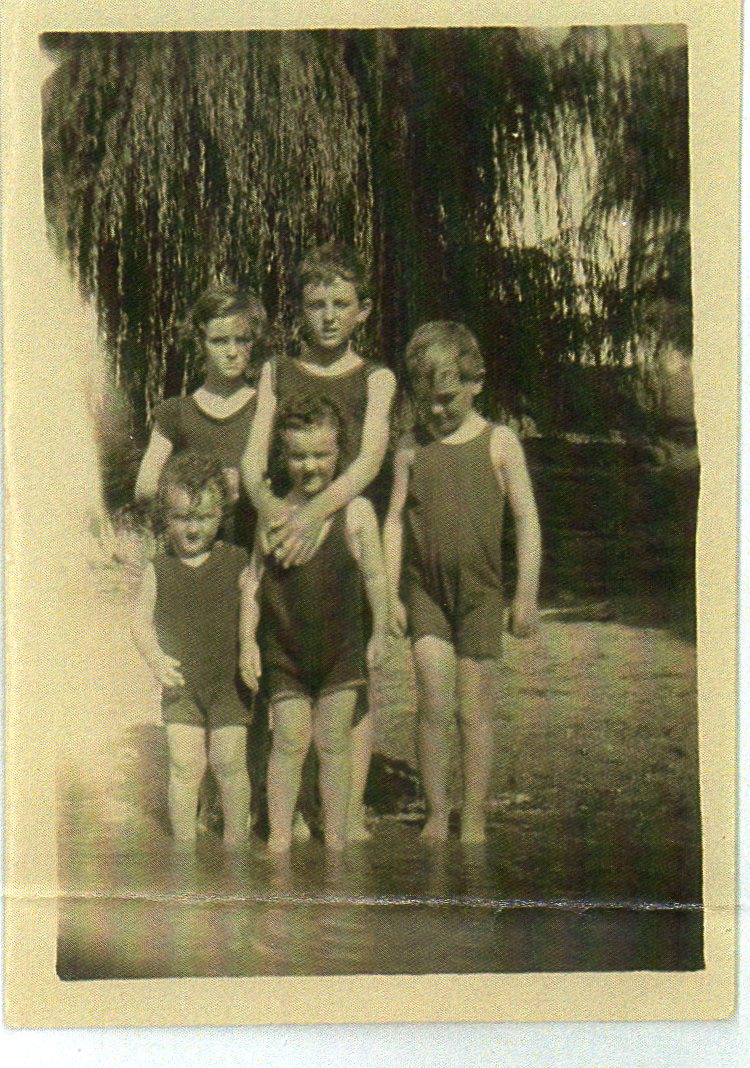
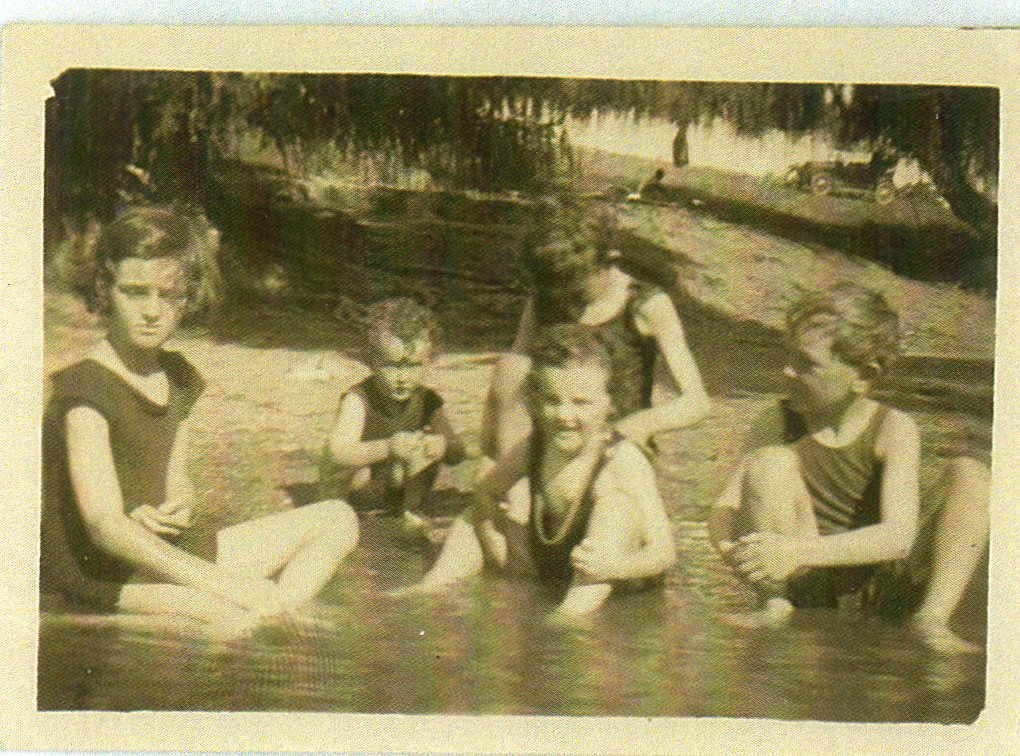
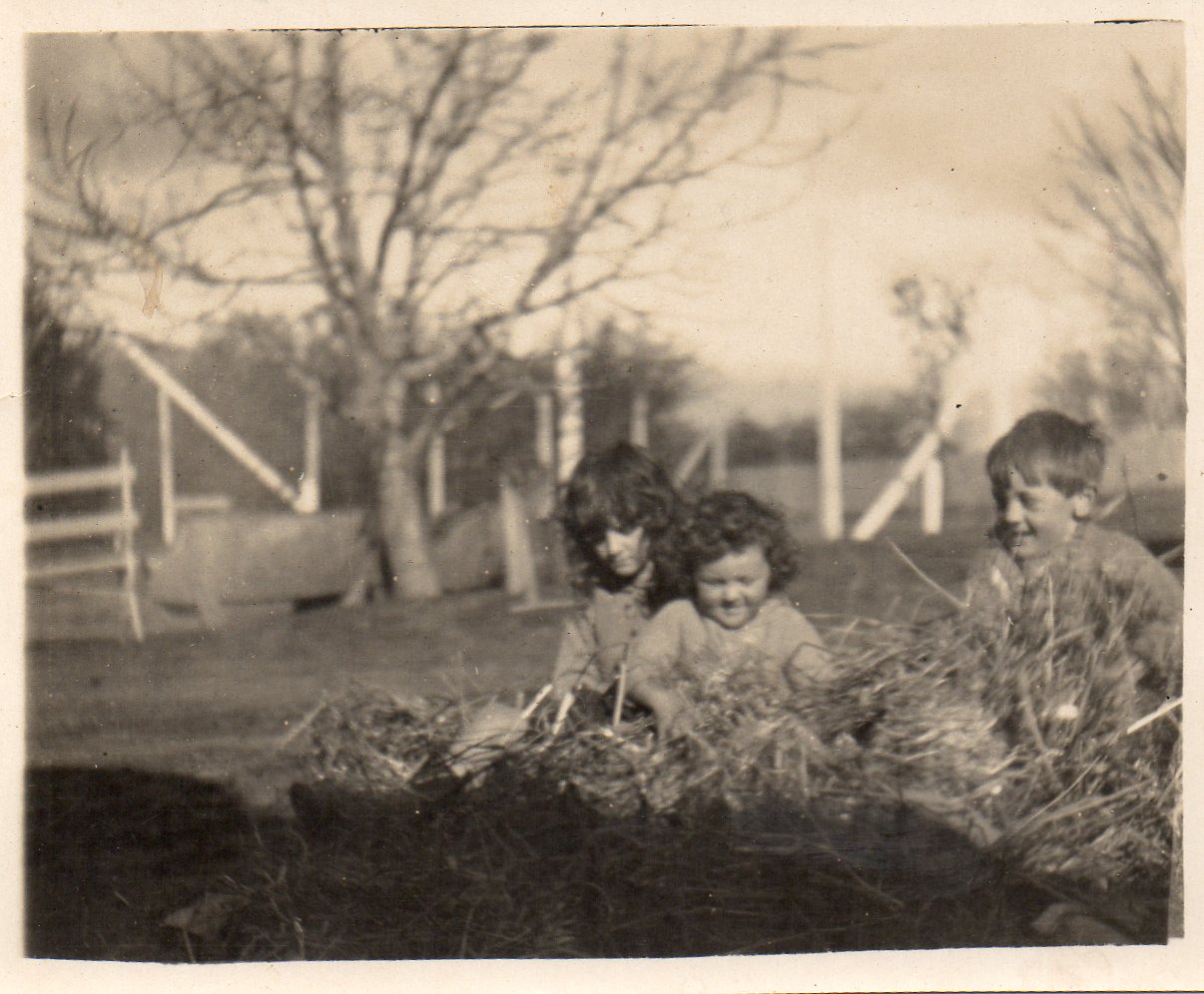
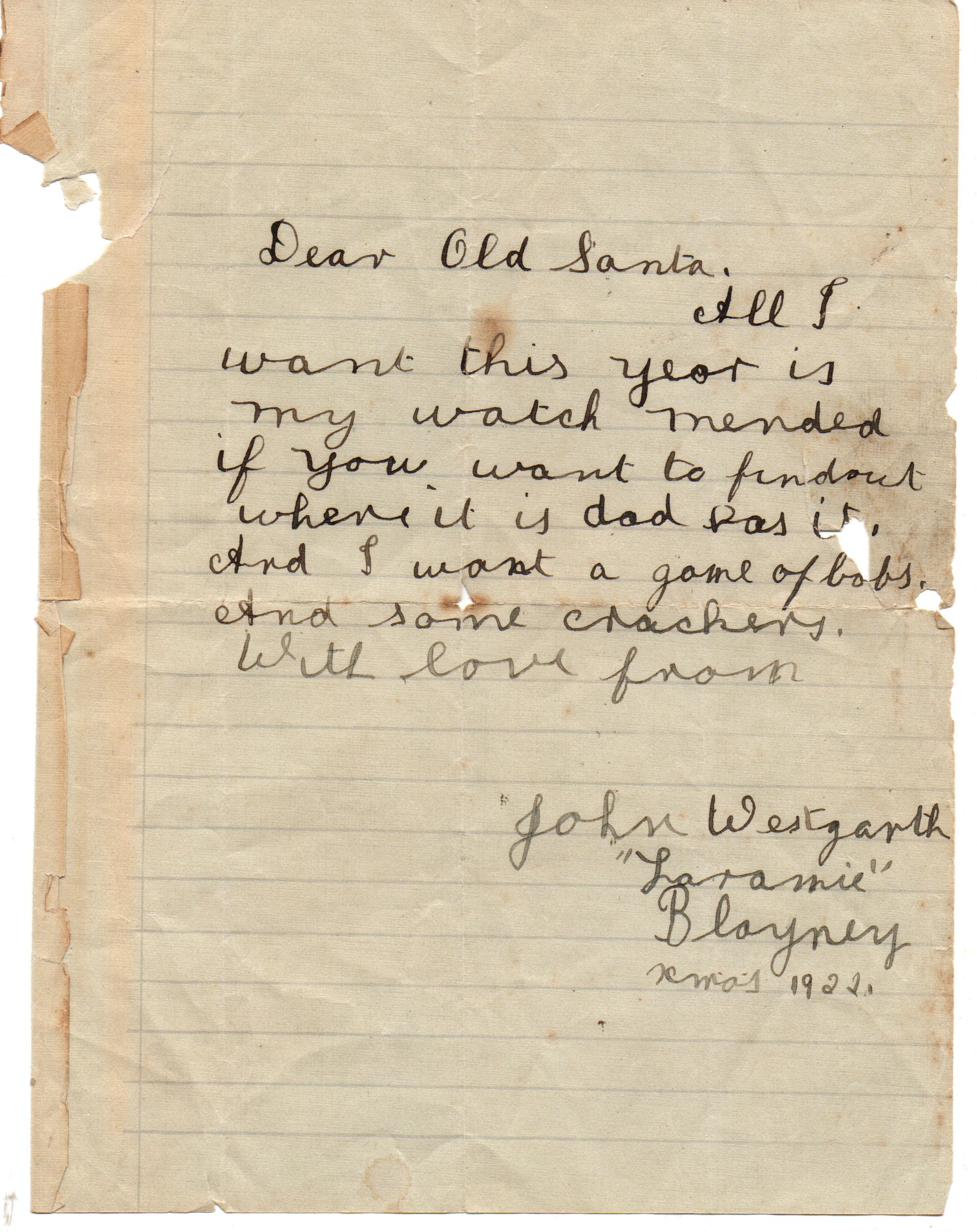
A Child’s View of Santa, 1922.
I was given this letter from my father, aged 9, to Santa. You can see that children had different ambitions in those days: hardly any young people wear a watch now, and Christmas gifts are a lot more expensive.
Legal Problems
Neil Thornton’s notes tell us that Dudley and a prominent businessman, George Starr, were prosecuted for running a chocolate wheel at the hospital sports on Anniversary Day (probably Australia Day?). The magistrate decided that the sports day was not a bazaar, so he fined Dudley and George Starr £1/8/- each. Reference: The Wyalong Advocate, Tuesday, 17th April 1923
In 1924, Neil Thornton tells us, Dudley represented his brother-in-law, Claude, who was then president of the RSL, in a case against the Blayney Municipal Council for a breach of the 1919 Returned Soldiers and Sailors Act. The case was dismissed.
Not long after this, on 25th January 1925, Dudley severed his business association with Pile and Westgarth and became a full partner in the firm of A.J.McLachlan, Westgarth and Company. The decision was made to move to Sydney.
The light side of Dudley
My grandfather loved a little joke. He taught us to drink our soup out of the plate, much to the disgust of our conservative mother. He turned over his empty boiled egg and offered it to the unsuspecting child. He had ‘toys’ such as a mechanical vault which opened its doors and revealed a hand which grabbed a proffered sixpence. Another toy was a sailor with a bottle of whisky who could be wound up. He would then drink a glass whilst his eyes glowed with delight! He also loved to make an occasion a bit special by writing a special ‘poem’ or making a menu full of sly jokes.
During the war, my sister, Lynne, stayed with our grandparents Yaryar and Char, probably because our mother had to travel to see our father. Char made Lynne a little stove out of a wooden box and put some light switches on it for controls. He called Lynne ‘Mrs Dantripp’ and the name stuck as I remember my mother calling her that. Our grandmother was a great cook and cooked for the soldiers right through the war, so Lynne must have ‘cooked’ alongside her. Kathleen was always gentle and long suffering with us grandchildren.
Char, as we called him, grew up with four brothers and was an expert at snooker and chess. Chess appealed to his competitive nature and his type of intellect. Bunny (Brian), the clever son, was also a devotee of chess, even carrying a chess set with him to war. When Char retired, he installed a full size billiard table in his home at Leura and he taught my cousin, Scott, to play snooker and love chess.
1925
In 1925, Lucy Florence was suffering with tuberculosis, a terminal disease, which had already claimed her daughter, Doreen. Also, John was going to turn 12 in May. Living in Sydney would allow the children to attend high school as day boys and girls. Dudley found a large inexpensive house, ‘Bellsize’, at 25 Kent Road, Rose Bay, close to Cranbrook School for the boys and the family moved in. The same year, on 4th December, his mother died.
Lucy Florence was buried with George Charles in Waverley Cemetery overlooking the sea. Her three remaining sons were joint executors of her will. (see the blog about Lucy Florence and the children)
Family Relations: Coming to Sydney meant catching up with many relatives for Dudley, but for Kathleen it meant being much further away from her extensive family. Her sister, Ruth, married Gordon Phillips and lived in Sydney, but her brothers went on the land, except Robert who became a Doctor in Bathurst. Joyce eventually married Ronald Mackay, a stock and station agent at Coonabarrabran.
Three grandmothers for the Westgarths
Kathleen’s mother, Anne Glasson, was known to my father and his brothers and sisters as ‘Little Granny’. Lucy Florence got the title of ‘Gummum’, typical of the kind of joke enjoyed by my grandfather. Probably the children also knew Granny Mansfield, but I did not hear my father speak of her. She was Lucy Florence’s stepmother and outlived her stepdaughter by 8 years, passing away on 12th May 1930.
The Great Depression.
McLachlan, Westgarth and Co. was at first a successful business, but in 1929, the world went into an economic Depression – a situation which took years to rectify and caused millions around the world to be out of work and children to starve.
The Great Depression started in the United States after a major fall in stock prices that began around September 4, 1929, and became worldwide news with the stock market crash of October 29, 1929, (known as Black Tuesday). Between 1929 and 1932, worldwide gross domestic product (GDP) fell by an estimated 15%. By comparison, worldwide GDP fell by less than 1% from 2008 to 2009 during the Great Recession.[4] Some economies started to recover by the mid-1930s. However, in many countries, the negative effects of the Great Depression lasted until the beginning of World War II.[5]
The Great Depression had devastating effects in countries both rich and poor. Personal income, tax revenue, profits and prices dropped, while international trade plunged by more than 50%. Unemployment in the U.S. rose to 25% and in some countries rose as high as 33%.[6
Business must have suffered for Dudley and his partner, but worse was to come. In 1936, just as the impact of the Depression was lessening, A.J.McLachlan embezzled the funds and absconded to England. Dudley was left with a ruined business, full of debts and a family to provide for.
I found this rather ironical case that my grandfather defended in 1936:
The Daily Telegraph, 2nd June 1936, Page 17
In Bankruptcy.
Re Christian Sander, Ice cream and cheesemanufacturer, of Taree. Estate sequestrated December 19, 1933. Unsecured liabilities, £3161. The application for a certificate was refused. Mr. R. D. Mayne for the Official Receiver; Mr. Dudley Westgarth for the bankrupt. His Honor said the examination was very unsatisfactory Indeed. Bankrupt had committed breaches of the award, sent In false returns, avoided taxation, falsified his books, swindled his employees, had not disclosed all his property, having transferred part of It to another State, and had torn up part of his books:
Before the ‘ Registrar In Bankruptcy, Mr.Keaney
1937
The next year, 1937, Dudley showed his mettle by forming his own business as Dudley Westgarth and Co. His partners were Arthur Kingsford Smith and my father, John, who was admitted as a solicitor and made a Notary Public.
I remember going to see Winifred Kingsford-Smith when I was about 4, in 1947. I am unclear as to the relationship of Arthur to the famous Sir Charles Kingsford Smith, but there must be one. Winifred was the sister of Sir Charles, according to an online family tree.
Char told me how hard he had worked to pay back all the funds which had been stolen by his partner. This disaster made his name as a man of integrity, but at what cost?
Cranbrook
Cranbrook School was established on 22 July 1918 in Bellevue Hill on the shores of Sydney Harbour. The School was founded at a time when the outcome of the Great War was beginning to swing in favour of the Allied forces and feelings of optimism were strong in people’s vision of the future.
Cranbrook had been a private home with extensive grounds bordering the harbour, when it was purchased as a boys’ school. The school had a Council made up of interested parents and Dudley became a member of Council after his sons attended the school. A company called Cranbrook Playing Fields Ltd. controlled the extensive property for the school and received revenue from it. This company found itself owing money to its members when the Minister for Works allowed Woollahra Council to take over some of the land. The Minister refused to pay 15,253 pounds which the Valuer-General decreed was a fair price. It was Dudley who represented the Council in this matter. ‘The article does not relate what happened in the end! Here is the front page:
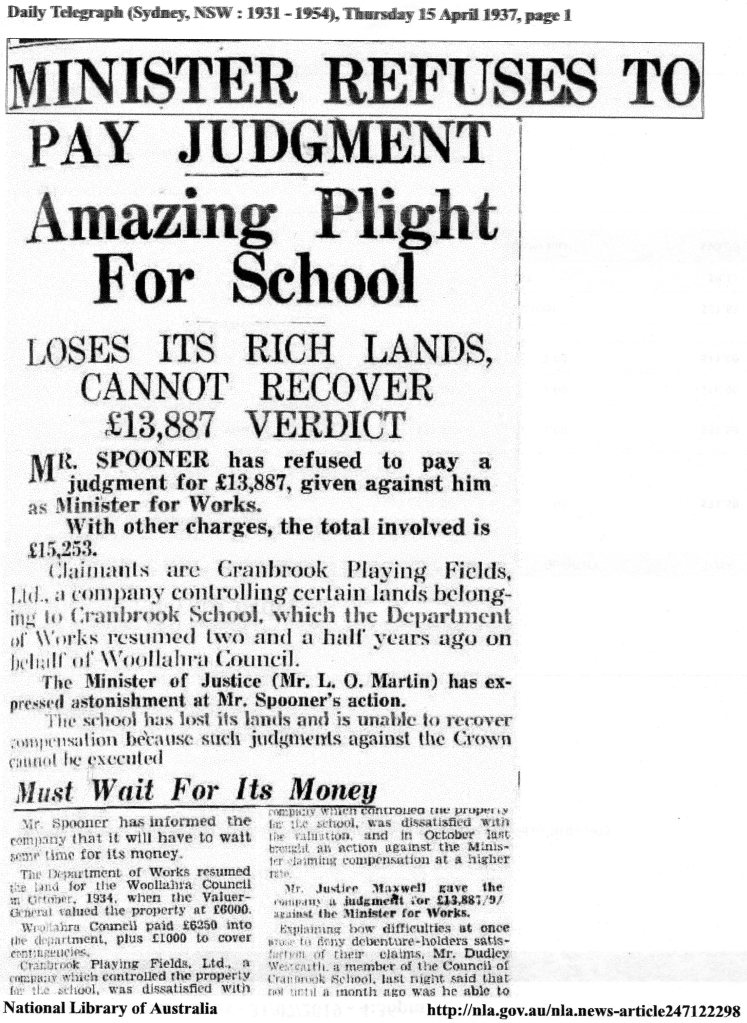
Schooling:
The family must have arrived in Rose Bay at the beginning of 1925, because in February 11 year old John and 9 year old Brian began their studies at Cranbrook. Probably Nancy, 10, would have started school at Ascham too. Cranbrook was an elite boys’ school in Rose Bay, established in 1918. Ascham was a much older establishment and the girls would be studying where their mother studied before them. As the population of White Australians in 1925 was around six million, most of whom would not be wealthy, their classes at Ascham and Cranbrook were not large. https://en.wikipedia.org/wiki/Demography_of_Australia
The Archives at Cranbrook School have provided the following information on the academic careers of John, Brian (Bunny) and Donald (Tonny).
- John Dudley WESTGARTH [OC 1931]
- Entry: 3 February, 1925 (IIIB)
- Exit: 18 December, 1931 (VIA)
- Class of 1931, Chelmsford House
- Intermediate Certificate, 1929
- Leaving Certificate , 1931
- Sergeant., 1931
School details sourced from the Valete section of the school magazine, The Cranbrookian (May, 1932, p.37):
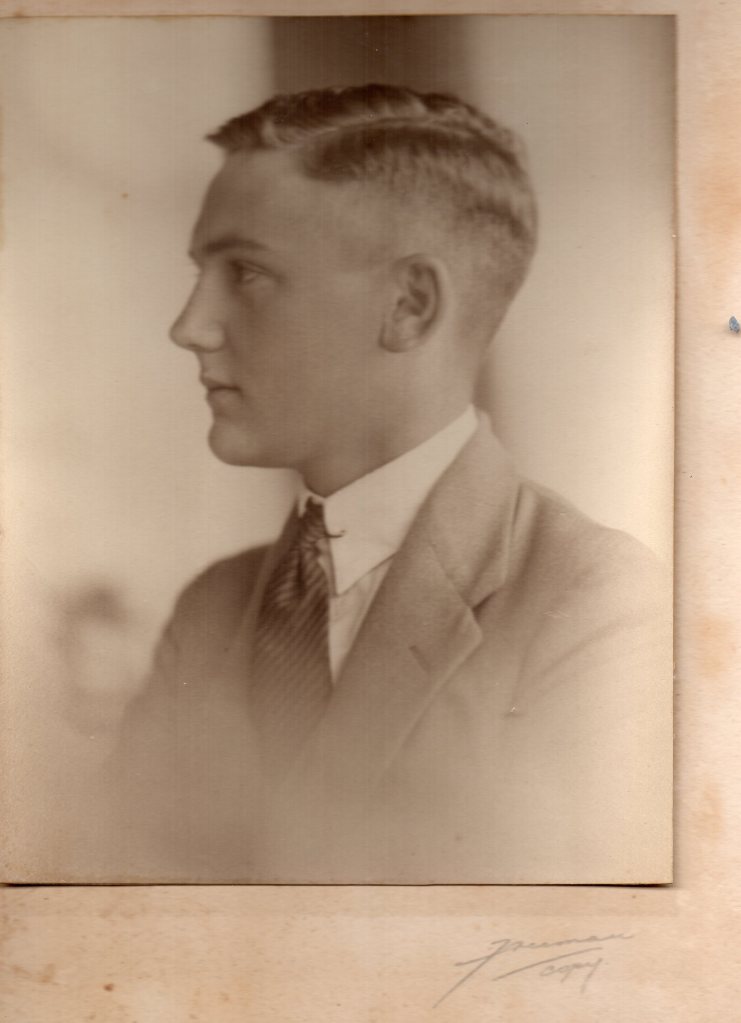
John was an average student and enjoyed long distance running. He was a Sergeant in Cadets. Boys’ private schools in those days always had Military Cadets. Perhaps the public schools did too…. As subjects of the British Empire, the boys were taught early about drilling and fighting for the King or Queen.
After he left school, John became an articled clerk at Dudley Westgarth and Co, following the old tradition of studying Law through the Solicitor’s Admission Board (1932-1936. He became a partner in the newly-formed Dudley Westgarth and Co. in 1937.
This beautiful menu for the celebration dinner is typical of Char’s little jokes.
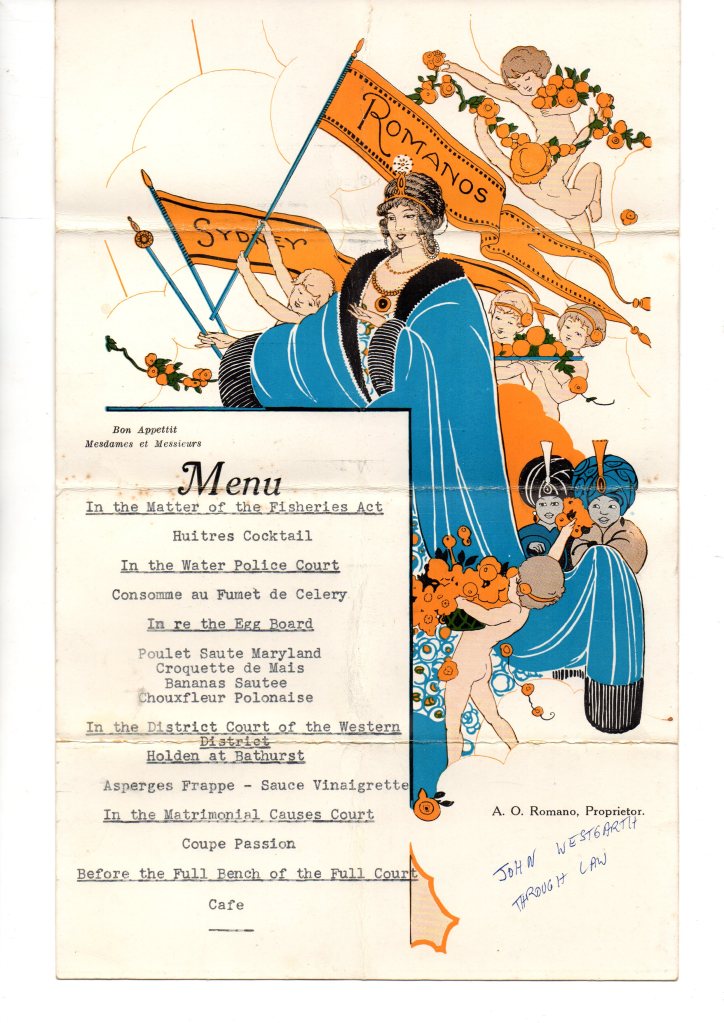
John married Eleanor Barbara Cairnes Boydell on November 30 1938.
- Brian Dudley WESTGARTH [OC 1932]
- Entry: 3 February, 1925 (I)
- Exit: 16 December, 1932 (VIA)
- Class of 1932, Chelmsford House
- Intermediate Certificate, 1930
- Leaving Certificate, 1932
- Sergeant., 1932
School details sourced from the Valete section of the school magazine, The Cranbrookian (May, 1933, p.42):
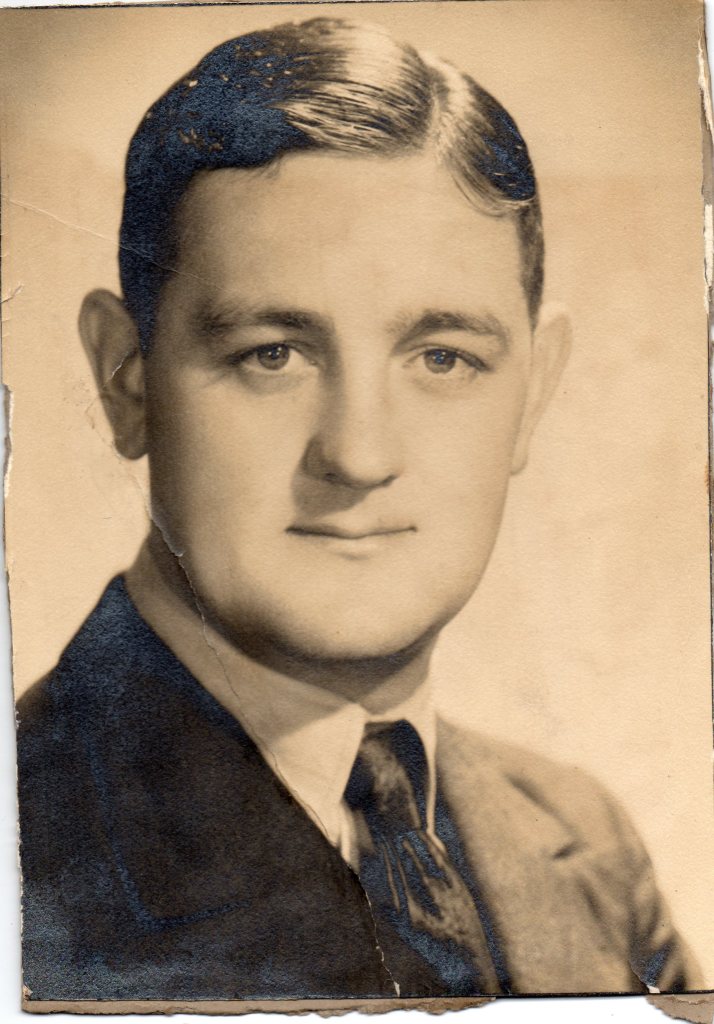
Brian, who was only 15 when he sat the Leaving, was a gifted student, receiving a very good pass in seven subjects. He inherited the ability for the Law which his father and grandfather had before him. Brian completed his Law studies at Sydney University and was a Judge’s Associate, a Barrister and and Accountant when the Second World War broke out.
- Donald Dudley WESTGARTH [OC 1939]
- Preferred name “Tonny”
- Entry: 4 February, 1930 (I)
- Exit: 12 December, 1939 (VI)
- Class of 1939, Chelmsford House
- Intermediate Certificate, 1937
- Leaving Certificate, 1939
- 1st XI (Cricket), 1939
- 1st XV (Rugby), 1937 & 1939
- Corporal, 1938-39
School details sourced from the Valete section of the school magazine, The Cranbrookian (May, 1940, p.44):
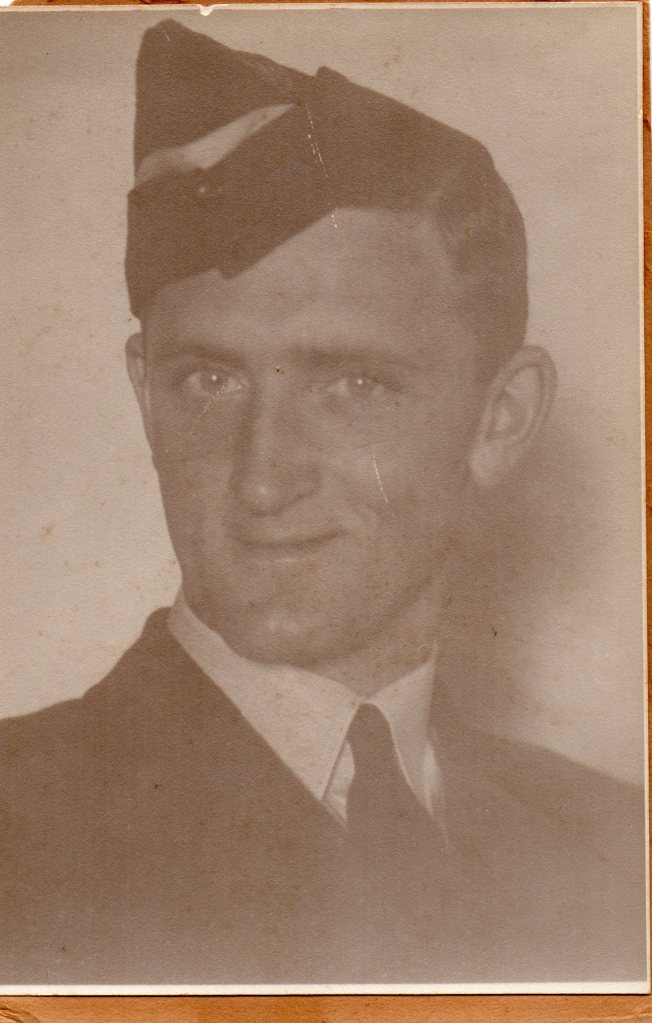
Donald was the sportsman of the three, but did not make the rank of sergeant in the Cadets. He had only finished school when the war broke out, but became a clerk in Dudley Westgarth and Co. the next year.
Here are the results of the Leaving Certificate for the 3 boys:
John 1931, a class of sixteen boys. (18 years old)
English B, Latin L, Maths I B, Maths 11 B, Ancient History B. An average pass.
Brian 1932, a class of fifteen boys. (15 years old)
English A, History B, Latin B, French B, Chemistry B, Maths 1 A, Maths 11 A. In spite of being only fifteen years old, Brian had an excellent pass in seven subjects!
Donald, 1939, class of 23 boys of whom 13 matriculated for university. (18 years old)
English B, Latin L, French B, Maths 1 B. Only four subjects and one is ‘L’.
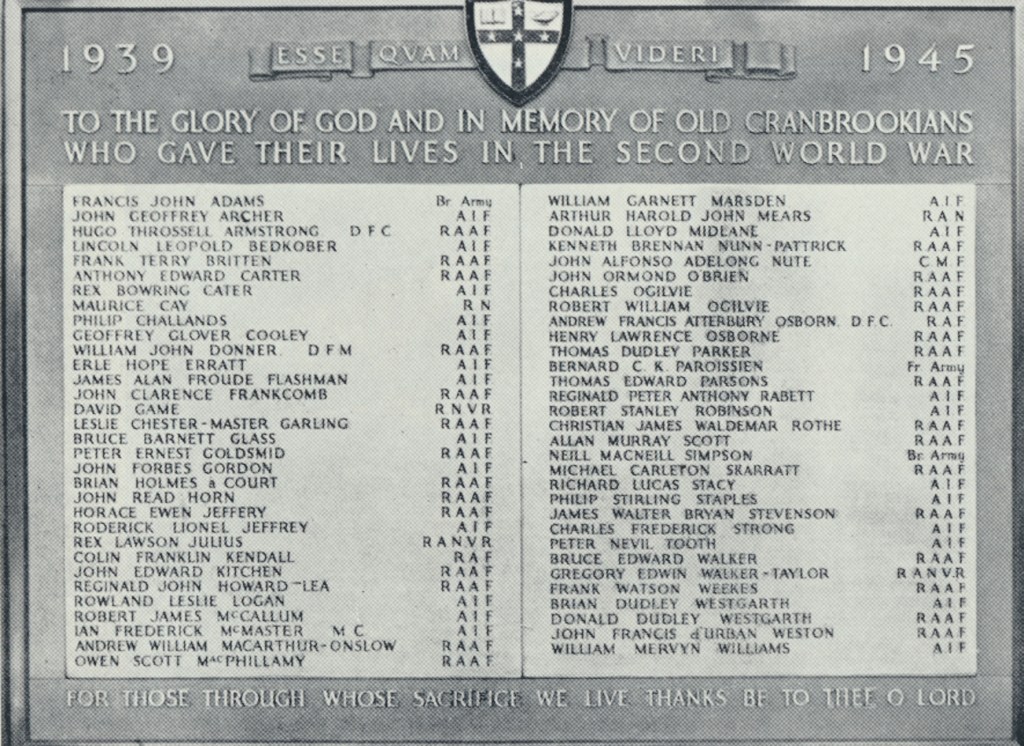
Brian and Donald are remembered on the memorial to the Second World War which is in the chapel at Cranbrook. That is a story I will tell later…….
Ascham School.
You will know from the history of Lucy Kathleen that she attended Ascham and made good friendships there. So Nancy and Mollie also attended Ascham School, which is at Edgecliff. It is only a short tram ride from Rose Bay, through Double Bay and up the hill to Edgecliff. In those days, trams ran from the city to Watsons Bay, along New South Head Road and then on to Old South Head Road, past the lighthouse and down to Watsons Bay.
Nancy:
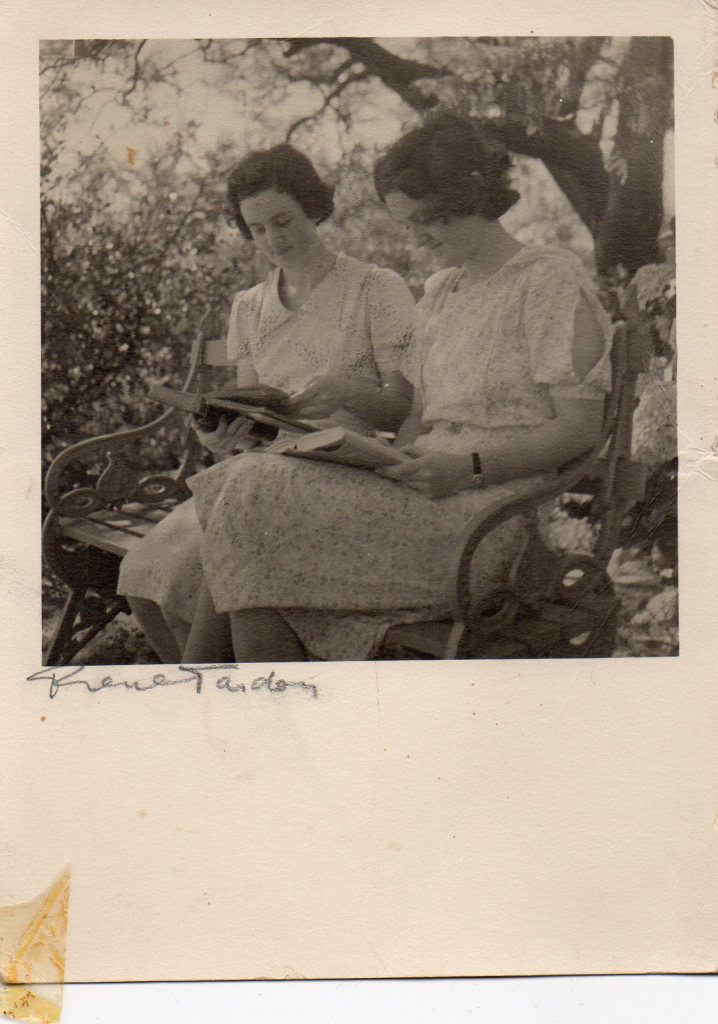
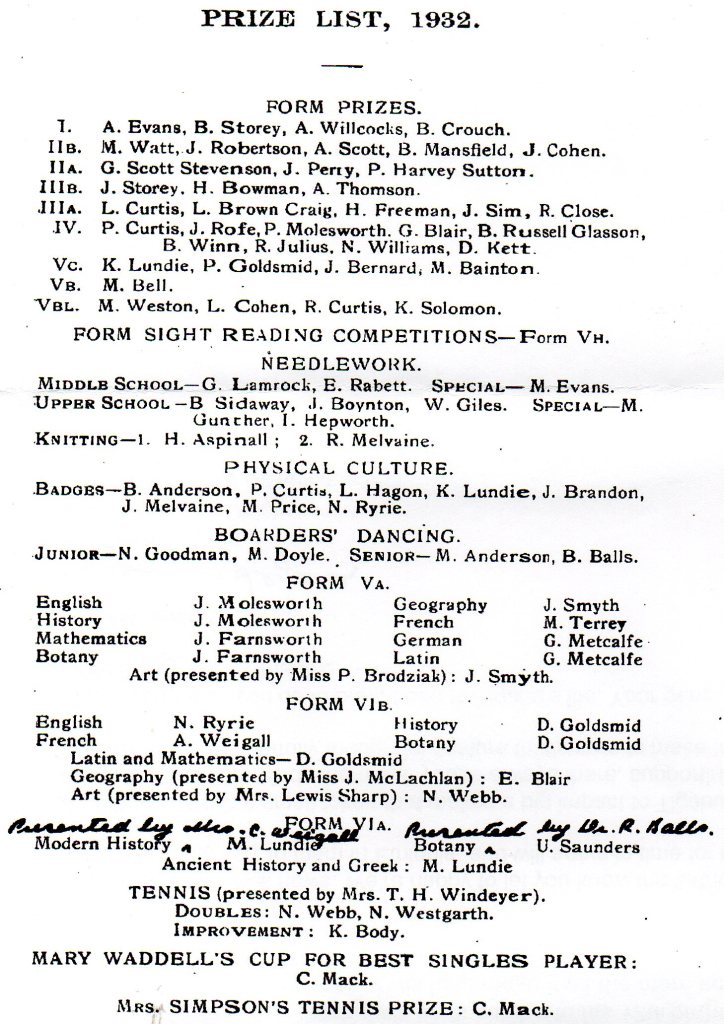
Nancy attended Ascham from 1925 aged 10, starting in Year 3. She left in qt the end of 1932 when she completed Year 10, so she did not sit the Leaving Certificate, which was in Year 11. Although she left at the end of 1932, she is part of the class of 1933, because her more academic contemporaries stayed on for the final year and left at the end of 1933.
Unfortunately I have no photos of Nancy at school. Nancy excelled at sport and sewing, but was not academic. She was in the 1931 Tildesley Shield team and in 1932 she was awarded a tennis prize.
After Nancy left school, she did a Secretarial course and worked as a Secretary in Sydney city. Nancy told her daughter that at one workplace she was sacked for wanting to open the window! Those were the days when women had a place! Nancy must have been a compentent secretary because she worked for about nine years before her marriage, but she would have always been controversial. From 1940, there must have been plenty of jobs as young men volunteered for the forces and women took their place.
Nancy married Raymond Alexander (Pat) Woodhill on May 30th 1942, probably whilst he was on leave. Pat was married in his uniform. They are a handsome couple!
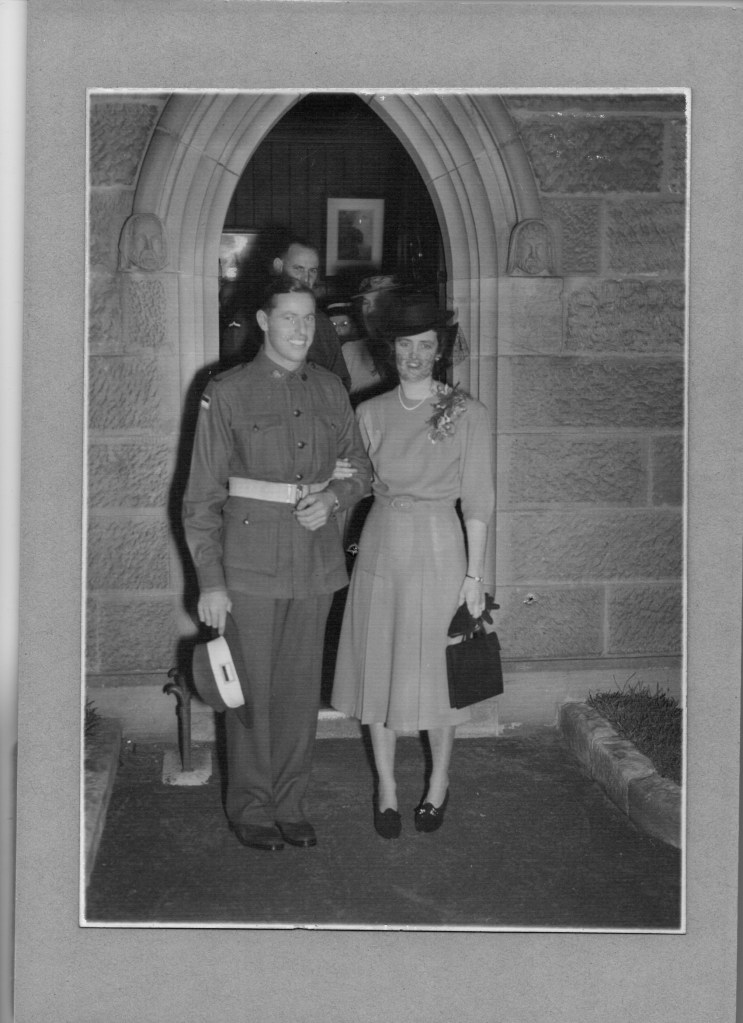
SMH Wednesday 24th June 1942 Page 14
MARRIAGES;:
WOODHILL-WESTGARTH –
May 30, at St. Mark’s, Darling Point, Nancy Ruth, elder
daughter of Mr. and Mrs. Dudley Westgarth of Darling Point to Raymond Alexander (Pat),
son of Mr. and Mrs. P. Woodhill, of Austinmer.
Mollie:
Mollie attended Ascham from 1927, when she was 7 years old, until she completed the Leaving Certificate in1936. She is part of the graduating class of 1936.
1936 was the 50th year since the establishment of a girls school which was originally called ‘Miss Wallis’ School’ after the founder, Miss Marie Wallis. She renamed the school ‘Ascham’ in 1890.
The school was named after Sir Roger Ascham who was known for his enlightened educational philosophy and was tutor to Queen Elizabeth 1 of England. The coat of arms and motto of Roger Ascham were adopted as the school badge . You can see the badge in the middle banner of the five held up by students. The motto is ‘Vi et Animo’, which is roughly ‘life and spirit’.
Below is a photograph of all the students participating in a pageant to celebrate the school Jubilee. There was also a service of thanksgiving. Mollie is in the back row, 5th from the left, with a mob cap and smock. The uniforms of the older girls are the same as those worn by Kathleen, but the uniforms of the younger girls are exactly the same as I wore at Ascham from 1949-1960!
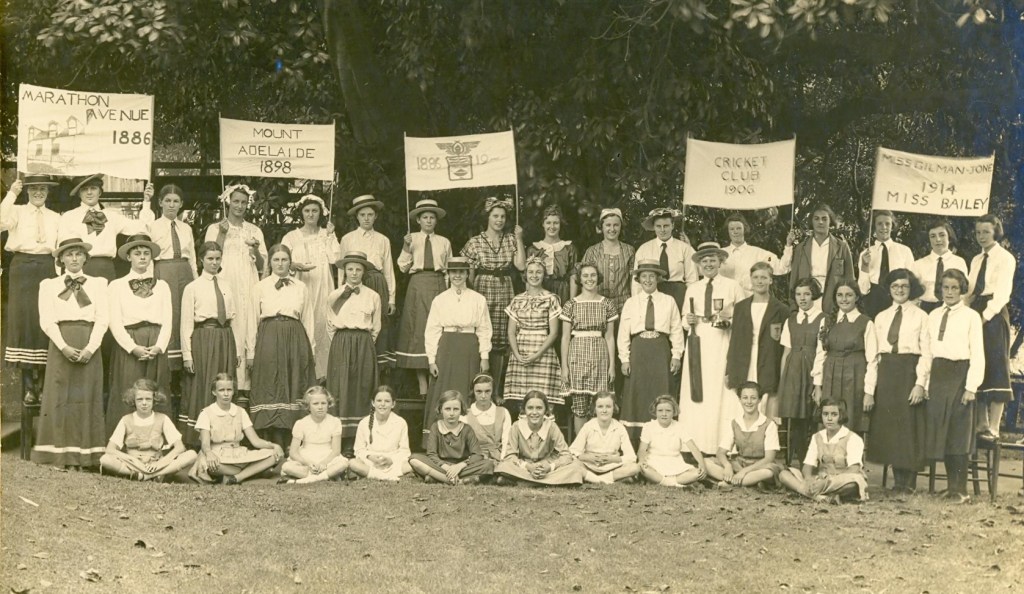
Mollie was more academic than her sister and went on to Sydney University to study Law. She told me that she was so excited and overwhelmed with new freedoms, ideas and lifestyles that she failed all her subjects in her first year at university! She did complete her Bachelor of Arts in 1940 and she was admitted to study law through the Solicitors’ Admission Board and was admitted as a solicitor in 1945, which achievement coincided with the tragic deaths of her brothers. She became the fourth Ascham graduate in law,
Ascham’s First Graduates by Miriama Simmons, Archivist
My current research project is to identify the first university graduates in each profession. At the time of Ascham’s Jubilee in 1936, thirty-four former students had graduated – a remarkable feat in an era when most girls were discouraged from academic study.
LAW:
Olivia Fiaschi [McCarthy] Ascham: 1926-1936
Graduated: Syd .Uni., LL.B 1942
Valma Step [Cahill] Ascham: 1930 – 1941
Graduated: Syd. Uni., LL.B 1946
Melia O’Donnell [Nicholson]Ascham: 1931 – 1941
Graduated: Syd. Uni., LL.B 1946
Mollie Westgarth [Sibiriakoff]
Ascham: 1927 – 1936 Graduated: BA 1940; became an articled clerk in Dudley’s office and was admitted as a solicitor in 1945:
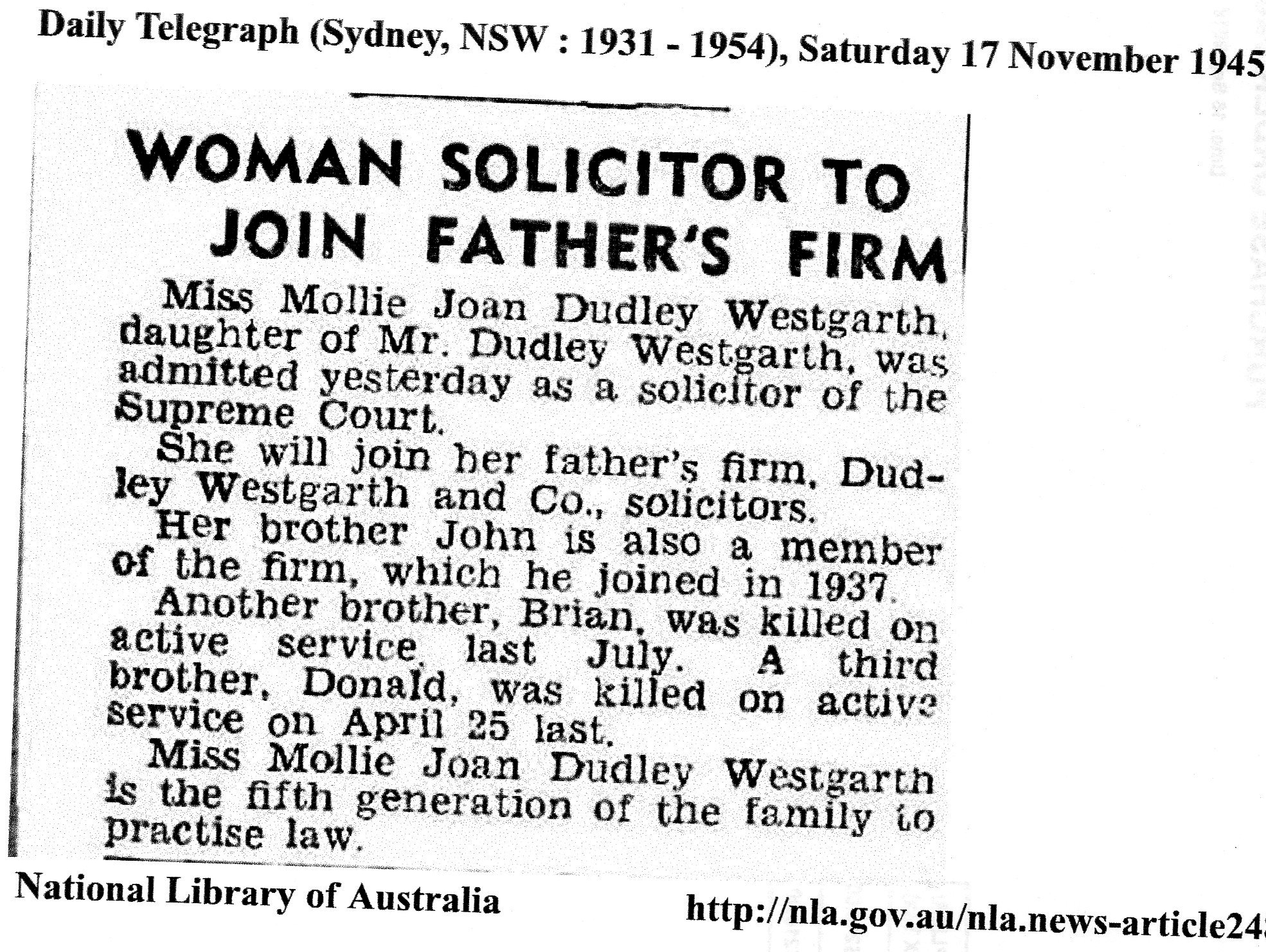
A sad little article which tells of the loss of talent which the war had caused. The five generations referred to are George Allen, his son Sir George Wigram Allen, his nephew by marriage George Charles Westgarth, his sons George and Dudley Westgarth and now John and Mollie. Although Mollie was a qualified solicitor, she admitted that she found it hard to work in an industry which, at that time, was a man’s world.
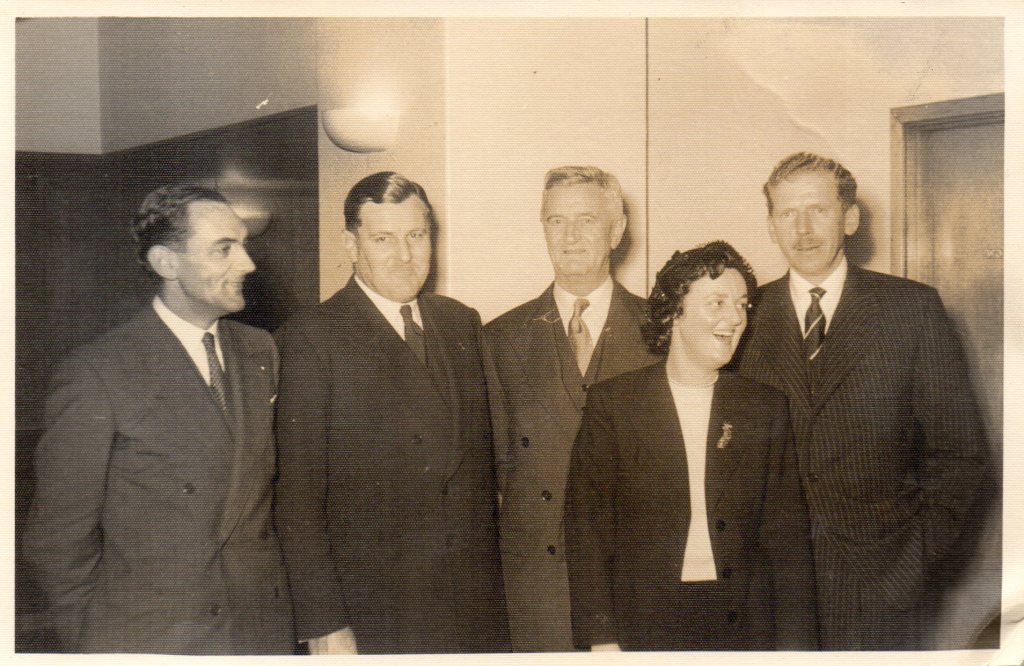
A famous legal connection and family scandal.
Ronald, Char’s older brother, had a son, Nigel and two daughters, Judith and Sheila. Judith met John Wentworth Shand at the Killara Tennis Club and as a result he left his wife and four children for her. He divorced his wife in November 1939 and married Judith, aged 28, in December. They had two children.
The photo below shows his celebration party, in January 1943, when he became a King’s Counsel. He was the top barrister of his time, but died in 1959 of cancer. Only a cottage in Pymble remained for his widow, who married again and lived into her 90s.
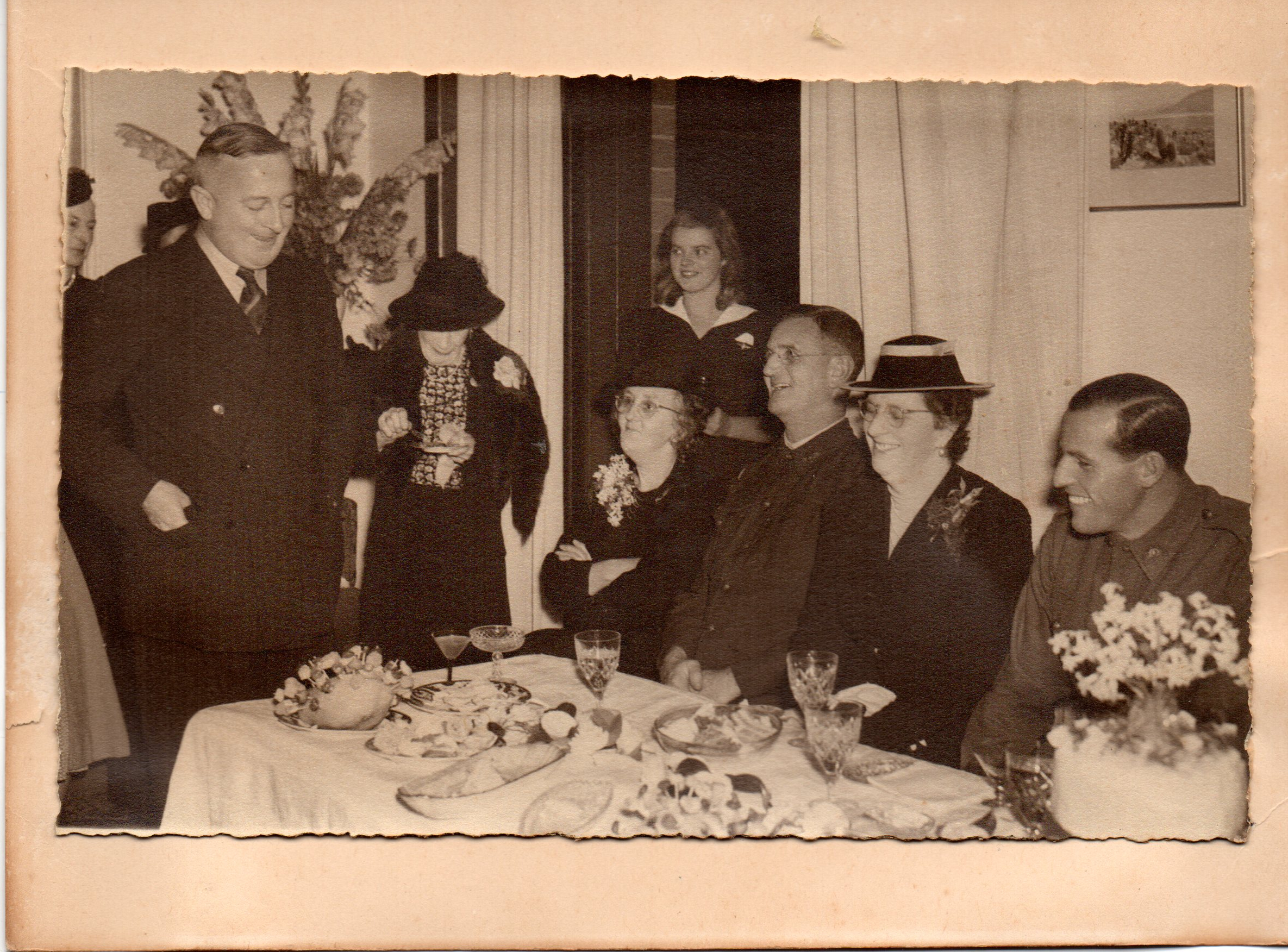
Moll goes to London
Soon after her admission, Mollie received a bequest in the will of Ina Campbell, which enabled her to make the sea voyage to London and work there, returning in August 1950. Before she left in 1948, she was one of three bridesmaids to her dear friend Dabee Evans who, two years or more after the death of Tonny, married Tim Bettington, a grazier from Merriwa, Hunter Valley, New South Wales. This must have been a happy ending to the tragedy of Dabee’s first love.
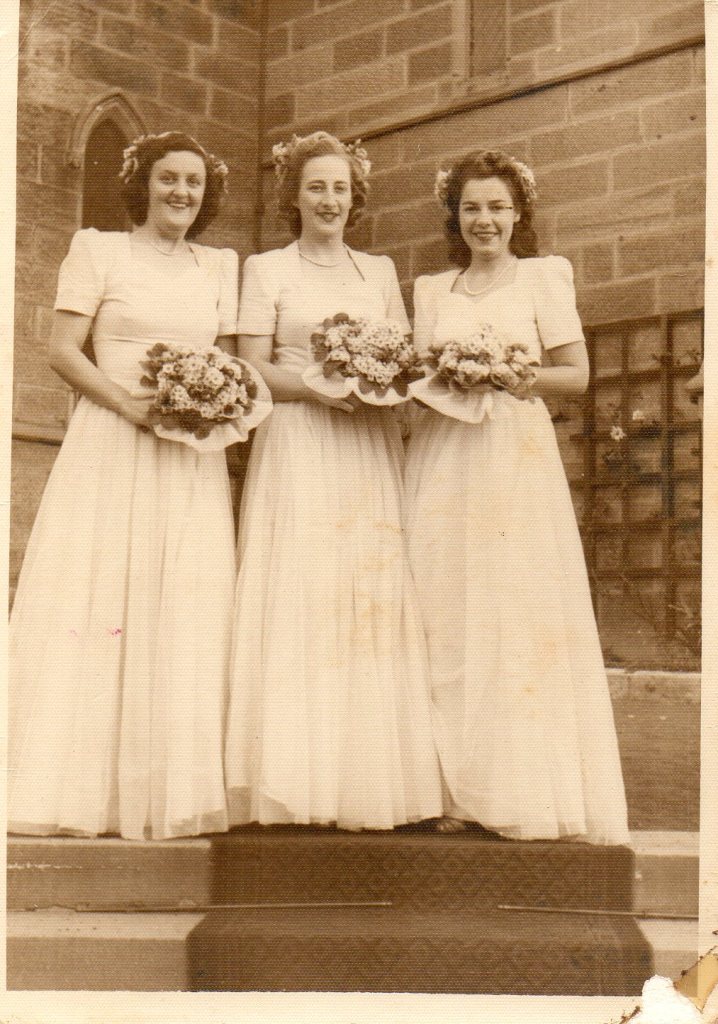
Bringelong:
Some time during the Depression, before his partner, McLachlan, embezzled the funds, Dudley must have invested in a cottage in the Blue Mountains at Wentworth Falls. All the children were at Cranbrook or Ascham by 1930, so the cottage would have made an economical and popular holiday venue for family and friends in the 30s. Remember that both Dudley and Kathleen came from large families and were used to having lots of people around.
The Blue Mountains were very popular for holidays between the Wars. Trains ran up the mountains, stopping at all stations to Katoomba, where the Carrington Hotel was enormous fun. Around Wentworth Falls and Katoomba were waterfalls, rock formations and lots of wonderful places to walk to. At Katoomba there were the famous rocks called the Three Sisters and the Scenic Railway made out of an old coal railway line. Further on, there was the Hydro Majestic, a magnificent hotel and spa, at Medlow Bath. Beyond the Hydro was the lovely Megalong Valley
Char, in his usual style, called the cottage ‘Bringelong’ which is presumably a corruption of ‘bring along’ – and that is what the children did, bringing friends to Bringelong for a mountain holiday. The cottage was built of weatherboards and had an open fireplace. Adjacent to it was an outbuilding called The Sleepout where there were lots of bunks. At the back of the house, the bush sloped down to a clear running stream. Lovely!
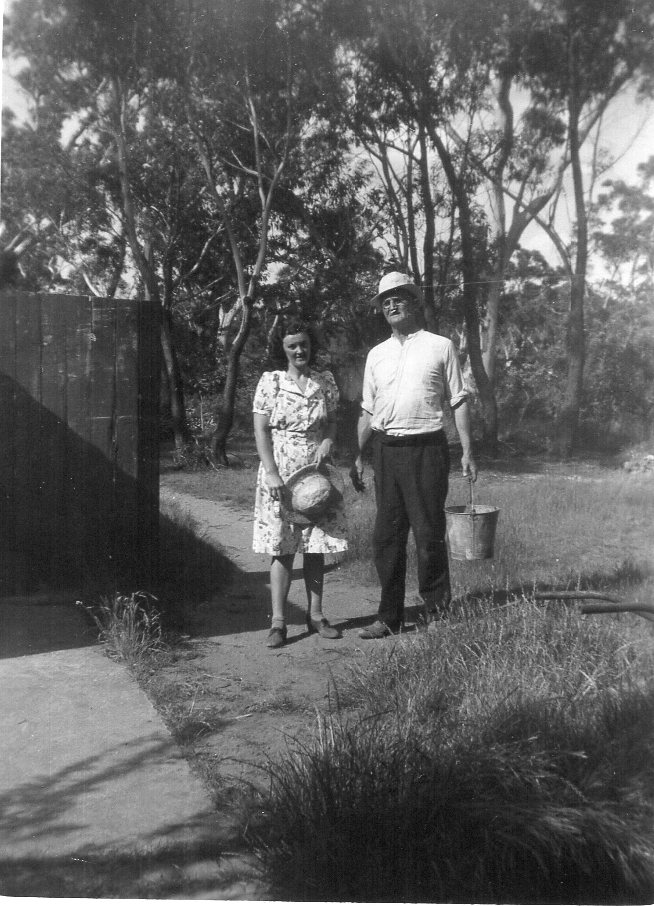
Our parents courted at Bringelong, having met at a Sydney dance party doing the Jolly Miller. In 1935 my father, John, was 22 and my mother, Barbara, 21.
My elder sister, Lynne, remembers going there during the war, catching the train crowded with uniformed men. During her stay, many ‘boys’ came and went, staying in the Sleepout, probably friends of Bunny and Tonny.
I remember going to Bringelong when I was four or just five, probably in 1948. Auntie Mollie took me down to the creek and we caught yabbies with a piece of string and meat. Afterwards I remember making toast on the open fire. Both activities were firsts for me and I have a clear memory of them. This photo is the evidence!
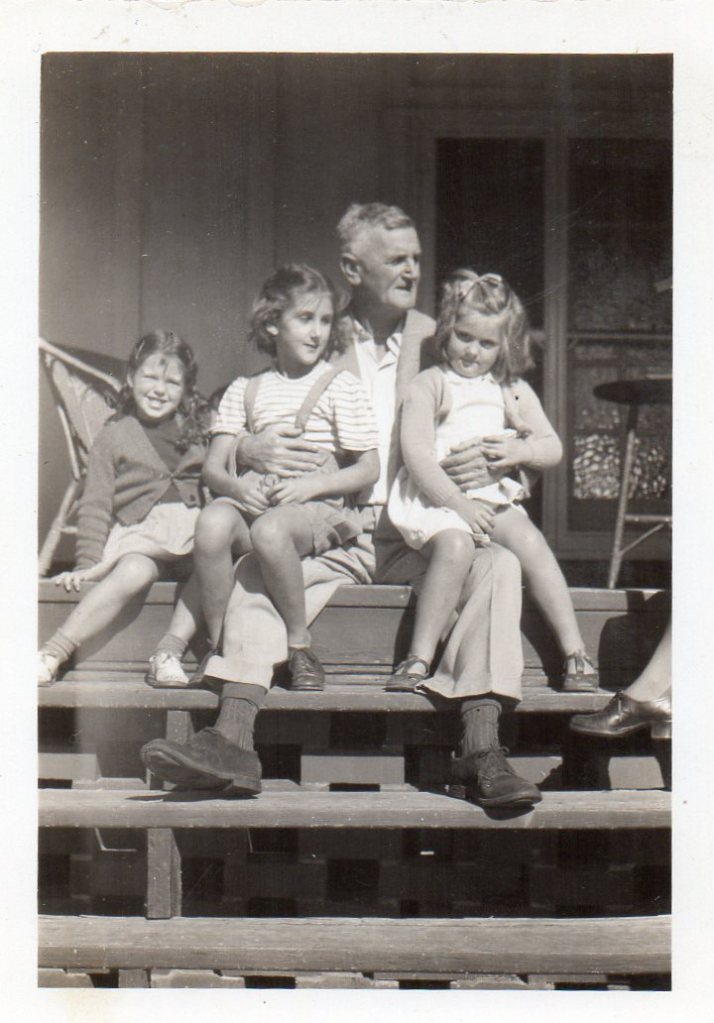
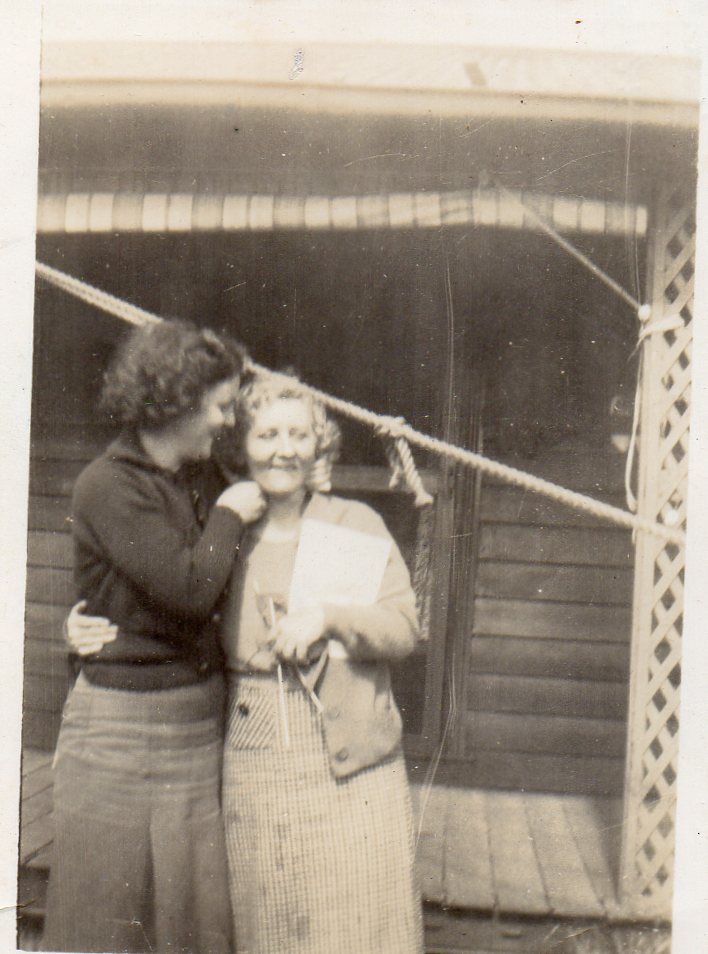
I never went again, because I believe the house burned down in one of the terrible bushfires which in the past raced through the mountains. My sister, Lynne, confirmed that Bringelong was burned down. Bad luck for the grandchildren!
Here are some articles from the period which explain the universal fear of fire and need to organise against it:
1938 Marriage of John and Barbara
In 1938, John had an established income and was 25 years old. Barbara (Eleanor Barbara Cairnes Boydell) was 24 and came from a wealthy family. Her father, Sydney Grant Boydell, was Clerk of the Legislative Assembly of New South Wales, youngest son of Bishop Broughton’s daughter, Mary Phoebe and William Barker Boydell. https://www.findagrave.com/memorial/144304790/mary-phoebe-boydell
The Boydells had a property, Allynbrook, and church, St Mary on Allyn, at Gresford, New South Wales. The property on the Allyn River is now called ‘Boydells’ and is a vineyard. You can also stay there. https://boydells.com.au/stay-with-us/
Her mother was Katharine Gill, the daughter of George Gill and Anna Maria Dinsmuir Cairnes. (My middle name is Cairnes. I am told it is a good Scottish name).The Gills (McGills) were three Protestant Irish immigrants from Derry, the capital of County Tyrone in Northern Ireland. They became sheep graziers in New South Wales and the eldest, John Gill was a member of Parliament for a few years. George Gill had a sheep station called Emu Creek, at Walcha. https://www.geni.com/people/George-Gill-Sr/6000000009619222277
The Wikipedia entry for Walcha gives the history at: https://en.wikipedia.org/wiki/Walcha,_New_South_Wales.
It states: “Hamilton Collins Sempill was the first settler in the New England area when he took up the ‘Wolka’ run in 1832, establishing slab huts where ‘Langford’ now stands. Other early runs around the district were Bergen-op-Zoom (1834), Ohio (1836), Europambela (c.1836), Surveyor’s Creek (1836), Emu Creek (c.1837), Ingalba (1837), Orandumbie (1837), Tiara (1837) and Winterbourne (1837). “ This property must have been settled by someone else and bought by George R Gill. The date is too early.
Wedding Day:
The marriage of John and Barbara was celebrated at the Cranbrook Chapel and the reception at Elizabeth Bay House on November 30th. They honeymooned in Tasmania, which must have been breathtakingly beautiful in those days.
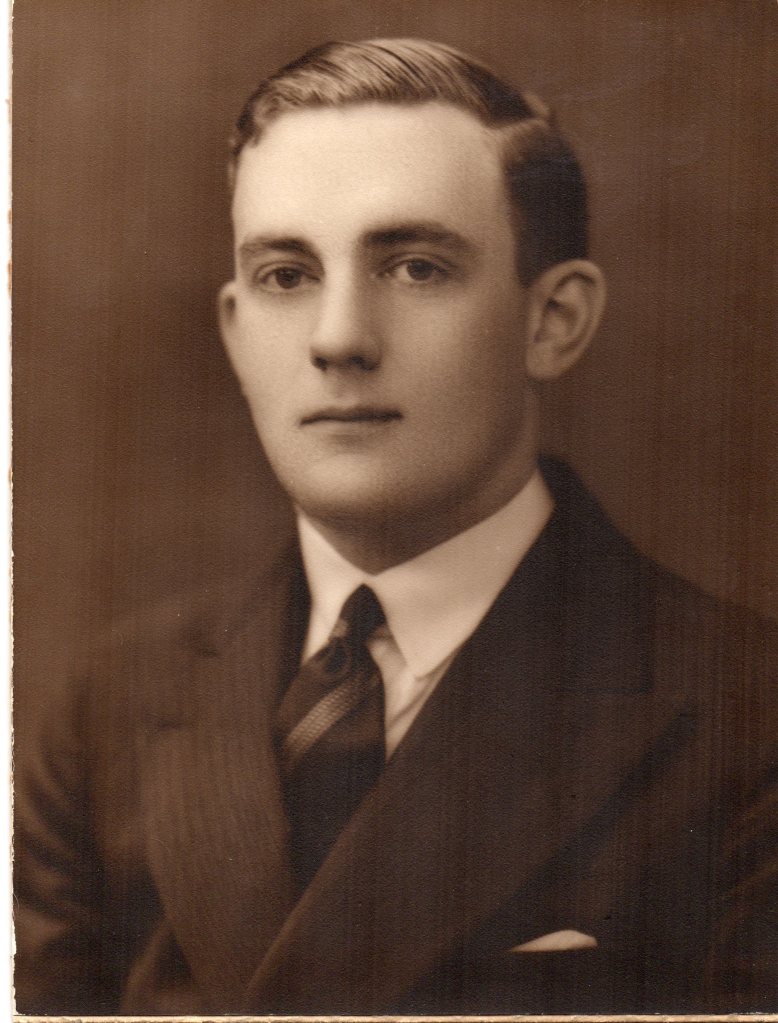
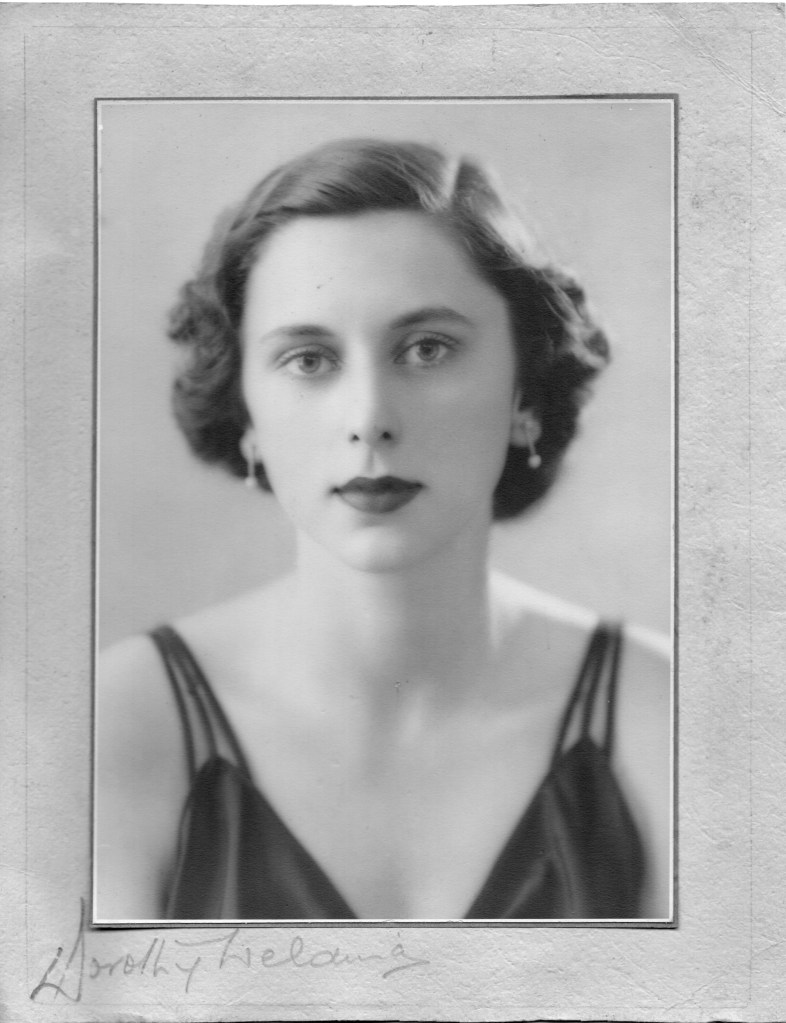
The article that accompanies this photo talks about the beautiful clothes of the bride and bride’s mother. The Boydell family had the money to spend on clothes and loved clothes. In contrast, Kathleen had a sewing woman, Mrs Clinch, an English widow, who came regularly to make clothes for the family. Kathleen would have been wearing a home made dress.
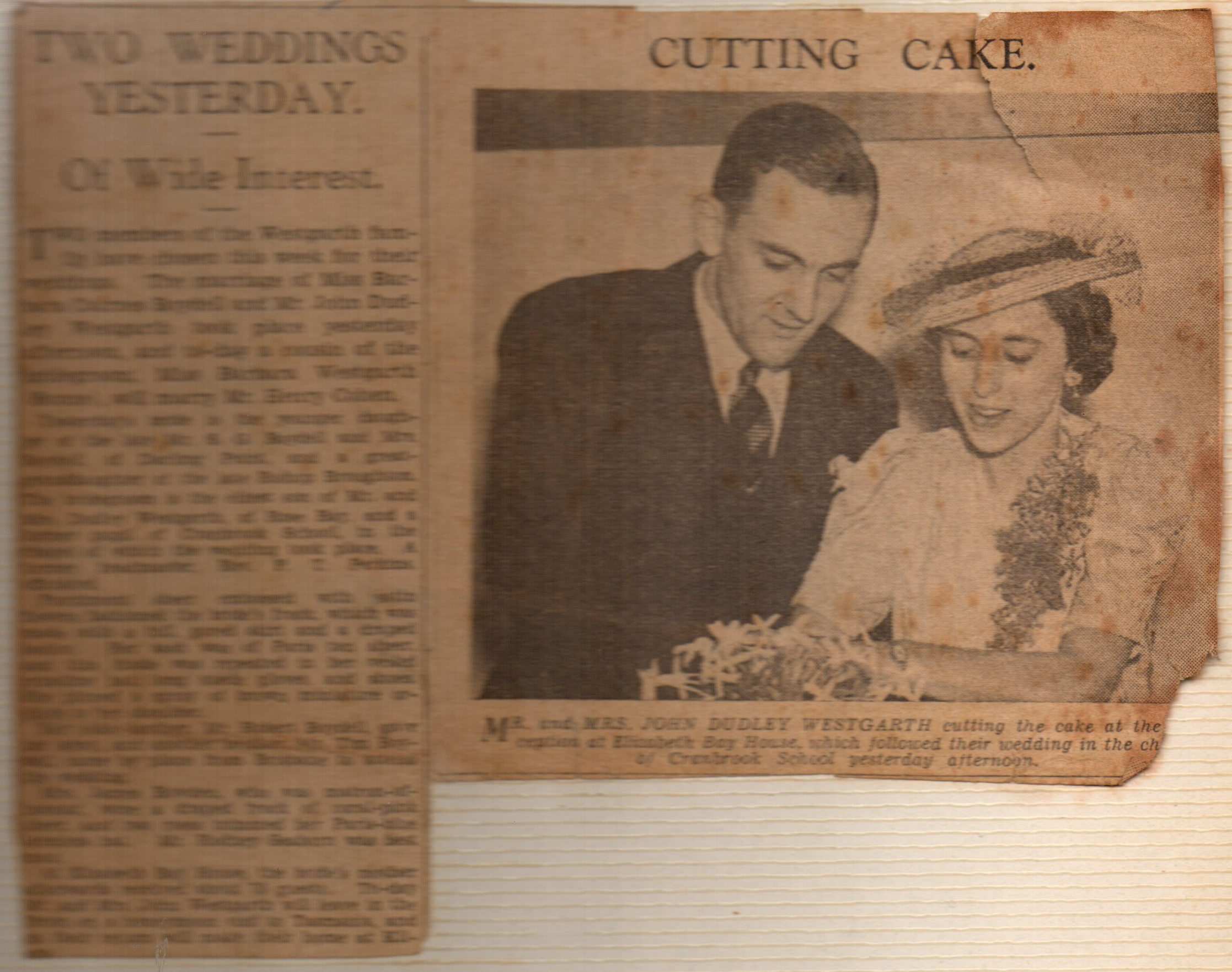
Wartime:
On September 3rd, 1939, Britain declared war on Germany because the Nazis led by Hitler had begun their campaign of aggression by invading Poland. Hitler soon followed this conquest by moving west across France, the Netherlands and Belgium. Hitler and his allies became known as ‘the Axis powers’ and Britain and her allies were ‘the Allies’.
For Kathleen and Dudley the outbreak of war in Europe must have been one of the worst moments of their lives, if not the very worst. They had three sons all of fighting age. They had each lost their favourite brother in the last war and seen the memorials go up, all over the country, to the thousands of others who had not returned.
According to the First World War page on the Australian War Memorial website, from a population of fewer than five million, 416,809 men enlisted, of which over 60,000 were killed and 156,000 wounded, gassed, or taken prisoner. The latest figure for those killed is given as 62,000, Nov 8, 2019
Australia follows Britain in declaring war on Nazi Germany:
Great Britain declared war on Germany and her allies (the Axis) on September 3rd 1939. Australia declared war the same day, even though Australia was no longer a colony, because we were part of the British Empire and George V1 was our King.
To Kathleen and Dudley’s distress, all three sons signed up for the forces by 1942.
By 1940 they had sold Bellsize and moved to 519 New South Head Road Rose Bay. By 1942 they were in ‘The Annery’ 3 Marathon Road, Darling Point.
My elder sister, Lynne, went to stay with them there during the time that John, her father, was in the Matilda Tank Battallion. That was when Dudley/Char made her the stove. Char and Yaryar/Kathleen would remain at The Annery until the end of the war when the fate of their brave sons was clear.
Lynne told me she was Yaryar’s kitchen helper’. “She was always cooking or knitting socks on four needles. She made fruit cakes for ‘Food for Britain’ 24 hours a day. I don’t know when she slept”, said Lynne. Kathleen would have been cooking and knitting socks since 1940 as she had done as a young wife during the First World War. She was so small, but her heart was so big.
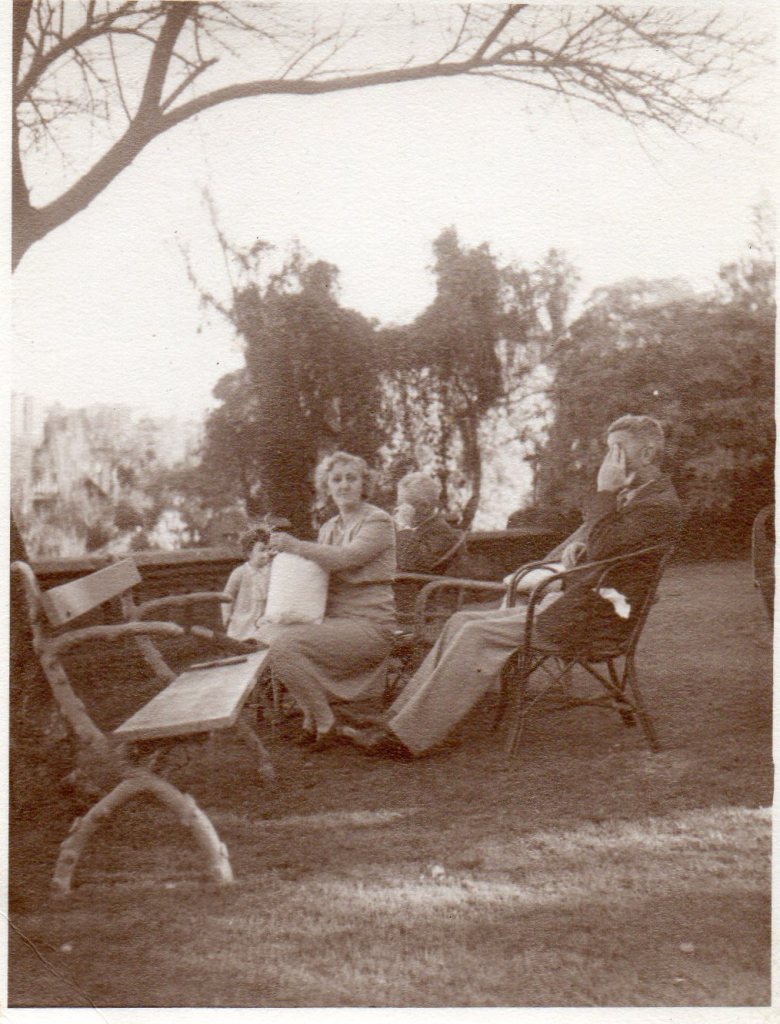
As well as all the other sadnesses of sons going to war, Yaryar’s mother died on 13th April, 1942. She must have moved to Rose Bay where Eric, her son lived at 17 Balfour Road, Rose Bay. She had arteriosclerosis and had been in the Thornbury Convalescent Home, Newcastle Street, Rose Bay. The location would have been very good for the Westgarths to be able to visit and care for her. Aunt Ruth, her second daughter, also lived in Sydney.
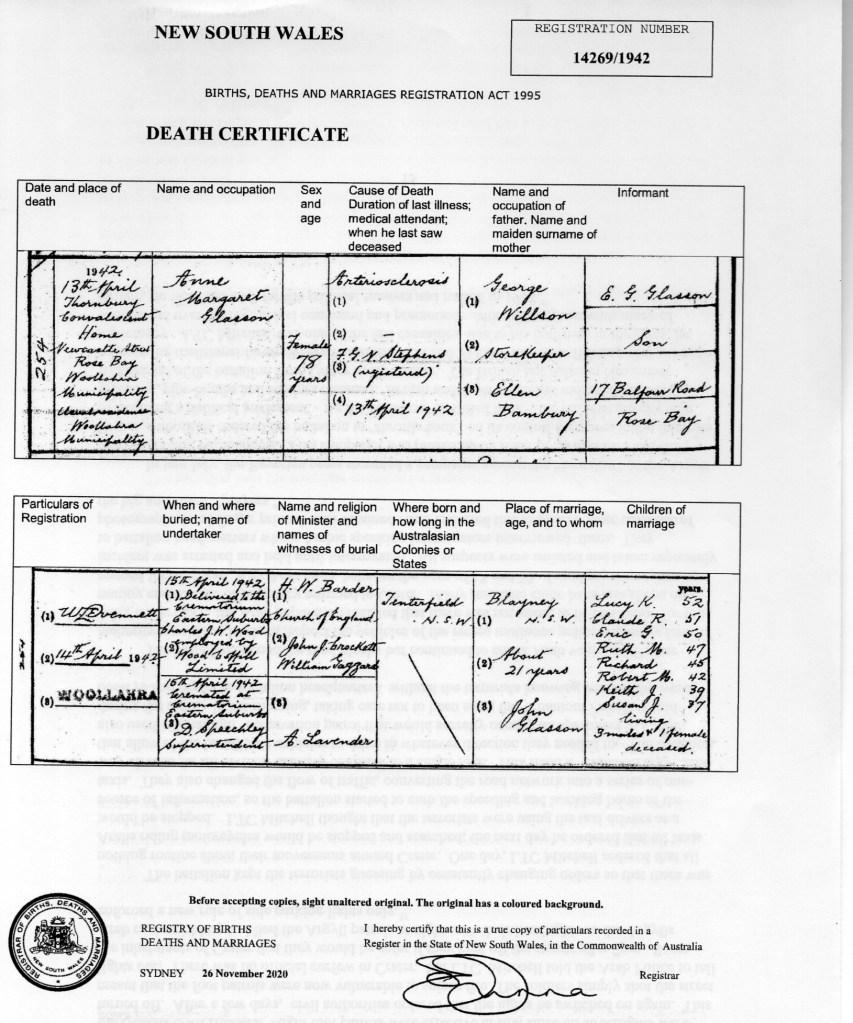
Dudley and his sons all joined the Citizen Military Forces. Here is Dudley’s record in the National Archives:
WESTGARTH DUDLEY : Service Number – N225537 : Date of birth – 01 Jun 1887 : Place of birth – SYDNEY NSW : Place of enlistment: RANDWICK NSW : Next of Kin: WESTGARTH LK
John, Enlisted 21st August 1942.
John’s CMF number was N84890. All recruits from New South Wales had an N before their number. Victorians had a V and so on. Those who joined the AIF had NX before their number. You will see that on the service records below.
Perhaps the Fall of Singapore on January 31st 1942 prompted John to join the AIF and prompted his choice of a tank battallion. If the Japanese, who were now in Singapore, reached Australia, tanks would be used to fight the enemy.
Here he is in his new uniform with mum and Lynne. Mum was expecting another baby but she had a miscarriage carrying buckets of water in the 1942 drought. It was a boy.
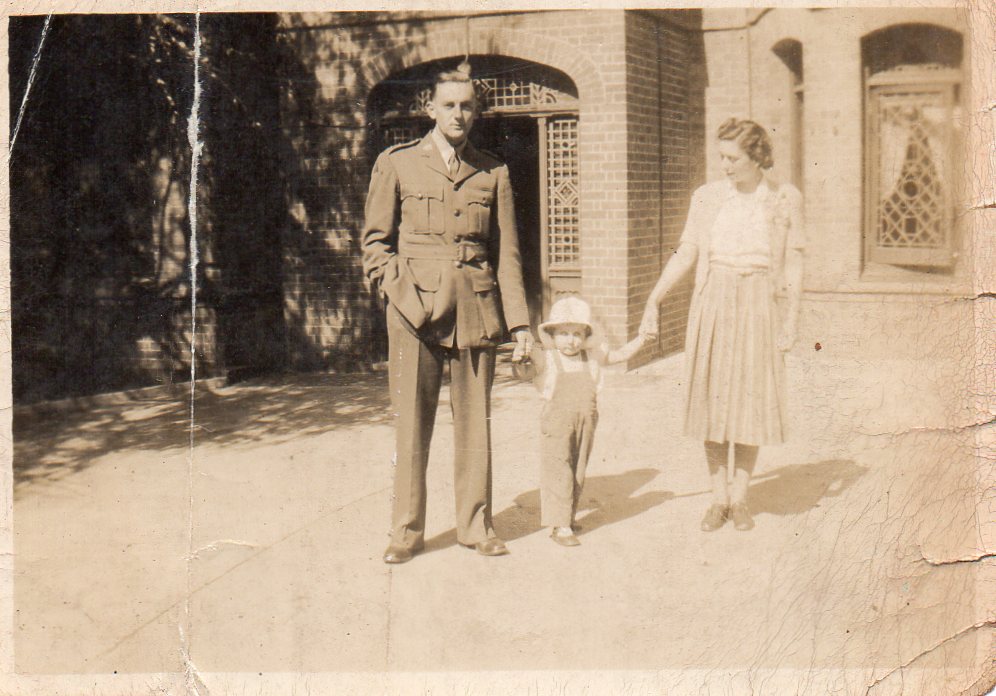
Here is John’s record from the 3rd Australian Tank Battallion, Australian Tank Corps of the Australian Army.
The ip address for this certificate is: http://www.ww2roll.gov.au/script/veteran_certificate.asp?VeteranID-221502
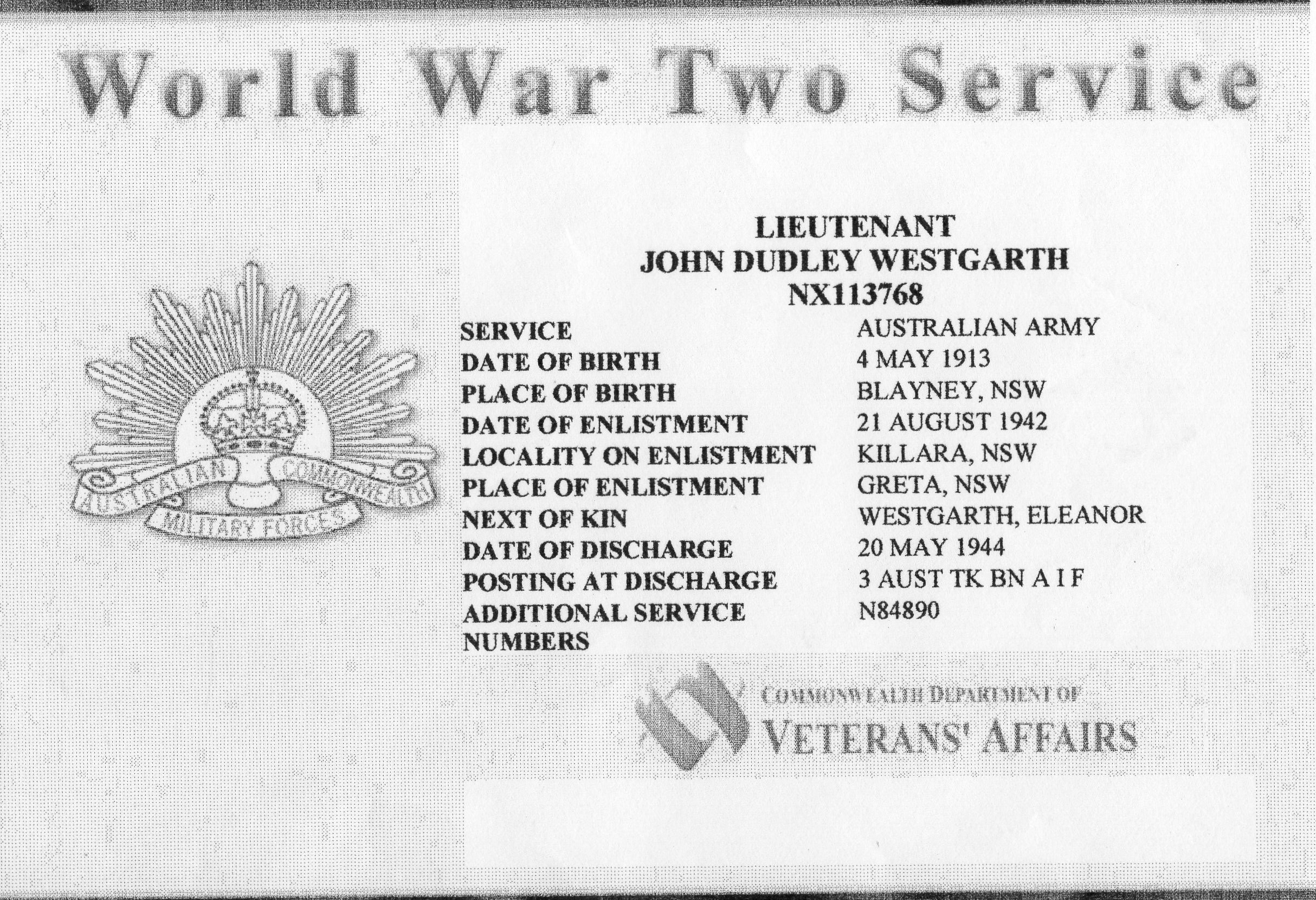
He was lucky that tanks could not be used against the Japanese in the islands, so John was demobilised without having to fired a shot in 1944. You can see here he was living in Killara with Eleanor Barbara Cairnes Westgarth (nee Boydell), his wife who hated the name of Eleanor!
At first they lived at 41 Powell Street, Killara, but when John was demobilized on 20/5/44 he returned to 5 Coronga Crescent, Killara. With my father in the tank battallion, my mother moved around quite a bit, probably to get support for Lynne who was only 2.
I was born on 24th September 1943 and at that time mum lived with her mother, Katharine Boydell, in Edgecliff Road. I cried a lot and my grandmother hated it, perhaps because she was so frail, saying “Stop that baby crying!” So I was given a dummy.
When we moved to Coronga Crescent in 1944, Mrs Boydell, my grandmother, went to live with Robert (Bob), her eldest son. She died soon after.
Dad called his Matilda tank ‘Barbara Lynne’ after his wife, Eleanor Barbara and daughter, Barbara Lynne, born 11/2/1940.
John’s enlistment form which is held in the National Archives:
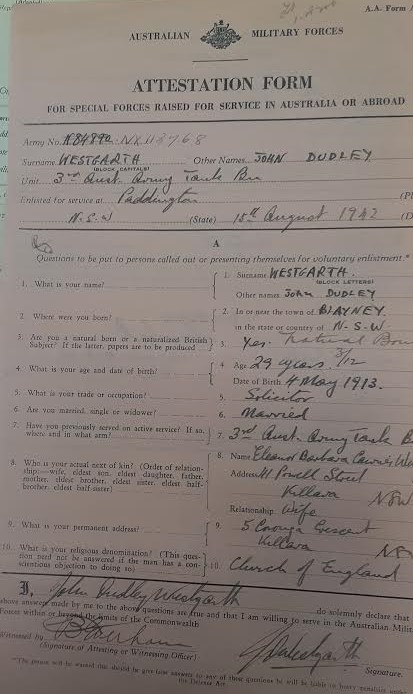
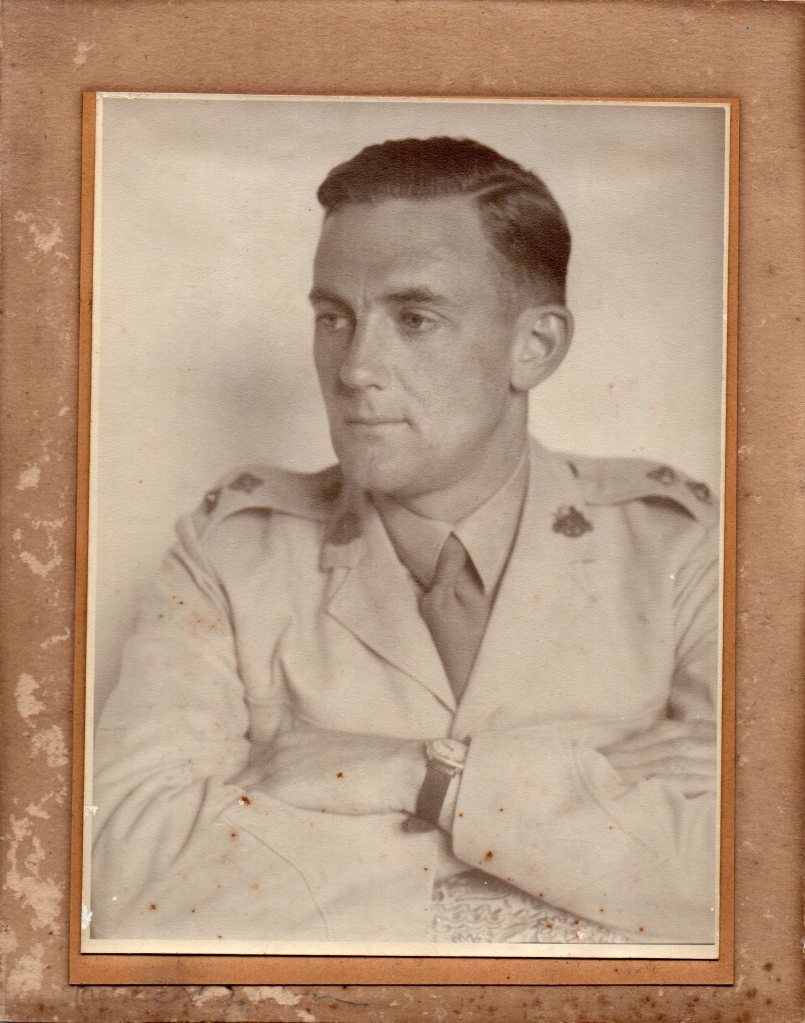
Lucky for John and for all Australians, the Japanese did not reach our shores except in raids, so John was demobilised on 20th May 1944. At that time, the AIF was fighting in New Guinea and tanks were of no use in that terrain.
Captain John
John had been in line for a promotion to the rank of Captain. The Australian National Archive holds the papers in Melbourne, as property of the Army. In 1948, John was given the rank of Captain. (It seems to me to have been quite an unnecessary effort, as he did not fight. But of course he would have if the Japanese had arrived.)
Dudley enlisted in the Citizen Military Forces
On 1st April, 1942, with the Japanese coming closer, Dudley, aged 54, joined the CMF. Dudley liked a little joke, so perhaps he thought of himself as an April Fool enlisting at the age of 54.
Of course he still had his legal practice to run, so his aim in joining up was to be available when the ‘chips were down’ I suppose. Anyway he was eventually demobilised because he ‘did not attend parades’. I thought this comment was very military and very funny!
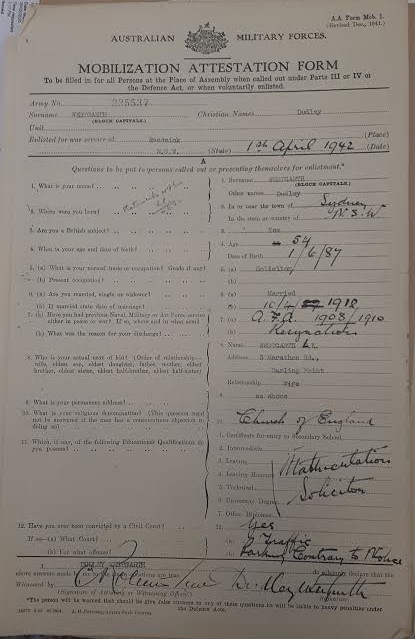
I have a lot of information about Dudley from his enlistment papers which are held here in Canberra. From the form below, I learned that Dudley had the family gall bladder problem, that he had never been vaccinated in his life and that he had contracted the Spanish Flu, which killed millions round the world in 1919, after World War 1 (and was the last pandemic before the Covid 19 which is sweeping the world as I write in 2020).
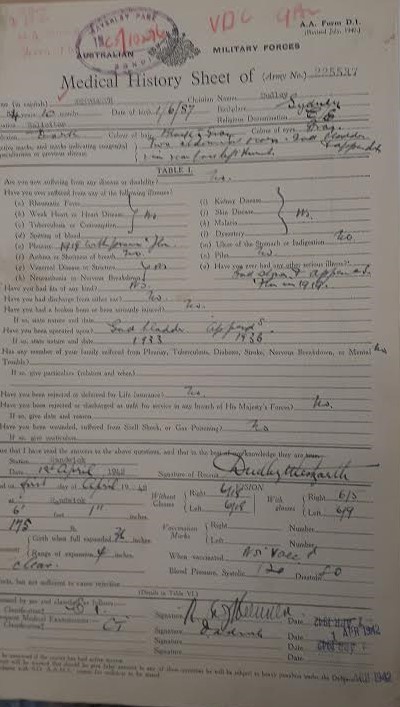
The form also shows that at 54 he had perfect blood pressure and was a good weight for his height. You can see below that he would be a useful person to have in a unit as he was handy at a lot of jobs, both manual and intellectual.
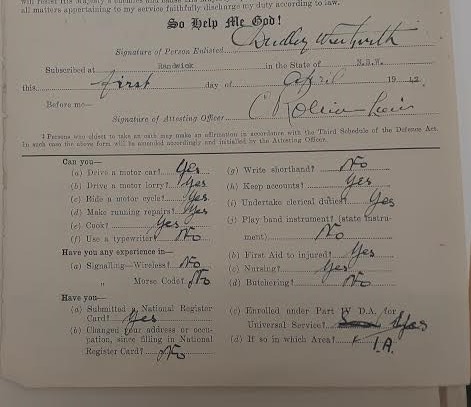
Dudley was given a NX number for the Australian Imperial Forces (AIF) which was the Army, but he seems to have stayed in the CMF and was demobilised in 1944. Here is the official form which has his CMF number 225537.
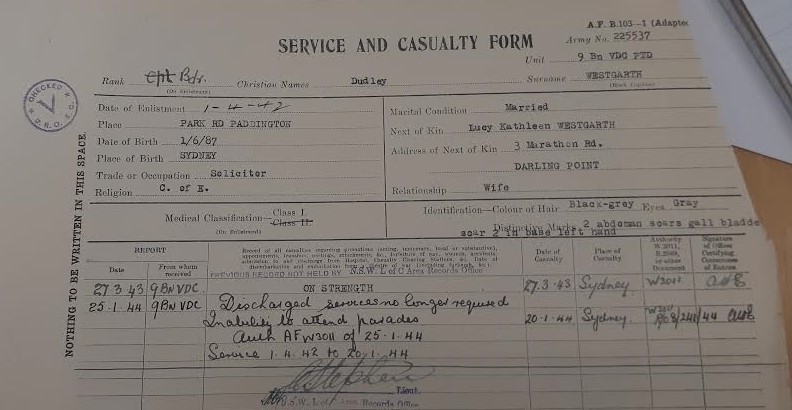
Brian enlisted in the Army 10/4/1940
Brian, or Bunny, the clever one, who was said to ‘have the common touch’, had no girlfriend when he joined up. He was already a qualified barrister and an accountant, although he was only 23 years old. In 1917 he had been born a British subject, as Australia was part of the British Empire, and this is surely the reason for his quick response to the call to arms.
He had been in military units since his time in high schoo. He was in the CMF from 15/11/1939 to 30/4/1940 but I could not find his number. He went on from there to the AIF, to fight the enemy in foreign lands. Here is an overview of his service, written up in 1983 by the Central Army Records Office in St Kilda, Victoria:
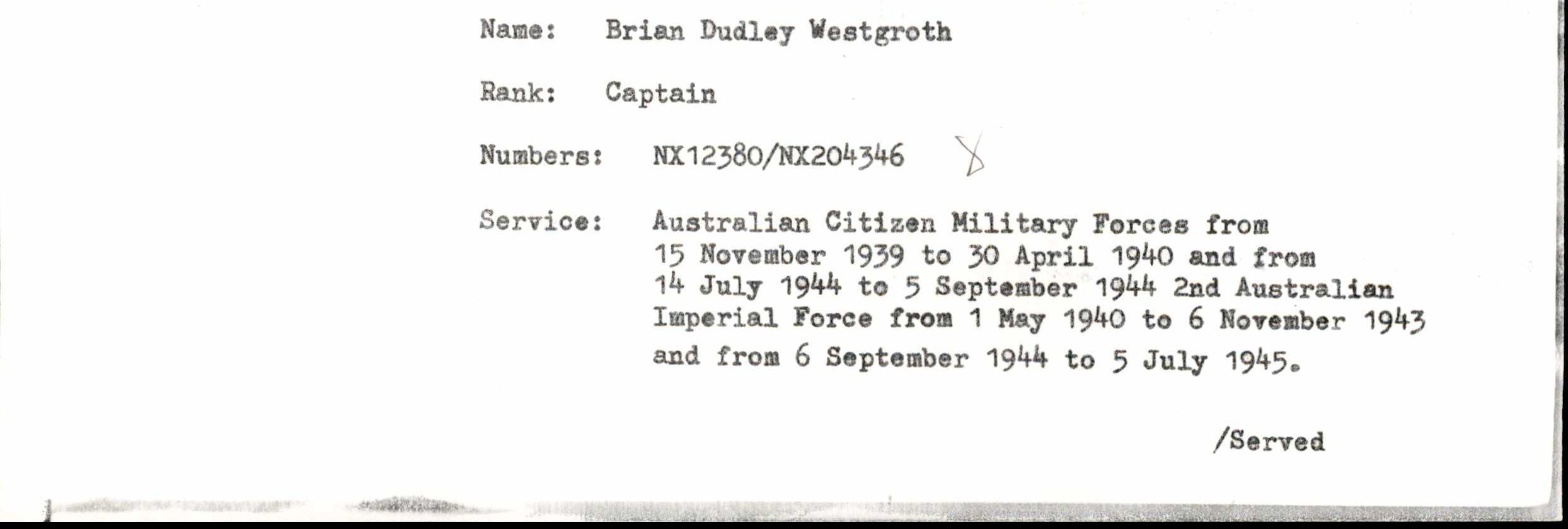
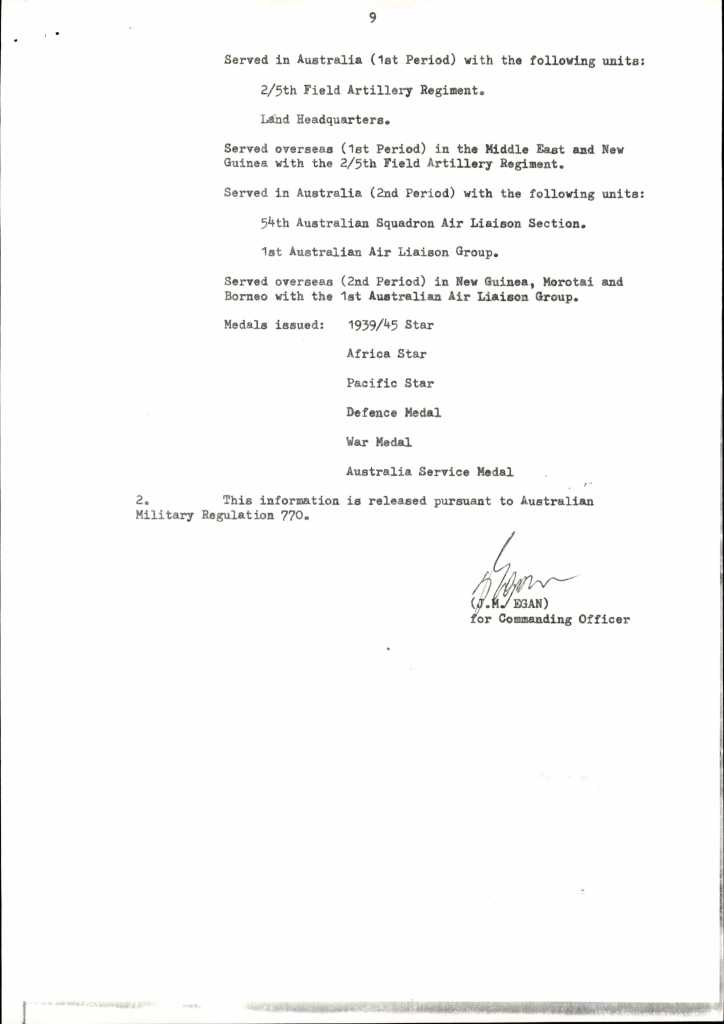
Here is Brian’s enlistment form for 10/4/1940. He already had achieved a Law Degree with Honours and had studied Accountancy. At just 23 he was practising as a Barrister when war broke out on September 3rd 1939.
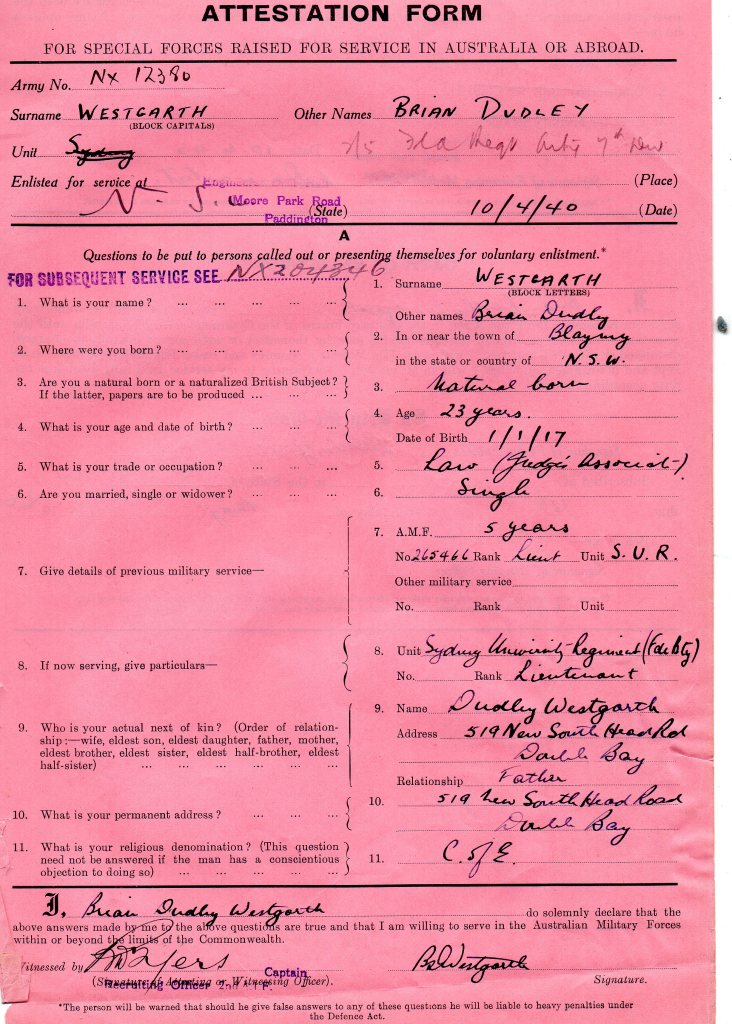
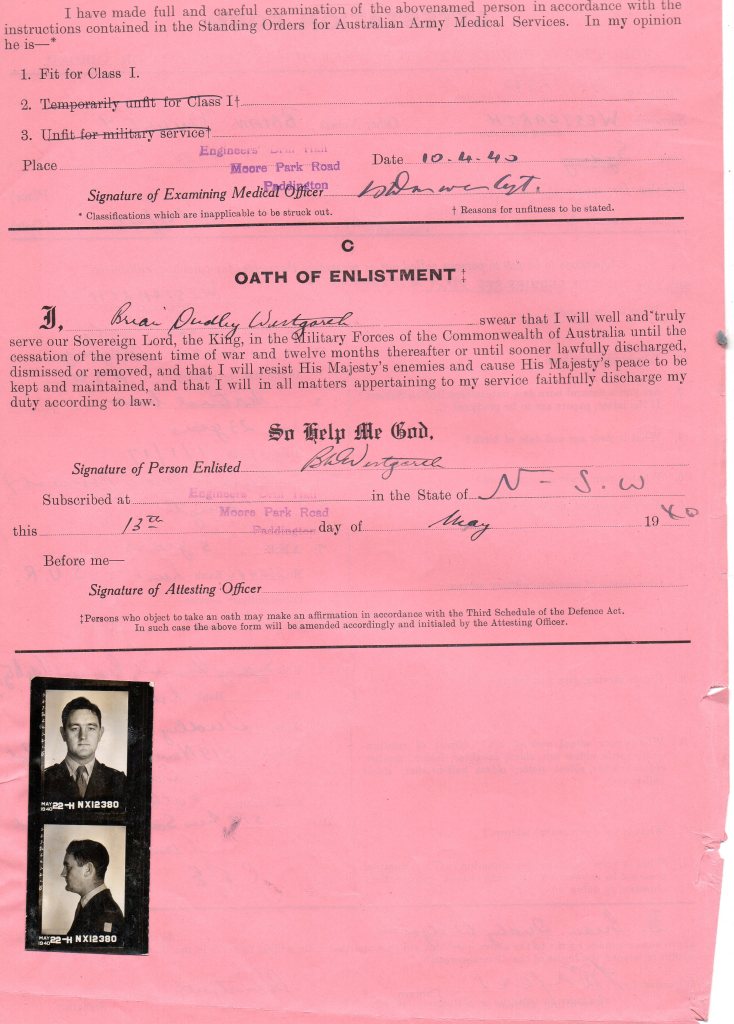
After his service in the 2/5th Australian Field Artillery Regiment, in the Middle East and then New Guinea, He embarked for Australia on 7th February 1942 and debarked on 18th May. He then worked at headquarters in Melbourne. in 1943 with the Japanese approaching through the islands, Brian applied to join the RAAF and become a pilot:
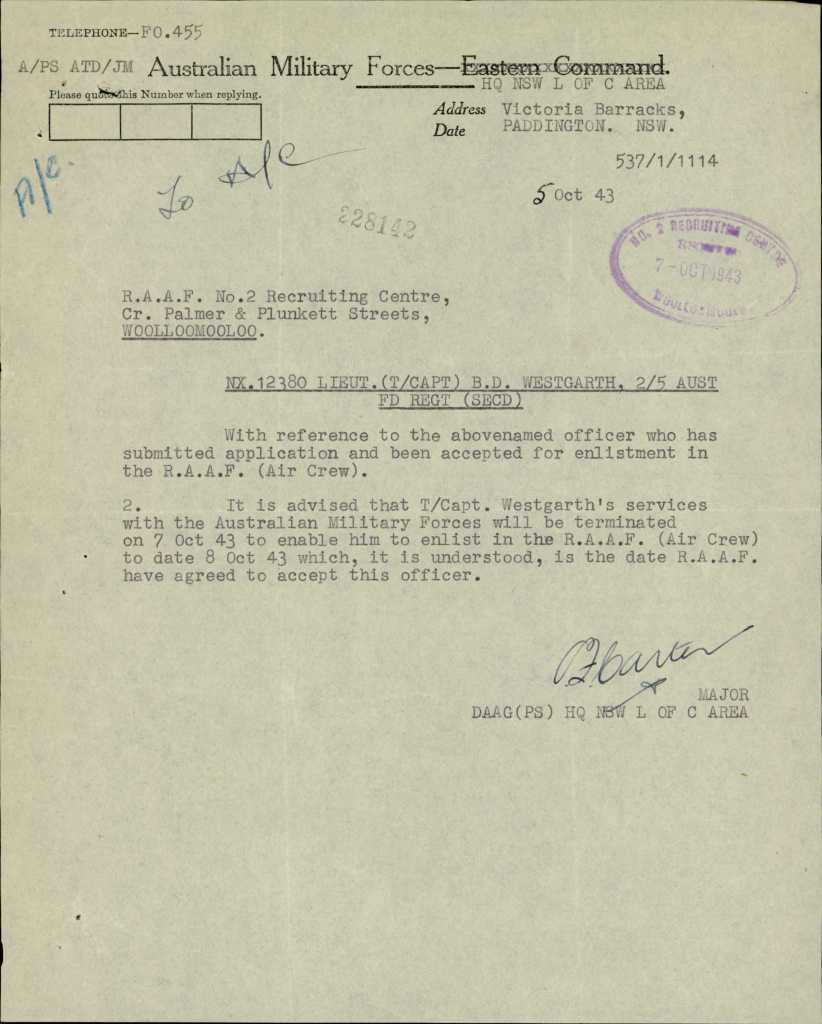
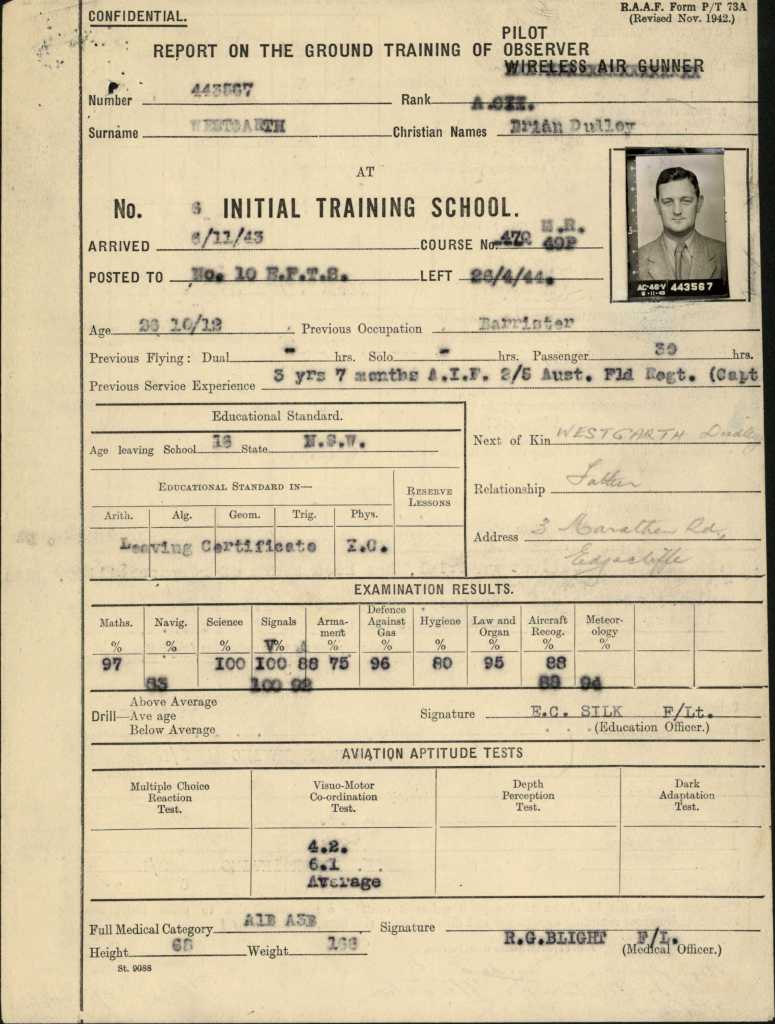
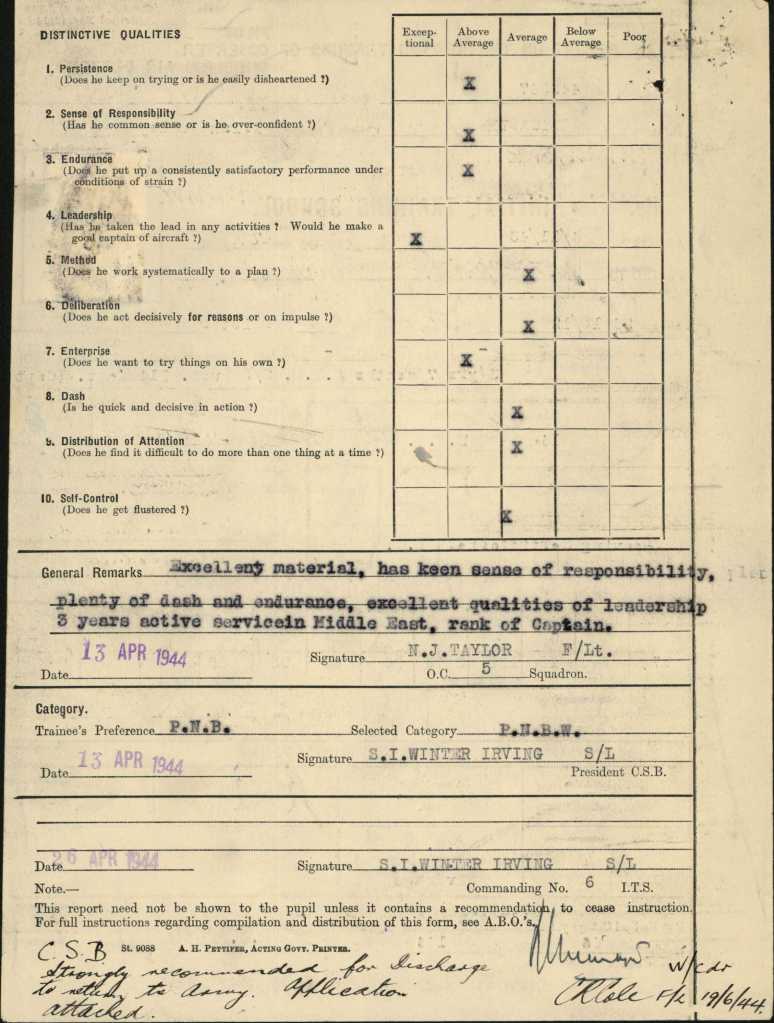
Unfortunately, although he had so many qualities, he did not have the athleticism needed and failed his pilot’s traininig:
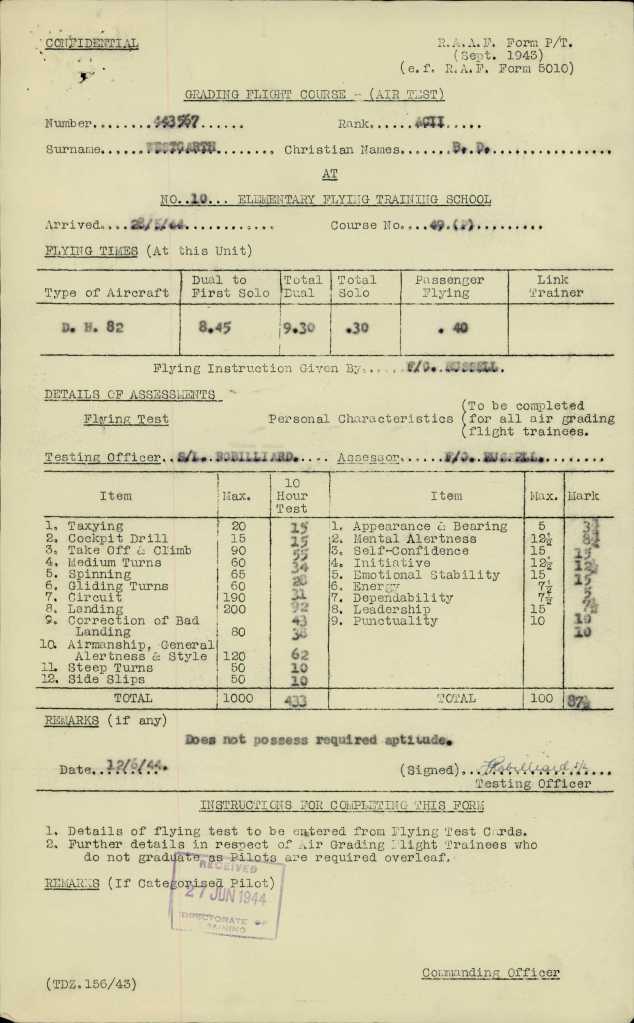
At this stage, he was recommended by all to go back to civilian life. He had given such good service and the war in Europe was already won. Also, he had so much to give in his profession. But Bunny refused to stop the fight against the Japanese and applied to re-enlist in the Army
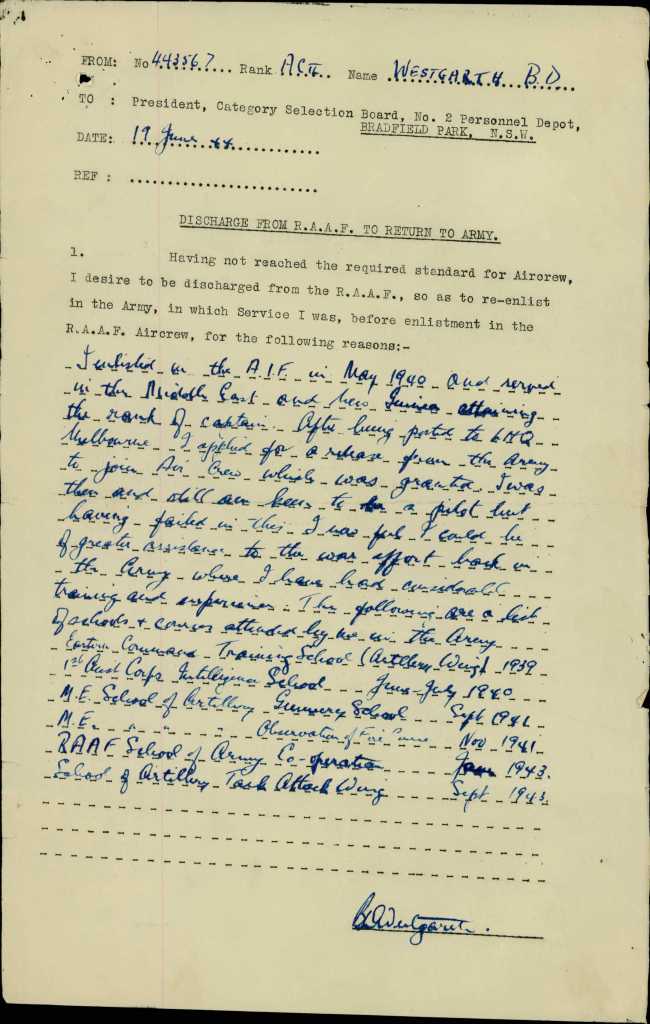
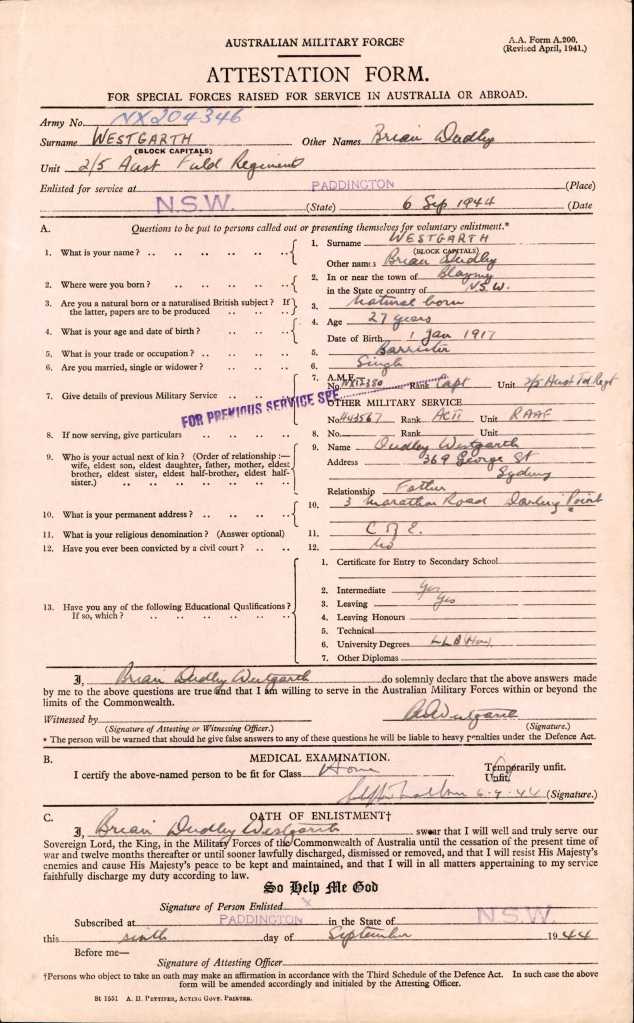
Owing to the kinds of courses attended and his natural sense of dury, Bunny was sent to Air Observation units. Firstly, he was with the 54th Australian Squadron Air Liaison Section and then moved to the 1st Australian Air Liaison Group.
As an Air Observer, Bunny’s job was as part of a bomber crew, reporting information to headquarters whilst flying over enemy territory. He also had to direct the gunner.
On 5th July 1945. on a mission in a Liberator bomber over Balikpapan, southern Borneo, where the Japanese had bases, Bunny and all the crew were killed. Here is a report issued the same day:
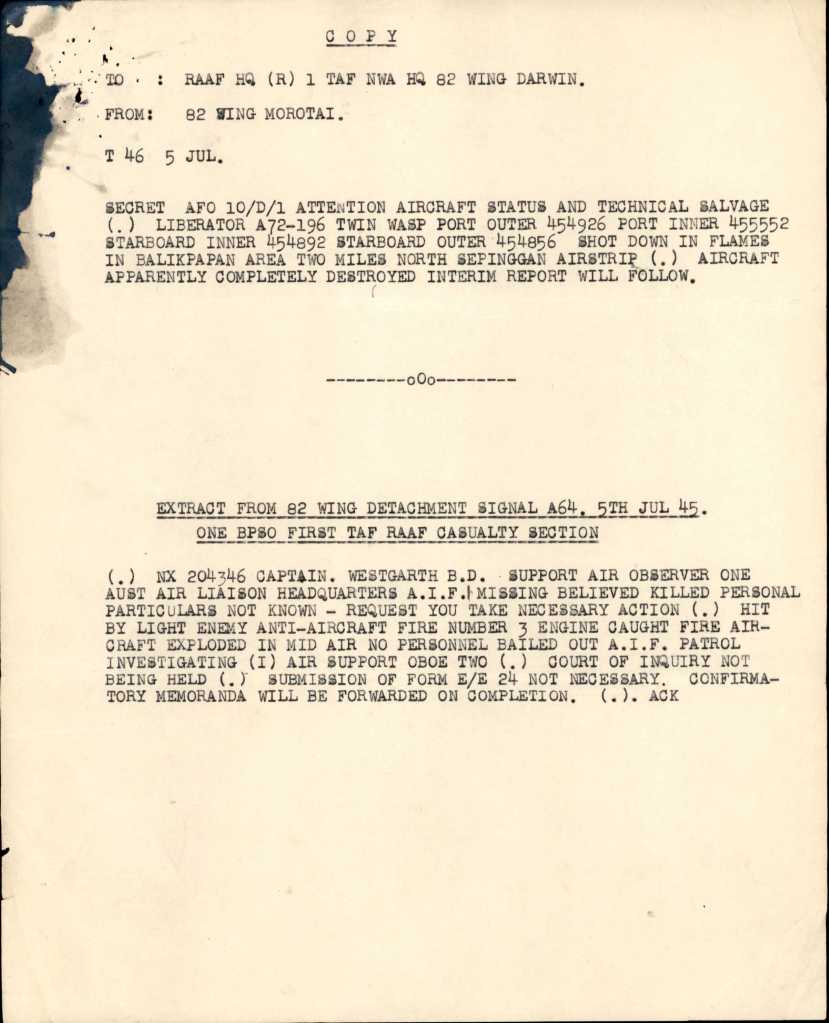
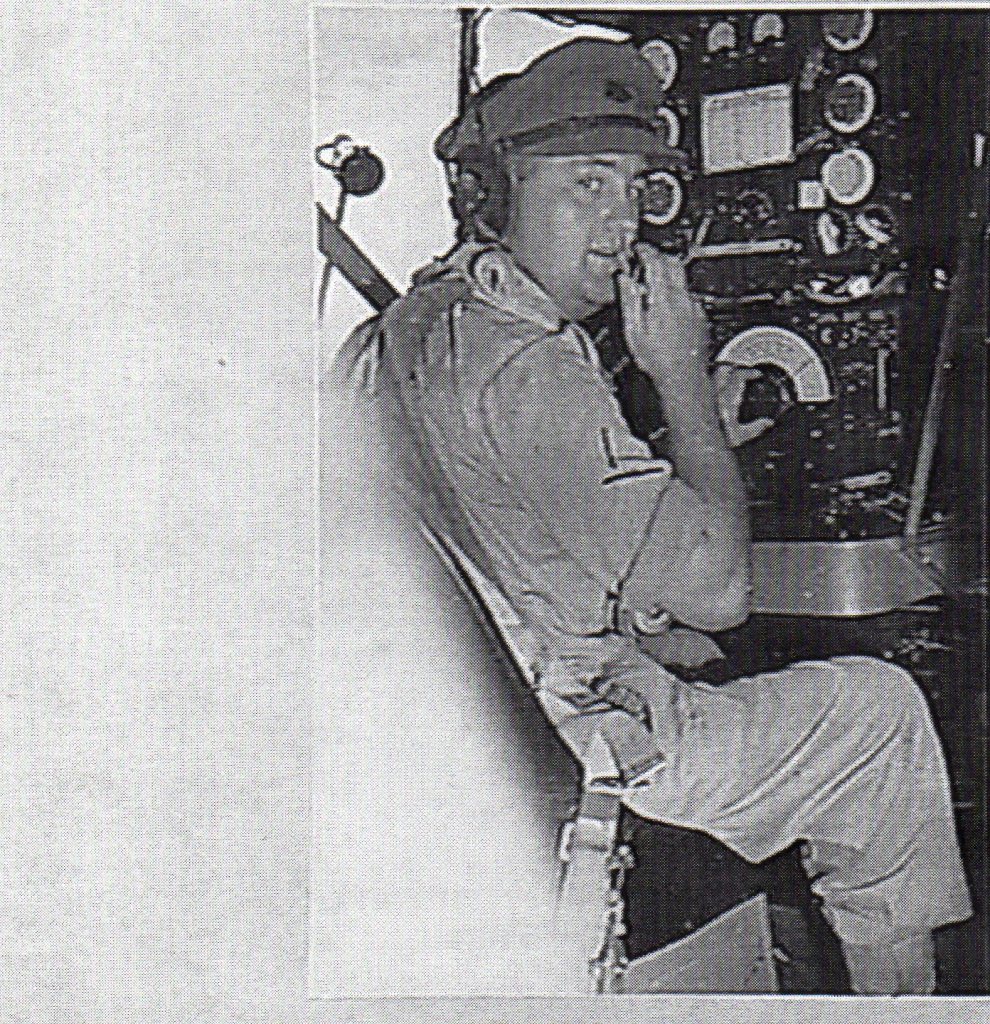
An informal portrait of Captain B D Westgarth, 4 Command Army Liaison Section GP 813 RAAF at the radio set in an Avro Anson Aircraft. Captain Westgarth was killed in action during operations over Balikpapan (Borneo) on 5th July 1945.
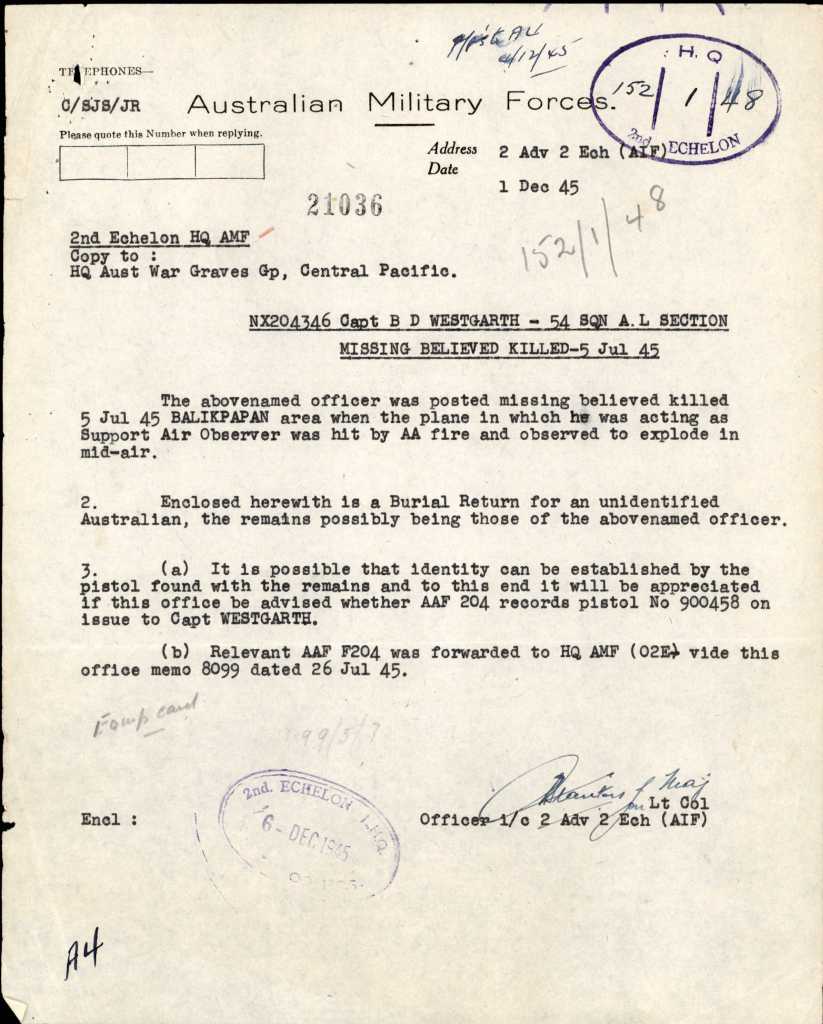
Brian’s body was identified and buried. This letter expresses how much he gave and could have given if he lived:
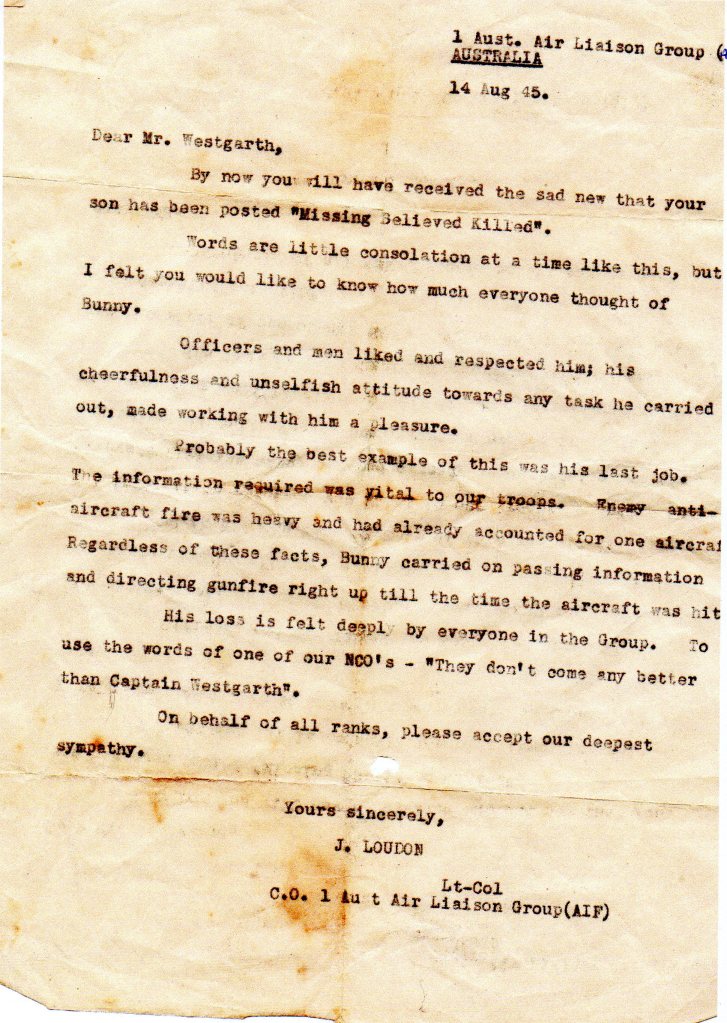
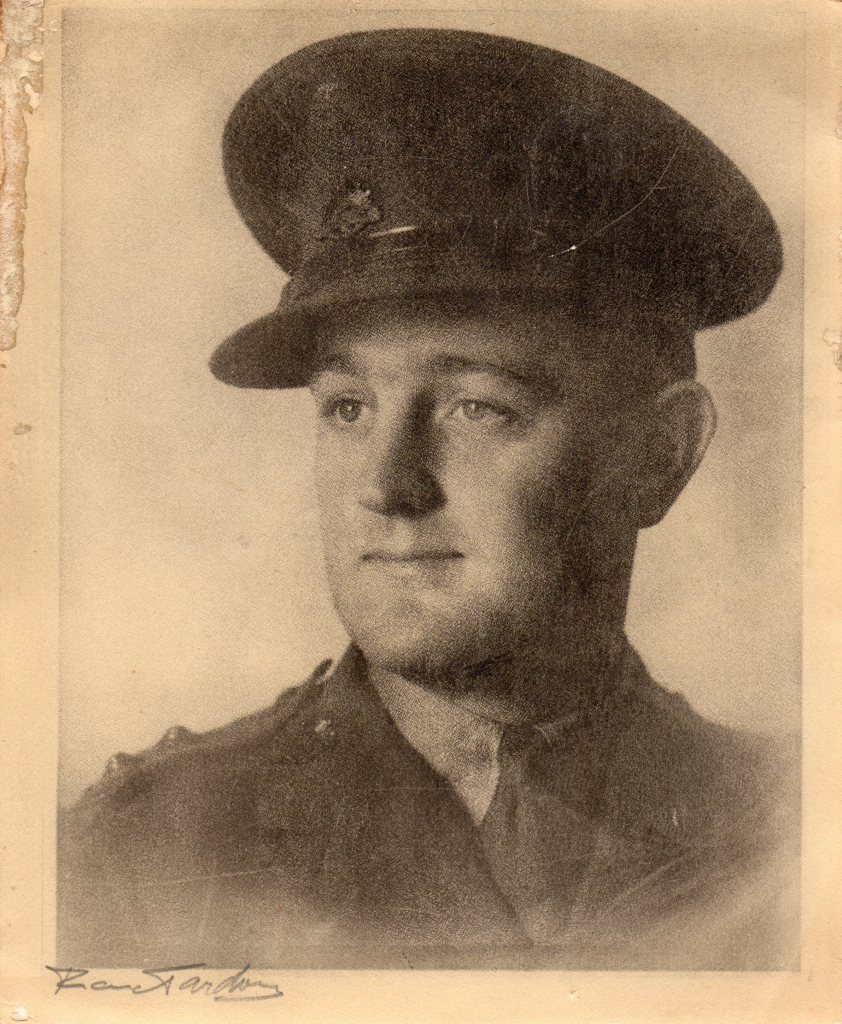
Amongst the clothes and shaving gear and other effects returned to the family after Bunny’s death, were two chess sets and a book on chess. A chip off the old block!
Cemetery – Labuan War Cemetery, Sandakan, BORNEO
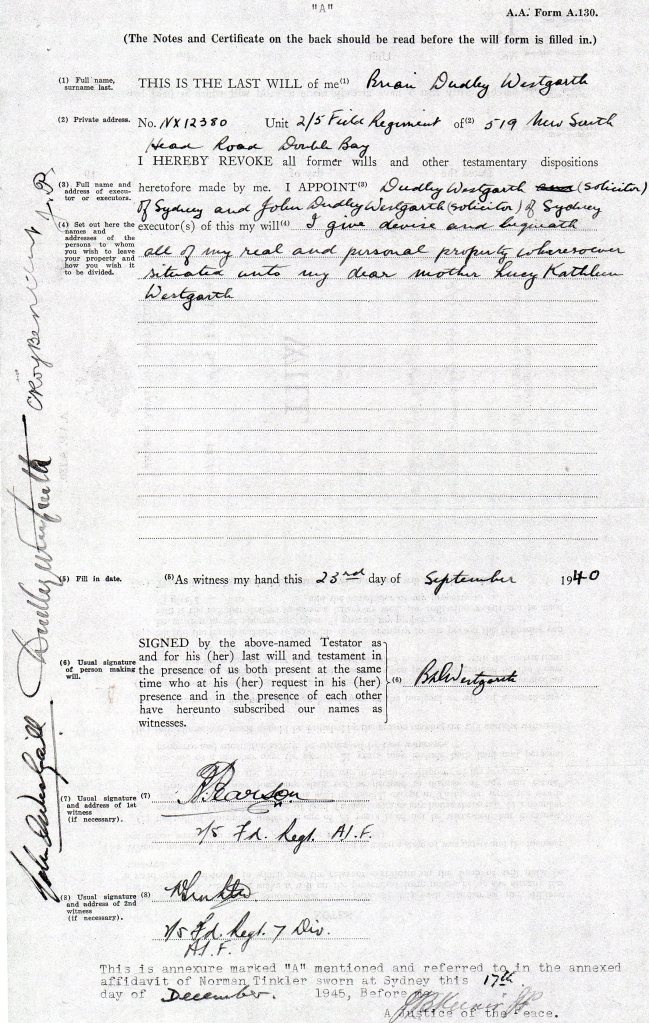
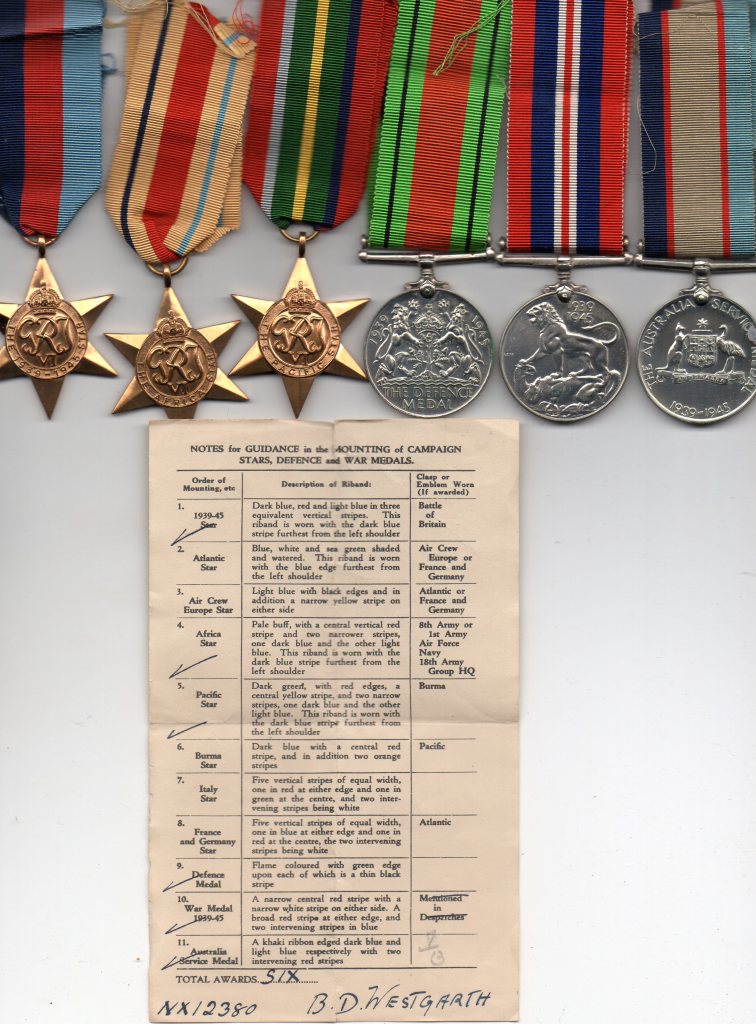
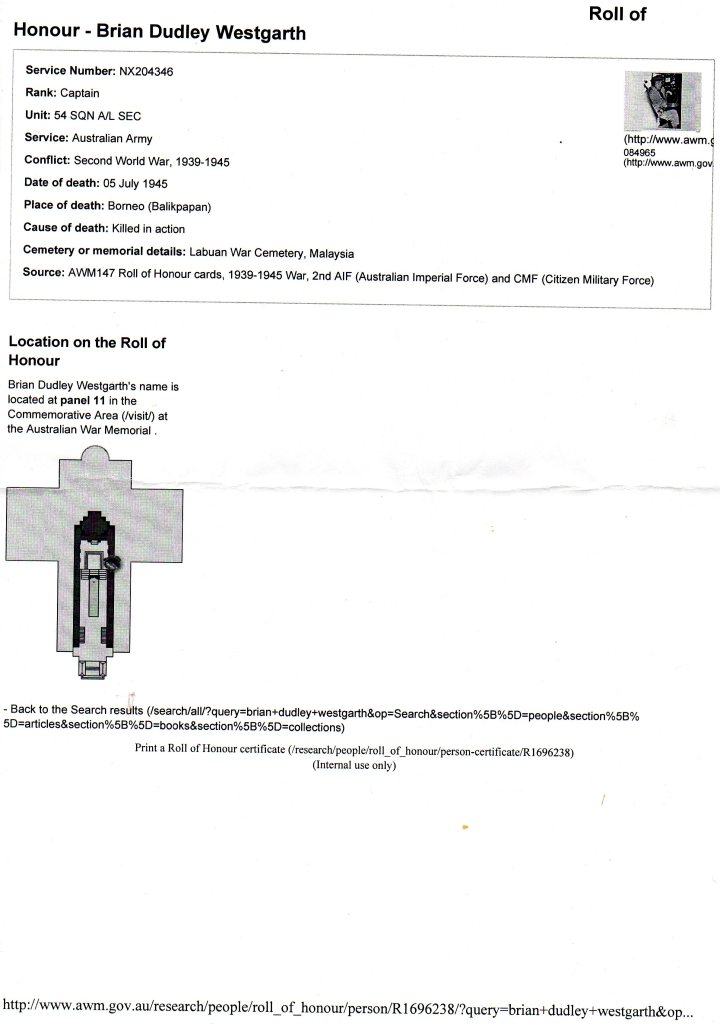
Donald enlisted in the Royal Australian Air Force on 17th August 1941
Donald, or Tonny, was only 19 when he enlisted in the Air Force. He was a friendly, loving young man, good at sport and in love with a charming girl called Dabee Evans. I was always told that they had an agreement that they would marry, but at 19 he was too young.
Dabee came from a large country property at Rylstone, which in Australian terms is quite near Blayney. The name of the property was Dabee! So that is where her unique name comes from. Here she is with Tonny:
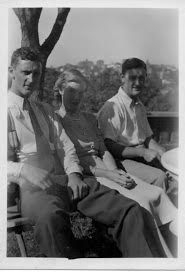
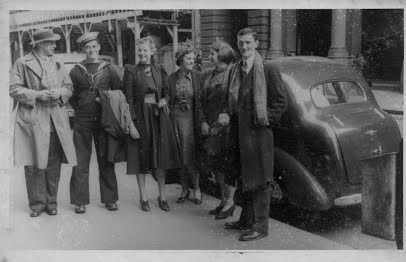
Donald (Tonny) had been in the Cranbrook Cadets and enlisted in the Second Army Regiment in 1940 reaching the rank of Corporal. From the Archives:
Westgarth, Donald Dudley; Army Number – N9784; Date of birth – 13/10/1921
He enlisted in the RAAF on 17th August 1941. His dream was to be a pilot and was awarded his flying badge on 24/6/1942 with the rank of Sergeant. Here is the official photo:
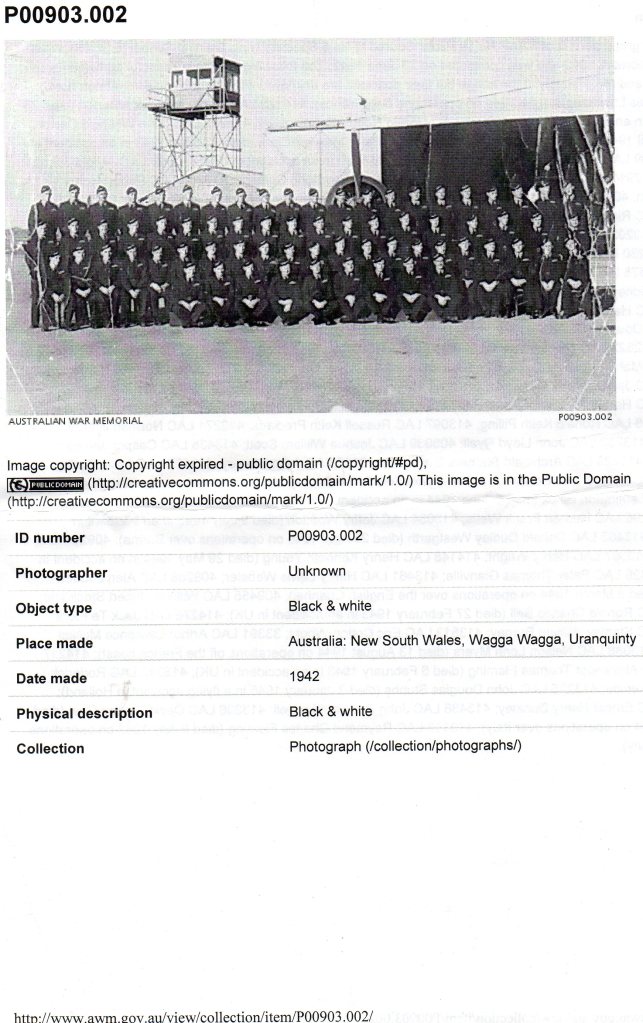
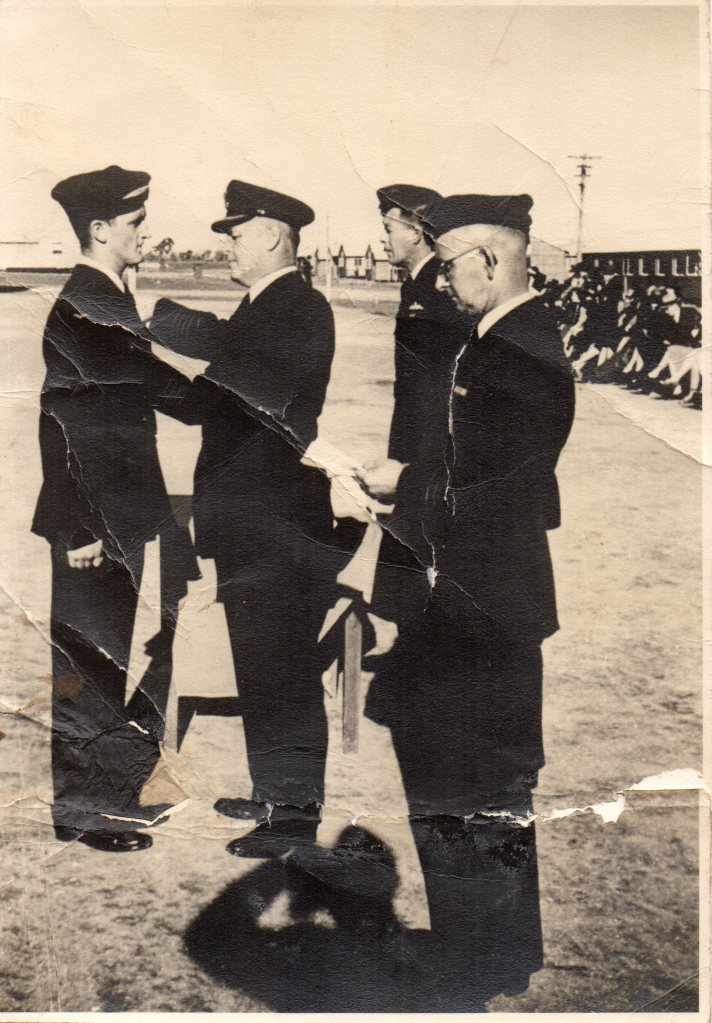
He embarked for service overseas on 24/8/1942 and disembarked on 18/11/42. He had 9 days Privilege Leave from 29/11/1942 to 7/12/1942, perhaps until his course started.
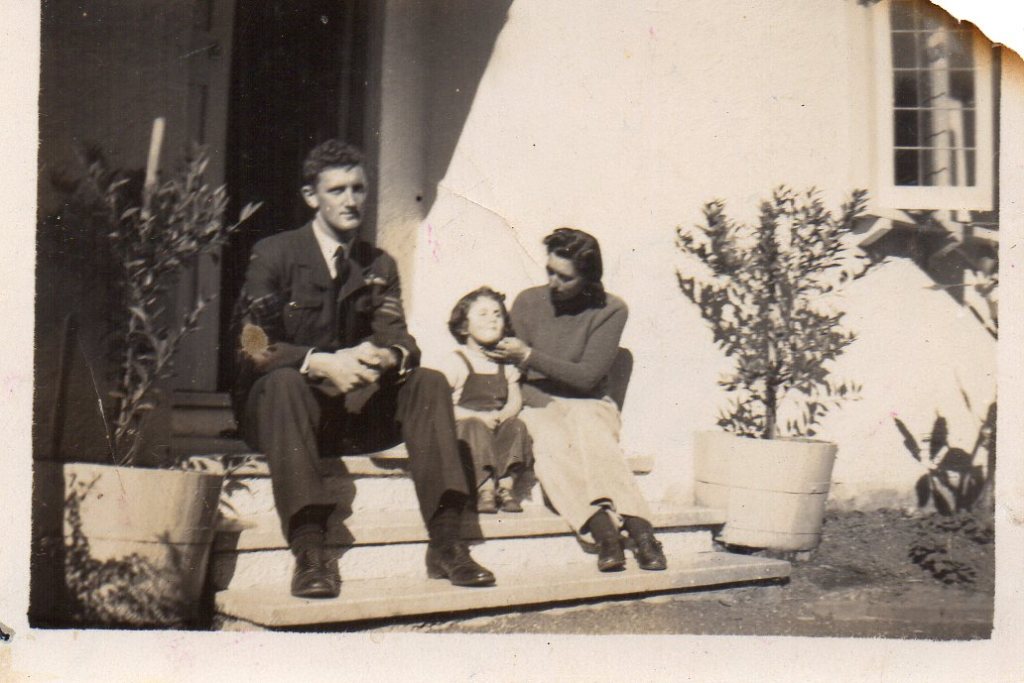
During transit the ship had docked at Capetown and Donald was docked a day’s pay for being AWOL for 12 hours 30 minutes. 146 He was apprehended in Adderley Street. Donald’s conduct reports were always good after that.
He was taken into the advanced flying unit on 19/1/43 at Tealing in Scotland, flying Hurricanes and graduated on 2/3 1943.
The Hawker Hurricane is a British single-seat fighter aircraft of the 1930s–40s that was designed and predominantly built by Hawker Aircraft Ltd. for service with the Royal Air Force (RAF).
en.wikipedia.org › wiki › Hawker_Hurricane
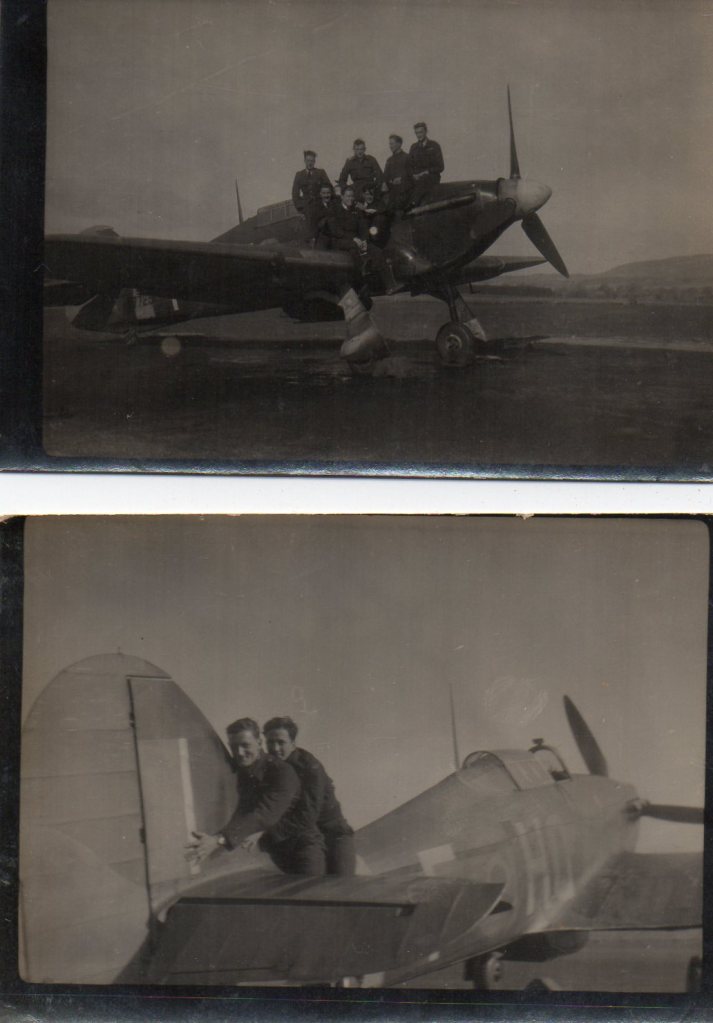
Donald is the nearest of the two in the lower picture.
He was transferred to the RAF station in India on 10/5/1943 and taken on by the RAF 146 Squadron on 8/8/1943 as a Warrant Officer. In India he was granted local leave of 14 days twice in 1944: 23-2-44 to 7-3-44 and 9-6-44 to 22-6-44, but whether he got home to Sydney is doubtful.
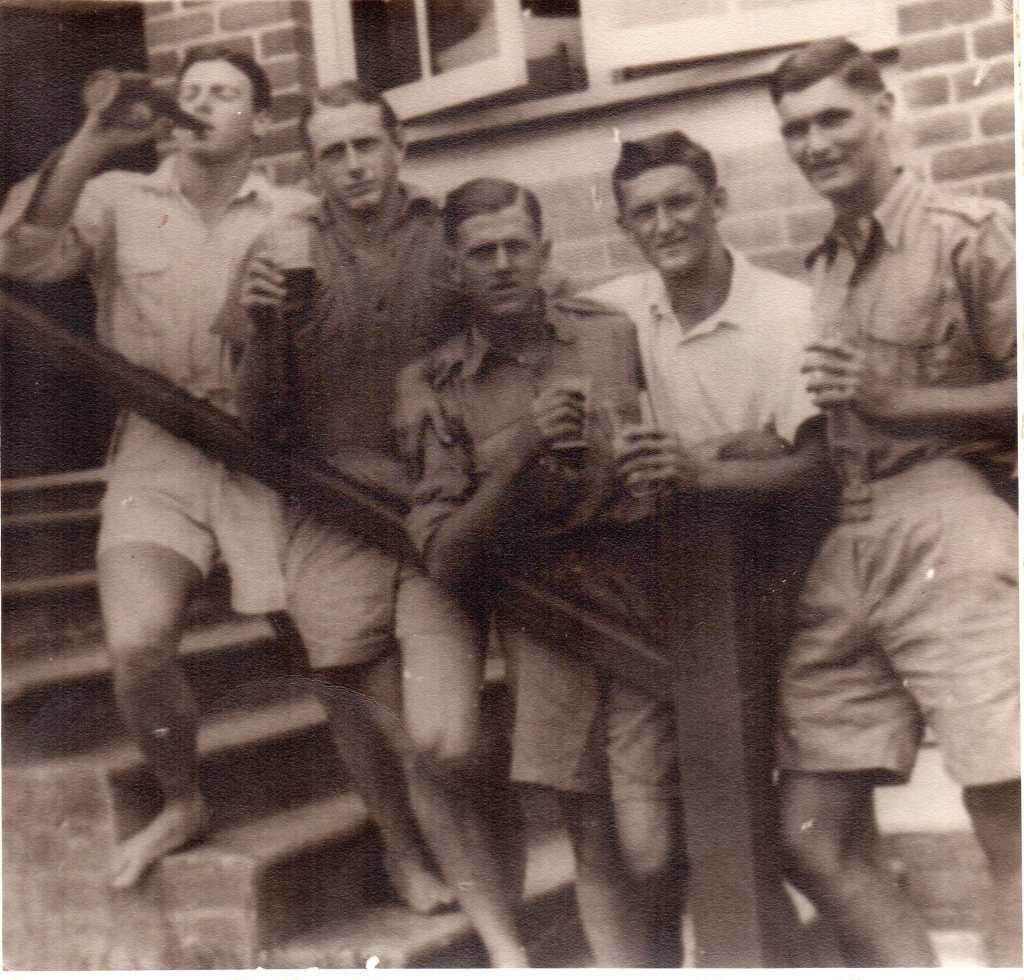
In India he flew many missions in a Wirraway DH 82.
The CAC Wirraway was a training and general purpose military aircraft manufactured in Australia by the Commonwealth Aircraft Corporation between 1939 and 1946. It was an Australian development of the North American NA-16 training aircraft.
Range: 1,200 km Cruise speed: 250 km Weight: 1,810 kg Engine type: Pratt & Whitney R-1340 Wasp
On 25/4/1945 had a mid-air collision coming in to land at Myinyan, Burma and was killed instantly. In 1945 he was commissioned as a Pilot, but you can see he was still a Warrant Officer when he died.
The account of the collision is by SCUDAMORE G L – (Warrant Officer); Service Number – 1338765. It is not digitised but I read it in the archives. This is a summary of Warrant Officer Scudamore’s account.
Donald was coming in to land at the Myinyan airfield, flying a Thunderbolt BJ 325. At the same moment another plane, a Harrard 2B OF 109, came in to land. The two planes collided and Donald’s plane continued to fly on for a distance, but the report said he must have died instantly.
Donald was only 23 years old, but had a wonderful adventurous youth. However, I would rather have had my uncle survive to live and love.
Donald’s Grave:
Unlike today in the 21st century, the war dead were not brought home but buried where they fell. Donald was put into a temporary grave and then transferred to the War Cemetery in Rangoon. He is buried at Takkuyan War Cemetery, Rangoon: Plot XXI Row C Grave 19. A bronze plaque was later erected: R 16/23/29.
Australian War Memorial, Canberra:
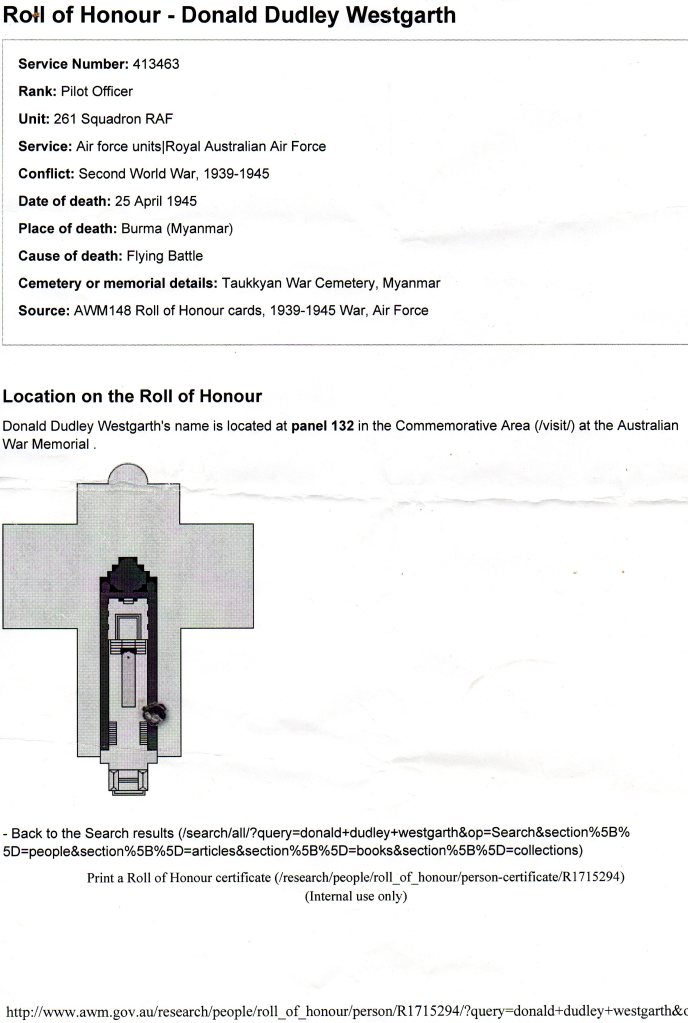
Winning the Peace.
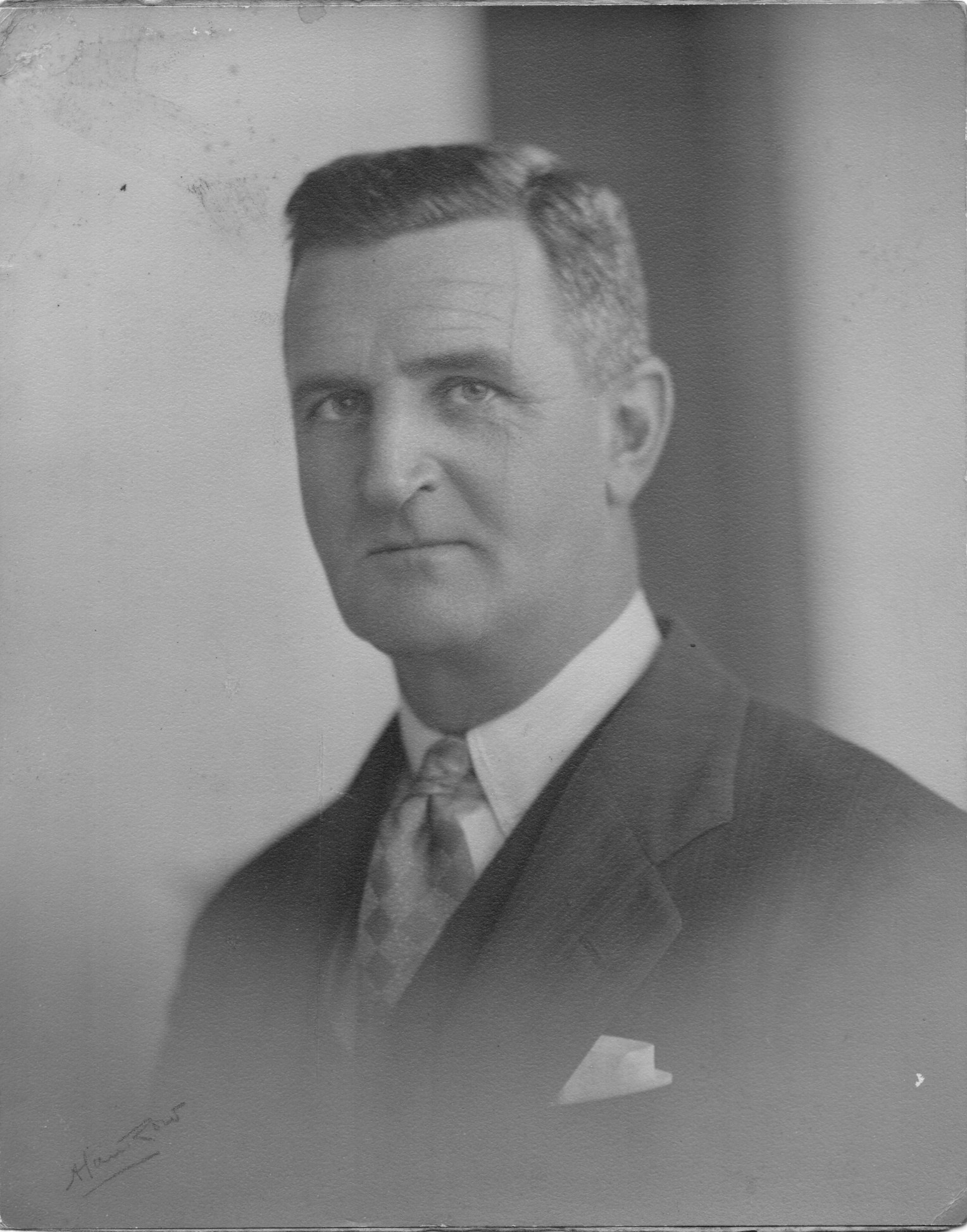
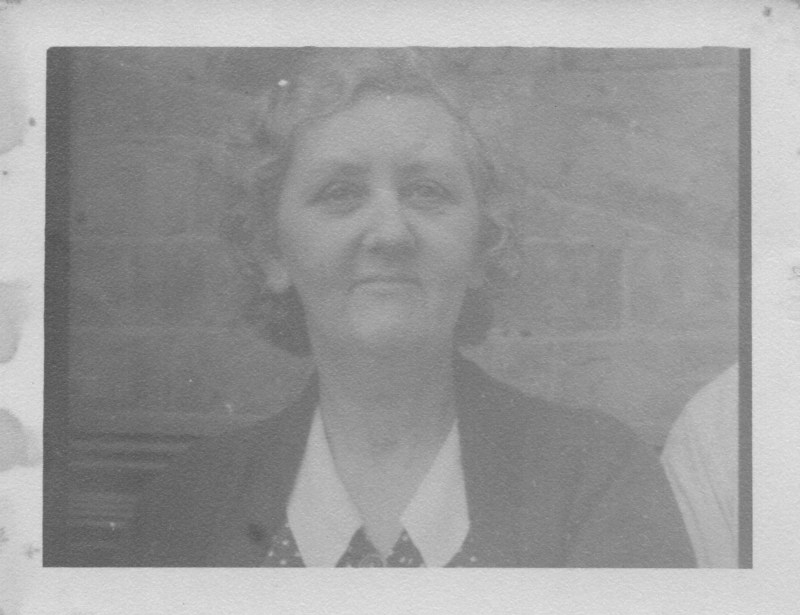
The war was over on August 14 1945. The Westgarths also had to reconstruct their lives. Here are a grieving John and his mother probably around that time.
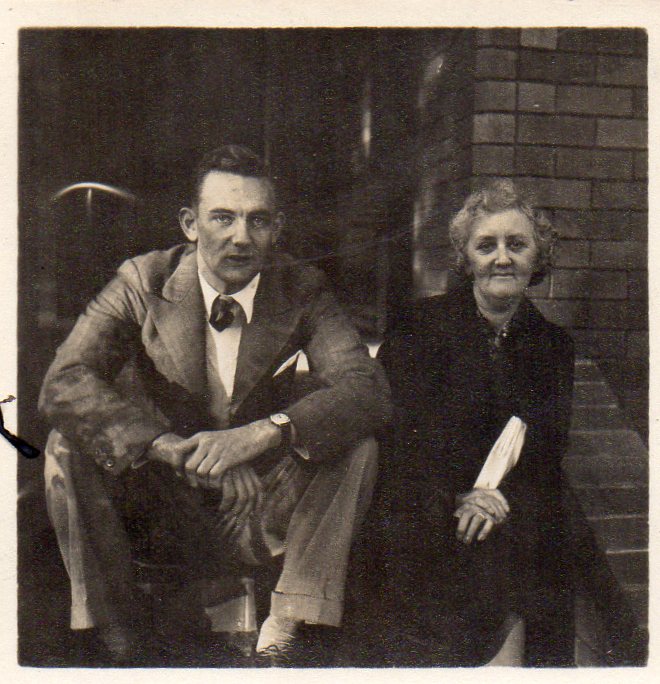
Dudley, Kathleen and Mollie found a new home at 7 Vaucluse Road, Vaucluse, which had been the property of Miss Ina Campbell.
I found information in the National Archives about the Estate of Ina Mary Campbell, sometimes called Selina, who died on October 15th 1945. She was a very unusual in leaving two houses, money and other assets so that her Estate totalled £18,106/18/2d (eighteen thousand, one hundred and six pounds, eighteen shillings and tuppence. As her house at 26 Kent Road Rose Bay was valued at £3,200, you can see that she was a fabulously wealthy single woman.
Although I cannot find her on the family tree, she must have belonged to the Campbells of the Duntroon, Woden and Ginninderra sheep properties, here in the ACT. They were a very successful and prosperous family and also very influential in society.
Miss Campbell had a little dog and her own car. Here is her photo. Miss Campbell looks like she has driven into the interior somewhere.
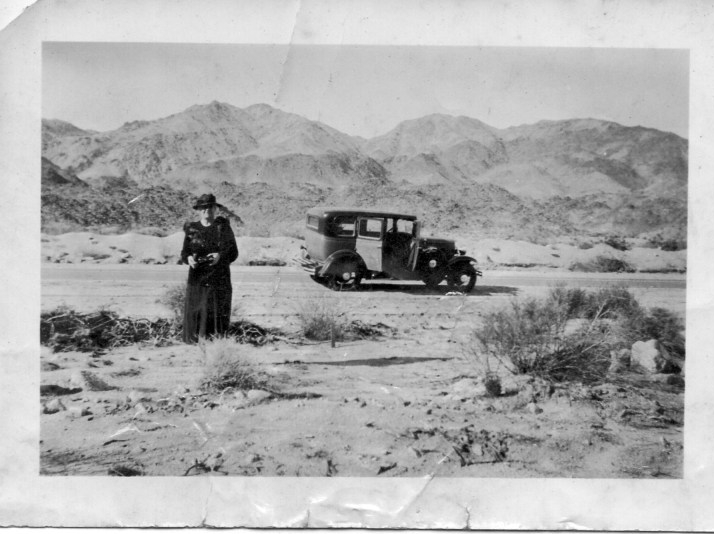
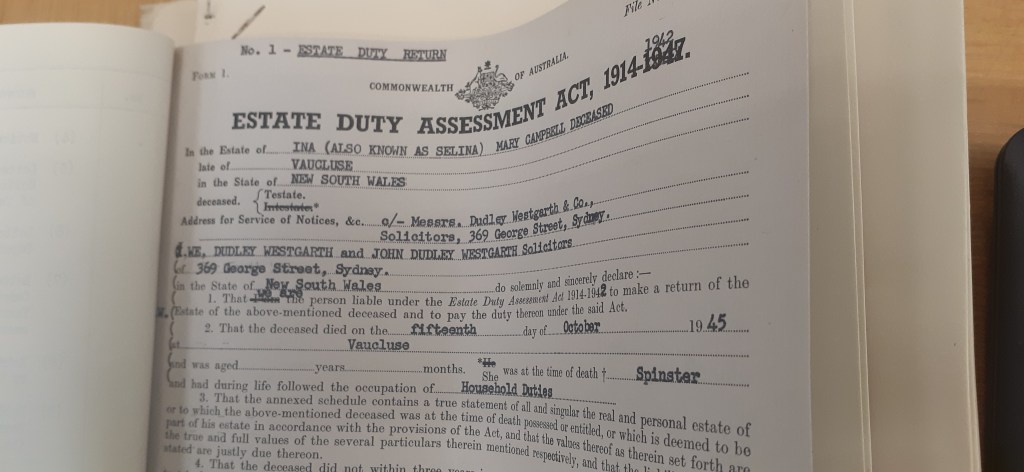
Dudley and the family lived at 25 Kent Road and must have known Miss Campbell who owned number 26, which she rented out. She lived at her other house, number 7, Vaucluse Road, Vaucluse. Dudley and Kathleen also visited her there.
Lynne told me: ‘I remember going to number 7 with Char and Yaryar before they moved in. We had afternoon tea in the garden and Miss Campbell’s dog had a saucer of tea too.’ This must have been in 1944, before Lynne went to school. Ina Campbell died the next year, leaving a bequest for Mollie.
Dudley became her solicitor and executor. When she died and death duties were paid, the two houses were auctioned, probably around July 1946. The Westgarths bought number 7 and Mrs E.E. Reading bought number 26 Kent Road, Rose Bay.
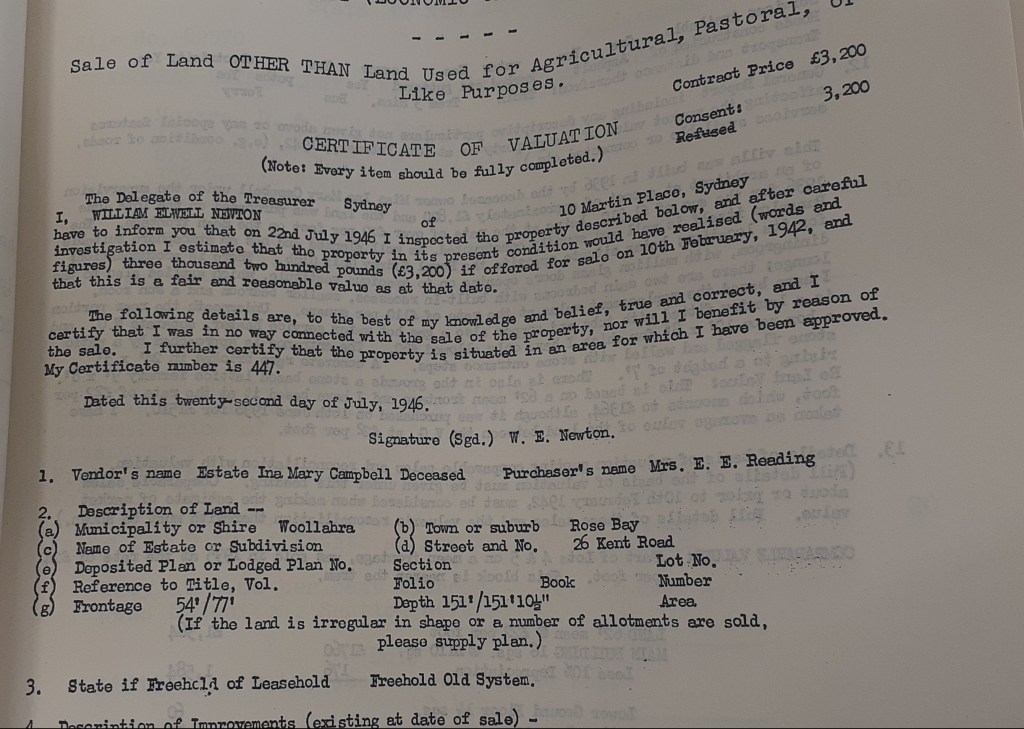
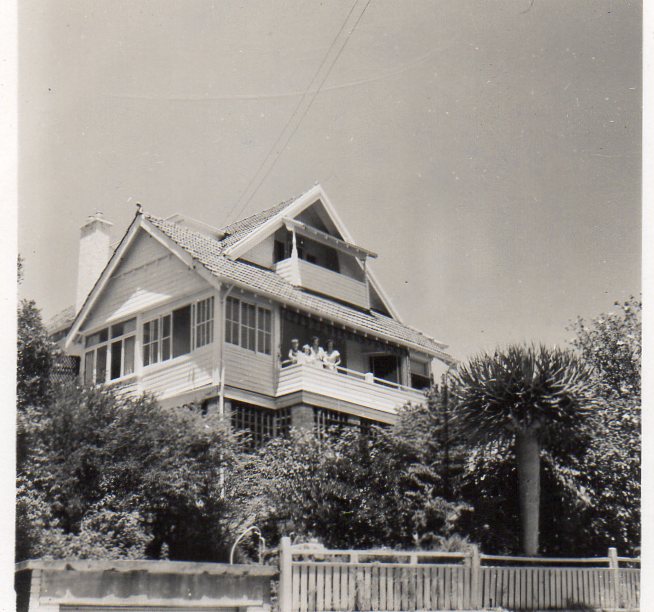
The garage was on the street which was walled right along with Sydney sandstone. You walked up steps to a verandah at the front of the house. Above the verandah there was a second storey with a peaked roof and a balcony which looked up the Harbour to the Bridge. It was a red tiled house with a large garden on the right where the trees are. The first tree at the gate (which is not visible on the right), was a macadamia and at the top of the stairs there was a huge palm in a circular garden. Behind the house round the cement yard were sheds, some citrus trees and a banana palm.
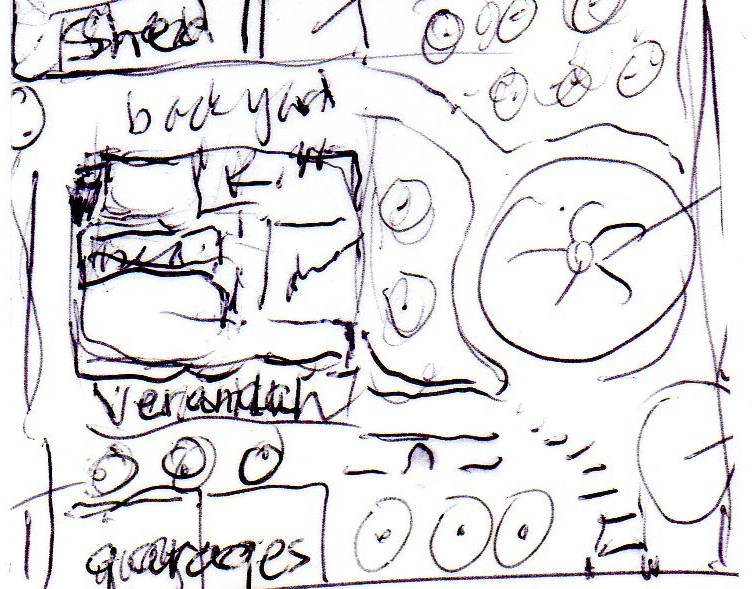
The front of the house had verandahs on each level in Federation style and they looked up the harbour to the bridge. Upstairs at the back, there was a small bedroom where I slept with Anthony on beds covered with batik quilts whilst the South Head lighthouse sent its beam round and round the ceiling till we slept. The front room upstairs, a big room with balcony, was Auntie Mollie’s room. She was working as a lawyer in London, having received a bequest from Miss Campbell for this purpose.
Grandchildren:
Lynne was the oldest grandchild, born February 11 1940. In 1942 my mother had a miscarriage of a boy and the following year she gave birth to me on 24th September 1943. In my photos I have my head on one side as a result of my breech birth.
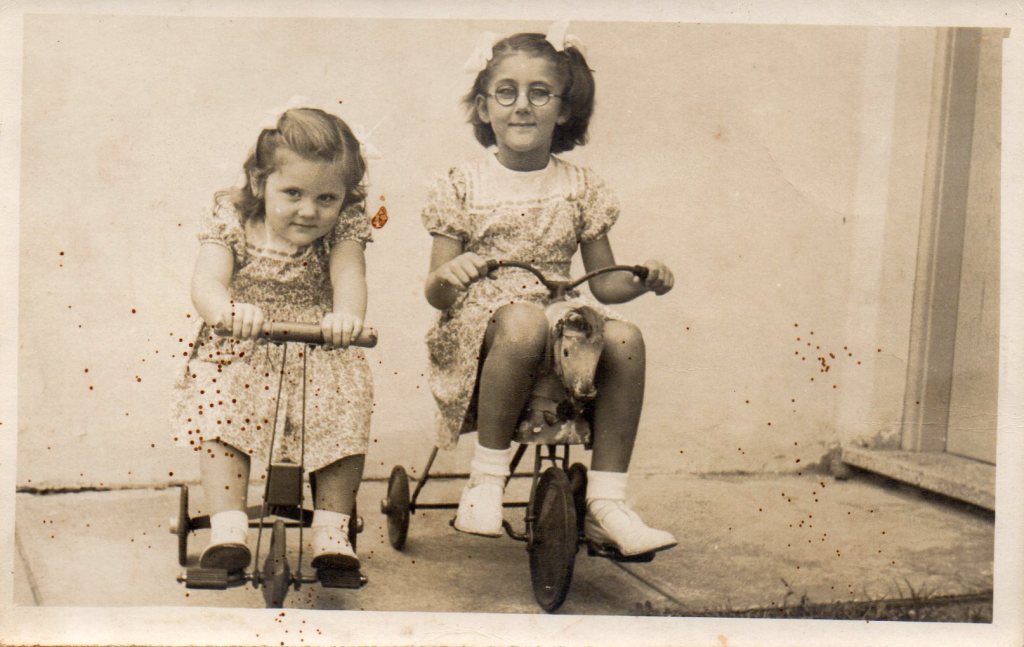
My cousin Anthony John Woodhill was born a week later on 1st October 1943. Two years later, Julie Anne Woodhill was born on June 21st 1945.
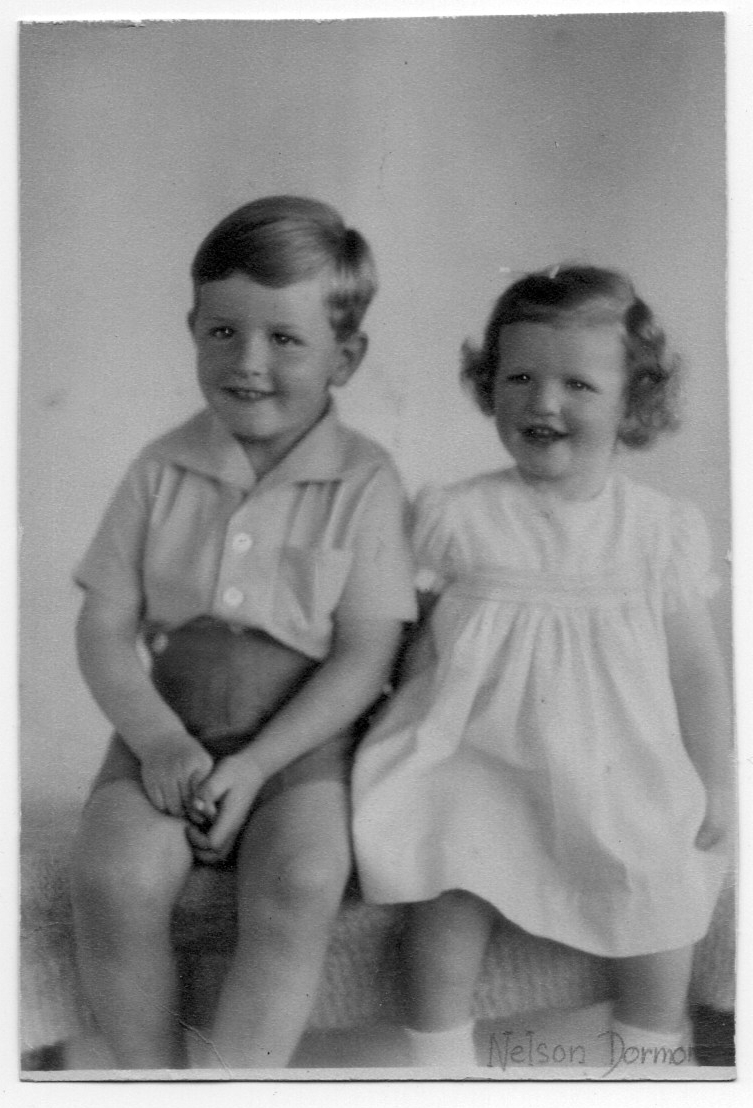
There would be four more grandchildren, but by 1945 there were only four. Perhaps we were a solace to our grandparents in those post-war days, or perhaps they just wanted to do the best for their remaining children. Their grief never seemed to interfere with their love and care of us.
St Mark’s Darling Point
My parents were not churchgoers, though nominally Anglican, but I was baptised at St Mark’s and later went to kindergarten there. Ascham girls were marched there for religious occastions.
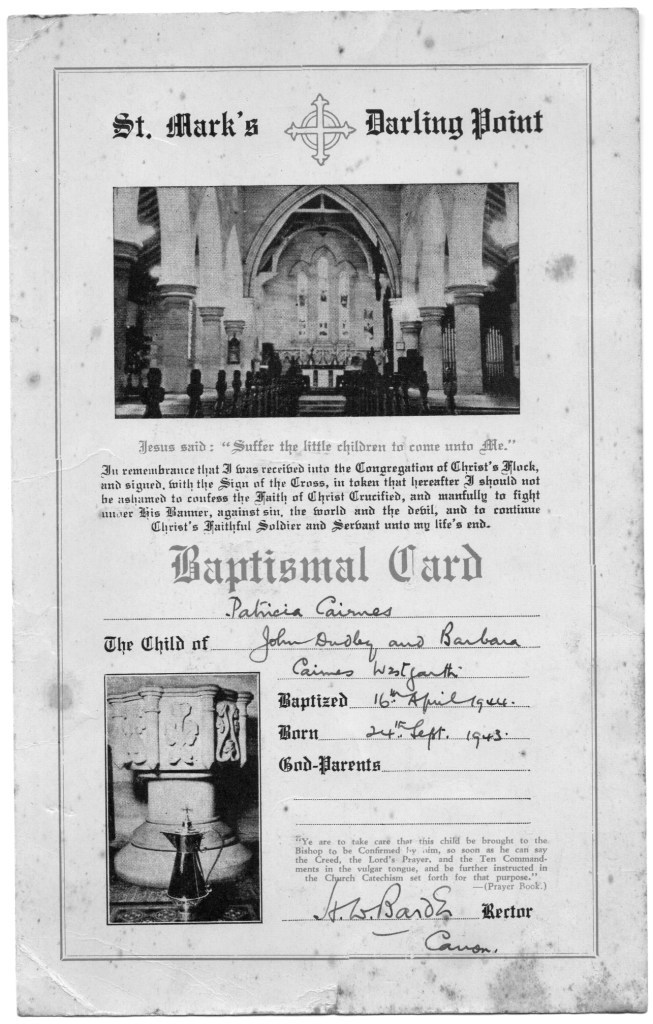
Number 7
When I was a little girl of 3 or 4, not yet at Saint Marks Kindergarten, Darling Point, I was often dropped off by my mother to be minded at number 7 Vaucluse Road, Vaucluse. (My elder sister was at a school called Fairfield and my younger sister was not born till 1949.) At that time, probably 1946 to 1948, my cousin Anthony, one week younger than I, was always there and later, sometimes, his sister, Julie. The house was on a double block and the garden extended over the southern half. The three of us used to play in this formal garden where a round bed contained a huge palm tree. From the round bed, going down the path to the road, we passed a big macadamia tree, the nuts of which we small kids spent hours cracking with rocks. In those days the trees in summer were full of cicadas, yellow, green and black. Butterflies were much more common too. We collected the cicadas and their empty cases, putting them into “display boxes”. We called them Yellow Mondays, Black Princes and Greengrocers – not sure why. One day we made a lemonade stand on the path outside the gate, but nobody stopped to have some. We could not understand it!
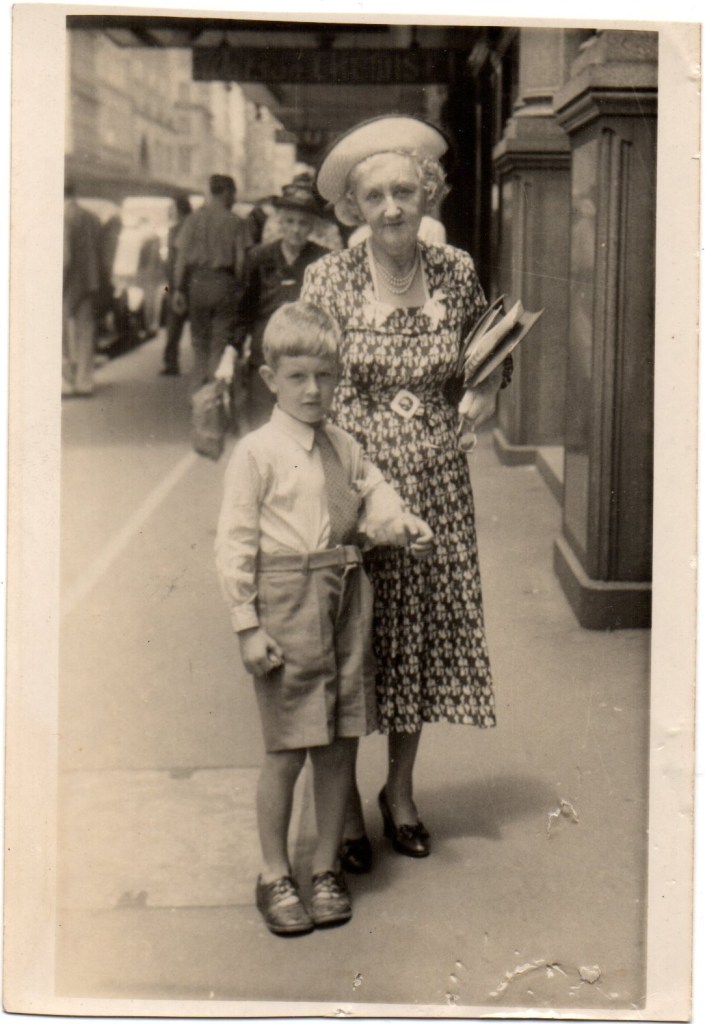
Anthony has often told me how much his grandparents meant to him and what he has to thank them for. Lynne also told me what high regard she holds them in.
Moll in London, 1948 to 1950
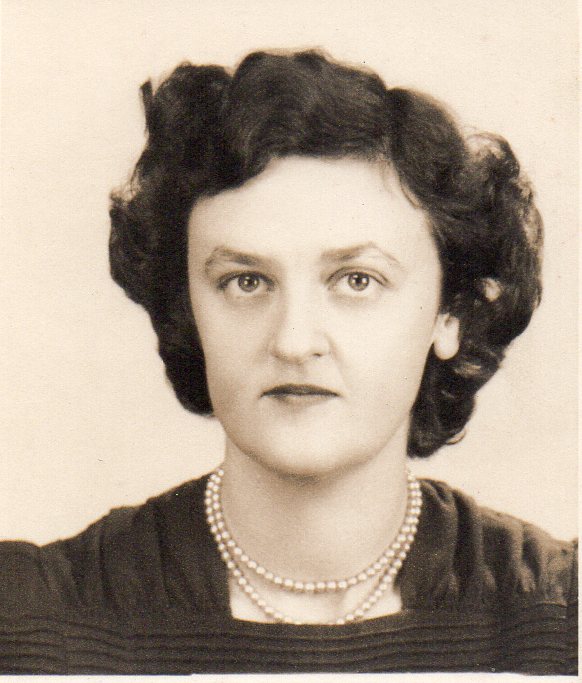
Mollie must have seen a London full of bomb sites and war damage of all sorts. Food of course was scarce and probably not good quality in those post-war days, whilst we were eating well in Australia. Here she is in England, with Doctor Rodney Seaborn, dad’s school friend.
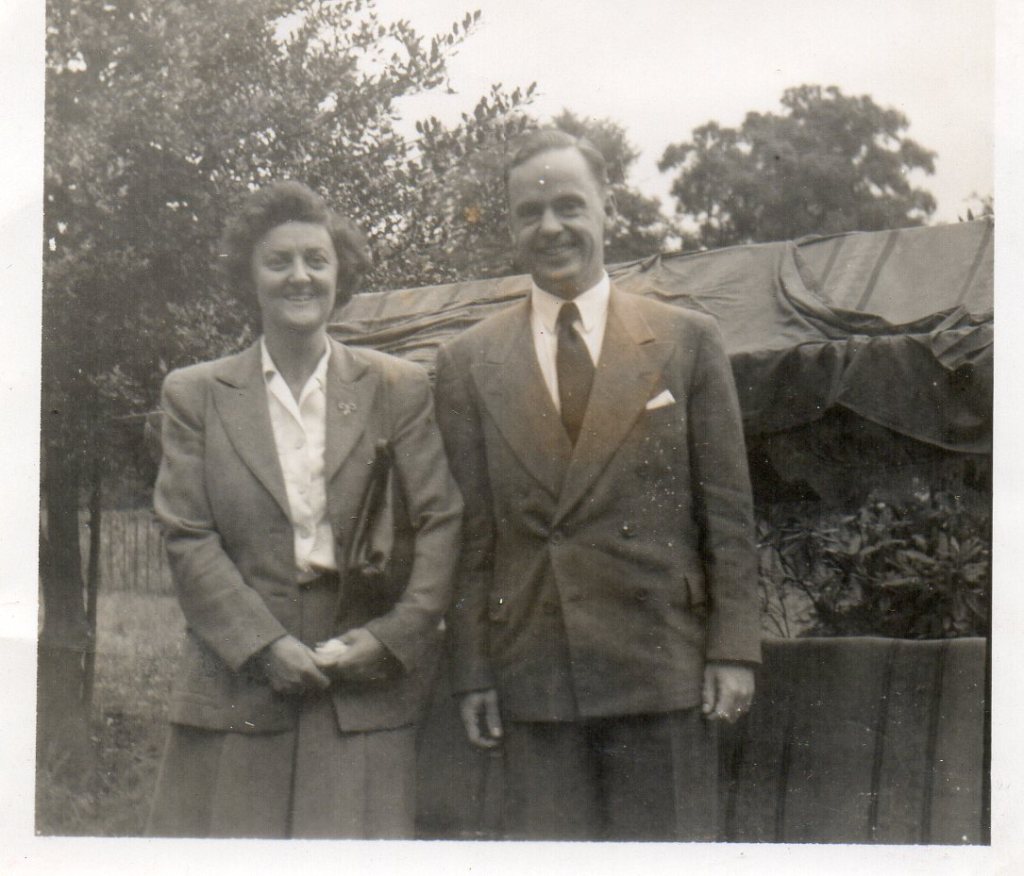
In 1950, Mollie returned to her country and her room. It was during the time I was often at Number 7. She was a young woman of 30.
Julie found this article about her return to Australia. It was in Nancy’s desk. Unfortunately it does not tell us what paper or magazine it came from:
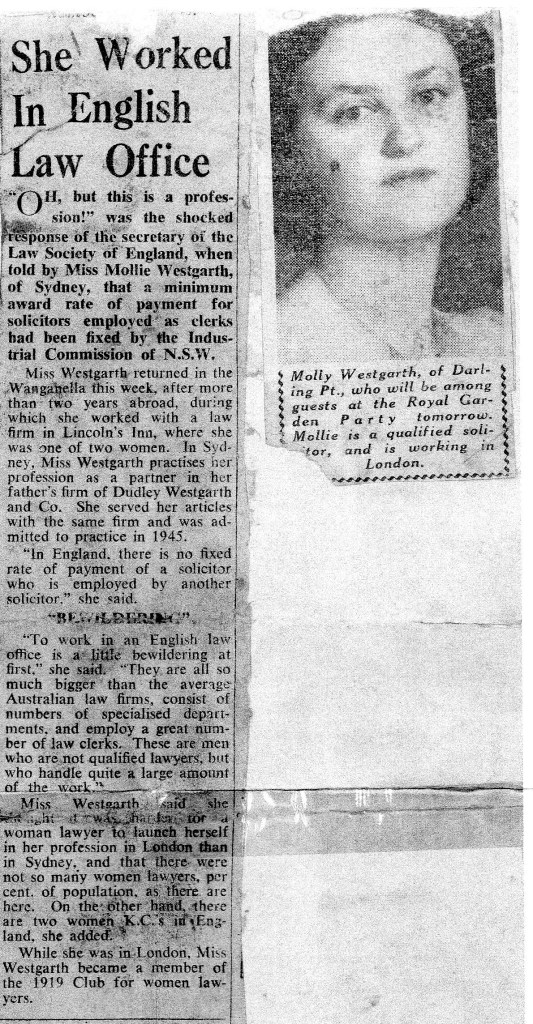
Childish Pranks?
One day Anthony and I found her asleep on her bed. Her mouth was open and she was dead asleep. Perhaps she had just returned from her long journey. I am not sure who was responsible for the idea, but we naughty children started pouring a glass of water into her mouth! Luckily for us she woke up with a tremendous jerk and saved herself from suffocation! She was too kind to punish us, but we were definitely made aware of our transgression. I had forgotten all about this incident, but was reminded of it recently by Anthony.
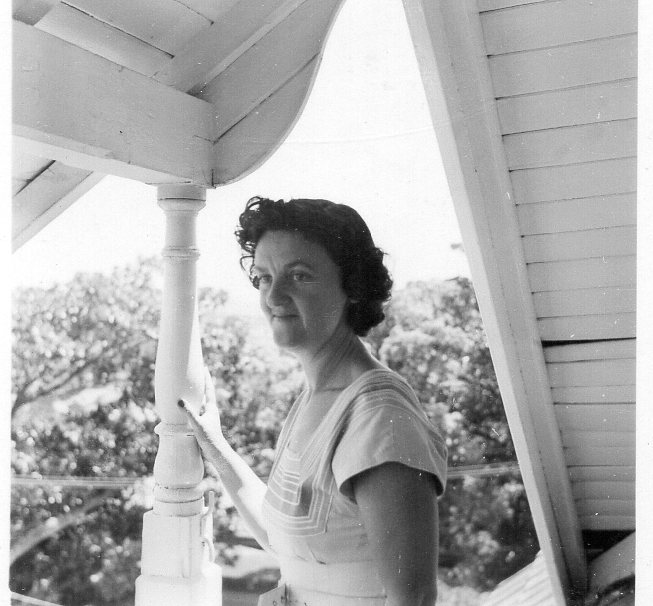
Our grandfather was around 60 at that time. He was six feet two inches tall, (about two metres) and a dominant personality. He loved a joke with children and had a range of toys which he would bring out to amuse or mystify us. He also loved teasing. Char, as we called him, had three brothers and three sisters, plus a half brother and sister, so he probably had plenty of practice teasing siblings in his family. I remember that he used to smoke and coughed a lot. Driving in the car, he would spit out the window – not something done today! Later, he developed emphysema.
Some of the cases Char dealt with in those days.
Char would not be around a lot, because he had his work in the city, but he also would go to see clients in the country. I remember him coming back from Mudgee, where he had gone to see a client at Nomby, maybe the Cox family. He also worked for Street’s Ice Cream.
The National Archives are a wealth of interest for the researcher. I found several legal cases on a list of files between Dudley Westgarth and Co. and the Commonwealth.
- Three of them were to do with the large fortune left by Ina Campbell upon her death.
- Another was a case, from 1937, concerning a black entertainer, Nina Mae McKinney and her manager who had a contract at the Tivoli (where vaudeville entertainment was popular at that time). Miss McKinney overstayed her visa and the Commonwealth Immigration Act was invoked because, of course, it was the time of the strict White Australia Policy. Char had to pay a good behaviour bond for her. She was sent back to the USA with her manager in February 1938.
- Another case shows just how paranoid a country can become in wartime. Two Jewish Hungarians and their families managed to reach Australia from Switzerland before the war and thus escape Nazi extermination. They changed their names from Szeklei and Jerkovitz to Sinclair and Zerky. (Cousin Julie was in the same class at school with Julie Zerky!) When the Sinclairs had a new baby, named Peter Robert, they composed a telegram to inform their parents in Hungary. As it was wartime, the Commonwealth refused to allow the telegram to be delivered in case it was a message to the enemy! (Trading with the Enemy Act, 1939-1940) Here it is, with part of an explanation by Westgarths to the Commonwealth:
Our Grandparents at Home
When at home, Char often helped out with us children, such as making grilled loin chops on a gridiron perched over an empty kero tin full of burning newspaper. Who needs a smart Weber or other barbecue? I must try it some time. But I saw the chops cook and ate them too. Yum!
There was a concrete yard along the back of the house, with a long shed parallel to the house. One end was a workshop and the other end was the room of Monty, the painter, who emerged in his overalls from time to time. Our grandfather told us he was the brother of Gladys Moncrieff, the famous Australian soprano. If so, he was the black sheep, living there and smelling of drink, but I think it was one of Char’s jokes. The back area also had a green part where a banana palm grew and produced great bunches of bananas. Our grandmother used to shell peas on the steps near the palm (in the days before convenience foods) and we were told, as our fingers hovered over the peas, that we would contract the Collywobbles. At age 4, I did not know whether to believe her or not, so probably obeyed the injunction to save the peas for lunch.
YarYar knew all the Nursery Rhymes and passed them on to me as we shelled the peas. She was a marvellous country cook. Going to Number 7 for a family lunch meant having a three course meal with homemade soup or grapefruit cut up with mint and sugar, followed by roast chicken with Yorkshire pudding, roast vegetables, peas and gravy, and then a baked pudding such as apple charlotte, rice pudding, baked custard, lemon delicious pudding and so on. For between meals she was a great maker of rock cakes, so there was always something in the tin. No wonder I was fat! Her technique for making a Swiss Roll was wonderful to watch as she deftly took the lightest of sponges out of the oven onto a tea towel, spread the strawberry jam and rolled it up. The last touch was the sprinkled icing sugar. I think I can still taste it!
I forgot to add that Char always carved the chicken and miraculously found a wishbone for everyone. This was very popular. At Christmas, our grandmother put a gold ring in the pudding, in the old fashioned way, (to predict who was next to marry), but that custom was soon replaced by solid silver money, either sixpence or threepence.
Children were very slim in those post-war days. Many did not have shoes, but we were privileged children and had plenty of clothes and food. I was always being told how fat I was. In the garden, between the flat area and the slope down to the road, there was a low wall with a little arch in it, a bit like the little door in Alice in Wonderland, I thought. Anyway I used to console my four-year-old self that if I could wriggle through I was not fat. I can still remember the triumph of wriggling through. I suppose I went to school before I got too big for it.
Although YarYar was only 4 feet 11 inches tall with size 2 shoes, she was very strong and could run up the kitchen stepladder (which I now have at the farm) to get something out of the top cupboards, or drive the heavy Wolsey into town to Anthony Horderns, sitting on a cushion so she could see where she was going.
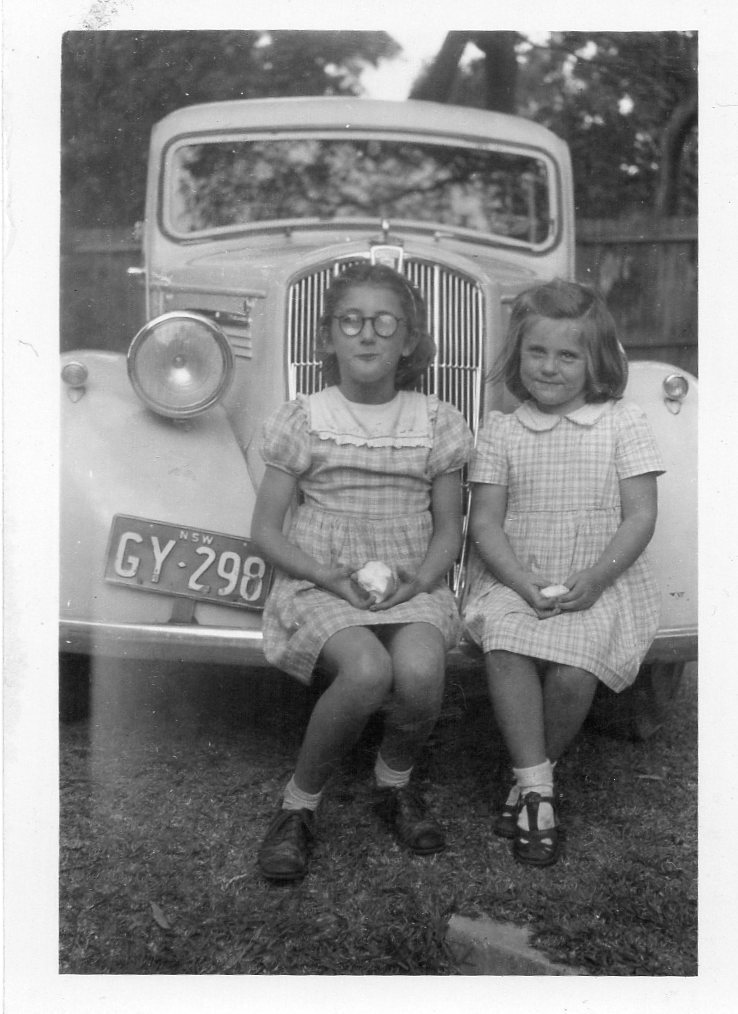
X-Rays for Feet
At Anthony Horderns department store you could buy anything and get it delivered. I remember going to get shoes for school, so I must have been just 5. When we got there, we realised I was not wearing socks, so the assistant put tissue paper round my feet and popped on the brown leather lace-up shoes which were compulsory at my private school, Ascham. Then I was told to mount onto a little platform and stand still. When I looked down, I could see my toes inside the leather shoes! X-ray machines for checking length and width of shoes were the latest thing in the 40s, perhaps a war-time development put to a new use? When it was understood that children’s feet were getting irradiated, the machines disappeared.
There were a few beautiful pieces around the house at number 7. One was a silver mirror frame with a nymph in silver appearing out of the frame to look at herself. Our grandfather used to hang his keys on her! It is now the proud possession of Scott Woodhill. There was also a huge ceramic bowl probably for an aspidistra or other pot plant. It had a panther and various semi precious looking medallions around it. Anthony Woodhill now has it. You can see the photo in the blog about George Charles.
I have a brass vase which must have been bought in Java by Yar Yar ( see above). The batik bedspreads on that long-ago bedroom would have come home with her from Java too.
The China Cabinet
There was a glass fronted cabinet In the hall and I used to look at the old fans, which must have been antique then. There was assorted china and glass, but also a mysterious tin of chocolate! As it was so old, I was not tempted to eat it. I was told that Queen Victoria sent the chocolate to the British soldiers in the Boer War, making it about 50 years old then. Char’s step brother, Jack, must have received it, but he did not eat it! Banjo Paterson also received the chocolate and did not eat it and it is now in the National Archives! I saw it on TV.
After I went to school, that magical time ended and I saw less of my grandparents, but they were still a constant in my life until they died.
 westgarth and glassons

that was a truly amazing story, I felt like I knew them. What a wonderful insight into life before I was born (1956). They dont make them like that anymore. incredible people who helped make Australia what is is today.
LikeLike
I met Dudley in the early 70’s when he was living in Gladstone Road Leura and still doing conveyancing work from home. I’d started in real estate with Theo Poulos a Katoomba estate agent and who was a good friend of your grandfathers. I would regularly being taking documents to ‘Mr Westgarth’ and we’d sit in his study and chat. A very friendly and personable man who was interested in what I was doing and yes, a great sense of humour. At the age he was .. a sharp mind!
Great work in bringing all this together!
Kind regards,
Greg
LikeLike
Dear Greg,
Thank you for taking the trouble to write. I am trying to make a full account. Do you remember him in his last years after he married Kitty? I had children in Canberra and did not see him much. I would be happy to get any reminiscences. I am working on the part up to his death in December 1974 now.
Trish Wilkinson nee Westgarth
LikeLike
Hi Trish,
It’s almost 4 years since I saw this article and now realised you’d replied to me! I Dudley had his office in one of the front rooms of the home overlooking the garden. His desk was quite large and always covered in documents tied in ribbons. He was always happy to see me when we’d chat for a while over a cup of tea. I remember his office as always untidy and books everywhere.
I first met Dudley around January 1972 and knew him to around the end of 1974 when I left Katoomba and moved to Sydney working in real estate. The fact he died in that December must have been very soon after I’d moved and given the last time I visited him he was very happy, wished me well with the move and waved from the front door … his death was ‘sudden’?
Kind regards,
Greg
LikeLike
He had emphysema and cancer of the face. He had a a lot of trouble with breathing, so probably that was his end. I could not attend his funeral as I was penniless and pregnant in Canberra, so I only know what is on the death certificate. Trish
LikeLike