- 1909: what happened to the family?
- Lucy Florence, headmistress, Fig Tree House
- What became of St Helens?
- Returning to the story of the family:
- Military service and death of Mervyn 1918
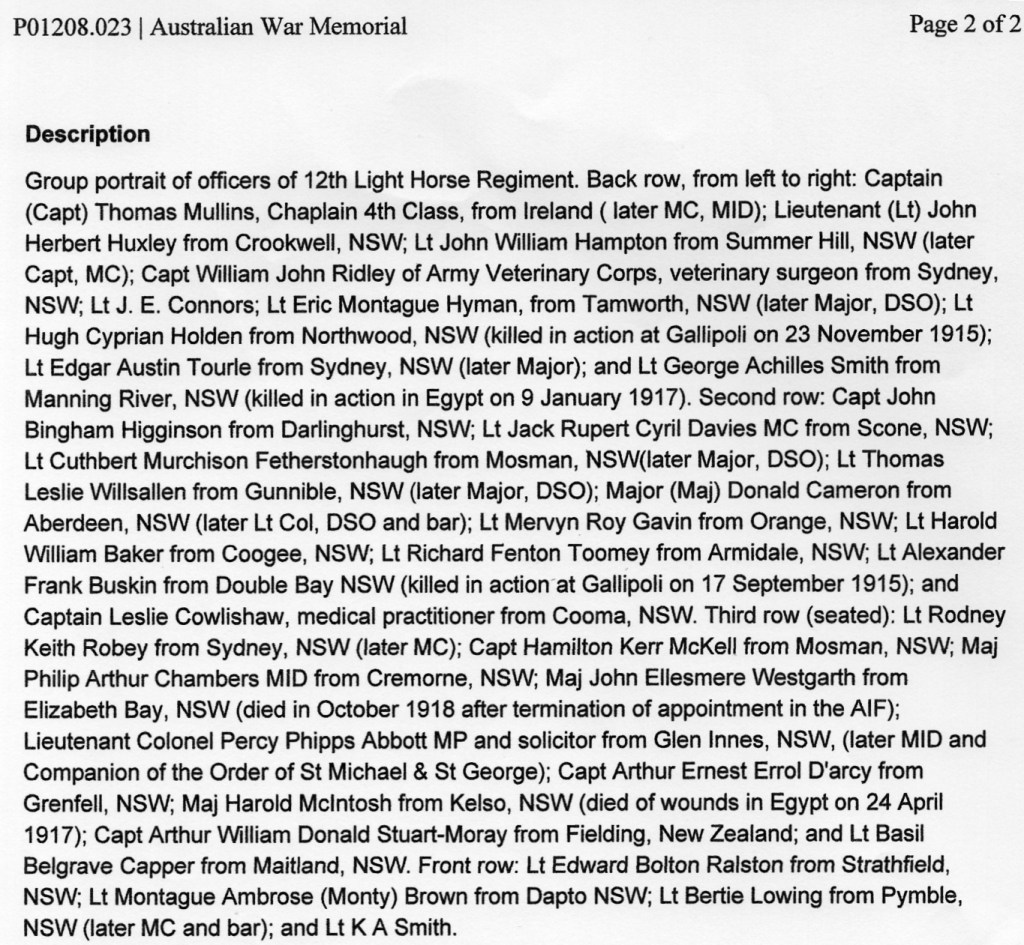
- Military career and death of John Ellesmere 1918
- Boer War Memorial:
- Death of Doreen 1920
- 1920: Family addresses, 3rd August
- 1925. Grandchildren and the death of Lucy Florence
- Death certificate and the winding up of the estate of Lucy Florence by George, Ronald and Dudley
1: What happened to the family? 1909
Introduction:
Lucy Florence would continue to receive income from the Will of George Allen until she died. You may remember that George Allen owned 96 acres in Glebe, which he bought from the church and called Toxteth Park. He also owned other property around Sydney. As time went on, of course they increased in value and produced income for the family and descendants.
The sons leave home:
After the death of George Charles, Mervyn found work in 1909 as a jackeroo on the Coan Downs Station in the Lake Cargelligo region. George Mansfield and Katrine Robertson finally married after a very long engagement and lived in Scone. Ronald married Darcy Daly and had a supply business in Spring Street, Sydney. The next year, 1910, Dudley graduated and went to Blayney.
COUNTRY SOLICITORS.
Name. Date of Admission. Place. Agent.
Weaver, Harry, 28 Nov, 1891 Armidale . Weaver and Allworth *
Weekes, E. E. 19 Nov, 1887 Gundagai W. E. Hawkins. *
Westcott, Albert E. (36) 25 May, 1907 Cessnock Reginald Harris.
Westgarth, Dudley (60) 27 Aug., 1910 Blayney, Weaver and Allworth.
Westgarth, G. (51) 25 May, 1907 Scone, Garland, Seaborn, and Abbott.
Lucy Florence, with three daughters to care for and debts to pay, must have sold St Helens for £5000. By the end of 1909, she had organised weddings for George and Ronald, helped Dudley complete his studies, sent Mervyn jackarooing and rented a large house on the Lane Cove River, known as Fig Tree House, (1 Reiby Road, Hunters Hill), to establish a school for girls. Her family, the Allens, owned property in Lane Cove.
At the school, Gwendoline, now 25, Violet or Poppy (19) and Doreen (13) would have had a home and/or an education in the company of the daughters of the elite of city and country properties. The newspapers of the time advertise many such establishments.
2: Lucy Florence, headmistress, Fig Tree House
Here is the advertisement for the inaugural school year, from the Sydney Morning Herald of January 1st 1910.
| A COLLEGE FOR GIRLS OF ALL AGES Will be open at FIG TREE HOUSE, LANE COVE RIVER, after Christmas. As only a limited number of Boarders can be taken, early application is desirable. Arrangements can be made for girls living at a distance to remain at the College during vacations. Apply for particulars and prospectus to: The Principal, Mrs WESTGARTH SMH Saturday January 1 1910 |
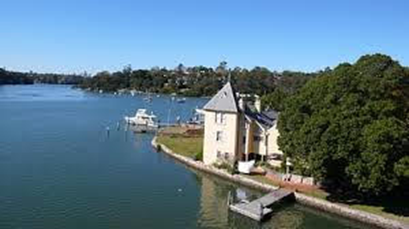
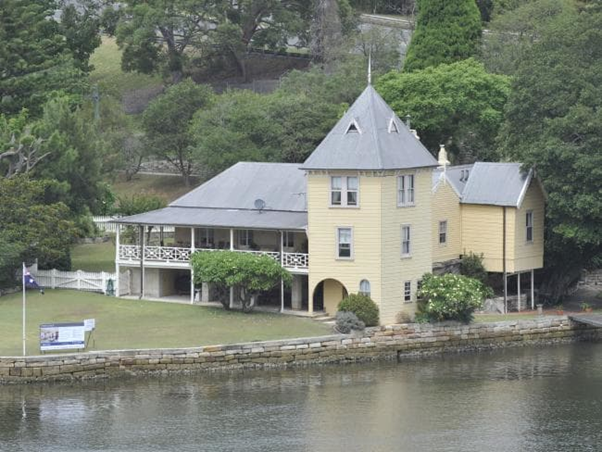
This tranquil scene on the Lane Cove River at Hunters Hill was utterly destroyed by completion of the new Fig Tree Bridge in 1963, (seen in background of second photo) which went straight through the centre of this image. The bridge was originally planned to form part of a north-western expressway, which was never built.
Fortunately, Fig Tree House, with its distinctive timber tower, (number 1 Reibey Road), remains. It is the oldest house in Hunters Hill. Originally owned by convict businesswoman Mary Reibey, Fig Tree Farm was later bought by Didier Joubert, and his son added the tower. Douglass Baglin, who produced many photographic books on Australia, lived nearby and recorded this scene from an earlier bridge to the west. https://shop.sl.nsw.gov.au/fig-tree-house-hunters-hill/
3: What happened to St Helens after the sale?
‘Subsequently the property passed into many hands, and by the 1940s it was known to many locals as “Blowfly Farm”, because it was used as a fly spray testing laboratory, until it was bought in 1949 and restored by Cyril and Mary Brookes.
By April 1970, it comprised 123 acres (49ha), bounded by Appin and Woodland Roads and the Georges River, and was run as a grazing property.’ (History of St Helens Park)
In March 1985, it was offered for sale as subdivisions:
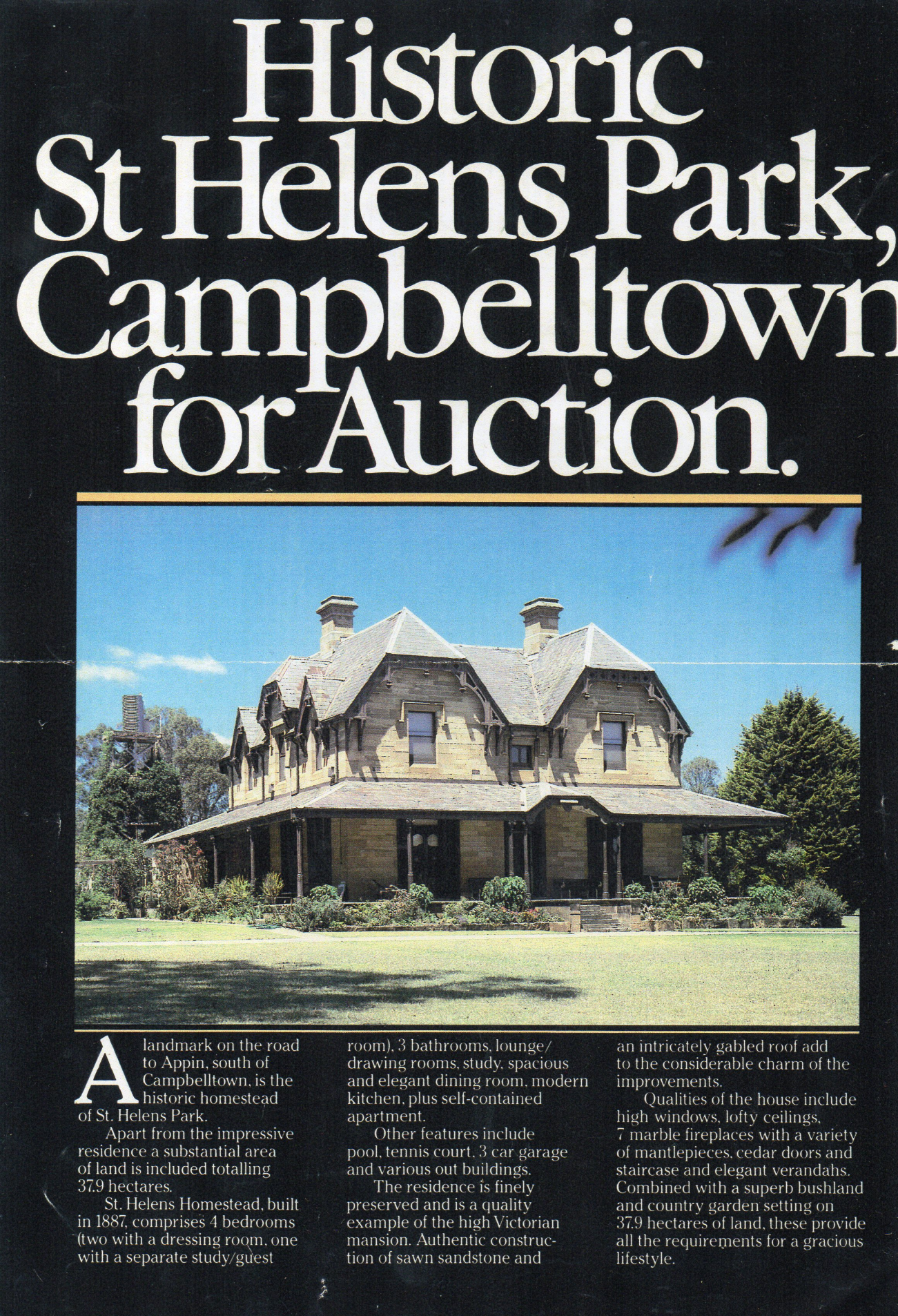
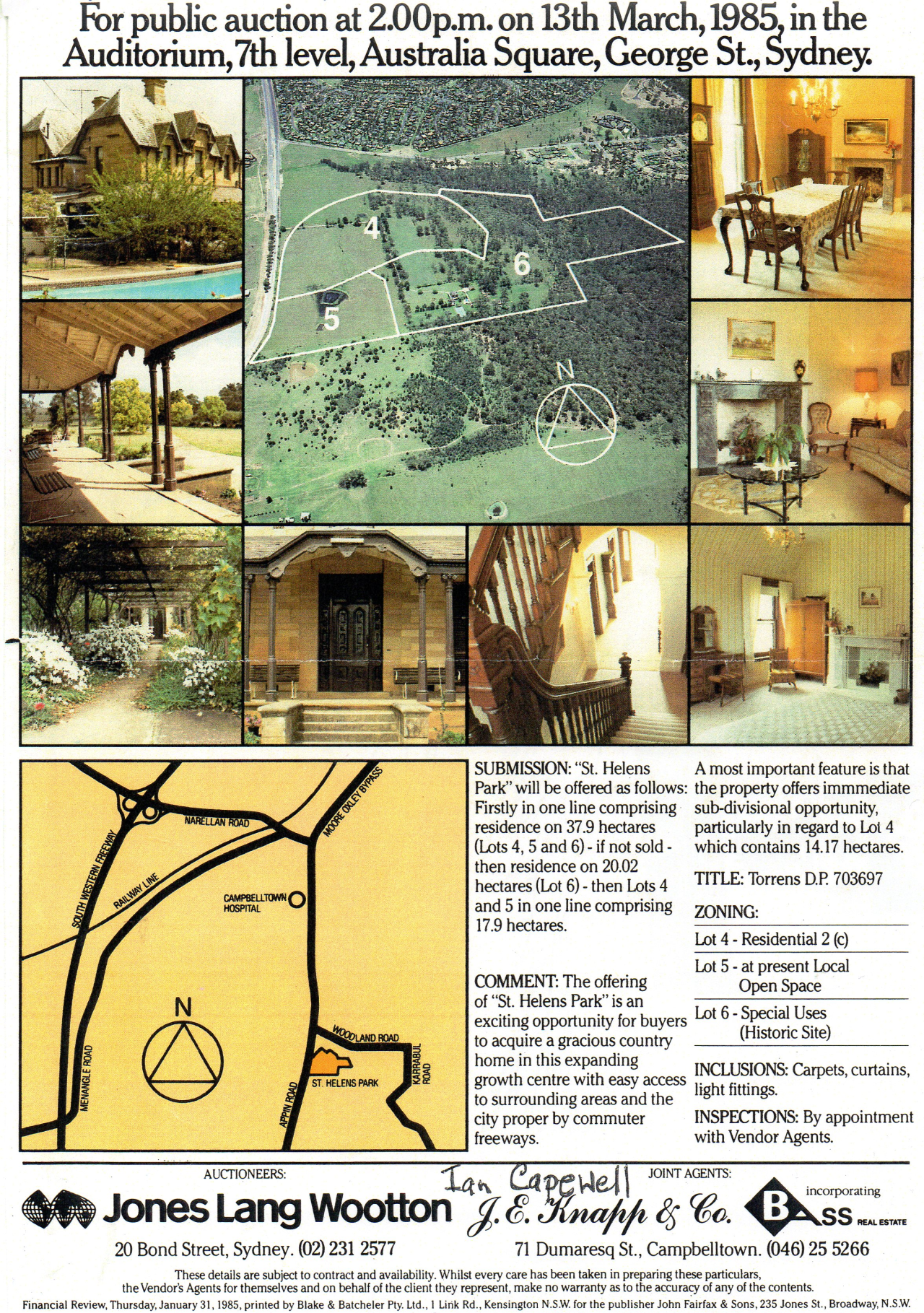
Various uses for the property, apart from its original and present role as a country house, have been as a school, a guesthouse and an experimental farm. (Illawarra Mercury, 12 March 1985).
As a result of its impending sale and subdivision (see the flyer for the sale above) an Interim Conservation Order was placed over the property on 15 March 1985. A Permanent Conservation Order was placed over the property on 16 May 1986. It was transferred to the State Heritage Register on 2 April 1999 and is now registered on the National Estate, (Federal Heritage Commission). https://www.campbelltown.nsw.gov.au/files/assets/public/document-resources/aboutcampbelltown/heritage/sthelensparkhousedam.pd
4: Returning to the story of the family:
1911
The next year, 1911, on June 1st, at age 21, Violet, (known as ‘Poppy’) married Reginald Stanley Collins. They had one daughter, Roslyn, born in 1912. They divorced on 27th April 1927. Perhaps the family upheaval and difficulties had pressured Poppy into making a marriage of convenience. Poppy spent some of the years with Roslyn at her mother’s flat in Manning Road, Double Bay.
1912
Dudley married Lucy Kathleen Glasson, on 10th April 1912 in Blayney.
1918
It is likely that the Fig Tree House School would have closed its doors before Doreen was married to Gerald Reeves Rainsford (26/6/1918), because in 1918 Lucy Florence was renting a flat at 66 or 68 Manning Road Double Bay. The paperwork seems to go to one address or the other!
Mervyn died of pneumonia (19/2/18) in Palestine.
Jack died in Sydney of complications of malaria (4/10/18).
As the records for these two are readily available online at the National Archives website, I have decided to write about these two brothers in as much detail as I can. George and Dudley will have separate blogs. I do not have much information about the other children, but if relatives wish to send me information, I will happily put it up on the blog.
5: Mervyn: Born 19/11/1888. Died 19/2/1918
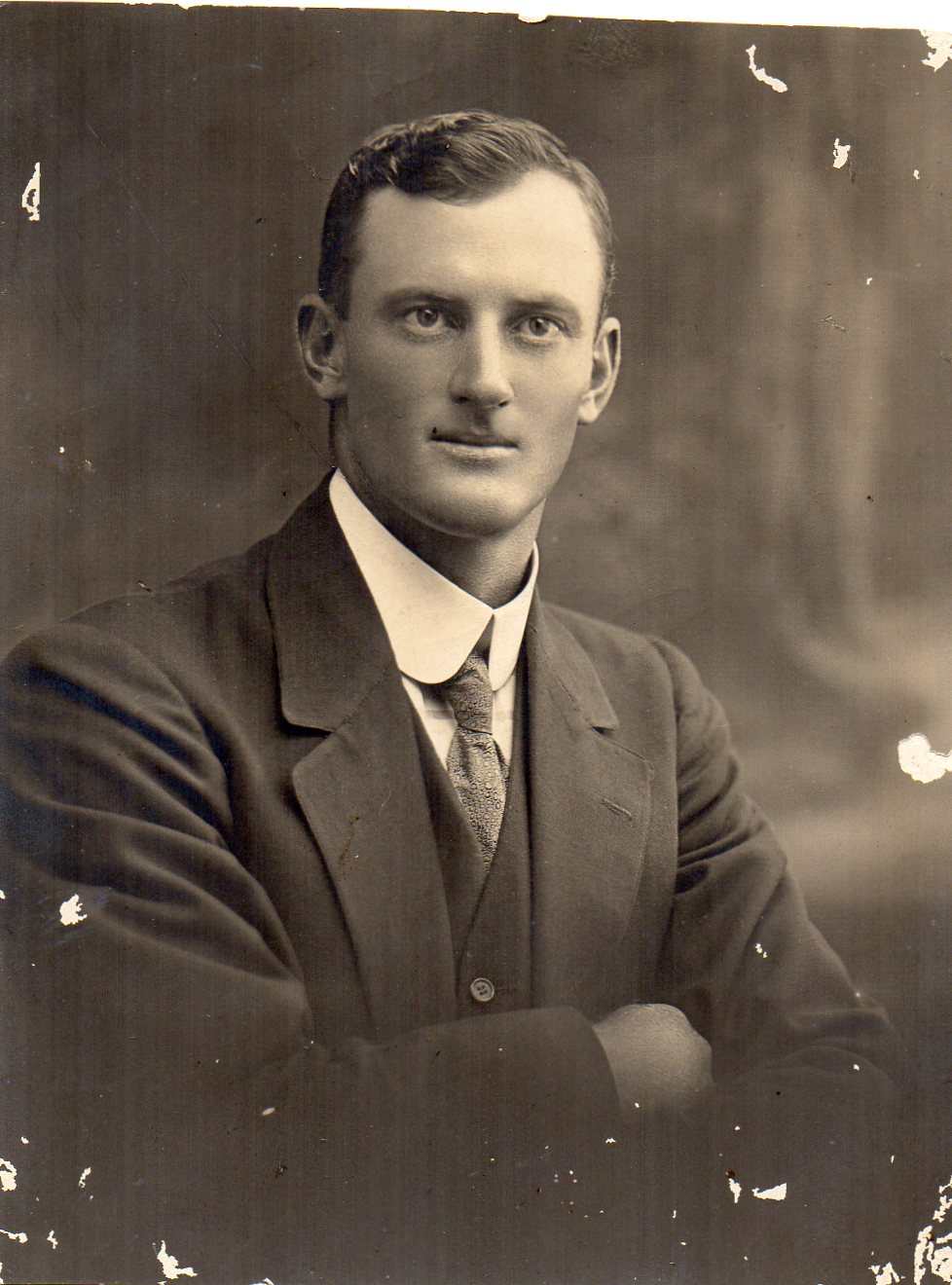
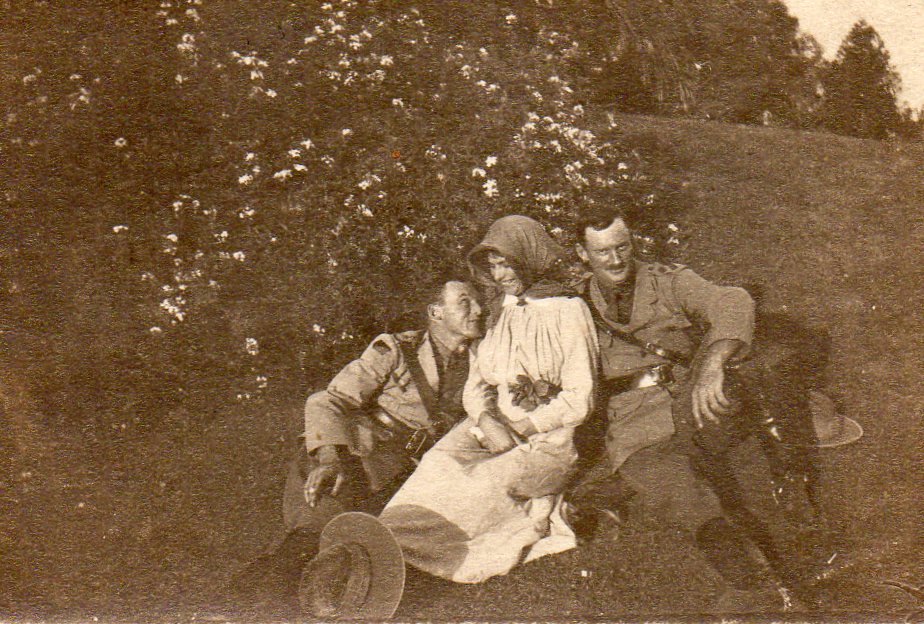
Thanks to Neil Thornton for all his research. I am copying most of what he wrote.
Like his brothers, Mervyn attended Sydney Grammar School and he was a competent athlete. He and Dudley were good runners and did well in sports at school.
Mervyn bred Australian rough coated Terriers and his own Terrier puppy was place first at the Sydney Royal Show in March 1902. Another of his dogs was called Tresco Bob (SMH July 8 1904). In 1902, Mervyn was a member of the Parramatta River Naval Cadets and received a mention for his shooting accuracy at the Field of Mars shooting range (SMH Tuesday 15th April 1902, page 6).
Mervyn enrolled in the Hawkesbury Agricultural College in 1905. At the Diploma Day held at the College on Tuesday, April 3 1906, in the Farm Class Category, Mervyn was awarded a Piggery Certificate (see the Windsor and Richmond Gazette, 7th April 1906). A vivid and entertaining description of the day is given.
Around 1909 Mervyn left Campbelltown and found work as a jackeroo on Coan Downs Station in the Lake Cargelligo region, 70 miles from Hillston. On 1th November 1914, Mervyn enlisted in the Australian Military Forces. His occupation was said to be station overseer and age 26 years.
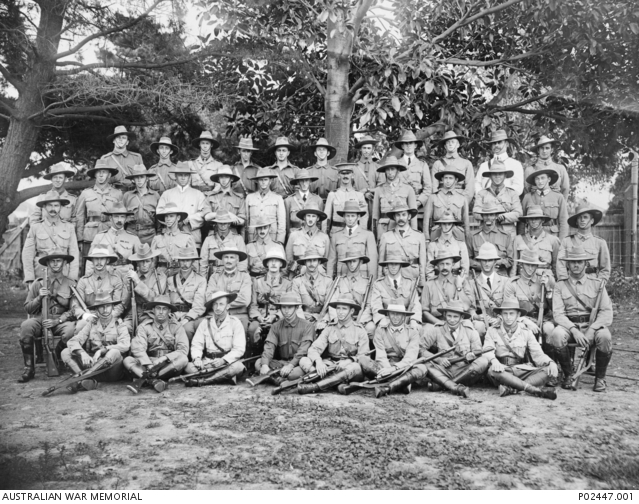
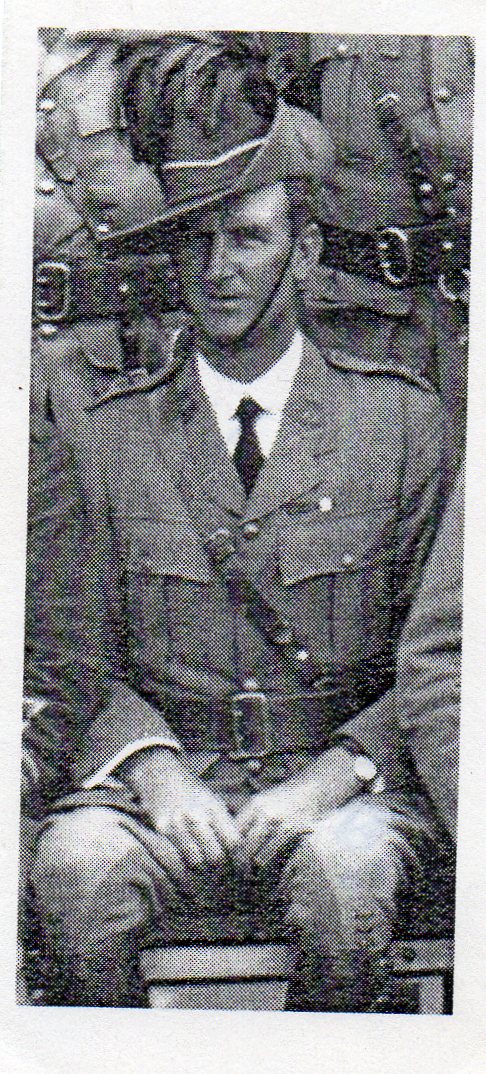
Mervyn and Jack, (John Ellesmere Westgarth who was 36 years old), attended a training course of the Australian Light Horse at the No 17 School of Instruction, Marrickville, between 8/2/15 and 6/3/15. The photograph below shows the two step brothers looking so alike. This photograph is part of a larger one available at: www.awm.gov.au/collection/P02447.001.
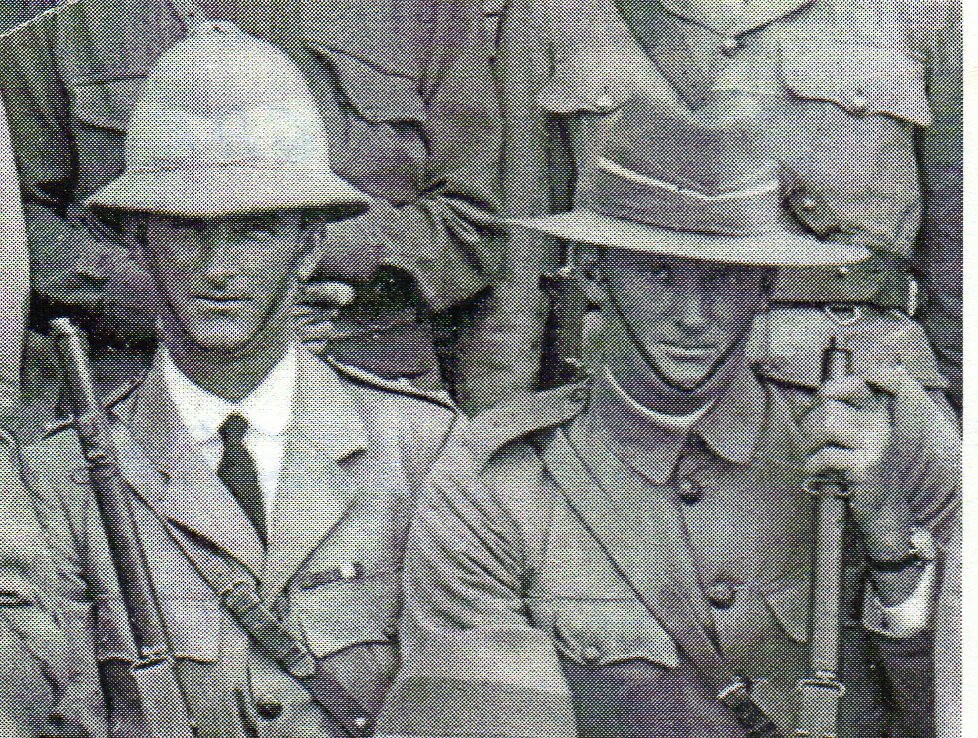
Group portrait of officers of the Australian Light Horse who attended a course at No. 17 School of Instruction, Marrickville between 8 February and 6 March 1915.
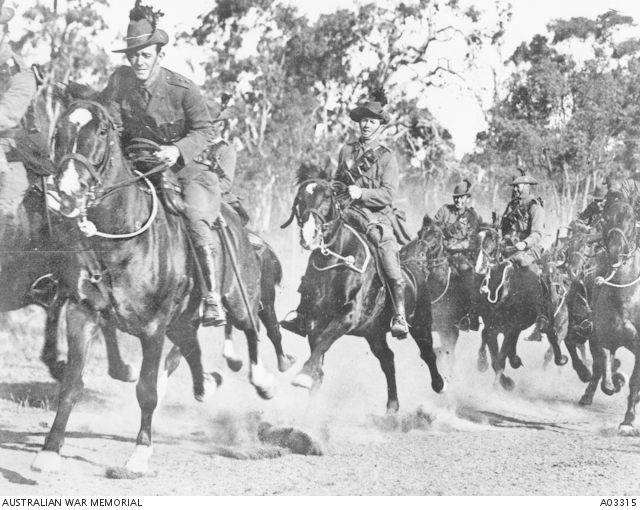
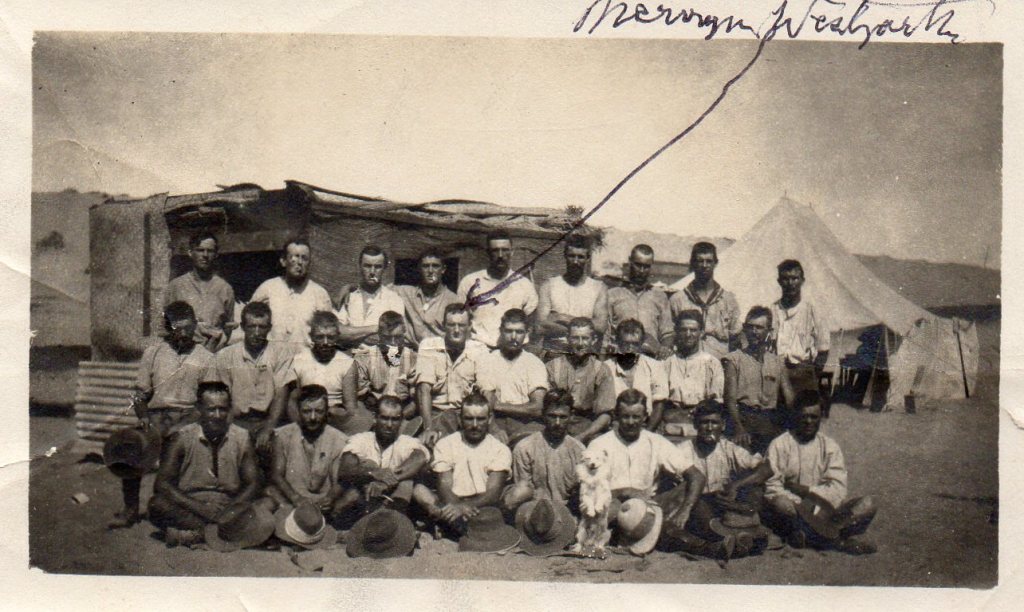
Mervyn and John travelled to Egypt, leaving on 13.6.1915 on the HMAS A29 Suevic. John was second in command of the 12th Light Horse Regiment and Mervyn was in the 7th. On arrival, Mervyn was soon made Sergeant, and soon after embarked for Gallipoli. Luckily he survived four months there and disembarked in Egypt on Christmas Day 1915. An eventful year!
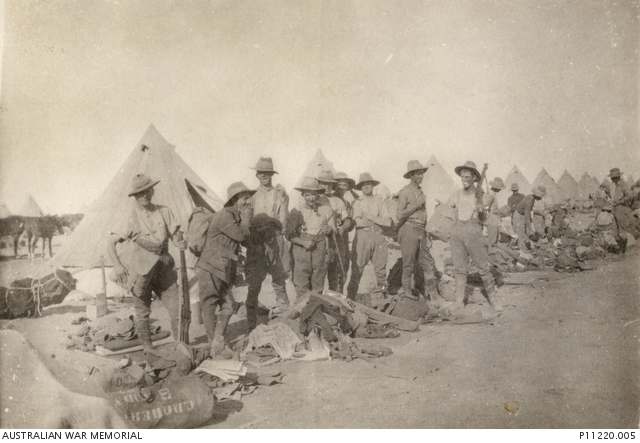
My grandfather always said Mervyn was ‘the best light horseman’ and that he was a trainer of the Light Horse.
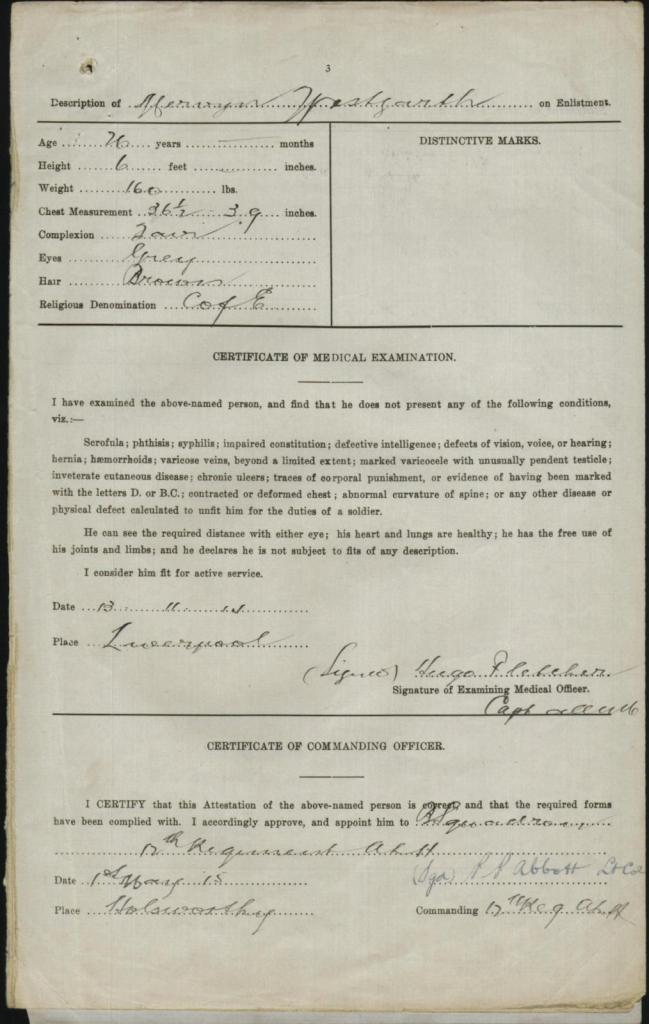
Sure enough, this service record shows that he was a trainer and soon became Second Lieutenant and then Lieutenant on 21st February 1917.
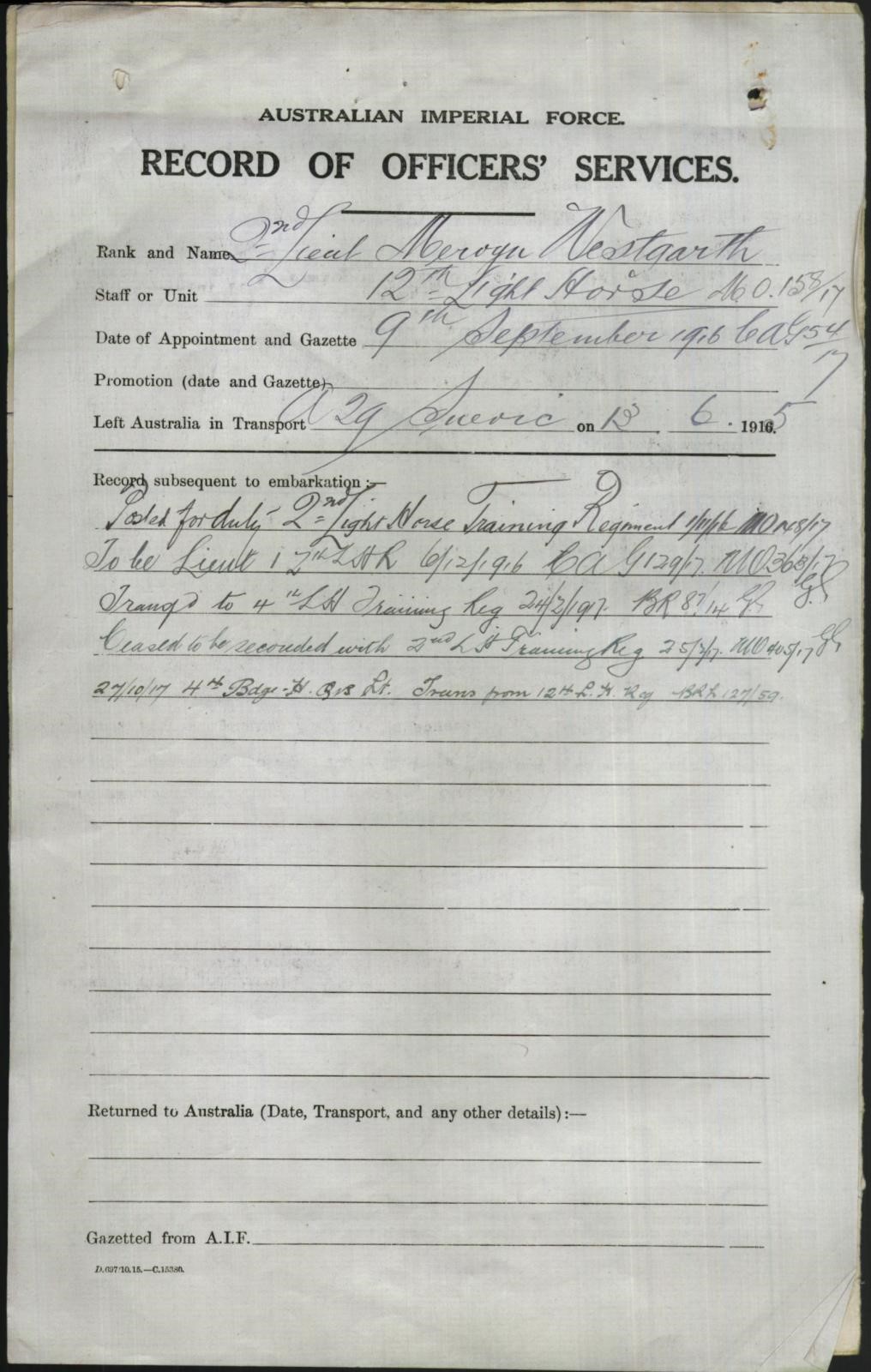
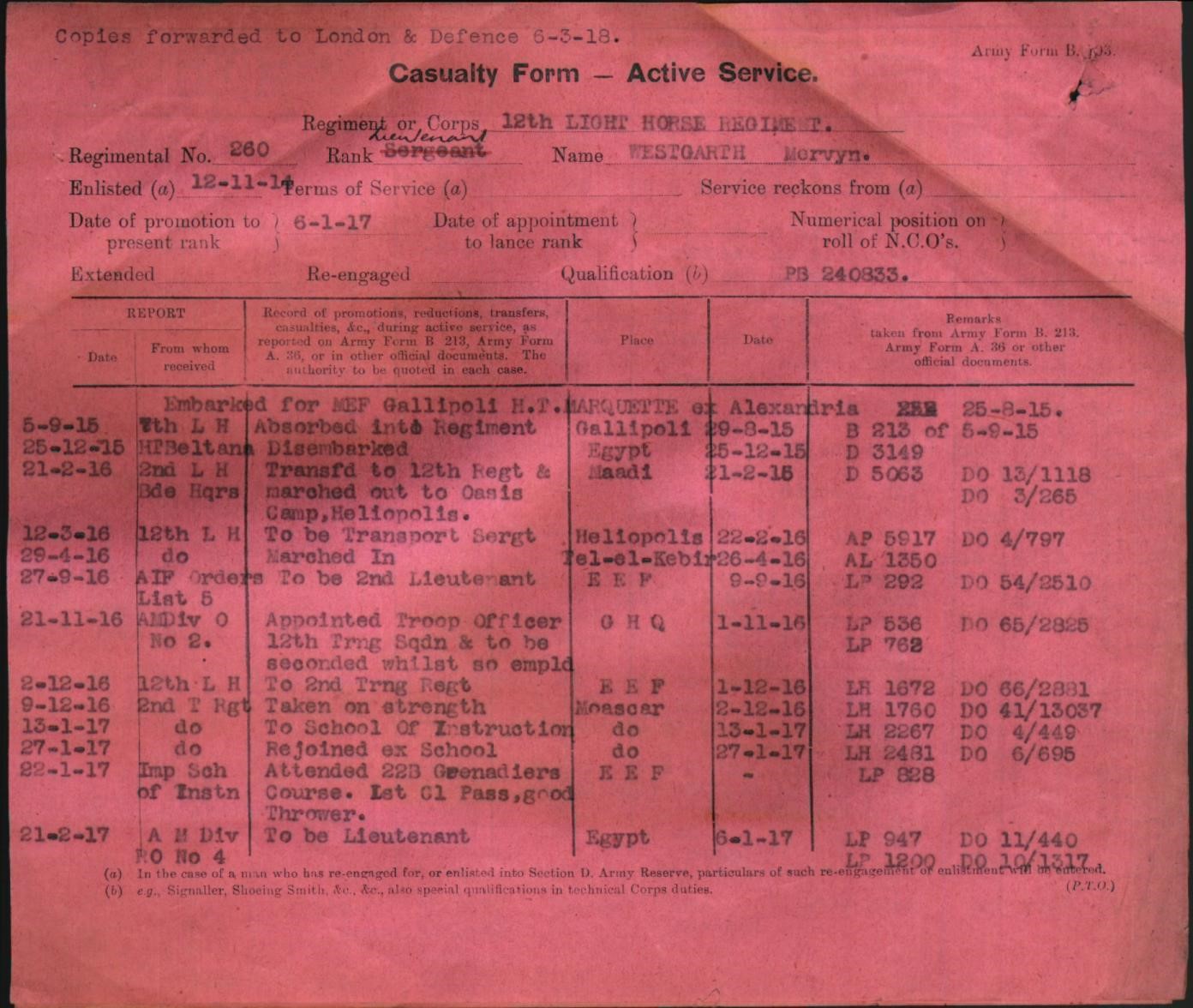
In 1917 he became ill for the first time, with septic sores in the groin and was hospitalised for three weeks, unable to ride. He was with the 12th Light Horse from July, but by October was on light duties as Burial Officer as his health deteriorated.
Beersheba
As a result of his deteriorating health, he did not take part in the last great cavalry charge, which took place on October 31st 1917, at Beersheba. As the attack at Gallipoli had not been successful in overcoming the Turks’ positions, the Australians were sent to attack overland. They travelled overnight and their horses had had no water for 36 hours. The wells at Beersheba were full. Perhaps the horses smelled it!
Below is a quote from the Wikipedia page. There are many interesting accounts on the internet.
“Australian Mounted Division‘s 4th and 12th Light Horse Regiments (4th Light Horse Brigade) conducted a mounted infantry charge with bayonets in their hands, their only weapon for mounted attack, as their rifles were slung across their backs. Part of the two regiments dismounted to attack entrenchments on Tel es Saba defending Beersheba, while the remainder of the light horsemen continued their charge into the town, capturing the place and part of the garrison as it was withdrawing. https://en.wikipedia.org/wiki/Battle_of_Beersheba_(1917
Mervyn returns to duty in November
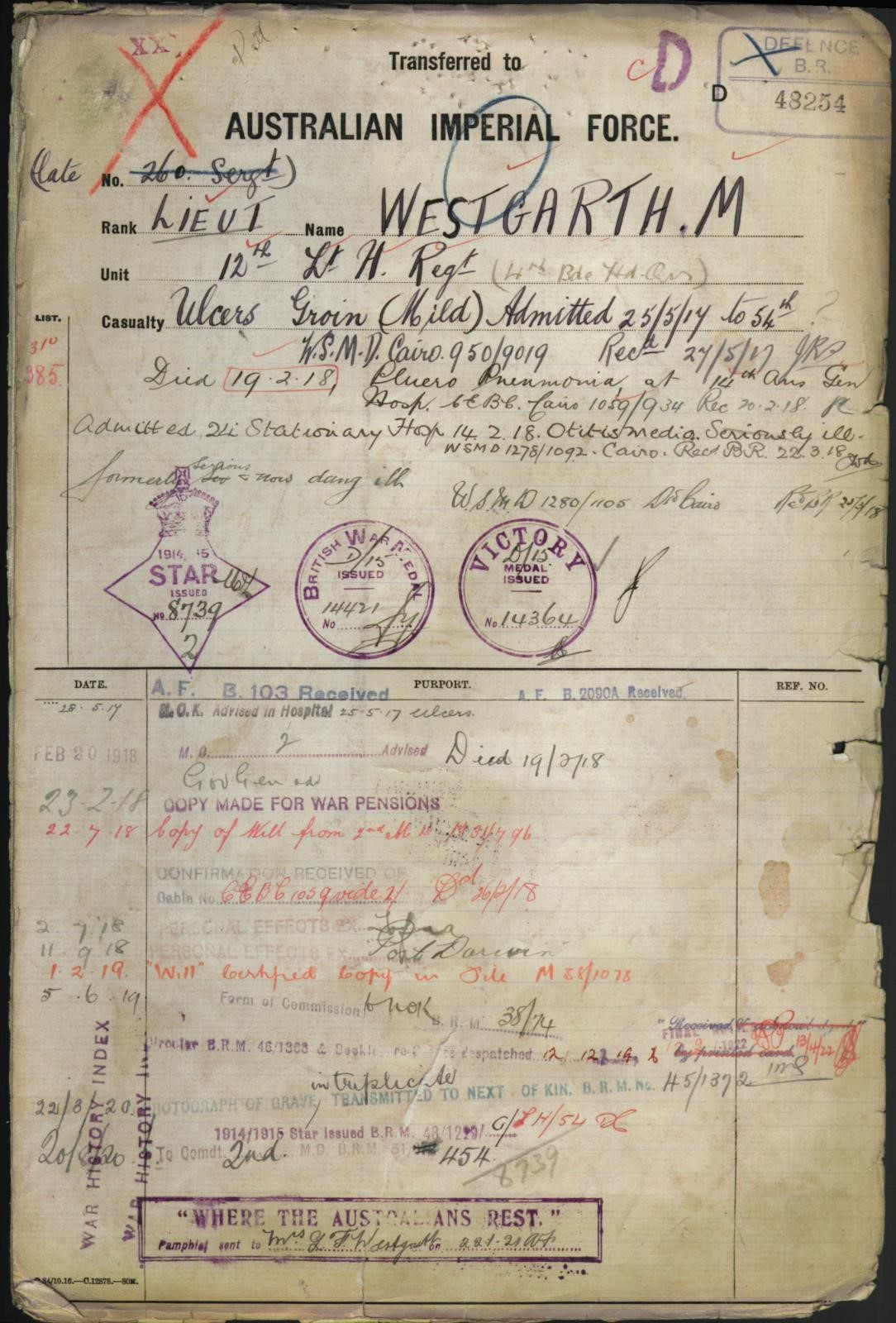
He went back to the 12th Light Horse in November, as Troop Officer, but by the beginning of February 1918 he was sick again. This time he had a cough and earache, but by 13th February he had bronchitis and middle ear. This worsened into pleuro pneumonia and ‘on 18/2/18 his condition became critical, he was delirious and unable to obtain any rest. He died at 12.50pm on 19/2/18”.(Doctor’s records)
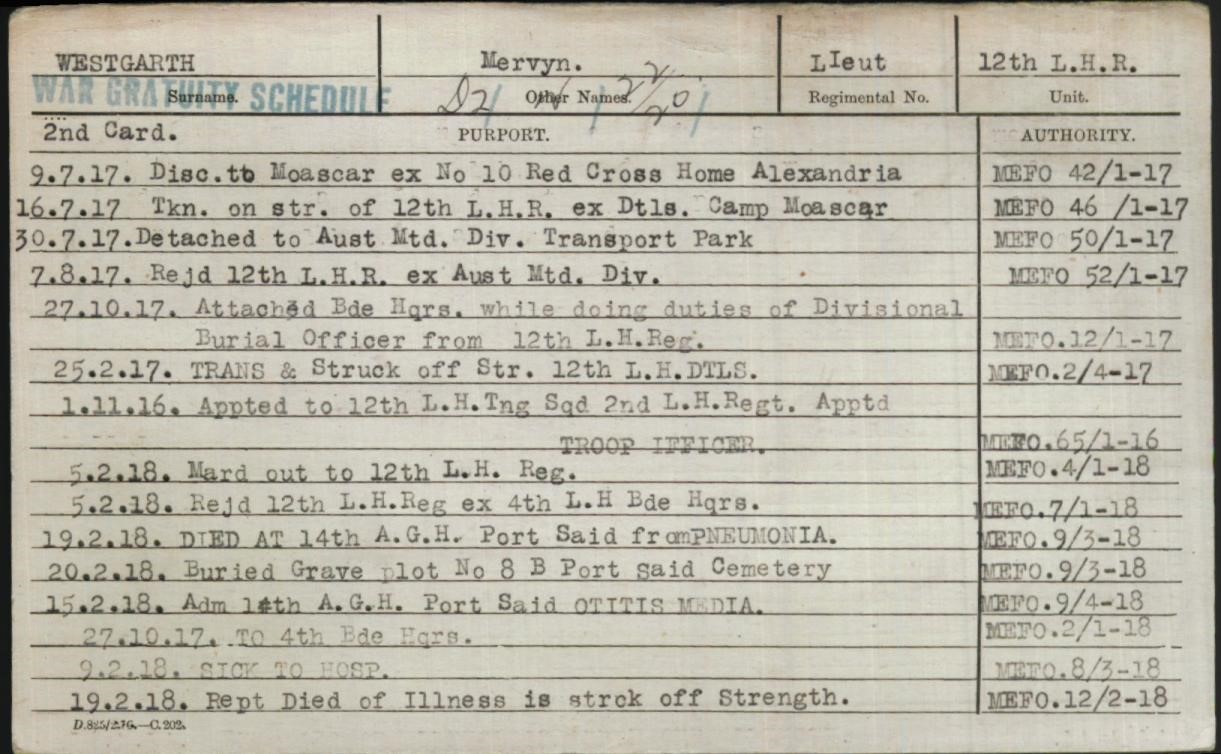
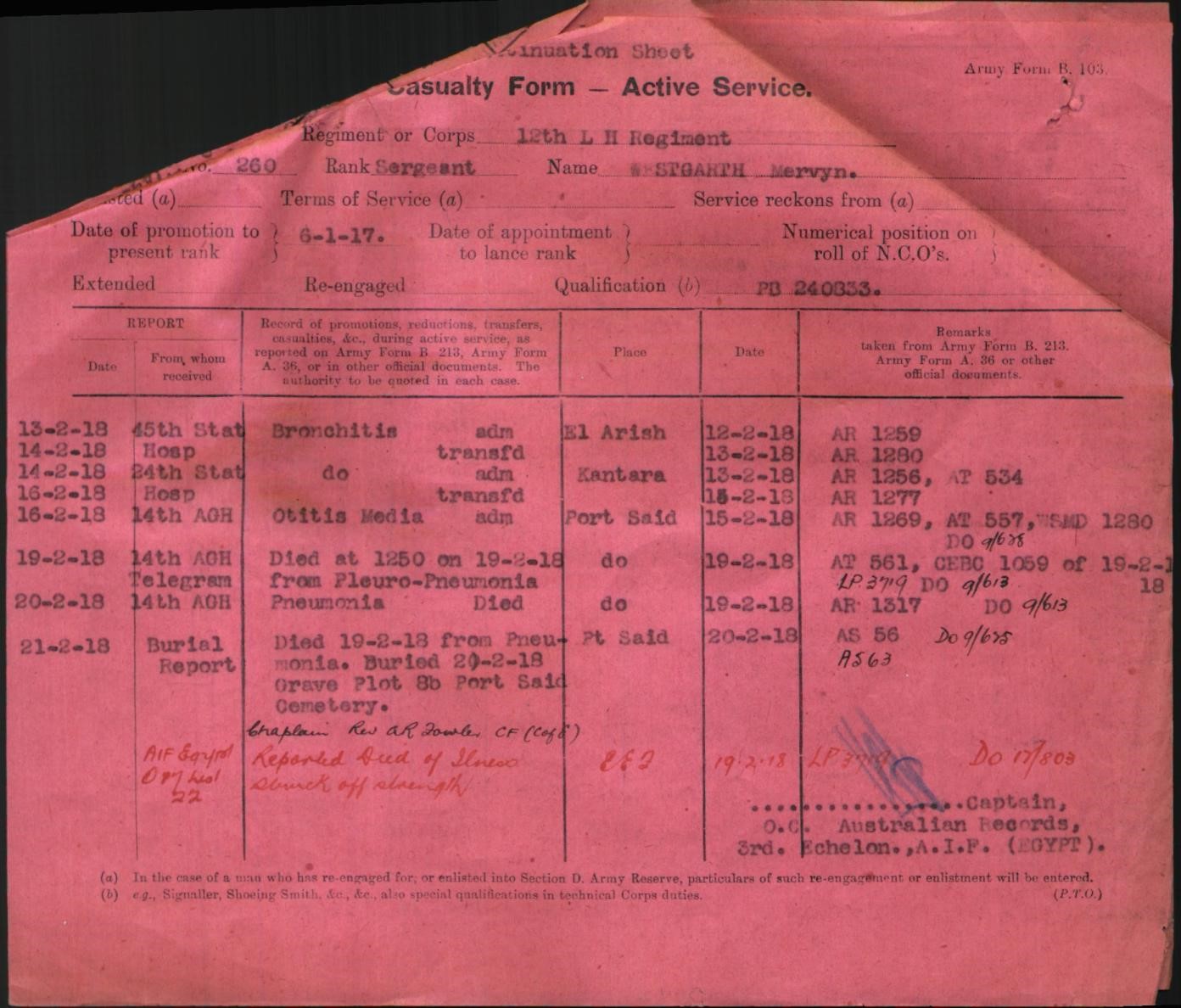
)My grandfather received the official information below in May, although Mervyn died in February.
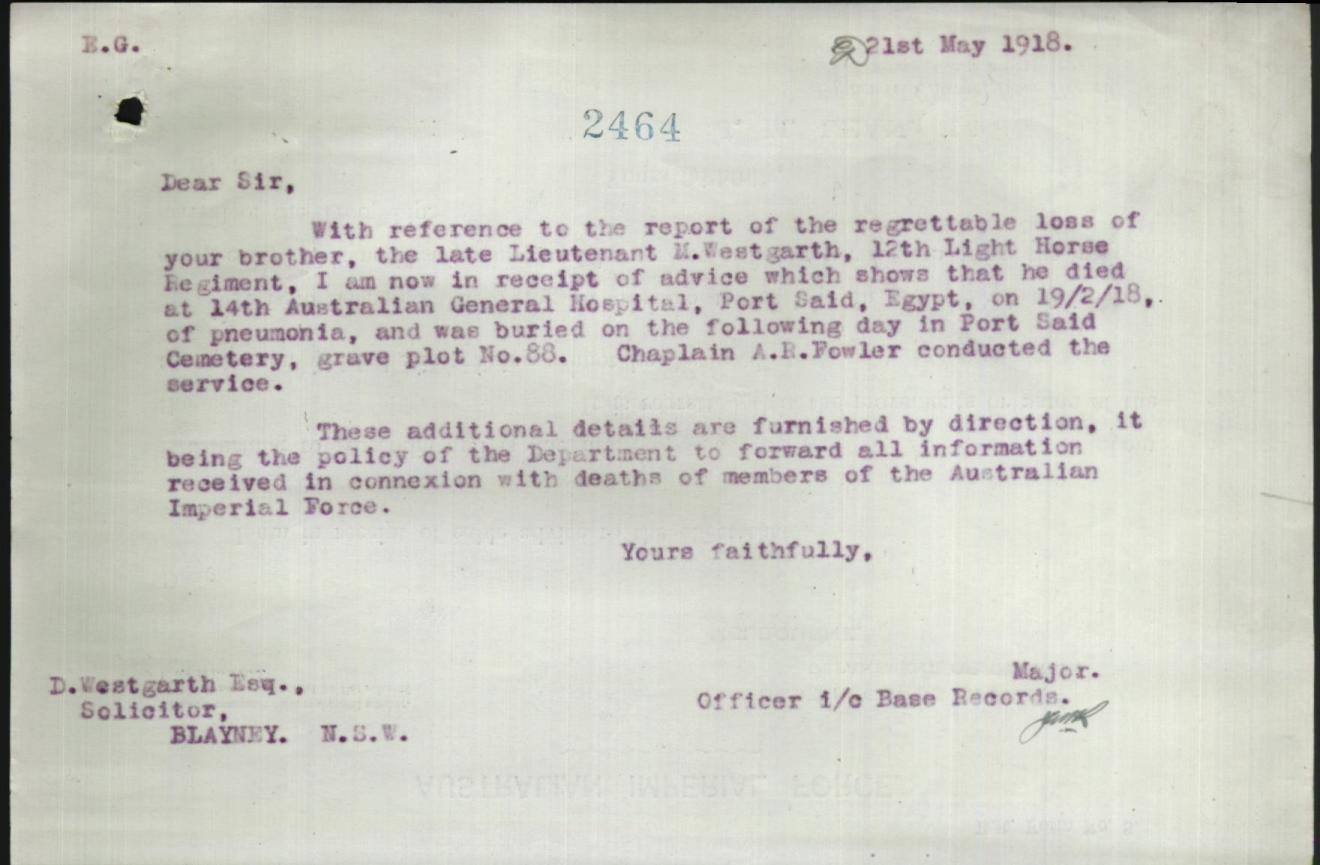
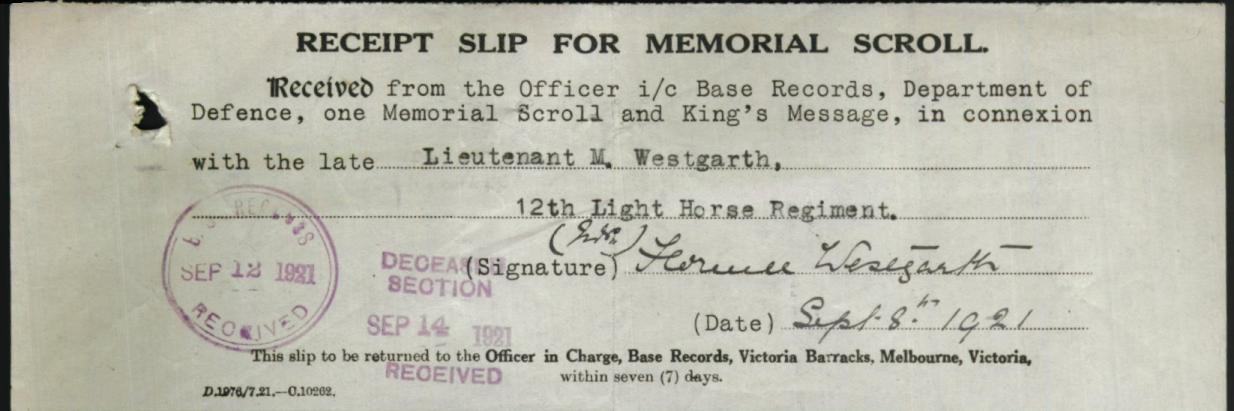
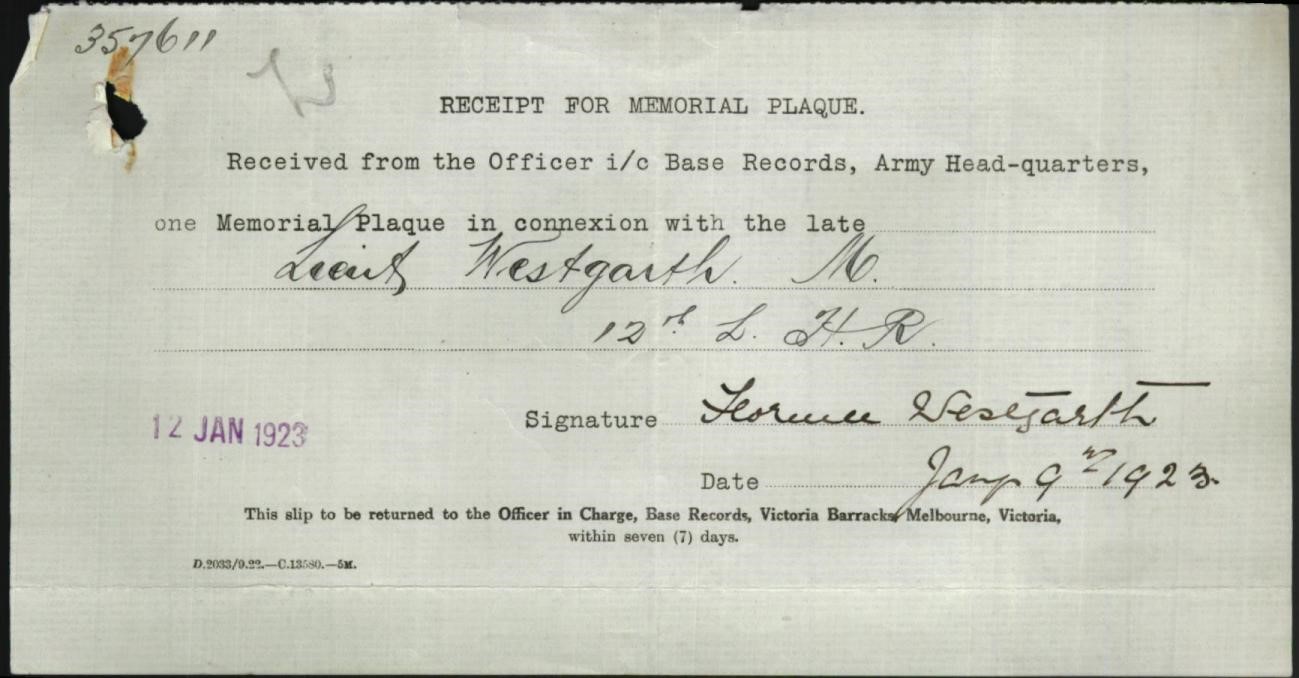
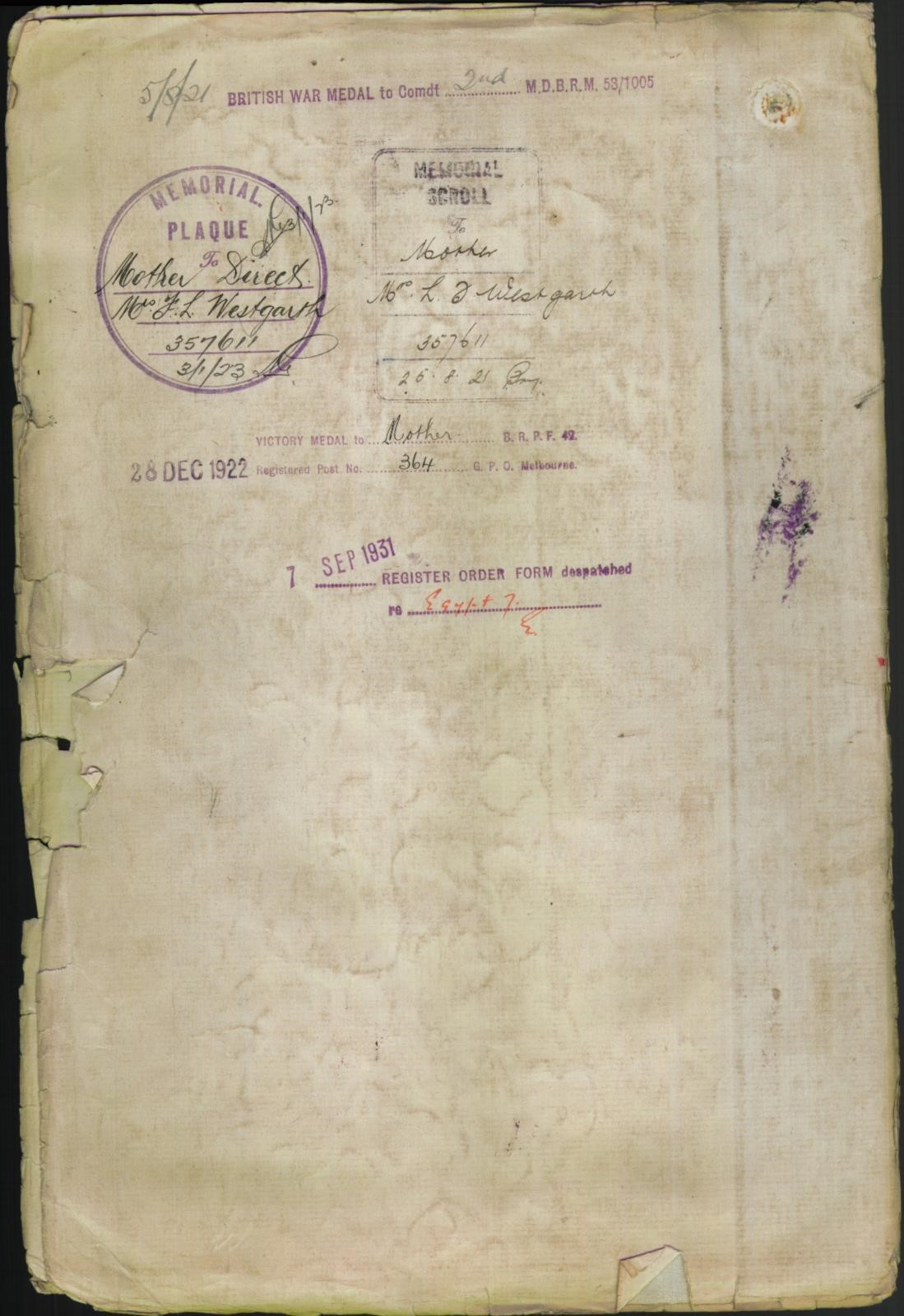
Lucy Florence received a scroll and later a plaque.
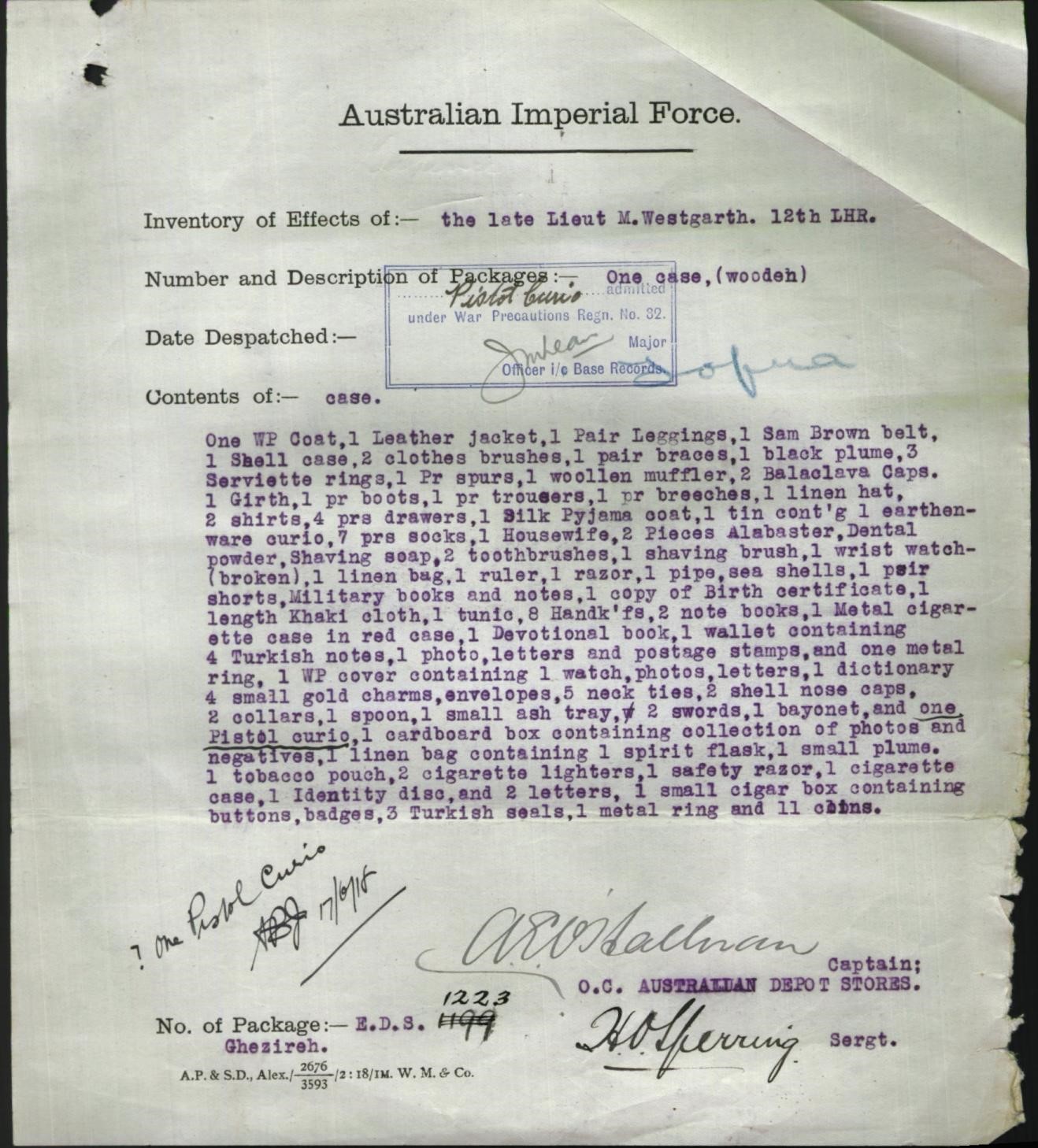
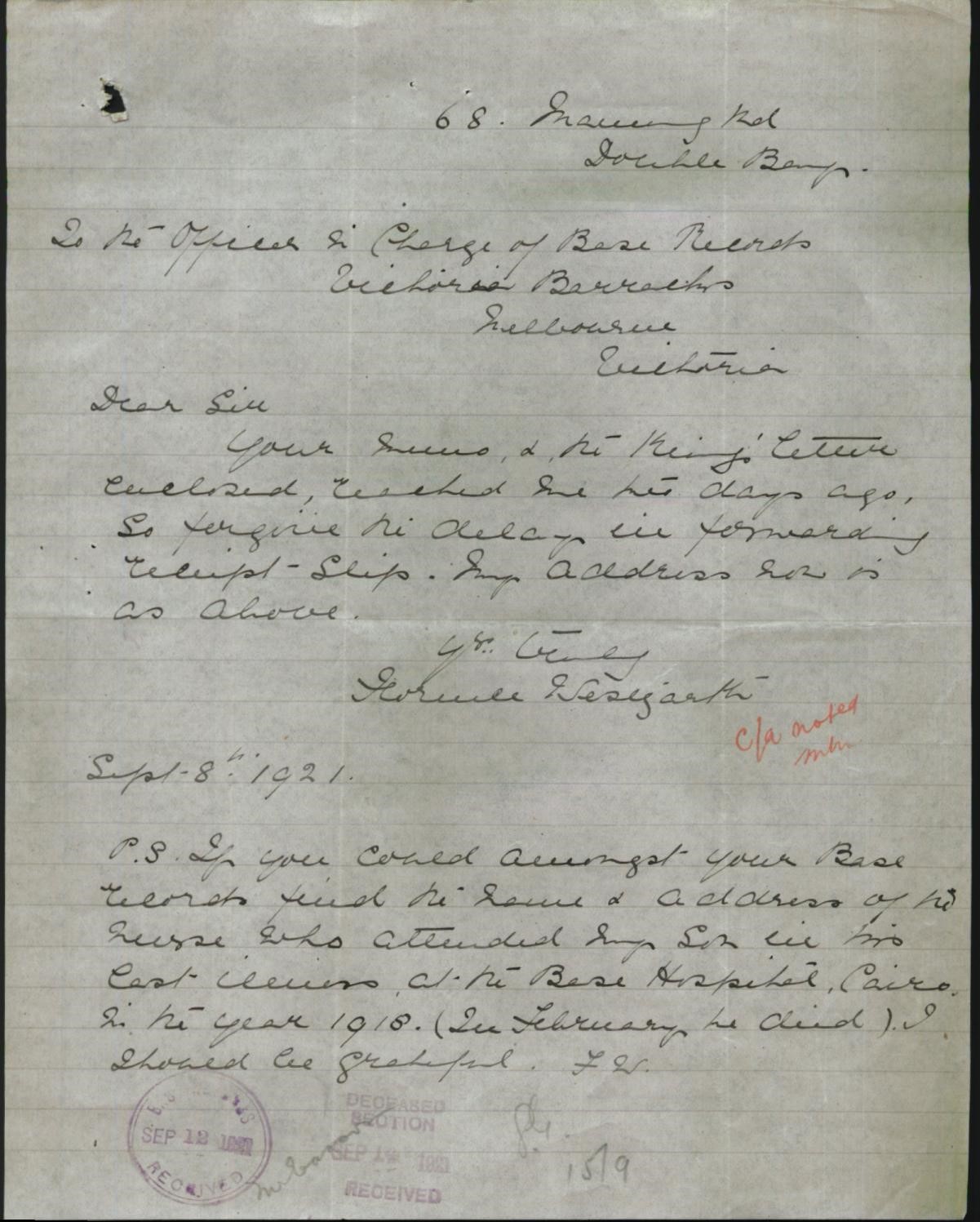
His mother wanted to know more about her son’s death. She wrote the following letter, hoping to have a personal talk to his nurse. The request was rejected, which perhaps was a blessing, considering the terrible death he suffered.
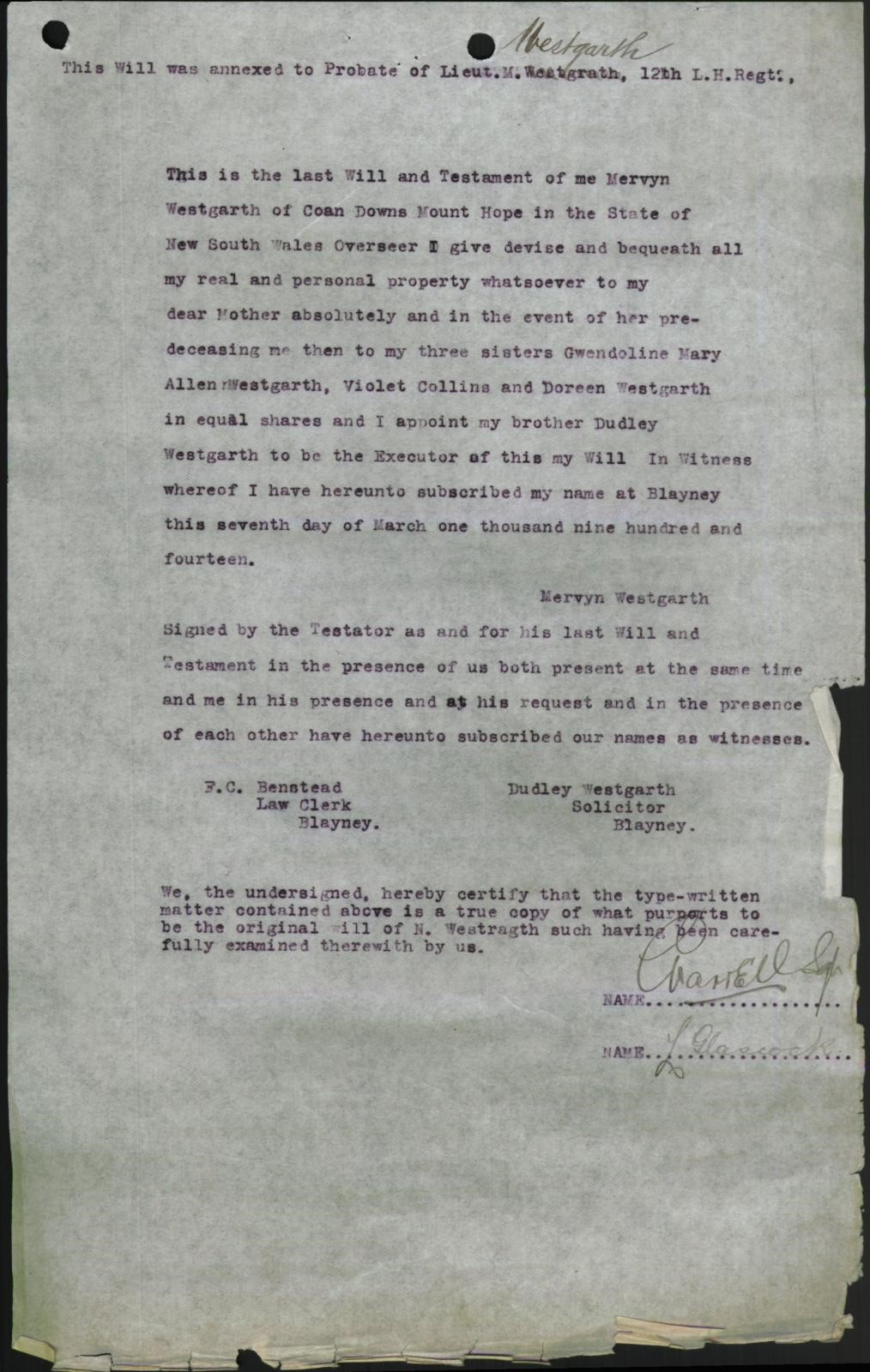
Mervyn made his Will at Blayney with Dudley before setting off to fight. Here is a copy:
Finally the medals he earned with his life were sent to Lucy Florence in 1922. He was never forgotten by my grandfather, so I wanted to write up his story. Thanks again to Neil Thornton.
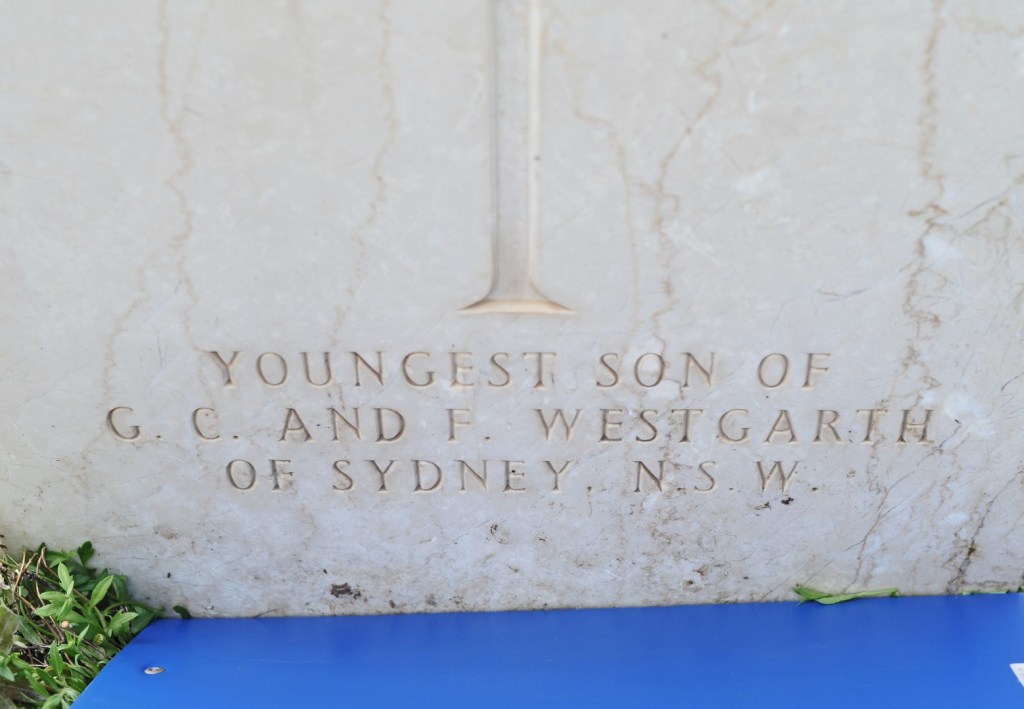
Mervyn was buried in the Port Said Military Cemetery, Cairo, Egypt. He is the only SGS boy interred there. Here are the photographs kindly sent by Philip Creagh.
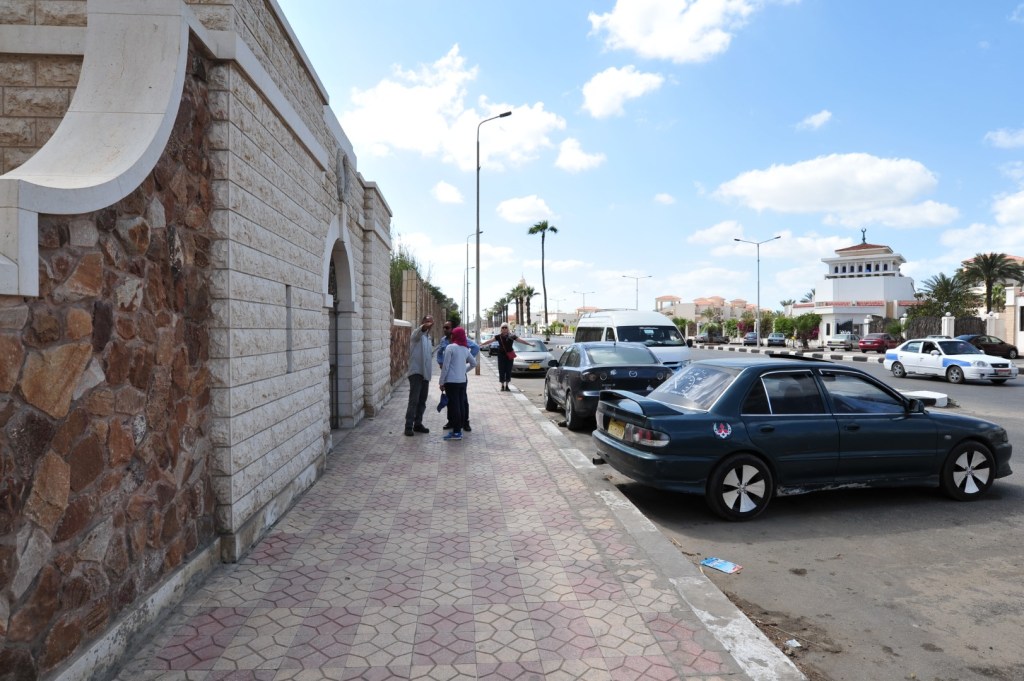
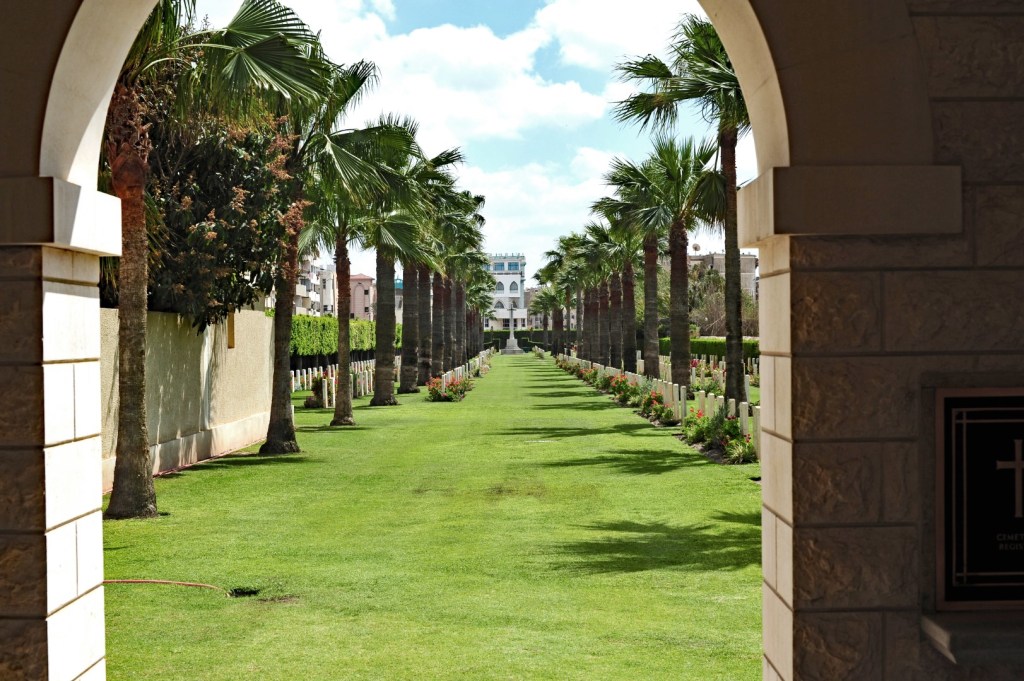
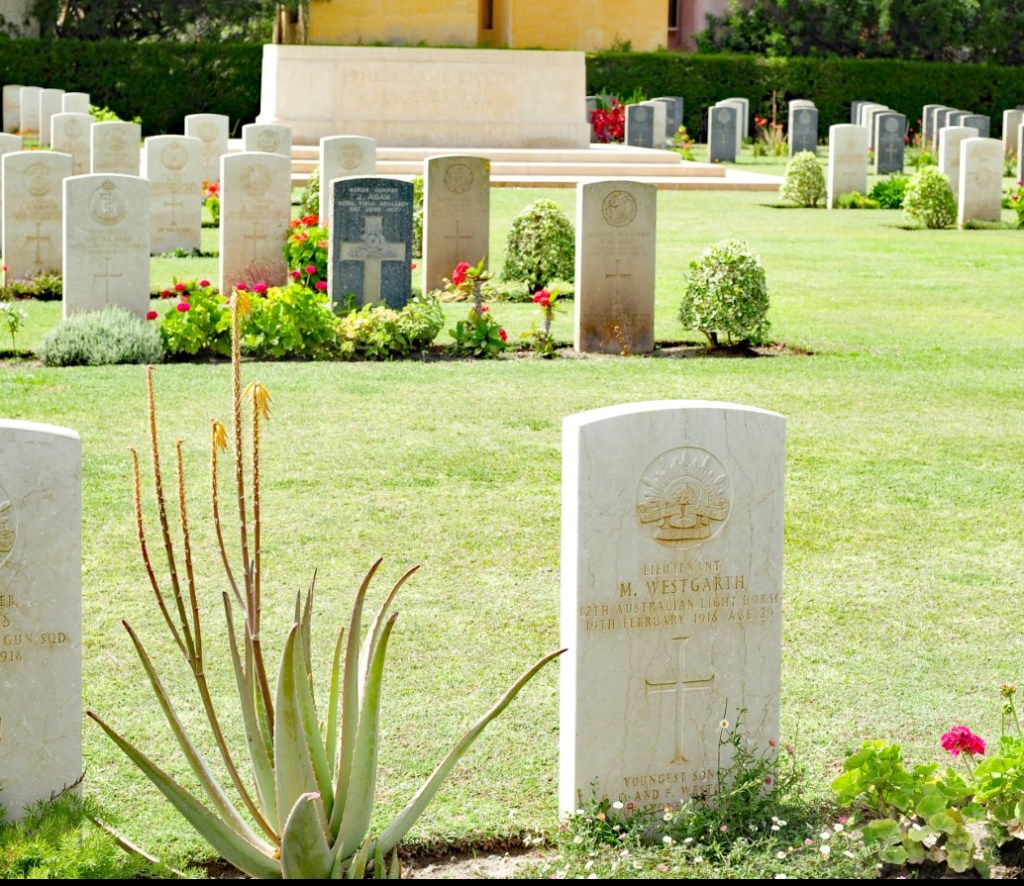
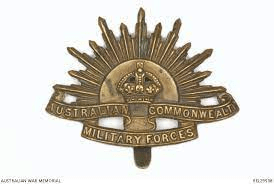
The Australian War Memorial, Canberra:
Second Lieutenant Mervyn Westgarth is on the First World War Honour Roll in the Courtyard. Details: 12th Light Horse
I have just received news from George Westgarth that Mervyn’s name will be projected onto the exterior of the Hall of Memory during 2022. The dates are below and full details can be read by clicking on the link below:
- Sun 27 February 2022 at 10:53pm
- Thu 16 June 2022 at 2:52am
- Sat 23 July 2022 at 5:51am
- Mon 07 November 2022 at 11:56pm https://www.awm.gov.au/collection/R1667856
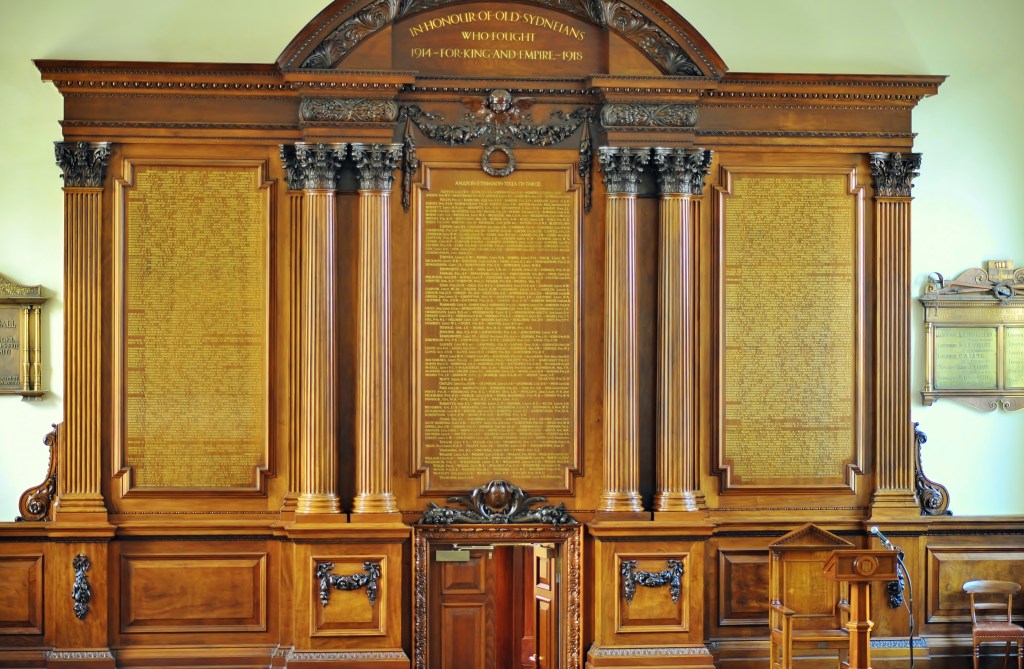
Mervyn is also on the Sydney Grammar School First World War Honour Roll.
A picture of the board at SGS has been sent to me by Philip Creagh, an old boy (1966), who has visited the graves of all the dead on the board, in many countries of the world.
Also on the Honour Roll is John Ellesmere, whose story is below.
6: Military Career and Death of John Ellesmere (Jack) Westgarth. Born 25/3/1877 Died 2/10/1918
Lucy Florence had an ‘annus horribilis’ in 1918, for whilst she was receiving the news of the death of her youngest son, her stepson John was fighting ill health in Elizabeth Bay after being sent home from the war and her daughter, Doreen, contracted TB.
I first heard of Jack when Dudley gave our son Jack’s binoculars in their leather case. They are still in our family. This is his story, pieced together with help from Neil Thornton!
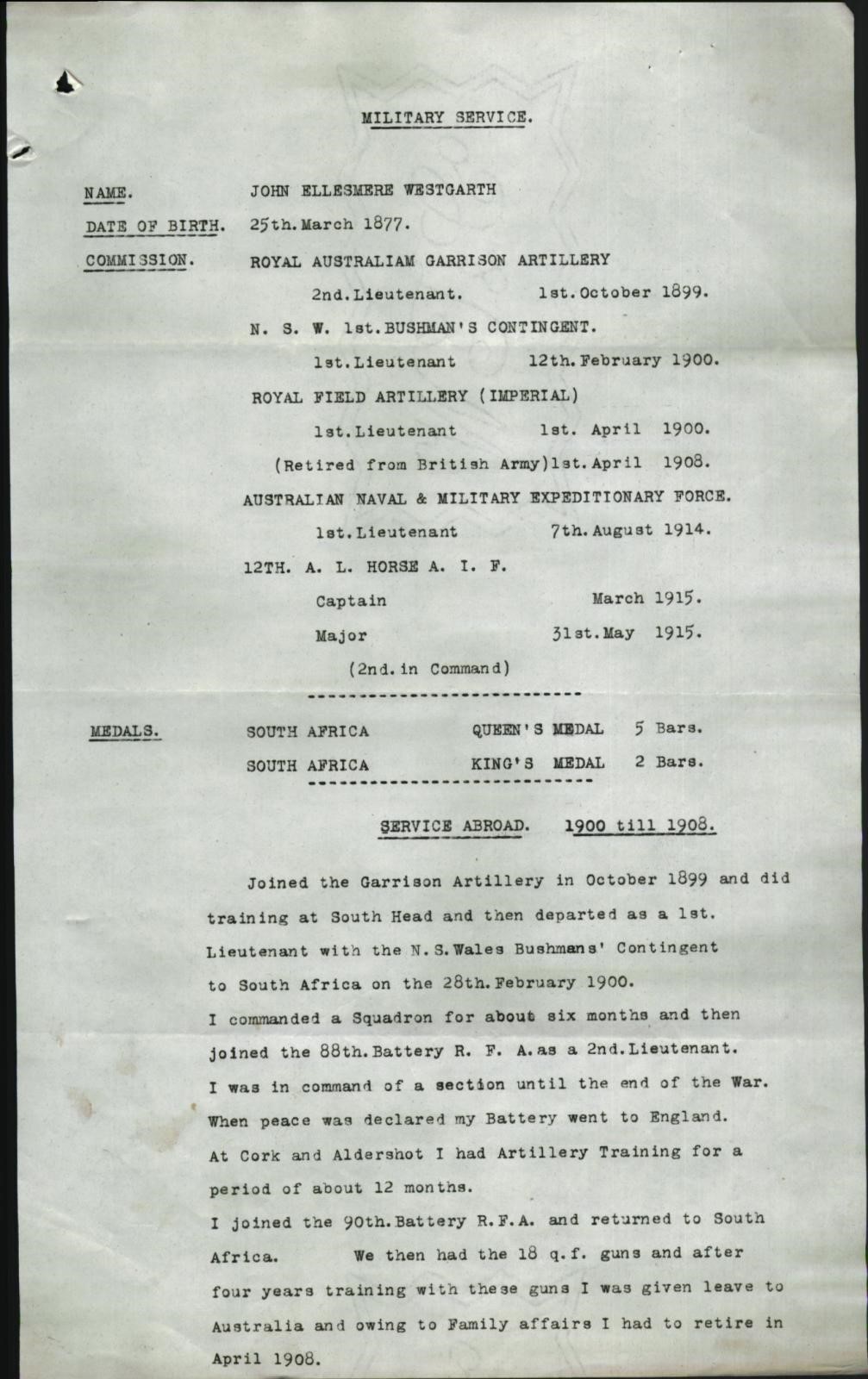
Jack was a professional soldier and rose to the rank of Major by the time he went with Mervyn to Egypt. Originally, he was going to be a solicitor and spent three years working as an articled clerk. However, he had his own income from his mother, Florence Sophia, a woman with an independent income, who died when he was a year old. From the will of his grandmother, Kate Rodd, who died on 19th November 1884 when he was only 7 years old that income would have increased. He decided to equip himself to join the first New South Wales Citizens’ Bushmen Contingent for the Boer War.
Therefore, on October 1st 1899 Jack joined the Royal Australian Garrison Artillery with the rank of Second Lieutenant. This became the first permanent Australian Military Force in the country, but had been formed in 1871, in the colony of New South Wales, when the Naval and Military Forces Act had been passed.
After completing his artillery training at South Head on 12th February, he left Australia for South Africa on 28/2/1900, just over a month since Federation! He commanded a Squadron for about six months before becoming the first Australian Officer to obtain a Commission in the British Army, joining the 88th Battery of the British Royal Field Artillery.
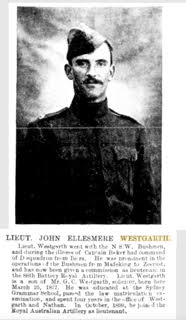
According to his medical records, John suffered an attack of Rheumatic Fever at the end of the Boer War in 1902. This is a disease known to weaken the heart.
After he recovered, he joined the 90th Battery of the Royal Field Artillery where he earned the Queen’s Medal six times over (medal plus 5 bars) and the King’s medal three times (medal plus 2 bars). Owing to his father’s grave health situation, he retired from the British Army on April 1st, 1908. Perhaps he was an April Fool, because he did not turn his back on soldiering.
Jack stayed home during the time that his father died and afterwards when his family all dispersed after selling up the home at St Helens, he stayed with his aunt, Constance King, because his mail below was sent to ‘Scotforth’, the home of the King family on Elizabeth Bay Road, Elizabeth Bay, Sydney. He had retired from the British Army and perhaps thought of finishing his articles to become a solicitor and marrying Miss Irene King, his cousin.
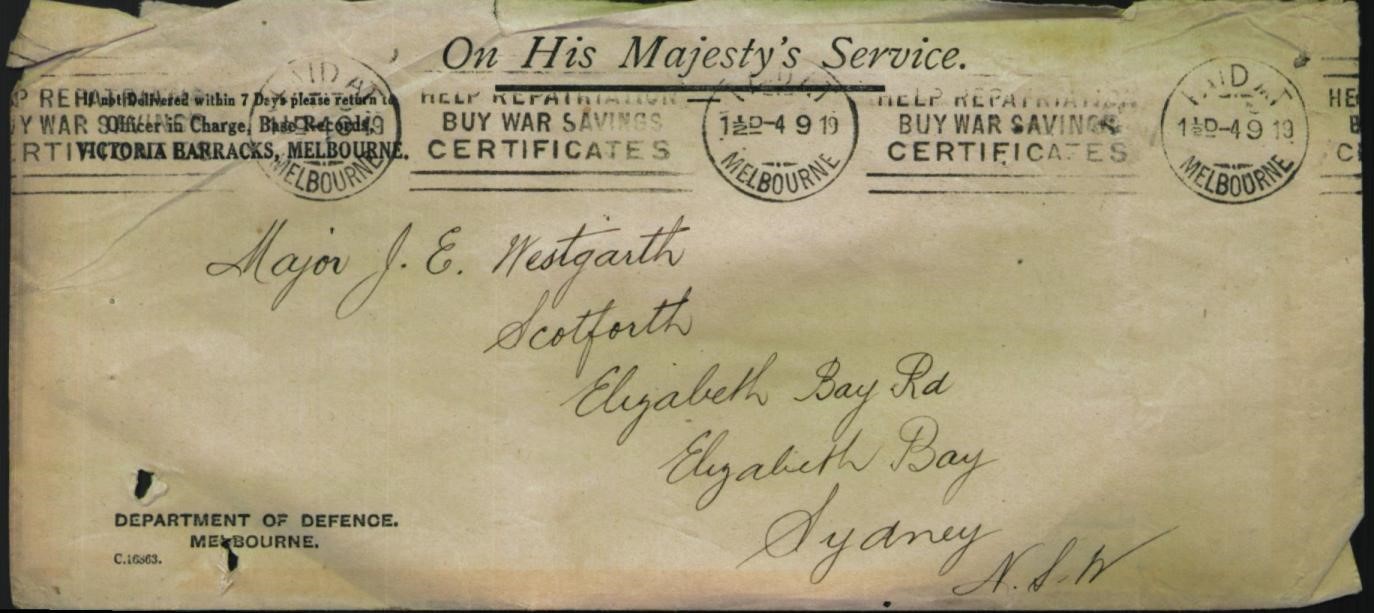
But that was not to be. He did not marry Irene, who was born in 1885 and was already 23 in 1908.
Jack returns to the army
Below is Jack’s own record of his service in the army, without mentioning any of his illnesses. The record shows that as soon as war was declared, on 6th August 1914 he joined the Australian Naval and Military Expeditionary Force, a volunteer force of about 2000 men, to seize all German possessions in Rabaul, New Guinea.
Group Portrait of the Officers’ Mess of the Australian Naval and Military Expeditionary Force. John is ninth from the right, back row, I am guessing!
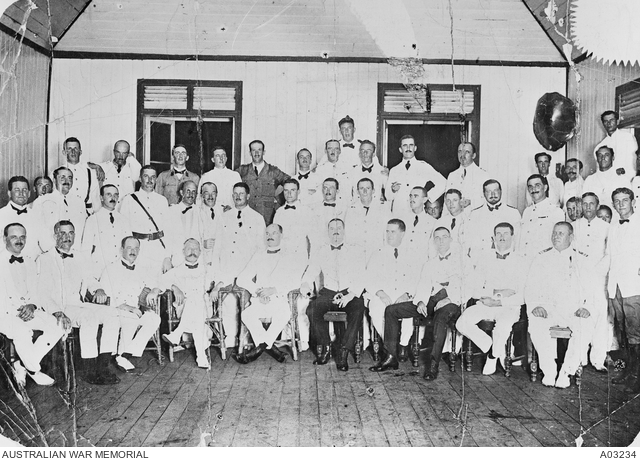
This they did. very swiftly, returning to Australia in January 1915, but whilst in New Guinea John fell ill with malaria. He was discharged from the ANMEF on 6/2/1915, but his health had been permanently damaged by Rheumatic Fever and now Malaria which never left his body.
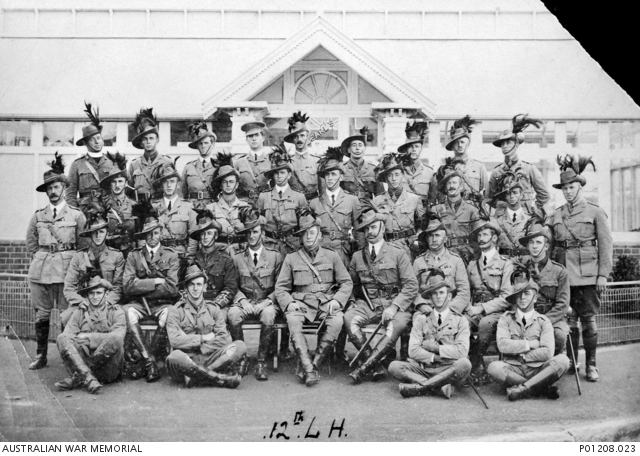
Two days later, he was attending the training course below! Instead of going back to the law, John immediately attended this training camp with Mervyn.
Group portrait of the officers of the Light Horse who attended a course at the Number 17 School in Marrickville New South Wales from 8th February to 6th March, 1915.
Left to right: back row: Lieutenants (Lt) E. H. Meredith, R. E. Ellerton, C. A. Brough, L. W. Davies [probably Louis Walter Davies], R. C. Dant, F. J. Dickson, A. W. K. Farquhar [Allan Wallis Kemmis Farquar], C. H. Bate, F. N. Snow [Frank Noel Snow], A. E. D’Arcy, Staff Sergeant Major (SgtM) W. Hudson, Assistant Instructor. Second back row: Lts A. Butler, A. B. Fitzhardinge, S. C. Calderwood [Stanley Charles Calderwood], C. G. Johnston, R. T. Williams, W. B. Christian, J. Kemp-Bruce, J. W. Connor, R. H. Richards, H. M. Sandy, K. W. A. Smith, R. C. Hunter. Third back row: SSgtM J. Dunlop (Assistant Instructor), SSgtM A. F. Clifton (Assistant Instructor), Lts H. W. Veness, C. K. Bragg, R. Barnett, Jack Rupert Cyril Davies, A. B. Pettigrew, J. G. Asser, W. J. S. Gillies, S. H. Haggarty, O. E. Carter, SSgtM V. McNamara (Assistant Instructor). Second front row: Lt H. N. Beiers, Captain H. F. White, Captain P. Connolly, Major G. D. Ross VD, Major R. C. Holman DSO (Instructor), Colonel D. P. White (Chief Instructor), Captains W. G. Alley, M. S. Kennedy [Malcolm Stuart Kennedy], P. Cureton, Lts H. F. Robinson, J. E. Westgarth [John Ellesmere Westgarth], M. Westgarth [Mervyn Westgarth], A. G. Brady. Front row: Lts E. St. J. N. Binnie [Ernest St John Northcote Binnie], E. Hyman [Eric Montagure Hyman?], G. N. Mills, W. T. Anderson, H. I. Johnson, G. Nugent [George Nugent?], E. B. Ralston [Edward Bolton Nugent?], A. M. Gerrard.
John Goes to Another Officers’ Training Camp
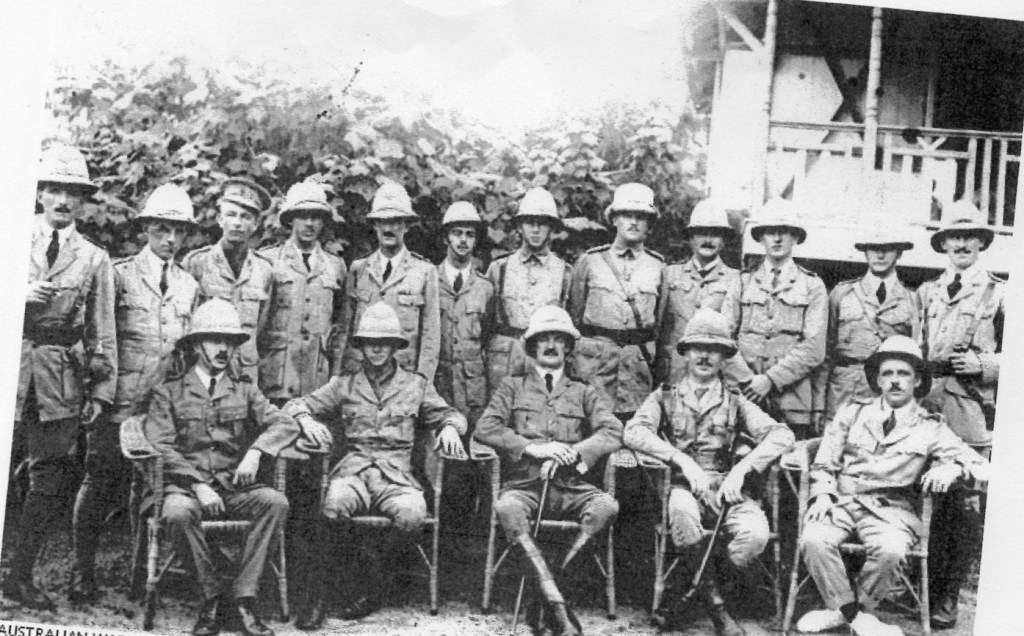
John, or Jack as he was called, completed his Light Horse examinations on May 10th, was promoted to Captain and then attended the above training at Holsworthy Barracks in Sydney. By the time the two brothers left for Egypt on the Suevic, he had been promoted to Major and was second in command of the 12th Light Horse Regiment.
The autobiography below tells the story of his deployment in Egypt, Gallipoli and back to Egypt by Christmas 1915.
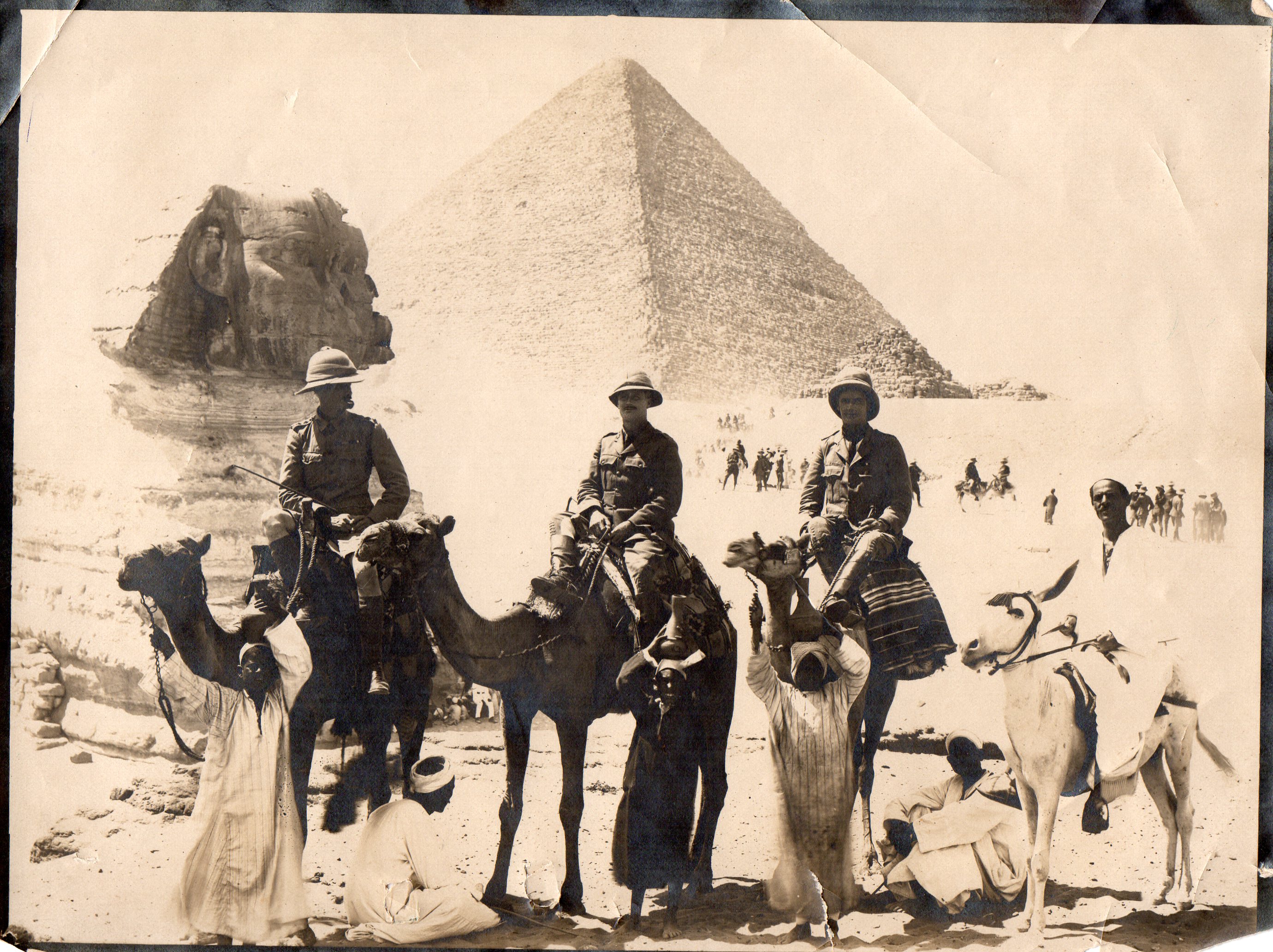
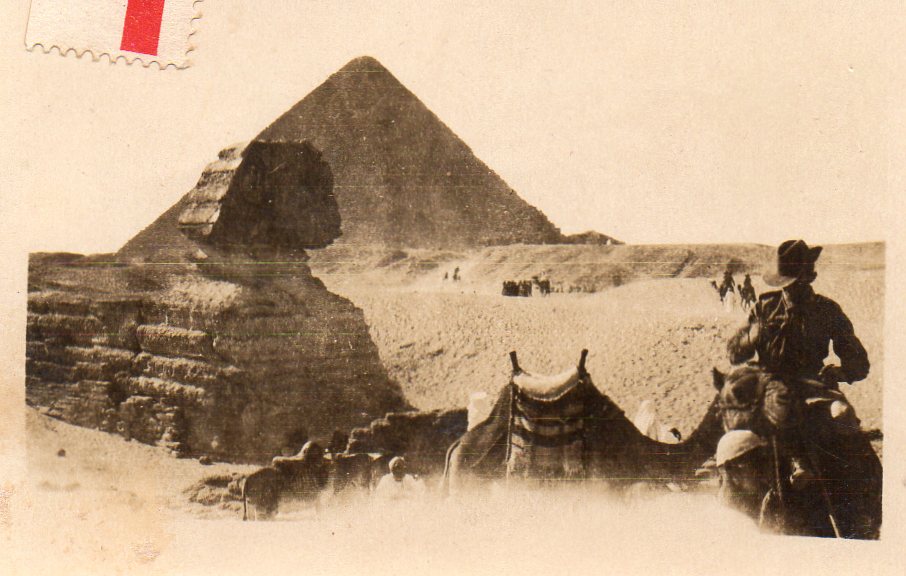
Here he is ‘doing’ the Great Pyramid at Giza and the Sphinx on camel back. According to the writing on the back of this photo, which I possess, Jack is the tall commanding looking man on the left. He looks very at ease riding his ‘ship of the desert’. There are 6 Egyptians attending the riders!
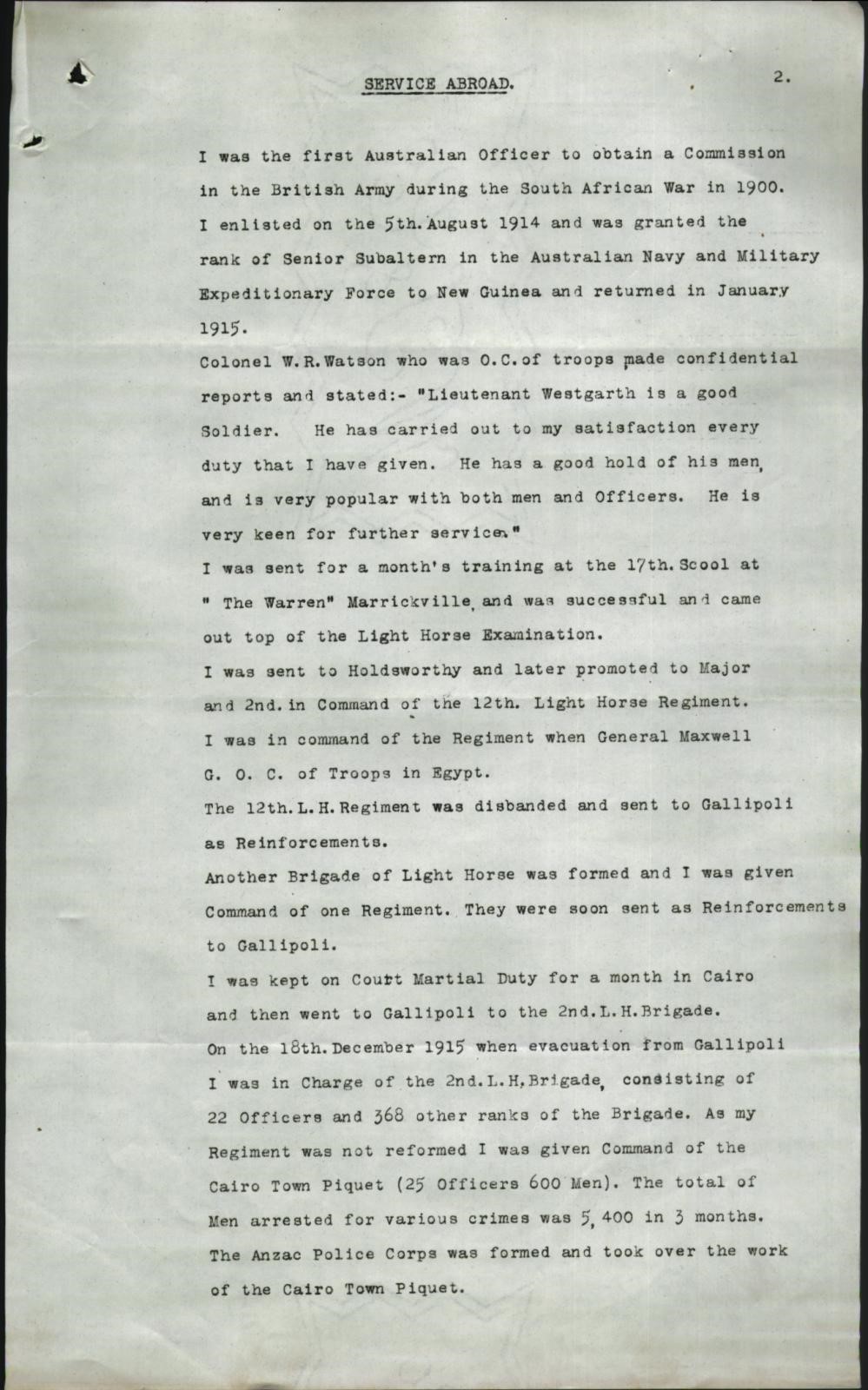
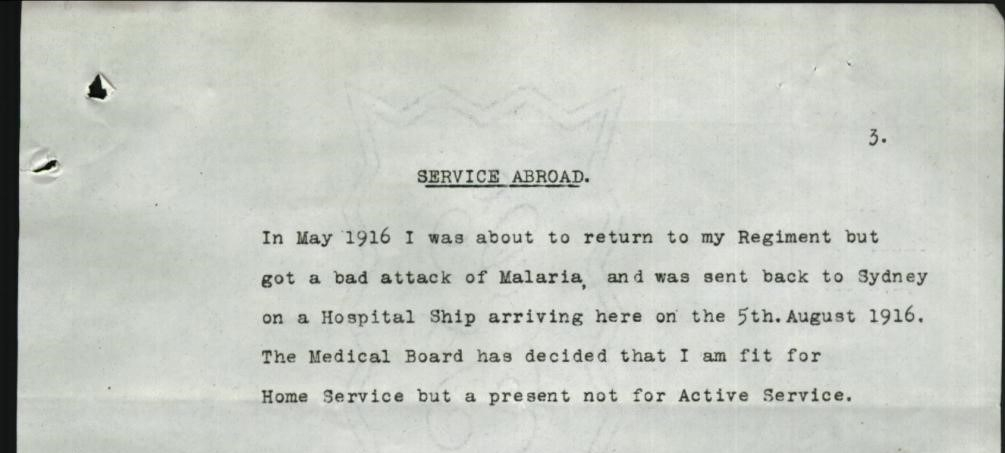
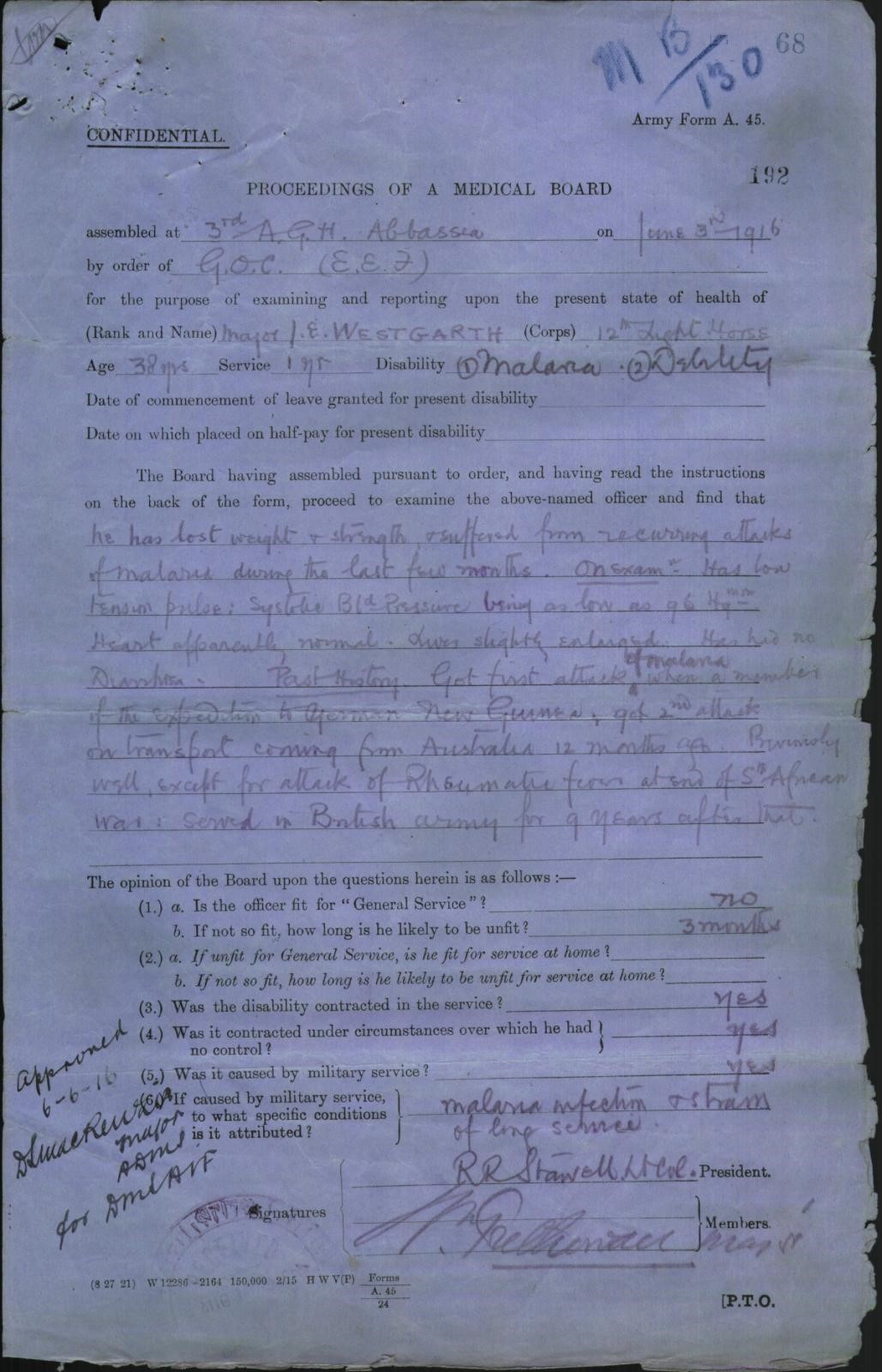
By May 1916 he was sick with malaria, lack of strength and general ill health, including neurasthenia, a condition akin to ‘shell shock’, which the doctor who filled in the form below felt had been caused by the length of his military service. For a trial period of three months, he was sent home as an invalid on the hospital ship Karoola, arriving in Sydney on 5/8/1916.
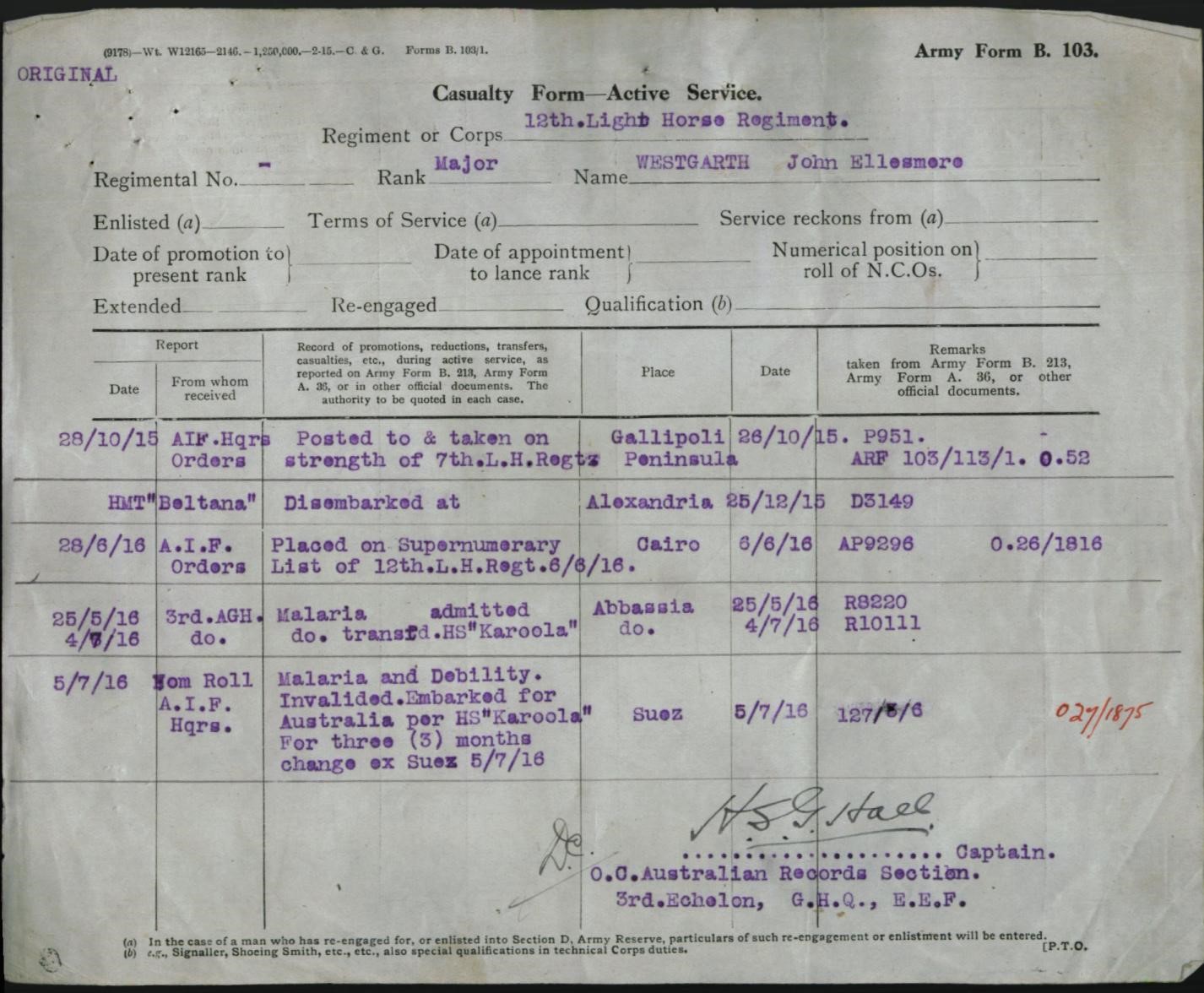
Although Jack wrote in his autobiography that he was pronounced fit for home service, his condition really remained poor and he was discharged from the army on 15/6/17, receiving a war pension of £1.3.9d (one pound three shillings and ninepence) per fortnight.
Jack remained an invalid for the next 15 months, living in the home of his aunt, Constance Josephine King, nee Rodd, at Scotforth, 43 Elizabeth Bay Road, Elizabeth Bay.
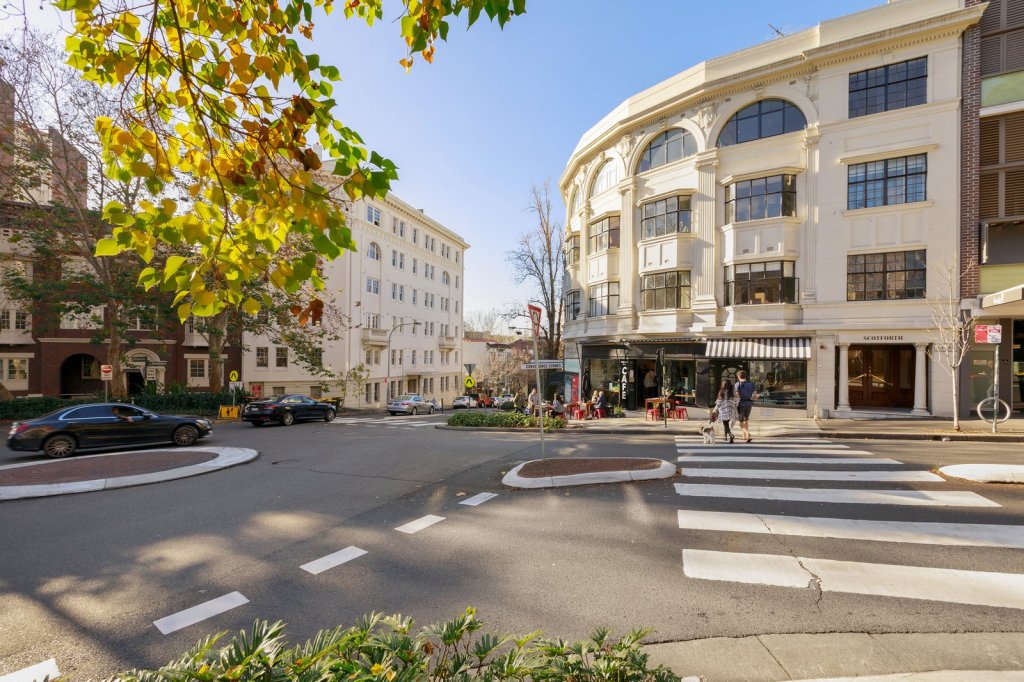
Here are some details of the interior, written in a real estate article: ‘Scotforth’s landmark Art-deco building makes a striking first impression, with a lobby adorned with marble flooring and staircase of original timber.’
Jack’s last illness at Scotforth, with his aunt, Constance King
Jack’s mother and father had both died well before he was invalided from active service and Lucy Florence, his stepmother, was running a girls’ school in Lane Cove, so had no time to nurse the sick man. He must have turned to his aunt for accommodation during his convalescence, in her spacious home.
Jack’s death:
Jack passed away in hospital on October 2nd 1918, the same year that Mervyn died. Jack must have had a strong relationship with Irene King, who was probably his cousin and lived at number 86. It was said that they were engaged to marry.
Medals
In 1920, the year Constance died, Irene applied to receive Jack’s medals. Her address is Scotforth. I thought she was living there when I saw her around 1950, as a child taken there by Dudley, but her death certificate states that she was living at Elizabeth Bay House, 7 Onslow Avenue, Elizabeth Bay.
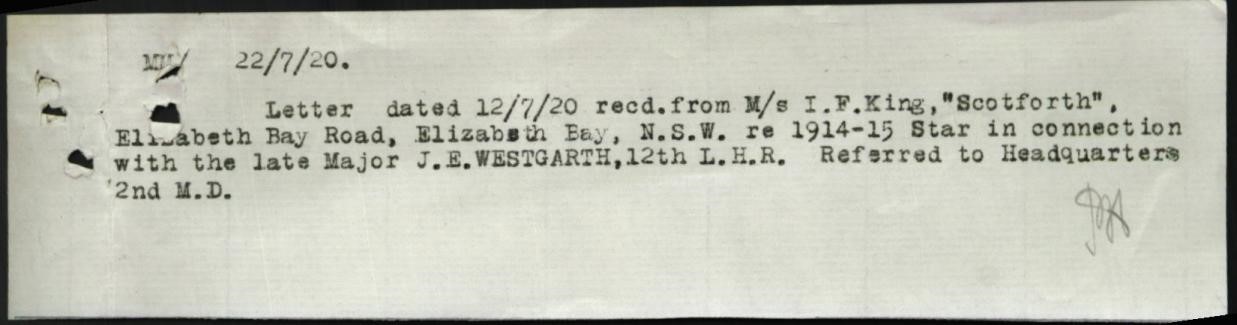
Jack might have given Irene his South African medals which are described above, but when she applied to the Army for Jack’s Great War medals, she was refused because she was not next of kin. The medals were all given to, Ella Florence Wickham, his sister, then living at Mudgee. They have come down the family through George Mansfield’s descendants and are now kept by Stuart Westgarth in Sydney.
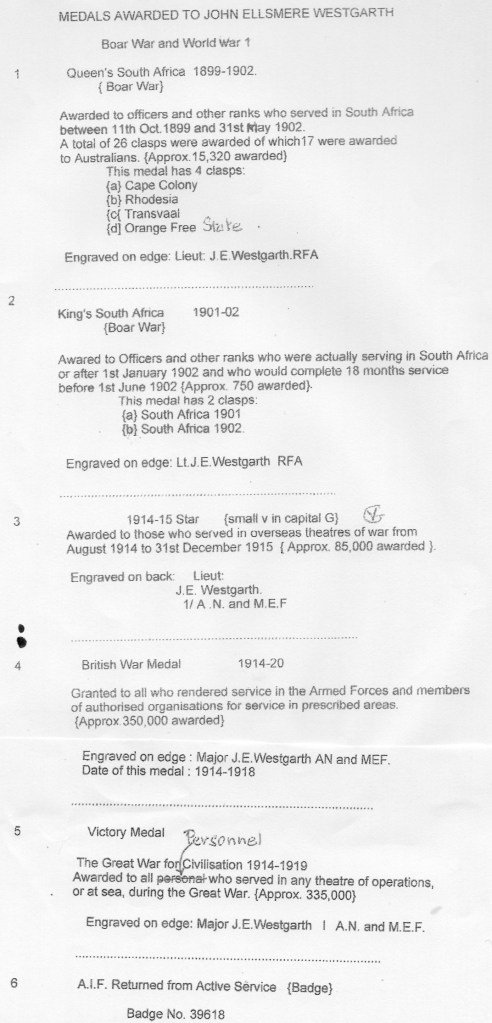
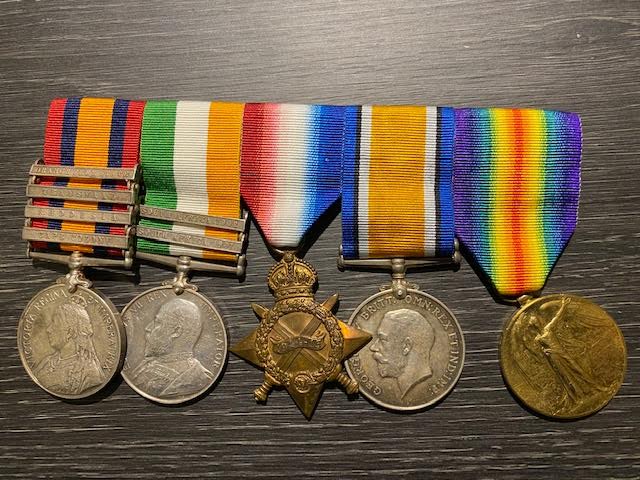
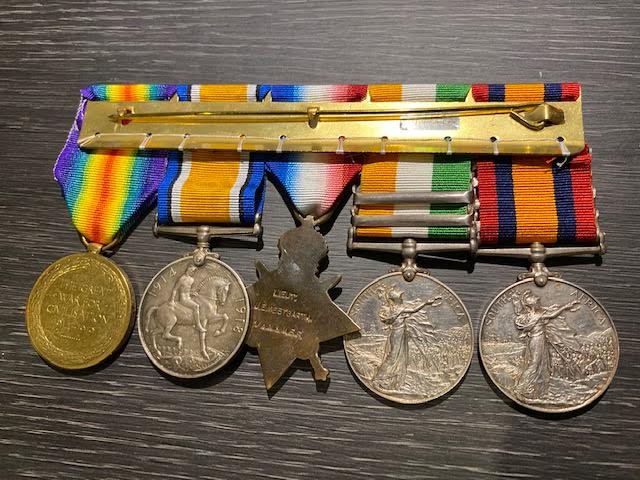
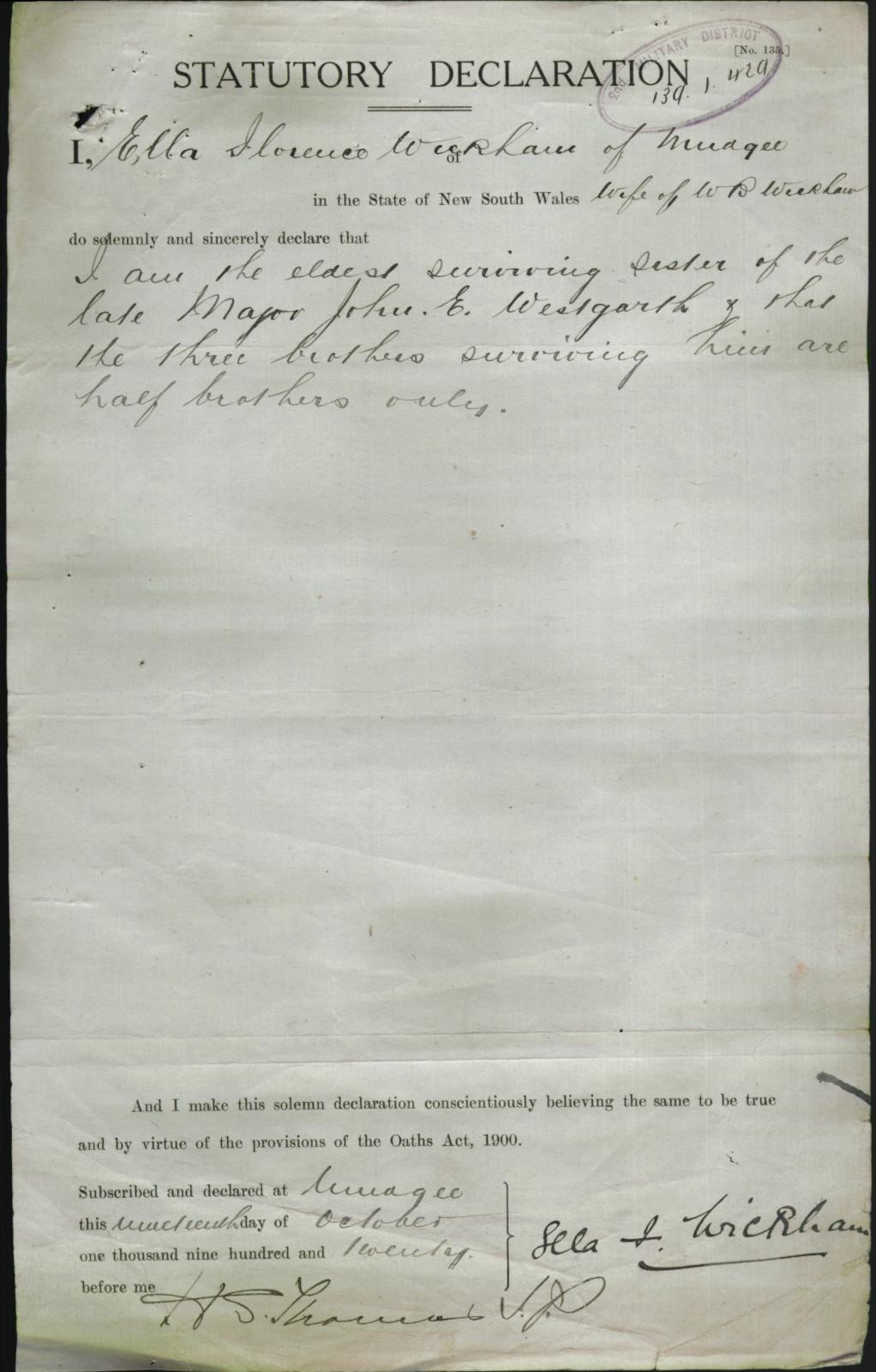
And here is the solution to the mystery of the missing medals! Handed down through the family. I wonder what happened to Mervyn’s medals…….
Dear Trish, I have Jack’s medals ( I have 6 medals and whether that is all I don’t know ). Dennis Cohen gave them to me years ago. He got them from his mother ( Aunt Barbara) and I assume she got them from her father ( my grandfather). Stuart
The End of the Story of a Military Man.
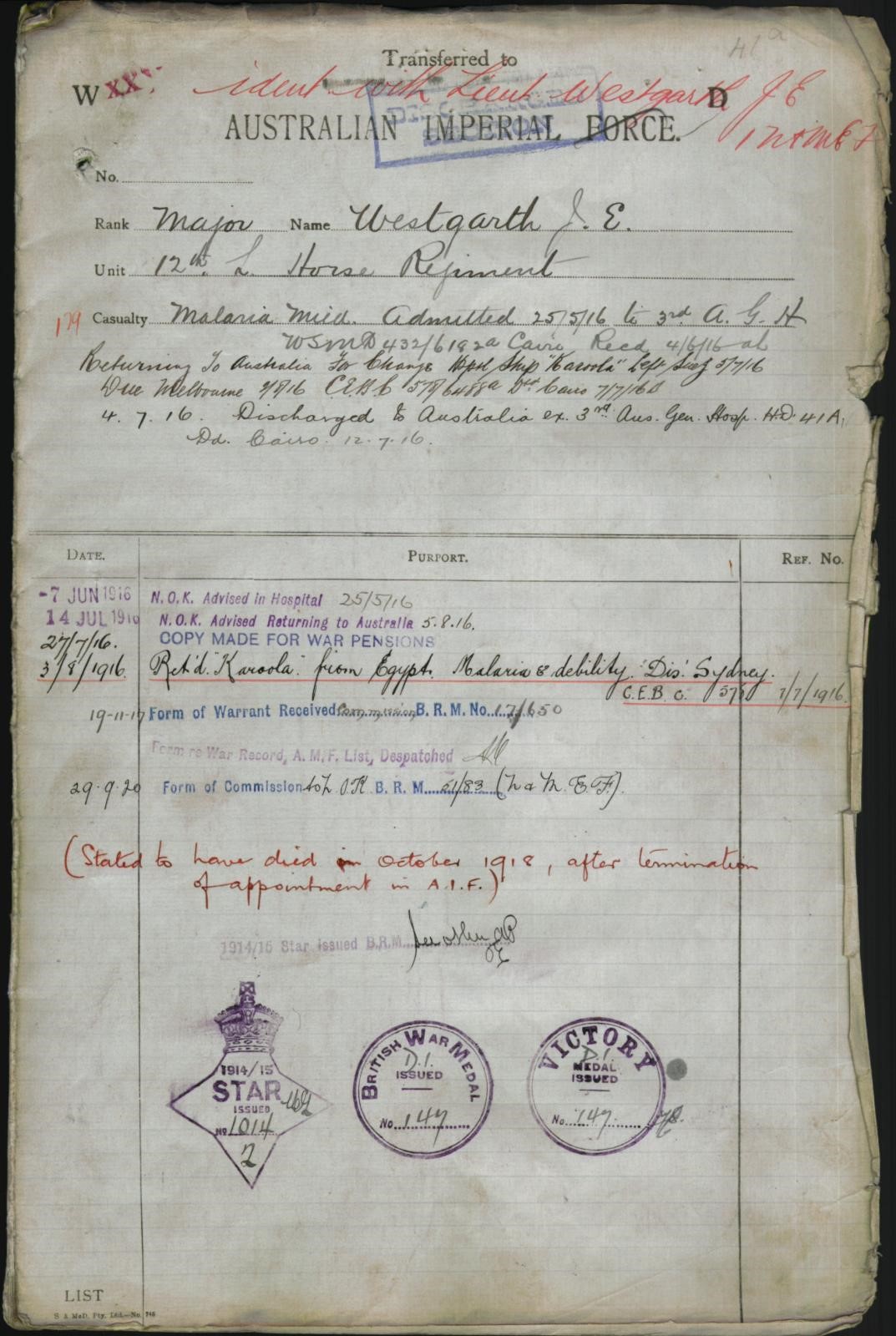
Sydney Morning Herald, Friday 4th October 1918.
LATE MAJOR WESTGARTH
The remains of Major J. E. Westgarth, late of the 12th Light Horse, who died on Wednesday, were interred yesterday, with military honours at South Head Cemetery. Lieut. G. W. Rickwood represented the State Commandant, Brigadier-General Lee and Major H. Stokes, R.A.F.A. represented Col. Osborne, C.O., R.G.A.
‘The late Major Westgarth was the eldest son of the late Mr G. C. Westgarth and saw service in South Africa. After the Boer War he went to England and held a commission in the Royal Field Artillery. He enlisted in 1914 and went to Rabaul. On his return to Australia, he re-enlisted in the Light Horse and went to Palestine, being invalided back to Australia some months ago’.
Grave of John Ellesmere Westgarth, South Head Cemetery
| BIRTH | 1877 |
|---|---|
| DEATH | 3 Oct 1918 (aged 40–41) |
| BURIAL | South Head Cemetery Vaucluse, Waverley Council, New South Wales, Australia |
| PLOT | S-M-GE-126 |
| MEMORIAL ID | 218833993 |
Irene
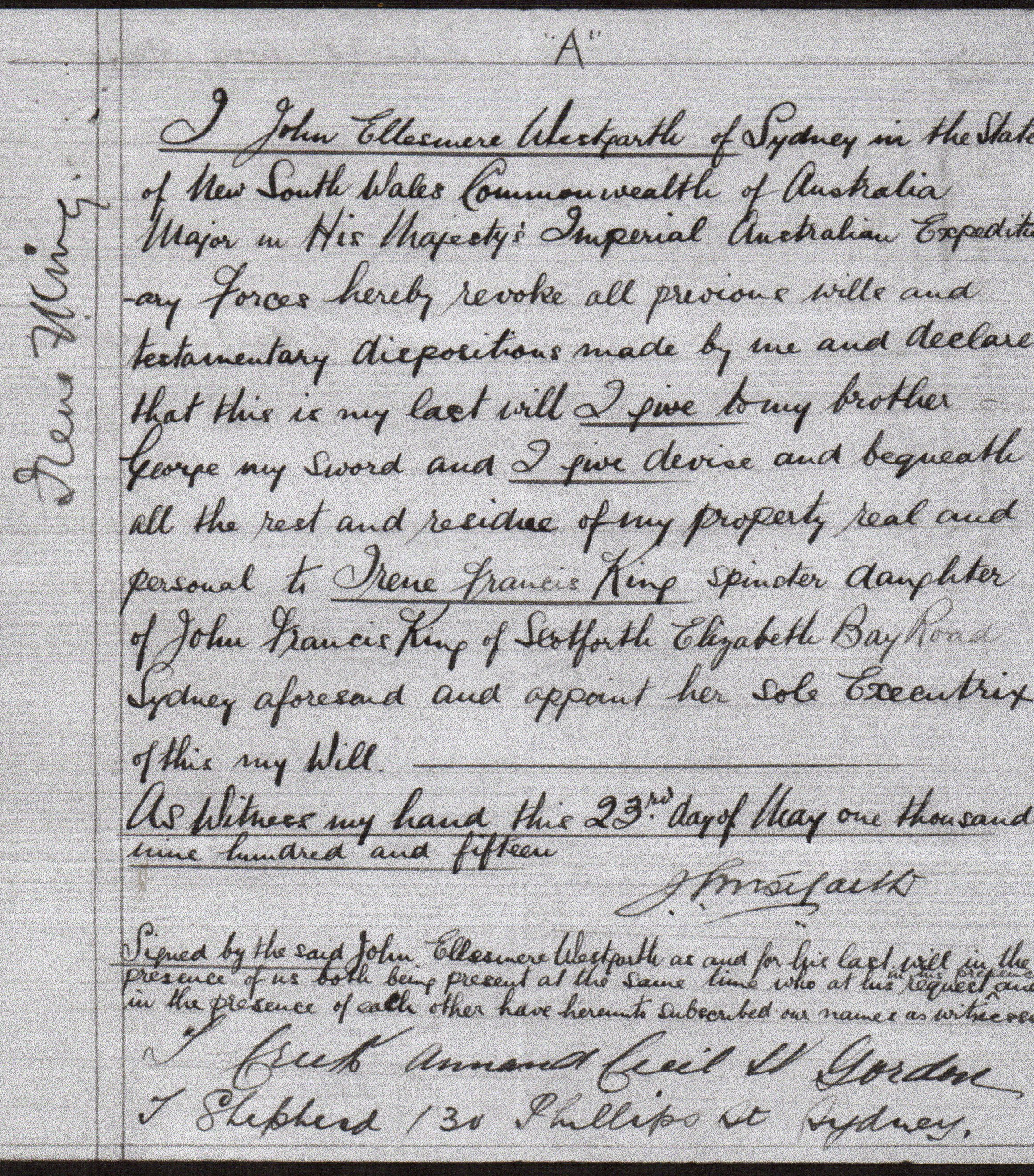
Irene never married. She became the executrix and sole beneficiary of Jack’s will, but he did not leave a large fortune, only 518 pounds, 18 shillings and two pence. 150 pounds of this came from interest on his mother’s estate at Canoblas.
Jack’s Will
Jack had been a soldier for many years, living on soldier’s pay and later a pension. His main wealth would have been inherited. Here is his Will. He gave his sword to George Mansfield. Soldiers these days would not have a sword!
Torrens Title.
Estates owned in the early days of the colony of New South Wales were transferred to Torrens Title by Primary Application, especially after Federation in 1901.
In the State Archives, I found a Primary Application to transfer land in Bathurst to Torrens Title in the name of two related families, the Westgarths and the Kings. This application was made in 1898-9, just the time Jack was preparing to go to war in South Africa and might not return.
NRS-13012-3-[6/10142]-PA 10775 | Primary Application -George Charles Westgarth, Ella Florence Westgarth, John Ellesmere Westgarth, Robert John King, Constance Josephine King, Francis William King and The Permanent Trustee Company of New South Wales Limited, Parish of Beneree County of Bathurst 08-08-1898 to 28-11-1899
Robert John King was a member for Paddington of the Legislative Assembly of New South Wales, in business as George King & Company., Sydney, taking over the firm from his father. He was also manager of Underwood estate, Paddington, a director of the Australian Mutual Provident Society and auditor of the Australian Joint Stock Bank.
Date of Birth: 01/01/1839
Place of Birth: Sydney, New South Wales, Australia
Date of Death: 25/07/1899
Place of Death: Bondi, New South Wales, Australia
https://www.parliament.nsw.gov.au/members/Pages/member-details.aspx?pk=740
Francis William King was his brother, born on 16th October 1844. He married Constance Rodd. His death is recorded as 12th October, 1902, aged 57.
King family relationship
Constance Josephine Rodd, Jack;s aunt, was born in Sydney, New South Wales, on 4th January 1844 to John Savery RODD and Catherine “Kate” Murray.
Constance Josephine Rodd married Francis William King (b. October 16th 1844) in 1882 at age 38, and had 5 children, but it seems from the Ancestry family tree that most of them died young. Constance passed away on 22 Jun 1920 in Burwood, NSW, aged 76. https://www.ancestry.com.au/genealogy/records/constance-josephine-rodd-24-2ls2p4
Constance was Jack’s aunt, being the sister of Florence Sophia. She had received half of her mother, Kate’s, assets on Kate’s death in 1884, so must have been an unusually wealthy woman at that time. Francis William was the executor of Kate’s will.
Irene was the daughter of John Francis King, Company Director, and Emma Isabel Barber. Irene was given the middle name of ‘Francis’. She was probably John’s cousin, but her father was born in Montreal, Canada to Robert and Sarah King. The name. ‘Francis’, is a clue that Francis William and John Francis were related. John Francis and family were living just along the road from Scotforth, at 86 Elizabeth Bay Road.
Here it is today:
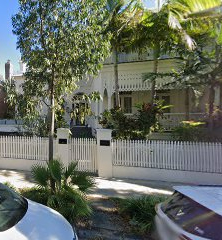
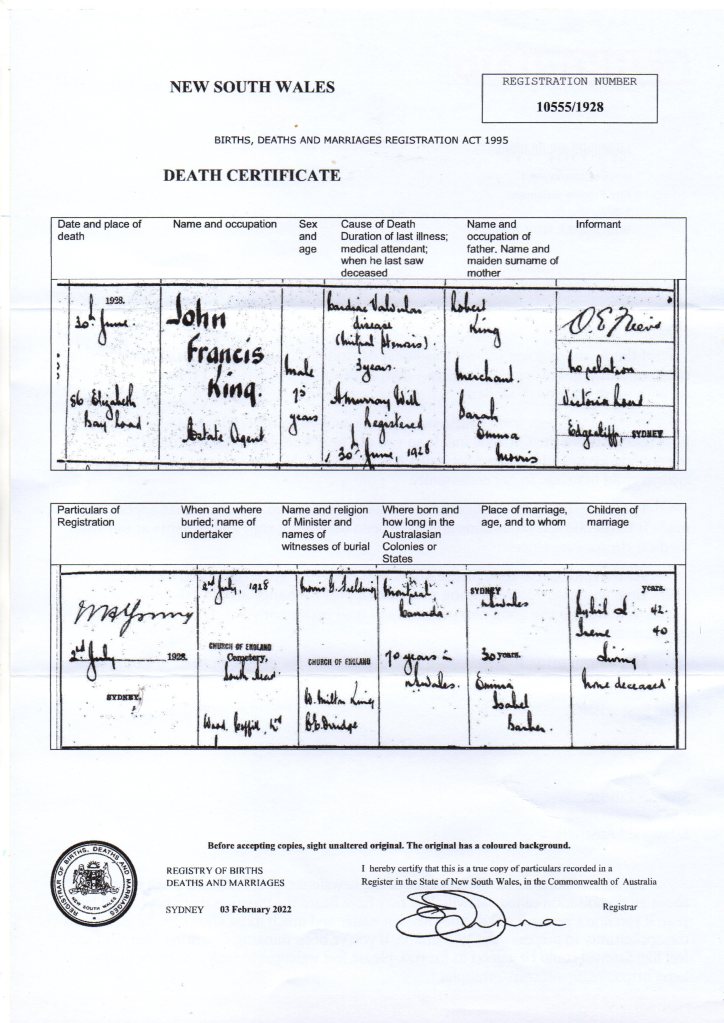
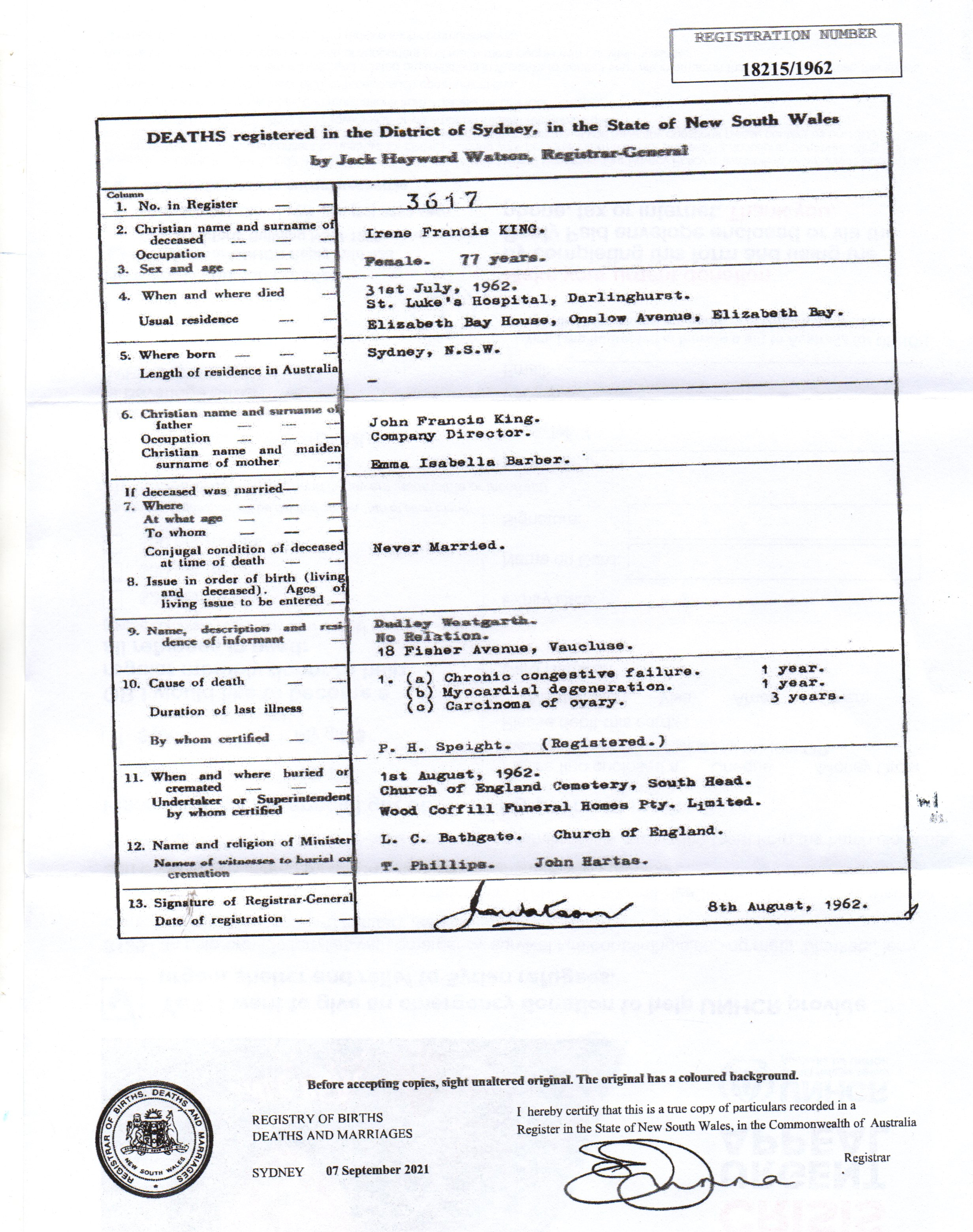
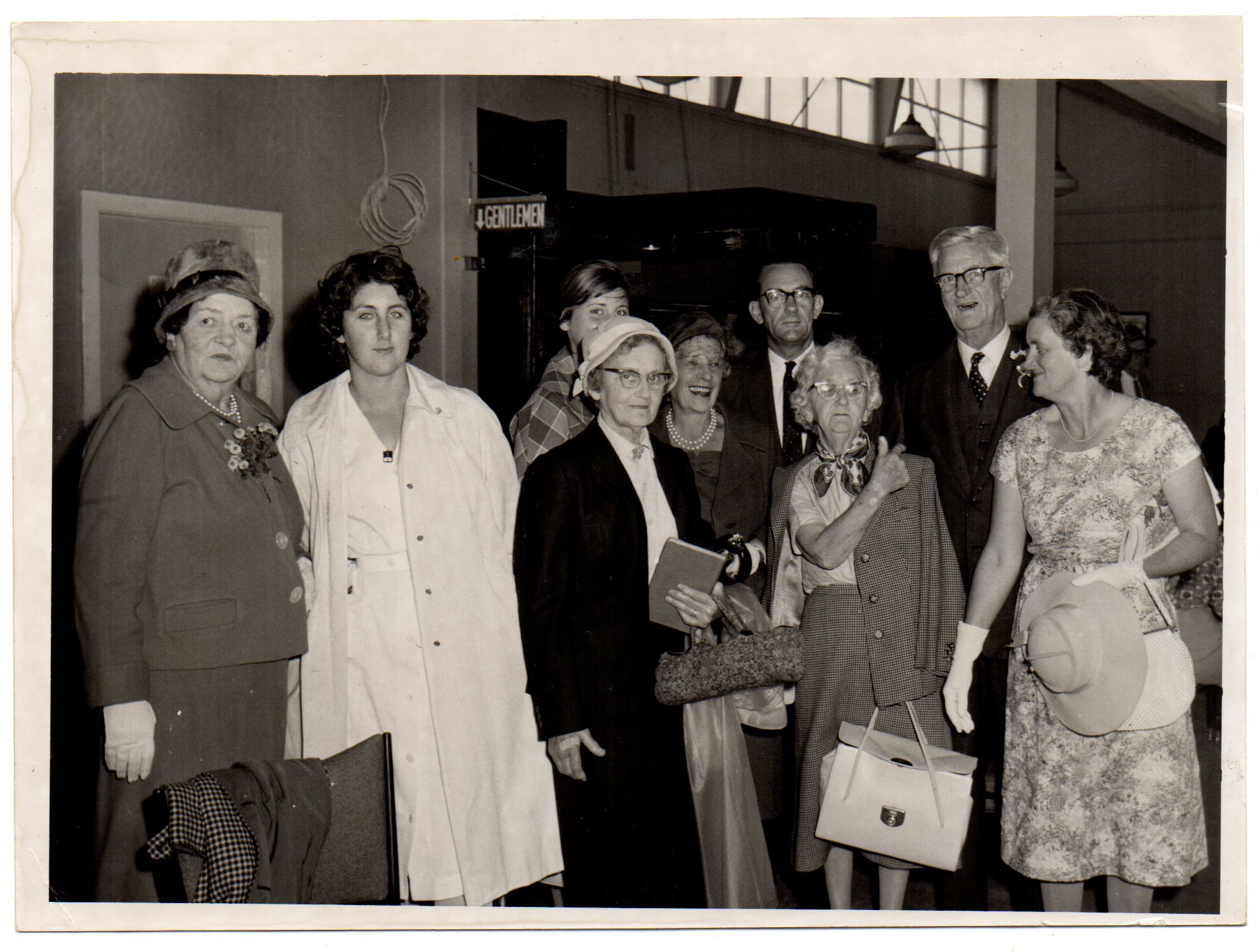
When Irene King died in 1962, her death certificate makes her aged 77, but according to her father’s death certificate she must have been 74, born in 1888. Dudley must have been her executor, because I was given her bangle, of red gold (gold and copper) which I still have and often wore when I was a young adult.
Here is her death Certificate, which shows that she was living at Elizabeth Bay House when she died.
7: Boer War Memorial:
Whenever I go past this monument in Canberra, on Anzac Parade, I think of John and Mervyn. Here is the link to the website: http://monumentaustralia.org.au/themes/conflict/boer/display/99622-national-boer-war-memorial-
Here are the riders going through the Australian Bush as they did all their lives until they volunteered. It’s a wonderful sight!
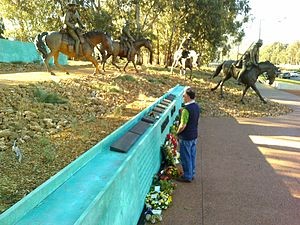
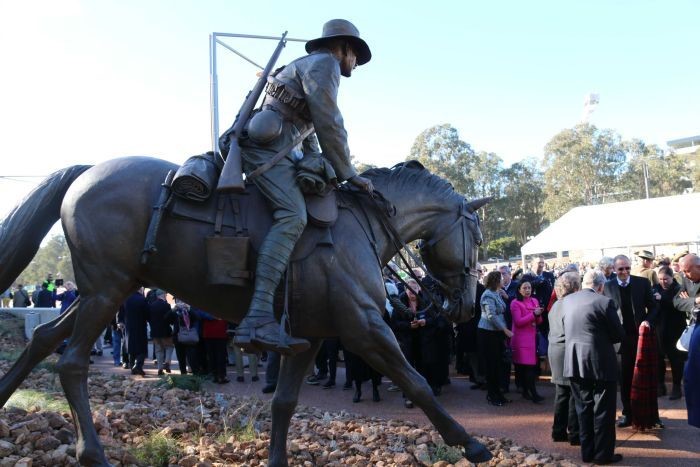
http://www.abc.net.au/news/2017-05-31/boer-war-memorial-unveiled-in-canberra/8576584
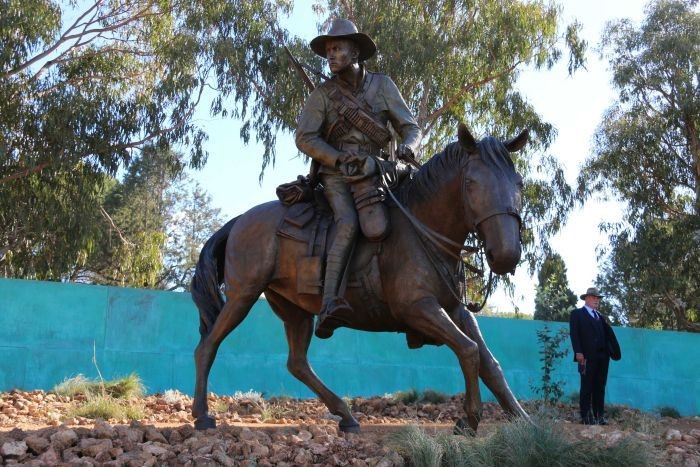
Australian War Memorial, Canberra:
John is on different rolls because of his long involvement with conflicts, but he is not on the Honour Roll, because he died at home.
- New South Wales Citizen Bushmen (Boer War 1899-1902), Lieutenant
- First World War Embarkation Roll, Major
- 12th Light Horse, Major
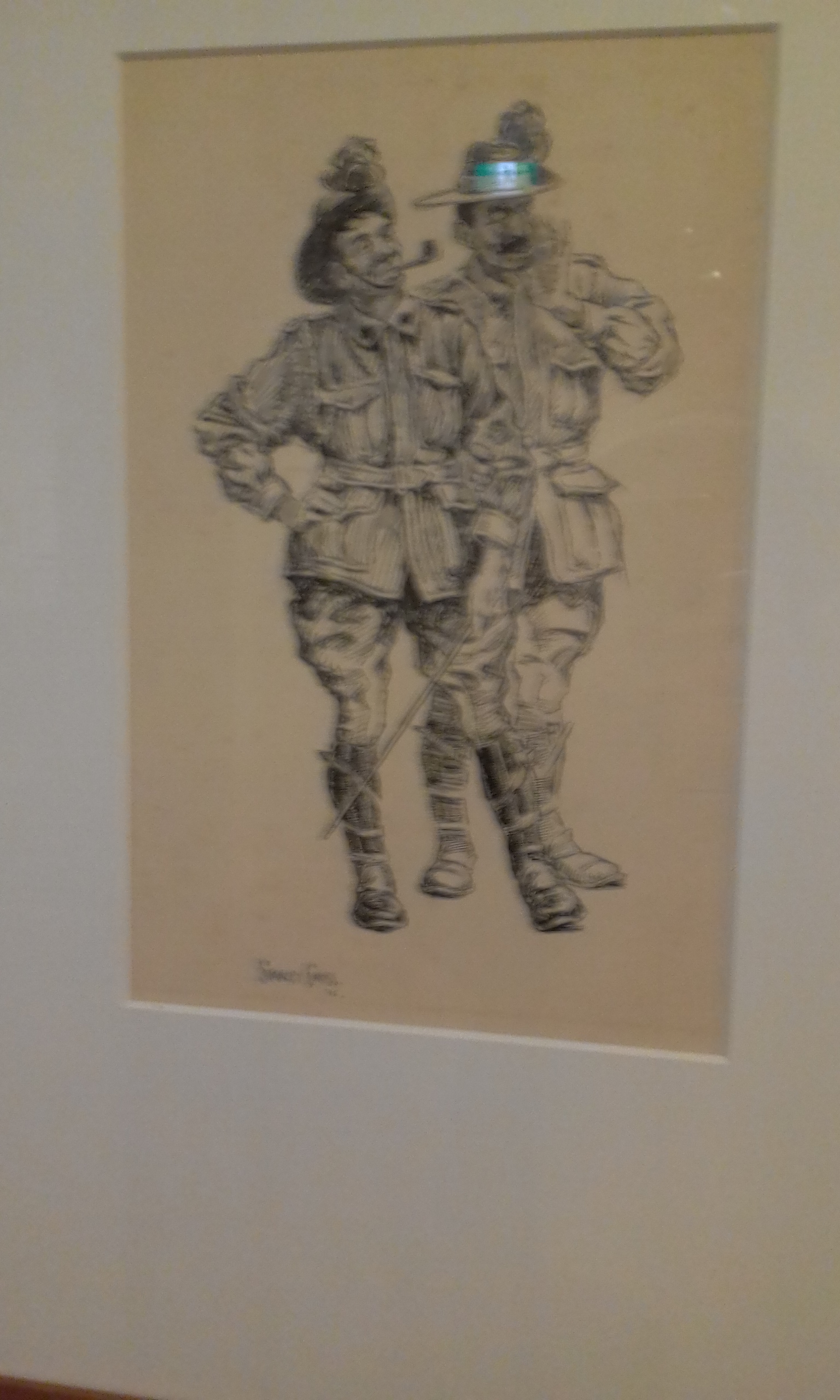
8: Doreen dies:
But further tragedy soon took place because Doreen, pregnant, was diagnosed with tuberculosis. Doreen’s baby was a girl, Marcia Doreen, born in 1919. Doreen would have been doubly troubled by her own illness and her lack of strength to care for her baby. She and Gerald Rainsford lived at ‘Frostender’, Fox Valley Road, Warrawee and Lucy Florence went to live with them.
On December 18th 1920, Doreen died at the age of 24. (Marcia did grow up and married Noel Hedges in 1942).
9: Family addresses, 20th August 1920.
Gwendoline had never married, but was living at 44 Karoola Road, Mosman.
Poppy was living at Double Bay, probably with her 8 year old daughter, Roslyn. (On 27/4/1927 she married again, to Gerald Wilfred Kemmis, who had two daughters). I have written about the Kemmis family in another blog.
Doreen had a baby, Marcia Doreen. Lucy Florence was living with her, at Warrawee. Doreen was ill with tuberculosis.
Dudley
Dudley and Lucy Kathleen Glasson married in 1912 and were still in Blayney, now with four children, John, Nancy, Brian and Mollie. Dudley was my grandfather and two blogs are dedicated to his life.
George
George and Katrine were in Scone. They also had four children by 1920, George, Barbara, Audrey and Winston. You can read about George and Katrine in the story of George Mansfield.
Ronald
Ronald’s Merchant address was 7 Spring Street, Sydney. He and Darcy had a son, Nigel and two daughters, Judith and Sheila. Ronald was officially a ‘Station Supplier’, probably what is now called a ‘Stock and Station Agent’.
In 1918, when the rabbit plague was eating out the paddocks of farmers across New South Wales, Ronald and Henry Howard Wheeler registered:
THE LITTLE DOCTOR RABBIT POISON COMPANY
Number INX-48-47983, details of THE LITTLE DOCTOR RABBIT POISON COMPANY can be found in the State Archives Business and Company Records 1903-1922. Registered at Ronald’s place of Business, 7 Spring Street Sydney, on 2 Oct 1918, just over a month before the end of the Great War, this company must have been a very profitable one. (File No31424, Item No[2/8548, Index Number48)
Ella
Ella Wickham was in Mudgee NSW, with her bank manager husband, Walter, and three children, Rupert, born in 1902, Allan, born in 1903 and Helen Ellesmere, born 1907.
I cannot find out much about the life of Ella and her family. Her death certificate shows that she had moved to Sydney and died at 4 Newark Crescent, Lindfield. Her son, Allan, was living in Lindfield when Ella died, aged 61.
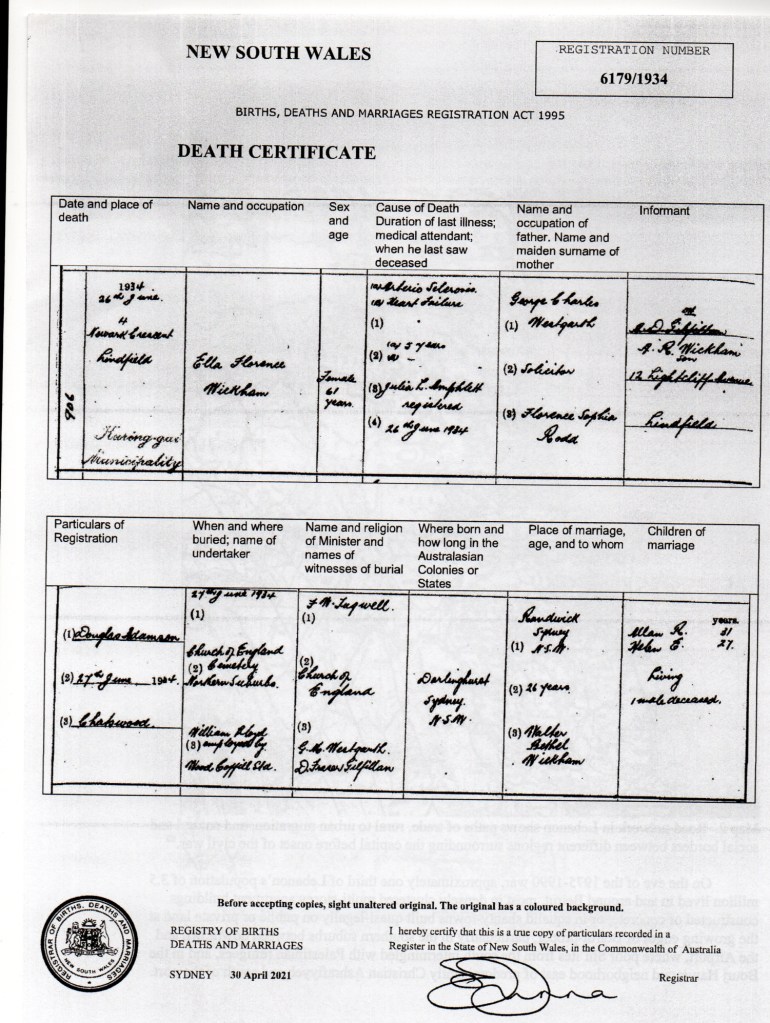
Rupert must be the deceased child on the death certificate above. He would only have been 12 when the first world war broke out, so it is unlikely he died a soldier’s death, but there were many diseases which killed the young before the production of penicillin in 1943. https://www.nobelprize.org/prizes/medicine/1945/florey/biographical/
Ella gave the Ellesmere name to her daughter, Helen , who was 27 at the time of her mother’s death in 1934. In 1936, Helen was living at Chatswood, probably with her father, Walter Wickham, who lived until 1943. That year, she married Douglas Fraser Gilfillan. They had a son, Richard Fraser Gilfillan. (Gilfillan is a well known Scottish name)
Tragic war story of Douglas Gilfillan
I remember Helen Gilfillan in about 1948, when she came to my grandparents’ home at number 7 Vaucluse Road. Her husband had died as a prisoner of the Japanese. He was a gunner in an anti-tank battery and his details are in this War Memorial post: https://www.awm.gov.au/collection/R1705875.
The full story of Douglas Fraser Gilfillan and his death is on this WikiTree post: https://www.wikitree.com/wiki/Gilfillan-458
According to the records of New South Wales, their son, Richard Fraser Gilfillan married Elizabeth Anne Isabel Powell in 1963, in Sydney. He must be about 82 years old.
10: 1925. Grandchildren and the death of Lucy Florence
Dudley and Kathleen and 5 children, John, Nancy, Brian, Mollie and Donald, moved to Sydney and bought ‘Belsize’, a large house at 25 Kent Road, Rose Bay, now the Indonesian Embassy.
George and Katrine had another son, David, and would have their sixth, Editha, in 1928.
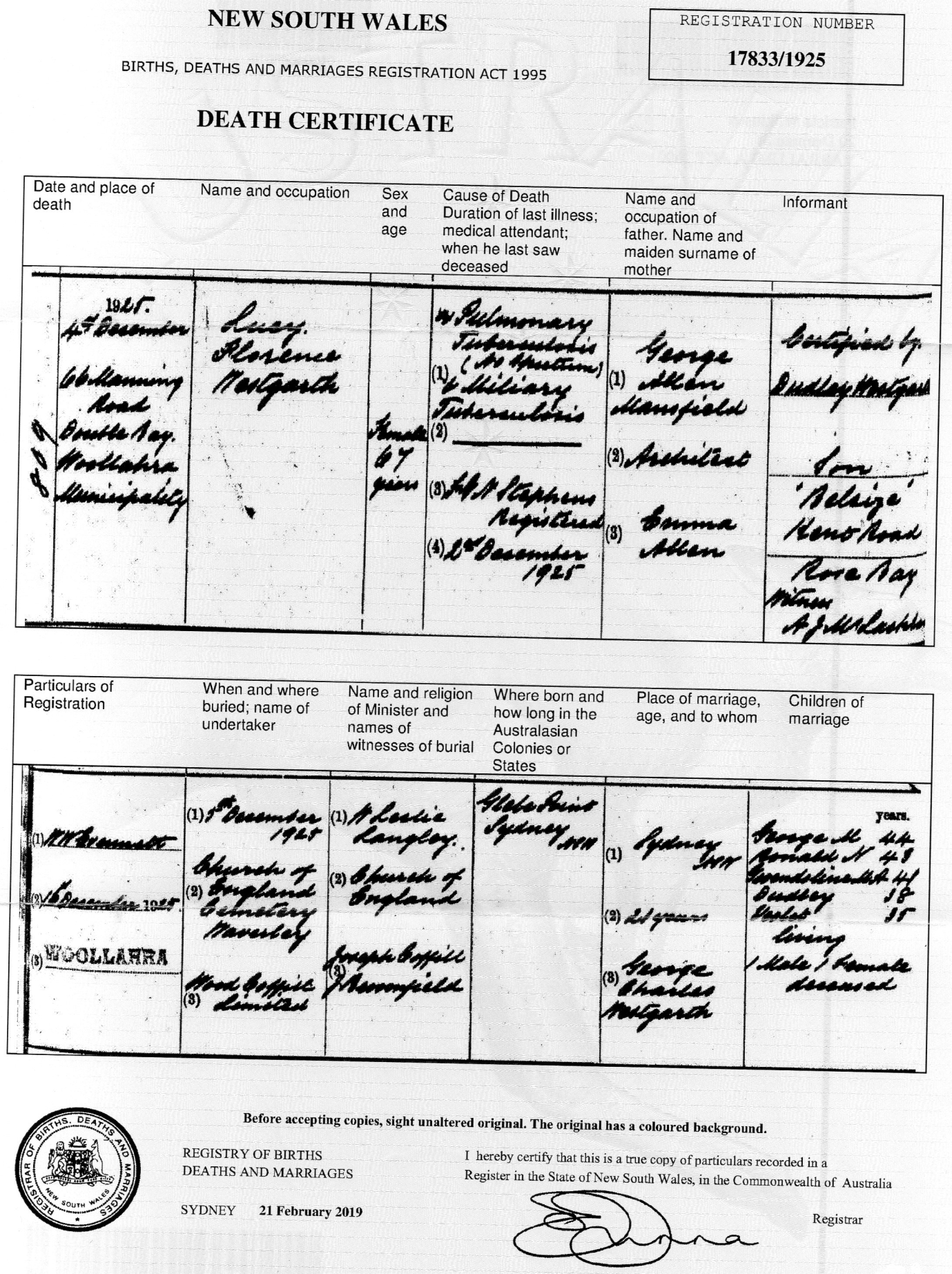
Lucy Florence had returned to her flat in Manning Road and died there on 4th December 1925, aged 66 years, but death notice says 67. She had two children predecease her, a male and a female, Mervyn and Doreen.
Counting step grandchildren, there would be 21 grandchildren in all from the marriages of the children of George Charles.
Just something personal to add here. My father was 12 when Lucy Florence died and knew her well. He and his siblings called her ‘Gummum’, probably because Dudley encouraged silly names. He and Kathleen were always ‘Char’ and ‘Yaryar’ to us.
| WESTGARTH – December 4 1925, at her residence, Manning Road, Double Bay, Lucy Florence, widow of the late George Charles Westgarth of Sydney, solicitor, aged 67 years. (SMH from Trove) |
Her grave:
Lucy Florence is buried with her husband, George Charles Westgarth, in the Waverley cemetery, St Thomas Road, Bronte New South Wales. Their plot is overlooking the sea. The number of the gravesite is W-7-CE-VL-992A. It is the Church of England section.. A large marble cross is over the grave.
Her death certificate shows that she also died of Tuberculosis.
Tuberculosis or TB disease is the result of having latent TB germs (in the lungs) which have become active. This is known as having active TB. Overall about 5 to 10 % of people with latent TB, who do not receive treatment for it, will become sick at some time in their lives.
Some people become sick soon after they have become infected, before their immune system (the part of the body that fights diseases) can fight the bacteria. Other people don’t get sick at first but they get sick years later when their immune system becomes weak for another reason. https://www.tbfacts.org/tb/
Possible causes:
1:Lucy Florence had to spend a long cold winter in substandard lodgings in 1906, when George Charles was searching for a cure. Perhaps she inhaled the bacteria at that time, and it was latent for many years. TB was a disease pervasive in England with such a wet and cold climate. Remember that six people had died of TB on the clipper ship which brought George Charles to Australia all those years ago!
2: A more likely reason for her contracting TB is that her youngest daughter, Doreen, had died of pulmonary tuberculosis five years before. When I was a young adult, people were still having routine x-rays for TB.
During the time that Lucy Florence was ill, she would have had the support of Ronald and Dudley, who were both living in Sydney, but George, also, made all the efforts he could to help his mother. Her estate papers show that she spent an extensive period of time in Scone Hospital, costing £13.13.0 and spent £11.11.0 on the account of Doctor V. H. Grieve of Scone. In contrast, the Vaucluse doctor’s charges were only £1.15.6, showing that she was cared for longer In Scone during her last illness.
11: Death certificate and the winding up of the estate of Lucy Florence by George, Ronald and Dudley
Here is the death certificate. Once again it was Dudley’s melancholy duty to sign the certificate:
How did widows live in those days? This is what most women had to look forward to:
| 1909 | From April the Old-Age Pension (AP) was payable to people who were aged 65 years and over, or were aged 60 years and over and were permanently incapacitated for work. Groups excluded from eligibility were those living overseas, ‘aliens’, those naturalised for less than three years, overseas born ‘asiatics’, and ‘aboriginal natives’ of Australia, Africa, The Pacific Islands or New Zealand. Applicants for AP were required: to be residing in Australia when claiming a pension and to have continuously resided in Australia for at least 20 years (absences of up to one tenth of the total period of residence were not taken to interrupt the continuity of residence), to be of good character, to have not deserted or failed to maintain their wife (if a husband) or deserted their husband (if a wife), in the preceding five years, without just cause, and to have not deserted (if a mother) or failed to maintain (if a father) any children under 14 years of age, in the preceding five years. The pension was means tested. Pensions could be paid to institutions, organisations or other persons where a pensioner was considered unfit to be entrusted with a pension. | Fisher, ALP |
| 1910 | From November a section of the original Act providing for pension eligibility at 60 years of age for women commenced to take effect. | Fisher, ALP |
Not very generous at all when viewed from our perspective, but luckily Lucy Florence had an income and probably did not fit the criterion for a pension.
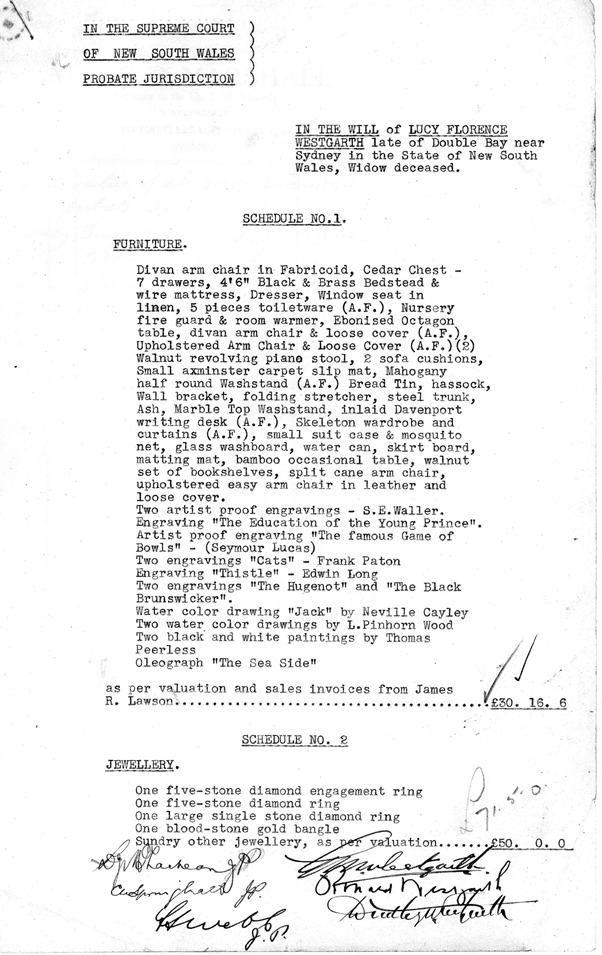
Her income came from her mother, who was an Allen of Toxteth Park. Lucy’s children had all given up their share to their mother, so that upon her death she had a sizeable bank account for those days. She also had jewellery worth £71.5.0, which was a lot of money:
- a single
stone diamond ring - a five
stone diamond ring - a four
stone diamond ring - a cluster
sapphire and diamond ring - a bangle
Her interest in the estate of George Allen was 17/420ths, but at her death it amounted to £1553.3.5 (one thousand five hundred and fifty-three pounds three shillings and fivepence). Altogether her executors had to pay death duty on £1605. The duty came to £32.2.0 (thirty-two pounds two shillings).
And who were her executors? Her three living sons together signed all the paperwork for the execution of her affairs. See below: Each signature has to be verified by a Justice of the Peace on this list of personal belongings. Interesting to see that the sapphire and diamond cluster ring is no longer on the list!
Postscript:
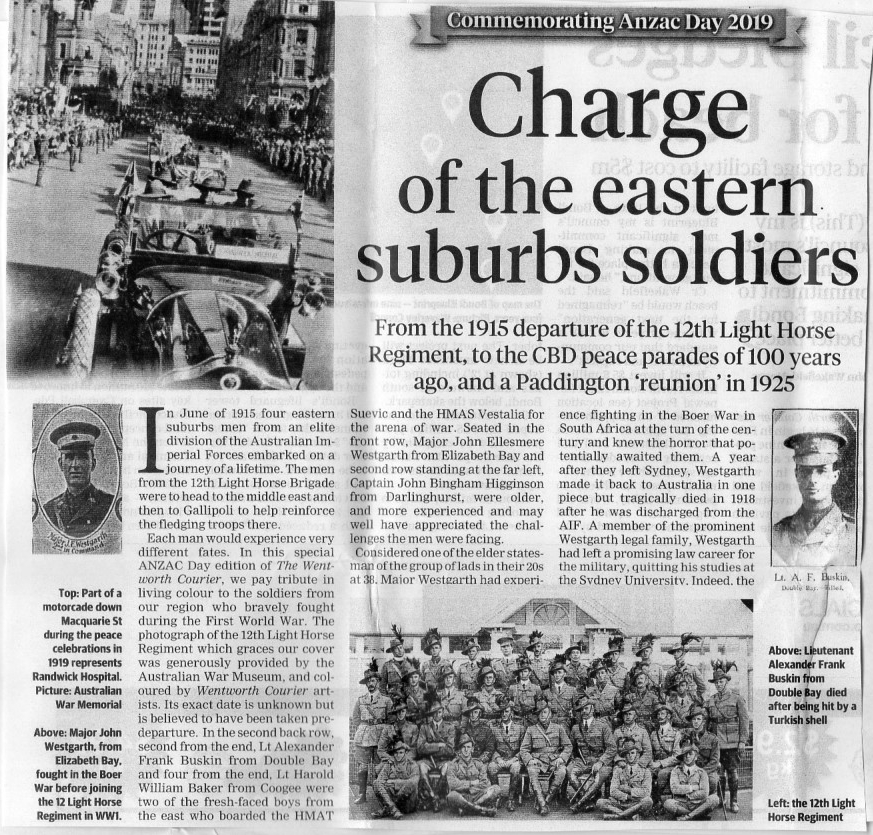
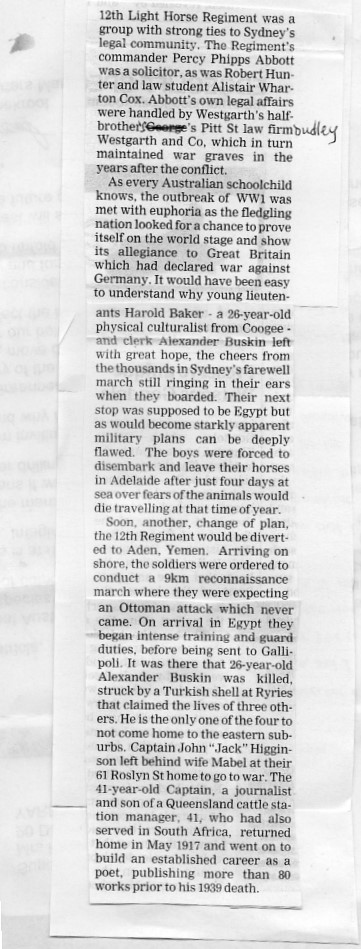
Julie Woodhill sent me this article from the Wentworth Courier, which concerns Eastern Suburbs soldiers who went to Gallipoli and includes John Ellesmere Westgarth. You can read the whole article online at the Wentworth Courier site. The photograph does not include Mervyn, who was also in the 12 Light Horse, because this is a photo of the officers. John (Jack) was second in command.
http://newslocal.smedia.com.au/wentworth-courier/
 westgarth and glassons