Index:
- Introduction about the changing nationality of the family when the colonies federated in 1901 and became the nation of Australia.
- Early life of George Charles
- His legal career
- First marriage to Florence Sophia Rodd and information about her parentage
- Death of Florence Sophia
- Second marriage to Lucy Florence Mansfield
- Information about the Allen and Mansfield families and her father, George Allen Mansfield.
- Coat of Arms and George Mansfield Westgarth’s letter
- Tresco
- Social clubs to which G C Westgarth belonged
- Some furnishings still in the family
- Portrait of G C Westgarth aged about 40
- Death of Kate Rodd
- Last two daughters born.
- Souvenirs of trip to England
- List of all children of George Charles
- Glen Lorne
- Development of the railway system in New South Wales.
- History of Campbelltown
- Information about St Helens
- Letter from George Mansfield aged 8 and his father’s reply.
- Christmas Card with George, Ronald and Dudley
- Life at St Helens and at the Pines, Avoca Street, Randwick
- Family connections
- Events of 1900 and Federation in 1901
- 1902, sale of Tresco.
- George Charles’ health deteriorates and another portrait
- Letters and portraits to and from London
- Portraits of George Mansfield Westgarth and his fiancee Katrine Robertson
- Return to Australia witout a cure
- 1908 Death of George Charles
- More money problems
- 1908, when G.A. Mansfield, William Henry and George Charles died.
Introduction
This is my second post. The first one took a lot of revising and learning on the job! This one will too. This one owes a lot to the treasure trove of documents and research done by Judy and Stephen Westgarth. We did a lot of photocopying!
Let’s look at the nationality of the family as the years went on.
William Westgarth was a British citizen who lived more than half his life in the colonies of Victoria, New South Wales and Tasmania. He had living parents in England for nearly all his life and returned ‘Home’ periodically.
George Charles, the subject of this blog, his eldest son, was also born in England and was a British citizen. Despite this, the colony had matured along with him and by the time he was twenty-one New South Wales offered a good future for George Charles, as a gentleman landowner with a large family and a good legal practice. Like his father, he periodically went to England for family, for medical help, for furnishings for his grand houses and for legal reasons.
Federation: In 1901, although British residents in Australia still had British citizenship and the country was still classed by Britain as a colony, the states had been federated into a new country, Australia. By the Act of the British Parliament in London, the Commonwealth of Australia was granted powers to govern itself, (but under the auspices of the monarchy in Britain). So George Charles would end his life as a citizen of Australia and all his children would become Australian citizens with British citizenship.
‘Australia became an independent nation on 1 January 1901 when the British Parliament passed legislation allowing the six Australian colonies to govern in their own right as part of the Commonwealth of Australia. The Commonwealth of Australia was established as a constitutional monarchy.
2: The Birth of George Charles, my great grandfather:
The story begins when George Charles Westgarth, eldest son of William and Elizabeth Westgarth, was born in his grandfather’s house in Church Road, West Derby, an outer suburb of Liverpool, in Lancashire. His birth date was December 8th 1846.
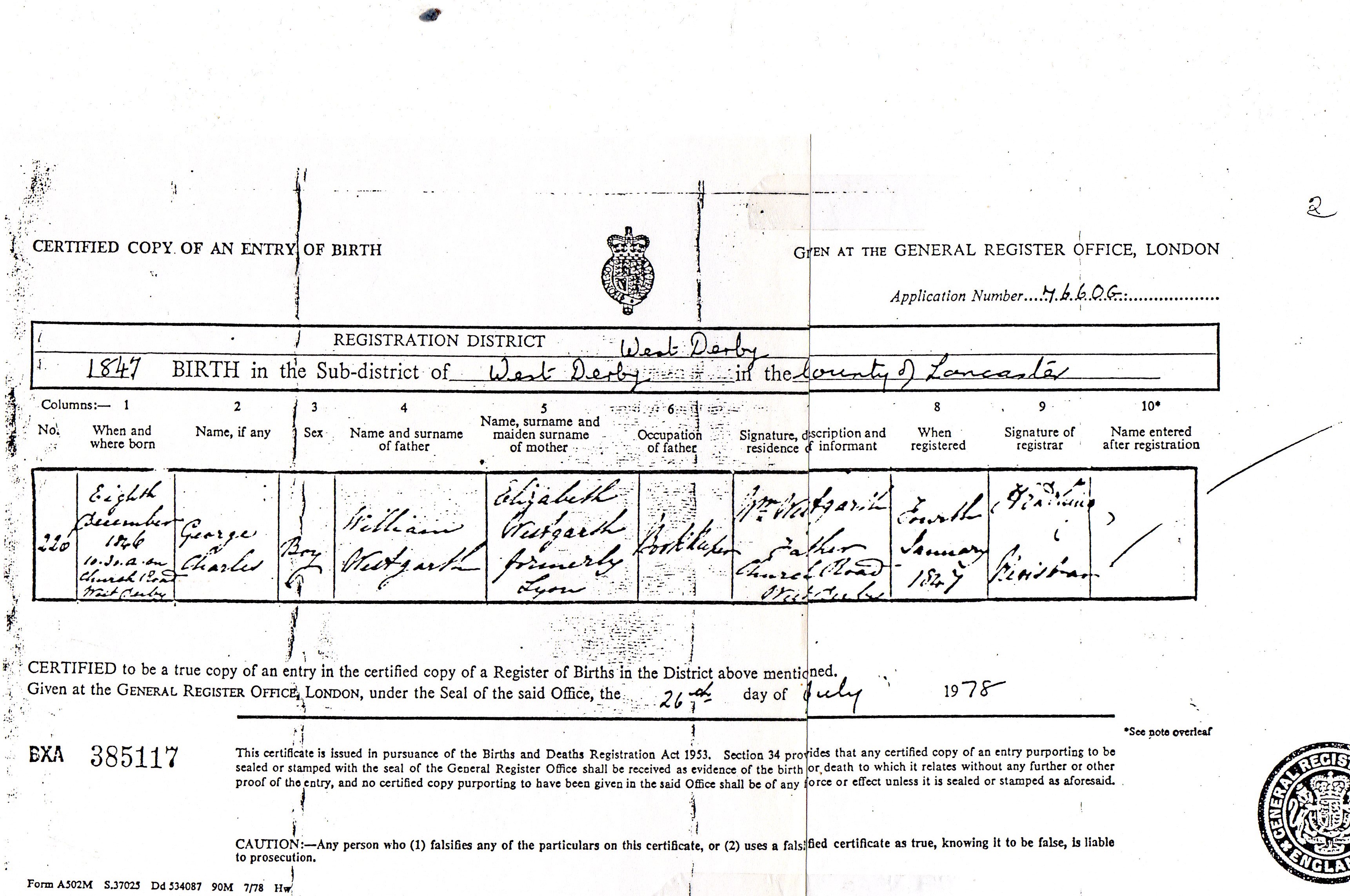
The family emigrates:
He was nearly six years old when he boarded the clipper ship, the Catherine Mitchell , on 30th September 1852, with his parents, Aunt Jane Lyon, Uncle Edwin Westgarth, his brother, William Henry (b. 24/5/48) and two sisters, Elizabeth Ann (b. 2/2/50) and Edith Isabel (19/9/1851). Perhaps because Edith was just over one year old when they embarked, she is not on the list of cabin passengers. (see previous blog)
George Charles, however, was old enough not only to experience the voyage under full sail across the world, but also to remember his life in Liverpool and the places where family lived. He would have been to the suburb of Stanley where his mum was born and to West Derby where he himself was born at his grandfather’s house. He had experienced life on a farm at Aughton. He would have been to the Liverpool docks on the Mersey where his father sent goods by sea or canal.
The name, Ellesmere, comes from a town in North Shropshire, just south of Lancashire, on a magnificent lake, or ‘mere’. (French for ‘sea’)
………….” This pretty little market town in the heart of the Shropshire countryside was actually the catalyst for one of the greatest canal networks in the country and subsequent feats of breathtaking engineering that challenged the great Thomas Telford. The town even gave its name ….. to Ellesmere Port to confirm the fact.’……………….Ellesmere is directly south of Ellesmere Port, in the north of Shropshire. It is very likely that George Charles and family had visited this beauty spot on their holiday outings. Here is a description from a travel site:-
“ Ellesmere has always been an important settlement ever since those clever ancient Britons found that the magnificent glacial Mere was an ideal place for some genuine rest and relaxation, a spot of fishing, gentle boating and gazing at the views and wildlife. Ellesmere still draws people today for exactly the same reasons.”
(www.ellesmere.info)
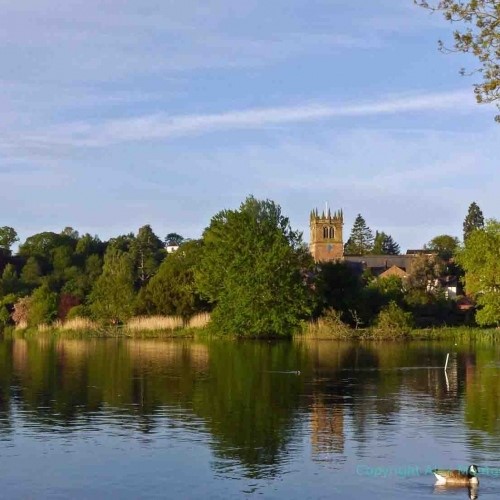
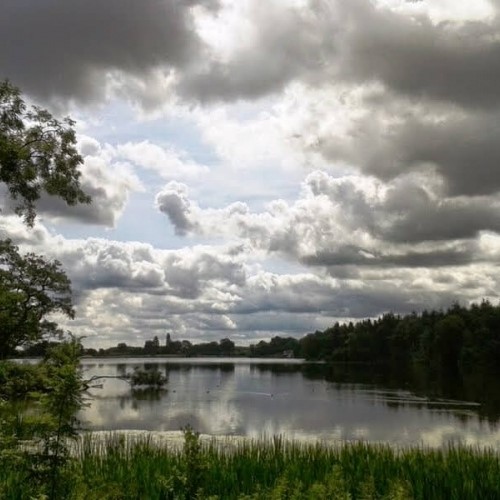
Note: The name, ‘Ellesmere’, will become a family name for the eldest son of George Charles, perhaps because of the proximity of Rode Hall in southernmost Cheshire to the seat of the Earl of Ellesmere in Shropshire. George Charles will marry a Miss Rodd, a name, (de Rode), which belonged to one of the French who invaded England in 1066 with William the Conqueror. Rode Hall was their ancestral house.
Rode Hall, a Georgian country house, is now the seat of the Wilbraham family, members of the landed gentry in the parish of Odd Rode, Cheshire, England. The estate, with the original timber-framed manor house, was purchased by the Wilbrahams from the ancient de Rode family in 1669. https://en.wikipedia.org/wiki/Rode_Hall
Earl of Ellesmere, (pronounced “Ells-mere”), in the County of Shropshire, is a title in the Peerage of the United Kingdom. It was created in 1846 for the Conservative politician, Lord Francis Egerton. https://en.wikipedia.org/wiki/Earl_of_Ellesmere.
Names which referred to the peerage in England were fashionable amongst those who were born in England, but grew up in New South Wales. My grandfather, Dudley, received his name owing to the Australian visit of Lord Dudley. Sydney and Melbourne are both names of peers of the British realm.
St Helens
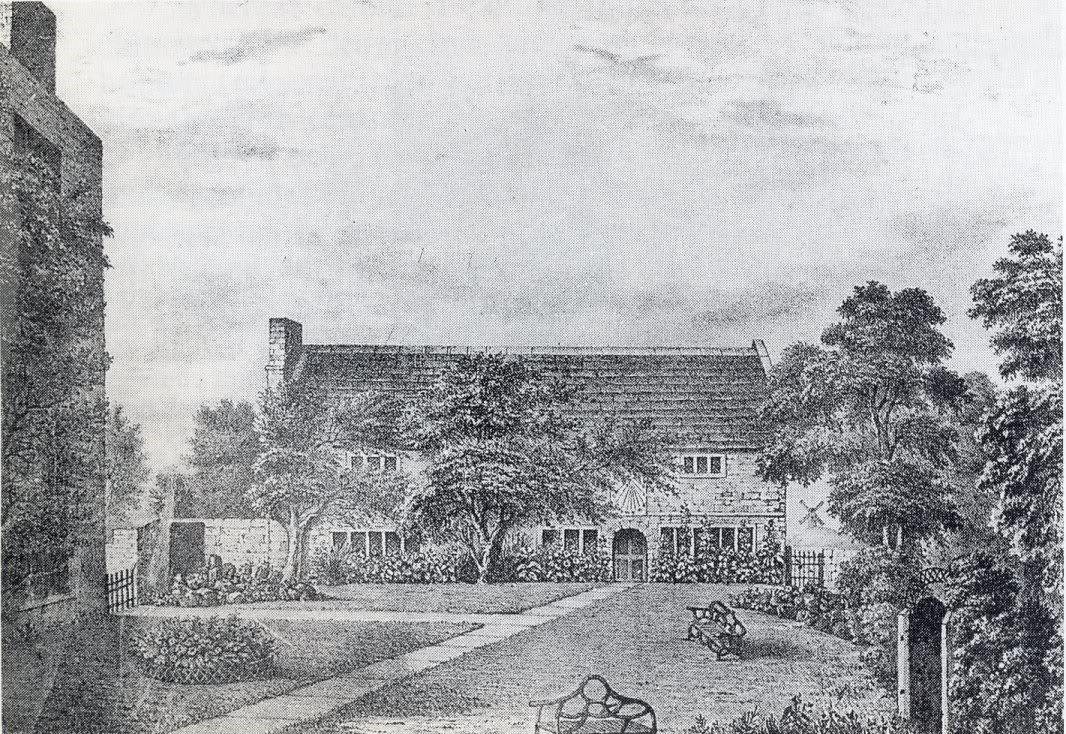
Another place he must have visited was the market town of St Helens, west of Liverpool, which was a place of green fields and old buildings in the 1840s. This memory must have stayed with him when he was taken from the city of his birth in 1852 to emigrate to Australia. He might have returned to England after he came of age (21), perhaps on his honeymoon after his marriage in 1872. Below is an old print showing the tranquil setting of the meeting house building. Note: George Charles will one day have a country house called St Helens.
Arrival in Melbourne:
After all the excitement for five year old George Charles of travelling in a clipper ship and having his birthday en route, the six-year old boy arrived in the colony of Port Phillip on 23rd January 1853 in the middle of the chaos of the gold rush.
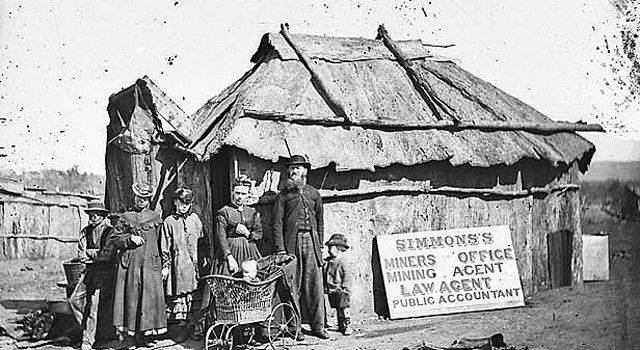
Luckily the family found a home in Young Street Collingwood, hopefully better than the one above which must have been typical of many. The hustle and bustle of a “frontier town”, crowded living conditions and the scarcity of infrastructure such as potable water must have made life difficult for Elizabeth and the children. I have already written about all the babies born whilst they were in Melbourne, the first one six days after arrival, who all died except for Florence Maude, born 15/6/55.
William, who probably had hoped to get a job with a steamship company, became an auditor at the newly established Government Audit Office. After a while, the family moved to Fitzroy Street Collingwood, presumably better accommodation, where Florence was born. However the chance for advancement came when William got his job as manager of the Australasian Steam Navigation Company, in another developing region, Maitland, on the Hunter River.
Move to Maitland:
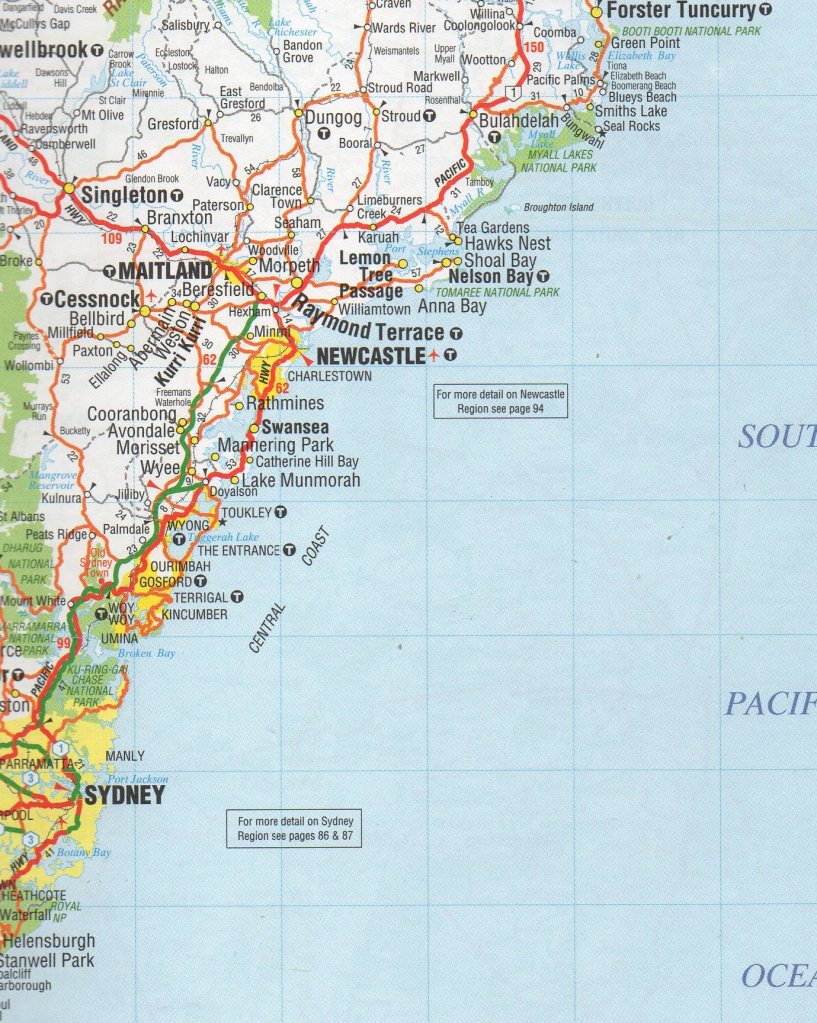
It was a long journey for the Westgarths to move to William’s new employment in Maitland, but they would have travelled by steamship, in relative comfort. Here is a map of the relationship of Maitland to Newcastle, 35 kilometres away along the Hunter River. You can see Raymond Terrace nearby.
When the family moved to Maitland in 1858, a high school had just opened. George Charles and his brother, William Henry, attended Maitland High School and finished their education there after the family went to Sydney in 1861.
3: Further education – The Law and his legal career
After leaving school, George Charles did not immediately move to Sydney, but became articled to Messrs Mullen and Gorrick in Maitland, the only solicitors north of the Hawkesbury at that time. He was the elder brother, so perhaps he stayed in Maitland because he was waiting for William Henry to graduate from High School.
It was the practice at the time to serve articles with a practising lawyer in order to qualify as a solicitor. This law was changed in 1877.
“The Australian Courts Act, 1828 (9 Geo. IV, c. 83) provided for the Supreme Court to make rules for admission of “Attorneys, Solicitors and Barristers”, subject to a right of disallowance in the Crown. An Admission Rule announced on 5 September 1829 provided for the profession to be divided into two branches, only barristers and advocates from Great Britain and Ireland were eligible for admission to the Bar, while solicitors could only be drawn from –
* Solicitors in Great Britain and Ireland
* Persons who had served five years of clerkship to a practicing solicitor or attorney in New South Wales.
* Persons who had served five years of clerkship partly in England and partly in New South Wales
* Persons who had served five years as a Clerk in the Office of the Supreme Court
The Crown approved these rules in 1834, adding a number of additional procedures. Those wishing to become articled clerks had to pass an introduction interview before the Judges of the Supreme Court where proof of their age, tuition, and academic achievements were checked. The Supreme Court also appointed the Master in Equity, a barrister and two attorneys as Examiners who vetted applicants’ suitability for admission”. (State Archives and Records Authority of New South Wales)
When we get to the appointment of George Mansfield to Scone and Dudley to Blayney, you will see the name of the examiner has been included in the report.
Of course, although New South Wales had self government since 1855, it was still a colony of Great Britain. Therefore, the British system of admission had been adopted in NSW.
Moving to Sydney:
At some time, perhaps when William graduated, George Charles was assigned to the Sydney solicitors Messrs Want, Son and Johnson. In July 1870 he was admitted as an attorney, proctor and solicitor of the Supreme Court of New South Wales. He was given special commendation for his efficiency and knowledge of his profession. Below are his advertised application and then the report of his admission.
IN THE SUPREME COURT OF NEW SOUTH WALES.
NOTICE is hereby given, that I, GEORGE CHARLES WESTGARTH, of Five Dock, near Sydney, in the colony of New South Wales, formerly serving under articles of Clerkship to William Henry Mullen, of West Maitland, in the colony aforesaid, an attorney, solicitor, and proctor of this honourable Court; afterwards under assignment of articles to Randolph John Want, late of Sydney aforesaid, an attorney, solicitor, and proctor of this honourable Court, since deceased ; and subsequently under assignment of articles to Randolph Charles Want, of Sydney aforesaid, an attorney, solicitor, and proctor of this honourable Court ;- intend to apply, on the last day of the present term, to be admitted an Attorney, Solicitor, and Proctor of the Supreme Court of New South Wales
Dated this eighth day of July, A.D. 1870.
GEORGE CHARLES WESTGARTH. SMH 9/7/1870
…………………………………………………………………………………………………………
SUPREME COURT-SATURDAY.
(Before their Honours Sir Alfred Stephen, Mr. Justice Hargrave, & Mr. Justice Faucett.) ADMISSION OF ATTORNEYS.
The following gentlemen were admitted attorneys, solicitors, and proctors of the Supreme Court of New South Wales.
Mr. George Charles Westgarth, from the office of Messrs. Mullen and Gorrick, of West Maitland, and (by assignment) of Messrs. Want, Son, and Johnson, of Sydney. Admitted on the motion of the Attorney-General (Sir W. M. Manning). It was stated that this gentleman had at his examination shown peculiar efficiency and knowledge of his profession. A certificate from the Examiners to that effect was read to the Court, and the Chief Justice, in ordering Mr. Westgarth’s admission, complimented the latter upon having passed his examinations so satisfactorily. SMH WEDNESDAY, JULY 19, 1870.
George Charles’ legal practice:
George Charles makes his first appearance in the Law Almanac (which contains a list of every lawyer practising in NSW and can be accessed online) in 1871. He was for a while in partnership with Alfred John Cape at 142 Pitt Street, Sydney (Cape and Westgarth). This partnership was dissolved in 1882 and it seems George Charles was for a while at 33 Hunter Street, Sydney. However from 1883 he was a partner in Norton, Smith, Westgarth and Sanders at Marlborough Chambers, 2 O’Connell Street, Sydney. This partnership turned into Norton, Smith and Westgarth when Sanders died. The partnership continued at 2 O’Connell Street, into 1887 when George Charles retired. This was the year that St Helen’s, the house at Appin, was built and the family moved there.
“He was at one time in partnership with Mr Alfred Cape and subsequently joined the firm of Messrs. Norton, Smith and Co. Shortly after retiring from this firm, he entered into partnership with Mr Alfred Nathan.” (from his obituary).
We know that by 1894, he was a partner in the firm Westgarth, Nathan and Co. in the National Mutual Chambers, Corner of Pitt and Bond Streets and later the Mutual Life of New York Building, Martin Place (now a Heritage building). The family went back to live in the city, first at Randwick and then at Kirribilli, when George Charles resumed his career. This partnership with Nathan lasted until 1908, when he died.
A well-connected solicitor.
According to the obituary of his son, George Mansfield Westgarth, George Charles “was a close associate of Sir Samuel Griffiths, R.B.O’Connar and Sir Edmund Barton (later Prime Minister), a trio of early stalwarts who were the first Justices appointed to the High Court of Australia immediately after it was constituted”
After receiving his admission to the Supreme Court, George Charles had entered into the ranks of the marriageable gentlemen of Sydney Society, especially since he was British born and of Anglican religion.
4: First Marriage into Society:
On 2nd July 1872, George Charles married Florence Sophia Rodd, who was born at Blackdown, in Bathurst, New South Wales in 1841. Florence came from a wealthy landowning family, but at the time of her marriage, her father was deceased and she was 30 years old.
The Rodds
This is the story of Florence Sophia’s grandfather.
‘John Tremayne Rodd (1777-1844) was for a time tutor at Blundell’s School at Tiverton in Devon. He afterwards spent some years in India and then became a hydrographer in the Royal Navy and was principally associated with a survey of the Red Sea.
Resigning from the Navy on the death of his wife, he left for Australia with his three young sons and after a voyage of 104 days reached Hobart Town on 22 January 1822 in the ‘Tiger’. Three months later they embarked in the ‘Castle Forbes’, arriving in Sydney on 25th April 1822.
His sons were, at the time they left England, in their teens:
Rodd, John Savery, 15, came free, Tiger,1821. Protestant landholder Bathurst 1806-1870 Rodd, Robert Adamson, 13, came free, Tiger, 1821, 1808-1876 ; Rodd, Brent Clements, 12, came free, Tiger, 1821, Protestant, clerk, E.J. Keith, Pitt Street Sydney 1809-1898
John Tremayne Rodd was appointed an Assistant Surveyor on 30 June 1825 and three years later, owing to an injury received whilst on duty, was given the position of Superintendent of Works at Newcastle – an appointment which called for less arduous and active exertion.
Newcastle had been established as a penal settlement in 1804, for coal mining and later, cedar cutting and lime burning. In 1823 Governor Brisbane abandoned the penal settlement at Newcastle and removed the convicts to Port Macquarie. In the same year Newcastle was proclaimed a free settlement. Although Newcastle was no longer officially a penal settlement, convicts did continue to be employed in the mines for some years. https://www.records.nsw.gov.au/agency/2111
From the position at Newcastle he retired in 1829 and at the end of 1830 went to England to correct a misrepresentation that appeared to have been transmitted regarding the extent of the land held by him by grant. His appeal was successful and the Governor was directed, on 20 November 1831, to grant him 1,800 acres that he had rented from the Government immediately adjoining his farm near Broke on the Wollombi River, if still available. The full area was not however available and consequently only 800 acres were granted at the location desired – on 9 April 1835 – together with 1,000 acres at the confluence of the Berenderry Creek and Krui River, in the county of Bligh.’ (Taken from ‘Pioneer Families of Australia’, page 138).
The story of how Florence Sophia’s parents met, settled and prospered in Australia was published in this Sydney Mail article, ‘Pioneer Families Today and Yesterday’ which is found on Trove:
“Pioneer Families Today and Yesterday”, of Wednesday 6th March 1935, page 21
“MISS LEILA RODD, who until recently was the honorary treasurer of the Women’s Pioneer Society, is a descendant of John Tremayne Rodd, who was born in 1777 at Evesham, England and who came to Sydney in 1822. He was for a time tutor to the family of the Blaxlands of Newington. Subsequently, on his return to England, he left his son, John Savery Rodd with Thomas Iceley, of Coombing Park, Carcoar, (who had been a fellow-passenger on the Tiger), his second son with Gregory Blaxland and the third son. Brent, at school in Sydney. ( The latter was afterwards a well-known lawyer, who married a sister of Sir John Robertson and lived at Barnstaple Manor, Five Dock. He also owned Rodd Island, in Sydney Harbour.)
His eldest son, John Savery Rodd of Carcoar was left a large fortune by a (Savery) relative in England, and when he was on his way to England to take possession of it he met the beautiful Miss Catherine Murray, who was on her way to Ireland to enter a convent. She was the orphan daughter of Dr. Thomas Murray, army surgeon from Limerick, and a cousin of Sir Terence Aubrey Murray, (of Yarralumla), whose son, Sir Hubert Murray, is now Lieutenant-Governor of Papua. The voyage to England (on the Florentia, which sailed on March 1st 1837,) lasted six months, and at the end of it Miss Murray became the wife of John Savery Rodd (September 20th 1837).
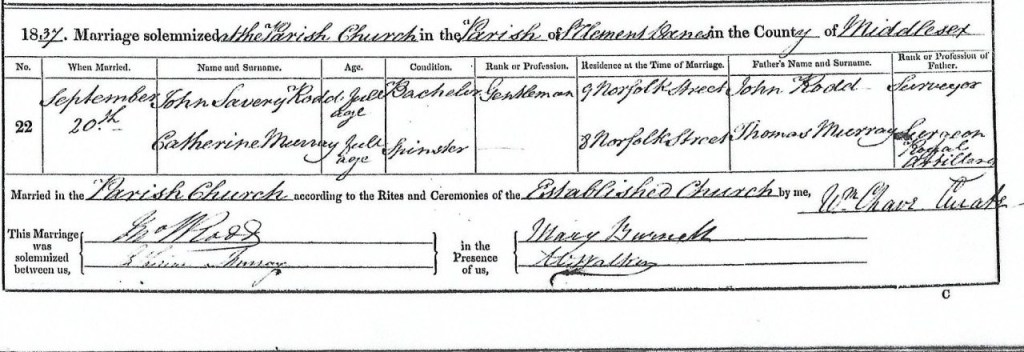
After doing the Grand Tour the couple returned to Coombing Park. John Savery Rodd was a magistrate and one of the first trustees of the Church of England at Carcoar. He was a man of considerable wealth and influence. In 1843 he purchased Blackdown, Bathurst, from Henry Hawkins, which property he disposed of to Henry Rotton in 1852. His only son, John Tremayne Rodd, was born at Blackdown in 1848 and married a descendant of Dr. Thomas Arndell.
After leaving Blackdown, John Savery Rodd purchased Fleurs, the original home of the Darvall family on the South Creek, about 12 miles from St. Marys, and leased the old Government House at Parramatta as a town residence. He was a member of the A.J.C.(Australian Jockey Club) and of the Australian Club, and the foundation member of the Union Club. He entertained lavishly and his daughters were recognised as the belles of Sydney society. He finally purchased and resided at Tarpeian, Potts Point, and died in 1870.
His son inherited and lived at Fleurs. He married Teresa, a daughter of Dr. Maddox of Launceston, whose grandmother was Mary Arndell. Their son, Tremayne Rodd, now lives at Manly, and belongs to the Pioneers’ Club. He was born in 1872, and was in 1896 amateur champion boxer of Australia. His son Geoffrey Tremayne Rodd represents the fifth generation of the family, and as a lieutenant in the Royal Navy has had a distinguished career. “
Photograph of John Savery Rodd 1806-1870 and his only son, John Tremayne Rodd, 1848-1900 (Given to me by Judith and Stephen Westgarth)
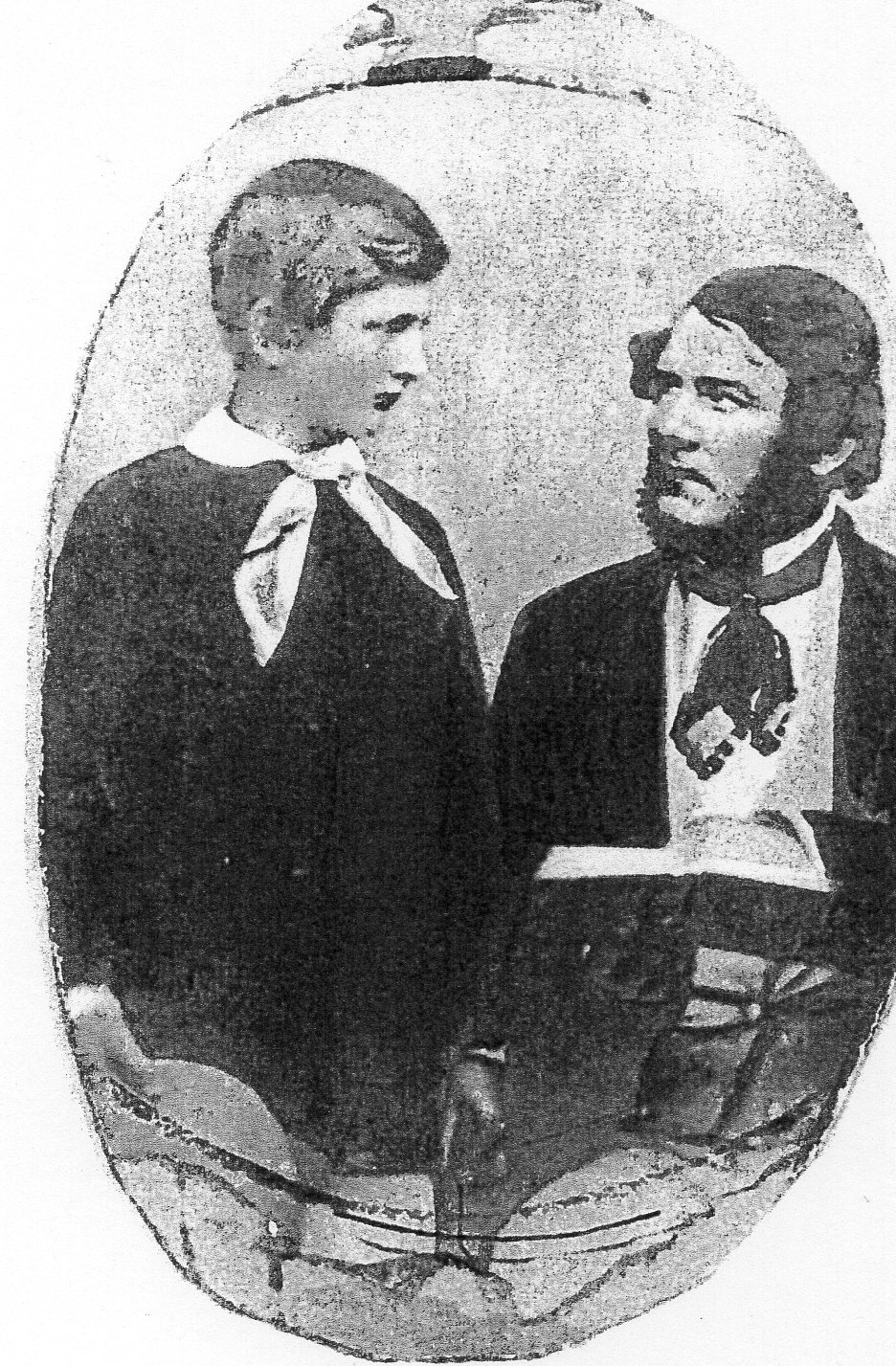
This story illustrates how free settlers, or ‘Pioneers’, had kept close contact with the ‘Old Country’ and had transferred their British social aspirations to the Colony. John Savery Rodd invested his inheritance in rural property and advanced the prospects of his son and daughters.
At the time of his death, he had a rural property called Fleurs at St Mary’s consisting of 1800 acres and he was also renting the Mayoral house at Parramatta. He had other freehold properties and many leased runs for cattle and sheep. In Sydney, he purchased ‘Tarpeian’ at Potts Point in 1865. Here are the details of the sale:
18/11/1865 Bought by John Savery Rodd
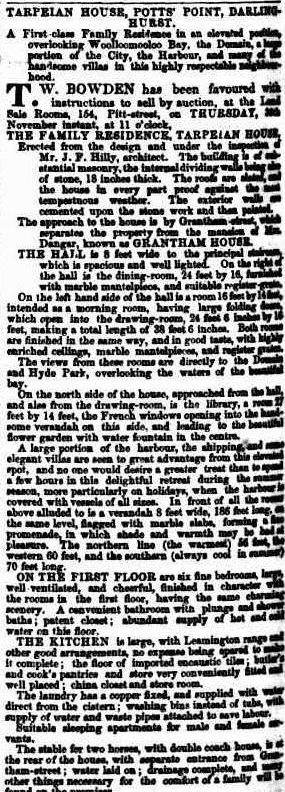
In marrying Miss Rodd, who was much older than he was, George Charles gained valuable social connections. Miss Florence Sophia Rodd was also a very wealthy woman, inheriting £5000 in 1870, a sum that, prudently invested, would give her about £500 a year. The money was, by the terms of the will, hers to keep, not to be the property of her husband upon marriage. In her father’s Will, he left his wife £100 a year (plus a lump sum and other legacies) so you can see Florence Sophia was very well off. Florence Sophia also had a share in the mortgages and profits of Rodd landholdings other than those gifted to her mother and brother.
(I have a copy of the Will, and a copy of the Will of her mother, Kate.)
Marriage to Florence Sophia takes place:
On the 2nd July, at St. John’s Church, Darlinghurst, by the Rev. Thomas Hayden, M.A., George Charles Westgarth, Esq, of Sydney, solicitor, to Florence Sophia, daughter of the late John Savery Rodd, Esq, of Fleurs, St. Mary’s.
(Sydney Morning Herald 10/7/72
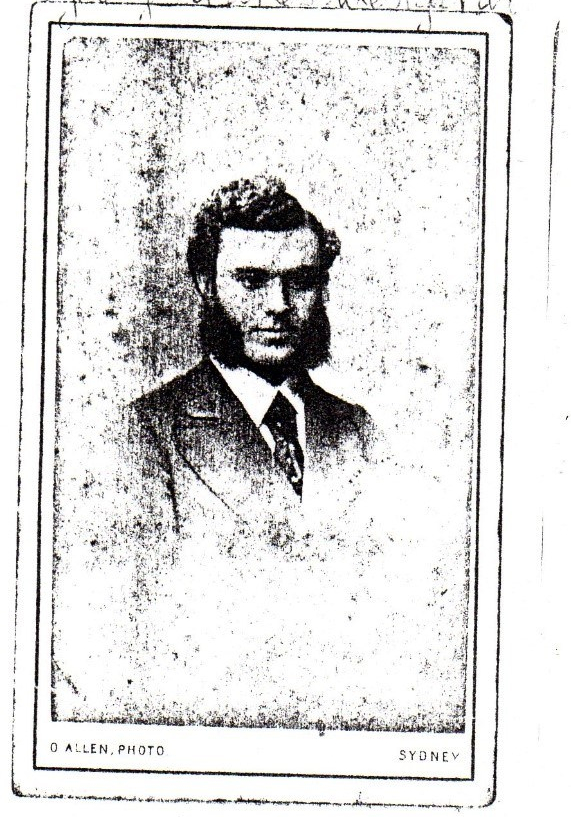
This is definitely a portrait of George Charles. It looks to me that he was about 25 years old and wearing his best clothes, so it is probably his wedding portrait for his first marriage to Florence Sophia, born in 1841 in Bathurst. Florence was 30 at the time of the marriage, 5 years older than George Charles. I have no portrait of her.
The Colonies get closer to the mother country!
There were three reasons for this: By the 1870s, the development of steamships had reached such a point that the voyage ‘home’ took only six to eight weeks, less than half the time a clipper ship had taken. Also, the Suez Canal had been built and it opened to all shipping in November 1869, changing the route to a much shorter one through the Mediterranean Sea. Lastly, by 1872, the Overland Telegraph was completed and messages and news between the colonies and Britain only took a day for a reply. No longer would news of family or political matters be six months out of date!
It is very likely the newly-weds took a trip to England in 1872. Florence and George Charles had living relatives in England. The counties of Worcestershire, (the Rodd family) Shropshire (Ellesmere) and Lancashire (the Westgarth family), are all in the west of England. George Charles remembered Liverpool and his grandparents. Florence Sophia’s parents were married in England and during her childhood they could have taken her back to Worcester and to County Cork in Ireland, the home of the Murrays. The ties to the Old Country were very strong and New South Wales was still just a colony.
Their first home:
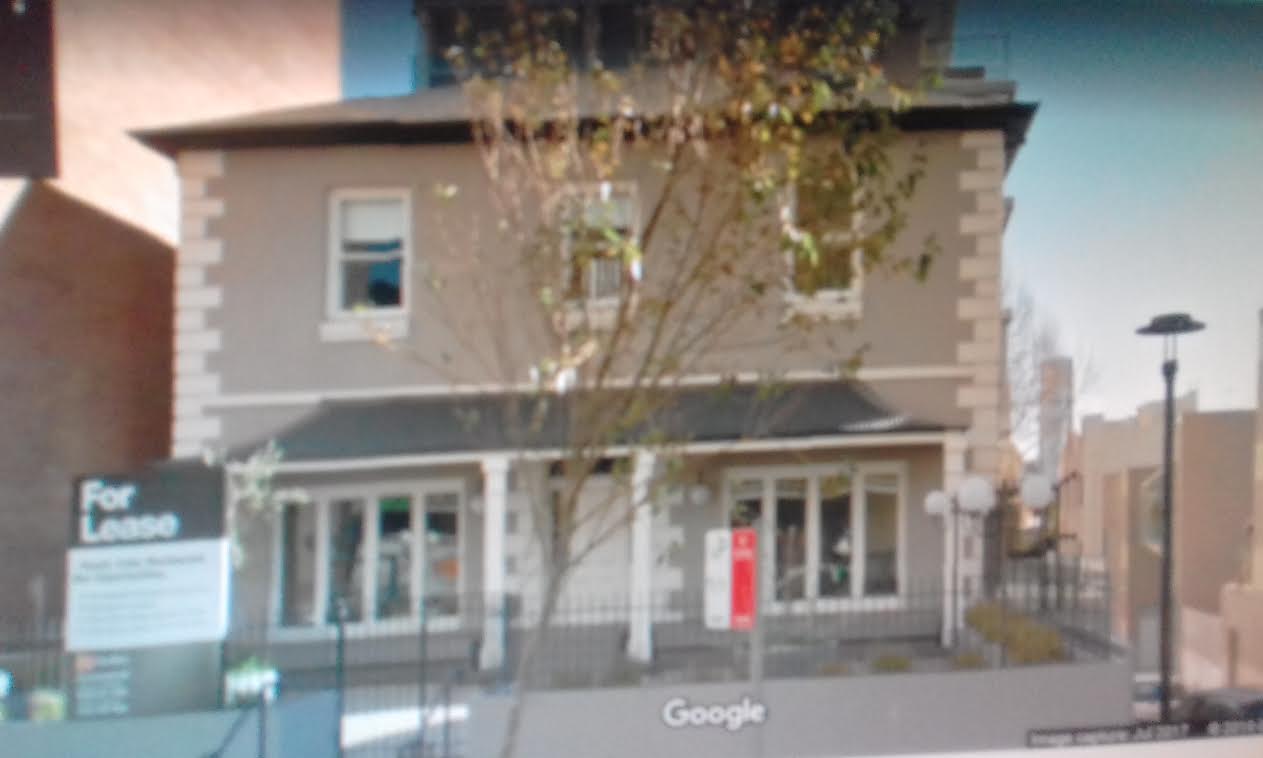
The Westgarth family were living at 229 Darlinghurst Road in 1874, so they were probably there at the time of the marriage, (although they moved a lot and had been at Five Dock in 1870), because George Charles and Florence set up house at 211 Darlinghurst Road. Kate Rodd, Florence’s mother, still lived at Tarpeian at Potts Point, so the area between Potts Point and Darlinghurst appears to have been fashionable in the 1870s. Darlinghurst Road must have been a lovely tree-lined street then, with a church and many Victorian villas. This is what is left of number 211, taken from an LJHooker advertisement.
The couple had a daughter, Ella Florence, on 6/6/1873, then a daughter, Constance, in 1875, who only lived for a year, and a son, John Ellesmere Westgarth on 25/3/1877.
I thought it was interesting that the children were called Ella Florence and John Ellesmere. Sentimental or aspirational? George Charles was leaving his roots behind him.
5: Death of Florence Sophia
Florence died the next year, 28th June 1878, aged 36. Her death certificate reveals that she died of middle ear infection AND peritonitis, which is inflammation of the organs of the body. It must have been a very sad and terrible death, at such a young age leaving a widowed husband and two small children. Her death certificate is below. It shows that George Charles was not present at her death and her brother, John Tremayne Rodd who had inherited the property, Fleurs, at St Mary’s, signed the death certificate. It also shows that she was buried at Rookwood Cemetery, called the ‘necropolis’ (or city of the dead) on the certificate. This cemetery had only been commenced about 10 years before.
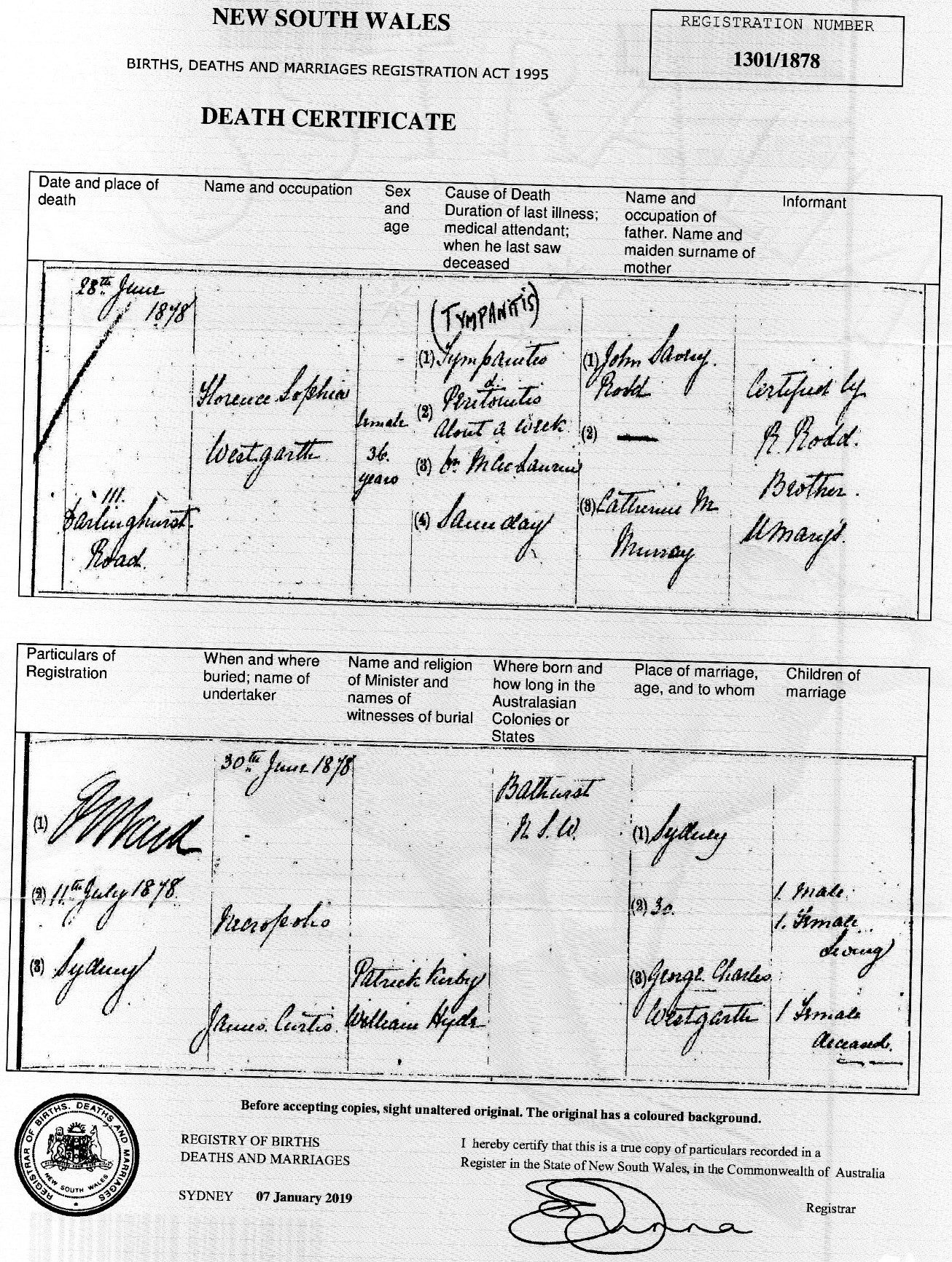
When I enquired about the situation of her grave, I found that ‘Westgarth’ had been misspelled as ‘Westgrath’, but after some confusion I found her plot, which is Zone B, Section AA, Allotment 69. The spelling has now been changed, over 100 years too late.
When Florence Sophia died, John was 15 months old and Ella about 5. The legacy left by her father would have passed to her children by the terms of his Will. George Charles was the solicitor for her mother, Catharine (Kate) Rodd, and would have administered their legacy, investing the capital and their share of mortgages and profits of the Rodd estate.
The children also had wealthy relatives, such as Sir Terence Aubrey Murray (Kate’s cousin) of the large sheep station, Yarralumla (now the residence of the Governor-General of Australia). Even closer to home, was Kate’s influential brother, who had also emigrated to Australia. Here is his obituary:
The Albury Banner and Wodonga Express (NSW : 1871 – 1938)Friday 29 October 1897 – Page 28
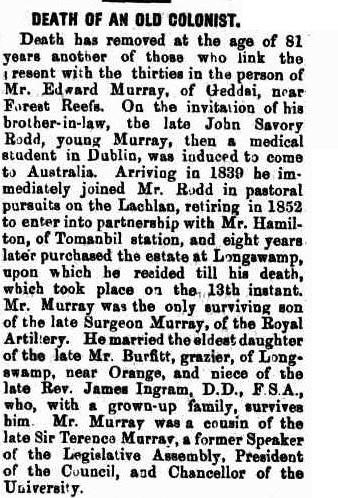
6: Second Marriage to Lucy Florence Mansfield
Two years later, while George Charles was still a partner with Alfred John Cape, he made another excellent society marriage with Lucy Florence Mansfield, the daughter of the celebrated architect, George Allen Mansfield, on 4th March 1880, at St Mark’s Church, Darling Point. This time George Charles was thirteen years older than his bride. Lucy Florence was twenty and George Charles was thirty-three. Ella would have been 6 or 7 and John nearly 3 years old.
Here is their marriage certificate:
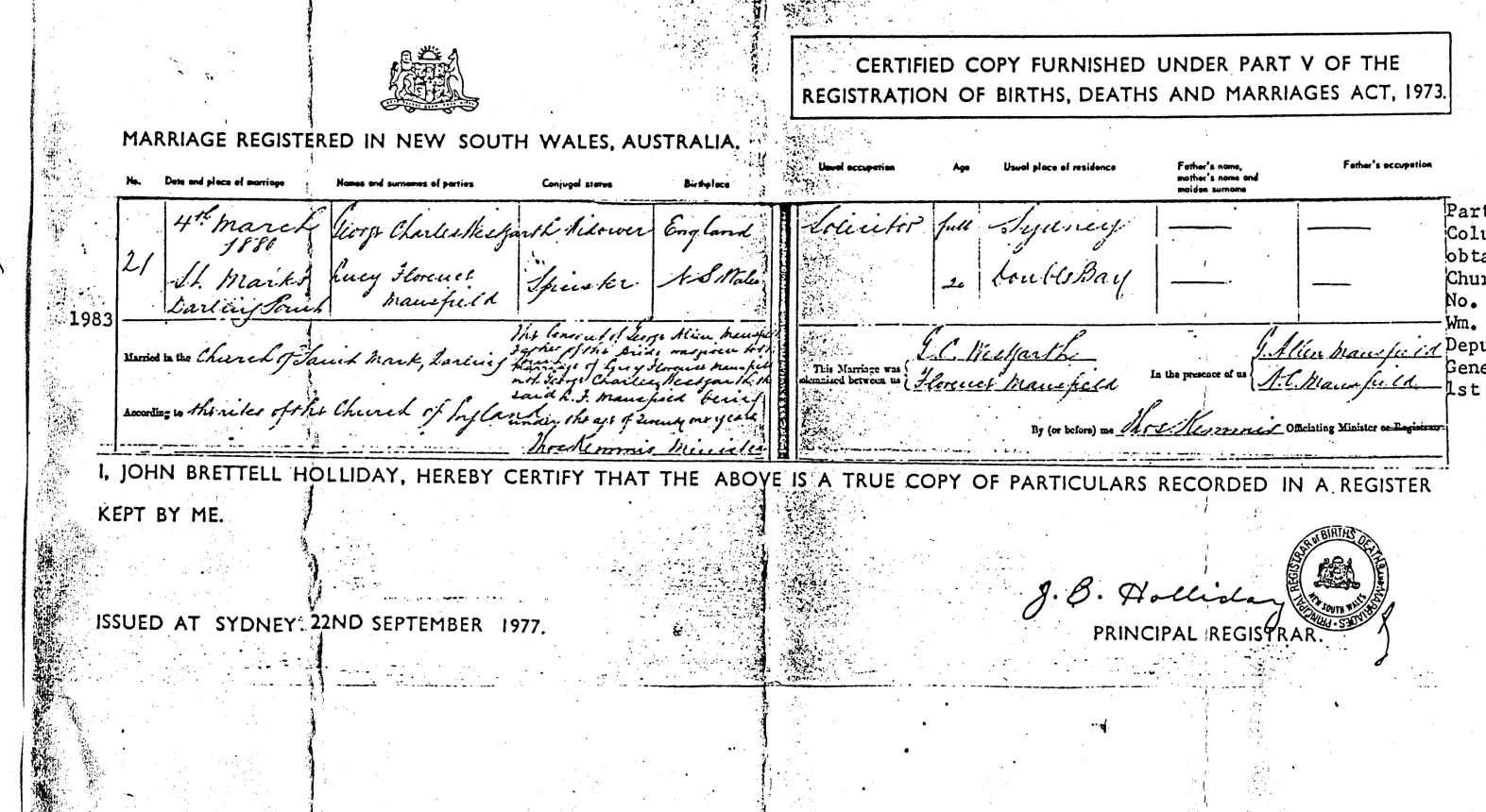
Lucy Florence and her siblings had lost their mother, Mary Emma Lucy Allen in 1861. She died at age 29, when Lucy Florence was about a year old. Her father married again in 1863 to Mary Anne Lorne McDougall, who became Lucy’s new mother.
A picture of Lucy Florence.
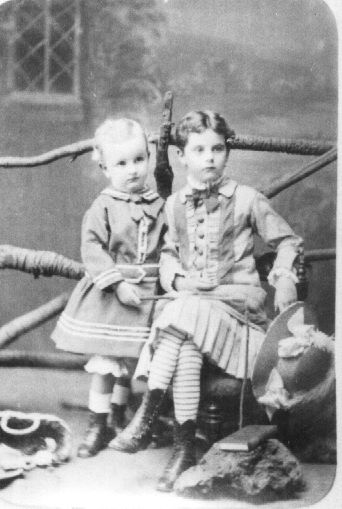
Dudley, my grandfather, never showed me pictures of his mother, but Julie has this dugerrotype, an early kind of photograph. It is a portrait of two very different little girls. The one on the left, who looks very bored, is Lucy Florence, Char’s mother. The girl on the right is her half sister, Lorne’s daughter. They certainly are very different little girls.
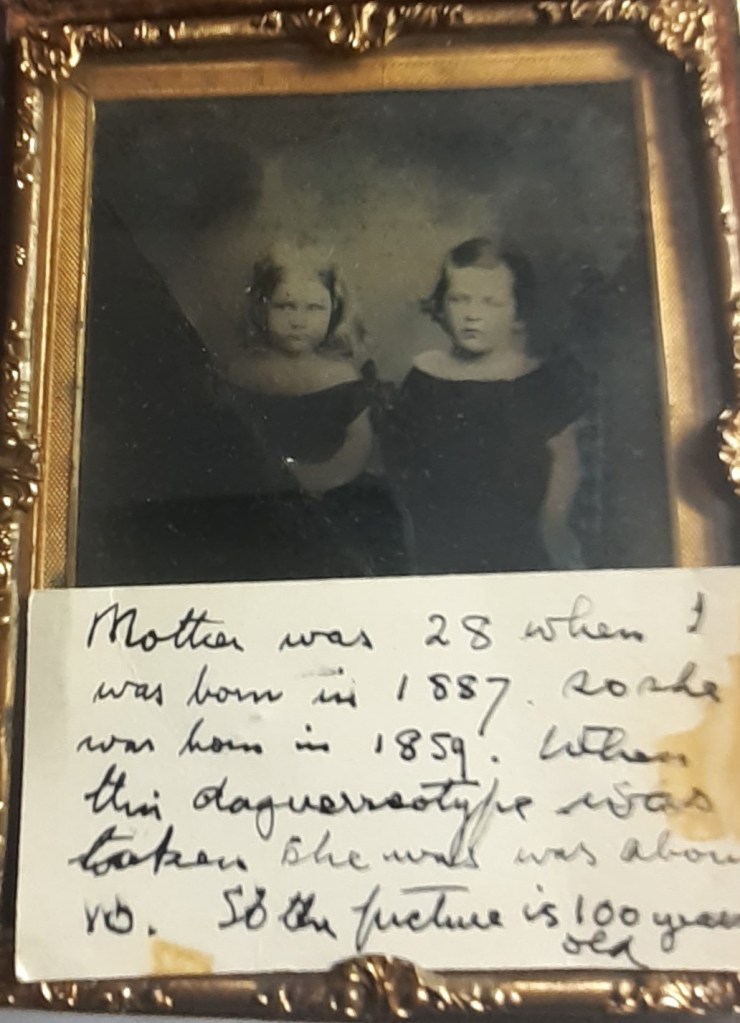
Mary Anne, known as ‘Lorne’, had four children of her own, but she became well-loved ‘Granny Mansfield’ to the Westgarth children and lived to be 94 years old, outliving her stepdaughter by five years! So my father must have known her quite well.
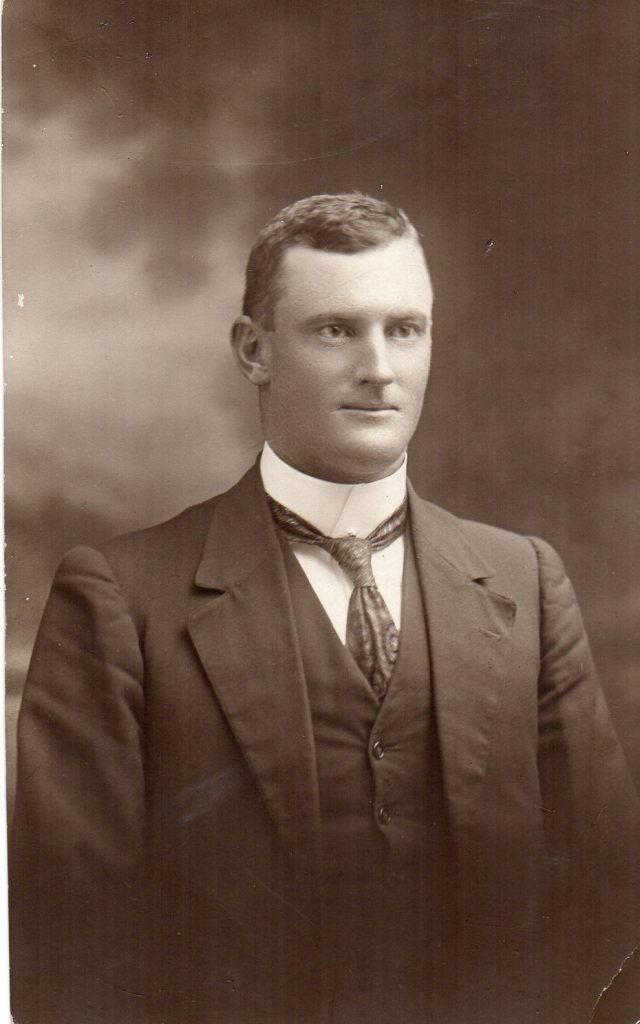
This must be the engagement portrait of George Charles, who was 33.
7: Mansfield Family background:
George Allen Mansfield was the eldest son of the Reverend Ralph Mansfield (1799-1880), Methodist missionary and newspaper editor, who was born on 12 March 1799 at Toxteth Park, Liverpool, England. His second wife, the mother of George Allen Mansfield, was Lucy Shelley, the daughter of a missionary, whom he married in 1832.
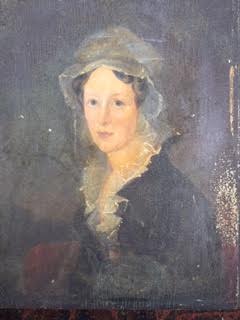
This is a portrait of Lucy Shelley by an unknown artist, purchased by Stephen Westgarth.
Lucy Shelley was born 1806, Parramatta NSW. Father: Reverend William Shelley; Mother: Elizabeth Bean. She married the Reverend Ralph Mansfield on 5th April 1832. Died: 5th October 1888, Burwood.
(www.the 1788-1829pioneerassociation.org.au/Lucy%Shelley.html
Stephen sent me this email about Lucy (nee Shelley) Mansfield.
“Hi, I got Lucy more than 10 years ago from Mr Oakes of Lane Cove. He was in his 70s then. In 1871, Mr Oakes’ ancestor, George Oakes, commissioned his nephew, George Allen Mansfield, to design him a ‘gentleman’s ‘ residence in Macquarie Street. It is still there, now called ‘History House’.
Mr Oakes said the family had always called her ‘Lovely aunt Lucy’ as his grandparents or great grandparents would have called her that. Her father was a missionary. Her mother was a Bean, probably of the clan of WW1 historian Charles Bean. The Art Gallery of NSW said the portrait was from the 1840s. The lace hairpiece is the period giveaway. The portrait needs restoration.”
Ralph Mansfield gave his eldest son the names of another prominent Methodist, the lawyer, George Allen. Allen returned the compliment by calling his large property in Glebe ‘Toxteth Park’. The relationship with the Allen family would be an important support to Lucy Florence throughout her married life.
A CONVICT ANCESTOR
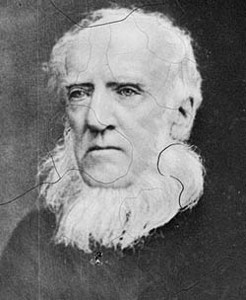
I remember my grandfather, Dudley, telling me in a joking way about his convict ‘ancestor’ who did not pay tax on the labels of his medicine bottles. Here he is, in the story of George Allen, the grandfather of Lucy Florence. From the Australian Dictionary of Biography: http://adb.anu.edu.au/biography/allen-george-1696
ALLEN, George (1800–1877) by Norman Cowper and Vivienne Parsons
George Allen (1800-1877), solicitor, was born on 23 November 1800 at Southwark, London, the second son of Richard Allen, a physician of London, and his second wife Mary, née Tickfold. Richard Allen died in 1806, leaving a widow and five children between 14 and 6, and little to support them. As well as his practice, he had had a business of vending medicines; it was managed by Thomas Collicott, whom his widow married in 1809. In 1812 Collicott was convicted of failing to affix revenue stamps to his medicine bottles, and was transported to New South Wales in the Earl Spencer in October 1813. His wife, with George Allen and two other children of her first marriage and three children of Collicott’s previous marriage, followed him, reaching Sydney in the Mary Anne in January 1816.
Mrs Collicott bore a letter of introduction to Governor Lachlan Macquarie, who received her kindly and arranged for George Allen to be articled to the government solicitor, William Moore, but this fell through on Moore’s suspension after a quarrel with the governor. Instead, Allen was articled in July 1817 to Frederick Garling; Collicott, who described himself as a merchant, paid the premium of £100, and supported George until he was able to provide for himself. Allen was admitted to practise as a solicitor on 24 July 1822. He was the first solicitor who had received his legal training in the colony, and the founder of the oldest legal firm in Australia. His office was at first on the corner of George and Hunter Streets, later in Macquarie Street, and from 1825 in Elizabeth Street.
During the five years of his articles and until his marriage, Allen was a lonely man, because of the absence of his family, first at Parramatta and afterwards in Hobart Town, and because, though not an emancipist, he had few friends among the free settlers, since his stepfather was an ex-convict. This may have been a reason why he became intensely religious. He joined the Methodist Society in 1821 and was soon a leading member. He was active in the Wesleyan Missionary Society, the Sydney Bethel Union, the Religious Tract Society, and the British and Foreign Bible Society. In keeping with the spirit of the times, he extended his puritanism to his purse, and his affairs prospered. By 1831 he owned three houses in Sydney, held an estate of thirty acres (12 ha) at Botany Bay, had acquired from the Church and School Corporation ninety-six acres (39 ha) of the old St Philip’s glebe, and had built there a house, Toxteth Park, where he and his family lived for the rest of his life. Besides conducting a lucrative legal practice, he was a founding director of the Gaslight Co. in 1836, as well as its solicitor, became the solicitor of the Bank of New South Wales in 1843, was a director of the bank in 1860-66 and 1868-77, and its president in 1863-66, and was a vice-president of the New South Wales Savings Bank and a director of several other companies.
Allen was humane and philanthropic and had a strong sense of duty. He was the honorary secretary of the Benevolent Society for many years and a member of the Temperance Society. In 1826 he joined the Agricultural and Horticultural Society. In November 1842 he was elected a councillor of Bourke Ward in the first poll for the Municipal Council of Sydney, and he was also an alderman for Brisbane Ward. He supported the popular cause in the council, advocating the employment of the poor rather than convicts on public works, though this may have been with the object of relieving the Benevolent Society from the burden of helping them. From November 1844 to November 1845 he was mayor of Sydney. In July 1845 Governor Sir George Gipps appointed him to the vacancy in the Legislative Council created by John Blaxland‘s resignation. In 1856 he was appointed for five years as a member of the first Legislative Council under responsible government, and in 1861 was reappointed for life, but resigned in 1873. He was elected chairman of committees in the Legislative Council on twenty-two occasions.
He was a founder of the Sydney Free Grammar School in 1825, and at various times its secretary, president of its trustees, and a trustee of its successor, the Sydney College. He was a member of the Denominational Board from 1848 to 1866, and of the Council of Education, established after the Public Schools Act of 1866, from 1867 to 1873. He became a member of the senate of the University of Sydney in 1859.
In 1847 he had taken his son, George Wigram, into partnership, the name of their firm being Allen & Son. He retired in 1855. The practice has been carried on uninterruptedly since 1822; since 1894 its name has been Allen Allen & Hemsley.
George Allen had married Jane, the daughter of the schoolmaster, Thomas Bowden, on 24 July 1823; she bore him fourteen children, of whom five sons and five daughters survived infancy. His son George Wigram was not only his partner and successor in his legal firm but continued many of his public activities, becoming minister of justice and public instruction in Parkes’s administration in 1873-75, and afterwards Speaker of the Legislative Assembly.
On George Allen’s death on 3 November 1877 the Sydney Morning Herald referred to him as ‘one of the foremost public citizens, who overcame the temptation of successful men to live a life of easy self-indulgence’. The sour description of him in Rev. John Watkins’s Journal on 6 May 1871 as ‘the stereotyped chairman of religious meetings’ did him far less than justice. He was assiduous and successful in the practice of his profession, a supporter of good causes, zealous for the public interest and a man of piety and rectitude.’
The Glebe
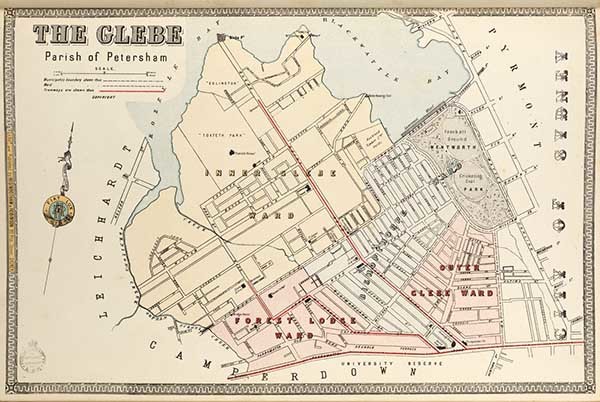
Glebe was originally inhabited by the Cadigal clan which occupied a territory that embraced Sydney Cove and stretched along the southern side of Port Jackson from South Head to about Petersham. As Sydney Town expanded, Glebe’s aboriginal population dwindled and no evidence of the Cadigal’s presence is found in modern Glebe.
In the early struggling years of the first settlement at Sydney Cove (1788), Governor Phillip first surveyed, in 1790, the penal colony at Sydney town. He made a grant of 400 acres of land to the Church of England, in the person of the Rev. Richard Johnson, Chaplain to the First Fleet. This land became known as ‘The Glebe’ (or St Phillips Glebe) from the Latin word glaeba (a clod of earth) and, through its ecclesiastical use, signified church land.
Financial difficulty forced the church to sell some of its land. In 1831 George Allen acquired 96 acres and built a home which he called Toxteth Park.
The architect John Verge was commissioned by solicitor George Allen to design Toxteth Park. The house was an elegant white stone building consisting of a rectangular central block of two storeys with long verandahs around two of its sides supported by Doric columns of fluted iron. The main elevation with its plain Georgian front had long shuttered French windows, was planned to give wide views of the park lands and cultivated shrubberies, planted with oaks, firs and pines.
By 1856 a two strata society began to develop. The homes of the gentry were built on Glebe Point while many workers lived at the southern end of The Glebe.
…………………………………………………………………….
Below is the obituary of George Allen Mansfield, his son in law, born June 16th 1834. It appeared in the Sydney Morning Herald of 21st January, 1908
DEATH OF MR. G. A. MANSFIELD A PIONEER ARCHITECT. 1834-1908
The death took place yesterday of Mr George Allen Mansfield F.R., I.B.A., at his residence, Darling Point, at the age of 73. His death removes one of Sydney’s oldest and most respected architects for few men have had more to do with the beautifying of the chief city of Australia by the designing of some of Its most prominent public and commercial buildings than the deceased gentleman. The late Mr. Mansfield was a native of this city. He was the eldest son of the late Rev. Ralph Mansfield, a name closely identified with the early history of the colony.
George Allen Mansfield was educated at the school of the late Mr. W. T. Cape, and amongst his contemporaries were the late Mr. Justice Windeyer, the late Sir George Innes and the late Mr. Alexander Oliver. In 1850 Mr. Mansfield was articled to the late John Frederick Hilly, who was then the leading architect of Sydney. Soon after the expiration of his articles he was taken into partnership and for several years the firm of Hilly and Mansfield carried on business in this city. Finally, Mr. Mansfield entered into business on his own account and he received the support of the principal capitalists of Sydney, and rapidly acquired an extensive business.
Amongst the principal buildings erected from his designs and under his supervision were the Royal Prince Alfred Hospital, the A.M.P. Society’s building in Pitt street, the Australia Hotel, the Savings Bank of New South Wales, the old and new City Bank, the City Mutual Life Assurance Company’s offices, the Civil Service Co-operative Stores, Commercial Bank of Australia, Pitt Street, and the country branches of the Commercial Bank. Nearly the whole of the principal buildings in O’Connell street, including the stores of Messrs Bradley, Newton and Lamb, and David Cohen and Co., were erected by him.
In the year 1860 the Government of the colony invited designs for new Houses of Parliament in Sydney, the competition for which was thrown open to the world, first and second premiums of £600 and £300 respectively being offered for the most successful designs. A large number of plans were received from England and the Continent of Europe, and even from America, with a few from the colonies. Though a very young man and with the limited advantages of a then colonial education, Mr Mansfield determined to compete for the prize. A commission was appointed by the Government of the day to adjudicate upon the designs which were sent in under motto. After long and careful consideration three designs were selected from which the final choice had to be made. The first and second were accorded to designs from England. The third design which approached so nearly to success was found to be the work of the young Australian architect.
Not very long after this the office of colonial architect became vacant, and the position was offered by the late Sir Charles Cowper, then Premier, to Mr. Mansfield, who declined it, preferring the freedom and the chances of private practice. In 1867 when the Council of Education was established under the Public Schools Act, Mr. Mansfield was appointed as its architect, and assumed the charge of all existing Public School buildings, and the designing and construction of all new ones. At this time the Public schools were in a very unsatisfactory condition, as to lighting, ventilation, and sanitary arrangements. A marked alteration soon took place. A type of building was selected by Mr. Mansfield which admitted of wide differences in size and cost, yet stamped a uniform character on all the new schools built at that time. Examples of the larger schools erected in this style may be seen in the fine buildings at Crown Street, Surry Hills, Cleveland Street, Pyrmont, and Sussex Street.
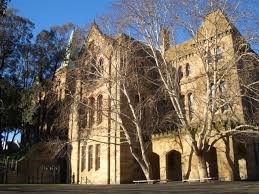
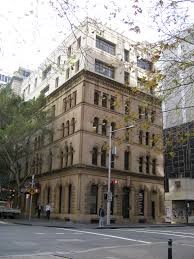
In December, 1879, a Ministerial Department of Instruction took the place of the Council of Education, and it became necessary that all officers connected with it should come into the Civil Service. As this would have involved the loss of Mr. Mansfield’s private practice he resigned his position as architect to the department. He was, however, paid the compliment by the newly appointed Minister, Sir John Robertson, of being asked to name his successor. In 1871 the architects of Sydney decided to form an association, and the first Institute of Architects was established. Mr. Mansfield was unanimously chosen its first president, and on August 21, 1871, he delivered an inaugural address before his Excellency the Governor, Lord Belmore, and a crowded audience in the Chamber of Commerce. For many years he filled the post of president to the institute.
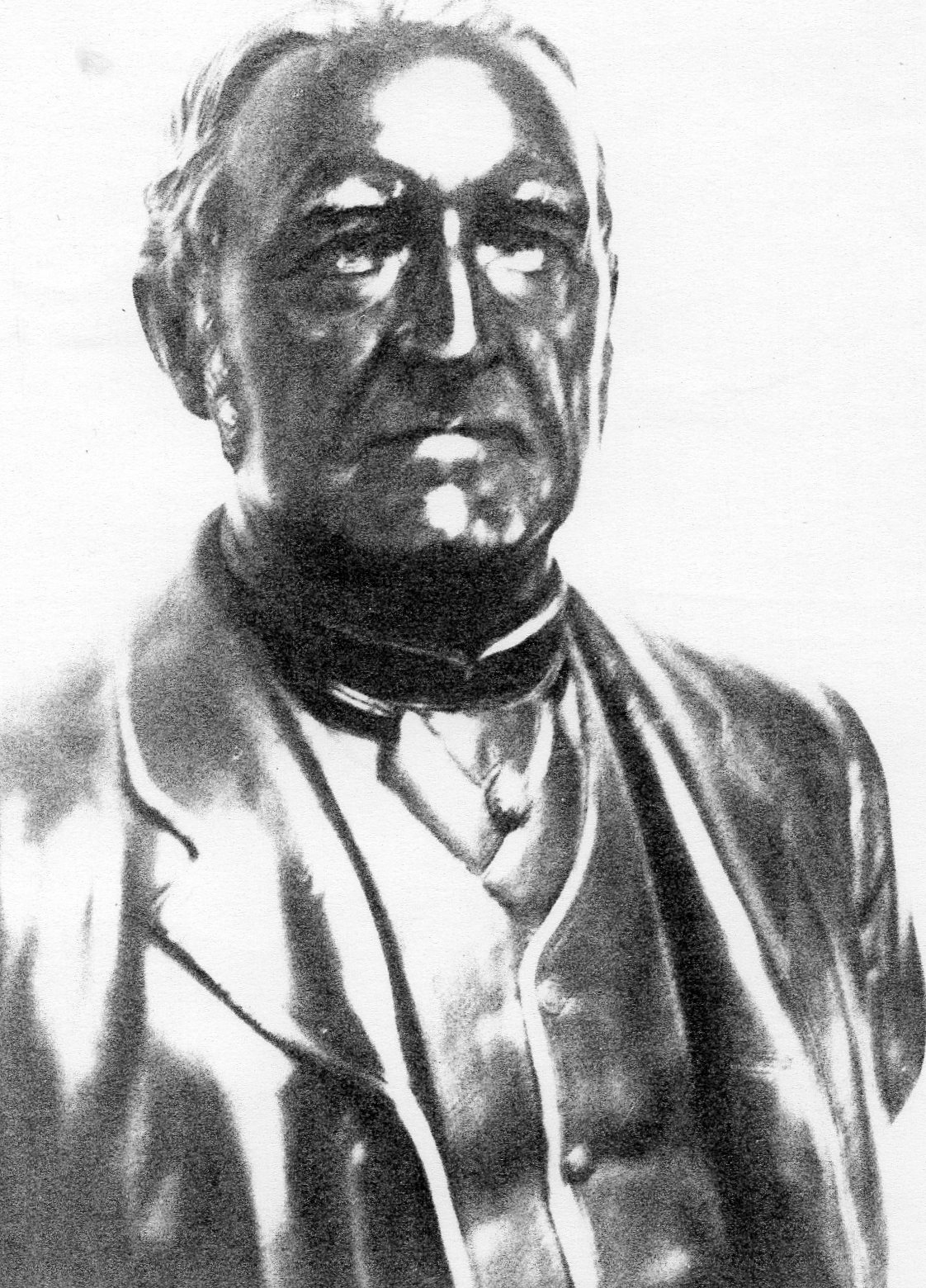
In 1873 Mr. Mansfield was elected a Fellow of the Royal Institute of British Architects. He was the first Australian-born architect to attain to that distinguished honour.
For many years Mr. Mansfield acted as architect to the Australian Gaslight Company, and he designed and erected all the buildings connected with the Darling Harbour establishment, in addition to many difficult and important engineering works.
Mr. Mansfield was one of those who took an active part in the establishment of the volunteer system of national defence in the colony in 1860. He was one of the first enrolled in one of the original companies, that of the Glebe, and for five years he held a commission as first lieutenant in that company, devoting much time and attention to promoting its efficiency. For nine years he was an alderman of the borough of the Glebe, and afforded much assistance in the laying out of the borough by his professional knowledge.
Though not a prominent politician, Mr. Mansfield always took a keen interest in the public affairs of his native country. On several occasions he was urged to stand for East Sydney, but always declined. He was, however, appointed to the Commission of the Peace.
For many years Mr Mansfield practised as an architect in this city with his brother Ralph, and some of Sydney’s leading architects to-day, men such as Mr. John Reid, Mr. Robertson, Mr. Marks, Mr. John Kemp, and others, received much of their training in his office.
For the last three years Mr. Mansfield’s health precluded him from taking an active part in his business, which has been carried on by his son. Although an active businessman Mr. Mansfield was also well known in sporting circles, having been a keen cricketer. He was the founder of the old Toxteth Cricket Club. He was also a successful yachtsman in his young days. He leaves a widow and a family of seven.’
Just to clarify relationships:……
‘George Allen Mansfield was born on 15 June 1834 at Sydney, eldest son of Ralph Mansfield and Lucy, nee Shelley. On 31 July 1856 he married Mary Emma Lucy Allen who died on 9 May 1861, aged 29 years. There were three children of the marriage. He then married Mary Anne Lorne McDougall at All Saints Church Singleton on 6 March 1863. There were four children from the marriage. He died at Darling Point on 20 January 1908, aged 73 years. Mary Mansfield (Lorne) died on 15 May 1930, aged 94 years.’ http://www.sydneyaldermen.com.au
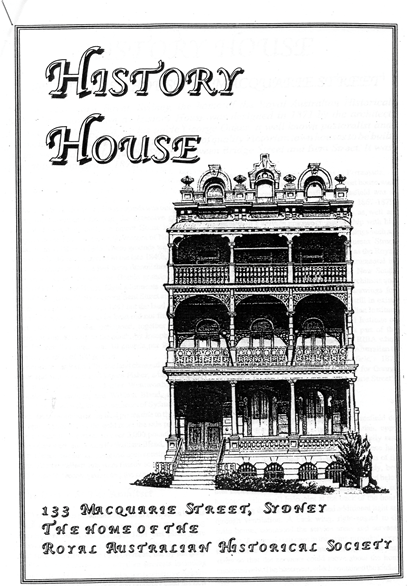
HISTORY HOUSE: A Mansfield design, still in Macquarie Street, Sydney
Following the gold rush, in 1857, when housing was scarce, George Oakes bought an allotment in Macquarie Street and employed his nephew, his nephew, G.A.Mansfield, to design a town residence for him. He also had a residence at Parramatta. The house was completed in 1880.
After his sudden death in a road accident, the house went through many hands, even being a medical practice, but 100 years after it was built, in 1980, it was opened as the premises of the Royal Australian Historical Society was faithfully restored by Clive Lucas and Partners in 1985 and so has been saved for posterity.
8: FAMILY COAT OF ARMS:
George Charles Westgarth had a coat of arms. One of my earliest memories was the coat of arms framed on the wall of grandfather Dudley’s home in Vaucluse.
George Charles was by 1870 a Sydney solicitor looking for a suitable wife to advance his status. He knew how the landed gentry lived in England and at the age of 24 he was taking his chance to have a similar life in the colony of New South Wales. He designed himself a coat of arms, which, according to the website of the College of Arms, was often done.
‘The College of Arms in the United Kingdom can make new grants of arms even today. To be granted a new coat of arms for you or your family, you must submit a formal request to the College of Arms directly. This applies to individuals, corporations, and private organizations……There is nothing wrong with designing your own coat of arms for your family.’ https://ancestralfindings.com
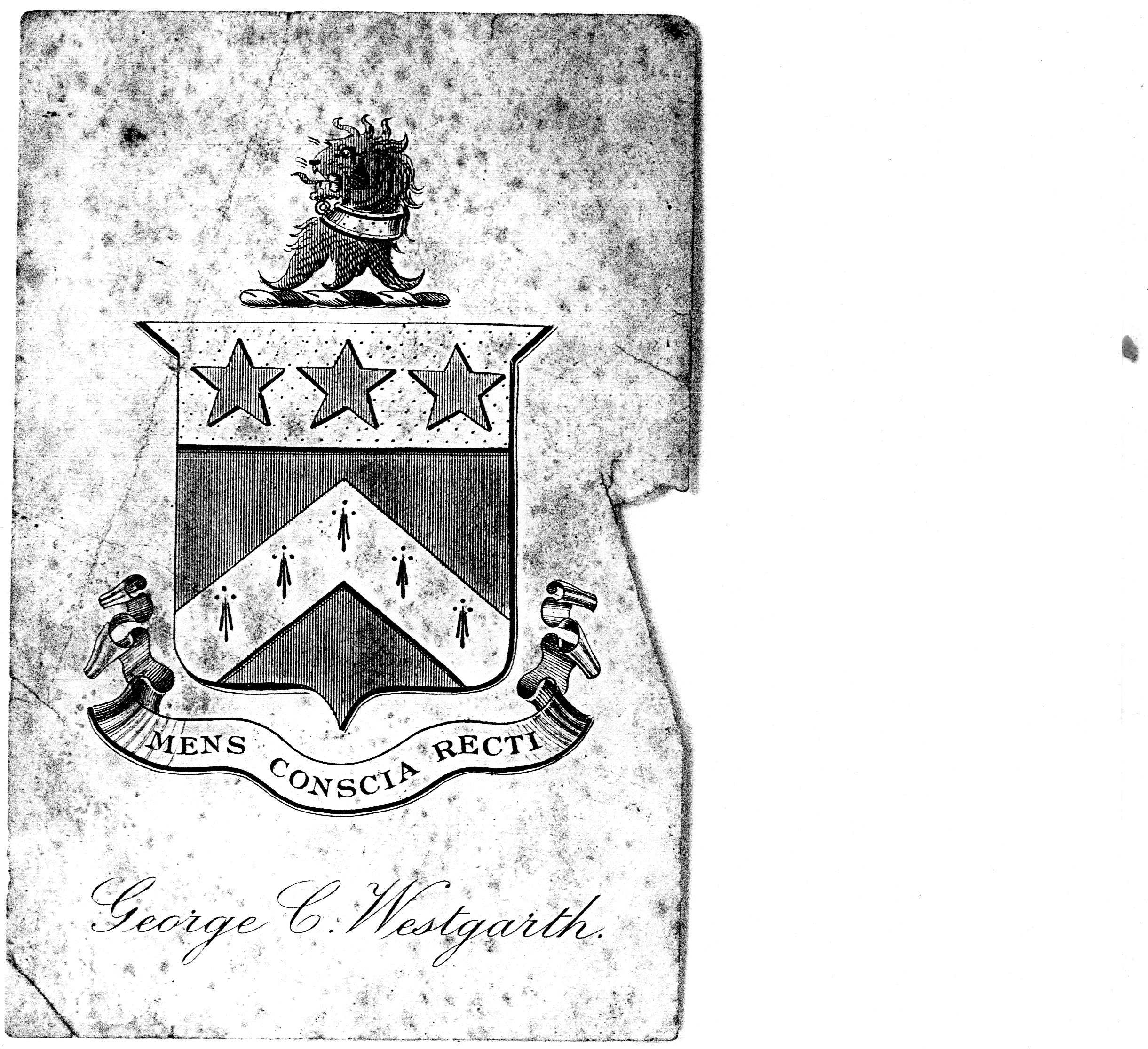
I wrote to the College of Arms. They replied that they have no record of granting a coat of arms to George Charles. I suggest these meanings for the parts of the above coat of arms, after looking on this site: https://www.heraldryandcrests.com/pages/heraldic-symbolism-a-z
The Lion: courage
Stars: ambition/achievement (which don’t seem to feature in heraldry)
Red background: Fortitude, patience in battle
Ermine: nobility
V shape or chevron: protection and defence
Motto: Right mindedness and honesty
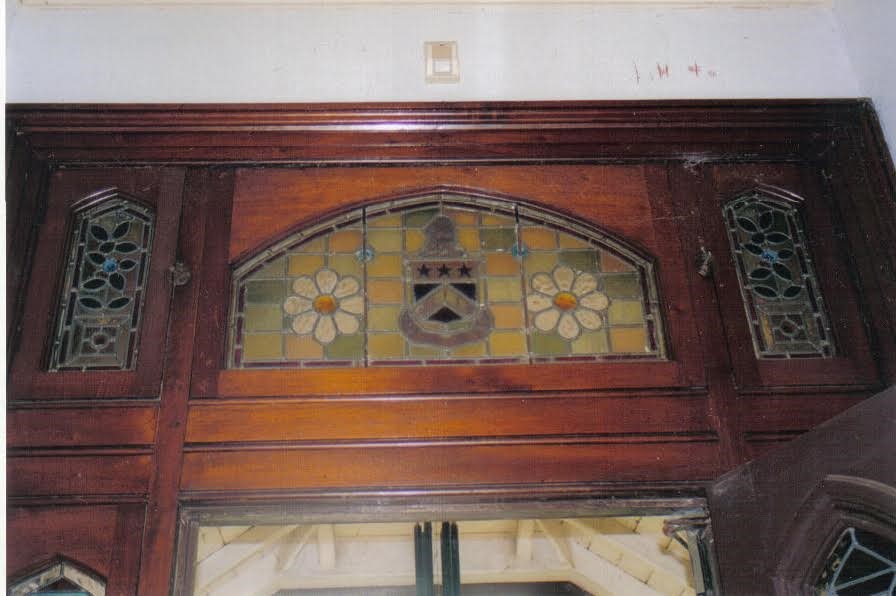
When George Charles built his house in Appin in 1887, he had the coat of arms featured in the stained glass over the front door. I obtained this photo from the Campbelltown Historical Society. You can sense what a magnificent front door it is. I unfortunately have no other photographs of the interior of the house, but have some objects which are featured below, plus a list of contents from a sale poster and the deceased estate, which I will mention in detail later. Here is the photograph:
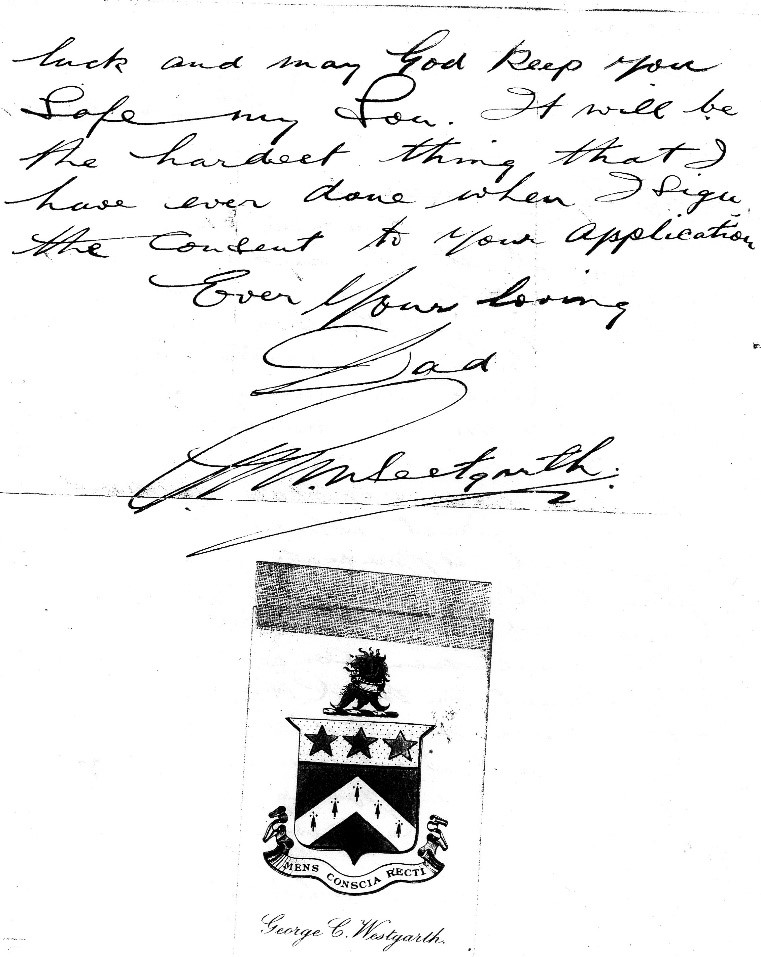
Here is a letter from his son, George Mansfield Westgarth, to his son David who had volunteered for war in 1941. The letter shows George’s pride in the Westgarth coat of arms as well as his love and pride of his son.
Scone, 5th December 1941
My dear David,
This is to wish you a happy birthday and many happier returns. I enclose a copy of my father’s coat of arms, on which is the motto: “Mens Conscia Recti” meaning, as you know, “A mind conscious of right”. Live up to it my son. I also give you my father’s gold mounted crest, which I hope you will appreciate as a family keepsake. The crest is engraved on a blood stone.
I shall now consent to your enlistment in the RAAF which you have wanted me to do for the last twelve months. I think 19 years old is young enough and I have given you time to think it over. You have your mother’s pluck and my self-will and we are both very proud of you. Good luck and may God keep you safe my son. It will be the hardest thing that I have ever done when I sign the consent to your application.
Ever your loving
Dad
G.M.Westgarth
9: NEW HOME:
In 1880, George Charles bought a new home for his second wife, Lucy Florence. It was a very special building, which in those days was situated on the outskirts of Sydney. In doing so George Charles had definitely reached the ranks of Sydney society.
Tresco, Elizabeth Bay: The Genius of the Place 8/11/2017
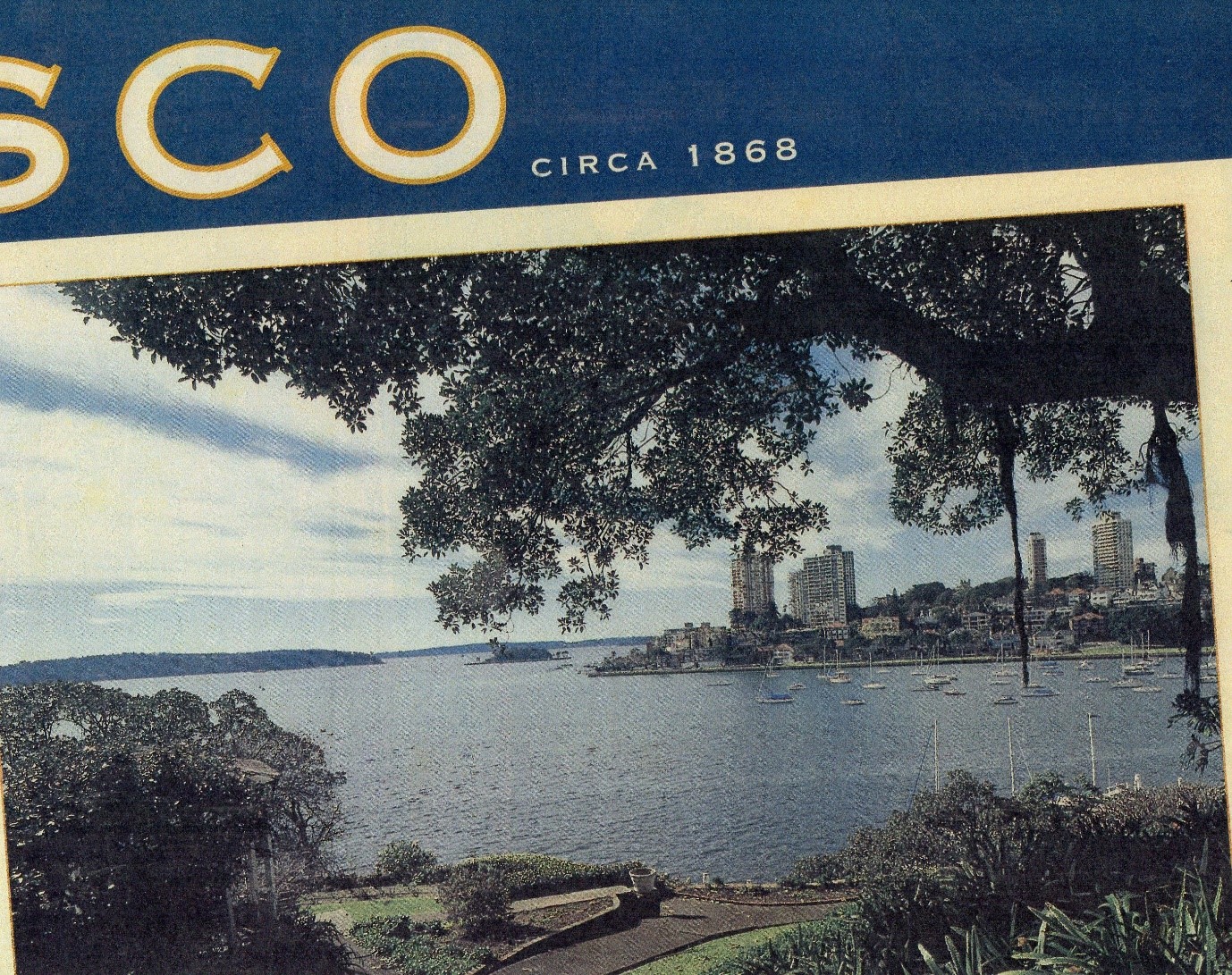
CRADLED in the fulcrum of Elizabeth Bay Road is Tresco, an 1868 marine villa whose streetscape shrouds its historical mystique. It enjoys its dress-circle harbour location with cascading gardens, a noble fig tree and a swimming pool set into the harbour and is a diamond in its setting – with just as many facets.
Alexander Macleay’s 1865 sub-division was the first in the area, scissoring his Elizabeth Bay House estate into lots. The Tresco site, Lot number 97, was purchased by Thomas Rowe (1829-99), architect, and was built and then occupied by the Rowe family for four years (1872-76).
The Sydney Morning Herald, 9th December 1865, noted comments by the agents, Richardson and Wrench: “This is an unrivalled site with extensive frontage to the waters of Elizabeth Bay.” Tresco was the first home built alongside the original Kincoppal, now demolished. It retains its original name and is the only home in the area on its original, complete site.
Thomas Rowe was more than an architect: he was a man of merit. A former cabinet maker and builder, he emigrated from Penzance, near the Isles of Scilly off the English Cornwall coast, which his mother’s descendants once governed, including Tresco Island. He arrived in 1848 and, after success on the gold fields, found he was just in time for Australia’s greatest building boom. He designed the Great Synagogue, Newington School, Stanmore, St George’s church, Sydney CBD, The Royal Arcade (now demolished) and many Methodist churches.
He became a Sydney Councillor, the first Mayor of Manly, founder and a president of the Institute of Architects, reclaimed and designed Rushcutters Bay Park and was a Lieutenant-Colonel in the army engineer corps: he invented a new, labour-saving mechanical shovel. Rowe Street, Sydney, is named after him.
He was also rich, but over-ambitious plans for a natatorium, an indoor health and pool complex, almost bankrupted him. He died, aged 69, after a cab accident. He also had a sense of humour, naming his sons Christopher Wren Rowe, Leonardo Rowe, Tresco Rowe and Ruskin Rowe.
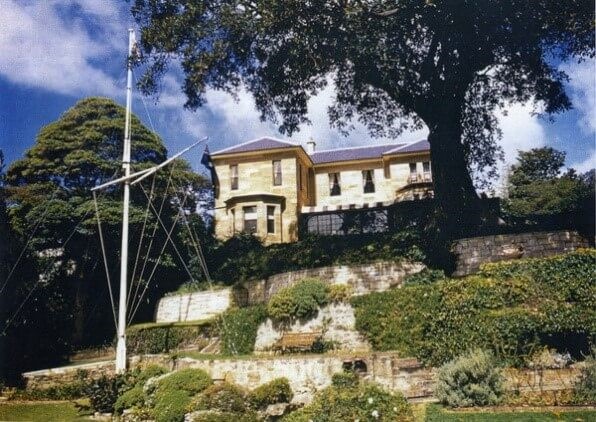
After Rowe on-sold the Tresco lease, it was tenanted to various dignitaries including Henry Kater MLC, Philip Morton, MLA, James Macarthur-Onslow and Sir Kelso King. In 1876 Mr William Oswald Gilchrist purchased the leasehold, selling it to Mr George Charles Westgarth in 1880, after which the gardens were developed and a new east wing was added including servants’ outbuildings, all still remaining. Perhaps GA Mansfield, George’s father-in-law planned the extensions although there is no signature on the plans. A Moreton Bay fig tree was planted.
In 1902 Tresco was purchased by the Crown and in 1913 it was designated for the Navy, for the Senior Naval Officer in Sydney. The Navy occupied the house for the next 94 years until 1997 with an armada of 45 Rear Admirals, 3 Commodores and 17 Captains in residence. A lavish banquet was held in 2007 by the current owners in their honour with former Rear Admirals present. During the Navy’s time important conservation works were undertaken while maintaining original rich cedar fittings and 19th century paint finishes. The fig tree was nurtured.
Today, Tresco is used as Thomas Rowe intended, a privately-owned home. Its well-proportioned interior rooms and cedar furnishings have been kept: the gardens, heritage wharf, and pool are carefully decorated. A rare 1830s gnarled carob bean tree, the oldest in Australia, still lazily overhangs the front fence. The statuesque 120-year branches of the old fig tree support the children’s rope swing. This fig tree is the oldest and largest on private property.
The 18th century English poet, Alexander Pope’s phrase, ‘the genius of the place’ defines the nexus between a house and its natural landscape and setting: “To build, to plant … In all, let Nature never be forgot. Consult the Genius of the Place.” By Andrew Woodhouse, Director, Heritage Solutions
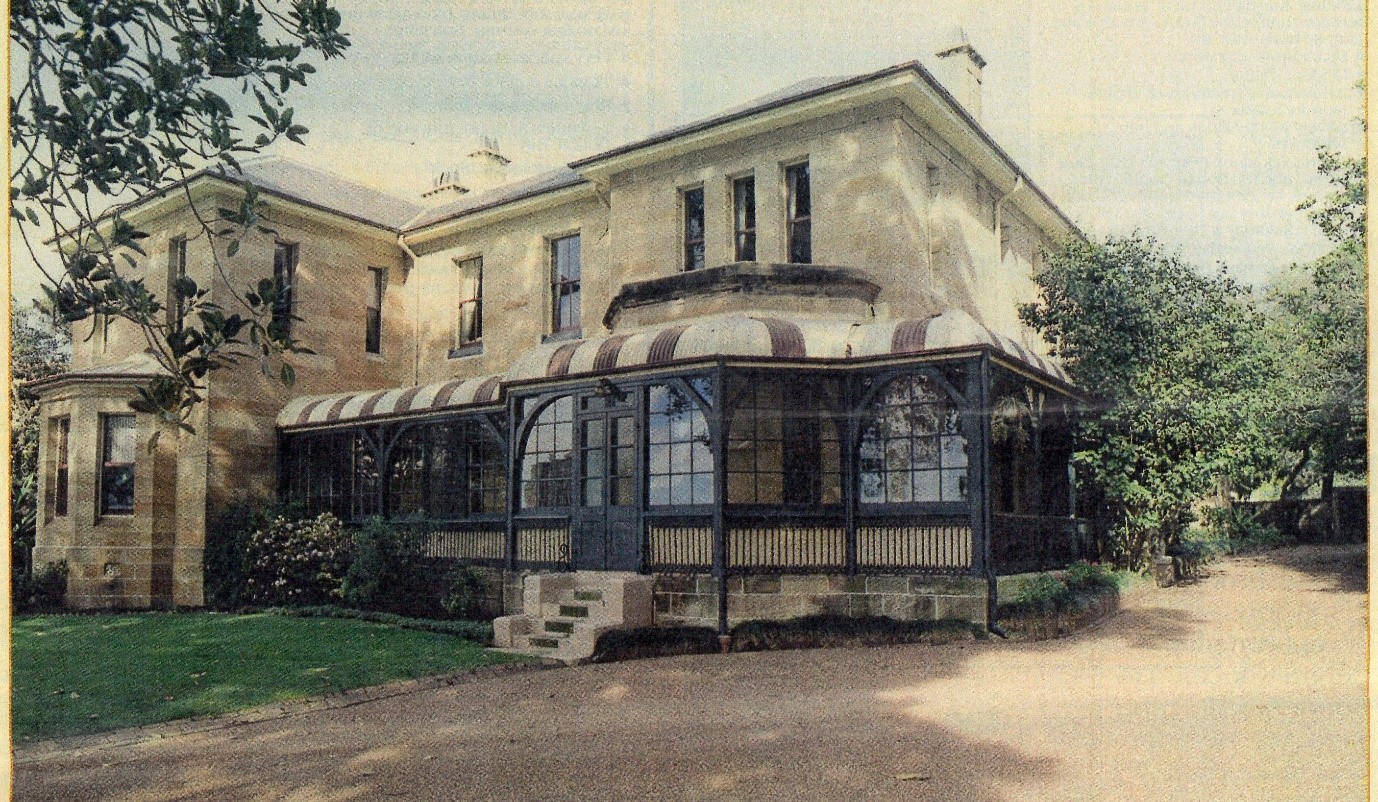
Rowe had built a 13 room early Victorian sandstone house with coach house, stable and garden, which George Charles Westgarth bought for £5,100. He took up residence with Lucy Florence, but by 1883 they had two sons, George Mansfield and Ronald Nigel, as well as the son and daughter from George Charles’ first marriage and the house needed expansion!
Here is the birth certificate of the first born at Tresco, George Mansfield Westgarth, 3/2/1881.
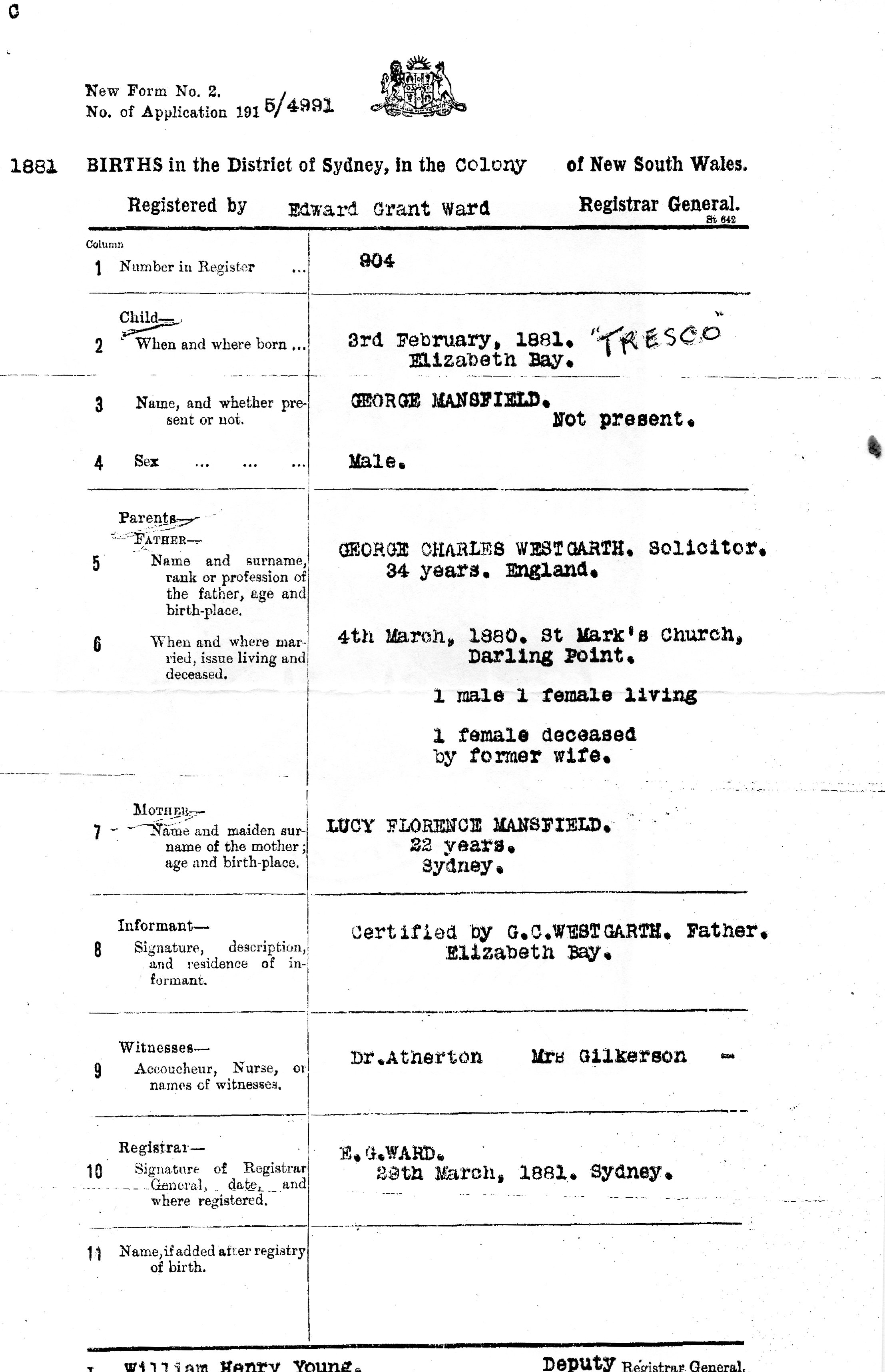
Ronald Nigel was born on 21st February 1882. George Charles had plans for an east wing drawn up and by December 1884 the alterations and extensions were finished and a daughter, Gwendoline, was born.
Renovations:
The renovations also included a bay window to the drawing room, a widening of the verandah on the north façade, installations of the cast iron balustrade, an additional floor to the kitchen wing, outbuldiings beside the coach house, renovation of the outbuildings to the utility courtyard and a wash house. On the water frontage, there was developed a boat harbour and covered davits. A summer house and fernery were erected to the western boundary of the middle garden. In the 1890s the verandah was partially enclosed as you can see below. (it is very likely that G.A.Mansfield planned the renovations).
There was a sweeping view of the harbour from the house:
10: SOCIAL CLUBS:
At the same time, in the eighties, George Charles sought membership of gentlemen’s clubs. With Alfred W Nathan, George Charles was a member of the Incorporated Law Institute, which was set up on 22nd Sept 1884:
Memorandum of Association of the Law Society of NSW.
We, the several persons whose names and addresses are subscribed are desirous of being formed into a Company in pursuance of this Memorandum of Association.
- Alfred De Lissa
- 2. John Williamson
- G C Westgarth, 2 0’Connell Street Sydney: Solicitor and Notary Solicitor”
It is a list of 36 solicitors who were founding members of the Law Society and George Charles is the third on the list!
Secondly, in 1887 George Charles was elected a Fellow of the Royal Colonial Institute.
As explained in Wikipedia, it was a learned society: https://en.wikipedia.org/wiki/Royal_Commonwealth_Society
The Royal Commonwealth Society was founded in 1868, as a non-political, learned organisation; a royal charter was granted in 1869, and a clubhouse opened in 1885. The Society’s name slowly evolved: from The Colonial Society (1868-1869), to The Royal Colonial Society (1869-1870), to The Royal Colonial Institute (1870-1928), to The Royal Empire Society (1928-1958); The Royal Commonwealth Society was adopted in 1958.[3]
The Society may be seen from early on to have been progressive in its time towards equality and diversity. A woman was first invited by The Royal Colonial Institute to read a research paper in 1894, and The Royal Colonial Institute was one of the first learned organisations to admit women as full Fellows, in 1922.[1] The Society’s first Asian member was Ji ju Sanjo, son of the Japanese prime minister (Sanjo Sanetomi), in 1872; the first African member was Samuel Bannerman, of the Gold Coast, in 1879.[4]
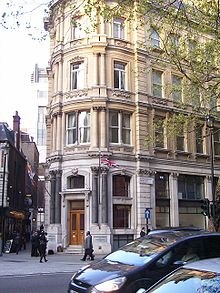
George Charles and Lucy Florence attended parties with the ‘ascendancy’ of Sydney. Note all the Knights of the Garter, the politicians and the gentlemen with ‘esquire’ after their name. (The Esq after the names meant that they were property owners of wealth.)
These articles from the Sydney Morning Herald show George Charles to belong to Sydney Society. In this article of 18th June, 1892 George Charles was a Steward for a ball “in the presence of his Excellency the Governor (of New South Wales) AND the Countess of Jersey…”
A PLAIN AND FANCY DRESS BALL will be hold at the CENTENNIAL HALL,
on WEDNESDAY, 21st JUNE, 1892
Under the Patronage and in the Presence of His Excellency the GOVERNOR andthe COUNTESS OF JERSEY, The Hon. Sir Frederick Darley, K.C.M.G., The Hon. Sir Alfred Stephen, C.B., K.C.M G.,The Hon. Sir William Manning, K.C.M.G., Maj.-General Richardson, C.B., Colonel Roberts. C.M.G., and His Right Worshipful the Mayor of Sydney.
Cards may be had from the following Gentlemen, who have kindly consented to act as Stewards: A. Wigram Allen, Esq, the Hon. W. R. Campbell, M.LC., J. Arthur Dowling, Esq,D. P. Dickson, Esq, Charles Fairfax, Esq, G. Neville Griffiths, Esq, E W. Knox, Esq, Adrian Knox, Esq, the Hon. W. A. Long, M.L.C., P. B. Lark Esq, U. S. Levy, Esq, A. H. Macarthur, Esq, George Miller, Esq, Alfred Nathan Esq, ………….G. Westgarth, Esq,
……………………………………………………………………Tickets, l0 shillings each.
George Charles and Alfred Nathan must also have been in the other two clubs for gentlemen, the Australian Club and the Union Club. In this Society article from the Sydney Morning Herald of 3 Feb 1894, the high society of Sydney are attending that most British of social sports, a cricket match. Miss Westgarth would be Ella, who was twenty-one.
“A cricket match between members of the Australian and Union Clubs was played on Rushcutters Bay, on Tuesday last, and though one frequently hears that everyone is out ofTown, there was a good attendance, the ladies mustering in greater numerical proportion than in the case of the 5000 present at the intercolonial match the day before. The victory of New South Wales was naturally very popular and gave an additional interest to the match between the two local teams. The Australian Club won, but the friendly feeling was manifested with equal fervour to both sides. A marquee was erected for refreshments and afternoon tea was served to the visitors. Those included:Mrs Edward Hutton, Sir Henry Ogle, Mrs. Airey, Mrs and Miss Pilcher, Miss Hack(Adelaide) and Mr Jay, Mrs. A. H. Savage, Mr. and Mrs. A. H. Macarthur, Mrs. Hatchard, Mrs. Hotham, Miss and Mr Robertson, Miss and Mr. Bayley Macarthur, Mrs and Miss Warden Graves, Mrs. A. J. Brady and Miss Campbell, Mrs. and Miss Paul, Mr. and Mrs. George Westgarth and Miss Westgarth, etc etc………and Mr AW Nathan who carried out his bat when his side was defeated.” (abridged version)
11: Furniture for Tresco? Some furnishings still in the family
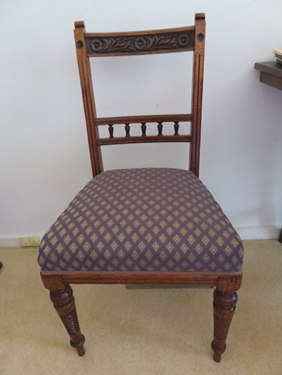
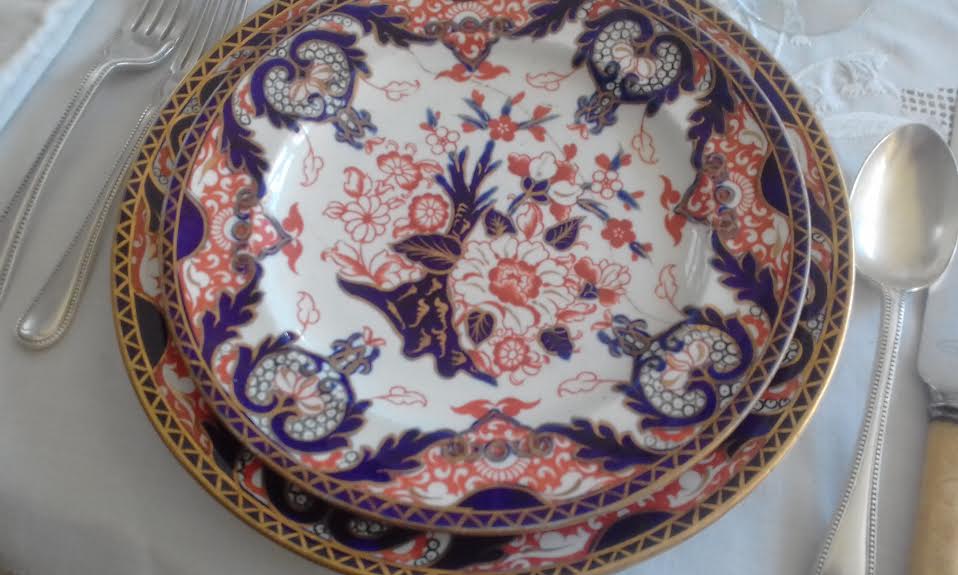
Furnishing a house in a style suitable for a gentleman meant importing furniture from England. George Charles and Lucy Florence most probably arranged to import a cedar dining table which could be extended to seat 12 easily. There were also 12 chairs, a Crown Derby dinner set (earthenware not porcelain) in the fashionable Japanese style and a set of bead pattern cutlery. See the pictures below. The table was sold by my stepmother, Yvonne, in the 1980s.
Here is some information about this fashionable crockery and cutlery, from Wikipedia:
1884 Crown Derby Imari Kings Pattern 10.1″ 25.75cm 19th Century Earthenware Dinner Plate.
‘Imari-yaki ‘is a Western term for a brightly-coloured style of Arita ware: Japanese export porcelain made in the area of Arita, in the former Hizen Province, northwestern Kyūshū. They were exported to Europe in large quantities, especially between the second half of the 17th century and the first half of the 18th century.
The style was so successful that Chinese and European producers began to copy it. Typically Imari ware (in the English use of the term) isdecorated in underglaze blue, with red, gold, black for outlines, and sometimes other colours, added in overglaze. In the most characteristic floral designs most of the surface is coloured, with “a tendency to overdecoration that leads to fussiness”. A lot of porcelain was produced. The earthenware below must have been a cheaper option for everyday use in the middle class…..
Silver plate
After the 1840’s electroplating became a more common method of silverplating metal items. This process was developed by Elkington’s of Birmingham, and it soon replaced Old Sheffield Plate as a manufacturing method in Sheffield.
When we were children there was the most marvellous pot in the house at Char’s place (Dudley’s) at number 7 Vaucluse Road. Here it is, now in the possession of cousin Anthony Woodhill:
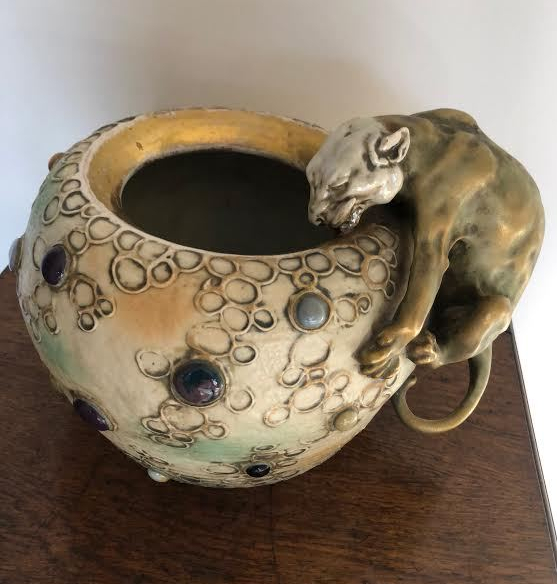
This area of central Europe was close to Dresden, Germany and benefited from the long tradition of ceramics manufacturing among the peoples of eastern Germany. The ceramics Reissner and his 2 partners produced was known for its unique styles and the interesting glazes they used to create what became known as “Amphora” pottery or simply “Teplitz”.
………………………………………………………………………………………………………………………………………….
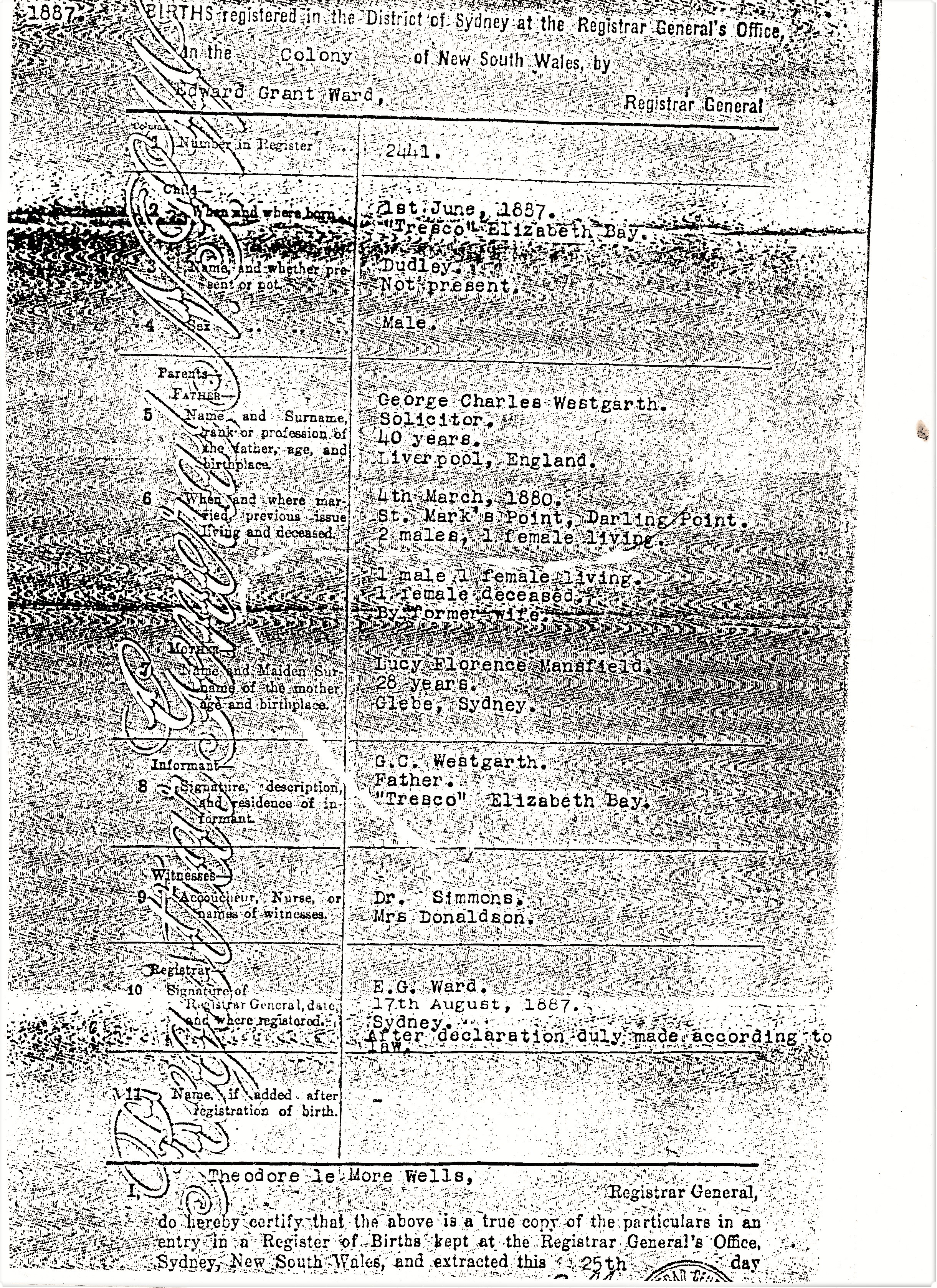
The Westgarths owned Tresco until 1902, according to most accounts, but they rented it out from 1891 and sold it to the Crown in 1902. During the time at Tresco my grandfather Dudley (1887) and his beloved brother Mervyn (1888) were born. A very fly spotted birth certificate!
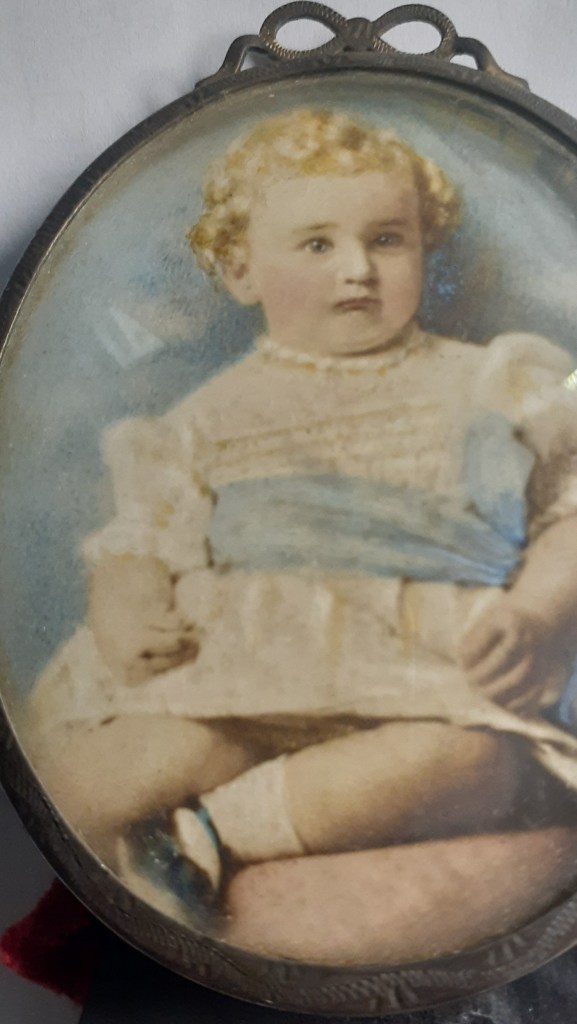
Julie also has this miniature of Dudley Westgarth, at his Christening in a typical costume for little children, with a blue sash. He has his mother’s fair hair and the Mansfield nose.
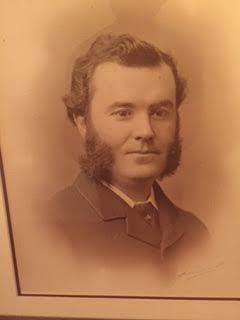
12: Portrait of George Charles
Here is a portrait photograph of George Charles when he was around 45 years old, looking a little careworn. It is now the property of Stephen’s brother, Stuart Westgarth.
13: Death of Florence Sophia’s mother, Kate,
who was Ella and John’s grandmother:
Death notice of Catherine Savery Rodd,
Sydney Morning Herald, 19 November 1884
Rodd – November 19 at her residence, 111 Laskellly Terrace, Macleay Street, Kate, relict of the late John Savery Rodd of Fleurs.
In 1884, Kate Rodd died, at 111 Laskelly Terrace, Macleay Street, King’s Cross. Her solicitor was George Charles, who attended her funeral. According to her deathbed will, signed in a failing hand, her personal fortune was to be divided between her daughter, Constance Josephine and her son, John Tremayne Rodd. It seems that the other three sisters had all died. All the legacies to descendants bequeathed by her husband, John Savery Rodd, were to be continued by the terms of her will. Although she only had an estate of twenty pounds, she had a property in Kings Cross and interest in all the lands owned by her deceased husband. Here is her grave:
Headstone of Kate Savery Rodd, St John’s Ashfield Cemetery, photograph kindly provided by PV COW ancestry.com family tree
‘In affectionate remembrance of Kate, relict of the late John Savery Rodd, who departed this life 19th November 1884 aged 70 years.’
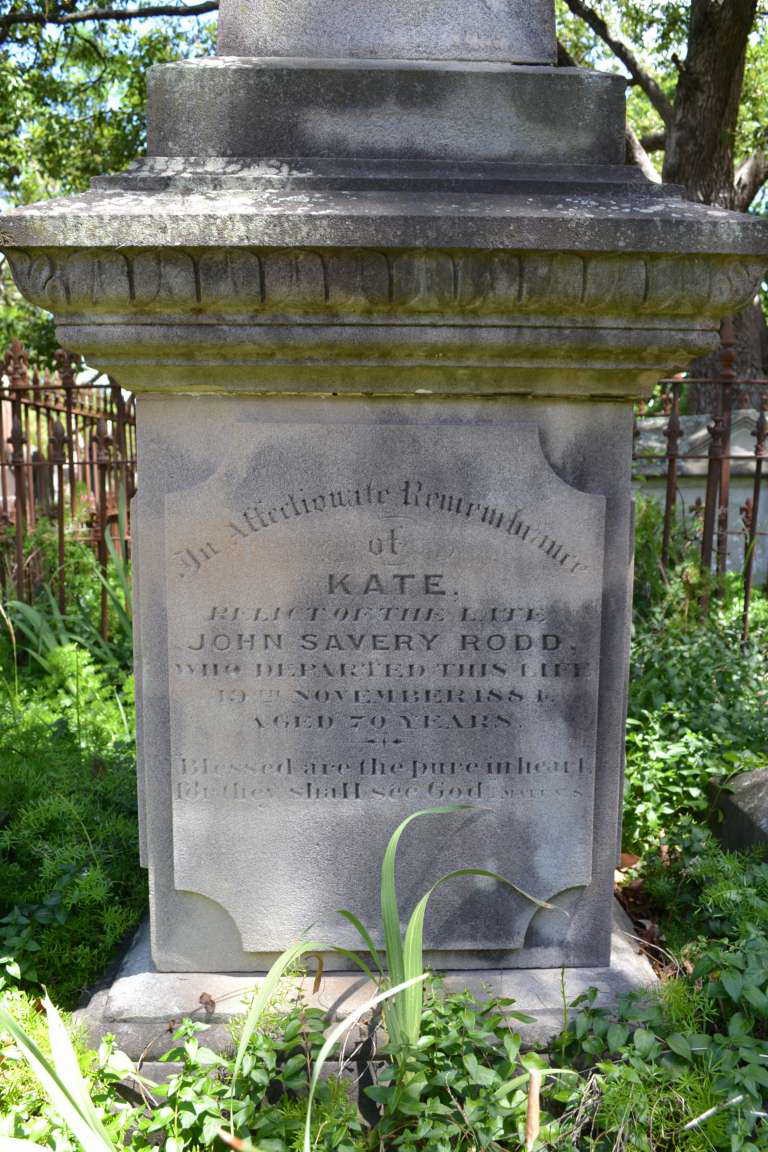
Many thanks to the family history site of the Murray family which has given me so much information about the Rodds and Murrays. It can be found at: http://www.relativesmatter.com/2017/07/20/656/ The Murray Family of Limerick, Ireland
14: More daughters for Lucy Florence:
Violet was born in 1890 in England, where George Charles and Lucy Florence had gone for the wedding of ‘Aunt Vi’, Violet Westgarth, who was about 23 years old when she married Cyril Field. I think the baby was named in her honour – a kind of wedding gift! She was born at 187 Queensgate Mansions, South Kensington, London. The family called her by a nickname ‘Poppy’ instead of Violet!
The last child, Doreen, was born at ‘Budleigh’ Kirribili Point North Sydney on 2nd November 1896. According to letters owned by Judy Westgarth, the family must have moved into St Helen’s (see below) soon after it was built in 1887. They moved out of Tresco and leased it in 1891. He must have had a substantial income from Tresco.
15: Souvenirs of the Trip to England:
Apart from the new baby, Violet, the Westgarths brought back some plaques from Naples. Steamships now travelled through the Suez Canal and passengers could enjoy calling in at Mediterranean ports along the route to England. I suggest the plaques below were bought by George Charles and Lucy Florence in Naples as souvenirs of their voyage. I remember them in the hallway of Dudley’s house, 7 Vaucluse Road, Vaucluse.
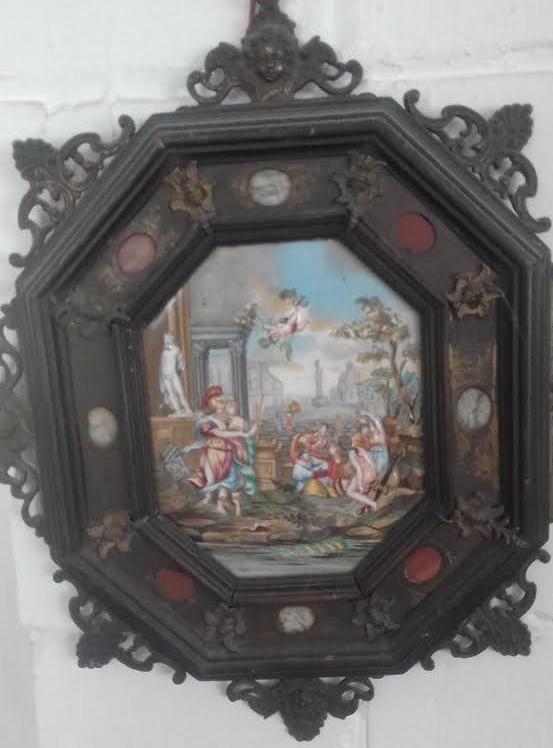
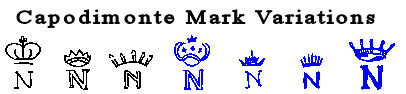
From the pottery mark on the back, I have traced them to the Capodimonte porcelain factory in Naples, Italy. It was established in 1743 and made in direct emulation of Meissen porcelain. The company is most known for its figurines and decorative flowers that were applied to vases and cups.
Following a trend in the later years of the Naples porcelain factory,[19] after it closed, Neapolitan potteries continued to make creamware, fine glazed earthenware, similar to English Wedgwood. During the second half of the 19th century, the first private porcelain factories in Naples were created, eventually including Majello (1867), Mollica, Cacciapuoti, Visconti, and many others. It was at that time that my plaques were made and sold to tourists.
Naples porcelain had the usual mark of a crown over a blue “N”,[17] though this mark has been, and continues to be, used by many imitations of greatly varying quality.[18]
By 1891, when he and Lucy returned from London, they had five growing sons and a total of 8 children. The boys were 14, 10, 9, 4 and 3 years old. The girls were 18, 7, a baby and one yet unborn.
Ella Florence Westgarth, b.6/6/1873,
John Ellesmere Westgarth b.25/3/1877
George Mansfield Westgarth b.3/2/1881
Ronald Nigel Westgarth b.21/2/1882
Gwendoline Mary Allen Westgarth b.1884
Dudley Westgarth b. 1/6/1887
Mervyn Westgarth b. 19/11/1888
Violet Westgarth (known as ‘Poppy”) b.1890 in South Kensington, England
Doreen Westgarth b.2/11/1896 in ‘Budleigh’ Kirribili Point
Contrast the survival rate of their babies with that of William and Elizabeth Westgarth! Good accommodation, good food and a good water supply were all available to wealthy Sydney residents by the 1880s.
17: Why move to Campbelltown? Glen Lorne
In the 1870s the Mansfield family had purchased a country retreat on Appin Road. G.A. Mansfield renovated it in 1879. It was called ‘Glen Lorne’, seen in the 1881 picture below. Photo below thanks to ‘The History Buff’: https://www.google.com/imgres?imgurl=http://3.bp.blogspot.com/
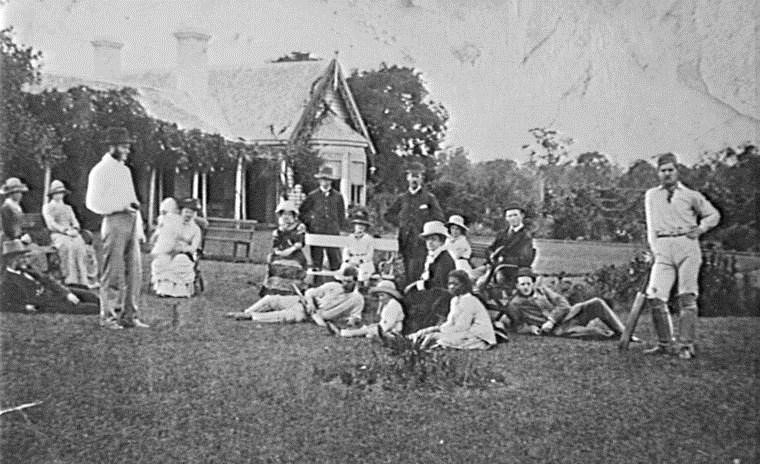
Glen Lorne was George Allen Mansfield’s country residence and 300 acres at Appin. He bought it in 1870, added another 100 acres, renovated it and then moved in, on 9th July 1879. Two earth dams and a stone dam were built for him by his son in law, our great grandfather George Charles. (The house burned down in the 1980s.)
The photograph above is posed, showing all members of the immediate family at their country residence. The subject of the photograph is that iconic British upper class afternoon activity – a cricket match. The older males pose with bat and ball or recline on the ground. Lorne is surrounded by the two young children, her own boys, an aboriginal servant and a married couple. Lucy Florence and Lorne’s daughters are near their father and to the right of them are another couple
Mansfield lived mostly in Glebe, because he married Mary Emma Lucy Allen of Toxteth Park, Glebe, (now St Scholastica’s School) but Emma died in 1861. He married Lorne McDougall in 1863. She had four children, born in 1864, 1865, 1869 and 1870.

From family pictures, Stephen and George Michael Westgarth can be sure that George Charles Westgarth is standing on the left, holding a cricket ball. His father in law, G.A.Mansfield, is reclining on the far left and his second wife, Lorne, called ‘Granny Mansfield’, is sitting next to the aboriginal servant. George Charles’ wife, Lucy Florence, in a white dress, is near George Charles. She is holding her first child, born in that year, George Mansfield Westgarth, who became Stephen and George Michael’s grandfather. The little boy and girl near Lorne would be Ella Florence (8) and John Ellesmere (4). The children of Lorne are in the photo: two girls 17 and 16 near their father and two boys 12 and 11 near their mother. The two young men are the right age to be Lucy Florence’s brothers, one holding the bat and one reclining. They were Allen Cecil, 24 and George Harold, 20 at that time.
There are two middle-aged couples in the background of the photo. The couple on the left, the man standing behind his wife, is probably Augustus James Gore, youngest son of the late Thomas Goodall Gore, of County Mayo, Ireland (but Anglican) with his wife, Kate. We know he is in the photograph. He was a contemporary of George Charles, being born in 1845, but he was a ‘currency kid’ being born in New South Wales, not ‘coming free’ as George Charles had done. As the manager of the Commercial Bank in Campbelltown he was a worthy figure to ask to a party, but not to appear in the foreground of this photo of a Sydney family of money and influence. By the way, Augustus Gore was to die on the job at the Commercial Bank in 1903. Thanks to the Campbelltown and Airds Historical Society for alerting me to Mr and Mrs Gore.
(I haven’t talked about religious prejudice in this blog, but it was still strong when I was a child. Only Protestant religions were acceptable for social and commercial advancement in the colonies of the nineteenth century and in early federated Australia too.)
George Charles acquires a country house at Appin:
In 1886, George Charles followed his father in law and purchased land nearby at Appin, where a home would be built by 1887, designed by his father-in-law, with room for his growing family and horse paddocks for his boys. According to some accounts, the house was a wedding present for George Charles and Lucy Florence.
Life out of town would not have been possible without the development of the railway. About twenty years after the railway arrived, G.A.Mansfield bought Glen Lorne. With the convenience of the railway it was possible to live like a squire and still get to town for business or pleasure.
18: Railways https://en.wikipedia.org/wiki/Rail_transport_in_New_South_Wales
The Sydney Railway Company was the first company to start rail transport in New South Wales, but it encountered many troubles: engineers came and went; real estate required became expensive and difficult to acquire; money, supplies and manpower ran short, partly because of the gold rush. Eventually the property of the Sydney Railway Company was transferred to the government of New South Wales on 3 September 1855. On 26 September 1855 the line from Sydney to Parramatta Junction (near Granville station), with stations at Newtown, Ashfield, Burwood and Homebush, was opened. The Sydney terminal station was on the south side of Devonshire Street, just south of the current Central station. Although the vicinity was sometimes referred to as Redfern, it was not near the current Redfern station. This line is still the core line of the Sydney suburban rail system.
The Sydney Railway Company was the first company to start rail transport in New South Wales, but it encountered many troubles: engineers came and went; real estate required became expensive and difficult to acquire; money, supplies and manpower ran short, partly because of the gold rush. Eventually the property of the Sydney Railway Company was transferred to the government of New South Wales on 3 September 1855. On 26 September 1855 the line from Sydney to Parramatta Junction (near Granville station), with stations at Newtown, Ashfield, Burwood and Homebush, was opened. The Sydney terminal station was on the south side of Devonshire Street, just south of the current Central station. Although the vicinity was sometimes referred to as Redfern, it was not near the current Redfern station. This line is still the core line of the Sydney suburban rail system.
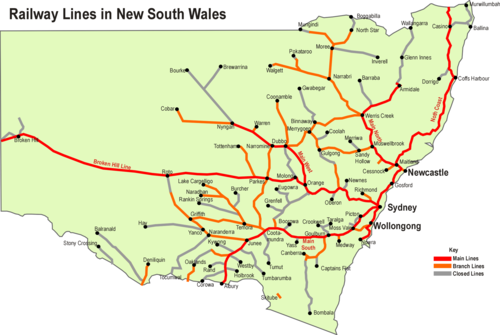
Main Southern line: An extension of the line from Parramatta Junction to Liverpool was opened on the first anniversary of the Sydney–Parramatta line – 26 September 1856. It was extended to Campbelltown in 1858, Picton in 1863, Mittagong in 1867, Marulan in 1868, Goulburn in 1869, Yass Junction in 1876, Binalong in November 1876, Galong, Harden- Murrumburrahand Cootamundra in 1877, Junee in 1878, Wagga Wagga in 1879, Uranquinty, The Rock and Henty in 1880 and Albury in 1881.
Mail Coaches:
Prior to the railway, the mail coaches provided the only means of public transport to Campbelltown. Daily coaches operated to and from Sydney, Liverpool, Campbelltown, Appin, Wollongong, Dapto, Camden, Picton, Berrima, Marulan and Goulburn. Campbelltown was an important stop for the coaches and even after the railway reached Campbelltown coach links were still provided to Camden, Appin and the Illawarra because the Sutherland to Wollongong railway line was not completed until 1887. Ref: CAMPBELLTOWN LOCAL GOVERNMENT AREA HERITAGE REVIEW FOR CAMPBELLTOWN CITY COUNCIL
Local History:
The original inhabitants of the Campbelltown area were mostly people of the Tharawal ( Dharawal) language group, who ranged from the coast to the east, the Georges River in the west, north to Botany Bay and south to Nowra. However Campbelltown was a meeting point with the Dharug language group (whose area extended across the Blue Mountains) and early history of the area includes references to both peoples (Liston, 1988; ).With establishment of the convict colony in Sydney in 1788 the displacement of Aboriginal people began. A smallpox epidemic decimated many of the coastal clans, but was less destructive amongst the inland peoples. Escaped cattle from the convict settlement moved south and bred in the Campbelltown/Camden area and after their discovery in 1795, the area became known as the ‘Cow Pastures’ (or Cowpasture) In 1805 Jon Macarthur obtained a grant of 5000 acres (later expanded to 10,000) in the area, some of the best grazing land then known in the colony. By 1809 34 settlers had received grants in the newly named Minto district (named after Lord Minto, the Governor-General of India) in the northern portion of Campbelltown. Many of these were Irish, including surveyor James Meehan, who allocated himself a generous portion (now Macquarie Fields). Prominent settlers included Charles Throsby, who was allocated 500 acres (now Glenfield), Dr. William Redfern (Campbellfield), Dr.John Townson (Varroville) and Richard Brooks (Denham Court). Though peaceful, the Tharawal people bore the brunt of a punitive expedition led by Captain James Wallis in 1816. At least 14 Tharawal people were massacred at Appin, to the distress of sympathetic settlers such as Throsby of Glenfield. Corroborees and other ceremonies continued under the protection of the Macarthurs of Camden Park, though numbers steadily declined. As the district became more densely settled a town was needed further south than Liverpool. Campbelltown was formally established in 1820 and named in honour of Mrs Elizabeth Macquarie’s maiden name, Campbell. In 1826 the town plan was formalised. Copies of the two deeds of grant dated 8 October 1816, signed by L Macquarie and witnessed by H C Antill and Joseph Cowgill granted respectively 90 acres to Samuel Larkin and 110 acres to John Wild. The 90 acres for a quit rent of two shillings and the 110 acres for three shillings, the Larkin land to be called Ambarvale and the Wild land Egypt Farm. Successive grants and transfers contain the names of Samuel Harding, David Nowland, and William Peaton. Then on 24 April 1886 John Edmund Wild transferred 110 acres to George Charles Westgarth. On 6 May 1886 Westgarth also acquired a further parcel of land from George Henry Graham which included part of the original grant to Samuel Larkin. St Helen’s Park was built in 1887 to the design of architect George Allen Mansfield. It was given to Sydney solicitor, George Westgarth as a wedding present, after he married Mansfield’s daughter, Lucy Florence. The contractor was George Lusted. George Westgarth was the founder of a Sydney-based law firm. Then at an auction of Crown lands on 30 October 1895 George Charles Westgarth purchase the 13 acres described as Portion 296, on which he later built a dam across Spring Creek to ensure the homestead’s water supply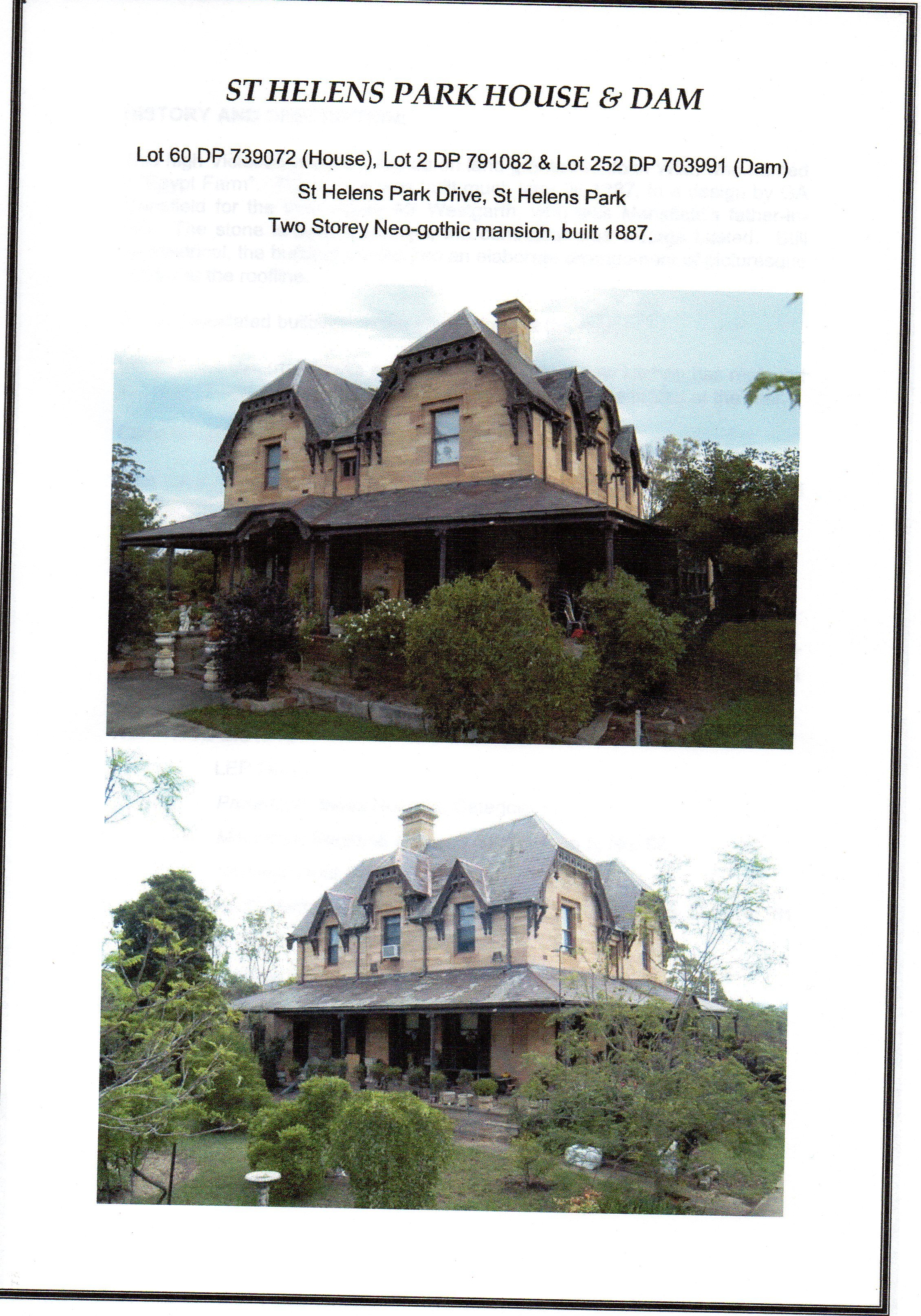
The building is symmetrical, but breaks into an elaborate arrangement of picturesque gables at the roofline. Some associated buildings in the same Menangle stone are at the rear. Internal and external details are intact, except that a new kitchen has replaced the original and a small service wing of one storey situated at the rear. There are seven large marble chimney pieces, each of a different colour. The joinery is of cedar, being unpainted except to skirtings and architraves, with fine built-in cupboards in the bedrooms. A small stone dairy and timber stables of late Victorian design were at come distance from the house. There was also a stone cool room, a carriage shed and a barn. It is a fine example of the High Victorian mansion by a leading practitioner of the period (G.A.Mansfield). It is a highly picturesque building of considerable architectural interest. (From the sale catalogue)
George Charles had his family coat of arms displayed in leadlight above the four panelled front door, in the transom light. It was also repeated on the first floor landing.
Why did George Charles call his country home St Helens? I suspect he may have been trying to recreate the countryside that he remembered as a boy in Lancashire. British immigrants to the colonies brought with them everything they had at home, including trees, horses and even foxes and rabbits. Australia is littered with English place names too.
‘St Helen’s Park House and Dam are listed as a local heritage item in Campbelltown LEP 2002, but only the house and its immediate curtilage is listed on the State Heritage Register (the dam, also known as “Westgarth’s Dam” is referred to in the SHR listing and shown on the plan of the listing, but it is not within the SHR-gazetted curtilage). It is recommended that the NSW Heritage Council be requested to amend the SHR listing to include the dam.’ Reference: CAMPBELLTOWN LOCAL GOVERNMENT AREA HERITAGE REVIEW FOR CAMPBELLTOWN CITY COUNCIL
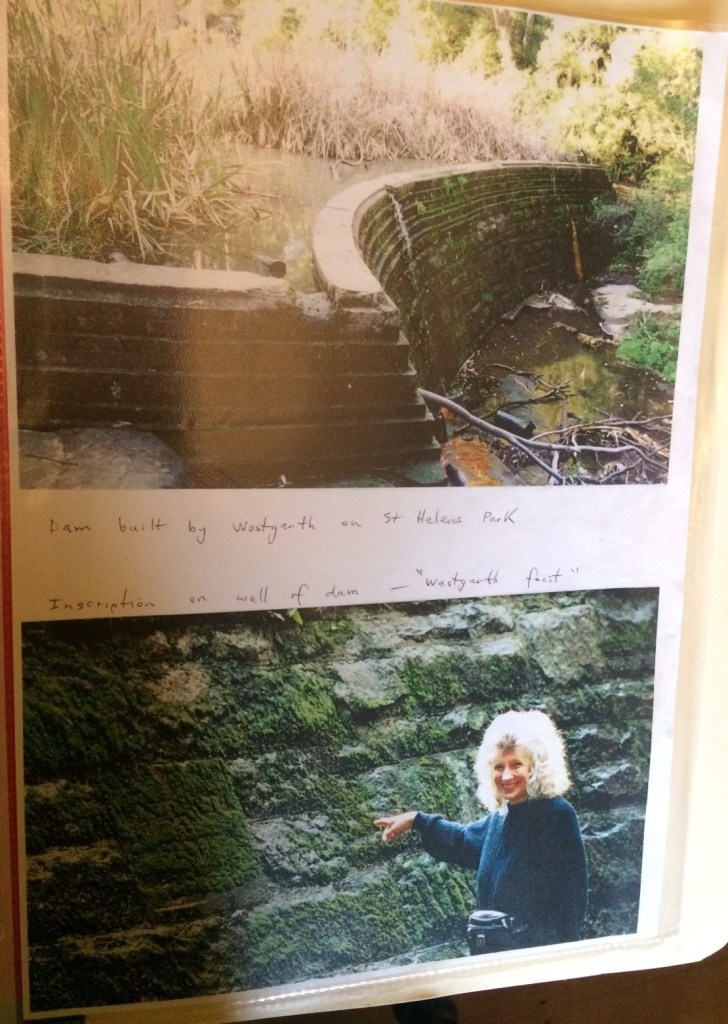
21: Letter from George Mansfield Westgarth, aged 8 and his father’s reply:
From 1887 George Charles had a town house and a country house. The children are at St Helens in the letter below and the parents are in Sydney. The first letter is written in 1889, from George Mansfield Westgarth, to his mother in Sydney and the reply in 1889 is from his father, George Charles.
St Helens, Campbelltown
Wednesday evening (1889)
My dear little mother,
Mrs Gately gave me a dear little parrot yesterday and Eddie Stanfield gave it to Mrs Gately and Spicer made me a dear little bird cage for it. It had a dear little drawer and a dear little handle to pull it out by and a dear little door behind it. I am quite well and very happy. I ride Nigger now and I like him better than Darby and he goes very well.
I hope you are well. I send you my love and Dudley and Aunty Vi and nurse. Good bye my own darling mother XXXXXXXX
Ever your loving son, Georgie
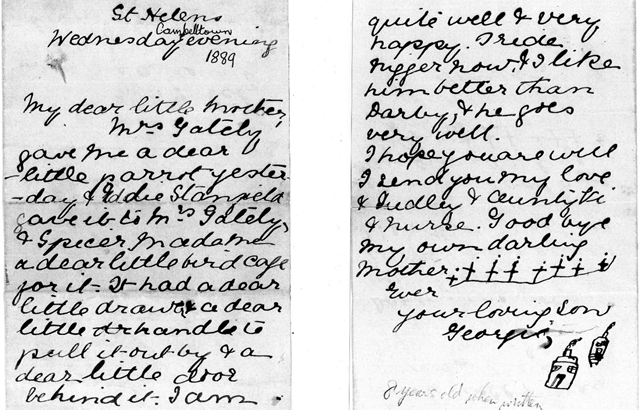
Sydney
16th April 1889
My dear little son,
I was so very pleased to get your little letter this morning. I had no idea my little boy was so clever with his pen. You must be very glad to be able to write. In this way you can make known to your friends far away all that you want – have a chat with me or Jack at school, just like I do with mother every day. I don’t expect you will be able to read this yet and will have to get mother to do it – but if you are attentive to your lessons you will soon be able to read as well as to write letters.
My boys are very good, obedient and manly little fellows and I feel very proud of them and I hope they may grow up to be good honorable men –
Good bye my son –
With much love, your affectionate father,G
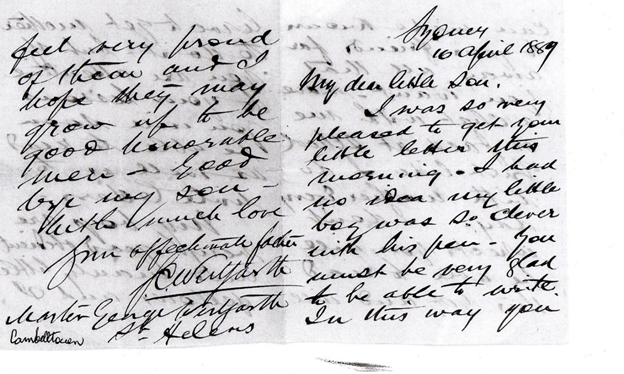
These letters are proof that Aunt Violet was not yet married in 1889, but was living at St Helens instead of in Hobart with her parents. She must have married Cyril Field in England, soon after. This must be the reason that George Charles and Lucy Florence decided on their trip to England in 1890! (They are also proof that the family moved to St Helens when it was built, but kept a home in Sydney.)
Another view of St Helens, with some outbuildings. The family had their own purpose-built billiard room. (My grandfather, Dudley, enjoyed a full size billiard table after he retired). From a publication about the historic buildings in the Campbelltown region, titled Colonial Buildings Macarthur Growth Centre.
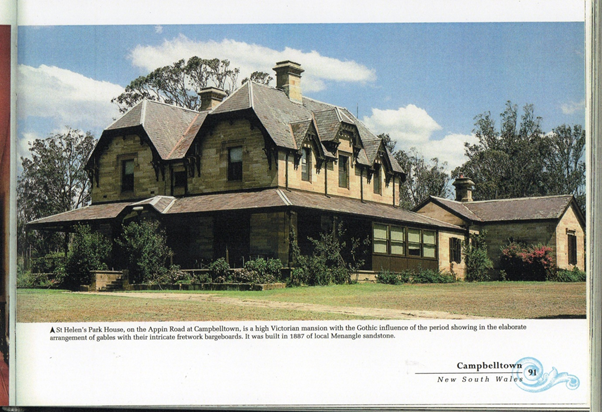
22: Life at St Helens and The Pines:
In 1891, life at St Helens must have been so free for the growing boys of the family. The boys obviously had ponies and spent much time riding and probably shooting in the surrounding bush. John Ellesmere, already 14, went to Sydney Grammar School from St Helens. He would eventually at age 22, join the Bushmen Contingent for the Boer War. Mervyn, only 3 when taken to Appin, was “the best Light Horseman in the First World War” according to Dudley, who was only a year older. In any case, by 1894 it was time for them to go to high school in town. St Helens was rented out.
George Westgarth sent me an To Let advertisement for St Helens dated 25th April 1894.
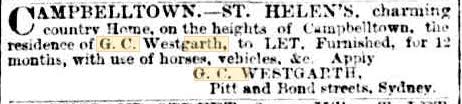
23: Christmas Card with George, Ronald and Dudley
Stephen also sent this faded Christmas card of George Charles and some of his boys, taken at Fairy Bower, Manly in 1894, on the Prince of Wales’ Birthday. (The Prince of Wales was Prince Albert, the eldest son of Queen Victoria, who reigned until 1901, when Albert became King Edward VII.) George Mansfield is second from left, Ronald on the left and Dudley on the right of the photograph. The family was renting at Kirribilli Point from that time, as George and Ronald were ready for school.
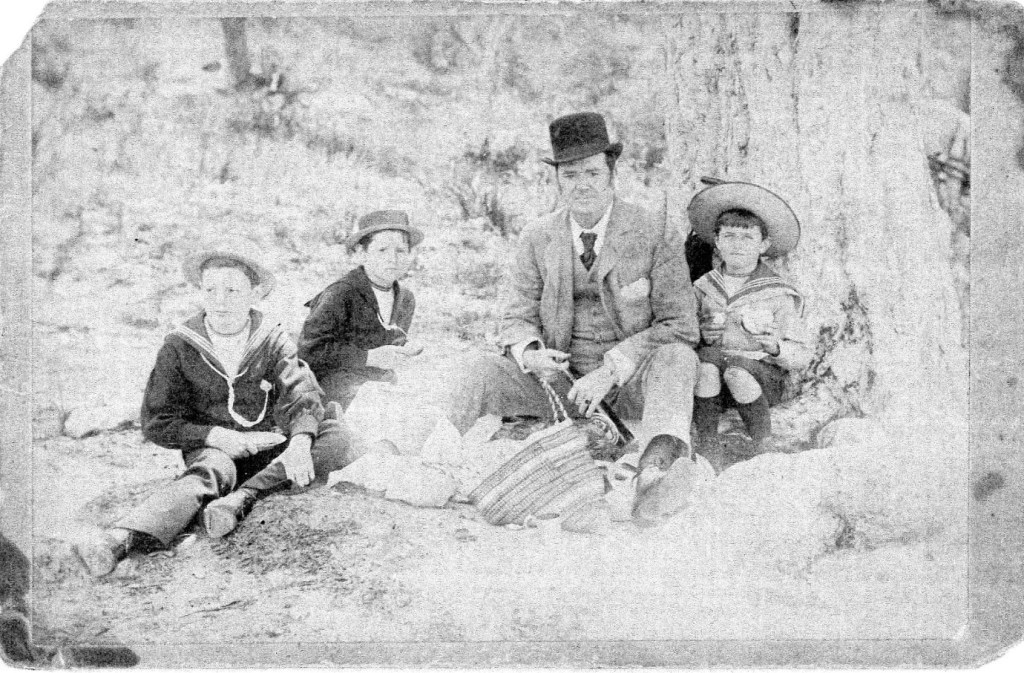
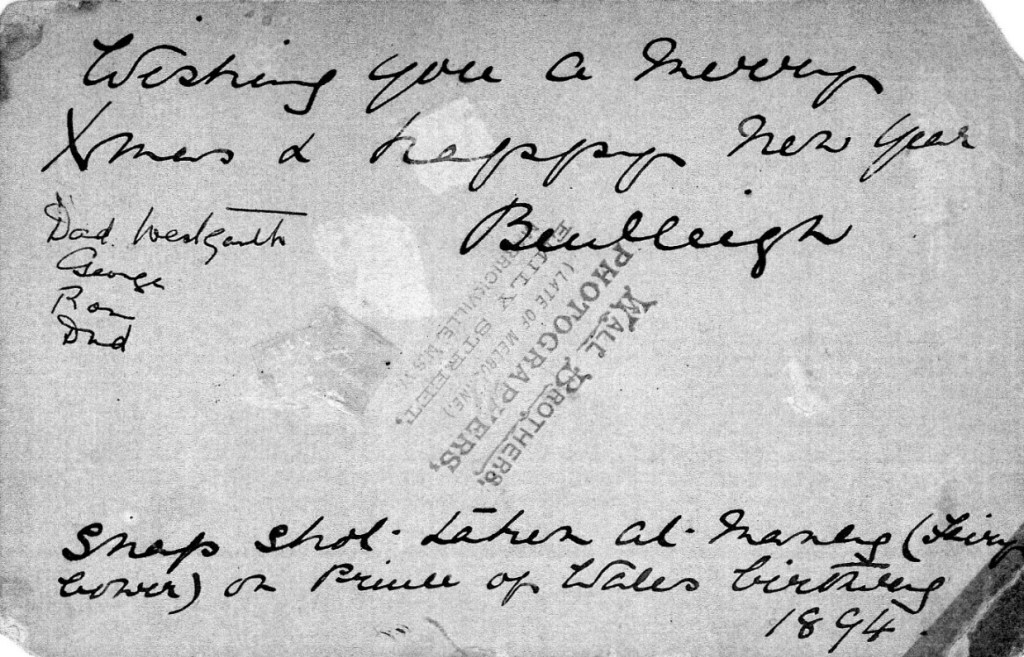
Firstly, they lived at Kirribilli Point North Sydney and George and Ronald went to Shore (North Shore Grammar School. Then, from 1897 they were definitely using The Pines as their city residence and all Lucy’s four boys attended Sydney Grammar School.
VOL01 308 3837 WESTGARTH JOHN (14) G C WESTGARTH, JAN 1891- SEP 1894 ST HELENS CAMPBELLTOWN
VOL01 374 4819 WESTGARTH GEORGE MANSFIELD (16 ) G C WESTGARTH, JUL 1897- DEC 1897,
THE PINES, AVOCA ST, RANDWICK
VOL01 374 4820 WESTGARTH RONALD (15) G C WESTGARTH, JUL 1897- DEC 1898, THE PINES, AVOCA ST, RANDWICK
VOL01 380 4916 WESTGARTH DUDLEY (10), G C WESTGARTH, BOND ST, FEB 1898
VOL01 405 5295 WESTGARTH MERVYN (11) G C WESTGARTH, JAN 1900 THE PINES AVOCA ST RANDWICK
For the boys as they grew to high school age, also, for the legal practice and social engagements, a house in town was much more convenient, even essential.
In 1896, Doreen, the baby, was born.
Here is the notice from the Sydney Morning Herald:

Then, from 1897, the family residence in town was ‘The Pines’ in Avoca Street, Randwick. Bond Street was the address of Westgarth, Nathan and Co. from 1894.
The Pines was in fashionable Avoca Street, Randwick.
The house has been pulled down and, in the article below, only the fence remains! George Charles must have given up the house around 1905 when Mervyn went to Agricultural College and returned to St Helens.
George Charles was at that time in poor health with an incurable rash. He and Lucy Florence went to London to find a cure for it at the end of 1905.
Thanks to the Randwick and District Historical Society for their help in finding this house and the following article. There were two houses of that era called ‘The Pines’ in Randwick!
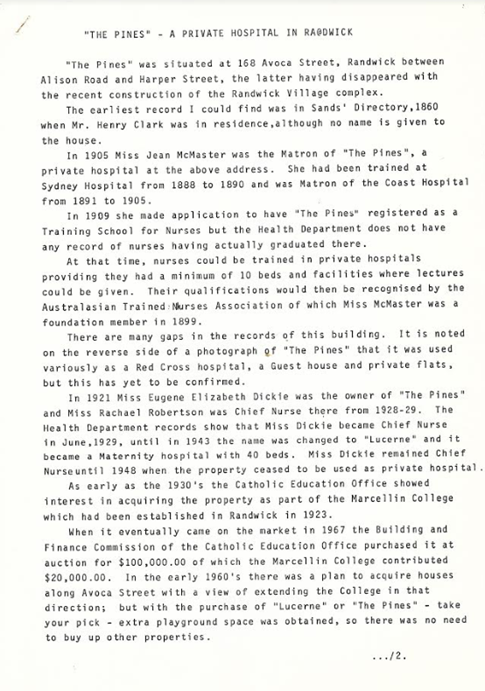
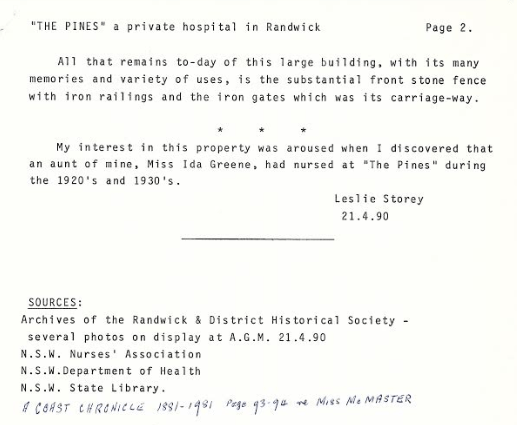
Ella was already 18 when the family moved into St Helens. She may have spent more time in town. Wealthy girls ‘came out’ at age 21 or earlier and she would have gone to many social occasions. She was 21 in 1894. Then, at age 26, in 1899, she married Walter Bethel Wickham, in Randwick, at St Jude’s Church and afterwards at The Pines.
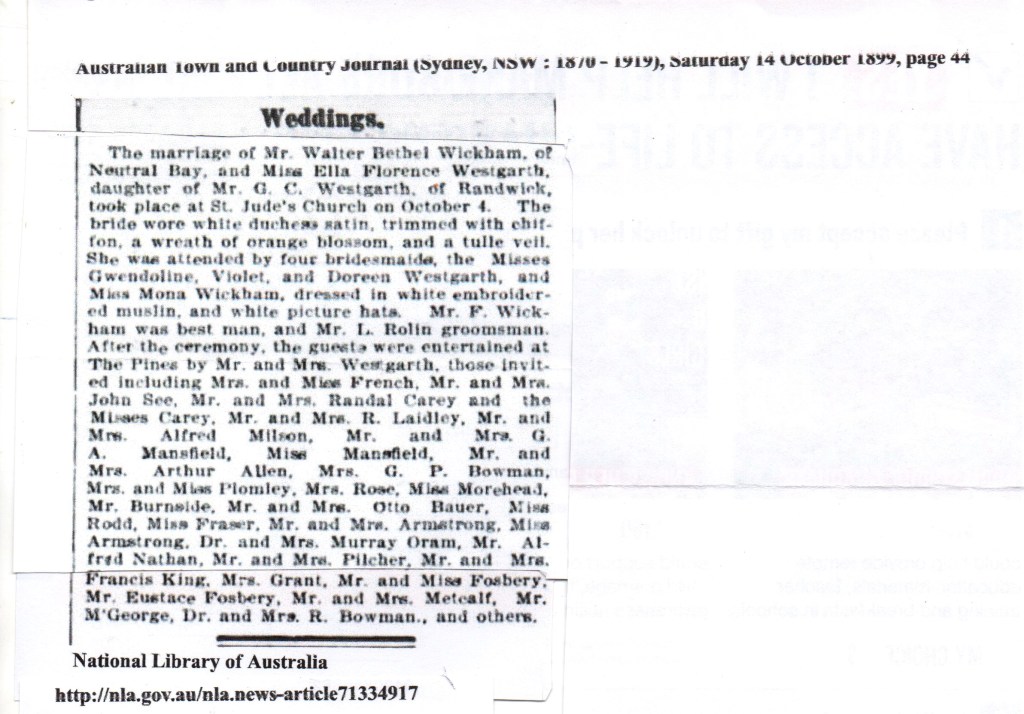
In 1899, the other girls, Gwendoline and Violet were 15 and 9 years old and Doreen was only 3 years old. She must have looked very sweet in a picture hat. Some of the guests were family, such as the Mansfields and Miss Rodd and Alfred Nathan was George Charles’ partner in the legal firm.
24: Family connections:
The 1890s were good to George Charles. His career prospered with his partnerships, especially with Alfred Nathan. There were many social occasions as indicated above. The Westgarths were connected by marriage to prominent families. They had many cousins in Sydney: the seven children of Elizabeth Ann, three children of Edith Isabel and four children of Florence Maude. There would have been Rodd and Mansfield cousins as well, living close by in Sydney, or on country estates. Just as Florence Sophia had been financially supported by the Rodds, Lucy Florence was supported by the Allens.
Deaths of Elizabeth and William
In the midst of his success, sadness came. George Charles’ mother died in Hobart in 1892. His father, William, a confirmed alcoholic, returned to Sydney in 1895 with his daughter, Marion, lodging in the Glebe, on the Allen estate, with his daughter Edith, her sick husband and three daughters. His house, which he must have built, was called ‘Westella’ after the house in Hobart. Finally, William Westgarth died of oedema of the lungs on 5th February 1899. Unlike John Savery Rodd, William would not have had much to bequeath to his many children and grandchildren, but Westella was sold, so that perhaps would have covered his debts. It would be necessary to get his estate papers to find out his final situation.
25: 1900 and Federation in 1901
By 1900 the Westgarth children were approximately 27, 23, 19, 18, 16,13, 12, 10 and 4 years old! The two children of Florence Sophia had left home. Ella had married and, on 28th February, John, equipping himself with funds from the legacy of his mother, had left for South Africa as First Lieutenant of the New South Wales Citizens Bushmen Contingent for the Boer War.
Some of the Bushmen’s Officers (Continued from page 389 )
LIEUTENANT J. E. WESTGARTH.
Lieutenant John Ellesmere Westgarth is the eldest son of Mr. G. C. Westgarth, a well-known solicitor. He was born at Sydney in 1877, and educated at the Sydney Grammar School. After serving three years under articles to his father, he last year joined the R. A. A. (Royal Australian Artillery) as a subaltern. He is a first-class rider, and athletics, pedestrianism, cricket, and tennis have been his favourite pastimes.
George Charles still had many responsibilities towards the children of his second marriage, none of whom had yet reached adulthood of 21 years.
Australians!
In 1900 all the citizens of the colonial states of Australia had to vote in a Referendum to decide whether or not to become one country, called Australia, under a Federal system, in which some powers stayed with states, but some powers for the whole continent were taken by a Federal Government. All states voted YES. Thus in January1901, the Westgarth children, all born in the colony of New South Wales as British citizens, now had dual citizenship and became Australians
Also in January1901, Queen Victoria died after 64 years on the throne. The Edwardian era began. “Sandwiched between the great achievements of the Victorian age and the global catastrophe of World War I, the Edwardian era heralded a new century of significant inventions and social changes, including powered flight, the rise of the motorcar and a new federated Australia.” https://sydneylivingmuseums.com.au/stories/edwardian-summer-sydney-through-lens-arthur-wigram-allen.
Sydney lawyer and identity Arthur Wigram Allen, a tirelessly enthusiastic photographer, was fascinated by the social and technological changes occurring during his lifetime. His talent for amateur photography produced extraordinary pictures that offer a fresh insight into the Edwardian years in Sydney. https://sydneylivingmuseums.com.au/stories/edwardian-summer-sydney-through-lens-arthur-wigram-allen ( He was a nephew of Lucy Florence)
26: 1902 Sale of Tresco:
Tresco was a leasehold property, although it had been privately sold to the Westgarths in 1880. The Crown bought it back in 1902. They must have wanted it for the Admiralty. I hope they gave him a fair price.
“Westgarth was to reside at Tresco until 1891, after which time the house was let to various tenants. In 1902 the leasehold was conveyed to The Crown, and management of the property assigned to the NSW and Commonwealth governments. The house was provided to the Admiralty as the official residence of the Captain-in-Charge of H.M.A Navel Establishment in Sydney. In 1913 the leasehold was transferred to The Commonwealth of Australia, however it was not until 1922 that the freehold was also acquired. “https://www.environment.nsw.gov.au/heritageapp/ViewHeritageItemDetails.aspx?ID=5045193
27: George Charles’ health deteriorates:
I remember my grandfather telling me about his father’s rash. For a long time I decided I must have made it up, but the evidence is there. Everything he told me has been verified as I work through the years. I think he said George Charles fell running for the train. The Bulletin reports a tram smash.
This article is from the Bulletin, the popular Australian magazine of the 19th and early 20th century. They have dramatised the story and made poor George Charles suffering from nightmares instead of an incurable rash!
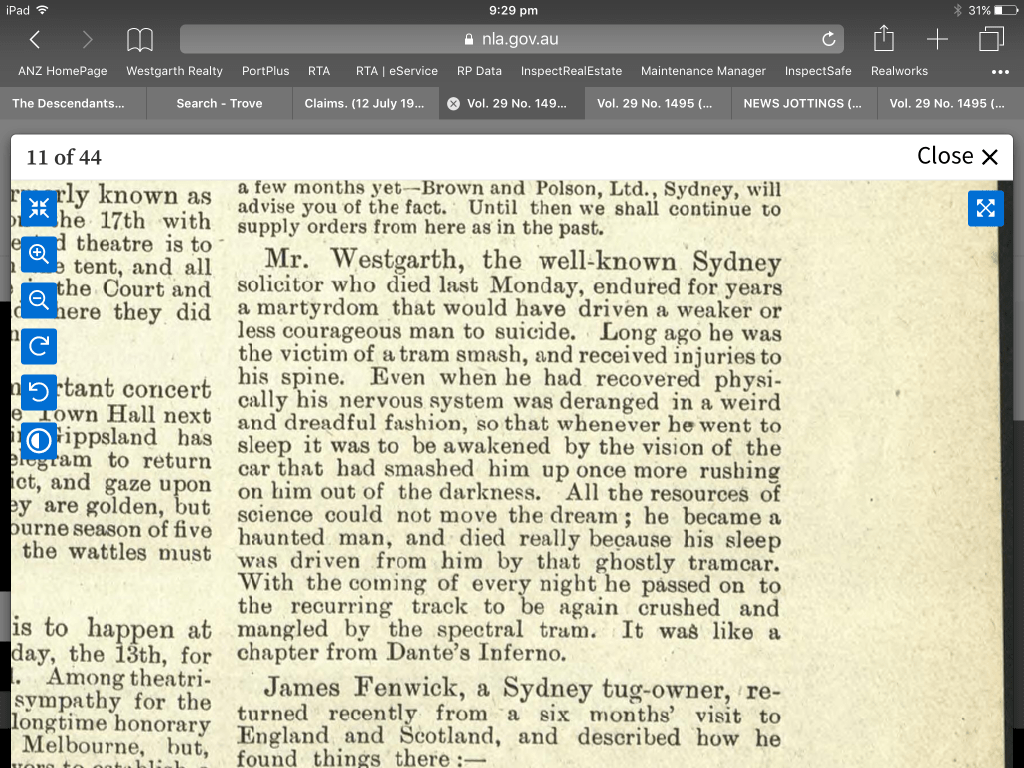
Here is another older portrait of George Charles, where he looks to be about 50 years old (property of Stuart Westgarth).
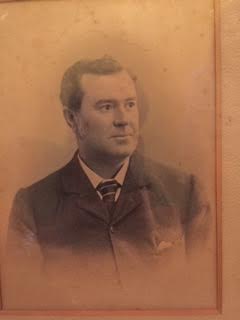
By 1904, George Charles must have been suffering from the rash and finding no cure, because in 1905, he consulted the medicos in London.
The real reason (told to me by George Michael) that he and Lucy Florence went to London at that time was that George Charles was the Respondent in an Appeal being heard in the Privy Council. This was a case in which Westgarth Nathan and Co were being sued. They won the case, but it was the subject of appeal.
Moving house again
The family left Randwick at this time. Probably they took possession of St Helens, which had been rented, but they also rented Fig Tree House, which would be important for Lucy Florence later on.
28: Letters and portraits to and from London
George Mansfield Westgarth or his wife Katrine, preserved these letters from 1906, which well describe the difficult circumstances his parents found themselves in as they pursued a cure which was beyond the ability of medicine at that time. The letters are written to George Mansfield’s fiancée, Katrine Robertson who was actually related to the Rodds!.
18 January 1906
My Dear Katrine,
It was pleasing dear to receive your letter. Of course I intended that you should have your photo taken with the others to send to us. What I complain of is the delay in receiving them. We have been getting them in instalments but neither yours, George’s, Ron’s or Dor’s have come to hand. Gwen’s we think very good but the others are too small and scarcely do justice. I hope yours will be nice, it can’t fail to be pretty –
You will no doubt have heard all news of us from Mrs Westgarth’s home letters. I have not yet written – indeed this is only the second letter I have so far written to Sydney – the other being one to Mr Nathan. I appeared before the Medical School of London last week for exhibition and seemed to cause much interest and perplexity. There were about 25 medicos present including most of the best men in London. They have pronounced my case one of the rarest and whether I can be cured or not seems problematical. They have all opined that it is not a case of either eczema or gout for which I was so long treated in Sydney. They say it is in no way constitutional but simply a local skin trouble probably brought on from a severe chill. I am to all appearances much the same as when I left – probably a little better – but I could scarcely expect much from the short time I have been under treatment here.
We had a beautiful passage out and I am longing for the return trip which will take me back to sunshine and warmth and to those most dear to me. I was very pleased to hear that George was successful in his exam. I hope he will prepare himself well for his final and get through that with equal success.
You are all very much in our thoughts as no doubt we are in yours – with best love and hoping to find you all well and happy on our return.
Yours affectionately
G.C.Westgarth
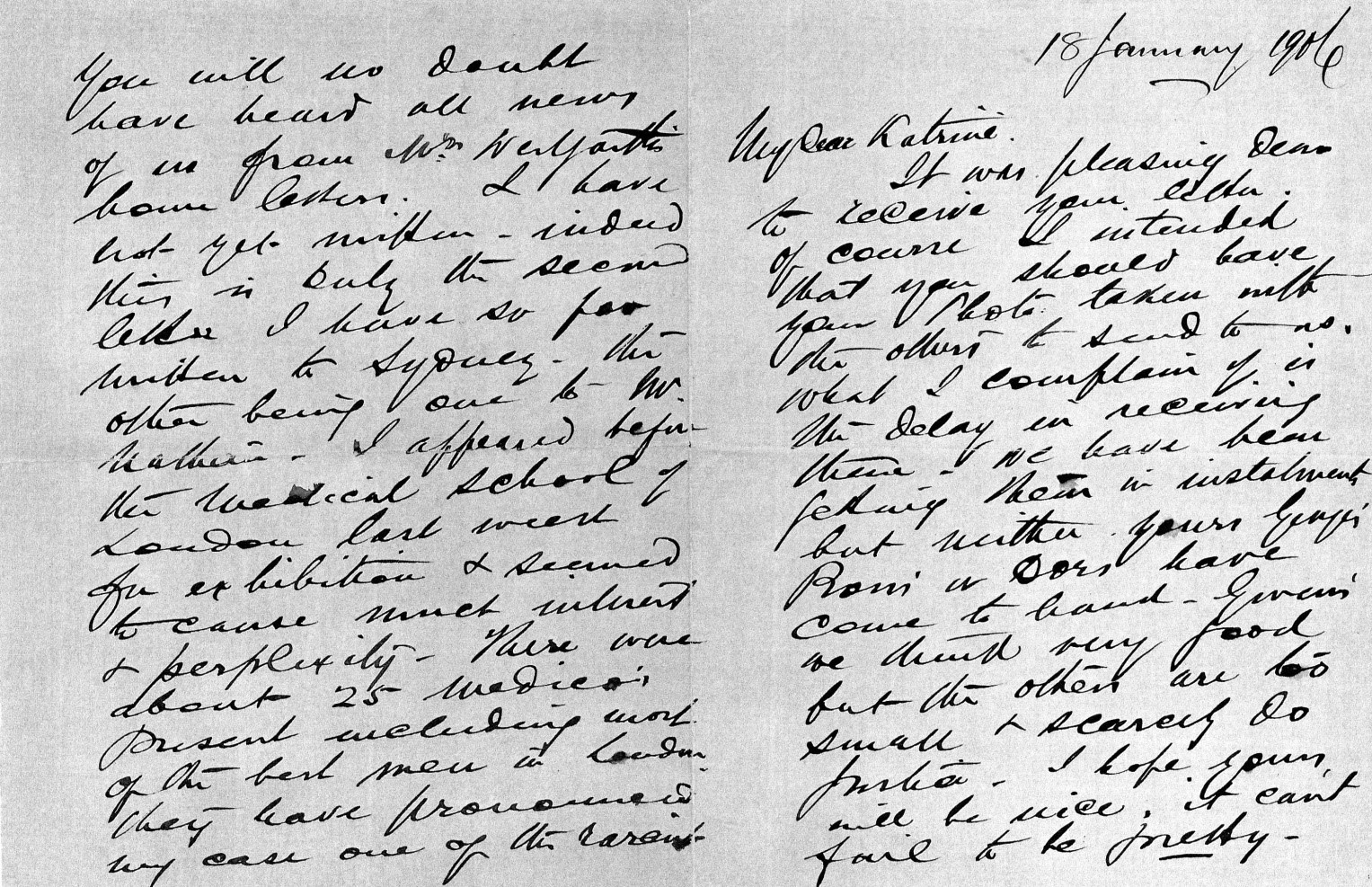
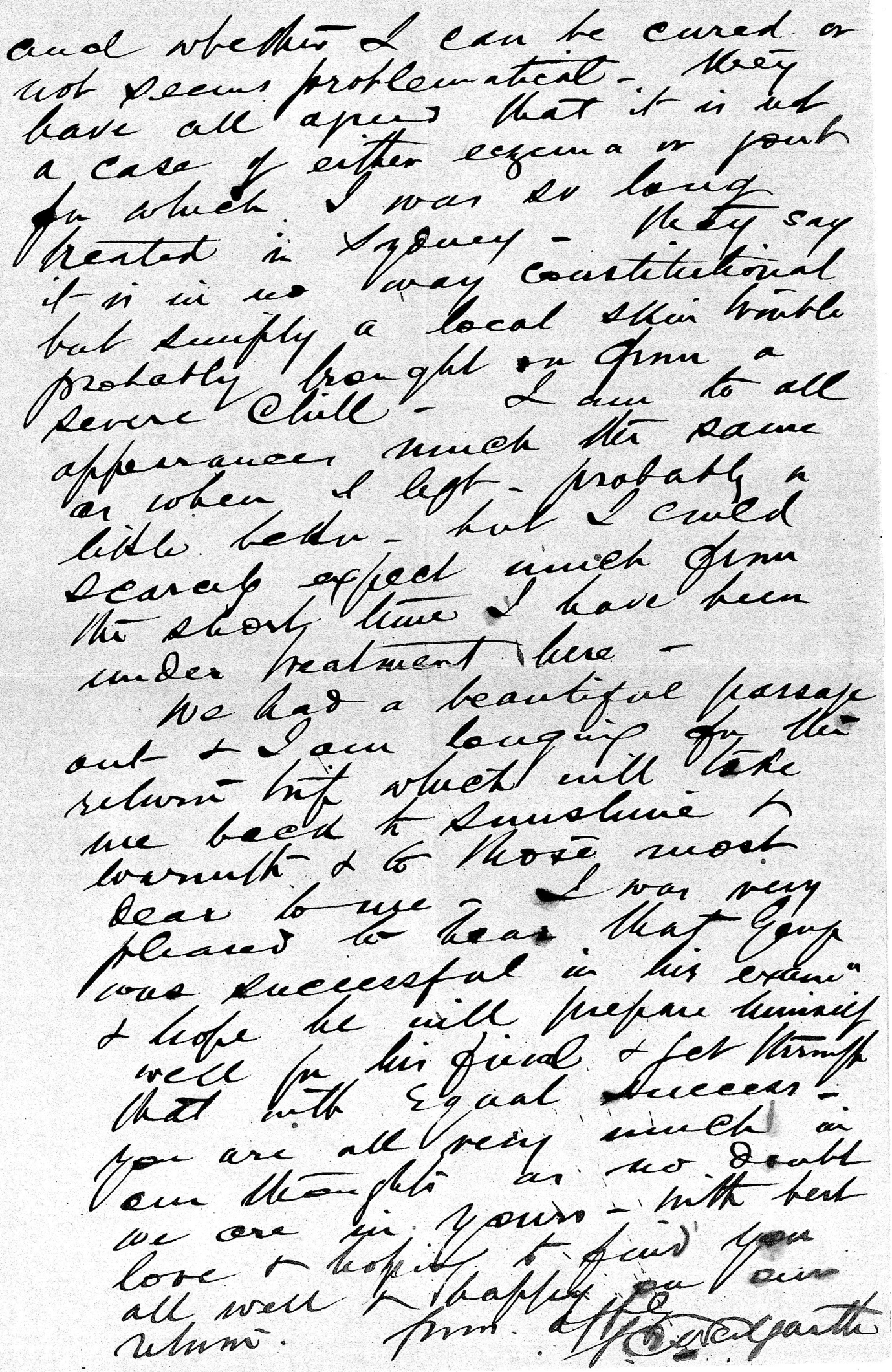
Lucy Florence was always well dressed. In a scrapbook donated to the Campbelltown Historical Society by the descendants of A. J. Gore the bank manager, comes this description of the outfit worn by Lucy Florence to a Campbelltown event:
‘Mrs G Westgarth wore a fawn cashmere dress faced with violet velvet and a fawn velvet bonnet with bunches of violets.’ (Cashmere is the finest wool cloth spun from the hair of Cashmere goats, originally from Kashmir. Velvet at that time was always made of silk and was very hard to keep in good condition.
Here is Lucy Florence’s reply to Katrine, who had sent her portrait photograph, with a lot about clothes!
Peru Hotel
Woburn Place
Russell Square
Monday, January 22nd 1906
My sweet Pretty Puss, (Mrs Potter knows the Geddeses and is going to write to her about me!) Your dear little face has just come by post. Also your nice long letter. I was delighted to get them. The photos are darlings, I am so proud of you girlie! My son’s sweet fiancée! (I’m not sure that it has two ‘e’s) ….
I sent you a lot of messages about fashions in my last letter home – I will not forget the glory box dear. – I wish old Nathan would send us some money, we are pretty hard pushed, be as careful as we will. – I have ridiculously cheap rooms, only £3.13 per week for two of us including all meals, but washing and fires mount it up – It is very cold this evening – feels like snow coming.
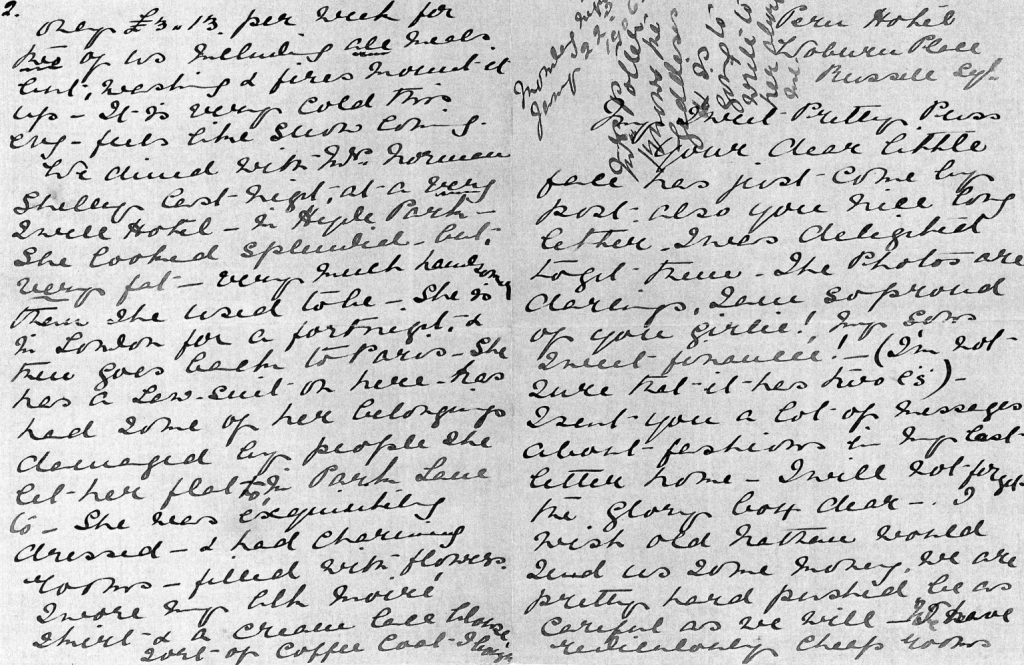
We dined with Mrs Norman Shelley last night, at a very swell hotel – in Hyde Park. – She looked splendid, but very fat – very much handsomer than she used to be – She is in London for a fortnight and then goes back to Paris. She has a law-suit on here – has had some of her belongings damaged by people she let her flat to in Park Lane too. She was exquisitely dressed – and had charming rooms filled with flowers. I wore my black moire skirt and a cream lace blouse, sort of coffee coat – I bought it at a sale reduced to 22/6. It’s a sweet dainty little garment and has sort of pinky amethyst ribbons on it. Looks sweet with my amethyst earrings etc.
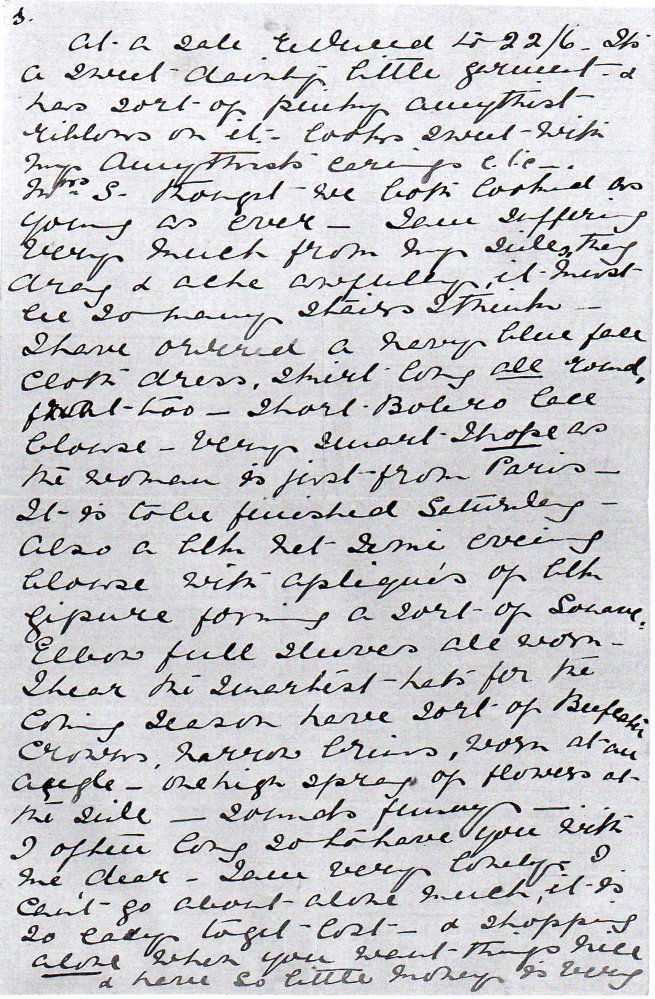
Mrs S thought we both looked as young as ever – I am suffering very much from my sides. They drag and ache awfully. It must be so many stairs I think – I have ordered a navy blue face (?) cloth dress, skirt long all round, front too – short bolero lace blouse – very smart I hope, as the woman is just from Paris. – It is to be finished Saturday – also a black net semi evening blouse with appliques of black guipure forming a sort of souave. Elbow full sleeves all worn – I hear the smartest hats for the coming season have sort of Beefeater crowns, narrow brims, worn at an angle – one high spray of flowers at the side – sounds funny. I often long so to have you with me dear – I am very lonely. I can’t go about alone much, it is so easy to get lost – and shopping alone when you want things nice and have so little money is very miserable work – and a man is only a nuisance -. The poor dear does his best and is very patient, but it worries me to have him hanging round – I have not bought a hat at all. We are to dine with Potters tomorrow night at Croydon and with Dolly again on Thursday and bridge afterwards – I shall not play… I will add more later.
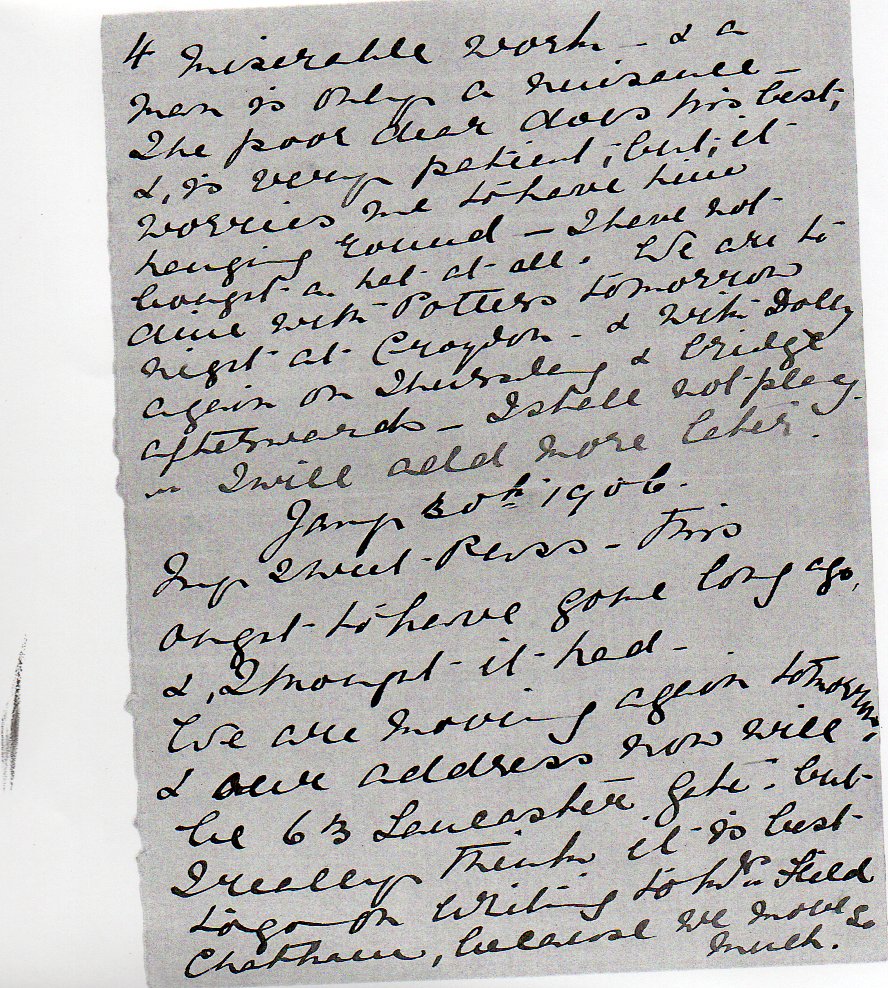
January 30th 1906: My sweet Puss – This ought to have gone long ago and I thought it had. We are moving again tomorrow and our address now will be 63 Lancashire Gate – but I really think it is best going on writing to Mrs Field Chatham, because we move so much.
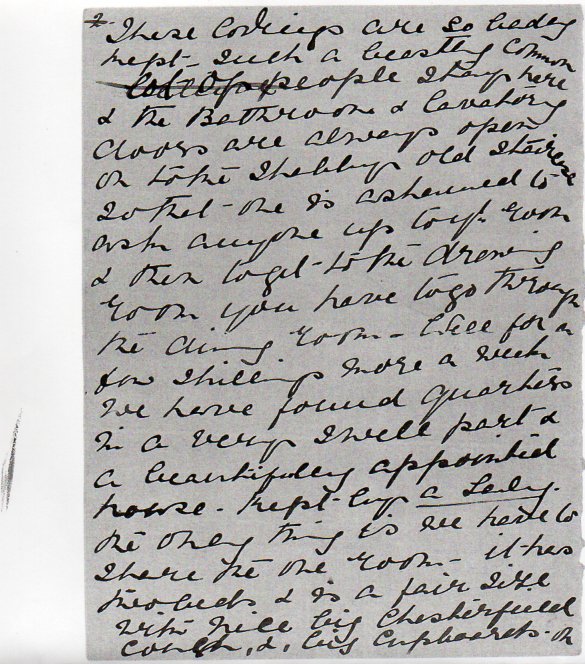
These lodgings are so badly kept – such a beastly common lot of people stay here and the Bathroom and lavatory doors are always open on to the shabby old staircase so that one is ashamed to ask anyone up to your room. And then to get to the drawing room you have to go through the dining room – Well for a few shillings more a week we have found quarters in a very swell part and a beautifully appointed house kept by a Lady. The only thing is we have to share the one room – it has two beds and is a fair size with nice big chesterfield couch and big cupboards – a third storey though and no lift. We have dined with the Potters and twice with Mrs Norman Shelley – exquisite dinner. I hardly know what the things were they were so beautifully got up. Baskets made of spun sugar to hold the sweets and decorated with a spray of pink roses and green leaves, all of sugar too and looking as if you had picked it out of the garden – The ice souffle was exquisite looking a dream – ice inside and hot outside!
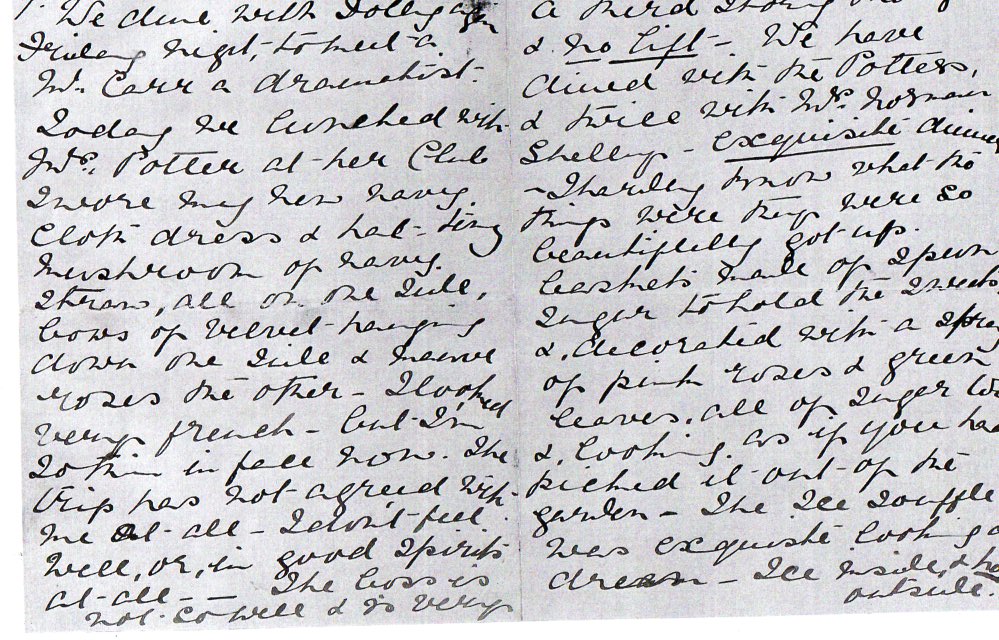
We dine with Dolly again Friday night, to meet a Mr Carr, a dramatist. Today we lunched with Mrs Potter at her Club. I wore my new navy cloth dress and hat with tiny mushrooms of navy straw, all on one side, bows of velvet hanging down one side and mauve roses the other – I looked very French – but I’m so thin in face now. The trip has not agreed with me at all – I don’t feel well, or, in good spirits at all – The boss is not so well and so very depressed, these London men are frauds only using the same old remedies .
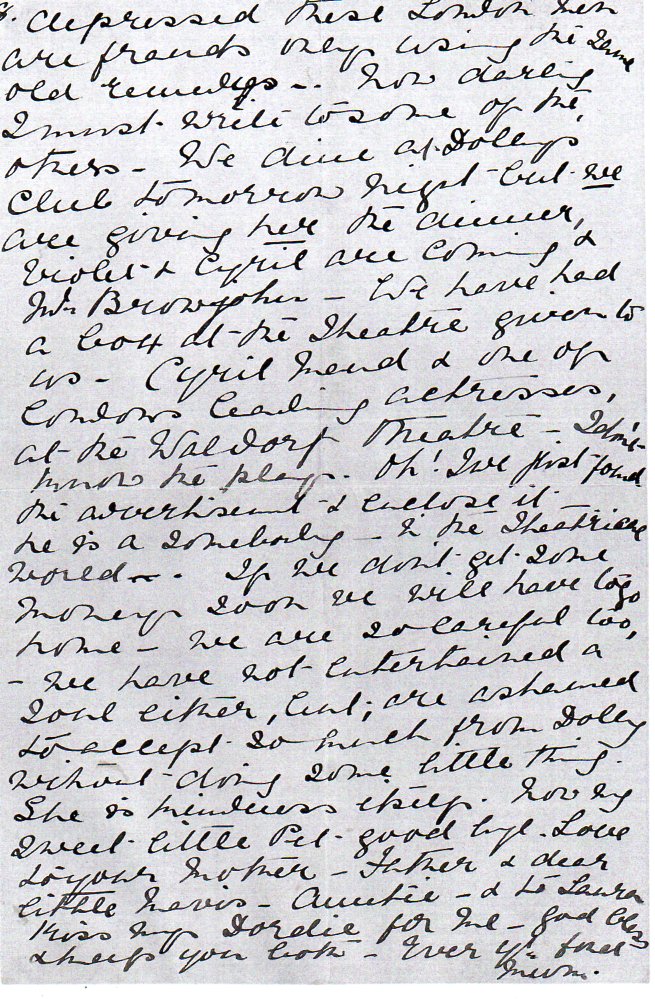
Now darling I must write to some of the others – We dine at Dolly’s club tomorrow night but we are giving her the dinner, Violet and Cyril are coming and Mr Browjohn(?) – We have had a box at the theatre given to us – Cyril …………… and one of London’s leading actresses, at the Waldorf Theatre – I don’t know the play. Oh! I’ve just found the advertisement and enclose it – he is a somebody in the theatrical world -. If we don’t get some money soon we will have to go home – we are so careful too, – we have not entertained a soul either, but are ashamed to accept so much from Dolly without doing some little thing. She is kindness itself.
Now my sweet little Pet – good bye. Love to your mother, father and dear little Mavis, – Auntie and to Laura. Kiss my Dordie for me – God bless and keep you both –
Ever your fond
Mum
Dolly and Mrs Potter seem to be good friends who are supporting the Westgarths in their predicament. Mrs Norman Shelley is Australian, her husband is a colleague of George Charles. He is obviously very rich and is related to them by marriage through Lucy Shelley, the mother of George Allen Mansfield.
29: Portraits of George Mansfield Westgarth and his fiancée Katrine Robertson, sent to London
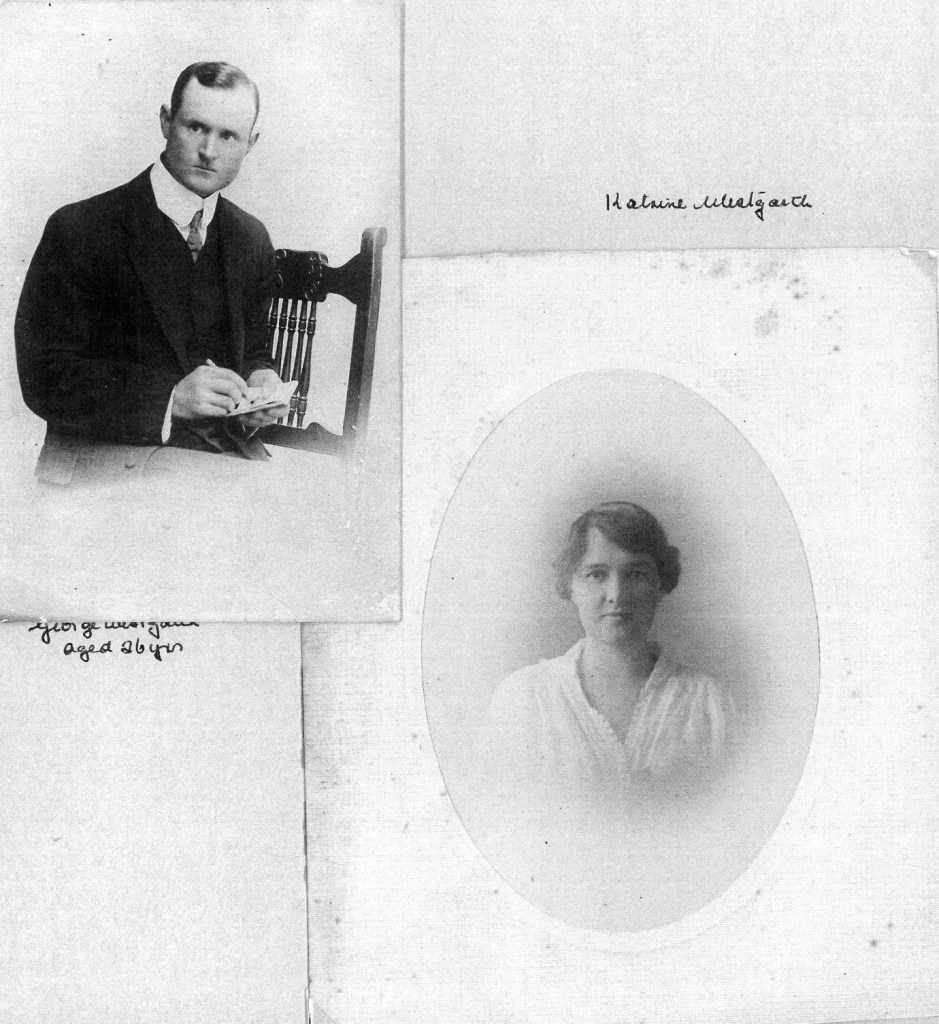
30: Return to Australia without a cure
George Charles and Lucy Florence must have returned to Sydney in 1906. George Charles, no longer a fit man, began to borrow money wherever he could. Tragically, Lucy Florence must have been incubating tuberculosis after living in such cold and damp accommodation
According to the Estate papers kept by the NSW State Archives, George Charles borrowed from his Life Assurance Policies, of which he had six, from the Bank of Australasia, from Allen, Allen and Hemsley, from Minter Simpson and Co, from his sister, Elizabeth Ann Lloyd, from his daughter Ella, from John, George Mansfield and Ronald. What a sad time for a man who was so successful and enjoying life so much.
Everyone seems to have helped. John, his eldest son, retired from the Royal Field Artillery to come and help his father. Here is the record in his own words: ‘ I joined the 90th Battery R.F.A. and returned to South Africa. We then had the 18 q.f. guns and after four years training with these guns I was given leave to Australia and owing to Family affairs I had to retire in April 1908.’
31: 1908 Death of George Charles
As well as a rash affecting the skin, which is the largest organ of the body, George Charles must have had a general breakdown of health. In the last year of his life, 1908, although he was still trying to work, he had bronchitis for six months according to his death certificate! Then, in half an hour, his larynx became obstructed and he died at home at St Helens on October 5th 1908.
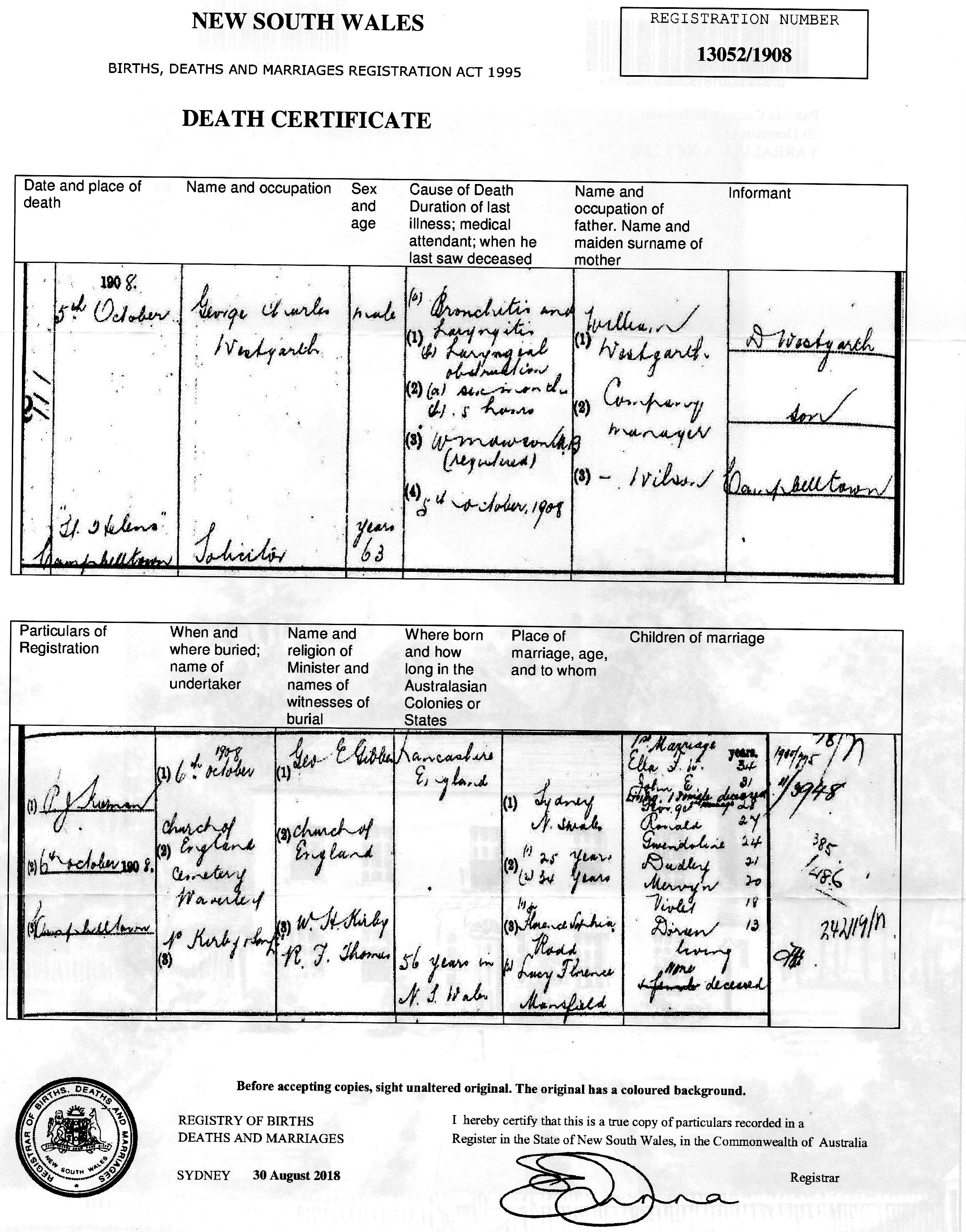
Sydney Morning Herald, Tuesday 6th October 1908:
Obituary
“Mr George Charles Westgarth, of Messrs. Westgarth, Nathan and Co., solicitors, died yesterday at his residence, St Helens Campbelltown. Mr Westgarth was highly respected in the profession. He was at one time in partnership with Mr Alfred Cape and subsequently joined the firm of Messrs. Norton, Smith and Co. Shortly after retiring from this firm, he entered into partnership with Mr Alfred Nathan. Mr Westgarth was married twice. His first wife was a Miss Rodd, his second a daughter of the late Mr George Allen Mansfield, the well known architect. Mr Westgarth leaves a widow, five sons and four daughters. “
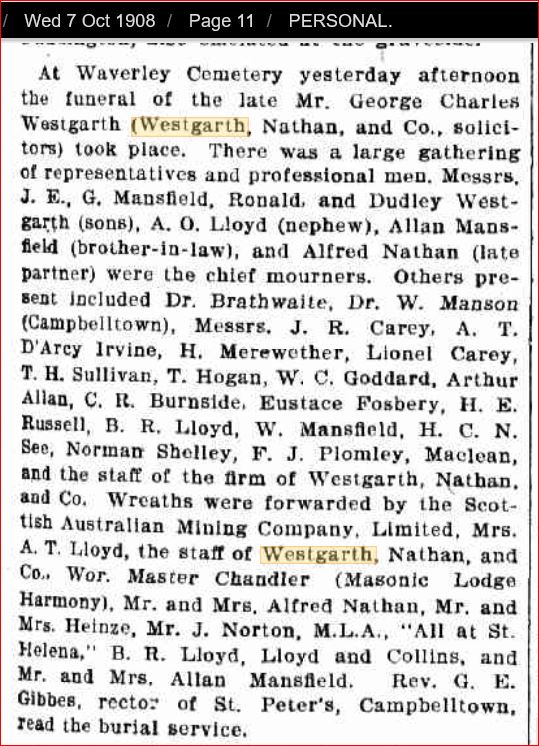
George Charles Westgarth and Lucy Florence Westgarth who loved and cared for each other and their family, are interred together in allotment W-7-CE-VL-992A. They are in an allotment that is about as close to the ocean as you can get in the Cemetery.
I am not at all sure where I found these paragraphs, but they seem to fit the mood and the time. I put in the names Dudley and Mervyn, who were in reality 21 and nearly 20 at the time:
“Following the coffin to the graveside, amongst family members was a young man of eighteen years. Very tall and strongly built, he had an expressive face and prominent features which made it seem that his worth was more than the sum of his physical strength. At the moment, his face expressed grief and loss, but the loss was more than losing a parent. He had lost his future plans. “Come, Dudley, farewell your father,” said his mother, gravely indicating the other children who were throwing single flowers down. He did so and retreated to the side of his younger brother, Mervyn. “Will we have to sell some horses?” Mervyn muttered to him. Horsemanship was his passion and though everyone rode horses if they could, Mervyn was the best horseman in the district. He could handle any horse, it seemed. And beat anyone in jumping, racing, steeplechasing, polo and all.
“I expect we will be seeing Mr Chapman later. Then we will know,” Dudley grimaced. “Mother will be the beneficiary, no doubt. And she has to provide for our sisters. And what about the house and servants? Will she be able to keep them?”
This question was answered when the executors looked at all the effects of George Charles and found the answer was ‘No’.
32: More money problems:
The home, St Helens, could not be sold to pay the debts of the deceased estate, because the mortgage was in favour of his wife and children, but:
- George Charles did have other property investments which brought in a total of £5174.
- At Westgarth Nathan and Co. all his furniture and books were sold and those of the firm were sold and the proceeds divided.
- St Helens’ had horses, sulkies, cattle, saddlery and so on, which were all sold. The furniture of St Helens was valued at £138.16, which was a lot of money.
Reading the sale posters for 1985 below, one gets a glimpse of the valuable fittings in the house, such as 7 marble fireplaces, three bathrooms and a separate weatherboard billiard room, as well as stables and other buildings.
However, after paying back all the loans, plus all the creditors, from the Draper to Penfold and Co Wine Merchants, from the Tailor to the men who were employed at St Helens, also the doctors and chemists who had tried to cure him, his assets were not enough to cover all the debts.
Some of the doctors and chemist were in Scone, so George Mansfield must have done all he could for his father by bringing him to Scone, where he took up practice in 1907. However, George Charles did die in St Helens, where Dudley had the responsibility for his mother and sisters.
John, or Jack as he was called, the eldest son, artilleryman with private income thanks to Florence Sophia’s legacy, came to the rescue of the family. An Annexure A was added to the estate papers, which stated that George Charles was entitled to £3040/1/9d for his share in the properties of his wife’s inheritance, Canoblas and Springfield. George Charles had a one tenth share of revenues from Canoblas and three tenth shares in Springfield. His estate was also entitled to £1000, which seems to have been given to John for a mortgage over St Helens and which was now repaid, according to the affidavit ‘O’ signed by Jack and Ella.
Here is the Annexure ‘A’ to the assets of the estate of the deceased, George Charles, signed by J. E. Westgarth, his son:
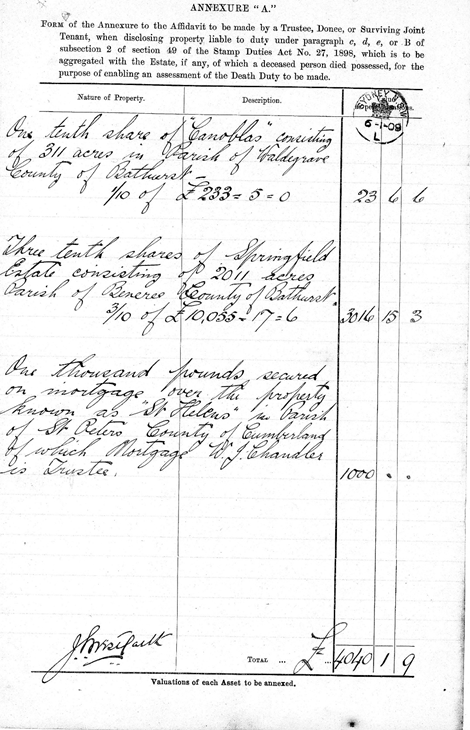
Therefore, the Estate of George Charles Westgarth managed to pay all debts. There was a sum left over of £3483.3.11 (Three thousand four hundred and eighty-three pounds three shillings and elevenpence.) This was a large sum in those days, enough to start a new course in life for the children and Lucy Florence.
As well as this amount, as Lucy Florence was the daughter of Emma Allen, as stated before, by virtue of the Will (d.1877), of her Grandfather, George Allen, she and her 7 children received £3478/16/- in the Estate settlement. This was secured by mortgages on St Helens in August, 1886 (when the land at Appin was bought), and subsequently in 1891,
Death Duties:
The death duty on the £3483.3.11 was one percent, because Jack and Ella signed an affidavit ‘O’ claiming that all the money in the above Annexure A was part of their inheritance.
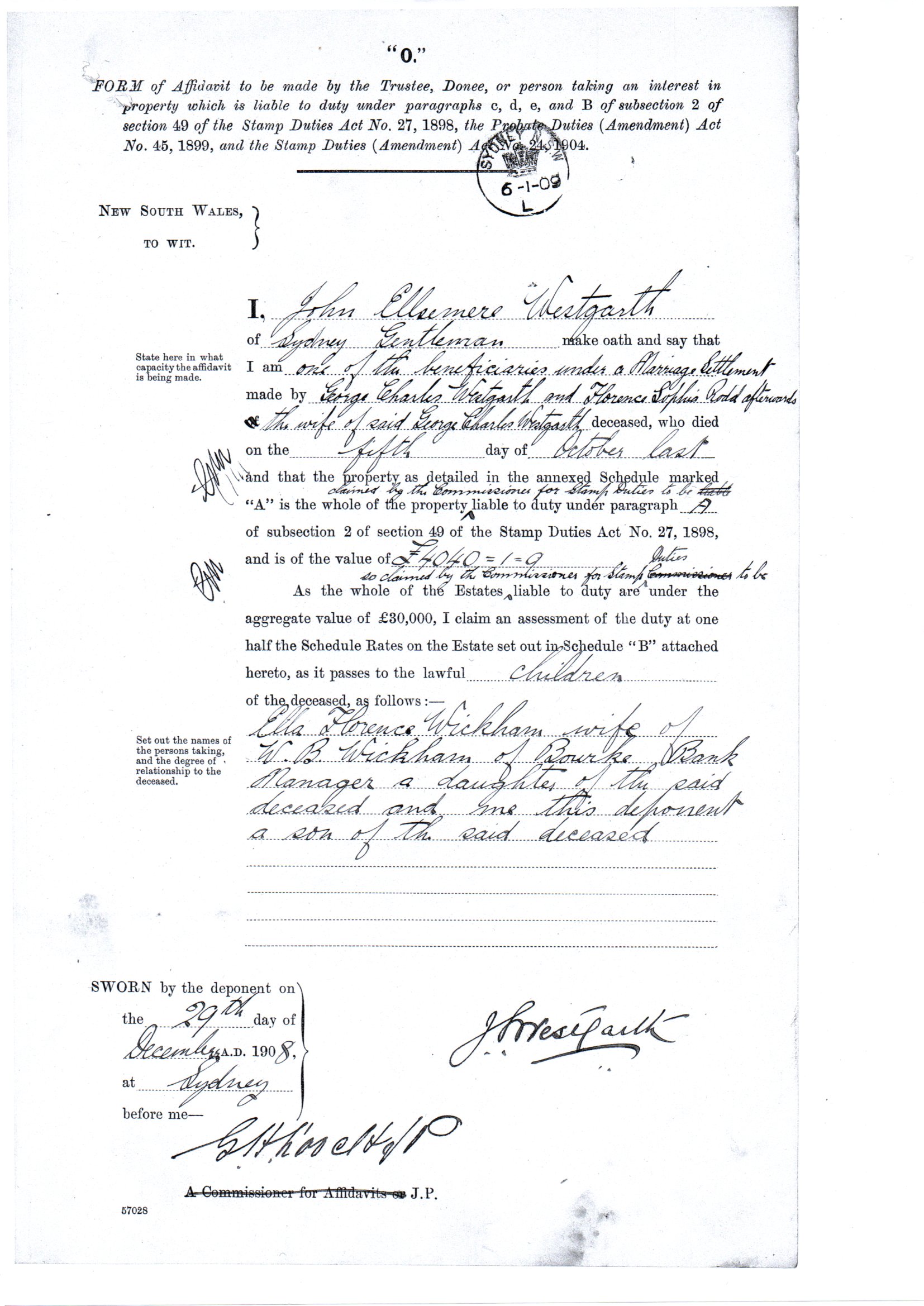
As a result, the estate had to pay £34.17 duty, which does not seem much to us, but in those days the dentist charged £5 and wages for workmen were £3 and £4.
Sale of St Helens
Thus the family did their best to support George Charles in his months of illness and then in the sad business of winding up his estate. Regarding St Helens, Lloyd Jones of David Jones Ltd and another buyer had each offered £5000 for the property, so Lucy Florence and the children, on selling, would have had a total of over £12,000 to support them.
Earlier in 1908, George Charles’ father-in-law G.A.Mansfield and his brother William Henry had died.
In 1908 Ella Wickham was living in Bourke, New South Wales with her Bank Manager husband.
In 1908, John (Jack) retired from the British Artillery, because of his father’s on- going ill health. “Owing to family affairs I had to retire…..” (Taken from his own memoirs copied below.) He most likely became engaged to Miss Irene King at this time. I met her when I was a child. My grandfather had kept in contact with her over the years since the death of John in 1918. As I remember, she was living in Elizabeth Bay and was a fat lady surrounded by red velvet.
In 1908, George Mansfield had finished his legal studies and was establishing his legal practice in Scone, New South Wales. Ronald was in the merchant business and courting Darcy Daly whom he married in 1909. Gwendoline would have been 24, but she never married. Dudley was studying law at Sydney University and Mervyn was studying at the Hawkesbury Agricultural College. The two younger girls, Violet (Poppy) and Doreen would have been 18 and 12 years old.
The eldest male child still living at home was Dudley, my grandfather, a law student. When George Charles died, it was Dudley who witnessed his decease within half an hour and it was his duty to sign the death certificate. Poor Dudley, just twenty-one years old, having such a sad and heavy responsibility. He was to have more in his life too.
Conclusion:
This concludes the story of George Charles. It is a long one, so I will write a separate blog about the family after his death until the death of Lucy Florence, who was only 49 years old in 1908.
 westgarth and glassons