Introduction:
First I would like to talk about the origin of the name ‘Westgarth’. The name is of Saxon origin and predates the Norman conquesty of 1066. The Angles and Saxons were from Scandinavia and surrounding lands, where our name still exists as Vestergaard. A rough translation is ‘westfield’ or ‘west yard. “The placename itself is composed of the Olde English pre 7th Century element “west”, west and the Norse, Middle English element “garth”. Locational surnames were developed when former inhabitants of a place moved to another area, usually to seek work, and were best identified by the name of their birthplace.” www.surnamedb.com/Surname/Westgarth
Here is an Australian example of a mixup of Vestergaard and Westgarth, caused by immigration and racism!
In a letter from Victoria in 1991, Bill Westgarth writes: “My wife and I have done some research on this. It appears that the V in Vestergaard is pronounced as W………It also appears that somewhere around the 1870s people who were in Australia with a German-sounding name were being victimised. This caused vast numbers of people to Anglicise their name. My father was born in Adelaide Gully on the Bendigo goldfields of Victon the 16th April, 1896. He always understood that his name was Westgarth……………but when he attempted to claim his superannuation, it was discovered that he did not have a birth certificate………………he had been registered as William James Vestergaard. At that time he had it legally changed to Westgarth…..”
On the trail of the life of William:
Researching William Westgarth was hard because I had to find my way through a forest of references to a very famous William Westgarth who was born in 1815 in England, lived in Melbourne from 1840, developed a trading company between Melbourne and London, wrote a book called ‘Australia Felix’, was a member of the Legislative body of the time and imported a prefabricated iron house which is in Toorak. There is a small suburb now named after him near Northcott, probably where his farm used to be. His name was Charles William, (1815-1889), and our ancestor was just baptised William, but, confusingly, both men were known as William and our William was not so famous at all.
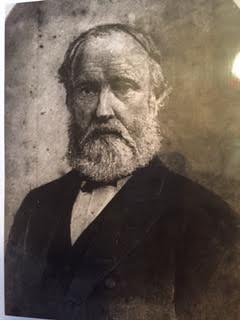
I have a photograph which is probably of William, sent to me by Stephen Westgarth. You can compare it with the family group taken probably in 1877 and let me know what you think. William is older in this portrait and looks a little unkempt and perhaps ashamed of himself. You will find out about that if you read on.
Other family portraits:
In this blog, I have included portraits of George Charles, his eldest son who was my great grandfather, but I have so far found none of his two wives. Perhaps in time we can find them.
Starting this blog, I knew nothing about William, except the family legend that he came to Australia as the first steamship company manager for the Australasian Steam Navigation Company, which turns out to be a half truth. William became the first manager of the Maitland Office of ASNCo, in 1858, but the company was flourishing in Sydney long before then.
Sources:
Thanks to a family tree by Barbara Dawson, information provided by Stephen and George Michael Westgarth, who are the grandsons of my great uncle George Mansfield Westgarth, also photos from Judith Westgarth and a wonderful research effort by her nephew Neil Thornton, plus snippets of information provided by surfing the net, I have put his life together. Although it may partly be a fanciful reconstruction, most of the information provided is factual.
William’s Character:
It seems to me that he was a man capable of bold decisions and hard work in a time when there was no Medicare Safety Net and many other government services which we depend on today. He lived a busy life from the time of his adulthood (21) and probably from the time he was old enough to learn bookkeeping. I have also found out he had his frailties and many losses in life, but that is not so unusual! Elizabeth, his wife, must have been very capable and hard working. She supported the family right to the end of her life!
Early marriage:
William Westgarth married Elizabeth Lyon when they were very young to marry by our standards today. William was just 21 that July and Elizabeth would be 21 on 4th December that year. As was quite common amongst working people, Elizabeth was already pregnant. They were married in Saint Paul’s Church of England in the Parish of Liverpool, County of Lancaster, on 17th July 1846.
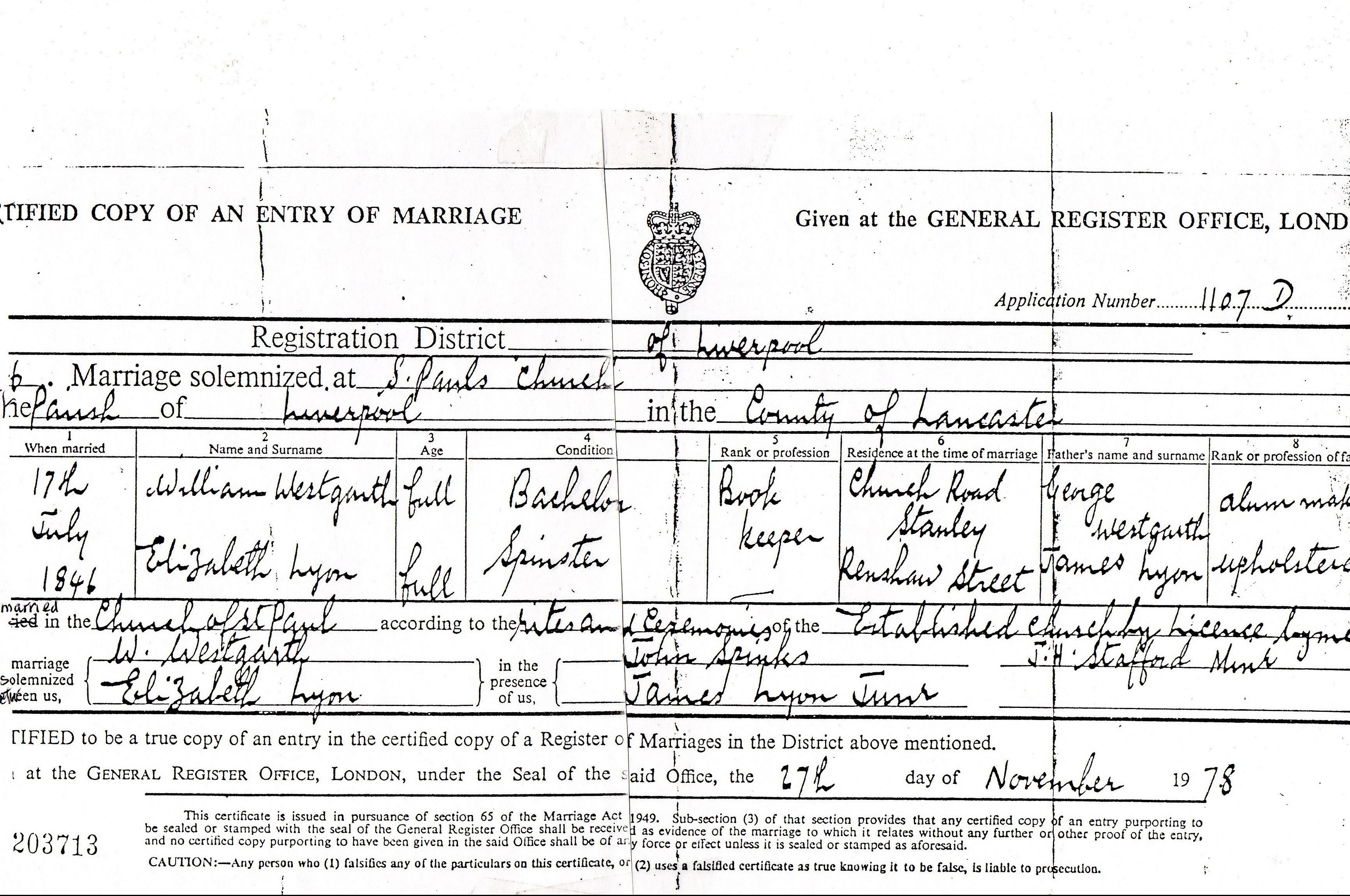
William’s father George Westgarth had married Elizabeth Craggs in Guisborough near Hull in 1814. Hull is a port city on the Humber River, in Yorkshire. Guisborough is north of Hull and near Whitby on the coast. William was born in Whitby, where Cook set out for the Pacific.
That was where George learned his trade as an alum maker, at the Bowlby Alum Works in Guisborough, Yorkshire, not far from Whitby.
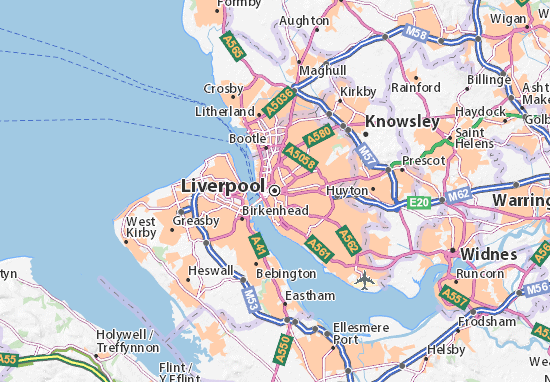
By the time of his marriage, George and Elizabeth, his parents, were living in West Derby, Lancashire, a suburb of the great port city of Liverpool. William was living in Church Road, Stanley and Elizabeth lived in Renshaw Street, Stanley, a suburb of Liverpool, in the house where she was born. Although not marked on the map, Stanley and West Derby were closer to the centre of the city than Huyton, which is marked. Presumably Liverpool was a lot smaller in 1850!
A longer family tree.
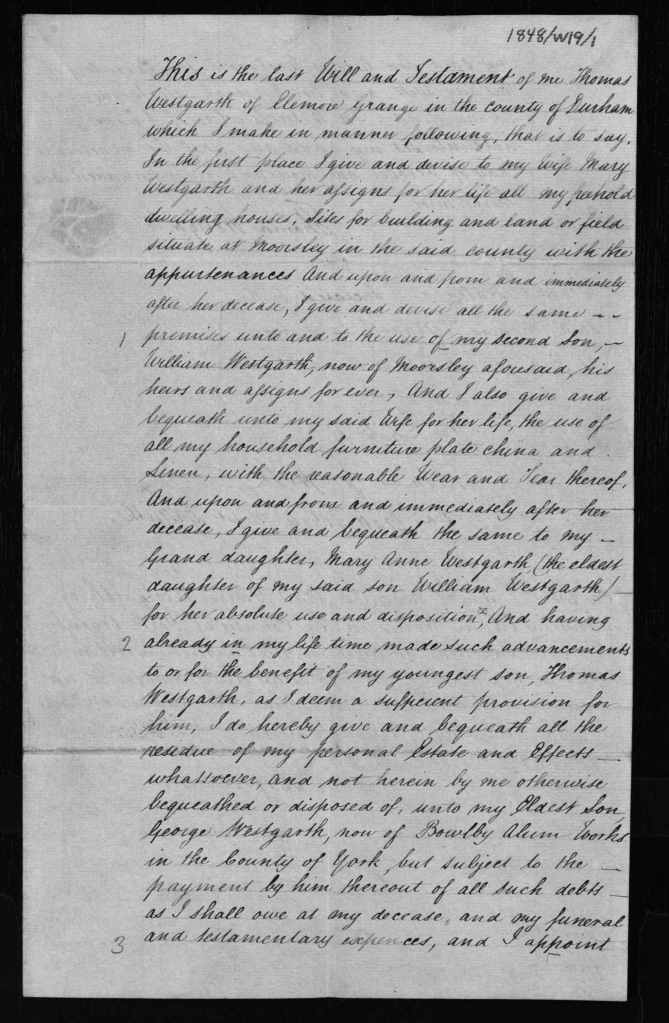
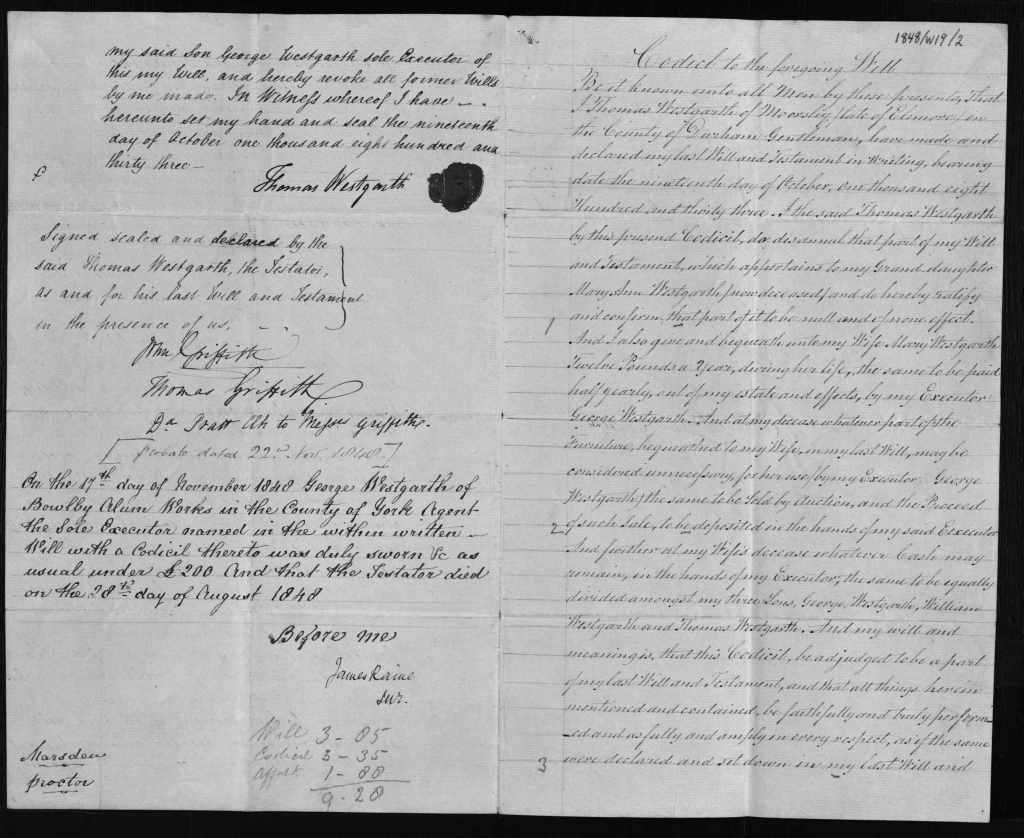
Richard Westgarth has tracked down the names of George Westgarth’s parents back in the 18th century! Thomas Westgarth and Mary Leverick were married in Pittington, Durham in July 1792 and George was christened there a few months later, in November 1792. Another case of pregnancy before marriage. George was their eldest son, as is written in the will below.
Richard has found Thomas’ will, which is nearly 200 years old, written in 1848. Does it say he lived at Elesmere Grange/Elemere Grange? This word keeps popping up.
Family Tree back to the 17th Century!
Now George Westgarth has continued the ancestry trail back to Thomas’ great grandfather, Cuthbert Westgarth, who was born in 1668 and died in 1702.
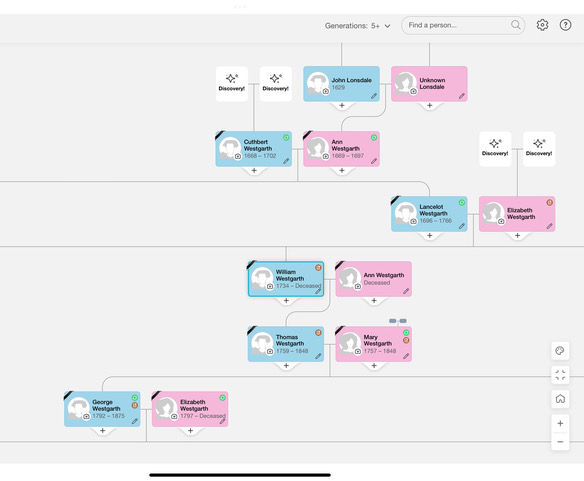
A short life, but you can see that Cuthbert had a son, Lancelot, whose will George also supplied. Here it is. Lancelot had sons called John, Lancelot, William, Thomas and Cuthbert. He was insistent that his daughter, Ann Gray should be well provided for.
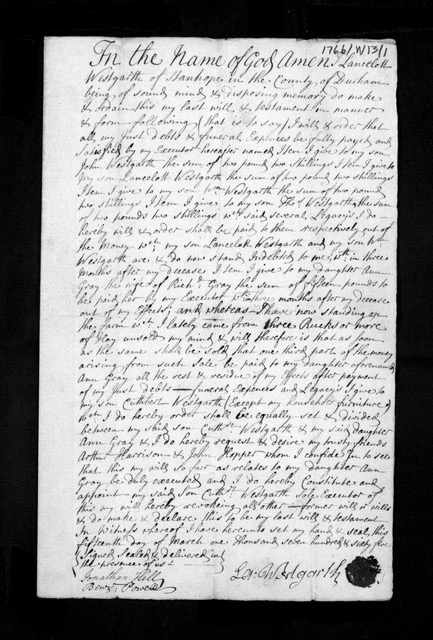
It seems to me that the making of wills is a precaution very well exercised in the Westgarth family. And so they became successful lawyers here in New South Wales!
Employment: Our William became a bookkeeper.
William’s employment at the time of the marriage (1846) was bookkeeper, perhaps for one of the shipping companies, for Liverpool was the departure point for many vessels to America, Europe, Australia and the colonies.
The 1851 census shows that William had become a farmer at Aughton, North of Liverpool. You can see Aughton on the map, where the family lived before coming to Australia. Two names on the map which feature in the Westgarth story are: St Helens and Ellesmere. More on these later!
George Westgarth and Elizabeth’s father, James Lyon, were tradesmen, an alum maker and an upholsterer. Both were good trades, but a maker of alum must have been a person of intelligence, as this explanation of its uses from Wikipedia shows: https://en.wikipedia.org/wiki/Alum
“Aluminium-based alums have been used since antiquity, and are still important in many industrial processes. The most widely used alum is potassium alum. It was used as a flocculant to clarify turbid liquids, as a mordant in dying, and in tanning. It is still widely used in the treatment of water, in medicine, for cosmetics (in deodorant and antitranspirants), in food preparation (in baking powder and pickling), and to fire-proof paper and cloth.
In traditional Japanese art, alum and animal glue were dissolved in water, forming a liquid known as dousa , and used as an undercoat for paper sizing.
Alum in the form of potassium aluminium sulphate in a concentrated bath of hot water is regularly used by jewellers and machinists to dissolve hardened steel drill bits that have broken off in items made of aluminium, copper, brass, gold (any karat) and silver (both sterling and fine). This is because alum does not react chemically to any significant degree with any of these metals, but will corrode steel. When heat is applied to an alum mixture holding a piece of work that has a drill bit stuck in it, if the lost bit is small enough, it can sometimes be dissolved / removed within hours.”
Children:
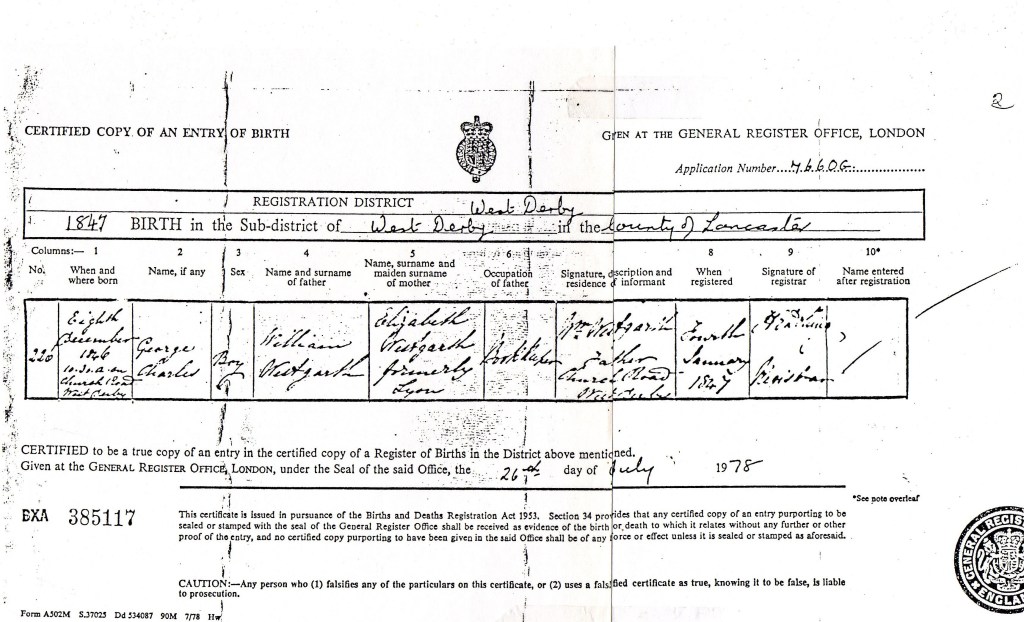
Their first child, George Charles Westgarth was born on 8th December 1846 in William’s father’s home in Church Road, West Derby. The baby was registered on 4th January 1847 and was soon followed by a brother, William Henry, (24/5/48) and then a sister, Elizabeth Ann, (2/2/50) both born at Aughton. By 1851 a second sister, Edith Isobel, was born, (19/9/51), at Ormskirk, six kilometres away from Aughton. George Charles was our great grandfather, so it is the story of his descendants that I have been researching. Here is his birth certificate:
Emigration:
By 1852, although William was fortunate enough to be living at Aughton with his young family, on 18 acres of land, employing two labourers, he had decided to emigrate. On 30th September, the family, Elizabeth’s sister, Jane and William’s brother Edwin, boarded the SV Catherine Mitchell, a clipper ship, bound for Melbourne.
Why did he take this bold decision with a young family to emigrate to the colony of New South Wales?
1.The first reason was the taxes which the government were heaping on farmers. I learned in the novel “The Red and the Black” by Stendhal, that the British Government gave 20,000 English pounds in gold to the French nobility to raise forces for the defeat of Napoleon. He was defeated in 1815 at Waterloo. After that, the British treasury was exhausted and the government resorted to high taxes in order to restore finances.
2.Farming was also no longer profitable in England, because American produce was flooding the market. A long canal, the Erie Canal, had been completed between Lake Erie through New York State to New York. Goods could come cheaply by barge to the port for export by steamship. The canal was completed in 1825 and cut transport costs by 95%.
3.Another reason was that William would have known about the gold rush that had started in eastern Australia in 1851. He may have had encouragement to go to the colony to work in the steamship trade which was flourishing. Basically, free settlers were motivated by the need to provide a better future for their wives and children.
Transport:
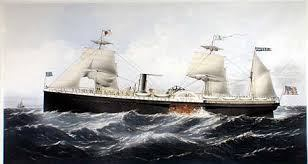
The clipper ship, Catherine Mitchell, left Liverpool on 2nd October 1852. Clipper ships were fast sailing ships which carried little cargo, being intended to transport people to far-off places in the minimum time.
Steamships had begun as paddle wheel cum sailing vessels which sailed between England and America from 1819, leaving from Liverpool. The Cunard Line had a fully paddle wheel service between Liverpool and Boston in 1840, but in 1843, Isambard Kingdom Brunel developed a screw propelled steamship, the SS Great Britain. Although steam ships with screw propellers were capable of long distance sailing, such ships could not yet carry enough coal for the long trips round the world. Clipper ships took that trade.
Clipper ships were modelled on the clipper ships of Baltimore in America, one of which is shown in the picture below. The journey to Australia had been accomplished in 100 days, though this was not average. The Catherine Mitchell took 112 days. Below: A Baltimore Clipper Ship;

In Australia, steamships were the preferred mode of sea transport, They were more reliable than ships which must wait for a fair wind in the sails and could carry enough coal for the distances required. Early steamships had sails too.
This English Paper of June 29th 1952 illustrates the importance of steam travel for a nautical nation. From TROVE.
SCREW VERSUS PADDLE WHEELS.
The race between the paddle-box steamer Humboldt and the screw steamer Great Britain across the Atlantic, was a most interesting and important one.
They both started from New York at the same time, and arrived in England at the same time, on Wednesday, one at Liverpool and the other at Cowes. The distance between Cowes and New York is greater than that between New York and Liverpool, and therefore the Humboldt must be considered to have had the advantage. The Humboldt is a remarkably fine steamer, and her voyage just completed was the quickest ever known between Cowes and New York. It is also worth noticing that the Peninsular and Oriental Company’s screw steamer Formosa, has just made the quickest passage ever known between the Clyde and Southhampton Water, she having run the distance in 50 hours.
Clipper ships:
Here is an article from the Liverpool Mail of October 2nd 1852, describing the Catherinie Mitcghell as having the latest improvements in comfort for passengers of a long distance clipper ship.
DEPARTURE OF THE CATHERINE MITCHELL.
This beautiful vessel, one of Messrs. Miller and Tompson’s ” Golden Line” of packets for Australia, took her departure from the Mersey, on Thursday, for Melbourne, Port Phillip, with a very valuable cargo, and a full complement of first and second cabin passengers, in all 250 souls on board. The Catherine Mitchell is a 13 years’ Clyde-built clipper ship, launched about two months ago, and she has been put together in the most costly and substantial manner, all the modern improvements in marine architecture having been applied to make her in every respect a superior ship. She is registered at 850 tons, and commanded by Captain James Baikie, a careful and experienced sea-man, and a thorough gentleman. This vessel was fitted in a style surpassing, in real comfort and convenience, anything that has preceded her, and every provision for the wants of passengers on such a lengthy voyage has been supplied in her case. Well arranged wash-houses (separate ones of course for each sex) are on the lower deck, and baths and water-closets on the upper or promenade deck. Fresh provisions, in unlimited quantity, were served out to all the passengers during her three days detention in the river, and the emigrants, who were all of a very respectable class. expressed themselves highly satisfied with the vessel and her accommodations. Passengers’ cooks and stewards for the second cabin were provided by the charterers, and the care and attention bestowed on these matters in this instance, is an example worthy of being imitated by brokers generally. –Liverpool Mail, October 2.
Passenger list showing the cabin passengers:
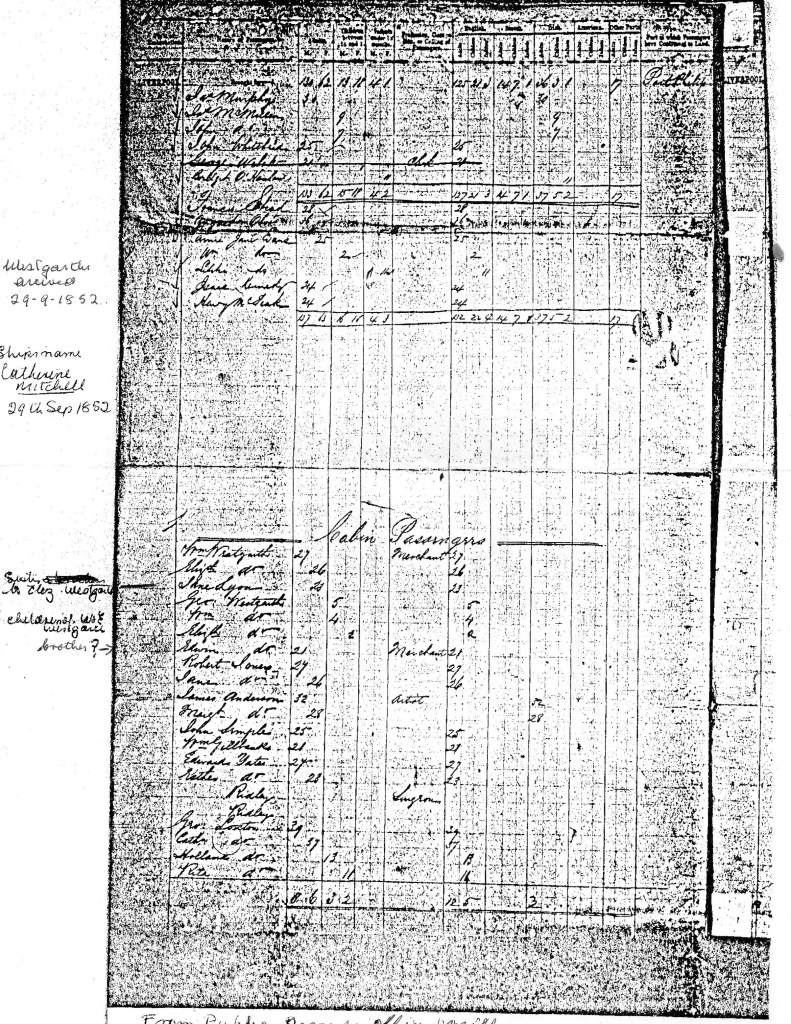
The shipping list shows the Westgarth family at the top of the Cabin Passenger list. The baby Edith is listed in the baby column. Listed in order are William, Elizabeth, Jane Lyon, her sister, George Charles, William, Elizabeth and Edwin Westgarth, William’s brother.
Situation in the colonies of New South Wales and Victoria
Owing to the gold rush, most probably, on August 5, 1850 ‘the Imperial Government granted an act ‘for the Better Government’ of the colonies creating the state of Victoria through the process’.https://www.abc.net.au/news/2015-07-01/victoria-day-was-secret-gold-behind-separation/6584322
The gold rush and the influx of immigrants from Ireland meant plenty of work for transport companies, but rail and coach services were no longer adequate and steamships were much faster and more reliable than sailing ships had been.
William and the family must have had high hopes to come to Australia at this time and work for a shipping company. Steamships were offering an essential service to newcomers who had very little choice of transport in a country without rail transport.
Steamship Services in the Colonies of the east coast.
Steamship travel was a very profitable service. The article below from the Sydney Morning Herald of 30th July 1852, is describing the wealth and popularity of the Australasian Steam Navigation Company.
All the dignitaries of Sydney attended the first voyage of the A.S.N.Co steamer, Yarra Yarra. They were accompanied by the Army bigwigs and company officials. The manager of the company, Mr Paterson, was farewelled on his return to England. Check out the kind of golden (in this case silver) handshake he received!
I have abridged this long newspaper article which describes the ‘high life’ British style, of the colony of New South Wales at the time of the gold rush.
EXCURSION ON BOARD THE STEAMER ‘YARRA YARRA https://trove.nla.gov.au/newspaper/article/161036196?searchTerm=Excursion%20on%20the%20Steamer%20Yarra%20Yarra%201852
30 July 1852 Sydney Morning Herald
“The whole of the arrangements for placing this fine steam-ship on the berth betweenSydney and Victoria having been completed, the Directors of the Australasian Steam Navigation Company invited a large party to accompany them in a trip down the harbour of Port Jackson and, in pursuance of this invitation, about 300 ladies and gentlemen, of Port Jackson and, in pursuance of this invitation, about 300 ladies and gentlemen, including the families of the leading people in Sydney, embarked yesterday, at the Company’s wharf. Among those present were the Colonial Secretary, with Mrs. E. Deas Thomson, and Miss Thomson. Sir Charles Nicholson, Speaker of the Legislative Council; and most of the leading members of the local legislature, with their families. The Solicitor General ; Colonel Bloomfield, and most of the officers of Her Majesty’s Eleventh Regiment ;and the officers of Lieutenant-General Wynyard’s staff; Colonel Cumberland, of H.M.96th Regiment, who is on a visit to the colony, Deputy-Commissary-General Ramsay and the principals of the leading mercantile firms of Sydney, with their families. At twelve o’clock precisely the Yarra Yarra was loosed from her moorings, the Band of H.M. 11th Regiment playing Rule Britannia. The day was remarkably fine, and every arrangement had been made to make this really a pleasure trip.
We may remind our readers, that this steamer arrived here on the 4th of April last, having been constructed for the A.S.N. Company by Messrs. Caird and Co., of Greenock, who built the hull ; the machinery having been supplied by Messrs. Denny, B. others. The chief cabin has excellent and luxurious accommodation for fifty passengers, but the forecabin, not having been constructed on a sufficiently large scale to meet the increasing transit between Sydney and Melbourne, the Company at once determined to enlarge it, and it now is capable of receiving 170 passengers. This, in fact, is a great feature in the Yarra Yarra.
Travellers are accustomed to find luxury preside aft in the superb steam-ships of modern Days, but when they find such influences extending to the fore-cabin, where the comfort and convenience of the passengers are studied with the same scrupulous care as marks the arrangements for the cuddy, the inspection of such a vessel becomes doubly agreeable. Such, we must particularly observe, is what will be found in the three fine saloons appropriated for the steerage passengers of the Yarra Yarra. However, our province to-day is not to give a description of the vessel, but to recount the proceedings of the gay party who had assembled on her deck to do honour to her enterprising proprietors.etc etc……………(Speech) “ It was impossible for the most sanguine to form an idea of the glorious destiny of this great colony and to those who by bringing out here a fleet of magnificent steam ships were so materially contributing to develop her resources, the gratitude of the nation was eminently due.” (Loud cheers).
After steaming down the harbour, the trip being enlivened by the martial strains of the gallant Eleventh’s band, the Yarra Yarra anchored in Rose Bay about half-past one o’clock. A sumptuous collation was then served up, the Chairman of the A. S. N, Company, Mr. Robert Campbell, M.L.C., presiding, supported on his right and left by the Colonial Secretary, Sir Charles Nicholson, and Colonel Cumberland, the Solicitor-Genera!, and Colonel Bloomfield. The younger branches were entertained in the large saloon of the fore cabin, where the honours were performed by Mr. T. W. Smart, M.L.C., Captain Browne, and Messrs. Paterson and Terry, the Manager and Assistant Manager of the Company.
To judge from the screams of laughter which every now and then reached the quarter-deck, and disturbed the gravity of honourable and learned speakers, it was quite evident that the juniors were in excellent hands ; and we detected certain sly young gentlemen stealing away to the children’s cabin, excusing themselves on the ground that it was “capital fun.”
The collation finished, the Chairman rose to propose the health of her Majesty the Queen, the sovereign lady who rules us, and who lives in the hearts of her subjects in every part of her great empire. On occasions like the present it was most gratifying to propose this toast in the presence of so many fair and loyal subjects of Queen Victoria. (Loud cheers.) And he (Mr. Campbell) would say, that in no part of the great British confederation was loyalty more deeply imbued in the hearts of the people than in Australasia. The toast was drunkwith enthusiasm, the band playing the National Anthem.
The Chairman then proposed the health of Prince Albert and the Royal Family, which was as warmly received, the band playing Prince Albert’s March. The next toast was his Excellency the Governor-General of Australasia. In proposing this toast, the Chairman said to those assembled at the present, the party was in honour of an important step in the progress of the colony’s communications by steam.
It was with much pleasure, that, in proposing the health of Sir Charles Fitz Roy, he had to refer to his Excellency’s zeal and sustained earnestness in the cause of internal communication, b) means of railroads in this colony. (Loud cheer.) Whether to the distant districts of the interior, or to the ports of the extensive Australian sea-board, the power of steam would now be rapidly applied ; and most gratifying to the colonists……………..that the Governor-General was a sincere supporter of this great innovation, and of social improvement for prosperity………………………
Captain Gilmour, the Commander of the Yarra Yarra, returned thanks. He congratulated not only the ASN Company but also the Australian colonists at large, upon this able addition to the colony’s steamships. Efficient as New South Wales was at pursuing her means of internal communication, increasing the power of her marine communication was a matter of the highest moment. (Cheers)……..
The Solicitor-General proposed thanks of Mr Paterson, the Manager and that of the ASN Company, dwelling in many complimentary terms upon their acknowledged efficiency. Mr. Paterson returned thanks.
The Chairman presented the testimonial to Mr. Paterson. It consists of a massive silver salver, and an elegant silver inkstand. On the former, the following inscription was engraved:- “Presented by the officers of the Australasian Steam Navigation Company to the Manager, James Paterson, Esq. on his departure for England, as a token of our regard and esteem. Sydney, July 30th 1852. In presenting it, the Chairman expressed the pleasure he felt at having been requested by the officers of the Company to place this testimonial, alike honourable to the Manager and to themselves, in the hands of Mr Paterson. Mr. Paterson. in acknowledging the kind and friendly feelings which had prompted his brother officers to present him with so valuable a token of their esteem….etc etc. ” (From Trove)
Gold Rush:
Up to 1850, the colony of New South Wales had been ‘riding on the sheep’s back’ but apart from wool sales, the economy had been slow. Convict transportation had ceased to the eastern part of Australia in the 40s, but ex convicts outnumbered the colonists who had arrived as free settlers. The colony needed educated people as administration became more complex. As their numbers grew, colonists were agitating for self-government instead of rule from Britain.
‘Prior to 1851, the colonial government of New South Wales, had suppressed news of gold finds which it believed would reduce the workforce and destabilise the economy.[1] After the California Gold Rush began in 1848, which caused many people to leave Australia for California to look for gold there, the New South Wales government rethought its position, and sought approval from the Colonial Office in England to allow the exploitation of the mineral resources and also offered rewards for the finding of payable gold.’ Taken from Wikipedia.
The first official discovery of gold was by Edward Hargraves at Ophir, near Orange, in 1851, but many goldfields were quickly opened up. Gold discoveries in Castlemaine, Daylesford, Ballarat, Beechworth and Bendigo sparked gold rushes similar to the California Gold Rush.[6] At its peak some two tonnes of gold per week flowed into the Treasury Building in Melbourne. (Wikipedia)
The Victorian Gold Discovery Committee wrote in 1854:
“The discovery of the Victorian Goldfields has converted a remote dependency into a country of world wide fame; it has attracted a population, extraordinary in number, with unprecedented rapidity; it has enhanced the value of property to an enormous extent; it has made this the richest country in the world; and, in less than three years, it has done for this colony the work of an age, and made its impulses felt in the most distant regions of the earth.”[2]
For a number of years the gold output from Victoria was greater than in any other country in the world with the exception of the more extensive fields of California. Victoria’s greatest yield for one year was in 1856, when 3,053,744 troy ounces (94,982 kg) of gold were extracted from the diggings.[3] From 1851 to 1896 the Victorian Mines Department reported that a total of 61,034,682 oz (1,898,391 kg) of gold was mined in Victoria.[4]
Of course people came from all parts of the world seeking their fortune. The potato famine in Ireland in the mid forties was already forcing thousands of poor Irish to make the journey from Liverpool. As the immigrant numbers grew, steamships were essential to carry passengers and cargo between the towns of Brisbane, Sydney, Melbourne and Hobart.
Arrival of the Westgarth family:
The family arrived on 21st January 1853 at Melbourne, Port Phillip which had become the independent colony of Victoria in the year 1851, probably due to the gold rush. The ship arrived with 267 passengers, 112 days from departure, but six passengers had died, mainly from consumption.
By 1852, Melbourne had become a Canvas Town. The gold rush had begun, ships were arriving at Port Phillip with would-be diggers, but there were no houses to accommodate this flood of people. https://blogs.slv.vic.gov.au/our-stories/canvas-town-a-floating-city-devoured-by-the-sun/ Here is a contemporary painting of the tent city.
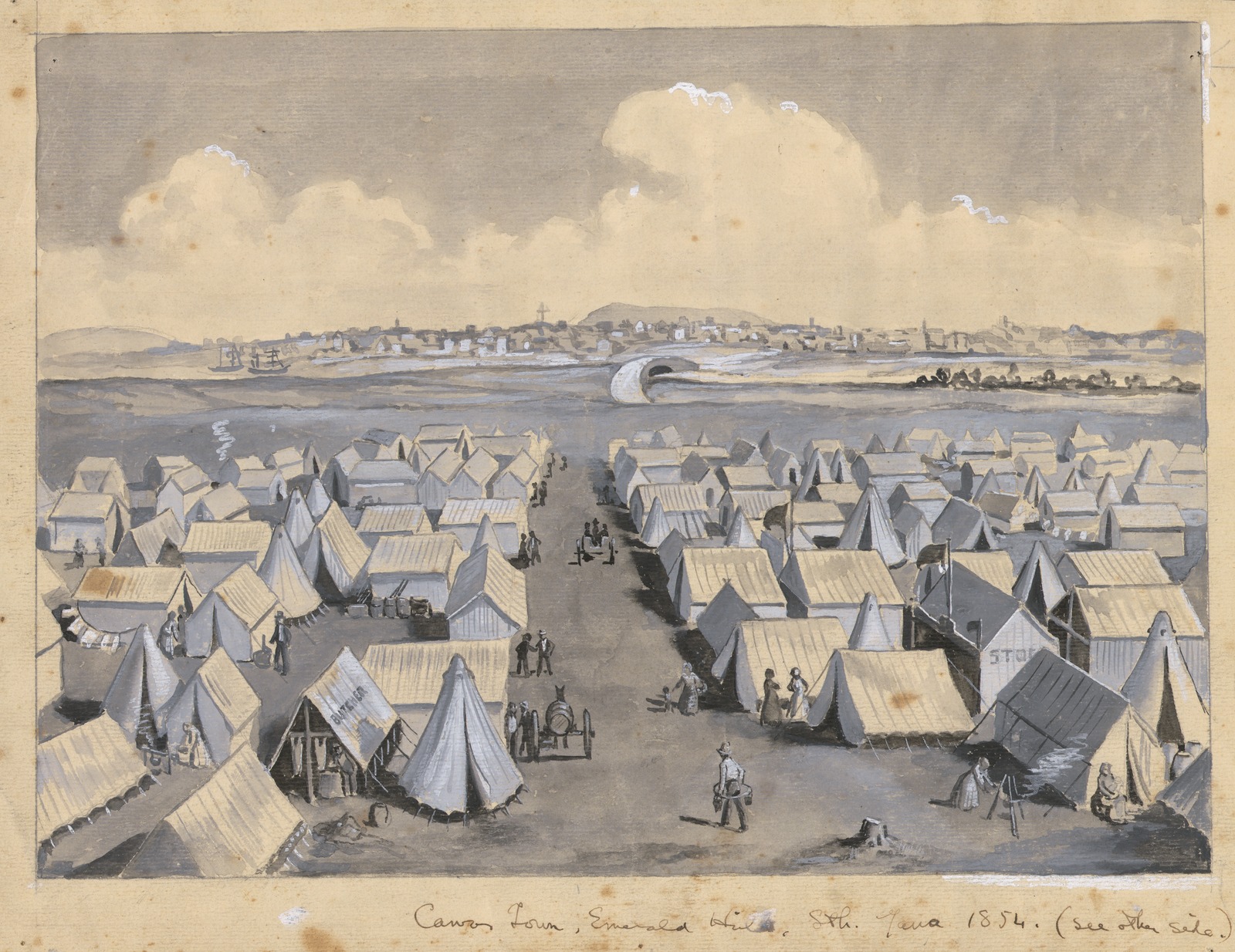 Canvas Town, Emerald Hill, Sth. Yarra, 1854. Watercolour painting by Raymond Lindsay
Elizabeth gave birth to baby Jane on 27th January, just six days after disembarking. It is most likely that she had the baby in a tent, where her husband and the 4 children, Jane Lyon and Edwin Westgarth would also have been living, for want of better accommodation. The family, it is said, soon moved into a house in Young Street, Collingwood,
Only a week after the birth, on February 2nd, William arrived in Sydney. Perhaps he went to Sydney to secure a promised (?) job with the Australasian Steam Navigation Company. He was unsuccessful, because the family remained in Melbourne until 1858 when the company employed him in Maitland.
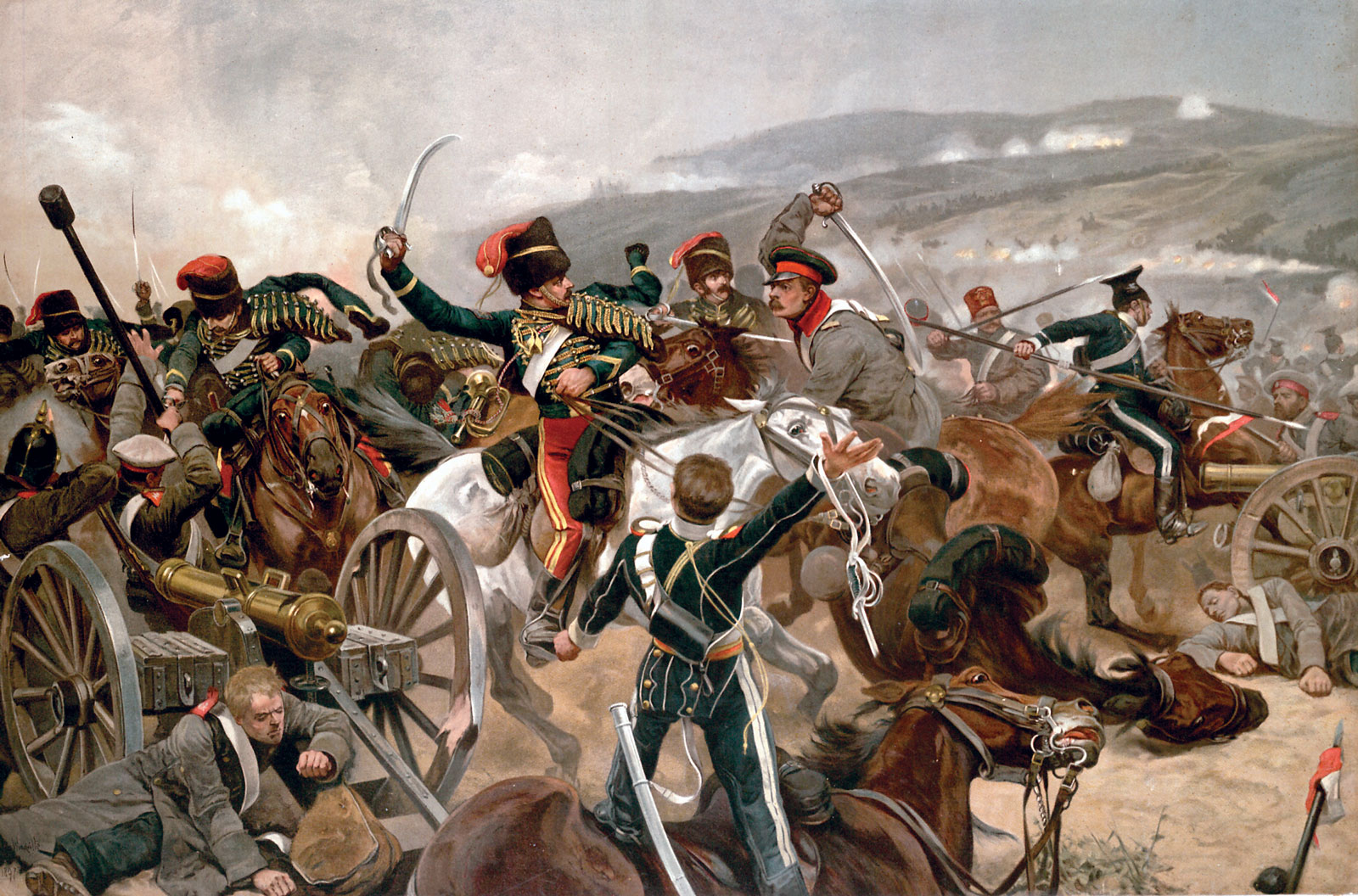
William may have been unlucky in 1853, because this was the eve of the Crimean War (October 1853 – March 30 1856), a cruel and bloody battle between the powers of Europe, including Britain who lost 25,000 men. This war greatly affected trade, even in faraway Australia, because the resources of Europe were spent on the conflict and its aftermath.
William’s Job:
William found work in the Audit office after they arrived in Melbourne. George Michael Westgarth has family notices from 2nd February 1855, which verify this fact.
The Victorian Office had really just opened! It was a plum job for a bookkeeper. ‘The first Auditor-General was appointed in 1851, making this one of the oldest public sector institutions in Victoria. The first Auditors-General examined the state’s finances and assessed whether the financial reports provided a fair and accurate representation of the state’s financial position at 30 June each year. Over time, VAGO (Victorian Auditors-General Office) was asked to broaden its work to look at how effectively the public sector was performing in its use of public resources.’ (www.audit.vic.gov.au)
Home Life:
The baby, Jane, soon died. There would have been no reliable source of clean water and the overcrowding would have encouraged childhood mortality. Soon after, Elizabeth was pregnant again, giving birth to Jane Pauline on 7th February 1854. This second Jane died the next year. (A happy event of 1854 was the marriage of her sister, Jane Lyon, to Henry Capel Piggot,)
Elizabeth had had four babies in Liverpool and none had died. What was the cause of these deaths? Poor housing for a start! The family must have lived in very crowded conditions. Here is another example of the housing solutions of the time.
The original tiny kit homes that helped solve Melbourne’s gold rush housing crisis
ABC Radio Melbourne By Nicole Mills
https://www.abc.net.au/news/2018-05-03/tiny-kit-homes-helped-solve-melbourne-gold-rush-housing-crisis/9680898 These tiny homes would have initially housed middle-class families. (Supplied: National Trust)
“Hidden among the crowded lanes and expensive streets of South Melbourne lies three remarkable tiny houses. But they’re not the kind being lauded in modern-day design magazines or snapped up by hip young couples trying to get a foot in an out-of-reach property market.
In fact, these three homes are among the first permanent buildings in Melbourne, having been shipped from England in packing crates and rebuilt here to solve a housing crisis from another era. ” Perhaps the other William Westgarth had imported them!
Iron Houses and the Other William Westgarth
When the family arrived in 1853, our William Westgarth met the famous William (Charles) Westgarth who had been in Melbourne for thirteen years, but had travelled back and forth to London. He was running an import-export company with his friend Mr Ross and he imported his own iron house.
I digress here from the story of our William, because famous William crops up in our story again later and because the story of the iron house is very interesting. I hope you find it so!
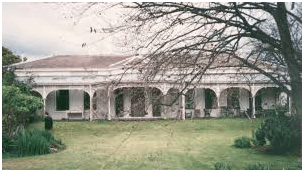
In 1855 William (Charles) Westgarth was awaiting the import of his own prefabricated mansion, ‘a ten room portable iron dwelling, manufactured by W and P McLellan of Glasgow’. It was erected in 1855. In a letter to her mother in 1855, Ellison Westgarth, William’s wife, writes: “Our house has not arrived yet. Mr Ross wishes us to put it down on a piece of ground belonging to him at Prahran, but William has not fixed yet. In the meantime we are very comfortable here, and for myself I am in no hurry to move, as town is much more cheerful when I know so few friends.” Prahran, which is an inner suburb, was it seems, outside the town in those days.
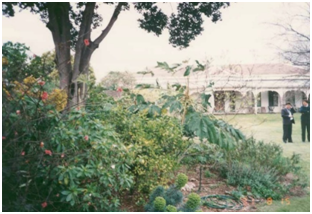
Actually, William chose his own site for the house: “The crown grantee of the land on which Tintern stands was T. Colclough, who obtained the property in 1845. William Westgarth acquired the 105 acre property around 1853, at around the same time he resigned his seat in the Victorian Legislative Assembly to return to England. It would appear that while in Britain he ordered a prefabricated structure for erection back in Melbourne.” (Victorian Heritage Database Report, 28/01/19)
Westgarth sold the house in 1857 and returned to England.
Tintern is of scientific, historical and architectural significance to the State of Victoria.
“Tintern is ……..a very rare surviving example of a 19th century pre-fabricated iron dwelling. Manufactured by W. and P. McLellan of Glasgow, the earliest part of the house illustrates the application of 19th century industrial techniques to housing construction and provides some idea of the nature of colonial development in the middle of the 19th century. The importation of portable houses to Australia reflected both the shortage of materials and workers in gold rush Victoria and the economic reliance of the colonies on Britain. While a large number of pre-fabricated dwellings were imported to Victoria during the gold rushes to cope with Melbourne’s rapidly growing population, very few now remain here, or, indeed, in the world. The use of decorative cast iron to simulate traditional rendered finishes, including brackets and scrolls, is a notable feature of the house.” (Victorian Heritage Database Report, 28/01/19)
The corrugated iron cottages which were imported to Melbourne were perhaps imported by W C Westgarth’s trading company. They were needed to house the overflowing population of fortune seekers, many of whom had to find lodgings in the growing city. Perhaps William’s family lived in one when they arrived!
Child mortality:
Reading the literature about this decade in Melbourne, I find that children died of many causes and infant mortality was about 1 out of 5 births. Consumption (TB) and all the usual childhood diseases, including smallpox and diphtheria, were spread easily in a town where immigrant shanties and confusion must have been everywhere. Burns from fires or scalds from boiling water happened often. The other big killer was unsafe water, causing gastroenteritis.
Here is an extract from: Melbourne Water: ‘History of our Water Supply System’
| 1840 | 5 years after its official beginning, Melbourne’s population had already reached 7,000. Water pumps were installed on the northern bank of the Yarra River. Men with water carts sold water, door to door, for three shillings a barrel, equal to about 30 cents for 550 litres. |
| 1850 | Due to the Victorian gold rush of the 1850s, Melbourne’s population rapidly increased and Melbourne was transformed into a major city. At the same time many new industries and buildings were being developed. These factors all meant that systems needed to be created to supply water to Melbourne. |
| 1853 | The Board of Commissionaires of Sewers and Water Supply was formed in response to the demand for a reliable water supply system. |
| 1857 | 1857 Yan Yean Reservoir, Melbourne’s first water supply reservoir, was completed and began to supply water to Melbourne, which by now had a population of 100,000. |
After the family moved to perhaps better accommodation in Fitzroy Street, Collingwood, Florence Maude was born on the 15th of June 1856, and she survived to marry and live until 1909, probably thanks to the Yan Yean Reservoir. Florence was baptised in Hobart in 1878. William and Elizabeth may not have wanted to tempt Fate by baptising the baby, Florence was 22 when baptised! One more birth is recorded during their time in Collingwood. Frederick Walter was born in 1858.
Steamship manager at last!
In mid 1858, the whole family left Melbourne for Maitland, a town 35 kilometres north-west of Newcastle. William had now gained employment in the steamship industry, but once again they were going to a town in the throes of development. William had finally become what the family myth relates, a manager of the Australasian Steam Navigation Company Office in Maitland on the Hunter River.
William went to his new post a little earlier than Elizabeth. She followed with the six children, but conditions would have been unsuitable for a baby and Frederick Walter died a few months later.
About the A.S.N.Company:
Formed in July 1851, the Australasian Steam Navigation Company replaced the Hunter River Steam Navigation Company. Alterations made to the Company meant that it could expand its activities within Australasia, while still servicing the route from Sydney to the Hunter River. Competition from other steamship companies began to arise during the 1850s and continued to grow in the following decades. In 1887 the Australasian Steam Navigation Company was taken over by the newly founded Australian United Steam Navigation Company.’ http://www.eoas.info
Schooling for the elder boys, now 12 and 10 years old.
George Charles and presumably his brother, William Henry, attended Maitland High School which had just opened in 1858. Maitland High School was a private boarding school, but George and William attended as dayboys. There is no mention of their sisters attending school.
Maitland History (www.maitlandmercury.co.au)
Prior to 1818 Awabakal, Wonnarua and Worimi Aboriginal nations lived in the Lower Hunter
1818-1838 First Europeans arrive in Maitland, Molly Morgan builds the Angel Inn, boat service established between Wallis Plains and Newcastle, official town of Maitland surveyed (now area of East Maitland), school established, Maitland’s first church – Scots Kirk – opened.
1839-1858 Caroline Chisholm established immigrants home, foundation laid for Maitland Hospital, Maitland Gaol opens, first Maitland high school opened.
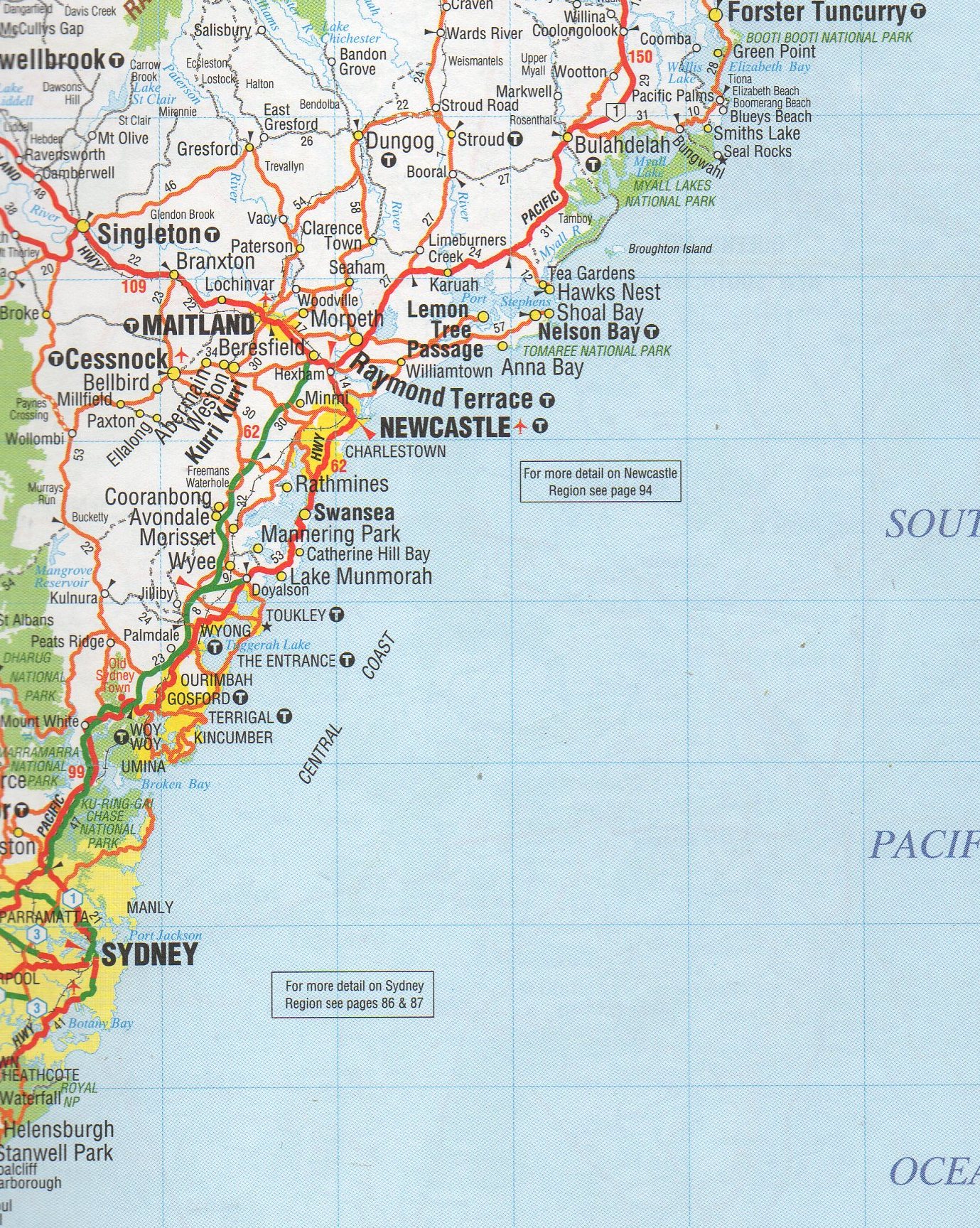
As you can see from the information above, Maitland was like a frontier town but William had got his foot in the door and was the Australasian Steam Navigation Company Manager from 1858 to 1861, when he was appointed Manager of the newly formed Queensland Steam Navigation Company and moved to Sydney. George Charles at least, stayed on at Maitland High School.
Taken from: ‘THE HISTORY OF THE Australian United Steam Navigation CO. LTD. AND ITS PREDECESSORS’
……………..’During 1861 the Queensland Steam Navigation Co. was floated, and an important appointment to the new Company was Captain Patullo. This officer did a considerable amount to place the Q.S.N. Co. on its feet and one of his first missions was to proceed to England and supervise the building of the three new steamers which the new Company had ordered. However, whilst he was in Glasgow supervising the building of the Q.S.N. Company’s first ship “Queensland” he studied for and obtained his certificate and brought the ship out to Australia…………………………
Early in 1862 the Queensland Government signed an agreement with the Queensland Steam Navigation Co .for the conveyance of the colony’s mails for three years from April 1. The “Queensland,” built specially for the trade, arrived in Brisbane amidst great rejoicing and was immediately placed in service. The Australasian Steam Navigation Co met this opposition by cutting its passage rates and the following comparative table gives the rates prevailing in August of that year:
A.S.N. Q.S.N.
Brisbane-Maryborough—Saloon:
£2 0 0 £2 5 0
Steerage:
17/6 £1.00
In the years 1863 and 1864 competition on the coast became fiercer and the war of rates which was carried on in the Sydney-Brisbane trade between the A.S.N. Co. and Q.S.N. Co. became so strong that by the end of 1864 the A.S.N, was actually charging only one-quarter of the rates previously charged.
With the advent of the year 1868 the Queensland Steam Navigation Co. suffered a crippling blow when it lost the mail subsidy from the Queensland Government, and being unable to carry on without it had perforce to cease trading. All its assets were sold to the Australasian Steam Navigation Co. for £42,000……………”
William’s work in Sydney:
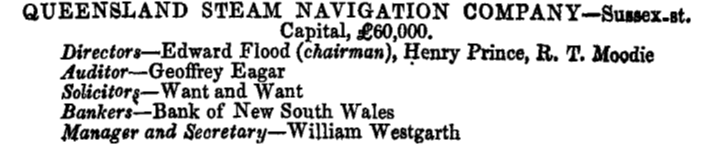
In 1866, William had been manager of this company since 1861, with an office in Sussex Street,. Here is an advertisement taken from the Sydney Morning Herald of March 6th 1865;
QUEENSLAND STEAM NAVIGATION COMPANY.
The favourite and powerful steamship LADY YOUNG, W. A. CURPHEY, commander, is now alongside the Company’s Wharf, and will be dispatched punctually at 5 p.m. on TUESDAY, 7th instant, to:
BRISBANE and IPSWICH,MARYBOROUGH,GLADSTONE, and ROCKHAMPTON.
Shippers will oblige by sending their goods down early.
W. WESTGARTH, Manager. Q. S. N. Co.’s Wharf, 4th March 1866.
This entry in the NSW Government Gazette of 1866 advertises the company:
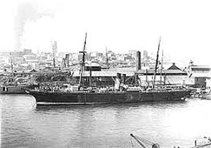
I found the following letter about the competition betweenthe two steamship companies. Things were not good….
Brisbane Courier 14th February 1865
QUEENSLAND STEAM NAVIGATION COMPANY,
TO THE EDITOR OF THE BRISBANE COURIER.
Sir,-I am instructed by the directors to hand you the enclosed letter, with a request that youwill be so good as to publish it for the information and amusement of the public generally, and the shareholders in this company in particular,
I am, Sir, yours respectfully,
JOHN STEPHENS, Secretary.
Brisbane, 13th February, 1865.
………………………………………………………..
Quiraing, Double Bay, Sydney,
February 6, 1866
” As a shareholder in the Q.S.N. Company, I address you, the Chairman of the Board of Directors, to urge upon the board the desirability of treating with your rivals, with a view of effecting some arrangement that will save both from destruction. I am sure, with your small paid-up capital and very heavy liabilities to the banks, it is impossible you can carry on such opposition as will drive the other company out of the trade.. And knowing as I do the opinion of the large shareholders in the A.S.N. Company, while they might yet agree to an amalgamation of both companies, on a fair and liberal basis for the Q.S.N. Company, they are determined that you shall not take the business from them. I am of opinion that no other arrangement can be made and it is for your board to make the first move in accomplishing this desirable end, merely placing the shareholders of the Q.S.N. Company in a most favourable position, instead of continuing as at present on the verge of ruin, with our credit bad, and the property depreciated in value. Do look upon our prospects in a commercial light, and I am sure you must arrive at the same conclusions as I have done for the past twelve months, and which I have urged so strongly but unsuccessfully on your brother directors. I make this last appeal to your good sense as a mercantile man. If I am still unsuccessful with you I must take another course, which, although distasteful to me, shall in a more unpopular manner force the board to wind up the company. I am sure the present low rates for freight and passage between Sydney and Brisbane do no good for the latter place. Very undesirable dealers make their way from Sydney and Melbourne with low class goods purchased at forced sales here or stolen to compete with your storekeepers and shopkeepers. Many of our immigrants find their way here, and you get in return our bad characters from the gaols and penal establishments. Should you deem my observations worthy of your consideration, I shall feel obliged to know your opinion, and what steps your board are likely to take to save us.
“I need not assure you that I shall be most happy to be the medium of communication in treating with the other company on your behalf, and as I am a large shareholder in it as well, I can bring considerable influence to bear on the general body of shareholders in smoothing down details, and settling the mode of proceeding with the arrangements”.
I remain, yours faithfully,
“J. D. M’LEAN.
“Henry Buckley, Esq., Chairman Q.S.N.Company, Brisbane.”
1868: A.S.N.Co takes over the Q.S.N.Co.
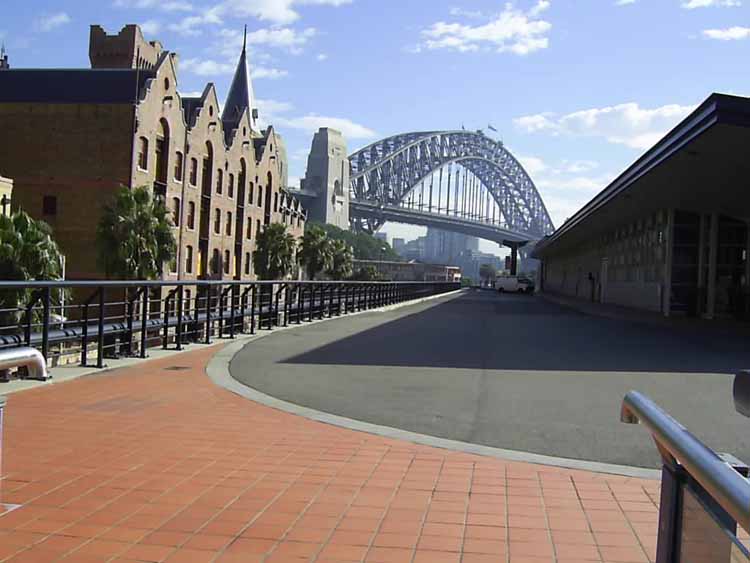
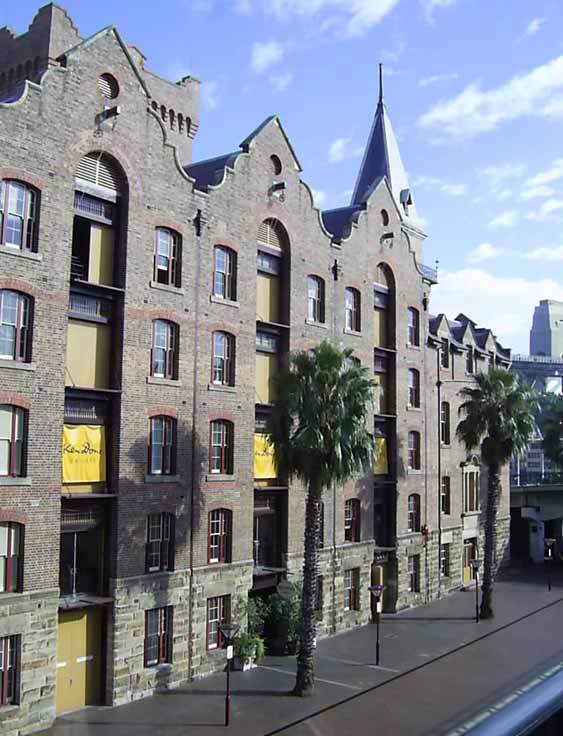
So in late 1868, William had the task of overseeing the merger of the Q.S.N.Co with the Australasian Steam Navigation Company, which went on to prosper. Later on A.S.N.Co erected a warehouse of great architectural merit on the waterfront at Circular Quay.
Designed by William Wardell, it was erected in 1883-4, well after William had retired to Hobart Tasmania. Images come from:
Sydney Architecture. com.au. Early Anglo-Dutch style.
Returning to the life of the family:
According to the records, Elizabeth had had another baby on 7th October 1860, in Sydney. Perhaps she came to Sydney first to find a home for the family. The baby was a girl, named Marion, who grew up and seems to have been an invaluable help to all.
The NSW Government Gazette records that Mrs W Westgarth was living at Surry Hills on 15th June 1862.
More babies were born in Sydney. Francis was born and died in 1863, Deborah was born in 1864 dying in 1865 and Frederick was born and died in 1866. Violet was born 1867 and survived to marry Cyril Field and have three children. Lastly Mabel G was born in 1869 but died in 1875 aged 6. All those childhood diseases were still around, also TB, but the greatest killer was gastroenteritis.
Sydney Water:
Sydney’s contagious diseases and underdeveloped water supply meant high infant mortality. According to Water NSW, before 1859 sewage was pumped into the harbour and clean water had to be bought from Busby’s Bore. From 1859, water was pumped from the Botany Swamps to a reservoir at Crown Street and later at Paddington. A sewage farm was begun at Botany. It does not seem like a sterile system!
In 1874 the family was living in Darlinghurst Road. From the NSW Government Gazette of 20th May 1874, is this record of property stolen from 229 Darlinghurst Road, a terrace house not far south of Kings Cross. No 233 still exists, but 229-231 are now the Kirketon Hotel.
“Stolen, between the hours of 1 and 2 p.m. the 13th instant, from the verandah of No. 229, Darlinghurst Road, the property of William Westgarth, A blue woollen shawl, a little soiled in centre ; value, 15s. Identifiable.”
This extract indicates that the sort of petty crime for which so many of our Australian ancestors were transported, was alive and well in Sydney at that time. There is a whole page given to stolen items. Fifteen shillings would have been a useful sum in those days.
Courting and Marriage:
It seems probable that one of the daughters had been careless with her shawl! Elizabeth Ann would have been courting with Arthur Tidman Lloyd, a customs officer, whom she married in 1876. They would have seven children.
The year before, in 1873, Edith had married George Wood Tate, a merchant. They would have three daughters. A shipping company manager would be happy to have a customs officer and a merchant for sons in law! They all go together quite nicely!
George Charles had also married. He married Florence Sophia Rodd on 2nd July 1872. Florence’s father, John Savery Rodd, was a man of property, but he had died two years before. The story of the marriage of Florence Sophia’s parents is very interesting. I will include it in the story of George Charles.
William has a new job and some wealth:
From page 981 of the NSW Government Gazette, we can see that in 1873 William had an office in Spring Street. He is associating with an H McLean. JD McLean (brother?) was a signatory to the Q.S.N.Co letter above.
William now had the wealth to buy shares in the new mining companies:
MEMORIAL.
I, THE undersigned, James Edwin Graham, hereby make application to register the “Ponsonby Copper Mining Company (Limited),” under the provisions of the ” Mining Partnerships Limited Liability Act, 1861 ;” and I do solemnly and sincerely declare, that the following statement is, to the best of my belief and knowledge, true in every particular, namely:
1. The name and style of the Company is the ” Ponsonby Copper Mining Company, (Limited).”
2. The place of operations is at the Ponsonby Mine, in the parish of Ponsonby, near Bathurst.
3. The nominal capital of the Company is seventy-five thousand pounds, in seventy-five thousand shares of one pound each.
4. The amount already paid up is sixty-six thousand pounds, forty-five thousand of the said shares having been allotted as paid up to eighteen shillings per share, and thirty thousand of the said shares being allotted as paid up to seventeen shillings per share.
5. The name of the Manager is James Edwin Graham.
6. The Office of the Company is at number 227, George Street, Sydney.
7. The names and several residences of the shareholders and the number of shares held by each at this date, are as follows :-
Number of shares Names and Residences. paid up to eighteen shillings.
John Nepean M’Intosh, Bathurst 10,000
Thomas Quinn, Cow Flat, near Bathurst 6,500
John Sharpe, Bathurst 6,875
Ernest Sharpe, Bathurst ° 6875
Whittingdale Johnson, Bathurst 6,770
Harold M‘Lean, Phillip-street, Sydney 2,500
William Westgarth, Spring-street, Sydney 2,700
George Robert Whiting, Hunter-street, Sydney 900
James Milson, junior, North Shore 1,000
William Burnett, Bathurst 875
Total: 45,000
The year before, 1872, he took 200 shares at 10 shillings each in the Rex Tin Mining Company in Inverell and agreed to another 500 contributing shares at 10 shillings.
“Westgarth William Sydney 500” (from the NSW Gazette, page 397)
Trouble for William:
In 1874 William was caught up in a legal battle over unpaid debts to which he is a garnishee (a third party who is instructed by way of legal notice to surrender money to settle a debt or claim)
From the orders of the Supreme Court of New South Wales on 2nd and again on 3rd September, 1874, William and two others are responsible for the debts of the Australasian and American Mail Steamship Company, because the owners of the business are not residents of the colony. So it seems William has changed jobs, but it is not a favourable change for him.
“A garnishee order is a serious matter, as it means a court order has been made to allow creditors to recover debt from third parties. They can do this in a number of ways, including taking money from the debtor’s bank account and/or from their salary. If you are issued with a garnishee order you should act quickly to explore your options and make an informed decision about your next step forward – otherwise, the situation will only get worse.” (Australian Debtsolvers .com.au)
From the NSW Government Gazette page 2718, is the following legal notice:
In the Supreme Court of New South Wales.
WHEREAS an action has been commenced in this Court, at the suit of the above named David Frith Aitchison, against the above named Hayden Hezekiah Hall and Paul Forbes, to recover the sum of three hundred and sixteen pounds and eightpence, for work and labour done and materials supplied by the said David Frith Aitchison, for and upon the retainer of the said Hayden Hezekiah Hall and Paul Forbes, carrying on business under the style or firm of ” The Australasian and American Mail Steamship Company” : And it being alleged that the said Hayden Hezekiah Hall and Paul Forbes do not reside within this Colony or its dependencies, a Writ, of Foreign Attachment has been issued, returnable on the eighteenth day of September instant, wherein William Buyers, William Westgarth, and Thomas Wood, all of Sydney, are garnishees : Notice is hereby given thereof; and if, at any time before final judgment in this action, the said Hayden Hezekiah Hall and Paul Forbes, or either of them (or any person on their or either of their behalf), will give the security and notice, and file the appearance and plea required by the Act entitled: ” An Act to consolidate and amend the Laws relating to actions against persons absent from the Colony and against persons sued as joint contractors,” the attachment may be dissolved.
Between David Frith Aitchison, plaintiff, and Hayden Hezekiah Hall and Paul Forbes, carrying on business under the style or firm of” The Australasian and American Mail Steamship Company,” defendants.
Dated this 3rd day of September, A.D. 1874.
GEORGE PENKIVIL SLADE, Plaintiff’s Attorney, Exchange, Sydney.
Payment:
William was one of three garnishees liable for the debt. He probably paid his share. At that stage he had two children married and another courting or engaged. His wife was no longer bearing children and he had some property and shares.
You can see above that William was paying 2,700 pounds (£2700) for shares in the Ponsonby Copper mining venture, so he was well off financially and had made good alliances with the marriages of his children. He could well afford to pay for the work, which split three ways would be £105/7/- (Trust me, I went to school when we did sums in LSD)
Problems with Alcoholism
During his time as steamship company manager, William may have become a heavy drinker. Alcoholism was a major problem of the time. I quote:
At first, 1862, the family was living in Surrey Hills, in 1870 it was Five Dock and by 1874 they were in Darlinghurst Road, but George Michael Westgarth has found evidence that they also lived at Argyle Street in The Rocks and Potts Point. Perhaps they were unlucky with their leases, or had to move to bigger premises as the family grew, or perhaps domestic troubles caused by alcoholism drove them to new premises.
What Happpened to Edwin Westgarth who arrived with the family?
Edwin, William’s younger brother, returned home to England, from Victoria, about 1874. In 1901, the census below reported that he was married and living in North Yorkshire with his wife, Esther. He was aged 69 years and Esther was 63. See last entry on the page.
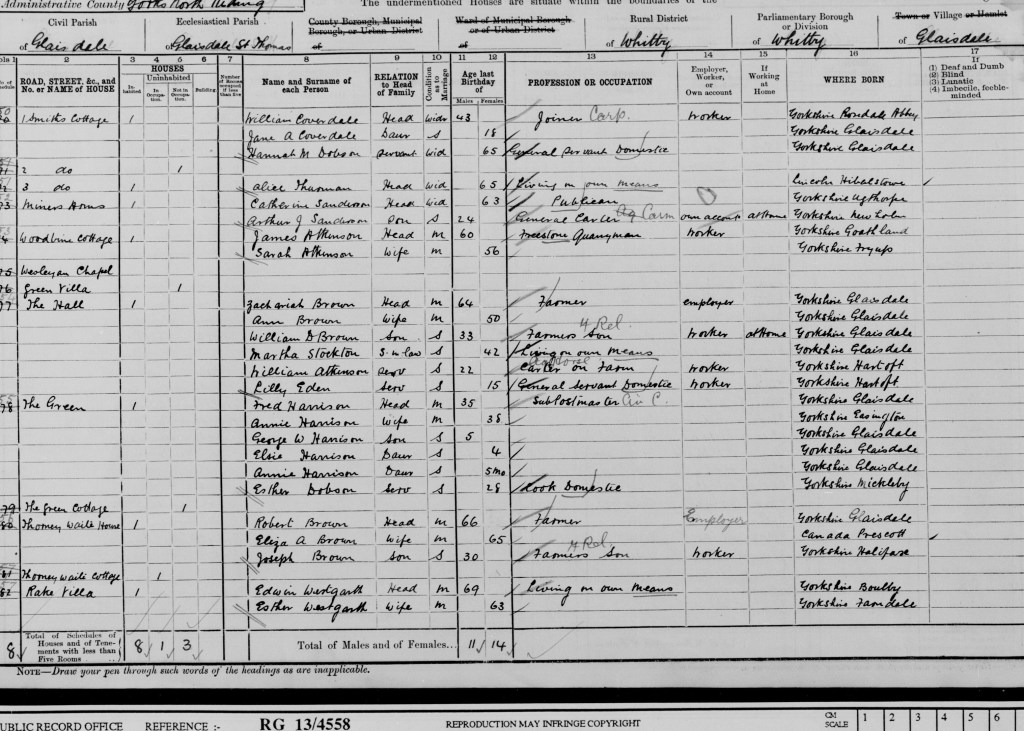
They were living at Rake Farm, Glaisdale and they were able to support themselves. You can look up the sales brochure at: https://www.peterillingworth.co.uk/. The number of barns and pens for animals bears witness to the productivity possible on this farm.
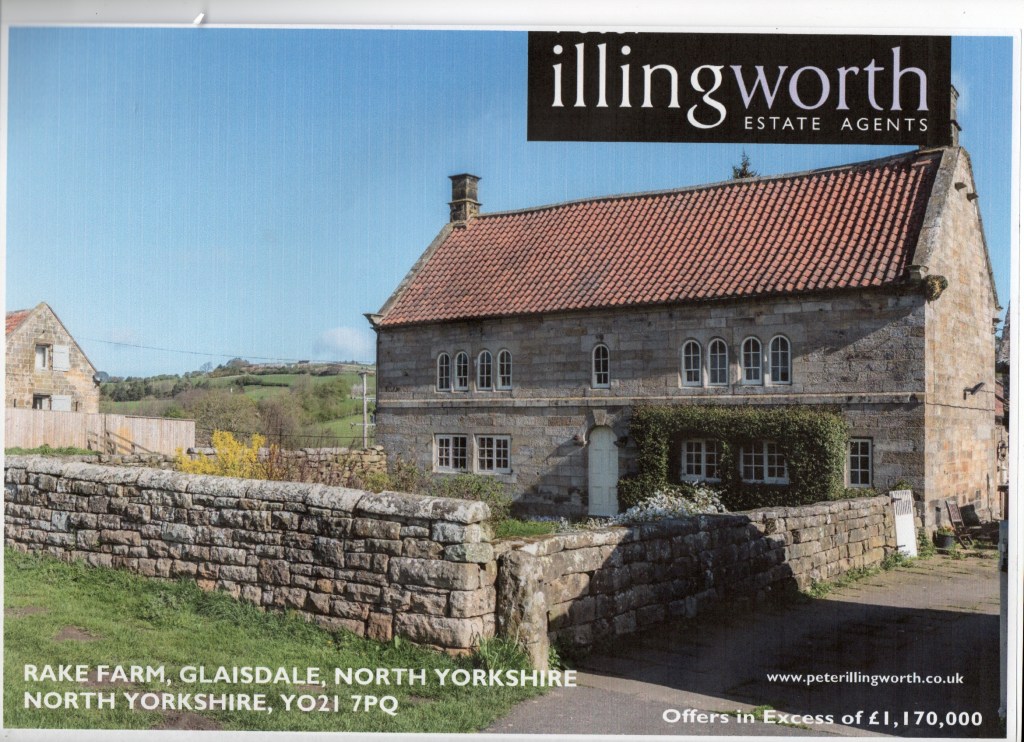
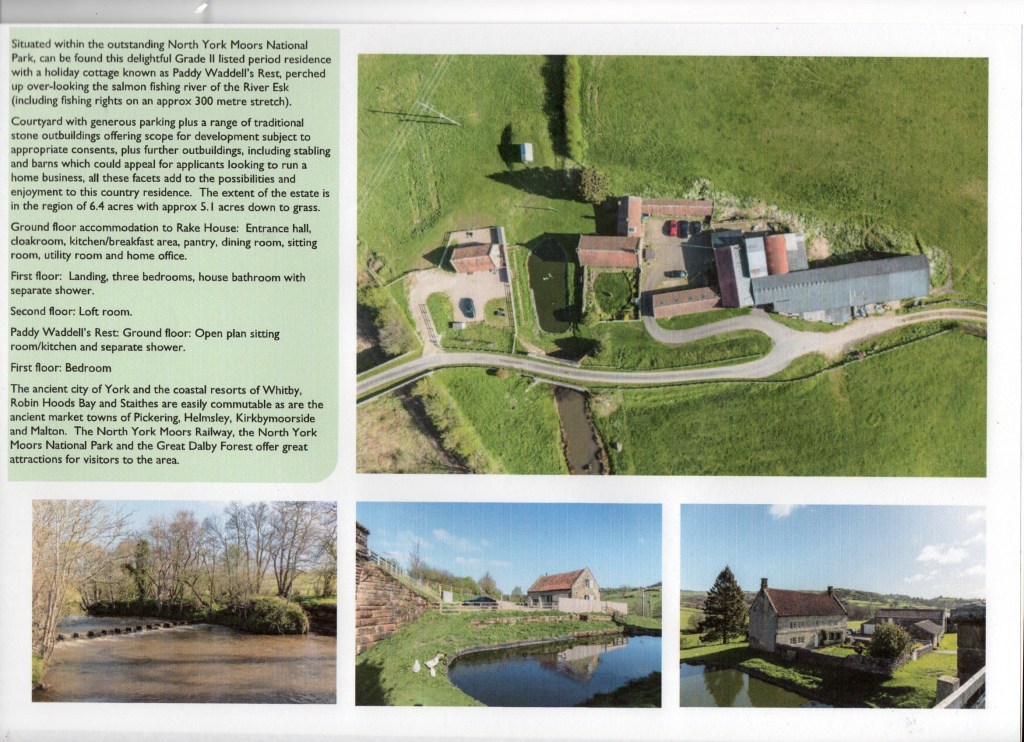
William and Elizabeth move to Hobart:
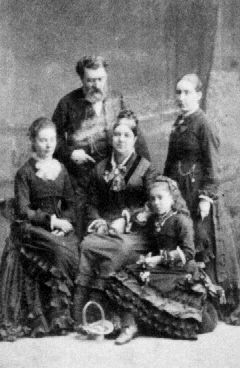
Elizabeth Ann married in 1876. Then in 1877, William changed the course of his life when he and Elizabeth and the remaining children purchased Westella House, 181 Elizabeth Street, (which is still extant in Hobart). They turned the building and grounds into a private hotel. Florence, 21, Marion, 18 and Violet, only 10 years old would have gone to Hobart with them. Lots of family to help with the guests! My records show the girls were all baptised together in 1878. Here is a family group taken around that time from the looks of the daughters. It might be advertising for the hotel or it might be on the day of the baptism?? I think it is a piece of early advertising, showing the hotel guests a united and loving family.
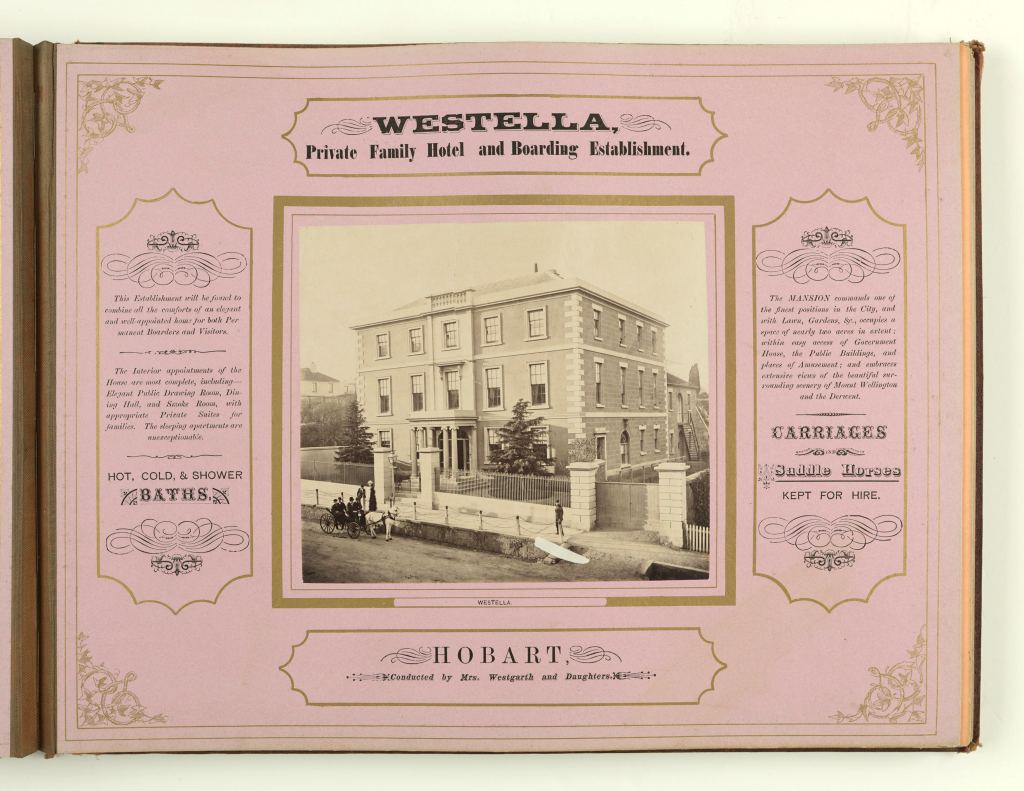
“Westella was built in 1835 by Henry Hopkins, merchant and philanthropist. Westella House was opened as a “first-class boarding establishment” in Hobart Town in 1877 by William Westgarth who was the proprietor from 1877 through 1895.” (www.flickr.com) Below are images of the building posted by Geoff Ritchie, 23/2/2014 on his blog ‘On the Convict Trail’
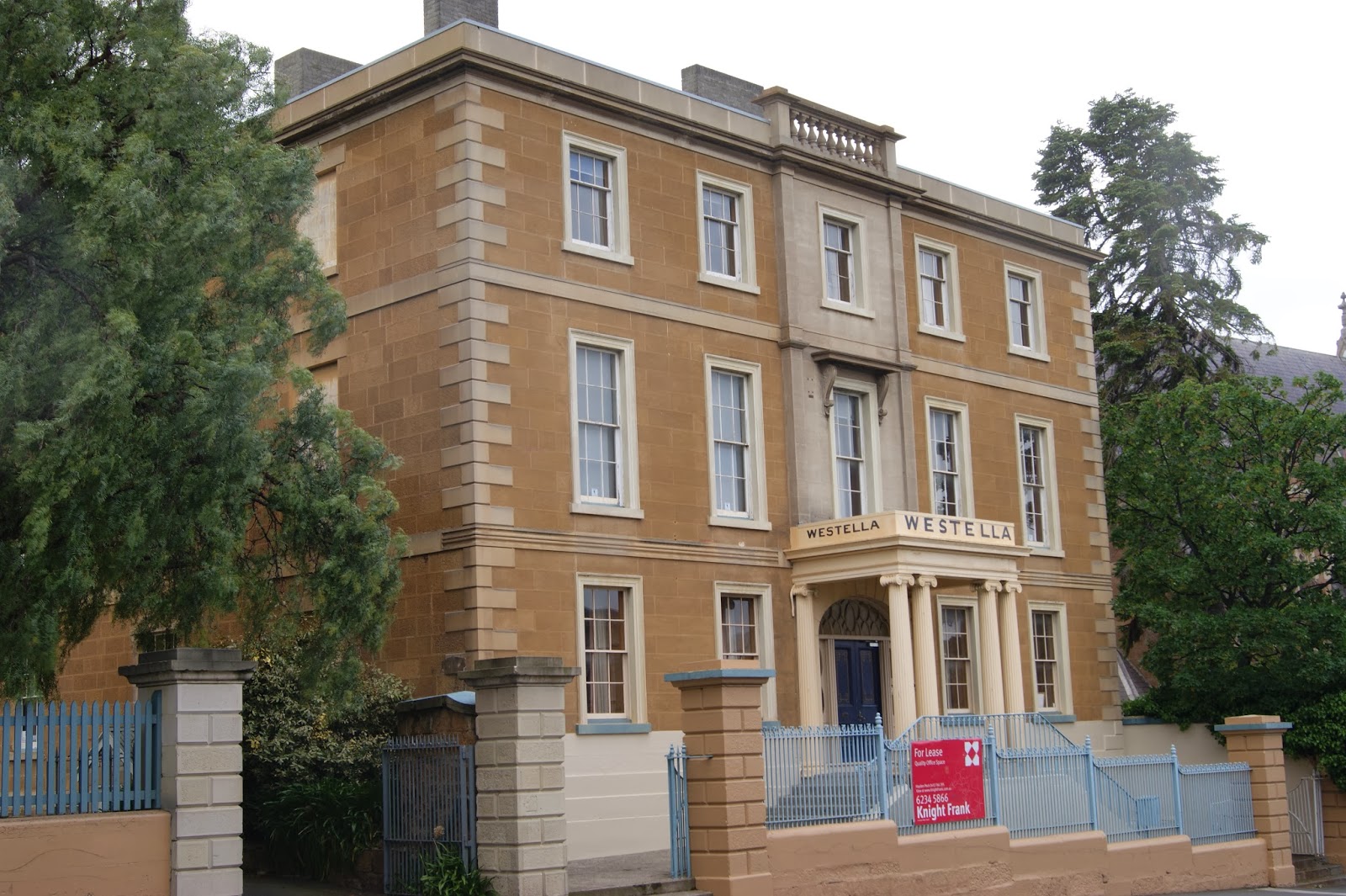
Built for Henry Hopkins, merchant and philanthropist (Hobarts first woolbuyer and exporter) credited with the foundation of Congregationalism in Tasmania, it is an outstanding example of a large colonial residence in the style of a Grecian Villa and is probably the finest remaining Georgian townhouse in Australia.
Henry Hopkins:
Hopkins arrived in Hobart Town in 1822 with a shipment of boots when they were in short supply. Mather and Hopkins became partners, and as retailers and buyers of produce opened a small shop in Elizabeth Street. As Hobart’s first wool buyer, Hopkins was credited with the entire export of the colony in 1822: twelve bales of wool bought at 4d. a pound, and sold in London at 7d……………………………..”
After ten years of exporting wool, in 1835 he was wealthy enough to build “Westella House”, then the biggest in Hobart Town, and still standing today. It had 48 rooms and the dining room could seat 60 guests. The great square stone house which still stands in Elizabeth Street, a landmark from which, in the absence of a Town Hall, were proclaimed the governor’s orders on King William’s death, Queen Victoria’s accession, (1837) the birth of Edward Prince of Wales, and later the cessation of (convict) transportation (1853).

According to Geoff Ritchie, the property is still in magnifiicent condition and is currently used as corporate office space.
Life in Westella:
The suggestion of William’s alcoholism becomes a public knowledge after the Westgarths became hoteliers in Hobart. William, the host, once again would have been led into temptation, drinking with guests. By 1882, things had become so violent that he was taken to court by his wife. At the time, there were Florence, Marion and Violet living at the hotel and probably William Henry, who was still single.
HOBART POLICE COURT
The Tasmanian Saturday 18th March 1882
Westgarth v. ‘ Westgarth was a charge of assault brought by Mrs. Westgarth against her husband, the proprietor of the Westella lodging house. Mr G.E. Featherstone appeared for the complainant. From the evidence it appeared that the defendant, who had been drinking and was under the influence of drink in the Court on Monday morning, used very bad language towards his wife and daughters and seized his wife by the throat, threatening to choke her.
A waiter on the premises who took the defendant away, witnessed the assault and testified to the frequent abuse to which the complainant was subjected. Defendant called no witnesses for his defence, but he made a statement by which he sought to defame his wife and prove himself a persecuted man. The Bench considered the assault proved and characterised it as of a malicious and unprovoked nature.
Defendant was fined 5 pounds, or in default sentenced to six months’ imprisonment and was also ordered to find two securities of 25 pounds each for his good behaviour for six months; in default of finding such securities to be imprisoned for six months.
Shame:
This is a shameful situation for William, brought on by alcoholism. It is a situation which must have been going on for a long time. And he was not alone in his vice:
Florence marries:
In 1883, during this period of ignominy for her father and unhappiness for her mother, Florence married John Wilson in Sydney. This must have been a welcome holiday, away from the hard work and stresses that the family were experiencing.
William goes “Home”
William now had a good behaviour bond on his head, or else imprisonment. He served out his 6 months probation on good behaviour, in return for a 6 month suspended sentence.
In March 1884 William again faced charges of verbally assulting Elizabeth. Elizabeth again had cause to call police and a court date was set. William however did not face the the court, instead he shipped out to England and did not return to Australia or Westella for a number of years. Violet may have gone with him.
William had the excuse of going to England to visit his father, his brother Edwin and other family members. George Westgarth was hale and hearty in the 1880s and he did not die until 1895, not long before William (1897). George died in Whitby, where he had been living when William was born.
William meets William C Westgarth
William was back at the hotel in 1888 when the famous William Westgarth stayed at Westella. Since March 1885 Marion had become Co-Proprietress. She was now 25 and was not engaged to be married. As the eldest unmarried daughter, she was ‘Miss Westgarth’.
Her younger sister, Violet, was only 18 years old, not yet an adult. In 1888, Violet turned 21. She was not mentioned being at the hotel when the two Williams met in Hobart in Winter 1888, so she was probably with George Charles in Sydney. By 1889 we know she was staying with her brother George Charles’ family at St Helens, Campbelltown, because his son wrote about her in his letter. In 1890 she was married in England.
Personal Recollections:
The famous William was making a visit ‘from the other hemisphere’ and afterwards published ‘Personal Recollections of Early Melbourne and Victoria’. This document may be read online from the Australian National Library. Incidentally the author would die the very next year. I hope it was not from the effects of his voyage! This is his recollection of the life of Westella, the Westgarths and of Hobart in that year:
“WESTELLA HOTEL – My first salutation came from an exact namesake of mine, Mr William Westgarth, whom I had known in Melbourne thirty-five years ago (1853) and who, after varying fortunes, had for the last dozen years been conducting a superior class of boarding house or family hotel. It was called Westella, and was situated in Elizabeth Street, the chief thoroughfare of Hobart. The house I recollected as that of Mr Henry Hopkins, a very early merchant of the city, whom I had met more than once between forty and fifty years ago. It was the undisputed palace of the city of its day; nor was it disposed, even now, to bend its head to any second position. As my friend conducted our party over the pretty scene of garden and cliff behind the house, we found it all wrapped in frost, except where the bright morning sun had struck, and we broke the ice quite quarter of an inch thick, on a fishpond of the grounds. Thus Tasmanian ascendancy in the civilized world is secured.
PROGRESS OF THE ANTIPODES – Already we began in Hobart and we continued as we went further north, to meet with indications of the progress of the age, quite abreast of and indeed rather ahead of, all that we have been used to at Home. For instance, we were hardly settled comfortably within Westella, when the waiter announced that Mr Fysh, the Tasmanian Premier, wished to see me. I had met Mr Fysh in London, and I quite expected that he wished to have a talk with me about Tasmanian Finance and Loans. “Is he waiting?” I asked, jumping up at once to go to him. “No, sir,” was the reply, “but he is speaking to you through the telephone.” I passed to the telephone room and the signal being sent that I was in attendance, I was given two ear caps and told to listen. A clear, but also “a still, small voice” came up as from the “vasty deep”. Whether from the smallness of it or from my being unaccustomed to that mysterious sort of thing, I did not catch the words and had to relinquish the business to our hostess, Miss Westgarth, and thus a meeting was conveniently arranged.
AUSTRALIAN FEATURES – Fortunately for us, we had arrived in a leisure season in the hotel way, so that our host was free to devote himself to us in sightseeing, and thus, with hardly a day and a half to spare, we got a fair idea of Hobart, including a drive along the Huon Road, in whose shaded valleys we found as much snow and ice as though we perambulated the Scotch Highlands in January. This had been however, an exceptionally severe winter. On the way to Government House, my eyes were once more regaled with the gum trees……………”
This is a first hand account of the life of the family. William was evidently very pleased to accommodate his famous guest in every way. The ‘Miss Westgarth’ referred to, would be Marion, who would not marry until 1913.
Our William must have been proud to have been the one to introduce his guest to the telephone. The hotel, “the undisputed palace of the city”, must have been profitable to have had such up to date and expensive equipment.
Elizabeth Westgarth:
In spite of the “varying fortunes” of her husband, Mrs Westgarth carried on a responsible and well regarded business, as shown by these newspaper articles (from Trove)
- Advertisement:
WANTED 16/11 1885
First-class FEMALE COOK. High Wages.
Mrs. WESTGARTH,
Westella.
2. In the Hobart Mercury, October 29th 1890, I found this newspaper article which represents the success of the hotel business and its status in the Hobart community.
IMPROVEMENTS AT WESTELLA
The visitors’ season is rapidly approaching and bearing in mind the experiences of last year and the demand for accommodation, Mrs Westgarth, the proprietress of this private hotel, has recently made condsiderable improvements and additions thereto. Foremost among these is the erection of a chalet adjacent to the main building, a two-storey erection providing additional bedroom space, the rooms in which are all fine, lofty apartments with modern ventilating appliances and furnished with handsome suites, locally manufactured, of Tasmanian woods. That old favourite domicile, the Bungalow, has also been entirely renovated. A praiseworthy change too, is the erection of new stables, entirely removed from the other premises. Such additional room as has been thus gained in the main building has been converted into pantry, carving and kitchen rooms. In the carving room a special feature is the provision of an apparatus for keeping food hot based on the principle which has obtained on board ocean-going steamers, although slightly improved in this case. Visitors will not find any very material change in the appointments of the old rooms, they are complete as can be wished presenting every feature of comfort, even bordering on luxury. The tennis lawn looks brightly enticing and here too is noticeable a novelty, the marking lines of the courts being strips of wood let into the ground. Ferneries and summer-houses abound in all corners of the grounds and should form cool retreats when the thermometer indicates a height of temperature such as made Sydney Smith express the wish to ‘cast off the flesh and sit in one’s bones’. Such improvements with minor ones too nuumerous to particularise, go to make as complete a woile as the most captious critic could demand.’
The house was obviously set in beautiful and extensive grounds which were as important to the business as the furnishing of the rooms. Foreign words in italics denoted a proprietess of education and culture! Note that Tasmanian timbers were used for furniture instead of importing furniture from Europe. I have a Victorian round table bought by my parents in Hobart, but it is not Huon pine!
3. Advertising: November 19th 1890
RESIDENTS OF HOBART.
MRS. WESTGARTH Invites Inspection of
“WESTELLA,
Which is Now Entirely Renovated and Ready for the Coming Season.
In addition to the House proper there has lately been erected a Beautiful
CHALET” IN THE FERNERY.
The Cottage in the Garden has been Re-arranged, and the Grounds, Gardens
and Tennis Lawn are now in Perfect Order.
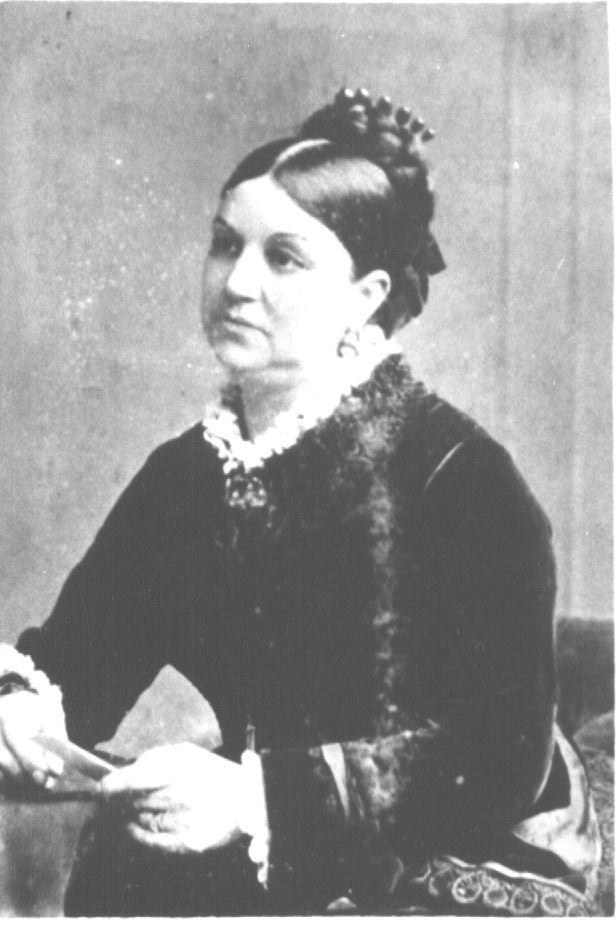
It seems that in 1890 the Westgarths were at the height of their success, mainly attributable to Elizabeth Westgarth who had had 14 children and then had the stamina to run a busy hotel. However, soon after that Elizabeth must have become unwell. She died on the 17th July 1892, leaving her husband in charge.
This sad notice appeared in the Hobart Mercury three months before her death:
THE TERMS FOB BOARD AND RESIDENCE AT
” WESTELLA,”
PRIVATE FAMILY HOTEL,
ARE NOW REDUCED TO TWO GUINEAS per week.
MRS. W. WESTGARTH, Proprietress.
(4/4/1892)
Another court case:
Now William was running the hotel and back in court for assault.
The Mercury Hobart Saturday 11 March, 1893, Page 3
SUPREME COURT.
The Supreme Court will sit in its £100 Jurisdiction on Wednesday next, before Mr. Justice Dodds. The following are the cases set down for hearing:
Jones v. Thompson, damages, £100; Parker v. Johnston, money payable, £13 10s.9d.; Bennett v. Males, damages, £15; Dickenson v. Mace, money payable, £1313s. Fitzroy v. Miller, trespass, £30; Hume vs Westgarth, assault, £90
Launceston Examiner 16th March 1893 page 5 reported the outcome:
In the case of Hume v. Westgarth, assault, £90, a verdict for the plaintiff for one shilling was returned, each party to pay his own costs.
With the loss of Elizabeth from the business, there was only the old alcoholic William and his faithful daughter, Marion to run it. The hotel became cheaper and was subject to tales such as the guest who went missing at the waterfront.
Advertisement 12/7/ 1893
Reported Missing.
Mr William Westgarth reported to the police last night that on Sunday, the I1 th inst, a second-class passenger by the R.M.S, Rimubava, named J. F .Hill, came to Westella and left his luggage consisting of two large portmanteaus and one small hand-bag. After dinner he left stating that he would go down to the steamer and see her off. He has not since returned. His description is given as that of a man about 40 years of age, height 5ft 7 ins, stout build, fair complexion, wearing moustache and side whiskers, and wore a brown tweed suit, black band hat.
And this:
TASMANIA POLICE GAZETTE 1894
MUNICIPALITY OF HOBART
Stolen from ” Westella,” Elizabeth-street, on the 12th instant: A green ham, about 20 lbs., value 15s; the property of Mr. William Westgarth.
Even the kitchen staff were stealing! I am sure it was unlikely that he would get the ham back, even if it was salt meat!
In 1895 William sold up and went to Sydney with Marion.
Leaving Westella:
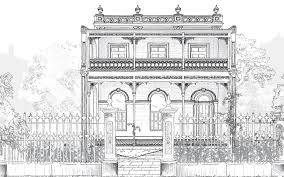
William took up residence in Glebe, which was the site of the 96 acre Toxteth Park, owned by the Allen family. William’s daughter-in-law, Lucy Florence, was an Allen. Her mother was Mary Emma Allen. ( See the blog about George Charles for information about the Allens). Thanks to Elsie Ritchie for the information about Edith Isobel, her forebear.
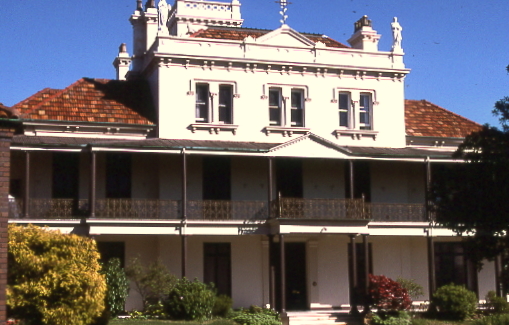
William not surprisingly named his house on Toxteth Park, ‘Westella’ after his hotel in Hobart. I have a photograph of the house, built in the late Victorian era, ( 1837-1901). Here it is:
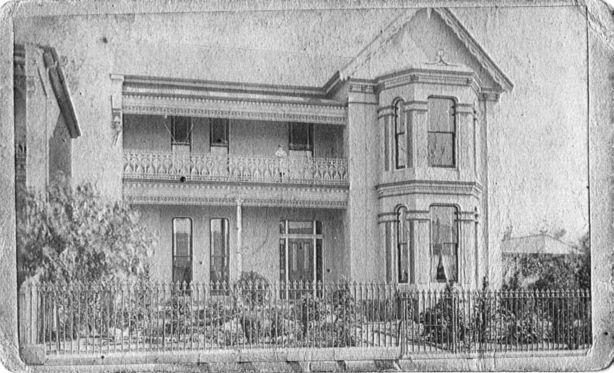
Edith Isobel:
From 1877, when George Allen died, his widow decided to rent out Toxteth House. William’s second daughter, Edith Isobel and her husband rented it. Edith Isobel, the sister-in-law of Lucy Florence, lived in Toxteth House with her husband George Tate and their three daughters.
In the 1890s, George Tate, became very ill. By the time he died in 1896, the equity in his business had been exhausted and Edith Isobel and her daughters had to move to the house on the estate her father was renting with Marion and which he had called ‘Westella’. Edith and Marion, who were sisters of course, shared domestic duties until the death of William.
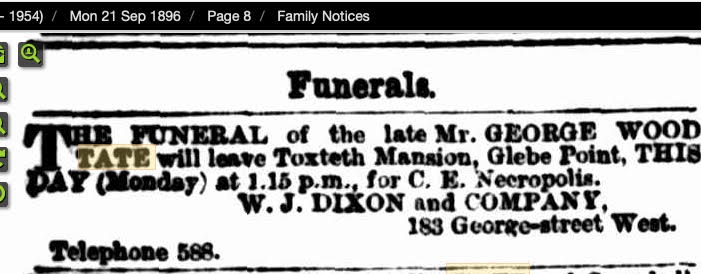
William lived till 1898. After the death of William, the house, was sold and the Edith Isobel and her youngest daughter, May, moved around staying with relatives until May married at the age of 18.

Florence Maud:
Florence had married John Reginald Wilson in 1883 and was living in Leichhardt with her 4 children, two boys and two girls (John, Vera, Frank and Dorothy).
Her husband John Reginald Wilson was born on 14 December 1853 in New South Wales, Australia and died on 29th September 1913 in Leichhardt, New South Wales. Florence Maud had already died on 5th January, 1909 at Leichhardt, not long after the deaths of her brothers in 1908. Her death notice is in the Sydney Morning Herald of Jan 6 1909. Leichhardt is not far west of Glebe and also borders the Harbour.
Marion:
Marion was already 33 years old when she came to Sydney with her father, William. In Hobart, she must have been very important in the running of the private hotel and in the care of her dying mother. In Glebe, once again she must have been invaluable, looking after her ailing father and helping Isobel with her three daughters.
Marion was 53 when, in 1913, she married Charles B. Richards, an American born in Michigan, Illinois in 1848. Charles was already 65 years old and had been married twice before to Australian wives. Evidently the marriage had no issue. They lived in Sydney.
George Westgarth told me: ‘It is my understanding that Marion ran a dress making business for many years, holding a particular patent for a dress making system, as well as being the head mistress of a dress making school in Sydney.’
Charles Richards’ second marriage had lasted longer and produced four children of which only two males survived to adulthood. This wife left him in 1908 and took both sons to the west coast of the USA. Charles Richards committed suicide (bullet to the brain) in Sydney in 1915. He is buried in the Church of England Cemetery in Randwick’.
Marion moved to the USA after the death of Charles, probably to keep in touch with her stepsons, because she was still calling herself ‘Richards’ when she died..
Elsie Ritchie told me: ‘Marion did not move to the USA for some years after his death. Then she revisited Sydney in 1920 at the same time as Edie, one of Edith’s children, travelled to Sydney. Later, in Los Angeles, Marion married again, to Nelson Brackett. In the marriage certificate she is listed as a widow. Nelson Brackett died in 1927.‘
Marion published a book entitled Inspirational Poems and Song Lyrics. Barbara Cohen, daughter of George Mansfield Westgarth, paid her a visit in the 1940s. (Thanks to Neil Thornton for this information)
Marion Richards dies aged 92.
Marion reverted to her first married name of Richards, the name she was cremated under in 1952. What a long and eventful life! She was 92 when she died!
Thanks to Elsie Ritchie for this information on Marion in USA. One of Elsie’s books has relevance to the Westgarths through Edith Isobel, George Charles’ sister. You can find it on the internet:

Elizabeth Ann:
Elizabeth Ann, in 1908, was living at ‘Glenara’, Henley, Gladesville, NSW. Her husband, Arthur Tidman Lloyd, had died and Elizabeth Ann was an executor. She would live until 1930, surrounded by many children and grandchildren.
Tate Family:
Here is the Tate family tree for Edith’s children and grandchildren, supplied by Elsie Ritchie, the second daughter of Henry Carter. Edith was born on 19/9/1851 at Ormskirk, near Liverpool.
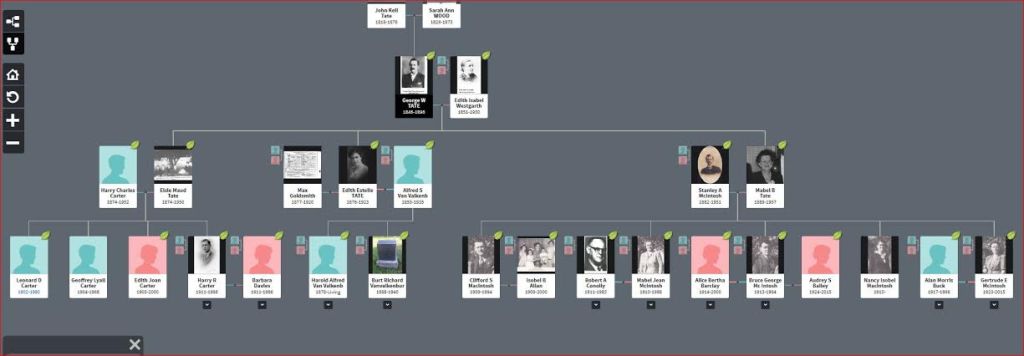
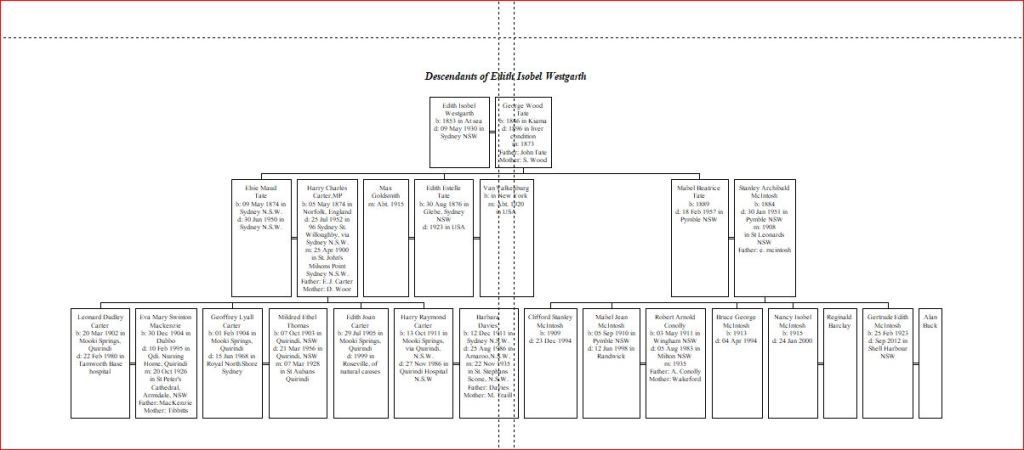
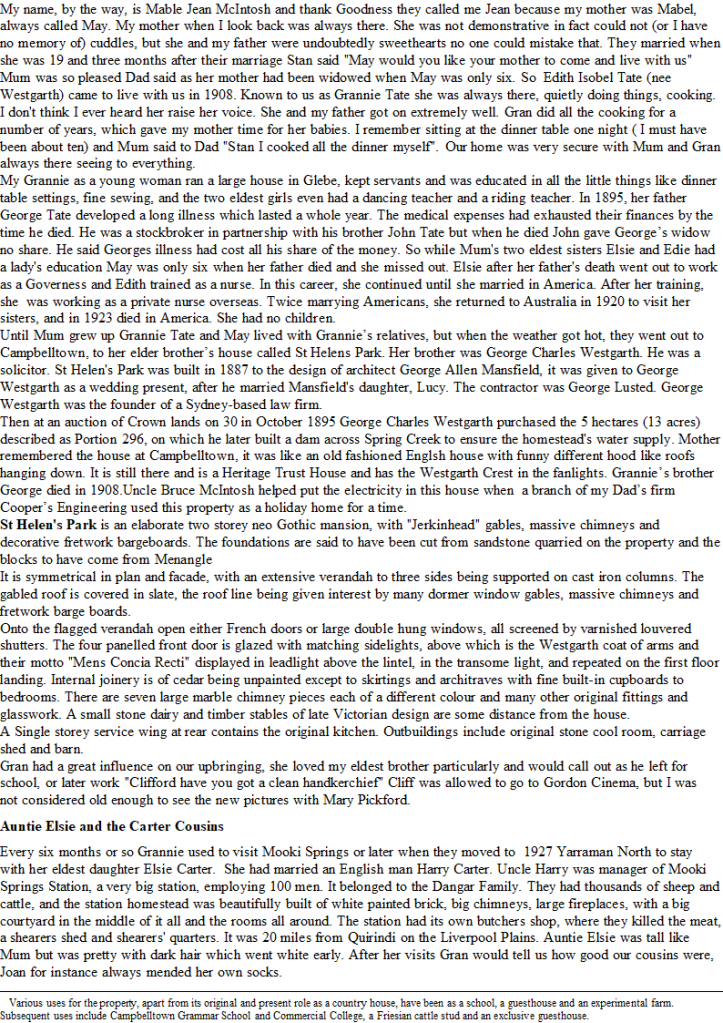
Edith Isobel and George Tate and had three daughters, Elsie, Edith and Mabel (Mae). This youngest daughter, Mabel , had a daughter, Mabel Jean, who wrote this account of growing up with Grannie Tate.
From Mabel Jean Connolly, nee McIntosh
More about Edith Tate from Elsie Ritchie:
A family party;
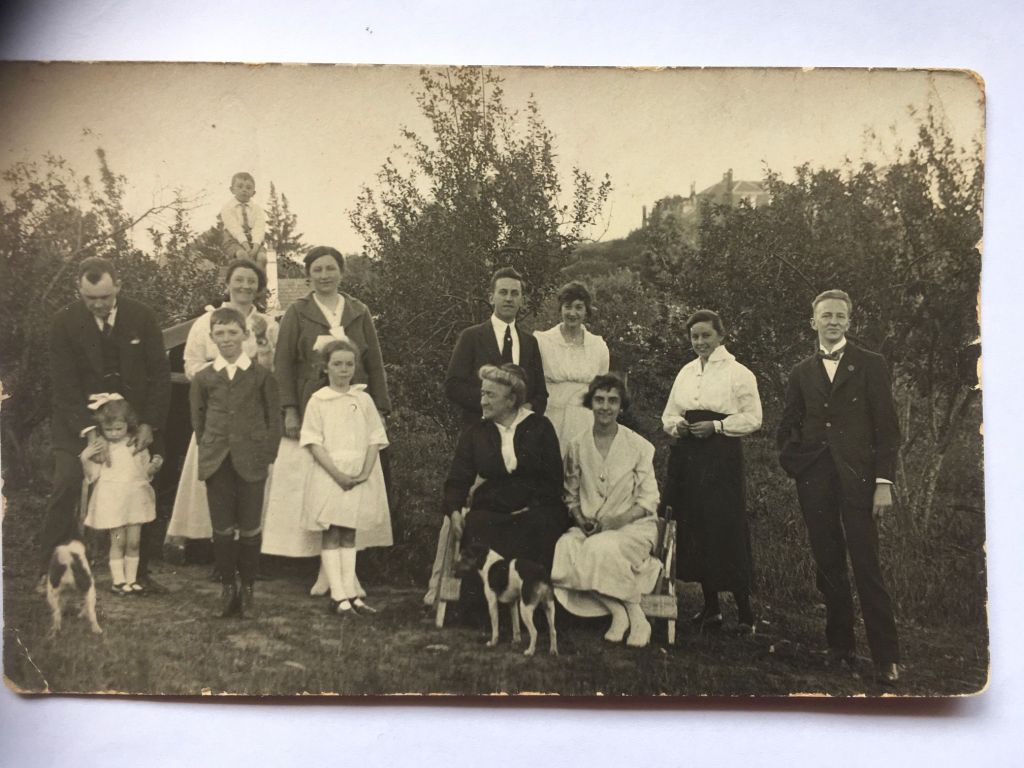
‘This picture, dated 1920, is of Edith Isobel Westgarth and her 3 daughters.
She is in the middle on the bench with Elsie next to her and Edie behind. I think Edie’s American fiance is the chap behind Edith Westgarth Tate.
On the left is her youngest daughter, Mae, with her 4 children and husband. Mae’s husband was told by her doctor she had to have help. The young woman next to Mae’s husband is probably the nanny. The eldest daughter is in front of Mae. She was 9. The young man and woman on the right of the group may be the stewards of the party.
Edie was back here in 1920 after being overseas for many years. Edie, got married in America in1922, but she died in 1923. I know that my grandmother, Elsie, is the girl on the bench as I have two other pictures of her in those days and I do have other pictures of second daughter, Edie. 1920 could well have been her second daughter’s return from America on a visit with engaged fiance, Samuel Valkenburg, and also a party for her mothers 70th. Edith would have turned 70 on 19/9/1921, so perhaps it was an early birthday party.‘
William Henry:
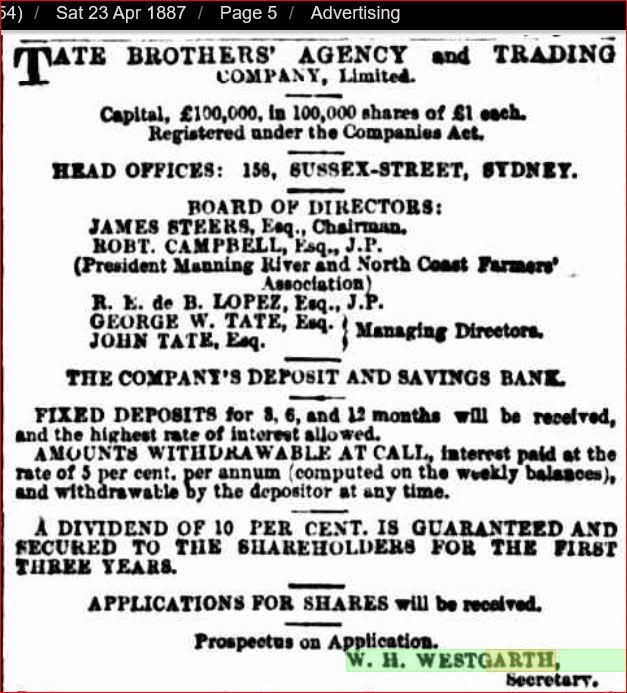
William Henry was a mystery to me until Elsie Ritchie uncovered some documents which unravel that mystery! William Henry became a company secretary like his father, so very likely he was trained by his father after William Henry came back to Sydney from school in Maitland. Whether Edith met George Tate through her brother, or whether William Henry got a job with Tate Brothers Agency and Trading Company Limited after Edith married George in 1873, I do not yet know. However, he was still working for Tate Brothers in 1887, two years after he had married Alice Satchall in 1885 at Raymond Terrace, near Maitland NSW.
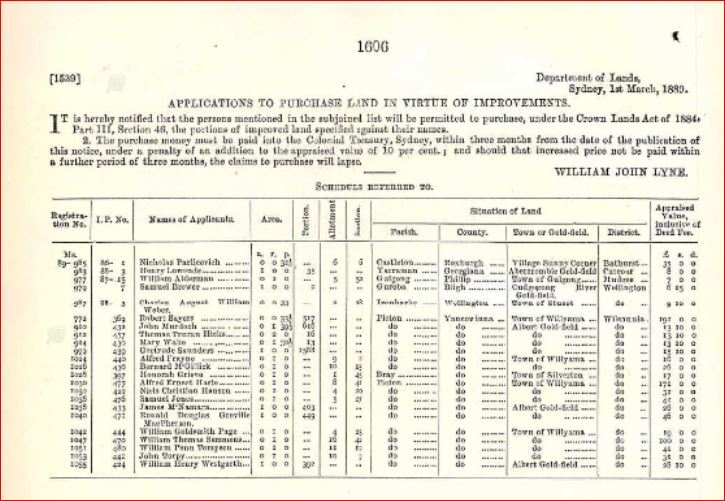
Like his father, William Henry invested in mining companies. Here he is listed at the bottom, buying a portion of the Albert Goldfield in the Parish of Picton, Town of Willyama in the District of Wilcannia. This is far west New South Wales. Whether he managed to pay for it in time and reap the rewards I do not know. This application is dated 1st March, 1880. Maybe he wanted to have enough money to marry Alice.
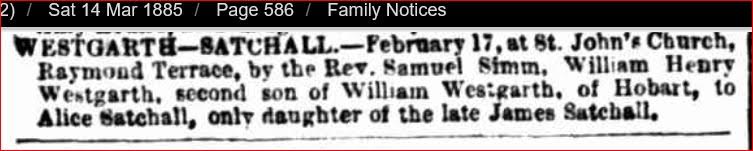
He and Alice seem to have gone to Tasmania around 1890. His mother, Elizabeth, was to die on 17th July 1892. After the death of Elizabeth. Cyril Archibald was born in 1893 in Hobart . A second child, Edith Olive was born after Westella was sold and grandfather William had gone to Glebe. She was born on 16th November 1899 and was only 19 at her death, she had no children, but she outlived her father.
In 1901 William definitely had a home at Sandfly, north of Hobart, because it features in the Tasmanian Post Office Directory 1901: Westgarth William H. landholder, Sandfly.’ However he may not have lived there more than a few years.
Perhaps he followed his father in all things and became an alcoholic. He had a large family and a wealthy brother in Sydney, yet he ended his life in a tiny town in western Tasmania. He became grocer and postmaster at Crotty in Western Tasmania.
Crotty
Crotty town reserve had been gazetted on 5 June 1900 and the town survey was completed in November 1900. It was designated to be the supply town for a new mining venture. By 1902 there had been development of over 150 dwellings, and 700 people living in the town, but the mining did not prosper. In 1990 the town was inundated by damming the King River.
Death of William Henry, the same year as his brother, George Charles.
William Henry died in Queenstown on the 12th April, 1908, just a few months before his elder brother!
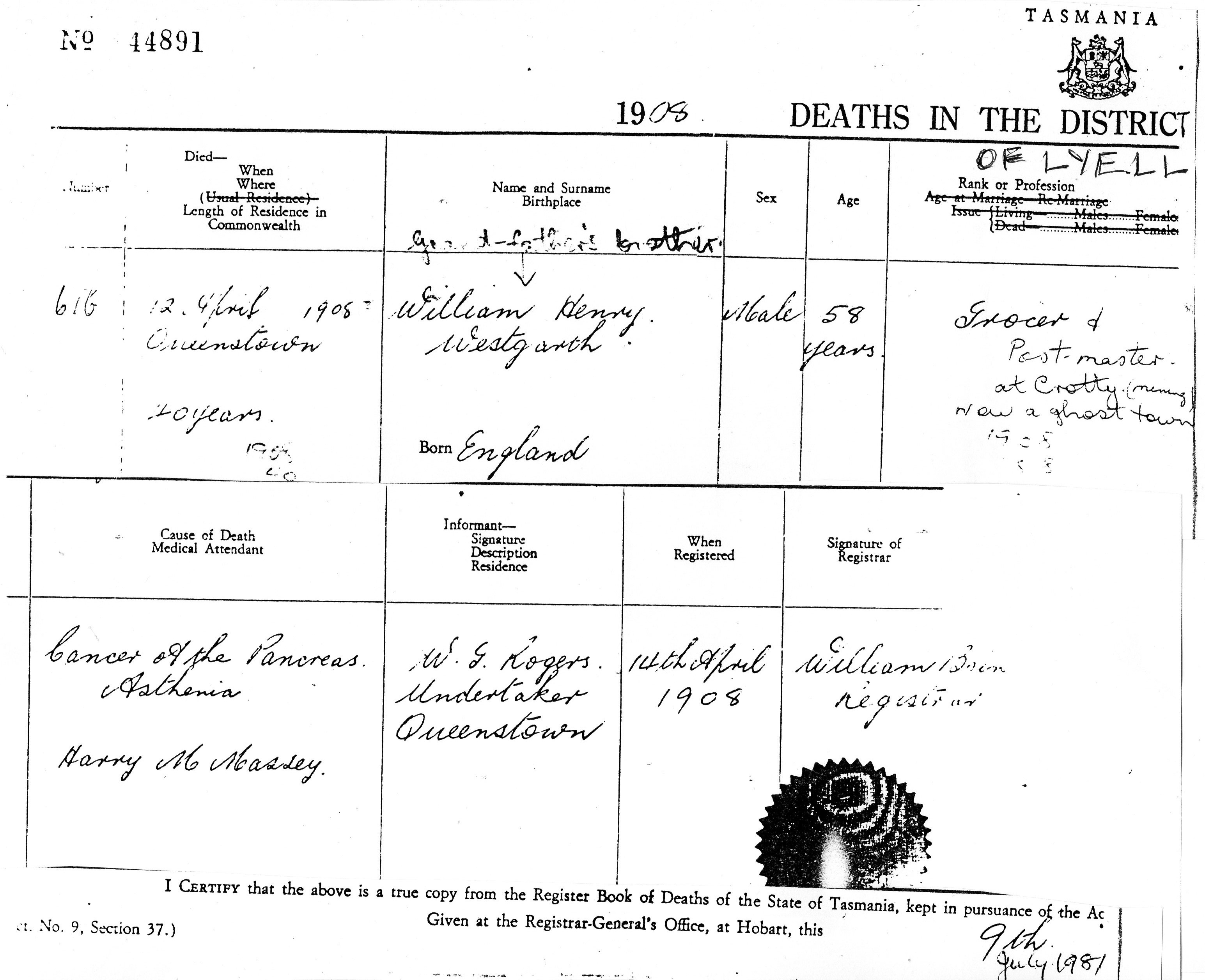
William Henry was born in May, 1848, he was actually 59. He was still in Sandfly in 1901, so it seems he could not have been in Queenstown for 10 years. Perhaps he moved across to Crotty in 1901 when the town was being constructed. Olive would have been about 18 months.
Violet:
The baby, Violet, at 23 years old, had married Cyril Field, a Captain of the Royal Marines, in England, in 1890. The couple lived in England for the rest of their lives and had four children: Dorothy Florence in 1890, Esme in 1892, Alistair (called Sandy) in 1897 and Marjorie in 1904. Violet was a great help to George Charles and Lucy Florence when they came to London in 1905-1906.
William in Sydney:
So when William arrived in Sydney, he had one married son and three married daughters around him and an unmarried daughter as well. He was an old alcoholic with a weak chest, but he had a flourishing family. Elizabeth Ann Lloyd had seven living children by the time he came back to Sydney, Edith Isobel Tate had three and Florence Wilson, four. George Charles had nine children, a town house and a country home, ‘St Helens’, at Appin.
Death of William:
Eventually the inevitable took place and his death certificate shows that William died in Glebe of oedema of the lungs (pneumonia?) when he was 73 years old. The death certificate, below, is very hard to read, but as he died on 5/2/1898, he must have only been 72.
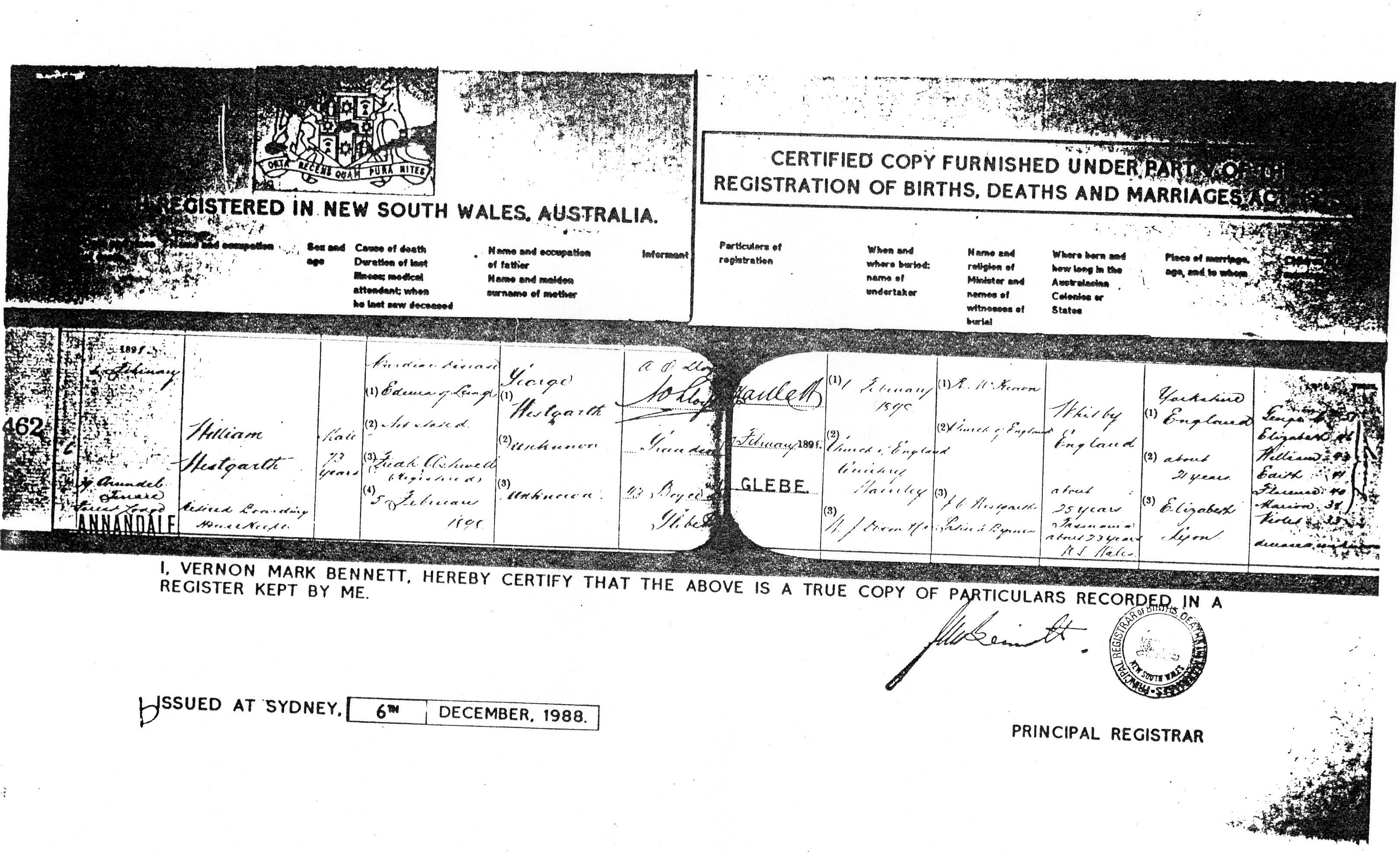
William’s Legacy
William did not have a legacy to leave to his children. It seems likely he was renting Westella in Glebe, unless it had been made part of a family trust. It was sold after he died. The New South Wales State Archives have no record of a will made by him. Here is the reply to my enquiry:
Dear Patricia, Thank you for your enquiry.
I have checked both our listings of Probate packets and Deceased estates and cannot find a listing for William Westgarth, who died at the Glebe, Sydney, 5 or 6 February 1898, aged 73 years. It does not appear that he left an estate that was probated or on which the NSW government charged stamp duty. It may be that he did not personally own the house or shares, possibly they they were in his wife’s name or part of a family trust.
Kind regards, Jennifer Sloggett
Postscript:
Although it is not directly our family, I would like to upload this article on Tintern, the house built by the other William Westgarth. It deserves to be known. Originally the house was built on 100 acres! A lot of houses now sit on the original block. Here is what it looked like in 1988:
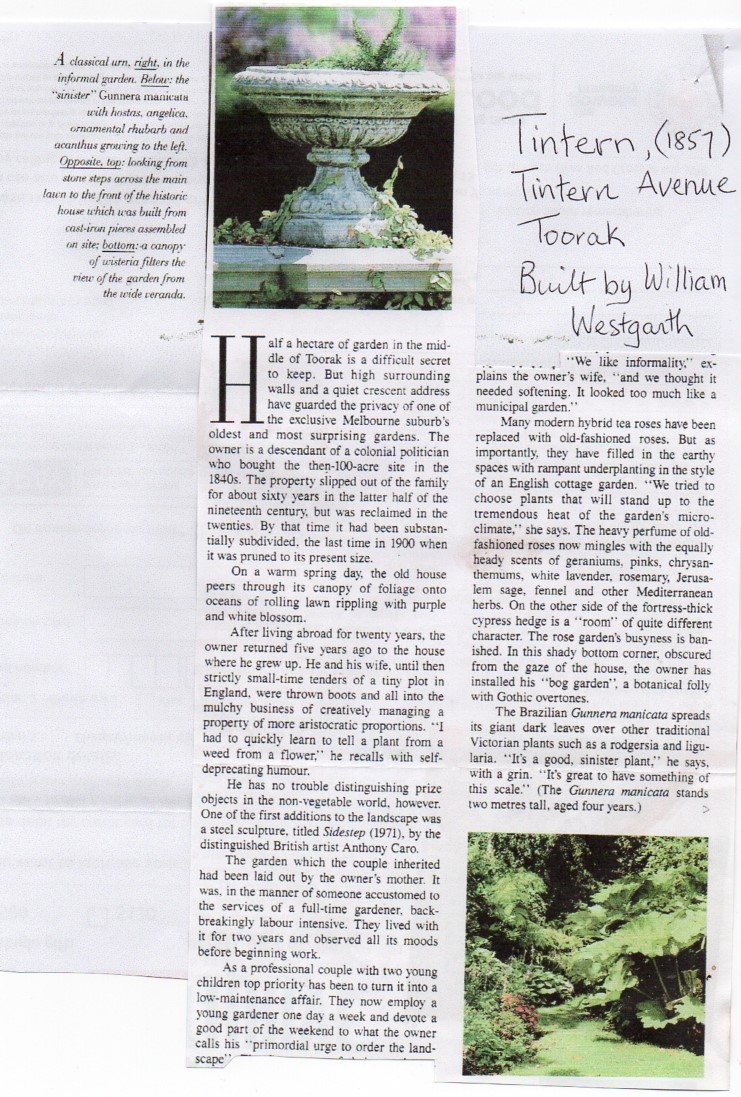
 westgarth and glassons