Introduction:
I set out to write this blog about the Westgarths because of my long relationship with Dudley and Kathleen, my father’s parents.
Kathleen was born Lucy Kathleen Glasson, so I have looked into her family history as well. The family has already been documented in the excellent book: The Glasson Saga by Mary Glasson as well as writing by the Reverend William Glasson, but I have copies of the letters of John Glasson, my grandmother’s great uncle, who was the first Glasson to emigrate. These letters are not online, so I am going to include them. The letters I have were typed by Olive Phllips, a granddaughter of John Glasson (daughter of his son John). They include a commentary written by Olive, who also researched and made notes on the letters written by the family in Cornwall. I have retyped them.
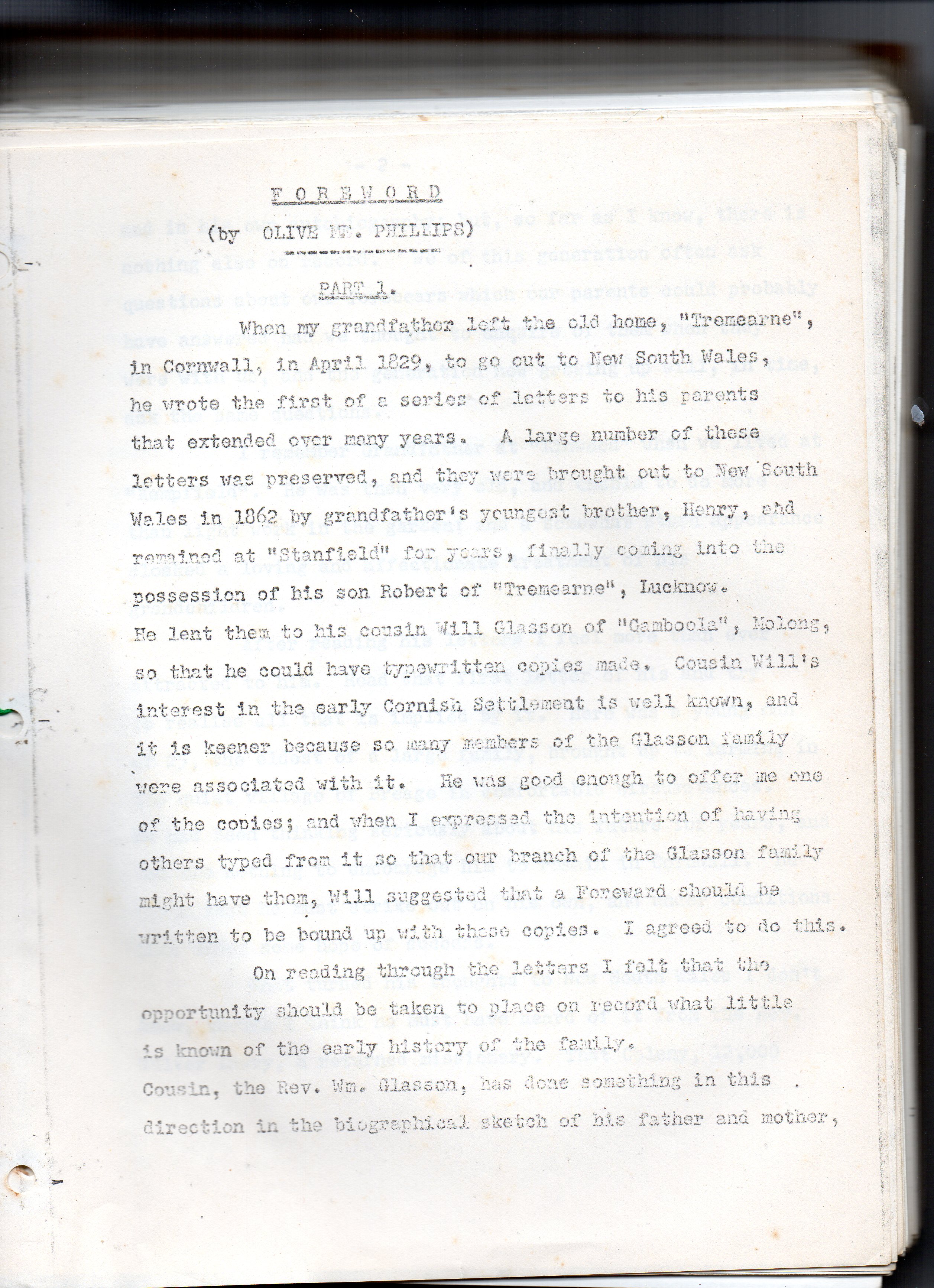
Here is Olive’s explanation of her research, which she conducted over about 20 years:
‘When my grandfather left the old home, “Tremearne” in Cornwall, in April 1829, to go out to New South Wales, he wrote the first of a series of letters to his parents that extended over many years. A large number of these letters was preserved and they were brought out to New South Wales in 1862 by grandfather’s youngest brother, Henry, and remained at “Stanfield” for years, finally coming into the possession of his son Robert of “Tremearne”, Lucknow. He lent them to his cousin, Will Glasson of Gamboola” Molong, so that he could have typewritten copies made. Cousin Will’s interest in the early Cornish Settlement is well known and it is keener because so many members of the Glasson family were associated with it. He was good enough to offer me one of the copies and when I expressed the intention of having others typed from it so that our branch of the Glasson family might have them, Will suggested that a Foreword should be written to be bound up with these copies. I agreed to do this. On reading through the letters I felt that the opportunity should be taken to place on record what little is known of the early history of the family. My cousin, the Reverend William Glasson, has done something in this direction in the biographical sketch of his father and mother and in his own autobiography, but so far as I know, there is nothing else on record. We of this generation often ask questions about our forebears which our parents could probably have answered had we thought to enquire of them when they were with us, and the generation now growing up will, in time, ask the same questions. I remember grandfather at “Linwood” (New Zealand) when we lived at “Kempfield”. He was then very old and unable to do more than light work in the garden and he had a somewhat stern appearance which cloaked a loving and affectionate treatment of his grandchildren. After reading his letters I feel more than ever attracted to him. Read that first letter and try to realise all that is implied by it. Here was a young man of 25, the eldest of a large family, brought up to farming in the quiet village of Breage in comfortable circumstances . He had been thinking seriously about his future for years and could see nothing to encourage him to remain in Cornwall. He feels that he must strike out on his own and under conditions that offer some hope of success. What turned his thoughts to New South Wales I don’t know, though I think he must have heard of it from the Reverend Walter Lawry, a returned missionary. That colony, 12,000 miles away, had been founded only 40 years before and was still a convict settlement, and it took 5 to 6 months for a vessel to reach Sydney from England. He knew living and working conditions would be crude and rough, and very different from what he had been used to’ nor did ne possess sufficient money to make the way smoother and easier. He has to face separation from his parents and brothers and sisters to whom he was greatly attached with all of a Cornishman’s love of home and kindred. He summed up the situation at home with precision, and the conditions and prospects in New South Wales with an intelligent reasoning that was fully justified by results. An interesting speculation is this: If grandfather had not gone out to New South Wales and become pioneer of the family, would any of his brothers have left Cornwall? It is of course, impossible to say, but it was 1838 before Richard and later Joseph arrived, and possibly neither of them would have ventured if John had not made good, or if his letters home had been full of the troubles and difficulties of life on the land. It is noticeable how free his letters are from “grousing” about hard work and hard times and all the drawbacks of a Colonial life. I feel that it is a duty as well as a privilege to write the Foreword to grandfather’s letters; to say what I can about him and grandmother Glasson for the benefit of their descendants, both present and future, and it give what seems to me to be well authenticated facts about the earlier generations of Glassons. I may mention here that Grandfather preserved a large number of letters written to him by his father, and they are still held at “Linwood”. I am sorry distance prevents an examination of them at this juncture (though I quote from them now and again) because it is possible I might be able to glean information which would enable me to fill in some gaps in Grandfather’s letters.’ (She did find the letters and summarised them. You can read them at the end of John’s letters. They do indeed fill in some gaps!)
List of topics:
- The Continental and Probable French Ancestry of the Cornish Glassons (1953)
- Background to land grants in NSW
- John’s letters
- His father’s letters (extracts)
- Olive’s original foreword with information about life in Cornwall.
- PART TWO concerning the Glassons in New South Wales.
- GRANDMOTHER Ann Evans
- Layout of the Cornish Settlement, Byng
- Religion in those days
- Conclusion of the Foreword (1935)
- SUPPLEMENTARY FOREWORD by Olive M.E.Phillips
- History of othe Glasson family at Tremearne, Cornwall
- John Glasson’s father’s plans to settle his family on farming land in Cornwall
- History of life of previous generations in Cornwall
- Mr John Smith, whose letters appear amongst John Glasson’s letters
- Tremearne
- Olive’s earlier discussion of the origin of the Glasson name in Cornwall
- Conclusion of the Supplementary Foreword (1945)
- THE CONTINENTAL AND PROBABLE FRENCH ANCESTRY OF THE CORNISH GLASSONS by Olive Phillips. (This is her final word on this subject, which had been discussed in the supplementary foreword of 1945, which you will find at the end of this blog).
‘When I wrote the supplementary foreword to The Glassons of Breage and the Pioneers, I expressed my belief that our Glasson ancestors were of Continental origin and quoted a reliable authority to show the name Glasson is well known in France and is borne by resident French citizens. Since then I discovered that many years ago there had been a Swiss Glasson in the Papal Guard at Rome and that one of the names given to the Cuirass or body armour now only worn by its members on ceremonial occasions, is the ‘Cuirass Glasson’. In August 1952 I issued a statement giving fuller details. I passed this information on to my cousin, Mrs Alice Tunks, in New Zealand, as additional evidence of the Glassons’ Continental origin and she replied there was no doubt the Cornish Glassons originally came from France and that our grandfather, Pioneer John Glasson, was the source of the information which had been repeated in the family by her father and mother. Grandfather stated that the Glassons came to England in the retinue of a French family whose name was spelt in various ways: St Aubyns, St Aubyn and St Albin, but in what capacity they came was not mentioned if known. Alice referred to me a book written by Walter Tregellas called “Cornish Worthies, Sketches of Some Eminent Cornishmen and Families”, published in 1884. A copy of this book is in the Mitchell Library in Sydney and I was able to learn from it a good deal about this French family. An authority states that it came out of Brittany and Plaus is given as the place of origin. The first English home seems to have been in Somersetshire and here in the middle of the 14th century – say 1350 – Guy de St Aubyn or Albin settled at Alfoxton. It appears to have been he who by his marriage with Eleanor Knoville first obtained a footing on Cornish soil and it was his grandson, Geffrey, who took up his residence at ‘Clowance’ on the latter’s marriage with Elizabeth Kymyell of “Kymyell”. I have not been able to locate Clowance, but from other references I believe it to have been an Estate with a mansion in the south of Cornwall, near Mounts Bay. Their son Geffrey has a monument in Crowan Church and Crowan was a well known Glasson centre from whence came our great grandmother Mary Glasson. I could write at length about the St Aubyn family, but all I need say is that it was one of the distinguished families in Cornwall from very early years both socially and politically, with possessions and valuable assets in almost every part of the Duchy. In 1659 Colonel John St Aubyn purchased St Michael’s Mount, 400 yards off the mainland in Mounts Bay, and that is where the present head of the family, Lord St Leven, lives. I regret I am unable to give the date or dates when the St Aubyns migrated from Somersetshire to Cornwall, probably taking the Glassons with them, and Tregellas is silent on this point. The name Glasson is not mentioned in the book. It will be noted that we have to rely on what Grandfather told his people and I am certain he was repeating what had been handed down as family history, most likely to have been kept alive from generation to generation by the early association of the Glassons with the locally famous St Aubyn family. In the supplementary foreword I was able to show from official documents that there were numerous Glassons in Cornwall in the fifteen hundreds and after and probably others were there long before, but I was unable to see the official documents that dealt with earlier periods. I can only add that I regard Grandfather’s statement about our French ancestry, outlined herein, as one he believed to be historically true. ‘ O.M.E.P. May 1953
2. (My research) Background to John Glasson becoming a free settler in New South Wales:
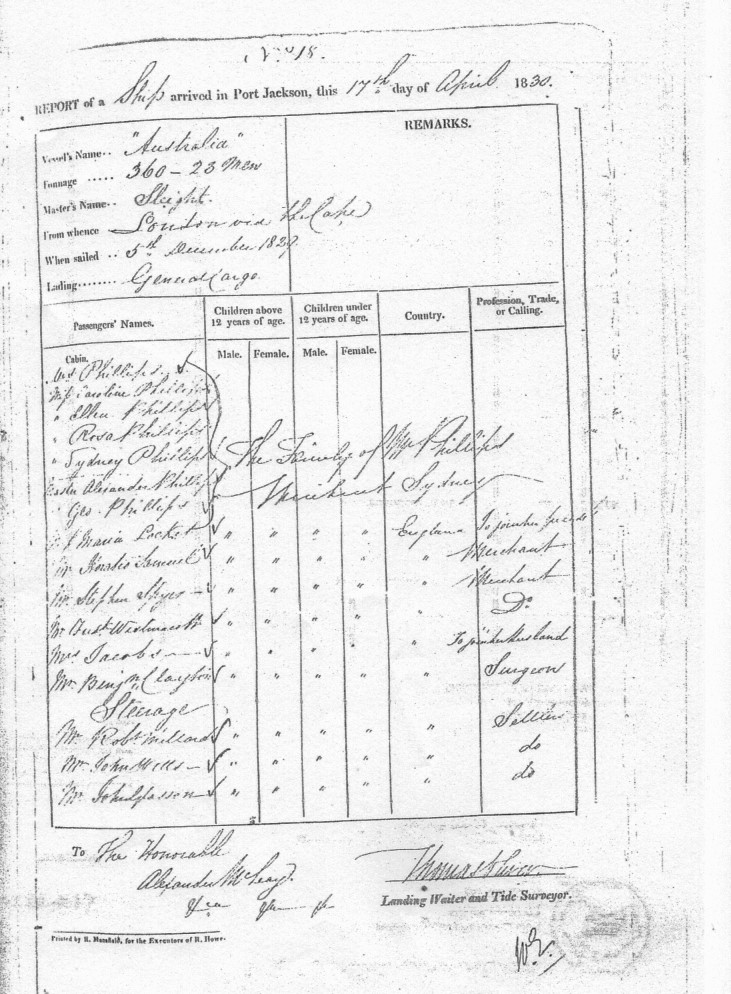
John Glasson of Breage, in Cornwall, United Kingdom, came to New South Wales, arriving on the Australia on 17th April 1830, in time for a grant of 640 acres ( a square mile) given to free settlers until 1831. Here is the passenger list which documents his arrival.
The History of Land Grants in New South Wales.
This history site called Websterworld gives a concise account of many Australian historical topics: http://www.websterworld.com/websterworld/aust/1/1793firstfreesettlersalia148.html This is their account of free settlement:
Governor Phillip requested the British Government to send free settlers to the colony of New South Wales during his time in office, but the first settlers did not arrive until after Phillip’s departure in December 1792. On 16 January 1793, the first free settlers from England arrived aboard the Bellona.
Their arrival meant that the colony was set to become more than just a penal settlement. By February 1793 the free settlers were taking up land grants of from 60 to 120 acres. They were supplied by the government with tools, seed, agricultural equipment, and two years provisions until their own crops grew and convict labour was free of charge. Because they were all free men the first settlers named the area of their grants ‘Liberty Plains’ (now Homebush and Strathfield).
A few sheep arrived in Australia with the First Fleet in 1788 but the wool producing industry which became the mainstay of the Australian economy for many years had its beginning with the arrival of Spanish merino sheep in 1797. On 16 May 1797 HMS Supply, under Captain Kent, arrived from South Africa with 33 Spanish merino ewes.
In 1825, land grants were for 640 acres. They were stopped by Governor Brisbane, under instructions from London, until the occupied land in New South Wales was surveyed and divided into 19 Counties.
By November 1925 this was completed and land grants resumed, but they were registered according to the Deeds Registration Act and a fee had to be paid to finalise the documents of ownership. https://en.wikipedia.org/wiki/Land_grant#Australia Land grants started to be phased out when private tendering was introduced, and stricter limits were placed on grants without purchase. From 9 January 1831, all land was to be sold at public auction.
So John Glasson managed to get his land grant of 640 acres of virgin bush near Bathurst just in time!. There is information in the Foreword about the way the grants were gained and the help of friends in this matter. …………………………………………………………………………………………………………………………………………..
John’s Story:
John decided to make the momentous trip 12000 miles across the globe, because farming in Cornwall was no longer profitable. This was the same experience as that described in my first blog about William Westgarth. It was also the experience of Kathleen’s grandfather, William. who tried without success to stay on the farm in Cornwall, but in 1852 came in search of his fortune with his wife and seven children.
Here is John’s letter to his father, explaining his decision to leave England. His letters continue, painting a picture of his decisions, achievements and losses until he emigrates again to New Zealand in 1857. He never returned to Cornwall. He married Ann Evans and had three children, John, Robert and Mary Ann.
2. LETTERS OF JOHN GLASSON JUNIOR
Bristol April 1828 My Dear Father, From a conviction that I ought now to speak or else hereafter hold my peace and presuming that I am now old enough to choose for myself, I have taken the liberty to inform you most respectfully that after maturely considering the business, after paying due attention to all accounts received from New South Wales during the last seven years, after weighing my prospects at home and after deliberating and counting the cost of separation from beloved parents and relatives and esteemed acquaintances, most probably to see some of them no more, – I say after balancing all these considerations in my mind over and over again – I am most determinedly confirmed in my original purpose of proceeding to that colony. I state this before you have retaken Pellar for me, which you have kindly purposed to do, as I have made up my mind to have nothing to do either with that place or Trevena. This resolution I shall most certainly persevere in. All that I request is the fulfilment of your promise made two years ago, that, when your present term expires, if I did not choose either of the abovementioned places, you would furnish me with as much money to proceed to New South Wales or Van Dieman’s Land as would be required to farm Pellar handsomely. This promise I now beg most humbly and respectfully to claim the fulfilment of, but a somewhat larger sum would be very desirable and would enable me to stock my farm more completely at the first outset and I could well afford to pay good interest for it. This, however, I do not by any means expect, nor shall its absence retard my proceeding to go out; from your past indulgences I am confident you will do all that lies in your power to establish my welfare. I do not expect you to entertain precisely the same ideas that I do on the subject, but as I am the party so vitally interested in the business, I feel assured you will not take upon yourself the responsibility of defeating my most earnest desire to procure in New South Wales the means of supporting a family in plenty and respectability, means which no small racker enjoys here, nor ever will attain to. Almost all the young farmers in this neighbourhood are sensible that to get married is to get into misery and poverty and so they very prudently remain single, unless a wife with a fortune can be procured, which falls to the lot of very few. If the girl has any personal attraction a match of convenience is what no man of spirit will submit to and such matches are most unhappy. I am not inclined to lead a life of batchelorism and to marry on my own resources here will not be prudent for a number of years and then all to be supported out of, at most a rack of 50 acres, times be as they may. In New South Wales the land is first quality and its produce, without paying rates and taxes, tythes and high rents, was worth by latest accounts as much almost as farming produces in England, besides an increasing demand for fine wool for English manufacture, the fine wools of New South Wales proving superior to any brought from Saxony or Spain. The increased cultivation of tobacco of which any quantity may be raised and exported is another source of wealth. It was the growing of tobacco that enabled the Virginian planters and still enables them, to acquire individually more wealth than all the farmers in a parish in Cornwall can produce. I do assure you that it gives me great pain of mind to trouble you so, and I sometimes almost wish I had not relations that I might be spared the almost death of separation; however once I am gone I shall trouble you no ore and then derive more pleasure in hearing from my distant friends than I can now experience in a daily intercourse with them. I have not acquainted Mr Lawry or anyone else of my present intentions, but have hidden till now in my breast; my resolutions are not hastily formed, but they will be strictly adhered to I assure you. I wish to set out in July or at latest in August and from you (as the only friend from whom I can expect pecuniary assistance) I humbly request the needful and only to have it a month or two earlier than would be required for me on Pellar is all the difference. From Mr Lawry I can get advice, from his friend Mr Hook in London I can have assistance in procuring a passage and the pleasure of advice from Mr Carvosso in the Colony. I have now only to add that I hope you will answer in a satisfactory manner the humble and earnest request of your dutiful, J.Glasson
Note by Olive Phillips: There is an old foolscap sheet of paper with the letters at Linwood, New Zealand. It is a good deal torn and some of the figures and writing are not decipherable. The writing is John Glasson Junior’s and throws some further light on what he was doing and the date he actually left home. The sheet is headed “Day Book”. 1828, September 29th: “I have the following articles to (sic) live and dead stock with which to commence farming on my own account on Ledgereth and Culvery at an annual rent of 60 pounds.” After listing the stock and plant he gives some particulars of money, seed (wheat, barley etc.) received between 20th October 1828 and 2nd May 1829, which is the last decipherable date: a long list follows of other receipts, but the paper is so worn and torn that none of them can be read. It is evident, however, that he was farming the properties after May 1829 and this proves that he did not leave home in 1828 when he wrote the first letter to his father in April 1828. When he finally left home is not clear, but it was probably late in 1829. John’s first letter to his father from London is undated, his second is dated 23rd September 1829, while the first letter from the father to son is dated 30th October 1829, but it is not until 13/11/29 that the father acknowledges receipt of any letter from John, and that one was his of 10/11/29.
However it is clear that John had left home and was in London before 23rd September 1829, though probably not long before. …………………………………………………………………………………………………………………………………………
No 7 Falcon Street, Falcon Square Cheapside, London, 1829 Dear Father, According to the promise I write you from London, I hope you have received the letter I wrote at Bristol I have already laid before you my reasons for going to Van Diemen’s Land in my letter to you last year. I shall therefore waive saying any more on that head at present. I have to be that Mother will buy for me a complete suit of clothes at Mitchell’s as clothes are cheaper at Helston than in London. I would also beg that not a moment may be lost in getting the things requested and sending them to me by the Steam Packet or by the Shipping Co. directed as above. The clothes that are at home will serve as a measure. I have bought some linen for shirts at a warehouse here much cheaper than at home and I shall get it made into shirts for best; yet let Mother et the linen I requested her. I have left enough to pay for all. I beg you will not think of dissuading me now from my enterprise, but get everything as quickly as possible, as I shall sail very soon and am in excellent health and spirits and do not repent the step I have taken. I could tell you a deal about things here if I had room, but I must put off this for another opportunity. I can live cheap here, an excellent dinner for 8 pence or 10 pence. Courtenay, Harry and I have been through many large warehouses; it would astonish you to see the quantity of goods etc. Please to give my duty to Grandmother, love to Eliza and brothers and sisters. There are several ships about to sail for Van Diemen’s Land and New South Wales and the fares are reasonable. I would advise you to go over and talk with Mr Lawry and take his newspaper with you. This I would observe I shall certainly proceed whether you assist me or not, but do as you may, I shall not fail to love and honour you, yet I do not feel the slightest desire to see any relations; the parting is now over and got through and in 7 years I hope to see you with great pleasure. Had I the capital I should not go out alone, but now though I know where to get a good wife that business must be deferred till another day. I should like to take Bishop with me, but that will depend on circumstances. I remain, dear Father, with love to Mother, Yours dutifully, J.Glasson P.S. Direct to me at Number 7 Falcon Street, Falcon Square, Cheapsode, London N.B. If you were to write Mr Carvosso, perhaps he will send a letter to his son, which you can send me with the clothes, etc. J.G.
City of London Hotel, 183 Aldergate Street, September 23rd 1829 Dear Father, I hope you will excuse my writing you again so soon, having removed my lodgings from where I wrote last evening to this place. I beg that your letters and the box of clothes, linen, etc, may be directed to me as above; however, if you have written before the receipt of this, I know where to fine the letter. I have removed here because I can live yet cheaper than at my last lodgings and my accommodation is very comfortable and quiet, having a large bedroom to myself and the use of sitting room and every comfort. I state this that you may not be concerned about me, as I know that it will give you pleasure to learn that I am in good quarters. I walk about London with as much confidence as I would at home, and I moeet with much more civility and attention than I have ever experienced in the country. Idle gambling folks only and such as drink and mix with low bad company and stand gaping at the fine things exhibited here get fleeced by the sharpers. I never pay the least attention to the people in the streets or mix with any person that I do not know. In coming down from Bristol we passed through Somerset, Wiltshire, Buckinghamshire and Middlesex. The country in most places is mot delightful, but the crops of barley and oats were to be saved and a great deal not cut, the quantity much the same per acre as in Cornwall. The wheat appears to have ben good and in Berkshire they were tilling the wheat again. I spent Sunday in Bristol and went to two Methodist Chapels, morning and evening. In the evening I heard Mr Beale in the largest Chapel in Bristol, where Conference is sometimes held. The sermon was very good, the congregation extremely quiet, but Cornish singing was wanting. I was also in two churches which are very grand – likewise through nearly all the town, wharfs and neighbouring terraces. I was introduced to the commercial room by a gentleman named Harper, my name was entered on the book as one who might come in and out when I lied and read the newspaper books, etc. On Monday morning we left Bristol at 6 o’clock, took a glass of beer and a biscuit at Bath, dined at Thatcham and go to London at half past eight in the evening, a distance of 122 miles in about 14 hours. We came up Bristol way because the fares are much lower on that route than straight on from Exeter. Since I have been in London I have walked a good deal every day but there appears no end to this vast city. I have been on the Royal Exchange, London Bridge, by St Paul’s Cathedral, the monuments etc, you can form no conception of this place. The new Post Office is opened today. It is about two minutes’ walk from my lodgings; it is a most astonishingly large and beautiful edifice, everything in the greatest profusion that the mind of man can desire. The meat is very good, veal particularly; in walking about you may meet a chop house at almost every ten doors where you may get dinner for 8 pence, tea and coffee with toast for 7 pence and everything of good quality in good apartments furnished with newspapers and books which anyone that choose may read, everything asked for is brought with the greatest politeness and though there are perhaps twenty persons in the room, no one has anything to say to you. Notwithstanding all these fine things I do not forget the business that brought me here and shall not remain here very long. Sailing day is not yet fixed but the ship is expecting to sail very shortly, having entered out at the Custom House. I beg therefore that you will be as quick as possible in getting the articles required in order and in sending them up, the box as before requested covered with canvas to prevent rubbing, with the directions written on the canvas in large letters, or on a card which must in that case be firmly stitched on. The cost of conveying them up by water will not be very high. I wish to have a blue coat, waistcoat of dark colour and dark trousers. I could buy all these things here, but Mother is a better judge of the quality. I requested Mother to get an old sword that hung at the head of my bed and put it in the chest. I was offered one in a scabbard at a Pawnbrokers, for 4 shillings and sixpence which probably cost 3 pounds being a very good one, but I am very careful about spending money on anything not quite necessary. I would observe that you will certainly gain by this proposal I made as you will have my late farms and will not have the charge of boarding me which could not be less than 12 pounds per annum. Do nothing for me that will injure yourselves. Of course you will deduct from my estate the expenses of postage, etc., and the cost of the clothes and please to send my day-book to me. You can copy whatever necessary. Please also enquire where T Waters lives. His brother John Waters will tell you, also where Prudy may be found from her Mother or sister. With love to Mother and all enquiring friends, I am dear Father, Your affectionate son, J.Glasson Junior
Falmouth November 3rd 1829 Dear Father, I suppose you thought I was gone from here before this. The sailing of the Carn Brea has been put off till today and will take place this afternoon. I have letters from a lady of this town to some respectable persons in New South Wales. One thing if you can do for me will increase my comfort on the voyage. Send me a bushel of white apple potatoes. You can put them in a pack or sack as may be convenient, directed: 30 Jarvis Crescent, Aldergate Street, London. They will be excellent with salt meat and one of the traders will take them up for a trifle. Send them immediately if you can by wagon, consigned to Uncle William here and he will forward them. I have nothing just now worth writing, only that I am not in the least dejected at leaving home. I had never thought my mind would have been so supported. I shall write you from London, when I sail. Meanwhile, I remain, Yours dutifully, John Glasson
London, November 10th 1829 Dear Parents, I have the pleasure of informing you that I got to town yesterday. We did not leave Falmouth till Wednesday noon, when we were attended with a smart breeze from the S>W> and a rolling sea, that for the first few hours made me extremely sick. The next day I got better, the sickness entirely left me and the remainder of the voyage was very pleasant till we arrived off Margate, when steering another course we had to beat up against the wind to Gravesend, where we came to on Sunday night. As that was the day fixed for the Australia’s leaving London, I was very uneasy and on Monday morning came to London by a steamer. On repairing on board the ship the Captain told me he expected to sail next Sunday; I am of opinion it will be some days later. It will please you to know that my spirits are very good, not the least dejected of melancholy and I hope you will be equally above being cast down. This morning I opened and read Father’s letter. The advice contained in it will be of the first importance for me to observe. I shall read it again. Before I left Falmouth I wrote Uncle Robert taking farewell of him, and warning him against drinking and when I got here I received an answer expressed in affectionate terms. He says he is like poor Uncle Henry, sees the good and approves it, condemns the bad, but too often pursues it. Uncle Robert, however, tells me that he shall often read my letter and that he is determined to be on his guard in future. My Uncle and Aunt in Falmouth were very kind indeed. Aunt presented me with two waistcoat pieces, two silk handkerchiefs, a pair of gloves a watch ribbon and needles and thread. I called in company with Uncle on a lady at Falmouth lately returned from the Colony. She expressed herself highly delighted with New South Wales and at our coming away said she was sorry only because she was not going with us. I have letters of introduction from her to some very respectable individuals, also a box with parcels for them and a piece of music for a young lady in Sydney. Speaking about ladies, I have something further respecting them. My dear Mother’s advice respecting my choosing a wife in New South Wales is very good, but is superfluous. I shall not take a wife in that colony. If ever I marry, and I hope I shall, my partner will be from home, nay I have fixed, unalterably fixed, my choice. Now I suppose you are anxious to know who is may be and I will tell you, I never before told anyone except the lady concerned, but shall be proud to confess my attachment anywhere. It is Elizabeth Bosustow, daughter of Mr Bosustow of Berkin and I have the happiness to know from herself that the passion is mutual. I must, however, strictly enjoin on you not to tell this to anyone. That Miss Bosustow confesses I am not indifferent to her. Be sure to keep this secret for her sake; if you divulge it I can hardly forgive you. I shall be glad if Father will state to Mr Bosustow at a convenient time, what are my prospects. This will be proper. The accomplishments of Miss B, mental and personal, are beyond my praise and I know that if I am successful in New South Wales and if both are spared, that she will consent to join her fate and fortune with me. I shall not want stimulus to exertion. When I left home it was my intention to take from hence various things requisite on a farm and in a house and in the purchase of which 20 pounds will go further than 30 pounds there, but after taking a memorandum of the most essential only and of them the smallest possible quantity, I have determined to let them all alone, as I find my funds would be exhausted and what would I do, suppose we were driven by stress of weather on our passage to put in at a foreign port to refit. Miss Simonds of Falmouth told me that being detained in a port sometime on her return from New South Wales cost her nearly 100 pounds in addition to her passage money. I do not expect anything of this sort with so fine a ship as the Australia, but still I ought not to have less than 20 pounds in my pocket on my arrival as it is impossible to say what may happen. It is always thought right for steerage passengers to expend about 10 pounds in things not allowed them from the ship as they have no fresh meat. I shall not put away half that sum in comforts and yet after I have provided bedding though I have some, and paid the expense of livery here perhaps a fortnight, the removing luggage and all the little expenses that cannot be calculated and bought a couple of hats and a pair of shoes (to say nothing about a saddle and bridle and a few of the most necessary articles) I shall not have left scarcely 15 or 10 pounds. This may seem strange to you but I can assert that I practise the most rigid economy well knowing that it is my interest and duty to do so. I of course am not ignorant that you have great difficulties to meet and it would be worse than ingratitude for me to add to them by requesting you to advance me more money, though I have not half the value of my stock and the 500 pounds from Mr Lawry I have given my note for, but thought it right to hide nothing from you and to state that I hope if I give 100 per cent more to get everything in the colony when I have received the amount of the bills. I shall write you again by Captain Bosustow, who has offered to take my parcel free of expense. I shall be glad to hear from you as often as convenient, meanwhile I remain, With love to all, Your dutiful son, John Glasson
London November 18th 1829 Dear Parents,I received your letter enclosing me a ten pound note which I did not expect and which I did not directly or indirectly request. It certainly was a seasonable supply as I had bought a saddle and bridle etc, which would have cost me 100 per cent more in the colony than here. I am no fully supplied, perfectly provided for, and I trust truly grateful to my dear parents for their kindness to me. Should a kind providence put it in my power to requite your goodness it will afford me the liveliest pleasure to anything for those who have done so much for me. The vessel with the potatoes is not arrived. They are on board the Active and I have arranged with a person here to take them. I believe that I shall be perfectly well off on board. Mr Melhuish, one of Uncle William’s friends, is well acquainted with Mr Buchanan the ship-broker to whom he recommended me, Mr M. also told that they were of the first respectability. It cost me two pounds in bedding as I got things that will serve as such after my arrival. It cost one pound about luggage in carriage and clearing on which I had to employ a broker. The things in London were all right and safe. The cyder is on board and the ale unbroken, any letters arriving here after my departure will be forwarded, but better not write me any more in London, but direct to Bathurst New South Wales. I have written to Mr T Mitchell respecting forwarding letters to me and he will explain to you. W Buchanan Esq, No 4 Leadenhall Street, London, will send me all letters sent cost free, in a parcel directed to him. The best way is to pay Mrs Carne, agent to the Steam Co., as Falmouth for the conveyance of the parcel to Mr Buchanan’s offices taking a receipt; mind to pay them to his office not merely to London. They will then go to NSW for nothing. I have desired T Mitchell to assist you in this and you can send a boy to Falmouth or arrange with Uncle to forward them – be sure don’t mismanage – I have sent the hat because it is not worth the trouble of taking. It will do for William or someone to run about. Let Mr Grylls wait and Mr Goode too and if I can possibly assist you next year, I will assuredly do so, at least I will as soon as I can. Do not fear but we shall be very well by and by. Every person I have seen that has been in the colony describes it as a fine country and I have this day seen a Mrs Hosking who was there 11 years and did well. I have letters to her son now a merchant there. I shall write you at every opportunity; when you write me next year let me know how the marle answered in Crilvors higher field. You must mind to write very close and number your letters that I may know if any are missed. I am in good health and spirits. My luggage is on board and I shall go on board also tomorrow. Give my love to Eliza and George and to all my brothers and sisters, grandmother and all that enquire for me. I expect if the wind remains fair that before this reaches you I shall have lost sight of Old England. Therefore, my dear parents I most dutifully and affectionately bid you, adieu. J. Glasson
Ship Australia Gravesend November 22nd 1829 Dear Parents, I am sorry to tax you so heavily in postage, yet I presume to seize this opportunity (perhaps the last this side of the globe) of informing you that your kind remittance came safe to hand. It was seasonable as I had expended several pounds in different articles necessary to my projected farm, such as a saddle and bridle and many things too numerous to specify. I hope providence will favour me with an opportunity of requiting your goodness another day. Meanwhile I hope the Almighty will direct you into the best way of providing against the difficulties with which He had seen it good to try you. We are now about 30 miles by water from London. We were towed down by a steamer this forenoon and expect, if the wind permit, to sail for New South Wales tomorrow, consequently we are on the eve of saying farewell to Old England, yet I feel my mind quite steady and firm. There are about 15 passengers, two of whom are like myself steerage passengers and are very agreeable young men, one of them from Dublin is going out to his uncle who wrote for him to come out and paid his passage money. I read the letter (his Uncle is a wheelwright) in which he says that in a little time he may expect to ride in his coach. My expectations are far more moderate, I shall be quite satisfied with riding a good horse and having a prosperous farm. When on shore at Gravesend on Thursday evening I spent the evening with a young man from Canada going to Sierra Leone in the Government service; on Saturday we parted to go on board our respective ships. I doubt if his friends will ever see him again. He told me he left a father and mother and 14 brothers and sisters in America his native country. The ship with the potatoes had not arrived when we left, but I had made arrangements concerning them. We have three horses and one cow on board also a lot of pigs, geese, ducks and poultry. One of Uncle William’s friends told me that I had got into good hands by going on the Australia. He knows the parties well, as far as I can see everything is as fair as could be expected and I am perfectly well off and satisfied. I have sent home my second best hat by Captain Bosustow; in it is a letter and one for Uncle William. I have letters enough to take to the colony with me, but I have also letters that give me as much pleasure, though from another hand. I wish you to write about Christmas as there will be a ship called the Elizabeth sailing then. You will end all the letters that my friends may write in a parcel to Walter Buchanan Esq., 6 Leadenhall Street, London, who will forward them to me, only do not forget to pay them to Mr B’s office as I promised him that should be done. They should be enclosed in a wrapper and directed as above – you can arrange with Uncle William to send them up and mind to pay the expenses of a porter to take them to MR Buchanan’s office – about 6 pence in addition to the carriage 1 shilling, a sum that will just pay the postage of one single letter, but by this plan you may send a dozen – mind always to adopt this plan and direct on the letters for me at Bathurst New South Wales. When you write tell me how all are, how the ….. get on, etc. Please to apprise my particular friend of this plan. I wish likewise for Eliza to show every civility to Miss Bosustow for most certainly if I marry anyone it will be her. Very few can judge of the feelings I (from various causes) experience on leaving the country that contains everyone I love, yet I hope the happy day will arrive when I shall see my friends again. Now I have something else to think about. I shall write you again the first ship after my arrival, till which time (with love to all) I remain, Very dear Parents Your dutiful son, John Glasson, Junior
P.S. I wrote to the Hon. Secretary of State for the Colonial department and today I received an answer containing the regulations respecting the granting of land. This I of course shall take to the colony as the sanction of H.M.Government to my going thither as a farmer. Any wool I may send home will be consigned to Messrs Meluish Gray and Co., Nicholas Lane, London, who promised to do their best to serve me. Uncle W. particularly recommended me to make them my agents. – Adieu. N.B. There is a Doctor on board. I have Mr Wesley’s sermons and hope to read them. Tell Thomas Mitchell to write in time for the ship Elizabeth. Don’t forget this last. J.G.
Ship Australia in the Downs December 4th 1829 Very dear Parent, I almost fear you will think I write far too frequently, et I cannot help informing you that we are as yet no further than this place. We were towed by a steamer to Gravesend and had they allowed her to take us to the Downs at that time, no doubt that instead of from this place I should by this time have written you from Madeira, as the wind was so fine in the Channel though contrary for coming down the river, which made our passage from Gravesend to this place extremely tedious. After all they got the same steamer to tow us here yesterday and then the wind which was fair turned quite foul, so that it becomes probable we shall be detained here a week or perhaps more till the wind shifts when we shall lose no time. Our provisions are abundant and the salt beef and pork are the best salted meat I have often seen, yet as you know I am not fond of salt meat. I have rice, grits and today I got from Deal near which we lie 120 red herrings very fine for 5 shillings and 6 pence, these things with my butter and cheese and a glass to the cook will make me well off. The cyder is all sound and no bottles broken. I have not begun them yet. I have them all in my own cabin where I have a snug bed place in which I sleep as well as on shore. I have not been out of the ship now for a fortnight, but we are all very anxious to proceed on our voyage and I no less am anxious to hear from you if it were possible. You know I put little stress on dreams, but I dreamt last night I stood at my dear mother’s bedside and methought she looked extremely pale and thin. It was nothing but a dream, but I would give almost anything to know how you all are. Observe the wind and if it be S or W from this time Friday until you receive this and still inclined to that quarter, do write me by return post, directed – Mr J Glasson, Ship Australia, Deal, Kent. Mind the wind, for if it comes fair we shall sail directly. At any rate write me in New South Wales very soon and don’t forget to write often. I am equally anxious to hear from you as you are from me. I wish you to write your first letter by post and it will go by the Caroline directly after the Australia, mind to pay the postage in Helston, or it will not be forwarded from London. About Christmas you may write and send letters from my friends, in a parcel to Mr Buchanan as I before directed and he will forward them and half a dozen papers cost free in his ship the Elizabeth. The parcel of papers must not exceed half a dozen; it is not legal I understand to put more than that number in one parcel. Let me know how all are and how Mr R Treweeke is, how the singer got on and what you are all about, the news etc., and write very closely on a sheet of full size and not letter paper and a single letter will contain much. Remember me to Mr Hendry, Miss Pascoe, Mr Matthews and family, Eliza and George Grandmother and all my brothers and sisters, Crowan folk and all relatives and enquiring friends. I am quite well and have got a great deal more figgy pudding than I can eat. I give it among the sailors. Still I would strongly recommend any family to provide provisions for themselves on a voyage like this. They would save much and get everything as they like, such as preserved meats, etc., a calculation might easily be made of the requisites. I shall write from Madeira and immediately when I get out. There are boys in this ship that have been to Sydney two or three times in her. This principal owner of the Ship is a Mr Scott, a respectable farmer in NSW, here I am told he has 8,000 acres of land. We have two horses on board. The sailors in tis ship need a missionary as much as any heathen and I am inclined to think them only a sample of what sailors generally are. There is also a lady a cabin passenger going out to her convict husband and there is reason to think her no better than she should be. I believe the Captain wishes her already in Sydney. He is a very agreeable man and an able, expert commander. I remain, my dear parents, Your dutiful and affectionate son, John Glasson
Ship Australia at the entrance of Table Bay Cape of Good Hope February 18th 1830 Very dear Parents, Immediately after sending a letter on shore at Deal, December 5th we weighed and proceeded on our voyage. The last land I saw was the Lands End on December 8th, after which we were nearly in a gale of contrary wind to the west of Scilly. I expected to write from Madeira, but we did not call, at this I have felt much concerned as I promised to write. We passed Madeira on the 22nd December, the Lone on the 22nd January after being three weeks making a few leagues owing to calm, light and contrary winds, afterwards we sailed very close to the Brazils but did not call. Our water being almost out we are now going into Cape Town to refresh. I am glad to embrace the opportunity of writing to let you know first that I am well. I have not had a day’s sickness since I saw you. Second I am well off in provisions and enjoy my food as well as I did when at your table at Tremearne. The meat is excellent and we have plenty of rich cakes baked almost every day, potatoes, etc. The sea almost all the way has been as smooth as Falmouth Harbour, but owing to contrary winds and calmness the voyage hither has been very tedious. I felt little inconvenience from heat in crossing the Line and the weather has been finer than you can conceive, whilst I write this we sail with a gentle air into Table Bay. The weather is like the finest at home in July, whilst immense mountains are close to our starboard beam, at the foot, a little from the beach are numbers of pretty white country houses or cottages, with plantations, vineyards and cattle about them. There are several ships in the bay and others coming in, altogether it is the most romantic scenery I ever saw. We see ladies and gents in gigs and on horseback; it is a fine Sunday afternoon. I shall finish this on shore. Cape Town March 1st: I write now at my lodgings on shore, where I shall stay a day or two; it is a private house of an English family who stopped here on their voyage to Sydney. The brig in which they sailed being (through negligence of the second mate whose watch it was at the time), thrown on the rocks to the north of this place at night. The man is a dyer and was persuaded to stay here there being few of that class here. This is a pretty sort of town the streets cross at right angles and plenty of trees before most of the fronts with a raised walk the length of the house for the convenience of the inmates and the public who can walk in the shade at any time. Provisions are of great plenty and of good quality, beef and mutton about 2 and a half per pound, you never tasted such fine grapes as I did this morning with my breakfast such is the custom here. Wine is good at about a shilling a gall. They drink it just as the people of England do cyder. Indeed this is a place I should like to stop at (if I were to consult pleasure) for a month. The houses are all flat roofed and stuccoed and wear a curious appearance from the ship. The white men are English and Dutch with plenty of slaves but very few servants. My landlady tells me that it is very difficult to get a white servant girl, most of these who come out here in that capacity get married. When they get a good maidservant, they have to pay 15 pounds or 16 pounds a year wages. The shipping lies before the town at a very short distance. Behind are most tremendous mountains, between the town and mountains are scattered country houses surrounded generally with trees and which have a rural agreeable look. The soil is a mixture of clay and sand, some of it is good but the good land is 60 or 70 miles in the interior whence the town is supplied, the farmers bringing their produce in wagons drawn by 10 or 12 and sometimes 30 oxen. The leaders being guided by a slave with a rope fastened to their horns. The market is every morning very early. I saw a great many wagons this morning most of them had 12 oxen about the size and condition of Methleigh bullocks in March month, that mostly draw in clumsy gear having ropes instead of chains. We expect to reach Sydney in about 8 weeks time when I shall write again. I think about you every day and as I can pray for you too, I know you do for me and it is a source of pleasure to know it. We have church on board almost very Sunday, the Captain is the Parson and the Chief mate the Clerk. I have been through the principal church here, it is large, has two side galleries very few pews and the body of the church is covered with chairs on which the congregation sit. It is a very good building, I hoped to have been on shore in time for preaching last evening but could not manage it. I wish you would put a letter in the post office for me in 8 or 10 weeks, the postage will not be high, you may think what a welcome present a letter will be; remember me to all enquirers, the singers, etc,. I have not room to specify names, you know my acquaintances. When you have seen Miss Bosustow let me know your opinion of her. I hope to hear that you are all well and that Mr Carter and R Treweeke and particularly George and dear sister Eliza are well. I suppose the boy is come by this time. When you write tell everything of news you can, but especially how you are getting on etc., I shall write Miss Bosustow as soon as this is finished and expect to send the letters by the Belle Alliance, which vessel sails for London in a day or so. Hoping to hear from you very soon after I get to New South Wales. I remain with love to brothers and sisters and grandmother. Very dear parents, Your dutiful son, John Glasson P.S. The oxen here do not seem to be much fatter than those attended to.
There is a gap of about 3 years here. John was still writing letters, but they have not been saved. It was a very hard period for him both physically and mentally and he says below that his letters reflected that! Some information about these years are in the following letters and reminiscences. Mr George Allen, the first lawyer trained in New South Wales and a staunch Methodist, helped John in many ways.
Sydney 30th May 1833 My dear Parents, I have the pleasure of informing that Bishop arrived here safe and well in March last and has been living at Mr Allen’s till the arrival of my team to take him and his baggage to Bathurst. This is the first time of my bringing produce to market and I am happy to say that though the price of cheese is at present low from the great quantities make, my return will amply provide everything necessary. I sold at Parramatta immediately after I got down. Next year I expect my return will be much greater. I have read just now your letter of October last. I confess I opened it with a sort of dread knowing what language I used in my letter of January 1832, I expected nothing but justly merited reproaches, but my dear Father does not even complain of my undutiful conduct which I shall ever repent and for which I know you forgive me. I saw Bishop for the first time this morning and you will think the questions I put to him were not few. I am most happy to hear that you are doing well, may providence continue to bless you and doubtless it will bless you. Do not fret or grieve at that Porthleven business I used to fuss at it but now think it was all ordered by an unerring providence. Of my own success I see no cause for fear; on my farm I am getting on with some spirit. I have the fencing for 10 acres all ready for putting up besides other improvements which I cannot stay to particularise now.
I have not received any money from Mr Allen since I last wrote and I may say that I think I can get on without any more cash from that quarter. As to the matter of getting a wife here I rather doubt that I shall please my fancy – you know I am now nearly thirty and not so apt to be smitten as some six or seven years back. When such an event happens, if indeed it ever does, I will send you the picture of the lady for your parlour. You can hardly imagine how very acute were my feelings when hearing Bishop talk about my brothers and sisters. It was a luxury. I am glad to hear that Joe has gone with Mr Ash to learn the tailoring business. It is I think a fine thing here. I just now dined at the new house of a tailor, a Cornishman – Lancashire House in Penzance is nothing to it. Mr Allen says that Bishop has been very busy working at Mr Allen’s, indoor and out. I am very much pleased to hear that you intend making your Will. It ought to have been done before. The fate of poor Mr Plumer and numerous others humbly reminds us that in the midst of life we are in death and that our life passes away like a shadow. The evening of my arrival at Parramatta I went to a prayer meeting at the Methodist Chapel. Two missionaries were present, Messrs Schofield and Manton. How different was what I saw and heard from what I am often obliged to see and hear; it seemed like stepping into another world. Mr Orton is gone on a visit to New Zealand and will not be back for some months. Two ships arrived in this port today from England. It is reported through the town that they bring sad tidings respecting the ship ‘Hibernian’ being burnt at sea with the loss of between one and two hundred passengers. Some thousands of persons have arrived here during the last twelve months and many more are expected. Bishop tells me that brother Richard speaks of coming here. If he has well counted the cost and is firmly fixed in his intention I certainly think he may do very well. He might soon attain a situation as overseer at 40 or 50 pounds a year and so get into a fine stock before he is as old as I am and he can remain with me until a situation presents itself, but before he embarks he should have a letter from the ship-owner or captain stating that provisions etc, are to be. Bishop says they were ill served on the Caroline. If he comes he should write as soon as a passage is engaged stating the name of the ship and then I shall be on the lookout for hm. I shall invest brother Joe’s money in the purchase of a very fine cow, for it’s of no use to buy 8 or 10 sheep on account, of the trouble of looking after them; the cow shall cost him nothing for the keep and if she prove unlucky I will give him another for nothing . Bishop says he wishes Jennie were here as she would make a good housekeeper. I think Bishop means a good wife too. Perhaps an opportunity may occur of her coming out as a servant to a lady or some respectable family; if she wishes, Mr Hosking might be able to get a passage for her in this way. If Robert happens to have a hand for any mechanics as a profession be sure don’t prevent him from learning it. I believe that all trades do well here if they are sober and steady. I trust the malting will not be neglected. As Bishop understands malting, it should be an excellent prospect realising money and I wish to be understood that my main object in endeavouring to get money is that my brothers and sisters may participate in the fruit of my speculations. This was always my object and I trust that it will be ever so. I am thankful for the articles sent by Bishop, only two things are wanting: the shovels and all my musical books. I would gladly give one pound for two shovels as I believe that they cannot be had in the colony. It has been a dry season till lately, yet in my district we had plenty of fine grass. My working oxen, notwithstanding all their work, are nearly fit to kill. It is indeed a fine part of the country. Fruit trees thrive remarkably well. I certainly think that in ten years time I shall be, if spared, a rich man from the produce of my apple trees, etc. I intend planting some acres of orchards. Apples sell here as from 2 pence to 6 pence each; only think what an acre of orchard will return. I can purchase young apple and other fruit trees such as peaches and of excellent kinds. I must not forget to return my thanks to Aunt for her present of a New Testament. Present my love and respects to her and to Uncle and family and to Grandmother and all relatives, brothers and sisters. I thank brother Robert for the present of a knife which comes in good time for I was just going to buy one. William continues his respects to Miss Russell. I understand well she is the type of good girl – such as one would be worth – I can’t say how much, in this country. Tell Mr Lawry (with my reacts) that his house at Parramatta is at present unoccupied. Mr Hunt has received Mr Lawry’s letter requesting him to manage the premises and communicated with Mr Allen on the subject and Mr Hunt told me that it seemed to him that Mr A was not willing for him to do as Mr Lawry suggested. I don’t know whether Mr Lawry received his money from NSW or not, but this I know that there is no sufficiently reason for the sums due not being paid, if they are not. It is not my business to meddle or I should like to know what sums have been paid by Mr Bingle and forwarded by Mr Allen. I shall write again in a few weeks. My dear Parents, Your most dutiful son, J. Glasson
Sydney 30th September 1833 My dear Parents, My last letter was dated from Sydney in May last. I should have written again ere now, had I not been disappointed of an opportunity of sending at the same time as I wrote to Mr Lawry and Mr Mitchell. I expected the person by whom I sent the above mentioned letters would stay a night at my farm and then I should have written, but he called earlier than I expected and passed immediately on, so that I had not time to write. However, it is time that I should satisfy your first enquiry on opening my letter. All is, I believe, well. Our journey home from Sydney in June was safe and pleasant. Bishop’s first job with me was planting apple and pear trees, after which we commenced clearing new land, the same I ploughed last Spring, ploughing it and sowing it with wheat and rye – 8 acres of wheat and one of rye. This we completed as also a good fence to the paddocks which contains 10 acres one of which is not yet broken up. Bishop desires to say that as far as he had opportunity of judging he likes the country very well. He is much pleased with the fine deep soil on my farm. His wages are 10 pounds cash and four heifers and their calves per annum. I think he has a very good chance of doing well. Bishop often talks about home, little Harry etc., and says he hopes to see all of you again. My early wheat, I mean the 3 acres sown in May last, looked when I left, extremely well. As fine as you ever saw. There has been very little rain fallen during the past winter and present spring. Still in our neighbourhood we have had just enough for sowing wheat, but at present rain is much wanted everywhere and unless we get some soon the late crops will be a failure. I may observe that the part where my farm lies stands the drought with respect to grain and grass better than any other part I have seen; cattle running the bush thereabout are in fine order. Bishop remarked that he never saw really fat cattle till he came to NSW. Certain it is that what are called ‘fat bullocks’ at home would not always be deemed such here. The prices at present are good at 3 pounds a head, and the demand such as to occasion the butcher to go into the interior to buy when they can meet with fat stock. I have not to explain the reason for my being in Sydney so soon after my last visit. Mr Allen has been frequently asking me to come with him to put his farm in order, as he knew nothing of the matter and was continually plagued by his men. I began to consider that my farm was made pretty comfortable and that Bishop could easily manage it, especially as my friends, Mr Geo. Hawke, resided on the farm; that the pleasure of polished society would be an agreeable change after the comparative solitude of a bush life; that at least I should lose nothing in a pecuniary sense by acceding to Mr Allen’s request, all these considerations with another not the least – the charm of making ‘sweet hay’ with the pretty girls that are frequently here – determined me to come down, which I did a fortnight since. My salary is to be 40 pounds a year and 10% on whatever produce I can raise for the market which is a little more than two miles distant. At present we have just nothing to sell but I intend growing artificial food and keeping dairy cow which is sure to pay, milk fetching 6 pence a quart. As soon as I took command I got as much work done in a day as Mr A could get done in three. I have six men here; one I keep drawing dung from Sydney where it costs 6 pence a load. I should observe that I always sit at table with Mr Allen and I feel myself quite at home. Your letters dated February and April have duly reached me. Your observations respecting Robert being a Carpenter are perfectly correct. I did not consider that point before. Certainly there ought ever to be one of my brothers with you as to take the burden as much as possible off your hands. As to your question regarding myself I would reply that were I in England again it would not be long before I found the way to NSW. Let others do as they think best. I hope the malt tiles will soon come out. It is a matter of great importance and we cannot fail (humanly speaking) to get handsomely by them. I have a very fine heifer calf and cow for Joe. Betty Pascoe’s glass, poor Jane’s cup, Robert’s knife and the handkerchiefs from sister Eliza all quite safe. My thanks are due to the donors. I shall not forget them though one is escaped to the ‘mountains of bliss’. May we all follow her. In August I sent you three parcels containing newspapers. I have since heard that they will be rather expensive in the postages from London to you; this being the case I will only send in future one now and again. Present my respects to all inquiring friends. They are, I know, too many to be named here, but I do not forget them. Bishop desires to be remembered to you. I remain, my dear Parents, Your ever affectionate and dutiful son, John Glasson P.S. Don’t put so many seals on your letter; one will do.
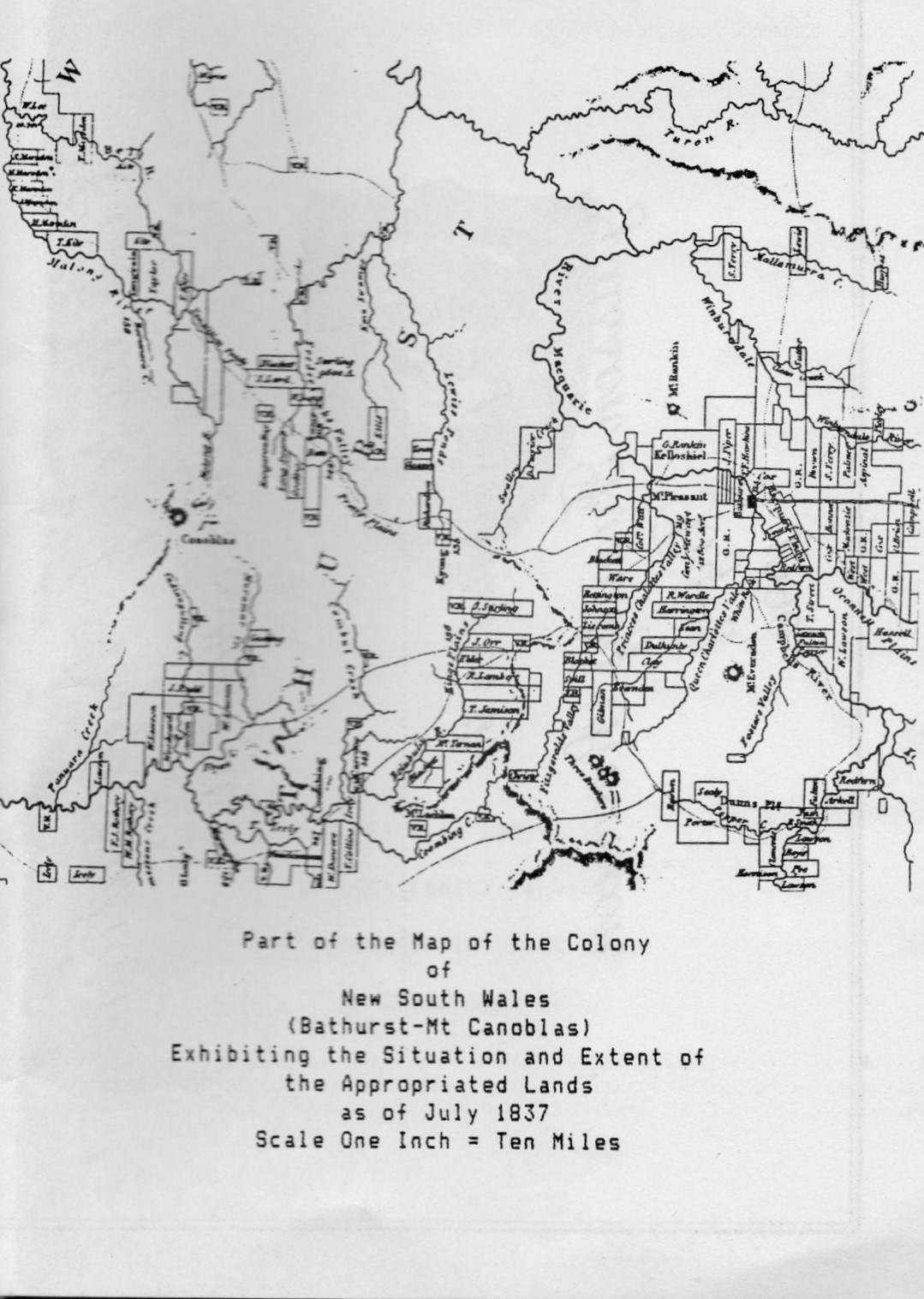
Mr Allen was a prominent Sydney Methodist with a very large landholding of 96 acres in Glebe, Sydney, called Toxteth Park (see the story of George Charles). He had arranged the grants of land for John Glasson and his Cornish friends (see the Foreword). Toxteth Park Sydney 8th January 1834 My dear Parents, My last letter was dated from this place 29th September, informing you of my having been engaged with Mr Allen as superintendent. A short time since, I received your letter of June last with the newspapers from Mr Mitchell and also Mrs Roberts’ present and letter. Present my sincere respects to that lady tell her that I feel proud at being remembered by her, that I thank her for the present which I have perused and shall take particular care of as coming from her, whom I esteem so highly. I am very glad to hear that my dear parents and brothers and sisters are all well, though I feel sorry that you should be so apprehensive of my being unwell. My health was never more perfect than at present. I have enjoyed the best of health since I have been in NSW. I have no recollection of being so ill as Mr Wright reported. I cannot think how he came to imagine so. By your letter and accounts by the newspaper, it seems the times with farmers are very bad. A Mr Case from St Newton who with his family arrived here in the Layton a few days ago and goes to Bathurst to settle, informs me that there is nothing to be got by farming in England except by those who have pretty large capitals. I assure you that I am very glad that I have a pretty good farm in Australia and do not by any means wish myself back paying rents and taxes, etc. I am afraid the last year was a bad one with you. I wish it was in my power to remit you something towards payment of what I have received, but my stock is not increased enough to make great returns, consequently I require every pound I can raise to increase my number of cattle, etc. By and by I have not the least doubt of making considerable return. This will be a profitable year with me, cheese and wheat sell at good prices. We have had plenty of rain since I last wrote. It was, however, too late to save the crops of wheat in many parts. Several farmers have not a single grain; consequently will have to buy and the wheat crop in general in the interior is very defective. In the lower districts near the sea the crops are an average one. At Van Diemen’s Land they seem to be worse off, as they are getting quantities of flour from Sydney, but their harvest not being reaped their harvest is uncertain. Wheat is cheap in Sydney now, because of the general practice of threshing and selling the wheat directly after harvest. It is at present 4 shillings per bushel, but I think it will be 8 shillings before Christmas. I hear frequently from Newton. I received a letter from Mr Hawke yesterday. It is dated January 4th. That you may form some idea of how matters are, I give you the following extract from it. “ We are getting on well with harvest and the dairy at the same time. All my wheat that is ripe is cut and your early wheat is cut to a few roods which will be done today. Your late wheat will be fit to cut in a few days. We have as fine weather as can be for harvest. We had occasional showers of rain until last Monday, but none since. I never saw the country looking so well as this season as at present. There is an abundance of grass of the freshest verdure, your trees, shrubs, etc are doing as well s might be expected in the most delightful season I ever knew in Australia. It is thought that wheat will be 10 shillings per bushel at Bathurst this season; but this will depend on Sydney prices. The crops are very indifferent in general . I don’t think there is enough in the district to supply it through the year. If wheat can be brought from Sydney to Bathurst for less than 10 shillings pr bushel, we cannot expect it to be so high. Mr Hawke has been offering 6 shillings per bushel for the contract. I think you will have 170 bushels at least to sell, if you have no more to supply than at present. I never saw a better crop than Mr Tom has in his great paddock. I expect he will have between 300 and 400 bushels in it. (The paddock is 30 acres of rich land, but only 8 or 9 acres of it, if so much are yet ploughed and tilled). The lower paddock is but a moderate crop.” I may observe by the way, that my land for wheat was only ploughed twice, first to break it up and then in ridges across the first plowing, the seed being sown, the furrow was harrowed with the harrow-tine you sent me and a harrow of my own making. This is all that was done to it. It had not manure; the crop even in an indifferent season is about 7 Cornish bushels per acre (statute). I shall manure some acres next year as we can make a pretty good amount of dung in and about the stockyards, pig stys, etc. I expect the dairy will defray all the ordinary outgoings this year, leaving the crop of wheat clean gain, besides the increase of stock and improvements on my farm. The improvements are very considerable. Bishop has built and excellent dairy with a stone and cob wall and well thatched roof. You will perceive that my affairs are in a very prosperous way and I know this will give you pleasure. Mr Lane has plenty of wheat notwithstanding he lost one field of about 11 acres which was totally destroyed by a tremendous hail storm a few days before Christmas. The Cornish farmers at Bathurst have always wheat to sell when others want ot buy and there is always a demand for wheat once in two years; and if there were not it would pay well to feed pigs with it. I am highly pleased with having taken my farm when I did as in that part we have the opportunity of selling wheat to the great stock-holders in the interior who scarcely ever grow enough for their own use. Besides there is no part that I have seen so good for grass and grain and at the same time so beautiful. My working oxen are at this time quite far, fit to kill, notwithstanding they had such severe work last winter and spring. Fat stock sell at high prices just now. I am told that bullocks of 600 pounds are worth 5 pounds. These are topping times for graziers. Mr Lane made between two and three hundred pounds off his wool last year. I suppose he will make 300 next season. The year before I came here he made only 50 pounds. Ewes are now worth one pound each. Bishop is very well and likes the country much; he is thinking about getting a wife to mend his stockings, made shirts, etc. I am almost beginning to think of the same adventure. In everything it is my constant prayer that Providence will direct me, but I place much more value on your prayers than my own. I am quite comfortable with Mr Allen. I have only to superintend, without dirtying my hand at any work, and I enjoy every comfort I can desire. At my leisure hours I frequently enjoy a tune on my flute, in the large dining room where there is a fine echo. We have plenty of music on the piano. Sometimes I see some very attractive young ladies here. All this is of course, very pleasing and in addition to those things I have the use of a most extensive library. Still Bathurst has much attraction for me that I think it likely that I shall return there next September. Always direct your letters there. If Mr Hawke has not sent out the tiles never mind as we can now get them in Sydney. Your remarks about a maltery here are very natural, but you would see it differently if you were one month at Bathurst. Mr Hawke and I have lately made an arrangement for me to look after his farm stock and do his dairy work, for which he is to pay me 15 pounds per annum and support two men, with the use of his oxen and tools. This will begin in March and will be for two years, he having engaged himself as a superintendant to a Colonel Wall, a few miles from Newton, which he will frequently visit. This he will do because he wants to collect together some cash to help carry on in the malting. 300 young females arrived here by the Layton, the same ship that held your letters, etc. Mr Rule, the doctor, hardly knows what to be at. The country is too healthy for many medical men to do well in it. There is now a mail coach to Bathurst twice a week, fare 2 pounds. It leaves Sydney at 4 p.m. and arrives at Bathurst (stopping a night on the road) the next morning at 8 o’clock. Tell Mr Lawry that I shall do as he requested and will write to him soon. Miss Bosustow is served just as she deserves; she never will (and never ought to be happy in a husband after the trick she served me. Had she remained true I would have been enabled to return and marry her next year. I care not for her. I desired her to destroy my letters and an elegant little book I gave her and let me know that she had done so. Please do enquire if she has fulfilled my request. I have burnt every vestige of hers in my possession. With love to Grandmother, brothers and sisters and all my friends, not forgetting Jenny Waters. I remain, dear Parents, Your most dutiful son, J. Glasson
Sydney 21st March 1834 My dear Parents, I have not received any letter from you since my last, which was written in January, but I have heard from Mr Hawke that his brother had called on you in August last and that you were all well. The Malt Tiles are arrived in Sydney and will soon be sent to Newton. Many thanks are due to my kind parents for forwarding them. I trust they will be the means of getting a pretty good share of money for Mr Hawke and me. The prospect is most encouraging; but we must begin with a little at first. I shall build a small malt-house next winter. I am quite well in health and thanks to providence though in a small way compared with many out here, am prosperous in my circumstances. Bishop, when I heard last, was very well and getting on famously with the farm. I shall however, return to Newton next September in order to get on with the malting, etc., as fast as possible. My harvest was all saved in fine order. I have a fine crop of potatoes ripe and an excellent one of turnips growing. My convict servants are very good ones, fine young men. Wheat will fetch a high price this year. General Stewart offered to give 6 shillings per bushel for 100 bushels but Mr Hawke thinks I may get 10 shillings by holding it a few months. My fine brood mare unluckily dropped her foal on the brink of the Fish River and the colt fell in and got drowned. This is all the ill luck I have had this year as far as I know. Mr Case and family are settled at Bathurst and are much pleased with the country. Mr Lane and the other Cornish are doing well. I am not, I think, very likely to get married in NSW and if I do not fully purpose to return to England in about six years, if my concerns go on as at present, I shall be able to live very comfortably at home on the proceeds of my property here. These matters are all under the control of providence and that providence has directed my way in many difficult places I have no doubt. I do every day pray to the Almighty for his guidance, but I have to lament a volatile, trifling spirit. Professors of religion are themselves very different from those in Cornwall in their manners and conversation. I frequently tell them that the NSW Methodists are not worthy of the name of Methodists. This they frankly acknowledge. Bathurst improves very rapidly and bids fair to become in a few years a very considerable town; as to beauty and salubrity of situation I have not seen its equal. Sometimes I think I will get married and settle in Australia; but then in a moment of think of my dear parents, my brothers and sisters, etc., and feel such a strong desire to see them again as puts to flight all thought of falling in love; otherwise I might not be long hesitating as there are some pleasing young ladies here, but as the song says ‘Homer Sweet Home’. Though I have a pretty place for a home in Australia – yet it is not the home associations with the recollections of my childhood and youth, the home of my kindred. You must not suppose form this that I am tired of New South Wales, I assure you that I am pleased with it and intend to remain in it awhile. I understand that Sydney is fully supplied with mechanics at present; many hundreds and even thousands having arrived during the last year or two. Still when they are well behaved they do well and there is still a scarcity in the interior. Sydney improves wonderfully. There is a new market erected – the finest I ever saw; it consists of four very large buildings open at the sides and supported by handsome pillars, every kind of goods is to be had there on market days. There is one deficiency – the butter is sold by men and old women, instead of pretty neat girls as at home. I reckon my property in NSW to be worth as follows: Farm with improvements, 200 pounds. Livestock, 100 pounds. Dead do. of different kinds, 50 pounds. Wheat, rye, cheese and pork (to sell) 100 pounds.
If I were to sell everything for cash it would not fetch as much; but were I under the necessity of purchasing as much as I have, I should not expect to buythe whole under 450 pounds and if I liked I could let the concern at a rent of at least 40 pounds a year or about 10% profit. I have now on my farm the following improvements – two good huts, a dairy hut, milking yard, one arable field of ten acres, one of 4 acres intended for an orchard in part planted, one grass fields of four acres and another of sixteen acres. You will see that I have not been idle since I received the 100 pounds. I am thus particular that you may know in case of anything occurring to me what property I have as I have provided by a Will that everything shall belong to you. Present my love to brothers and sisters and to all friends. Tell Jenny Waters that Mrs Allen is the best singerI have heard since I was in Breage Chapel. We sometimes go to concerts, Yours dutifully, J. Glasson
P.S. It appears likely that I shall not want a numerous company if I return home a bachelor – John and Tom Matthew, etc, etc. We shall form quite a snug Corps. Then I shall be able to tell the tough stories of Botany Bay. J.G.
Sydney 18th September 1834 My dear Parents, The last time I wrote to you was in May. I have not received any letter from you of later date that than 31st December. I received Uncle William’s letter, as likewise the newspapers, many thanks to you and to Mr Mitchell for sending them. I should have perused them with more pleasure had they contained more agreeable news than accounts of storms, wrecks and bad times which are mournfully conspicuous in their columns. We have here news from England to the latter end of May and I hope soon to have received a letter. With regard to myself everything goes well, I am as usual in good health, so also is Bishop and all Cornish friends. I have sold 80 bushels of wheat since I last wrote at 12 shillings and sixpence per bushel (Sgall) , have 20 cows and 20 calves at my option. The wheat was taken to Wellington Valley about 80 miles further in to the country and I shall shortly proceed thither to select my stock. The purchaser is the overseer for Judge Wylde and the Judge’s cattle are very fine. You will perceive that wheat sometimes pays us a trifle. Mr Lane has made, I suppose, 200 pounds by this year and Mr Tom nearly as much. Mr Allen received a letter from Mr Lawry a short time ago directing him to receive the monies advanced to me with the interest. Mr Lawry did not say what interest, but I always understood 5 percent, as the money was lent in England and I only got 97 pounds instead of 500 pounds, However, I presume he means English interest. Mr Allen has not requested me to pay any money . He seems rather inclined to leave the business to be settled between Mr Lawry and myself. Although I have been fortunate this year, my profit will be on necessity employed in increasing my livestock without which my future prosperity would be very much retarded, as I cannot expect to profit so much every year by my tillage. When this is represented to Mr Lawry I am sure he will consent to wait awhile for the money as he is not in want of it and as it is of such consequence to me, just getting comfortably settled. I trust that he is satisfied that here is no danger in the matter. What I propose is to send him the interest when it amounts to 30 pounds in a lump. I may mention another affair that demands a little of my cash this year, and which can hardly occur often. It is very likely that before you receive this I shall be no longer cruising in Bachelor’s Bay. The lady is a Miss Evans, who is in every calculated (if I may depend on my own judgment and that of all my friends here that know her) to render her admirer happy. After what I write about I need hardly say that Miss Evans had no fortune, although not without some prospects of obtaining something at a future day. I shall be more particular when I write again; at present I am straightened for time. I have been a year with Mr Allen and today I leave Sydney by the mail for Bathurst, which I expect to reach on Saturday the 20th. My cheese and my bacon arrived in town the day before yesterday. I sold the cheese, 1700 lbs at 5 pence per pound and the bacon, 300 lbs at 9 pence per pound. The latter was more than the market price, but I sold it to a person to whom I am sometimes a customer. The cheese in particular was excellent. I have been very busy in marketing and buying things to go up to the farm, etc, etc,. There has been great abundance of rain up the country this last winter. We expect a very fine spring as the consequence. Fat bullocks are no selling at 4 to 5 pounds a head. When I have fat stock to sell, money will come in easily. Till then I am content to jog along with outs and ins just at a balance, my farm meanwhile always improving. Mr Allen’s father died of apoplexy at his daughter’s Mrs McDougall’s at Hunters River on Saturday last. He was a pleasant old gentlemen and the only one I have had to join me well on the flute. I have spent many pleasant hours with them. Tell Mr Lawry of his death. I wish William and Richard would write me a letter. Any of my sisters and brothers that can might take the pains, I think, to write me sometimes – I wish to see how they can write. With love to sisters and brothers and Grandmother and all friends. I remain, very dear Parents, Your dutiful son J. Glasson
Newton Vale Bathurst 1st January 1835 My dear Parents, I have the pleasure to acknowledge the receipt of your letter of June last. For a considerable time previous I had not heard from yet. It appears that the times are still bad for farmers. I fear they will ever be while there exists so much rivalry in renting of land. I am, however, very happy to learn that you are, all of you, very well and that your crops were very good. I should think the landed interest in Parliament is stronger since the Reform took place than before and that therefore the Corn Bill would not be done away with, if it be thought essential to the agricultural classes’ welfare. Still, with all the protection that can be offered by the Legislature, many foreign countries can supply the London market at prices satisfactory to their farmers or the importers, after paying the duty. I should certainly conclude that grazing would be more profitable than tillage on such farms as you are, I make these remarks in reference to your observations respecting these matters in your last letter. My last letter was written the day I left Sydney. I reached Bathurst in two days without night travelling, found all well on my farm and very soon got smartly to work, preparatory to the step that I hinted I should soon take. I had to enlarge my house by the addition of two rooms, which having lately completed and also some other preliminary matters. I married on the 28th December Miss Annie Evans, a native of Wales and lately a resident of NS Wales. Miss Evans’ father was a seafaring man and commanded his own ship which was unfortunately wrecked. This unfortunate event nearly ruined Mr Evans, who soon after died, leaving my dear wife and two sons, whose mother had been dead a few years before. Miss Evans was after this brought up and educated by her elder brother, who was a merchant in an extensive business in London. In 1830 he also died leaving his property in the hands of trustees. Miss Evans, meeting with unkind treatment from them, took a situation as governess in a ladies’ school and, after a while, deceived by the false account circulated in London of the immense salaries given to young ladies as governesses in NSW, she came to this part of the world, bringing wither letters from highly respectable individuals in London, to several persons in Sydney. When I had the happiness to be introduced to her and having previously heard of her excellent character, I was prepared to fall in love with her. The result I have stated. For the last four or five months Miss Evans resided at Mr Lane’s where we spent our wedding day. I hope she is one that “will do me good and not evil all the days of my life”. I have now no regrets for the loss of Miss Bosustow’s love. My home wears a brighter face than heretofore; in fact it seems quite another place, now that the charm of a lovely woman’s face meets me, then let us, my dearest parents, have your blessing and the benefit of your prayers, that we may each of us fill well the part assigned to us. Respecting my brother Richard coming here, I would say, if you can spare him and he can make up his mind to the rough as well as smooth ground he will have to travel over; as I do not see what good he can do for himself at home, let him come out. He can repose himself awhile at Newton when he will be always sure of a welcome and at his leisure take a situation as overseer; salary about 50 pounds per annum besides board, etc. In this way he may in a few years become possessed of a pretty good stock and then if you can assist him to buy a farm of 320 acres he may do better than he possibly can in England. His passage out will cost now about 20 pounds and he should be careful to have a good ship and a regular agreement as to what kind of provisions he will receive and the quantities of them. I will write you again about this, not having room now. Richard must calculate on meeting with many troublesome men, as servants, etc, and that he will be, perhaps, far from church or chapel, besides the absence of pleasant company. If he comes, I should think he might obtain a situation in this district when I should frequently see him. My cattle are doing remarkably well, but I am sorry to tell you that Brother Joe’s yearling heifer has strayed. However she may be found yet and his cow has another fine steer calf by her side. In November, I went to Wellington for the cattle I mentioned, but could not have them in consequence of the stockmen being all away at a distant station and no one being there to collect the cattle. I have since attended sales, but could not meet with a suitable bargain , in consequence of the stock being put in large lots and sold at high prices. I have still the 50 pounds to lay out and shall invest some part of it in the projected brewery which will be set and going in a short time. Mr Hawke goes to Sydney directly after harvest to buy the different articles wanted and next winter we shall have good beer to sell. If our calculations be correct, we have the promise of good custom from every quarter where our intentions are known. I shall soon begin harvest. Wheat is of fine quality but rather thin, barley and rye the same. Fruit trees are growing very fine, particularly apples. I am in good health. Bishop is troubled with sore eyes. Last year Mr Lane made 250 pounds, Mr Tom 150 pounds and I (first year of selling any) 74 pounds for wheat. This year it will make little, but we shall keep it till it is wanted. I shall write again in February, till which time, I remain, dearest Parents Your dutiful son, J. Glasson P.S. My dear Anne joins me in presenting her dutiful respects to you. Present my respects to all friends and love to Grandmother and to sisters and brothers. We shall soon have a chapel at Bathurst and I hope here too and we expect to get a missionary appointed for us. This you will be glad to know. Present my respects to Mr Lawry. J.G.
COPY OF A LETTER FROM JOHN SMITH TO JOHN GLASSON OF NEWTON, BATHURST (Information about John Smith is in Topic 14) Sir, You will doubtless be surprised at receiving this from a person whom probably you have never heard of, but though an utter stranger to you, yet from the proximity of our dwellings in the Mother Country I am bold enough to claim you as an acquaintance. But to tell you without further preface who this quixotic stranger is – I am the son of John Smith of Trelandvean (or Trelandnean?) in the Parish of St Keverne (whom no doubt you know very well), an adventurer like many others to this distant part of the globe and though personally you are as perfect a stranger to me as I am to you, yet I am no unacquainted with your character and abilities and as it is natural to suppose, I shall do myself the pleasure of paying you an early visit in order to obtain that information respecting the colony which I know you and Mr Hawke are so well qualified to give. I called at your father’s a few days previous to my leaving Cornwall – they were all very well – I have two letters for you, one from your father and the other from the Reverend Mr Lawry (Wesleyan) with so much verbal intelligence that I believe I have forgotten the greater part. I am at present at lodgings at Mr Johnson’s awaiting the arrival of the Governor to whom I am the bearer of a letter from Lord Glenelg the Colonial Secretary. I am in want of a situation as overseer or superintendant and am rather undecided as to whether it is better to send the letters and newspapers I have with me by post, or wait till I can deliver them personally. I am charged with Mr and Mrs Johnson’s respects to you and Mrs Glasson. Hoping to see you in the course of a week or two I subscribe myself, Yours, very truly, John Smith
Newton 21st December 1835 Dearest Parents,
It is a good while now since I had the pleasure of a letter from you, your last being dated October 2nd I think. I then mentioned having some fine showers. I shall now proceed to state more respecting the season crops etc., after first informing you that we are all in good health. October was a fine showery month, but the first fortnight or three weeks in November were very dry, with parching winds and cold nights, the effects of which were very unfriendly to the wheat crops. The wheat in this district was very generally blighted particularly such as was pretty forward and growing rapidly. The tops of the ears were in many cases destroyed, but whether it was occasioned by the blighting wind or by the lightning we are not certain. It seems evident that if we had had a continuance of moist weather the mischief would not have occurred as in furrows and low spots that had more than their share of the rain the mischief did not occur. However, it pleased divine Providence to send rain just in time to save the crops from destruction, so that after all the mischief, we have the prospect of a pretty fair crop, which we expect to begin reaping in less than a week. Mr Tom and I have, we think, about 15 bushels of wheat to the acre. Mr Hawke has nearly 20 bushels. I think I have lost 50 bushels by the blight. Mr Tom more than 150. In other parts of the district the crops are partial; in general, not half of the crop, but in some places it is said it is abundant. I expect, however, that their abundant crops will prove about a third part smut as it often happens. In the interior beyond this neighbourhood there is scarcely any wheat, so that we expect to get a high price for what we have to part with. We have already had application s to purchase, but I shall not sell any for some time unless I get 13 shillings or 14 per bushel. So that it seems likely to be a profitable year to me in consequence of others being less fortunate. My barley is pretty fair. Where the ground was manured three or four years ago for potatoes, it is, I think, 50 bushels per acre. It is very finely penned and so is the wheat. The smallness of the produce with us will not appear surprising when you know the way the ground is prepared. Take my field as a specimen. In 1832 I broke it up for the first time, at seed time I plowed it across in ridges and sowed wheat in the furrows. Nothing more was done to it till seed time next year when it was again once plowed, sown and harvested and so again last harvest. You would think land so managed would not produce the seed (1 bushel to the acre) and such is the way that wheat is raised in NSW. We shall practise a better system when we have a little more command of labour, but at present we have so much of all sorts of work to do that we cannot spare time. I succeeded in ploughing up 9 acres of new and most excellent land last spring and I hope to get wheat in it next year. We have had a fair spring for grass and stock of all kinds sell now at most excellent prices. The cows which I bought 3 years back for 50 shillings each are now worth 4 pounds ten shillings each and I have not lost a single one of the Working Oxen that cost me 3 pounds 10 shillings each and are now worth 7 pounds. I have now nearly completed the walls of my barn. It is 30 feet by 15 feet with sides 11 feet high. I think it will when finished hold 400 bushels of wheat in the straw. Our brewery goes on and answers well; we have demand for more than we can supply at present. We sell ale at 2 shillings and beer at 1 and 6 per gallon. We find that we can malt nine months in the year. Our malt house is an exceedingly good one. Many people have pronounced it impossible to produce good beer in NSW. I think we shall demonstrate the contrary. A month ago we supplied a gentlemen resident about 30 miles from here with 50 gallons of ale which he immediately bottled and now the bottled ale is equal in briskness to the best London bottled porter you ever saw and superior in flavour. The fame of this ale has spread about and earnest applications for ale come from the leading men of the district in consequence. I requested on Bishop’s behalf that Jenny would come out and hope she may. Do any of my brothers think of coming to this country? I hope to render them service if they come out. At any rate, here they will find a comfortable home. There is very little difficulty in obtaining situations now. There is plenty of employment for every useful person. I annex a rough plan of my farm. Not having instruments at hand to make the distances and proportions exact, my plan will serve only for rough outline. Still, it will give you some idea of the farm. If you wish to know more accurately the improvements and capabilities of it – come and see it – I shall be most happy to show it to you. Its best production will be at your service whenever you may be inclined to require them. If affairs be unprosperous in England, come here and I will share all I have with yuou. I will supply you with all you may require. Everything I have you may command and if you cannot earn a profit for your labour and capital you may do better here. The field called Dowrack is the new one, 9 acres of which I broke up in the spring. It is none of it fenced as yet, but I have some of the fencing prepared and hope to get it all finished by next winter. As the brewery takes up a good deal of Bishop’s time, I am rather short handed at present. I shall increase my establishment when wheat becomes plentiful and cheap. At present, I am inclined to sell all I can. All my acquaintances in this part are doing well, much better than the majority of farmers in England. We have received news of the very great division in the Methodist connexion at home; it seems to us that the conference aims at too much power. We think its proceedings tyrannical. We have not, however, heard all the particulars. Remember my kind love to brothers and sisters and friends and accept the same ourselves, dearest parents, from your dutiful son, J. Glasson
Sydney 21st December 1844 My Dear Parents, As is usual at this season of the year I again address you from the Metropolis of the Southern World and I am happy to say under more encouraging circumstances than for some years past. My last letter was dated Juy, since then I have received yours of the 15th of June also the newspapers; all welcome. I perceive that plenty of rain had fallen in England on the 25th June and that the harvest particularly in respect of wheat was good. Times also mending and wool at a pretty good figure is welcome news to us. However, it is time for me to say that when I lefty home on the 11th instant all were well. I have heard from Bookanan to the 17th and all are well. In October we had a tremendously heavy rain for several days continuance. The ewes were lambing at the time and the loss on lambs was terrible. I dare say that I lost altogether more than 500 lambs. Some people lost much more and some whose lambing was over very few. It was mournful to see the little lambs drooping and dying in such a wholesale way and all our endeavours to save them were to a great extent unavailing. I shall still have at weaning 450 lambs. Mr Hawke and I intend them to divide the sheep we bought co-jointly. I suppose that I shall then have 2.900 sheep. I have lately purchased a sheep run on which I hope to have by and bye more than 3000 sheep besides a flock at home. This ‘station’ cost me 35 pounds. It is beyond the boundaries of location and I have no right to the soil which belongs to Her Majesty, but merely to all the grass and water on the run to the exclusion of all others, by paying a 10 pound license yearly and an assessment of 1 penny on each sheep. It was a mistake when you supposed I spoke of having sold my sheep to Mr Hawke. I have sold none these past four years. The only sheep I sold was a lot of 180 or so at 12 shillings and threepence each in December, 1840. The sheep bought between Mr Hawke and me have paid us well, notwithstanding the loss of lambs, etc. We hope to have above 2000 to divide. The wool of the last and present clip will, I think, leave the sheep clear to us including very expense, or in other words our profit will be I suppose at least 300 pounds. We have the account of the sale of our wool in London last August and shall receive about sixpence halfpenny per pound on the whole of it in addition to the advance of 10 pence per pound we received last December. I was offered 16 pence for mine this week at which price it would bring nearly 300 pounds, but I had previously engaged with a merchant to ship it for London taking 14 pence per pound as an advance. I shall also ship the wool belonging to Mr Hawke and myself. We never had a finer season with respect to grass and running water than at present. My wheat was looking well when I left home and I may say that generally people are taking heart again and now I desire to praise Almighty God who has carried me safely through the fiery trial and preserved me from feeling scarcely anything from the numerous cares pressing upon me and in Him will I trust for the future, for without His help I know I should very soon frail. I have received Mr W Womersley’s letter and than him for his favour. I hope I shall try what I may under the Divine blessing be able to do for those around me going swift towards the great pit. Many a one have I seen to all appearances tumble headlong into it. My feelings on this matter are shrinking from the work on account of my lack of grace and gifts, but I endeavour to look to God beseeching Him for His grace which alone can qualify me to speak one word in His great name with effort. I trust the Lord’s work will still go on in this land. Many hundreds have lately been brought into the way of peace, but many thousands are still going their way downwards; may the Lord have great pity upon and show mercy to this wicked and thoughtless people. Mary has written lately. Our little ones thrive apace, but little Mary Ann will never be very big. Still she has plenty of tongue and great spirit. I pray that the God of their Fathers may be theirs and their everlasting home. Richard and his family are quite well, also Joe and Bishop. I find Mr Allen Chief Magistrate of this city. I am to have the honour to dine with his worship tomorrow. I intend to write again February next, one of my eyes is weak and sore lately and writing I find tiresome to it. Sheep are getting up a little but horses and cattle continue very low. Still, if wool maintains its present price, I have not the least doubt of the prosperity of NSWales. Mr Smith from St Keverne is now here with me. He is well and getting on very rapidly in acquiring wealth. With love to all and everyone, I remain, Very dear Parents, Your affectionate and dutiful son, John Glasson
Bookanan 7th March 1845 My Dear Parents, I wrote from Sydney in December. Since then your letter of September has come to hand, with the newspapers and the letter to Joe. We are happy to learn that our dear parents were well and that all appear to be in good health and spirits. I have pleasure in return to be able to state that we also are in general well and abundantly blessed both with temporal enjoyments and means of grace. For these I desire to be truly thankful. We finished harvet about a month ago. At the commencement we had the heaviest floods of rain I have ever seen I think, anywhere. Our old house has a stream driving right through it and the flat in front was like a sea covered with the wreck of broken fences and logs, trees, etc. We shocked up the wheat we had cut and capped the shock and we had no occasion to open a shock or sheaf for the harvest as the weather for the rest was on the whole fine. I have, I suppose, 600 bushels or more of wheat of fine quality. I have not sold one as yet the price being ruinously low, 2 shillings is now the average here. In Sydney it is about 1 shilling and sixpence more. I was yesterday offered by a miller 2 shillings and two pence per bushel delivered from the barn. I offered 100 bushels at 2 shillings and sixpence. There aer so many small settlers raising heat in almost every corner that unless some great drought or other calamity overtake us I see no immediate prospect of wheat being much more than it is now. Still other things are nearly in proportion. A fine fat ox of 800 pounds for 2 pounds. A good saddle horse for about 8 or 10 pounds, but good cavalry horses are in demand for the troops in India. An agent from India being now here in the colony purchasing. Wages are now about 12 to 16 pounds for watchmen and shepherds and 18 to 20 pounds for bullock drivers. Our main stay is everywhere found in our numerous fine wool sheep. I am about to send two flocks to my newly acquired sheep run (about 1250 in number) and shall still keep the like number at home. I have lately paid a visit to my station as all runs are termed and am much pleased with it. It has a deal of ground of indifferent quality and a good deal merely tolerable, but it has also a great extent of the very best description of country for sheep. Fine sound ridges, thinly wooded and well grassed and watered. I expect it will suffice to keep about 4000 sheep in all seasons. The total number I have now is 2900, but I think of selling 400 full mouthed ewes and shall then have 1200 ewes left. We have had a fine crop of peaches and apples this year, but a slight one of grapes owing to a frost and too much heavy wet in the spring. We sold peaches at 2 pence per dozen and are still selling fine apples at 8 pence per dozen. Our peaches are done except about 200 pounds, preserved in sugar for winter use. Our one stock of bees is now becoming four and full of honey. We never, since my first arrival in NSW had the springs and brooks so high during the summer as this season. Some people prophesied that this country would become entirely parched and desert. Droughts of greater or less severity we shall doubtless at times be visited with, but the Providence of Almighty God has hitherto been sufficient for us in the worst of times and that will still avail in times to come. Be it our wisdom to walk aright before Him and doubtless all will be well. Mr Hawke has received your letter and is I believe quite satisfied. Joe has concluded on setting up his sign in this locality. He will have half an acre of land from me for 21 years at a trifling rent. He is preparing to erect his mansion and I believe has a pretty deal of work at his trade. I have no fear that he will do well. The land he applied for from the Government has never been brought to sale of some mistake of the surveyors about the boundaries; besides a neighbouring proprietor having intimated his intentions to oppose Joe in the sale of the land, and Joe having no relish for a land war, no money to carry it on, relinquished all intention of buying that allotment and is now content to sit down on his half acre which will indeed quite suffice him for orchard and garden. Richard has an idea of getting land by purchase of Government not many miles from here, but I have my doubt as to whether he will be allowed to get it easily. He certainly missed the only favourable opportunity of getting land that never presented itself to him. He will however, get on as his sheep are, I understand, doing well and he steers in expenses as close as possible (I must apologise for these ugly blots). I shall be glad to hear that Trevena Croft’s mine has answered expectations. William appears not to leave a stone unturned. I wish him and his co-adventurers success. Poor Mr Russell came to a sad end. How necessary to be always ready. I felt great interest in Mr Hendry’s movements and hope his mining speculation will not turn out a failure. I have ordered a nice little book for Miss Caroline Treweeke. It will come to you by the Preacher. It is entitled ‘The Daughter of England” by Mr Ellis. Please give it to her with my love and say that I shall write to her shortly. Where and how is Aunt Burrell and Betty Pascoe and Betsy Webb etc? They are, I hope, well. I hope Mr Sam Matthews got my letter. My love to all that family and all who may yet remember me to ask about me. Is Mr Grose dead and what changes must have taken place since I left Breage? I feel that I too am altered, but in some respects, I hope, for the better. All unite in love to our dear parents, brothers and sisters. Your dutiful son, John Glasson
Sydney 23rd December 1845 My dear Henry, Your letter of last January came duly to hand, but from a variety of causes which I shall not trouble you with the recital of, I have omitted to answer it until now – I may, however, mention that one reason was a bad fall off a horse by which my right wrist was severely sprained and which rendered the task of writing a letter for a good while a painful and difficult one. I was greatly interested with your information respecting the people and their doings at home. What would I not give for the enjoyment of home for a month to see you all, and my old friends too. In the absence of such gratification nothing so pleasurable as to receive frequent communication from the land and home I still love so dearly. It is usual for me to write my dear parents once a year from this place. My letter to you will serve instead for once especially as Mary has written also. When I left Bookanan on the 15th all was well. From the middle of October to the beginning of December but little rain fell and in consequence the grass was burnt up and the wheat more or less injured. Since then, however, delightful rains have fallen and put a new face on things. I expect now plenty of every necessary of life. Plenty of grapes, peaches, etc. You will suppose that in some respect the circumstances of our lives here differ materially from those of your at home – you are seldom required to be absent from Tremearne many hours together beyond the time occupied in a day’s work, or attendance at fair or market – we have occasionally to take long journeys and be absent from our homes and families for weeks together. In October I went to my sheep run about 90 miles into the interior and remained till the second week in November shearing my sheep there. Idon’t doubt but you would enjoy a day’s ride over that run, if you could get at it without the long tedious voyage between. You know, I suppose that we wash our sheep previous to shearing. It takes us about 4 or 5 hours to wash a flock of 600. We had a beautiful place for washing with clear soft water and a clean rocky bottom and landing place. You can scarcely imagine work requiring greater attention and energy. About 8 min make up one ‘pan’ at sheep washing . After my return to Bookanan I had to wash and shear two flocks there; but having engaged some able shearers we finished about 1200 sheep in three days and a half. I had Johnny to pick up the fleeces from which I separated the coarse locks, etc, and handed them to a man engaged in pressing them into bales for carriage to Sydney. About 250 to 300 pounds go to a bale and twelve bales to a load. I have 23 bales this year and have again shipped for the London market. If I am spared to see next year, I think I shall sell here. My last clip sold well in London and paid well for sending home. We had a good lambing this year. I have about 1050 fine lambs. The prices of sheep, cattle and horses are still very moderate, nor do I think they will advance very quickly. We weeant more labourers and shepherds and unless a considerable number be introduced, wages must rise, or sheep be boiled down for their fat and skins. Still to commence settling with any comfort in this country requires a pretty large sum of money especially if the man has a family. Young men if they have common sense, united to prudence and perseverance, stand a fair chance of getting on ultimately. I have been some time expecting a letter from William. I shall get one too, I hope from Father shortly. It was my intention to write to Miss F C Treweeke; I shall do so after I get home. I hope the book I ordered has reached her. There is to be a grand oratorio performed here this evening, Handel’s Messiah. I expect there will be about 100 performers and singers, chiefly professional. I should like to hear the music, but I have certain scruples regarding the performance of sacred music for public amusement and not for the work and glory of God and I deem it safer to deny myself. And now, dear Henry that you have grown six feet high, have you begun in right earnest to serve the God who has watched over your infancy and youth? You are now in the slippery path and you know you ought to love and serve your best friend. Begin at least now, so shall He still guide you and continue to guide and bless you if you continue faithfully in your love to him, and after this short day of life receive you to the enjoyment of endless life above. Love to my dear parents and to every one of you, From your affectionate brother, John Glasson
(Postmarked December 1845, a letter from Mary My Dear Parents, I must acknowledge I ought to have written to you long before this. But it is a great thing for me to write a letter, but however, I have not forgotten all of you in my prayers to God. I am thankful we are all in good health at present. John is about to leave for Sydney with his wool which is now a good price. John has this year 1060 lambs so you may think his sheep are increasing fast. John will have also a good crop of wheat; as to the fruit he will have several tons of grapes, plenty of apples and peaches and three hives of bees. We have taken off hives of bees that have weighed 60 to 80 pounds, so we have plenty of honey also. Joe is in his stone house and I wash his clothes and bake his bread for him. Richard has 5400 lambs. Emma has miscarried twice. Our little Mary Ann is now 3 years old and is a complete chatterbox; her papa is very fond of her. Ann is not in the family way again. It is very hot here just now, we are wishing for rain. Bishop is about the hay; he is got a cross old thing wishing he was married. We have a lot of turkeys and plenty of pigs also. Tell me where Aunt Burrell is, whether she is with you or not. I often think about my dear sisters living in darkness when God has been so good to them and they have been his enemies to the present time, I hope they will not be cut down in their sins. I often think about William and Susan having to work and then can hardly live. I should like to have a peep at Susan’s and Eliza’s children, in fact all of you, but if we never meet again on this earth, I hope we shall all meet again in heaven. I have received my sister Susan’s letters. I wish she had the grace of God in her heart and she would be able to go to prayer meetings and pray. Tell her and Elizabeth to write me and tell me how the dresses and bonnets are worn in England now. My dear Mother and Father, I should like you to send me a little of your hair, I suppose it is very grey by this time and tell me whether William and Elizabeth Pool are married yet and whether John and Susan Trounce are also and how many children Cousin Elenor Rosewarne has and how Aunt Pool and Aunt Hannah Pool are getting on. John was thrown from his horse and hurt his great toe so much he is lame. I have forgotten a great deal I had to say to you. I suppose you will hear some news about me soon. Your ever affectionate daughter Mary Glasson
Bookanan 17th June 1846 My dear Parent, I wrote to Henry from Sydney in December and you from this in March, enclosing a letter for Miss FC Treweeke. The last letter I have received from home is yours of September 22nd. My dear father used to be a very regular correspondent but of late his letters are ‘like angels’ visits, few and far between’ and nobody else scarcely writes to supply the lack. I think Henry William or George Treweeke might, if they would, one or other of them write at least at once a quarter. In this far country we all receive ‘English News’ with a quickened pulse and no news so interesting at Bookanan as news from dear old Tremearne. Do try and mend your ways a bit in this respect. I am happy to say that we are all in the enjoyment of a good measure of health and strength. The ‘Times’ also are greatly improved during the last year or two. Still, cattle and sheep are in low prices and from the large annual increase likely to remain so for some years to come. Good ewes and wethers are about 7 shillings. Wheat here 4 shillings to 5 shillings; in Sydney 7 shillings per bushel. Wages from 16 pounds to 22 pounds a year and rations. The present season is favourable for agriculture. We have fine soft rains but no floods as yet. The autumn was, however, very dry and consequently the grass did not come on very well for winter feed so that hereabout it is very hard on the stock. In the warmer parts the grass is very good. I returned from my sheep station (named Illunie) two or three days ago. There they have fine sheep feed. The sheep, four flocks in number, are looking very beautiful. In March, one of the shepherds happened to leave out about 100 of his flock (weaned lambs). The consequence was that the native dogs destroyed about 40, the rest being recovered. Such an occurrence is here called a ‘smash’ and generally ends with the shepherd running away or as we say ‘bolting’ because liable to pay for the sheep destroyed,. My shepherd bolted, but I have a much better one in his place. A Dr Leichhardt, a German, with a small party, returned to Sydney, since my last communication, having found their way overland to the Gulf of Carpentaria on the north coast. In their journey they discovered a great extent of rich and fertile country. I think, however, that most of it is too hot for sheep, but will do well for other stock and Indian corn, sugar, cotton, tobacco, etc. In some parts there is plenty of wild buffaloes and in the rivers alligators. Sir Thomas Mitchell is at present on his route across the country and further inland that the Dr’s track. He has sent back news from a place 100 miles beyond what has been reached before that he was passing through the finest country he had yet seen in the continent, expressing himself enraptured with it. I perceive by the last arrivals from home that Parliament had met and that very important changes in the duties on corn and other imports were proposed by the Government. I suppose that the farmers are in a great ‘stew’ about all this, but I hope that the ultimate results will be highly conductive to the national prosperity. I think that we, the seep masters of Australia, shall stand in the way of being benefitted by the change. We greatly approve of people at home getting new coats as soon as they desire them and nothing favours this like national prosperity. Our Governor is about leaving the colony and to use on old saying ‘his room is better than his company’. He is a man of great talents but a despot and no friend to this country. Our Legislative Council has made a dead stand against his favourite schemes and now that Lord Stanley and Mr Hope have left the Colonial Office in Downing Street, our hopes of better men and measures are rather strong. The railway movement in the land is I think likely to succeed. I will shortly send you a newspaper by which you will see how matters stand. If we get railways, and I have no doubt that we shall in a few years, the country will improve in such a way and at a rate not dreamed of two or three years ago, when many people thought the colony was ruined (but I never thought it was). I have dwelt at some length on political affairs in this letter and now will descend to other matters not less interesting to me, nor perhaps to you. I said before that all were well and for this I desire to be thankful to Almighty God. My dear wife is comparatively well, but never will be quite so in this world I fear. She is, however, able to attend to her duties about the home and the children, whom she also instructs, and they get on well. Johnny will some day soon write a letter to his relations on the other side of the globe. Bobby can read in the Testament and Mary Ann is a very lively and smart little girl and reads in an easy manner, but she is rather fond of showing off in smart things when she goes to chapel. The boys are growing fast, Mary Ann seems as though she would not be very big, her tongue, however, is quite long enough. Mary I mentioned in my last, her marriage to Mr J. Lane is they say in a ‘prosperous way’. They live at Willow Cottage and I think will do well. Joe seems to have plenty of business and makes me wait a long time for a garment sometimes. I trust that both he and Mary are both holding to the narrow way in the midst of worldly business. My hands are pretty full, I experience, I trust, something of the happiness springing from confidence in God and the prospect of a better inheritance. Once however, I must confess that I seem to have little spiritual life and need to continually pray for quickening grace. Bishop is well, and as usual, Richard and his family are also well. He has not settled yet, I believe, where he will next erect his tent, his time here having expired. I trust he will be guided aright in his movements. Cousin John is in difficulties. He struggles hard but I fear has no great head for business. He has a wife and four fine children. With our united love to all, I remain, very dear parents, Your dutiful son, John Glasson
Sydney 9th December 1846 Very dear Parents, I must confess that I have been very neglectful in respect of writing to you, my last letter bearing date I believe, July. Since then I have received yours of I think March and whilst I acknowledge that one of yours is worth fully two of mine, I must say that I wish that they came oftener and then there are William and Henry who I know can write at any rate as easily as I can, who hardly ever write. Maybe we poor vagrants at the end of the earth are not worth so much trouble as the writing to us once in six months should give. I left Bookanan a fortnight ago and am detained unusually long in Sydney waiting for the arrival of my wool. The drays having been greatly delayed through heavy rains. When I left all were, I am happy to say, in pretty good health. The country looking splendid only the rains have spoiled most of the hay and hindered the shearing . I had finished my shearing in time, but my hay, alas! And I had a fine crop. It is ruined with the exception perhaps of two or three tons which when I left was not cut. I have a fine clip of wool, about 7600 pounds and if the price were the same as last year, money would not be scarce. It is, however, now down to 12 pence to 13 pence per pound, a year back 17 pence to 18 pence was the rate. I shall be a loser by sending home last year of I expect 90 pounds. It is said that some who bought largely last year have lost 2000 pounds to 3000 pounds by their speculations. I have made up my mind to sell mine if I can obtain 14 pence per pound and if not, to ship to London and hope the market there will improve. The total expense of sending wool home is about 4 pence per pound. When the price, therefore is in London 18 pence to 2 shillings, it is at a low price here. The late lambing has been generally good. I had 1130 lambs and the sheep, cattle, etc are in high condition. The greatest obstacle in our way is the difficulty of obtaining men at a reasonable wage; indeed it is to be feared that a sufficient number will not be available at any wages by and by and nothing seems to be doing to remedy the evil. The present rate is 18 pounds to 22 pounds for shepherds. This country is now very different to shat it was when I landed in it and for years afterwards. We have no fear about Bushrangers and very little about robbery, with one exception i.e. with regard to fat steers and horses, some are not very scrupulous. This place increases wonderfully every year. I see great improvements in it. It has now about 3700 inhabitants. Bathurst town has 1900. The Methodists are getting rather numerous in Sydney. We have several new chapels in the course of erection and one to be opened next Sunday. Our Superintendent, Mr Boyce, appears to be a man well suited to his place. With regard to our cause at Bathurst, whilst we hope that on the whole the Societies are doing well, there is great need to pray and that earnestly, Lord revive Thy work. Some have fallen away. All need quickening. We have a very able preacher, Mr Hurst and are enlarging our chapel at Bathurst. When I reflect that my dear parents are now old and that I am myself no longer young, when I see those who when I came here were little ones in frocks now grown to men and women, I feel impressed with the transitory nature of all earthly things and yet without God’s help here is nothing higher sought. I trust that I shall more and more be led to seek the things which are above. The treasures which never fail. I will write again soon after my return to Bookanan, meanwhile, I must pray you to forgive my long silence, which was partly owing to my long absence at my station shearing and partly to much employment at home. There is now a mail making up for London which closes presently. I write in a hurry, rather. I send you a newspaper or two. With love to all, I remain, Very dear Parents, Your dutiful and affectionate son, John Glasson
A letter to his grandparents from John’s son John.
Bookanan June 19th 1847 My dear Grandpapa, Thinking that you and Grandmama will like to see my writing, I feel much pleasure in sending you a few lines, hoping that you will pardon any fault that I may commit in this letter and promising that I will write a much better one when I am more advanced in my learning. I should like very much to visit England to see you and Grandma and all my uncles, aunts and little cousins and also the beautiful places and things that I am told are there; but I prefer a home in the climate and under the sunshiny sky of my native land. Papa is building a house and we have a nice vineyard producing plenty of grapes and some other fruits. Bobby and Mary Ann are well and join with me in love to Grandma, uncles, aunts and cousins. Believe me to be, dear Grandpapa, Your dutiful Grandson, John Glasson
Bookanan 12th June 1847 Very dear Parents, On the other page you have Johnny’s epistle. He thinks he has done a great job and Bobby and Mary Ann feel rather tempted to envy him the privilege of writing to Grandpapa and Grandmama; but promise themselves great pleasure in the same line some future day. In this hope they will not be disappointed. I wrote you in the beginning of March, but have received no letter dated later than September last. I got two papers the other day, one of November 18th the other December 30th, and hope to enjoy the pleasure of a letter soon. As for William. Henry, George Treweeke or anyone except my dear Father, I have almost given up the idea of getting a letter from either of them and having been so long time absent from hoe and friends, it were perhaps indeed, unreasonable that I should suppose that they should take so much trouble merely to gratify me as the writing of a letter would involve. However I wish them well and shall be glad to her they are well and happy, notwithstanding. With regard to letters here, I have nothing very particular to communicate. We had a fine autumn, only rather dry. Lately we have been favoured with rains sufficient to admit of ploughing and sowing, though I have not yet set the plow going, having been busy in drawing the stone and burning lime for housebuilding which I hope will be completed before Christmas. In April we made near three hogsheads of wine which I think will be very good. We had besides, abundance of fine grapes and other fruits to use and sell. I have just commenced to give the vines their annual pruning. With regard to business, things go along very quietly at present. All kinds of stock and grain are low in prices. Immense numbers of sheep and cattle are being boiled down for the tallow and the meat which would feed thousands of the perishing poor in Ireland and elsewhere, is either given to pigs or thrown away. It is a great waste of the gifts of Providence, but we cannot help it if people prefer to die of hunger at home rather than come here when abundance would be their lot. Everyone who is able and willing to work – and that is not very hard neither – may assure themselves of good wages and plenty to eat and drink in NSW. Making a fortune is, of course, another affair, but I think we have nothing to complain of but much to be thankful of even on that score. We certainly require more shepherds and labourers to look after the increase of our flocks and to do the other work rendered necessary by that increase. Our present Governor is well liked, generally, but our late Governor, Sir Geoge Gipps, will we rather fear, work us no good with the Government at home, Richard and his family are well and I believe doing well. He has taken a farm, a very good one about three miles off and commences there next month. Mary and her husband are doing well, but his health is rather delicate. I hope however, that he is getting round as he looks much improved of late. Joe resides in a cottage of his own on this farm and has plenty of business – I have no fear of his getting on and more than this, I hope that he and Mary and her husband are travelling heavenwards. I enjoy excellent health, but about 20 months ago, I got a bad fall from a colt, by which I severely sprained my wrist and broke one of my great toes, the bone coming through the skin so as to let the blood out. I was a tBathurst and having showed my wrist to the doctor and ascertained that it was not dislocated, I did not think much of the toe and did not show it to him then. I had to ride immediately to my station to shear and suffered not a little from my hurts, and afterwards showing my to e to the doctor he said it was broken and must, of course, remain as it is – an encumbrance rather than a help in walking. I cannot bear to let it down on a rough stone or put weight on it. I never rode that horse again and have now a very quiet one to ride. My dear wife enjoys her usual health and is I hope striving to save her soul. Johnny is a very tall stout boy and I have little doubt but that if he lives he will be upwards of six feet high. Bobby is a fine stout little fellow. He is a good child and Mr Hawke, Mary, Joe and all say greatly resembles his Uncle Robert, which is also my opinion and this resemblance renders him the more interesting. Mary Ann is rather small, but she is ‘all there’. She rather fancies fine frocks, bonnets, etc, and likes to display her perfection at Chapel. She has, moreover, a very fluent little tongue. With regard to my own best and highest interests, I may say that I feel myself to be an unprofitable servant, but that I rely on the mercy of God through Christ. Sometimes lifted up a little with the hope of heaven; at other times dull and languid, the object I propose to myself is to do the will of God with a perfect heart and to walk in all things agreeable to His holy word. With our united love to you all, Your affectionate son, John Glasson
Bookanan 1st October 1847 Dear William, Your letter of February last reached me and was (I am sure I need not say) very welcome, particularly as I had not been favoured with one from you for years. I am glad to hear of your welfare and that of your dear wife and little ones, and above all to learn that you continue to mind the best things. It is a matter of gratitude for us all that the Almighty has been pleased to preserve our beloved parents to us and to bless and strengthen them in their old age. May we love Him with all our hearts. Well now, you requested a speedy answer which I am now rather too late to give. You want to know how many ‘hundred’ head of cattle you have in NSW. I will furnish a muster before I have done, but you will see that the word ‘hundred’ will not be needed at present to indicate the number. With respect to exchanging them for sheep, I do not doubt that sheep pay best in general, but anything less than a flock, say 600, will not pay for looking after. In fact a person to have sheep here ought to be here himself. There is so much attention required by sheep and people have so much business of their own to mind that the absentee proprietor stands a poorish chance in comparison with others. You sometimes talk of coming to NSW and I should be most happy to see you here. With this proviso that you and Mrs Glasson would not be disgusted at the country and of course repent coming to it because of the difficulties presented to a new beginner, especially to one arriving at a time when the land happens to be visited with a drought. Such regrets and disgusts are in most cases connected with no small portion of blame of all and sundry who may be so speaking or writing have induced the parties so disappointed to come out. Most persons with whom I am acquainted and whose feelings on arrival I have heard referred to, appear to have suffered from this source at first. The thing itself is not hard to account for. Emigrants have a fine picture of the land they are going to fixed in their mind’s eye. There are no rents, rates or taxes say they, the principal source of trouble in England and all other difficulties they esteem trifles. The land will produce with little labour and all the necessities of life and many luxuries besides. Landing in Sydney there are evidences enough of wealth and plenty (generally) and little or nothing of poverty, but then begins their ascent of the hill of fortune, if they take the right course and enter upon their task with determined resolution as well as with the utmost circumspection. Still it is uphill work and rough besides, and here some fail. They find that in NSW as in England, there are difficulties to be encountered and passing naturally from one extreme to another, they magnify obstacles in their way. They think they shall never be able to endure the ‘bush’ and its privations and perhaps curse the country and those who were the cause of their seeing it.
When I came out I was doomed to disappointment from more sources than one. At first I despised the country and wished myself at Ledgereth with Grandmother and Lovey and to work old Smiley and to tend Sparkey and Mealy the cows, but there was no help for it. What I had done I could not undo and with the courage of the fox which fights because it cannot get away I faced the hill and I assure you that I passed through difficulties of no ordinary kind, and after all I should probably have done nothing worth coming out here for, had not our Heavenly Father in answer to the prayers of our earthly one, taken me by the hand and sustained me. But then, all my privations and troubles rested with myself; I had no wife and little ones to share them, or rather I should say to cheer me under them and now my sentiments are first. I am sure that I could not have done near so well at home as I have here. I am quite satisfied with my position and would not exchange it for that of any farmer in Breage, but if I had a chance of doing as well in England – why – I should select that as my home before any other land the sun shines upon. I cannot say what you ought to do as I do not know your capital. It would cost at least 100 pounds to bring you all out. If you then had 200 pounds to begin with and are not afraid of privations such as a slab cottage, want of good house servants, etc, I think you would have a good chance of providing for your family better than at Trevena. I hope that Richard and I between us should be in circumstances to let you have 600 ewes on easy terms to begin with; I mean on credit for three years by your simply allowing interest at 8%. I suppose that I could do that myself. The greatest difficulty now is to get a sheep run in this part and with your small capital and family it would not be desirable to proceed to one of the out settlements where there is plenty of land vacant. Still I think this difficulty might be got over.
We have English news to the 4th June and are glad to see that the crops were then promising well. We hope the famine is now over. I expect that I am a sufferer by the failure of your crops as much as most of you (in respect of money). I reckon 100 pounds loss in the value of my wool. We have had plenty of rain here during the winter, more indeed, than was agreeable. Of late, the weather has become dry and we want rain. On the Sydney side of the mountains they have had a very dry winter and a general failure of crops there is expected. It is so long since we have been visited with severe drought, that we are now rather apprehensive of its recurrence. I leave on Monday the 4th for my sheep station Illunie to shear my sheep, about 4000 in number. I expect to be away about five weeks and to be in Sydney two months. I have 1600 lambs this season and the sheep are doing well. My own family is in pretty good health. Richard and family, Mary and her husband, Joe and his cat are all well. Mrs R.L. was brought to bed with a son last Saturday – all well. I must now conclude with requesting that you give our love to our dear parents and each and everyone of the family. Dear William, Yours affectionately John Glasson
Bullocks 4
Steers 6
Cows 10
Male calves 2
Female 2 Total 24, mustered 1st July 1847 Brand on rump: JO
……………………………………………………………………………………………………………………………………….
Debit. Mr W Glasson in account with John Glasson Credit.
1844 For keeping cattle, Oct.14 to cash paid 1846 Cash to Lizzy & Susan Glasson 3.0.0 Mr Hawke 3.1.6 ½ Dec. 24 buy fat bullock 2.2.0
1845 June 1st “ “ “ “ 1.4.7 ½ By balance 3.2.4 ½
1846 Nov. 1st “ “ “ 2.3.2 ¾
1847 May 26 “ “ “ 1.4.11 ¾
Total 8.4.4 ½ 8.4.4 ½
I have some cattle with Mr Hawke. Bishop the same and the expenses of the station being made up – each one is charged his proportion of the same at so much a head all round. I don’t want you to pay me the above balance now. J.G.
Bookanan 22nd May 1848
Very dear Parents,
I duly received your letter of September last. William’s letter to Joe dated in December has also arrived. We can always make our Father’s letters easily, but that letter of William’s being scrawled on blotting paper is rather too bad. Why would he use such paper? Tom appears to be struggling manfully against the bad times and gets on as well, I suppose as his neighbours. We are glad to hear of your welfare and hope Henry is getting over his ailment. We have received the West Britons down to 24th December. I am happy to say that we here are generally well. Richard and his family are well and so is Joe. Mary is in a flourishing state. Our two boys are growing like giants. Johnny is on the lookout for an answer to his letter to his Grandfather. Mary Ann though not very big assumes something of an air of consequence in her behaviour to her brothers, but she sometimes assures Bobby for his comfort that he is her ‘little pet’. Bobby takes it very meekly, seeming well pleased to enjoy the patronage of so great a lady. We perceive that although the crops in England and Ireland are most abundant, great distress exists among the poorer class through lack of employment, and among the commercial classes through the great failures and consequent loss of confidence, as well as from the inability of the working people to use many things which a better state of things would place within their reach. Fears of war with France in the event of the French King’s death are also felt. On many accounts this is a weary world. Our comfort is that the Lord still reigneth among the children of men and he is a refuge to all that trust in him. In N S Wales we are always on the lookout for news from England and far off as we are, feel an intense interest in everything affecting the land of our birth. I hope the Government will adopt the measures urged by the Duke of Wellington for the security of the land against foreign aggression. My last letter was dated in December. We soon got in our harvest alright and after that came the fruit season. I think we sold about 20 pounds worth of fruit of various sorts, used and kept a plenty and made two hogsheads of wine besides. We sold 12 pounds of wine of last year’s making and have, I think, plenty for use till the new will be fit to drink. I was at my sheep station last month. The sheep, 5430 in number, were doing extremely well. There is, however, a dispute about the boundary between my run and a neighbouring one called ‘Marengo’, the proprietor of which, a Mr Parr, alleges that a station of mine on which are two flocks of mine is on his run. I offered to refer the matter to the Commissioner of the District or to refer the matter to arbitration or to the Government. Instead of accepting either proposition, he ordered his superintendent to impound the sheep. He came early one morning and warned the shepherds of the consequences to themselves if they resisted and took a flock away. As soon as my superintendent got information he started in pursuit and coming up with them took the sheep by force and brought them back a summons we got and the case being heard was dismissed. We remain in possession of the ground, awaiting Mr Parr’s action at law which he immediately commenced and which I have instructed my attorney to defend. I think I have the best end of the case and have good witnesses. But, of course, the result of an appeal to law is generally uncertain. However, the Government are now passing an Act of Council for the adjustment of such disputes on the spot with small expense and I rather expect that my opponent will after all bring the matter to that court. Our new house is not finished yet. It is however, advancing towards completion. The plasterer is busy at work. The carpenters delay the work rather having two other jobs in hand. They are, however, excellent workmen and perform their work in first rate style. When finished, I will send you a description. The past season has been a beautiful one and stock of all kinds are in fine order. The price is very low and thousands of sheep and cattle being boiled down for their fat. Tons and tons of meat which your poor would jump at, being given to the pigs or thrown away. We are in need of shepherds, labourers, etc, who would live in plenty and receive good wages. I do not think it advisable for William to come out, for although stock can be got at a very low figure, a great difficulty of getting sheep runs exists, the country being fully occupied for a great distance in every direction. There is plenty of vacant country to the north and very good too, but it requires a good capital to go such a distance away, besides that which no newcomer has – experience in such enterprises. By a recent regulation proprietors of farms are entitled to claim the lease at 10 shillings per 640 acres per annum of three sections for every one they possess – provided so much remains near their land (that is )worth having in the settled districts. The consequences will be that all the land worth having will be taken up and as land so taken cannot be sublet, it will be folly for anyone not possessed of large means to come to this part of the country as a sheep farmer. Those who have capital, say 1000 pounds at the least, can buy sheep and station beyond the limits of location. Richard and Joe agree with me that it would be inadvisable for William to come out under these circumstances. Formerly we made money growing wheat and indeed by this I got money to buy sheep; but now wheat growing will not remunerate: 3 shillings a bushel is the highest price now at Bathurst. I do not now desire to cultivate beyond the requirements of my own establishment. Bathurst is getting to b e a bristling town, it has two steam mills busy at work and many handsome buildings in the course of erection. Population 2000.
I have often thought that I ought in fair play to have some little matter of furniture belonging to Grandmother. A picture or two would just meet my wishes. How I should like to see the ‘knitting lady’ hanging up in my best parlour, more for the sake of dear Grandfather and Grandmother and old recollections than the value of the picture, though I believe it is a good one. If you have at Tremearne I would willingly pay dear for it. I should like also to ‘inherit’ Father’s military commission, that my dear children’s children may have the comfort of knowing that one of their ancestors at least was a man of some distinction. With our united love to our dear Parents, sister, brothers and friends,
I remain, very dear Parents, Your dutiful and affectionate son, John Glasson
P.S. The young man who was sent out from Crowan several years ago, Zachary Williams by name has been living in this part lately. He was here a few days raising stone for a Mr Temple, who is building a steam mill. He appears to be ini good health, but said he had not heard from his relations for five years. This country appears to possess plenty of minerals. Discoveries of copper, etc, being continually made and will ultimately perhaps result greatly to our advantage. Father remarked in reference to the price of wool: “Had I been with yu I could have told you it would be better to sell at 1 shilling per pound than send to London’, but it turned out to be rather better than that. I was offered 13 ¾ Pence and would have taken 14, but by shipping to London, I netted 14 ½ pence. This referred to the clip of 46, last December, as stated in my last, I sold at 16 ¼ and should be glad to see reasons for repenting having done so. The prospect just new is not very flattering. I look forward with the hope of making 14 pence having never as yet made less than that. I should very much like to know what William, Henry and the others who went to America are doing. Where is Samuel Lankirk?
Give my love to William Webb, whose kindness to me when a little boy I shall never forget. Send to Betty Pascoe and tell her I often think of her and all the old hands and hope and pray that God will have mercy upon her and them. I would say to Betty to pray to God in right earnest, do not omit it, or in a little time all will be over and you will be undone forever. Give yourself no rest till you know that you are forgiven and ready for Heaven for the sake of the Blessed Saviour. To hear of this would rejoice my heart, but to hear that you had died without experiencing God’s forgiving mercy would make all my recollections of Betty Pascoe mournful indeed. Please to let me know the size and height of the parlours at Tremearne and Ledgereth.
2nd June Received Father’s letter of January 27 today. Mr Matthews is gone and I suppose Mrs Matthews too. Edward Hesson is gone and many besides. What sort of end did they make? We are all as Mr Willy used to tell us in his sermon, “dying men and women’. May we who yet live have wisdom to consider our latter end. Since I begun this letter we have very fine rains soaking the ground to a great depth. John Glasson
Sydney 19th January 1849
Dear Parents,
My last letter was written from this place in December. I therein mentioned having sold some wethers, to be delivered in January. I have this week delivered them accordingly. We judged them to weigh 57 pounds each and at 1 penny per pound, the price agreed up fetched four shillings and ninepence per head, , the expense of bringing them down altogether amounts to fivepence per head leaving a net price of four and fourpence which after all will pay tolerably well. I delivered 760. When I left Bookanan all were pretty well there. The crops of wheat, etc, looking very well, though the season has throughout been backward. Henry’s letter to Richard came to hand early in December. Susan’s to Mary and to Joe about a fortnight ago. We find that William is delayed for the present at least and it struck us all that if he had during the few years he had been farming augmented his capital from 250 pounds with which we suppose he commenced, to 5000 pounds, which we imagine he is now worth – that the policy of his emigrating at all was questionable. To let well alone is we think the safest course, especially with a large family, to remove which from Trevena to a new residence in the bush must necessarily be attended with trouble and suffering as well as expense. It is true that with 1000 pounds a man might do great things here just now. He might indeed double it perhaps in a couple of years. But he must go into the interior farther than men with delicate wives and young children care to go, everything being so new and strange to them. As to farming here now, it is worth nothing. I make more now of fruit and wine than of wheat which used to be everything to me. Enough for my own establishment is all I desire and no newcomers can find vacant runs, all being taken up within a convenient distance of the coast unless by going far north where there is plenty of room, but this must be for ‘old hands’ accustomed to such enterprises. I think Mr Thomas’s declining to fulfil the arrangement and to pay 45 pounds to be let off was all the better for William. Sue’s letter to Mary is very amusing to us all. How I should like to look in upon them at one of their snug parties. Of course, they would not know the stranger and I am afraid the pleasure if very distant for me, unless indeed I find a rich copper mine on my farm which after all is not very improbably. I see good specimens of copper in some places on my land, which I can knock out with the toe of my boot and intend to search more closely in a few weeks time; Mr R Lane is very sanguine that he has a fortune on his land close to mine, the lodes coming right into mine.
If the pictures be carefully packed in a small case lined with tin inside and so rendered airtight by being soldered and sent to cousin G Glasson who is I understand a broker in London, he could easily forward them. Only write to let me know the name of the ship by which they are sent.
Our wool market is very low, many settlers must be ruined, but I have no doubt of the colony prospering again, especially as minerals are being found in abundance. I sold Richard a bullock of Lizzy’s and Sue’s for 2 pounds which he will pay them for. If Mr Odger would copy the portraits of Father and Mother so as to send them at the same time and framed as those for Richard, he, Richard will settle with you for them and I can pay him here. There are ten ships with goods and passengers fitting out for California to get gold. It is thought that we shall have a great trade here. I write in great haste the ship being just ready to sail. May the Almighty in his mercy preserve and bless our dear, dear parents and all their children. May he guide us all by his counsel and afterwards receive us to his glory. Amen.
With love to all, I remain, dear Parents, Your dutiful son, John Glasson
Bookanan 10th September 1849
My dear Parents,
My last letter was dated 14th May. I think I have received one from you since but as all your letters go to Richard, Mary and Joe in turn, I have it not at hand to refer to. I have at any rate seen your last letter to Joe and certainly it gives a very gloomy account of things at home as far as this transitory world is concerned. Dear Thomas arrived out about three months ago and his version of the state of affairs in the neighbourhood of Helston, at Breage in particular, is really melancholy. Hundreds of houses deserted and desolate the former inhabitants gone to different parts in quest of bread. I can hardly get the subject out of my thoughts. May Almighty God have mercy upon the poor people and again satisfy them with bread. By a “West Briton” of April 18th I perceive that Tommy Trethowey, poor fellow, had met his death at the engine house where he worked. I hope he had held fast to his piety. With respect to the prospect of farmers at home, I hope times will mend or that at all events rents will be adjusted to meet the reduced scale of prices. I am of opinion that the reduction in the value of farm produce will be temporary, meantime affording an opportunity of taking land at low rates, but of course, in the meantime farmers must suffer. The view I take of these things is just this. That God designs the people of England to inhabit the waste places of the earth which the scriptures inform us he made to be inhabited; that nothing short of a want of temporal good at home will avail to bring about this result, and that all the results are intended to hasten in the general spread of the gospel. A year ago I was at Goulburn in circumstances of great trial. I have lost the case in the action brought against me and had a long and fatiguing journey, the bearer of bad news to my family, but I was not at that time aware of the extent of my loss. I supposed it to be about 200 pounds or so, but in a week or two I had to pay 330 immediately. I then went up to shear my sheep and while thus engaged heard a report of the great fall in wool prices, sixpence a pound it was said would be the value of the clip. That you may depend seemed like ruin at once. I thought of my many years of toil and care and if things were really so, all seemed in vain. However, things did not prove to be quite so bad as it was feared and although it has been a year of pecuniary straightness with me and indeed with all the settlers, I have hitherto been helped along and at present so far as we are able to see, being still short-sighted at best, my prospects are much improved. I endeavour daily I trust, to refer all things to the Lord and learn that hard lesson: submission to his will. Mary is greatly afflicted with rheumatism. The children are quite well; Johnny and Bobby are as sturdy and strong as ever you saw boys at their age. Mary Ann is greatly pleased with the frocks made with the print sent out by her Grandmother. She is like little girls generally, quite fond of her dresses and has a very fluent little tongue. She wants much to write home and is trying to improve in her writing principally I believe with that idea. You are, I think, aware that I commenced building a home about two years ago. I promised to tell you what sort of one it was and will now fulfil my promise. It being joined to what I built seven years ago and including that has three rooms 18 foot by 12 foot on the ground floor, besides a hall 30 foot by 11 foot divided into the front and back and a kitchen 17 ½ Feet by 11 feet paved with stone and a small bedroom for the kitchen man and upstairs four bedrooms and a store for our goods. Along the front is a verandah 50 feet by 6 feet paved with chiselled stone by L Willliams. The masons were but so so tradesmen. The carpenters excellent. For the floor hardwood is used. All the other work with a small exception is of cedar and the outside stuccoed. Though not a large house it is large enough for our family. Mr Tom has a very commodious one in the course of erection. I mentioned some time back of copper being found here. Well, we have now 6 miners engaged on tribute. Two on each of Mr Lane’s, Mr Hawke’s and on my farm and one as the captain of the pairs. They have taken ‘the pitch’ for six months from 22nd August. They are to give 10 shillings in the pound to Mr Hawke and to me and 12 shillings to Mr Lane. There are several lodes and the miners say they have never seen anywhere such a prospect of ore. They are in great spirits and are confident of getting good wages. They of course, are at all the expenses, only we credit them with provisions until they get the ore ready for market. We intend building a furnace and smelting the ore on the spot to save cartage and if the miners are not mistaken each of our farms will be worth thousands of pounds. However, these are among the uncertainties of this uncertain world. I expect to start for Illunie in three weeks to shear and hope to get a better price for my wool than last year. Rain fell soon after I last wrote. We have had a fine open winter just suitable for the stock pinched as they were and indeed still are, through the want of rain in the Autumn to provide winter feed. Of late and at present there has been and is an abundance of rain. We are wishing now for dry weather for the lambing and the work generally. We expect a fine early spring.
There is a subject which greatly affects us in this neighbourhood but upon which I have hitherto said nothing in my letters. I will now briefly state it and shall perhaps enlarge upon it another day. You are aware that we have here a small chapel and society. The work of the Lord greatly prospered here and in the circuit generally during the time that Mr Wilkinson was stationed amongst us. Mr B Hurst was his successor and of a different spirit and a good preacher and very attentive to the pecuniary affairs of the circuit, enlarging the building chapels and so on, towards which he also being a rich man liberally contributed. But instead of talking to us about our best interests, he indulges in remarks upon persons elsewhere which he accuses of hindering him in the discharge of his office. I was grieved that he should be so annoyed and as circuit steward supported his view. At the same time I felt the want of better topics – some arbitrary proceedings towards one of the local preachers whom he requires to attend the Leaders Meeting to answer a charge which was specified in writing and when present tried upon another charge instead and found guilty upon the testimony of one witness only. Refusing to allow the accused to call his witnesses and forthwith suspending him for six months. Together with his uncourteous manner here! We determined to seek to have another preacher in his place at the end of his third year in this circuit then close at hand. At the time I was not a Circuit steward but societysteward here and trustee for the Bathurst chapel and premises, as well as for the chapel here. Mr Hurst’s three years at Bathurst expiring at the district meeting for 1848 in July, I earnestly requested him to take another circuit on his own account as well as those to whom his ministry was not likely to do good. I should observe that the appointments here are made prospectively a year before they are carried out and sent home for the sanction of Conference and that Mr Hurst seemed to acquiesce and we hoped he would go without our taking the very unwilling step of appealing to the Laws of Methodism on this head. However, after he left this place he declared that no power on earth would remove him, calling us ‘radicals’ etc. As there was no time for lengthened correspondence we (the trustees of this chapel generally) drew up a memorial referring to the law on this subject, which precludes the appointment of a preacher for more than three years successively to any chapel settled upon the plan of the Model Deed, professing our willingness to receive any preacher whom the District Meeting should see fit to appoint in accordance with that law, but expressing our determination to reject Mr Hurst. Mr Hurst on his last visit to us saw a copy of the letter and, introducing the subject after our return from the chapel and just after administering the sacraments, said that if the District Meeting granted our request he thought his course clear not to take another circuit. The District Meeting did send Mr Hurst back and with him a young preacher. We did accredit Mr Millard (the young man) to us and we will rest content, But we cannot on principle receive him being planned and sent by Mr Hurst. We do not recognise his right to send anymore than to come. This year Mr Chapman, by all accounts a very devoted man, is sent to Bathurst. We now demand to be treated as full members and as such to have our arrears of tickets. If Mr Chapman be instructed to grant this, well. If not, and a few days will decide, we shall be one and all out of the Society and that not for violating Mr Wesley’s rules, but for daring to appeal to them against those whose business it is to see that they are obeyed and to respect them themselves. If it come to this and I really expect it will, we shall send a statement of the whole matter for you to give to Mr J G Cain to be laid by him before the Committee.
Richard and family, Mary and her husband and Joe are well. Mrs Hawke is expecting every day to be confined on her first child after having been married about twelve years.
With love to all, I remain very dear Parents, Your dutiful son, John Glasson
A letter to Henry.
Bookanan 28th August 1850
Dear Henry,
Your letter of January 25th came to hand on the 20thJune and at the same time one fromMr Goode Junior, on the subject of Mr Carlyon’s coming to NS Wales and wishing to know if I could conveniently accommodate him here for a year or two etc. I have lately, about a month ago, received Father’s letter written in February, as well as “The West Briton” giving an account of the farmers’ meeting at Bodwin and the other papers for Joe and Richard. In the beginning of your letter you say that after a long talk about writing you at length began operations. I may adopt the same remark for I have been a great while thinking and talking about writing home but somehow hindered me till now. And now for it. My last letter Father was written from Sydney under date Jan 31st. It rained I remember at that time. On my return I found that fine rain had fallen here also, since then we have had occasional showers but no heavy wet in this part. The ground is in good condition, but the weather looks dry and more rain will soon be desirable to bring on the spring; nearer Sydney they have been deluged with rain this winter and in the far interior very little has fallen, so that we regard it as a somewhat peculiar season. Great numbers of sheep have died this winter, some of rot and some of catarrh, which later disease is a dreadful scourge in some parts of the colony, sweeping thousands away almost every autumn and winter. I have had it several times in the neighbourhood of my station but happily it has not hitherto broken out in my flocks. It arises from bad management in the first place, but being highly contagious is very apt to spread from flock to flock and into a station. My sheep were looking beautiful when I was at the station a few weeks back and I heard the other day that they were continuing to do well. Before proceeding further I should state how we are. Myself and the children are well. Richard and the family are I believe well also and so are Joe and Mr John Lane.
Mary has been very poorly and is mending, but Anne is an invalid On the 28th of March she was confined and was in such a struggle for life that it proved the death of the infant, a very fine girl, just before it was born. The disease seems to be of a complicated character, dropsy and derangement of the digestive organs are the most prominent features in it. I left home for Bathurst on the day mentioned early in the morning having some business requiring immediate attention. Soon after I left she was taken dreadfully ill; the doctor who lives not far away was fetched and by prompt measures saved her life, but expecting that she would die sent a man after me. I had just finished my business when he arrived at Bathurst and from the message he brought me left me scarcely a gleam of hope to see her alive. My journey back was you will suppose, rapid and doleful. However the Lord in his mercy spared her life. How it will be for the time to come, we of course do not know, sometimes she appears better and at other times very ill. Still she struggles to attend to the children and other domestic matters and what is still more important, the concerns of her soul and eternity are not neglected.
You will conclude that we cannot under such circumstances agree to take Mr Carlyon as an inmate of our house and family. I have, however, arranged with Mr John Smith, whom Father will remember, to receive Mr Carlyon and give him every instruction in farming; Mr Smith having an extensive and well managed establishment as well as a commodious house. If Colonel Carlyon still wishes him to come out he could not possibly be placed better than with Mr Smith who is a man of business and integrity and is second to no man in the colony. I shall immediately write particulars to Mr Cooke. I have now six miners employed, all tributors. Mr Lane has eleven. We have an engine house built for a five horse power engine and machinery all on the way from Sydney, also a practical smelter to manage the smelting and hope to set to work before I go up the country to shear. We have a good quantity of ore raised. I have. I think, about 100 tons. Mr Lane has about the same amount, the kinds being blue and green carbonates, red and black oxides, yellow and grey ores etc, etc. There is no granite within three miles I believe. The ground is ‘killas, ’ in some places hard and in some places soft. The lead in my shaft which is down to 19 fathoms only as yet is about 2 feet wide, underlie 3 feet per fathom at first and for several fathoms it was sometimes full of ore, at others “Gossan” or “kilea” predominated but for the last five fathoms it has been regular, about one foot wide of solid ore chiefly black oxide but mixed with more or less of yellow and grey ores. The quality seems rich and if it continues, I suppose our fortunes may be made. There are several more lodes on my farm which we have not opened yet. Johnny and Bobby are very busy in their leisure hours digging upon a branch lode near Joe’s cottage. They have opened a hole about two or three feet deep and got out about ¼ ton of rich grey ore. Mary Ann is shareholder in their concern. I intend to write more particularly about the mine, but wish to have the smelting at work first. The population of this place is much increased by the miners and their families and I suppose a larger Chapel will soon be needful. We have very good preachers and the District Meeting which sat lately has given way to us on all the points at issue between them and us. We have the law clearly on our side. I am sorry to hear of the misfortunes of the Bosustows and others. Things are no doubt greatly changed since I saw my native land. You were then a little curly headed boy and now are I hope a stout powerful man and our beloved parents who were then a little past their prime are now in the winter of age. Oh, may well all arrive at that happy place which knows nothing about parting and decay. Let us one and all strive hard for this at all events. You mention your singing at the chapel and flute playing, etc. Such subjects once engrossed nearly all my thoughts. I could hardly sleep for some fine tune running in my head. This is not, I hardly need say, the case now. I have much else to think about, but still the principles abide and if I could but hear such singing as we once had at Breage Chapel when Tommy Trethowen, poor old Benjy, Henry Benny, Fanny Waters and others were there it would stir my very soul to its old feeling. In my nature I am like dear old Grandfather though not with a voice like him “Partial to real good singing and hating stupid, dead and alive drawling.” However I remember on one occasion when I heard fine music years ago.
I, as you know, lost my cause, but for all that Goulburn was very gay and there was music sounding everywhere, but I had a heavy heart and it was not music to me. I cannot look back upon that time but as one would look back to a battle from which he had escaped as with the skin of his teeth. After all I believe that I have no more of this world’s wealth than my adversary and he now says that he desires that we may be right good neighbours henceforth. I thought upon the many times I played hornpipes, etc. to the great annoyance of a lame girl who was making skirts and so forth at Tremearne and took it as a return in kind. The singing at our chapel is but so so. There is nothing like precision and spirit in it. Joe drags along behind the rest and won’t take telling. I shall write very fully about the mine when we have tried our lodes properly and smelted some ore. Mr Lane says that he would not take at this time fifty thousand pounds for his mineral land. It is quite possible mine may even equal his or even excel it as I have more land but he has more mines discovered than I have. Give my love to all enquiring friends. By the way, I wish you would copy that old tablet under the gallery in the Breage Chapel. I mean that relating to the King Charles the First and the County of Cornwall and send it to me next time you write. I rejoice to learn that dear Tommy died happy, but I do not think any music can fit Pope’s hymn as the old tune. I would like to play a duet with you very much but should require to practice a bit first , my hand being rather out now, but as you cannot tell what may happen.
With love to our dear Parents Yours affectionately, John Glasson
Bookanan 10th June 1851
My dear Parents,
It is indeed a great while since I last wrote to you. The only reason that I can assign is that I was always with something in hand which I wished to see the result of it. Yet I have to write without being able to report everything just as I wished. Through the mercy of the Lord, we are, with the exception of Nanny, pretty well. Mary Anne is rather subject to colds in the head otherwise she is well and a very smart little girl. Johnny is nearly as tall and strong as a man. Bobby is very stout and both will if they live, be gigantic fellows, no disgrace to the old stock. I hope and pray that they may early know the God before whom their fathers walked. I do not know how it will go with Nanny but am apprehensive of her being suddenly taken at the last. She is endeavouring to prepare for such an event, but is too much disturbed about worldly matters – careful and troubled about many things. Your letter to Joe came a few days ago. By it we are sorry to learn of George Treweeke’s mishap in losing so much money and of Captain Matthew’s death which I see announced in the West Briton which came yesterday. This is a world of trial and death. It is not our home. How needful to connect the remembrance of this with all the changing scenes of life. You are no doubt anxious to know how the mine is doing and this I will at once proceed to state. You are aware of Mr Lane and I putting up smelting works to avoid the carriage of ore to Sydney. Well, the scheme was a good one, but (what an ugly word) we failed in smelting through the person to whom we entrusted the work not putting up the proper kind of furnace. He erected blast furnaces such as are used to smelt iron ore, whereas draft furnaces should have been constructed. He did smelt some carbonate ore and produced splendid metal which brought 75pounds 15 shillings per ton in Sydney, 5 shillings higher than the refined South Australian sold at the same time, but then for two tons of copper ingots we got two and a half tons of scrap and the sulphurous ores cannot be smelted at all in such furnaces and as the ores are in great part of this class we consider our smelting works a failure. Of course, they cost something. I believe that my share of the outlay is at least 500 pounds and with this sum, in all 1000pounds, we might, had we known better, have had the right sort of furnaces and gone on furiously. We have, however, a good steam engine of four horse power and many other useful things for our money but still it was a great blunder. Since we stopped the smelting we have been sending away the ores, one parcel of 34 tons we sold for 327 pounds on the ground and have now a quantity being shipped in Sydney for Swanson upon which we take an advance and hope to receive a balance next year. We have sent 48 tons away and have about 30 more, most of which is dressed and ready to go. After deducting the miners’ tribute, my share will amount to something over the amount expended on the smelting works, so that after all I think I am no loser by the mine, independent of what may be got in the future and there is not much apparent room to doubt of the goodness of the mine.
I have little doubt that I should have let the ground (the sett) to a company before now if it had not been for the recent discovery of gold in this district. I dare say that you will have seen an announcement of this very important event in the paper before you receive this letter. I expected that of course, every kind of work would be left to dig for gold, but was most alarmed on account of the sheep, or sheet anchor. I am, however, happy to say that not many instances of shepherds bolting from their flocks have as yet occurred. Mine are, I believe, sturdy so far, and as the work is very hard and the work uncertain at the gold hunting few shepherds are able to bear it, not being used to work much. The diggings are only a few miles down the creek from here (though it is known that we have gold all about us) and at this time 2000 men are reported as employed there. Hundreds are arriving and very many leaving every day. Some have got hundreds of pounds worth of gold in a few minutes, while many have worked hard for next to nothing for three weeks. It is a perfect lottery and like that has many blanks. Still it will bring thousand and tens of thousands of people here, many of whom will be glad to do other kinds of work and although the colony is now all confusion about it, by and by I hope, great good will result. It will for instance cause the price of wheat, meat and of course (if we can keep them) sheep and cattle to increase. I send you some Bathurst papers and will also send a few Sydney Heralds; you may expect to hear from me again in a short time.
All the interior of the colony has been subjected to a terrible drought which is now breaking up. It destroyed thousands of sheep and cattle, particularly the latter. Nearly all my neighbours’ runs got dry and mine, having water, thousands (I believe) of their cattle strayed in and nearly finished my water too, when, thanks to the Lord there came a thunder storm one night (15th January) which filled the main water course for six miles in an hour and many of the ponds will float a 100 ton brig. They have had fine showers since. It rains nicely now and I hope to pass the winter without any heavy losses. My overseer was down the other day and reports that although two or three flocks are in low condition, the remaining are strong and all improving, 6000 in all. I grew no wheat last year. The crops generally were very short in this district and now the gold discovery has occasioned prices to run up to a terrible pitch. I bought two tons of flour at Goulburn the other day at 30 pounds per ton and have four tons in Sydney at 22 pounds. I expect it will drop something, but meantime many persons with small salaries and families to support are sadly straightened. Some, I fear, want bread, a very unusual thing in NS Wales. We expect the price of wool will be high next clip time, though it is likely that fleeces will be rather light in consequence of the late drought.
We had Mr Allen here three months ago. He seemed to enjoy his visit very much, as we did his company. He, with Mr Boyce and Mr Wilkinson attended our missionary meeting, as did also Mr W Walker formerly a missionary. The chapel was filled to overflowing . The speakers were excellent and the collection in all above 20 pounds. Tell Mr Carvosso this and also that Mr Allen has got quite stout. He is a very dignified gentleman with hair as white as our poor old parson.
Mr Boyce and Mr Allen did us the honour to make our home their home. After the meeting they asked Mary Ann, who made the best speech? She at once spoke her mind and replied: ‘Mr Walker”. The Government is about to lay out a village in this neighbourhood and has given u a two acre allotment to build a chapel when required, which we hope will be the case ere long. I may add regarding the mine that I have employed agents in Sydney to form a company to work it. They wrote me that they had little doubt of being able to do it upon my terms and were preparing a prospectus when the discovery of gold caused every other enterprise to be dropped for the present. I hope however, that in a little time the effect of this discovery will be to bring of miners and others more than it will employ, and so actually facilitate our mining interests. Time will show if this notion is correct. I propose to give the ‘sell’ for 21 years of 320 acres at 1/10 dues. Premium 2000 pounds to pay, which there is plenty of ore in sight. The land seems full of lodes and cross lodes and the ore everywhere rich, i.e. from 15 to 30% if well dressed. Average about 20%. If I should not succeed here, ask Captain Martin would an English Company be likely to take it provided a mining engineer’s report was available and forwarded? I could get Captain Clyme to do this. The capital to be expended (if required) is 10,000 pounds.
I expect the discovery of gold will induce the Home Government to lay on steamers to Sydney immediately and that correspondence with England will occupy less time in the future than in the past. I may add that this country seems to abound in minerals and will be of great value to England ere long.
With respect to what Joe mentioned, I wish to remark that I should not confine myself to the amount he named had I succeeded better with the mine and that if I can arrange with a Company as indicated you will soon hear of it. We are in the hands of the Lord to prosper or not as He sees will be bet. He may strip us of all and we must bow to His holy will, but if He enables us as I do hope He will, then our dear parents will add another to the thousands of former obligations we are under to receive as a token of our love the amount which shall be transmitted and expect it will be continued every year the Lord may please to spare them and us.
I am glad that you have taken Tremearne. I think the rent fairly arranged, but you did not say for how many years. Joe is doing well, Richard famously. I find plenty to engage all my ability and that I am in danger from the world especially. I do strive, I trust, to please God in all.
I remain, dear Parents, Your dutiful and affectionate son, John Glasson
P.S. If you send the pictures in my little box to George Glasson he could deliver them to Robert Brooks Esq., Australian Merchant and Shipper, London, who would send them to Captain Towns, Sydney, through which I ship my ore. Of course, this box must be addressed to me care of Captain Towns. J.G.
Bookanan 7th August 1852
My dear Parents,
I should not have refrained so long from writing to you, my last letter having date December 15th. But on account of there being now so many more from whom letters should come than was the case of a few years ago. I have now, however, long arrears to bring up. Beginning where I left off in December, but first I have to say that all are well with but, I believe, one exception, but that is one nearly affecting myself, namely my poor wife, who I am afraid is getting worse and with little if any prospect of amendment. We have received your letter giving account of the death of Uncle George Treweeke. I sympathise with Eliza in her bereavement, but the leading feeling in my mind is one of thankfulness and joy that George has got safe to Heaven. Bless the Lord for that. I hope the visitation will be sanctified to Eliza and the children. You did not say what was the supposed cause of the locked jaw. Death has been familiar to us here of late. A few days ago, after I left Sydney, Miss Turley in whose house I have had my Sydney home since 1842 died suddenly while in a boat and with her children enjoying a holiday (January 1). Last week, Mr Turley, an old soldier, died also and I have no doubt is gone to Heaven. Many of our neighbours have died. In May, Mrs Meaker, formerly servant of Captain Goode died of low typhoid fever. Her husband, poor fellow, died too of the same disease a fortnight ago. They were, I suppose, the strongest man and woman in the neighbourhood. These are warnings that speak with loud voice to us all: “Be ye also ready”. I have remarked this peculiarity in the past season, that although a splendid one for vegetation, a tendency to deteriorate and decay has been quite unusually prevalent in fruit, meat, etc, and in the human subject glandular swellings, diseases of the eyes and skin and sickness in general has been very common. We had but little thunder and lightning last summer. Possibly the atmosphere has been deficient in electricity. In January, Mrs Tuckfield came up from Sydney for the benefit of her health and remained till March, but I much fear she will not recover. We had several days of constant rain in harvest. We had the wheat in stooks and some damage was done, but little to what I apprehended. Our crop was about 300 bushels on 10 acres. We were carrying in wheat and had nearly finished when I received a letter from William, dated Sydney. I turned my back to the mow to rest a bit and read the letter aloud to Bishop who was on the mow.
And in due time we had the happiness of welcoming William and Mrs Glasson with all the younger children to Bookanan, the three bigger ones remaining in Sydney. Soon too, Lizzy made her appearance – dear little girl – William remained here about a month or five weeks and then went to Joe’s mansion which has been their home till two days ago, they went to their own residence at Guyong. I assure you that I think there is no danger of disagreements with William and Susan. Our opinion of Susan is the same as yours. We hope they will do well. Indeed William has made a good beginning. He bought all the crops (in stacks) on a farm at Guyong occupied by a pious local preacher named Beer who died during the harvest of inflammation of the chest and has taken the farm at a very low rent. The price of wheat having considerably advanced and the wheat turning out well, William expects to gain 150 pounds by his bargain, but no doubt he will fully inform you of his situation and prospects. Richard has been able to aid him in many respects and we all feel pleasure to do what we can. With respect to what you say regarding Nanny and Mrs RG visiting, etc, I must express my humble opinion that they had better rest content with being friendly at a distance. Besides, Nanny cannot travel out of this settlement. We have no gig and she is too unwell to ride above a mile or so on horseback. The gold has done us nothing but hurt yet in raising the wages of shepherds and men of every description. As well as the cost of carriage of supplies to the station, it has been and is, a source of much trouble and expense to the settlers. I hope, however, that the other side will soon turn up. It is already good for wheat growers and will maybe introduce plenty of men eventually for every purpose. The gold companies’ managers and people are coming thick, some of them were at my mine the day before yesterday and want to have the ‘let’ to work for copper as well as gold. I have however, given William the license to form a company in conjunction with Captain Joe Vivian and Martin and Mr Martin. He has forwarded the license to Mr Martin to whom I also wrote this week. I omitted to state that the ‘underlie’ in my shaft is estimated 2 feet 4 fathoms. William and Trevarton are much pleased with the mine and have reported their opinion home. The first Mail Steamer from England has arrived at Port Phillip in sixtytwo days. I suppose she is in Port Jackson by this time and very likely this may go by her to London. I will write to you again between this and going up to shear. Of course, you will have heard that Lizzie is married. I have little fear that she and her husband will do well. Lizzy’s home is small but like a bandbox as we used to say.
With our united love to everyone at home, I remain, Yours dutifully John Glasson
P.S. William says that Henry is a first rate farmer. I suppose he takes all the trouble of managing of Father. God Almighty bless my dear, dear Father and Mother, Amen. J.G. Present price of wheat 8 shillings 10 shillings per bushel, beef and mutton, 2 pence and 3 pence per pound. Carriage from Sydney to Bathurst: 10 shillings per hundredweight or ore 70 shillings to 80 shillings per ton of 21 hundredweight. Shepherds wages: 45 pounds to 26 pounds and rations. Labourers and mechanics: very high.
Bookanan 21st August 1852
My dear Parents,
I wrote you in the beginning of this month, but forgot to mention some things that I should not omit. And first, with regard to the portraits, I am very glad to have them. I could recognise Father at a glance; it is exactly the thing. Mother’s I had to look at a while and by degrees I could make out the resemblance. The larger portrait of Mother has not that expression of countenance. I want Joe to put that picture aside into a dark place. The ‘knitting lady’ I am very thankful to get. She looks now on our parlour just as formerly at Tremearne when Grandfather lived there. I judge by the costume that Grandfather (dear old man) bought this picture when he commenced housekeeping. I look upon it with a degree of reverence and will take especial care of its preservation. I am also thankful for the ‘Commissions”. In reading the first especially, I could not help thinking with what sentiments of military enthusiasm did father first read this. These documents will be regarded as an heirloom or relic. I did not get the copy of King Charles’ address to the County of Cornwall. William imagines it was sent but cannot tell what became of it.
We had a pretty good crop of fruit last summer, but much of the grapes, particularly the largest bunches, rotted through so much rain. We made one hogshead of wine and sold a pretty deal of all kinds. Bishop and I and the children cut nearly all the wheat. We had fine weather nearly all the time and very hot. I had bad eyes and had to wear a veil to keep the glare off and when I dropped my sickle could scarcely pick it up. When the rain came on and continued several days I thought we should have to buy our bread at a high price. But the Almighty was very merciful so that we have after all, plenty of wheat and I think never better bread. We are putting the same ground into wheat this year, such is our husbandry, but we are greatly hindered through the wet. The winter has been one of great foods and attended in some localities with heavy losses of property and much of life; whole families, house and all having been swept away. This arose through building too low on the banks of the river. The gold mines are still very productive, several companies have come out; but it is generally supposed they will not profit as they expected and some of them are on the lookout for copper as more likely to answer for companies. The miners generally prefer working copper mines for half the wages they get at gold. Wheat is now 10 shillings per bushel, but cattle and sheep are low. This is not likely to be the case bye and bye. I believe my sheep are doing well. I expect to be shearing in two months, but will probably write before then.
With our love to all, I remain, your dutiful son, John Glasson
P.S. John Evans and Jane are at Guyong. I would willingly have engaged them but Richard spoke to them on the subject first and then I did not like to induce them to come to me, which I thought they would willingly have done. Kind regards to William Webb and Betsy and poor old Betty Pascoe if she is alive. Also to Billy Saunders and Jenny – I hope she is able to enjoy her pinch of snuff and doesn’t want tuppence to buy it. If she should unfortunately be so bad off, I believe that I am somewhat pledged to help her so far. J.G.
To Henry:
Bookanan 28th October 1852
Dear Henry,
It is very unusual for me to be at Bookanan at so late in October. My being so now is attributable to the heavy wet during the winter and early spring which has rendered it impossible to convey the needed supplies for shearing to the station the rivers being too high and the ground so boggy that the travelling of teams into the far interior was impossible until the last few days. However, a team from Illunie is now at Bathurst and I and Johnny will I expect, start early next week so as to wash the sheep the latter end and begin shearing about Monday week, the fifth November. I wrote to Eliza last week and hope this will be in time for the steamer to Singapore so that both may come at the same time. We have news by the ‘Formosa’ to 7th August. I hear that there are letters arrived at Guyong to William from Mr Martin and to Richard or Joe from Father, but have not learned the particulars yet. I hope the harvesting at home turned out to expectations, but the revival of the potato blight is a lamentable affair. Trevanston told me this morning that Trevena mine is very rich and the standard of copper high. The ore I sent to Swansea did not turn out as well as I expected, but Captain Williams from Trenaine in Crowan being at the mine a dew weeks ago found great fault with the dressing of a parcel of ore lying on the floor. He said a great deal of stuff was left as ore which was not so and of course would very materially depreciate the percentage and the price. No doubt the same remarks would apply to the ore shipped. The result of course, a loss to me of some hundreds of pounds, simply because I did not understand the business and had no check upon those engaged, who on their part had an immediate interest in making the heaps of ore as many tons as possible. Captain Williams was very pleased with the ore and the appearance of the mine. He often remarked when looking at different lodes and specimens of ore: I wish they could fine the like of this at North Cranver, where he has, I suppose, some interest. He thinks the gold companies will do no good. Be so good as to inform Mr or Captain Martin of the above lest it be supposed these are low ores. I suppose that William will write to Mr Martin in explanation of the matter. There is much suffering at Port Phillip in consequence of so many people thronging there. I really don’t think the diggings will continue rich very long. Places soon get worked out. But we are sure to have plenty of men for other purposes bye and bye. William has made a first-rate commencement here. Joe has gone to attend a land sale today, intending to buy a few acres in our village reserve. There are hundreds of acres in our village reserve. There are hundreds of acres not yet measured for sale, but which will not doubt be put up as wanted. The price of wheat has gone up very much in expectation of the thousands of consumers on the way out. It is now 12 shillings to 13 shillings per bushel, though there is plenty on hand in this district. My next will, I suppose, be from Sydney in January unless something not now looked for occurs. Colds and sore throats are rather prevalent, but generally we are, I believe, pretty well, with the exception of Nanny, who is so very ill that I fear much on her account what a few months or even weeks may bring forth. I feel from having to be so long away under these circumstances, but cannot avoid it. My shepherds are still following the sheep. You may be sure the gold has caused many an anxiety and much expense to the sheep owners. I wish you would condescend to pen a few lines to me.
With love to our dear Parents and very one of you, I remain, yours affectionately, John Glasson
P.S. Trevarton has just come in (7pm) and says Joe has bought his lots of land. They were put up in what is called suburban lots of 6 to 6 acres, each upset price 2 pounds 10 shillings per acre. Poor Tregoning and a great many others I hear are departed. “What dying works we are”. We may meet in this world, but let us make sure of meeting in Heaven. Poor old Bishop continues the same kind of man he used to be. He is indeed very regular in attending the chapel,, but I fear does not pray. The cause of religion is rather low here. May God in mercy quicken and stir up such as fear Him and send a shaking among the dying bones, Amen. J.G.
From Richard Glasson of Guyong, (brother of John)
Guyong, June 11 1852
My dear Parents,
I beg to enclose you a draft on Messrs Risfern and Alexander of London for 80 pounds. I hope you have by this time received ‘First of same tenor and date”, in which case second and third will be useless. I beg also to state that this amount is just in performance of an arrangement made between John, Joe and myself, viz:- To pay you and the survivor of you during your lives the sum of 50 pounds per annum, including the rent you receive for our land at ……………………. You receive 15 pounds per annum free of all charges, as rent for the land already referred to. The sum of 70 pounds would be due to you for the present and last year. I beg, therefore, to say if I am correct as regards the rent, that the 10 pounds is intended for my sister Susan as payment for the few cattle, the progeny of the calf I gave her some years ago. I shall pay Lizzie 10 pounds also. I think it hardly necessary to state that the arrangement above referred to us, of course, subject to a contingency, viz: our ability to pay. Of this, however, I trust there is little cause for fear. In my last, I informed you that I should reduce the number of my sheep as I anticipated a great rise in wages consequent upon the gold discovery. Contrary, however, to my intentions at the date referred to, I bought a flock in June last and another in September both at 3 shillings each. They were what we call mixed flocks. I sold a few out of the first flock some months after for 9 shillings each. So that, although I sold last year upwards of 1200 fat sheep, I shore fully as many as I ever intended, about 5890, but as I had but few wethers to shear, the clip was not so heavy as it would otherwise have been. I obtained, however, a fair price, viz: a halfpenny per pound at Bathurst, my clip realising about 860 pounds. I hope this year to shear about 6500. In con sequence of the advance in wages of about 40%, graziers generally are compelled to put three flocks into two. I have 2100 sheep in charge of one shepherd to whom including his wife who is N hut keeper, I pay 55 pounds per year, besides rations and 200 pounds of flour extra To another man and his wife in charge of 1500 sheep I pay 40 pounds with rations and 200 pounds of flour. To single men shepherding say, 1000 sheep, I give 26 pounds per year so that you will see that if the gold discovery has been prejudicial to the interests of the graziers as it undoubtedly has been, at all events it has been a boon of no ordinary character to the labouring classes ad indeed to all who have to earn their living by manual labour. With us put to wheat growing, I beg to say that the prospect to my mind has never been so good at any previous period since my residence in the colony. Although we were helped by the Almighty with an abundant harvest, we are able to obtain what is unusual in such cases generally, viz: a good price for our wheat. I have sold some lately at 7 shillings per bushel to be taken from my barn and but for its being slightly damaged by the heavy rains in harvest, I could by taking it to Bathurst get 8 shillings and sixpence for it. Having given up to my brother William all the land I cultivated except about 10 acres (just land enough to raise wheat for my own establishment), I shall, you see, give up wheat growing just on the eve of a bright prospect of a long future for the farmer. I had almost forgotten to tell you that I purchased in January last 316 acres, 1 rood, 24 perches at 20 shillings per acre, the cost of which, therefore, being 316 pounds, 8 shillings.
I could not, you see, like lucky John, get the land ‘free gratis’ for nothing. The land in question is only about 30 roods from my home and I may add the bit of gold that I told you of last year, was found on this estate. I have since learned that it was found on what is now my land. I deem it unnecessary to say much of my brother William and his family as they have written for themselves, and of course, given expression to their views and opinions of our adopted country and perhaps of ourselves. I hope William will do well, a kind providence has been over him. What a pity he should have meddled with mining. I hope, henceforth, he will think less of mining and more of farming. His son Richard is a fine lad, but I cannot see plainly whether he has or has not been a spoiled pet, whether he is industrious and thoughtful or indolent or thoughtless. I wish my brother William had saved the money expended in teaching Richard assaying as for the present it is lost and ma never be of any service to him. I beg my dear Mother’s acceptance of the ring enclosed. It was made at Bathurst of Turon Gold and I hope it will fit the finger. John Evans is in my service, Jane works for Lizzy and Susan. I think John is a well disposed industrious man.
I hope to find myself engaged in writing you again soon. Though I have not written so often as I should, I hope the draft enclosed in a letter of Joe’s has taught you to believe that my dear dear parents are not wholly forgotten by their affectionate and dutiful son. Richard Glasson
P.S. We are all pretty well. Gustavus has not been home for four months. He has been with a Church of England clergyman I believe, a gentleman of sincere piety. He has just commenced to learn Latin. He will cost me upwards of fifty pounds this year. From the beginning of lambing to the end of shearing he has never slept under my roof. I scarcely know what I shall do without him when these busy times come again. We have had a splendid season, grass and water in abundance, sheep are doing well, the next clip will be a large one. I hope the price of wool is such as to enable us to keep our hearts up. I am paying John Evans 26 pounds per annum. R.G.
Bookanan 30th August 1854 Dear Parents, The last mail brought your letter to Lizzy together with Susan’s and Henry’s to Richard, bearing dates of May and June. We are glad to hear of dear Mother’s improvement and that hope may still be cherished of her at least partial recovery. However, we know from the highest authority that at his best estate man is altogether vanity. We are as the grass and the flower of the grass which withereth and passeth away. As in one country, as in every other, roam wherever we may. I have now the mournful duty of announcing to you that our dear Lizzy is no more. She was confined about a fortnight ago and had a painful time. She was, however, delivered of a fine girl, stillborn, and appeared to be doing very well. But although cautioned to be careful, she felt so well that she commenced doing some things about the house last Thursday. It appears that a chill was caught and that night she was seized with inflammation and difficulty of breathing. The doctor was fetched and from what he said, immediate danger was not apprehended. He applied remedies and had her kept very quiet, not allowing any person to come near her except those in attendance. Thus she continued, except that pain had subsided and she felt easy and was cheerful till Sunday evening about half past five o’clock as the sun was going down, dear Lizzy, just after saying ‘Thank you, Mrs Withers’ in reply to some token of kind attention died like a lamb. Her gentle spirit we have good reason to hope, ascended to a higher, happier world. On this latter subject you will now feel most interest and I am happy to be enabled to state that during her illness her mind was engaged in earnest prayer. Last Saturday she informed her husband that she could praise God for his goodness to her, and that the fear of death was gone. She was inclined to say much more, but the doctor had prohibited conversation. The funeral took place yesterday afternoon. The distance from her house from here is about four miles, but the miners mustered pretty strong and carried her, as they desired to do by hands, all the way. They sang hymns as at home. Mr Kelynack, our new preacher, read the service. The grave is in our chapel ground about two minutes walk from here. It was deep and built round with stone at the bottom. The baby’s coffin was placed on the other, with strong pieces of wood over both. You will have further particulars, I doubt no from Guyong. Mr Stephen is in great trouble ad well he may be for his loss is heavy. I did not see Lizzy since her confinement. I was there about a week previous to that and being assured that she was doing well, I did not think it best to go in. I saw her about a fortnight before that and it was then arranged that I should come and fetch her down to Bookanan for a few days in the spring, little thinking that I should see her no more on earth. I pray and hope that this stroke will be sanctified to us. I promised in my last in July to write this month about other matters. I must reserve those for another letter which will probably go by the same mail as this. We ae all as well as usual. I remain, dear Parents, Your dutiful son, John Glasson
Bookanan 17th October 1854 My very dear Parents, I wrote to you about six weeks ago with an enclosure similar to the one herein. I hope that you will receive it duly. Susan has written full particulars of dear Lizzy. Her grave is so near as to be a continual sermon to me. I scarce ever walk out without seeing it. I hope to meet in a much better world. Her death will, I hope, have a salutary influence on Richard and on her husband. Mr Stephens, I understand, contemplates returning immediately (almost) to England. The present is a very dry spring. I expect the crops will in consequence by slight. The fruit has also suffered from frosts, but the vines are all right yet. I start for station this afternoon and expect to be absent about six weeks. John goes with us to assist in shearing, etc. Expenses connected with sheep are very heavy; little profit remains to the grazier, the trouble being not a little to boot. We must endeavour to exercise patience and hope for a more satisfactory state of things. The mine looks well, William told me yesterday that the ore they are raising would nearly or quite pay costs, but the expenses are a vast deal too high, only think of a man and two boys (his sons) getting by this work 12 pounds per week. I am sure that this must be altered or the mine cannot be worked to advantage. I hope a great alteration in the rate of wages for all descriptions of labourers will take place ere long. It would be a blessing to the men themselves, generally to most the affluence of money is a curse. I am happy to say that we are all as well as usual. Our greatest want is more of the power of godliness. I confess to this for myself at least, and do pray that the Lord will pour down upon us the influences from above. We have good preachers but the people are much like the dry bones in the prophet’s vision. I very seldom have the pleasure to receive a letter from home. I hear that Evans and Jeffry have arrived in Sydney and that the former has engaged there with a mason; of the letter I hear nothing more. If it were not that circumstances are against it, I mean my family and business here, I should enjoy a visit to England by one of the large steamers, but I cannot see my way clear to take such a step and must forbear. We all look with anxiety for intelligence from home respecting the war; but more especially of our dear Mother and of dear Father and of every one of you. I have not heard from Eliza whether she received my letter or not. I hope that she will delay no longer to give her heart to her God, her best friend. Love to her and her family and to all at Ledgereth and Tremearne. To Aunt Pool also. I remain, my dear Parent, Dutifully and affectionately, J.Glasson
LETTER FROM RICHARD GLASSON, BUT FIRST PAGE MISSING.. 1856-57?, to Henry?
…must not forget Bishop’s injunction, viz: If he (George) is not a sober man, Bishop does not want to see him out here. Attend to the above if you please for poor old Bishop. We have been blessed with a fine winter and of late with some splendid rains which we were beginning to need. I finished my tillage 20th of last month, most of my wheat is up and looking well. I have wanted the scarifier very very much to clean some land. I did not, however, authorise William to complain about the matter I hope unworthily. You will send it with the least possible delay. John, I hear, has purchased some 900 acres of land in the district of Auckland, New Zealand. I suppose he will not worry or talk of going to America. I have lost no sheep for three months. Mr Tom has lost over 2000 lately and the son of the late Mr Lane nearly as many. Gusty is going up the country to prepare for lambing. Maria has also gone up with her sister Mrs Gilbour who came down to be confined. She has a daughter so that we are a small family now. We have today English news to 6th June, which upon the whole is very gratifying. Mrs G has a letter from Miss Simmons informing her of the death of her brother in May last. Why did not some of you write per the June mail as we are always glad to get a letter from home. I am going about three miles up the country to look at some land (about 1360 acres). I want a place to run my sheep after shearing. Sheep, as you know, require a change of run now and then. Should I buy the above I will get 6 sections with it for a run. I believe that I have sustained less losses in my sheep in proportion to the number kept than any of my neighbours. I attribute this to the prayers of our revered parents. Mr Oran who preached yesterday has just called and stays for the night, so that I must of necessity conclude. Mr Stephen again talks of going home. I saw a letter from yor good lady to Mrs W Glasson of 2nd June. I am, my dear Brother, Yours very affectionately. Richard Glasson
The following is unsigned, but appears to be by John Glasson on transferring to New Zealand around the month of May 1857. Memorandum for Richard
- To pay balance of Mary’s passage per Prince Alfred, 7 pounds
- To pay Mr Caldwell for the tea and butter, 14 pounds 18 shillings
- To give Mary balance of cheque after defraying her expenses in Sydney and on journey up.
Memorandum about the plough and harness: One Howard plough with single wheel to work also if desired as a swing plough.
To come with it:
2 wrought and 12 cast iron shares
I slide foot
I extra slide
If Uncle Henry wishes to dispose of his chain harrow, I will give as much for it rendered in Sydney as it would cost in London, supposing it to be in sound condition. The freight from Sydney to Auckland being about the same as from London to Auckland. It should be sent down as soon as convenient.
LETTER FROM WILLIAM GLASSON TO HIS BROTHER HENRY IN CORNWALL
Woodside 28th July 1857
My dear Henry,
Sandy and family are now at Woodside, all well. I shall wait your next letter to know your decision with respect to your coming to New Zealand. In my opinion this would be the best thing you could do – before sending you the cash advanced on my account. I received a letter from John a week since. He is so far well pleased and speaks of a tract of country of two million acres, now in the hands of the natives; quite as good as the best land on Bathurst plains and all accessible by inland navigation by boats. The Government is likely to effect a sale with the natives, after which will be the time to buy farms. I am inclined at present to look that way, but shall, I think, stay here until my lease expires. I find it necessary to look to the Almighty God to whom the future only is known. It is not in man to direct his own steps, June Sandy left this place last week – to live at Guyong with Richard. She became so mammy sick that they sent her home this week.
Our united regards to all our friends, too numerous to mention, not forgetting William Webb and Betty, Thomas, Sandy etc. I remain, my dear Brother, Your affectionate Brother William
P.S. All well, excuse this scribble. I have not time to write it out again. The land referred to is on the north side of the Waikato River.
THE FOLLOWING LETTER IS MINUS ITS FIRST PAGE AND IS FROM JOHN GLASSON THEN AT KARAKA NEW ZEALAND, TO HIS BROTHER HENRY IN NEW SOUTH WALES.
……..to be under medical treatment for some weeks at least. Miss Urquhart having written to John a report of what the doctors say, we expect he will be down in a few days.
Polly is also on the list of invalids, at least she is far from well and has to conform with regard to food, etc, to medical authorities. I sometimes fear she never will get well. Lovey is going to Auckland in a few days to be near professional aid in a time of need. You will see we are not devoid of circumstances tending to awaken our anxiety and to remind us of the need of help from above. For this I endeavour to pray and trust it will not be withholden. I am now in expectation of a letter from Susan, who, I hope, will now be better pleased with N S Wales than before her excursion to England. I dare say you often ponder over the subject of farming in NSW about rotation of crops, manures, suitable stock, etc. I have often thought about it and the violent alteration of flood and drought that have presented difficulties. I should like to try experiments as an amateur, i.e: as not being dependent upon successful results. Say with lucerne for mixing fresh cut with the wheat straw, in secure stacks to be kept till what is sure to come, a time of drought and short pastures on the farm, as well as for dairy cows and plough horses, etc, as convenient. With burnet for fresh winter feed, with a yarrow for permanent pasture, with rape for holding sheep on preparatory to wheat. Where you have many flocks of sheep to attend to you are always liable to be called off from whatever else you may have in hand by some emergency connected with them, when everything else has to be dropped. Do you know how Mr George Hawke’s burnet and yarrow are doing? In his letter some time ago he spoke favourably of them. I don’t much like Joe’s practice of leasing land to men whose only object is to get as much from it as they can and then leave it exhausted and full of rubbish like Guyong Flats. I suppose your shearing will not begin till the warmer parts have pretty well finished; and by the time your clip will be ready to send away I hope the price will rally a little. I must now close up for the time and again reverting to our old home, where many forgotten generations have preceded us, but which now knows little more of us than of them, may we ever remember that the earth is not to be our rest, that there is an infinitely better home awaiting for us in which those dear to us will hail our arrival and that to be prepared for this is, in truth, our main business here.
Love from all here to you and yours. I remain, dear Henry, Yours affectionately, John Glasson
LETTER FROM JOHN GLASSON JUNIOR IN NEW ZEALAND TO HIS UNCLE HENRY GLASSON IN NEW SOUTH WALES
Karaka 2nd January 1862
My dear Uncle,
As it is only the second day of the year 1862, I may as well begin by wishing you and all yours a happy and prosperous new year. The year did not begin quite pleasantly with me, for I was ill and in bed nearly all day yesterday. Today, however, I am much better. I fancy that people down here have not enjoyed their Christmas and New Year holidays this summer as well as usual, for the weather has been cold, blustering and showering – too much like England. I dare say you fresh comers from England love to see the snow outside and blazing fires and hot plum puddings indoors, but we southerners naturally prefer the bright warm sunshine, green fields and gay flowers. I hope I am not guilty of flippancy in going on like this; I am afraid I am so sometimes. At any rate, we’ll change the subject. I see by your last letter to Father that my reply to your kind letter had not reached you. I am sorry that I did not write some weeks sooner, for then you might have got it in England. However, you know by my last few lines to Cousin William what excuse I have to make for myself and whatever consideration that excuse may deserve I am sure you are quite willing to give. Although I have been in New Zealand for nearly five years, my knowledge of the country is but small, for about 39/40ths of my time are spent in Karaka where there is not much to be seen or learned. Still, I will answer your enquiries as well as I can, with pleasure. The climate is certainly much better for farming than New South Wales. The summers generally are long, warm and (during the three hottest months) rather dry. In fact, New Zealand has droughts as well as Australia, but not such severe ones. I don’t think the summers are ever too dry for wheat, although they are sometimes rather too dry for potatoes and rye grass and white clover, generally are well scorched by February. In the spring we get a great deal of blustering, showery weather, in the autumn less, but still, quite enough; in the winter less still I think, and during the hottest season, least of all; but even then there is generally a breeze from the middle of the forenoon till late in the afternoon, which prevents the heat from being oppressive. The greatest heat we have felt at Karaka this summer is 85 degrees in the shade, although I have very little doubt the heat was greater near Auckland and the pensioner villages, where the soil is a dark, dry, volcanic and where there are some thousands of acres consisting chiefly of dark scoria rocks. The winter is very mild as regards temperature, although we have some keen frosts in July and August. Changes of temperature are frequent and sudden at all times of the year, but not violent. You are aware that the climate has a high reputation for healthiness and I believe it well deserves it.
The country (waste) lands are generally spoken of as belonging to two divisions or kinds – bushland and open land. In thinking of the New Zealand bush you must imagine the trees to be about ten times as they were at Bathurst, with a thick undergrowth consisting of saplings and various kinds of creepers which climb to the tops of the trees and hang across from one tree to another, forming a network which no man could possibly penetrate except on foot. Many a man, accustomed to the smooth green fields of England, would stare if you were to take him into the bush and tell him you were about to cultivate that land while abundance of open land near by lay idle. Yet there are many people who settle on this land much rather than on the open land, and it certainly offers considerable advantages, especially to those who have but small capital. The soil is generally much better than the open land and as ploughing is quite out of the question a large outlay in bullocks, ploughs, etc is saved; nothing more being needed than axes and saws and as the timber is plentiful on every side, fencing is cheaper. About 2 pounds per acre is the usual cost of felling everything under three feet thickness. Felling ought to be finished by the end of August or September at the latest, and the burning should take place in the following Autumn. As quickly as possible after the burn the seed should be sown on the ashes and after that no further care is necessary, except, of course, to fence it. Some people sow rye grasses principally and save the crop for seed, which brings a good price – a plan which I regard as folly, for the grass dies and it becomes necessary to chip the land over with hoes and re-sow, which is a great expense. It would be much better, I think, to sow wheat thinly and plenty of clover with it; and better still, to sow nothing of any kind for a crop, but merely sow such things as would form a permanent pasture and the bush makes excellent pasture land when it is well managed. Of course, black logs and stumps strewed over a field are very unsightly, but people must not be over nice about such things. On the open land the prevailing vegetation if fern with bunches of flax scattered about, and here and there (chiefly in moist hollows and on the margin of water courses) a sort of scrub varying from 5 to 20 feet in height. In some places there is more flax than anything else, and in some there is little except scrub but on most of the open ground, the principal growth is fern. The principal objection to fern land is that it produces very little until the second or third year of cultivation. This, however, is only the case with land of good average quality; the best fern land will grow fair crops of wheat the first year, but unfortunately the best fern land is not plentiful. From what I hear, I think the greatest unpleasantness of being near a Maori settlement, arises from their proneness to come too frequently and squat about the house grinning and jabbering. I believe that they are not much given to pilfering. I should feel safer among these Maoris than amongst those Tipperary boys at King’s Plains. I forgot to say that the winds damage the crops occasionally. Last summer a great deal of wheat was shed out by two or three days of very violent wind which came as it was ripening. According to the present appearances there is good ground to believe that Sir George Grey will succeed in settling all differences with the natives without bloodshed. Lower Waikato has accepted his policy, though it still remains to be seen whether the Upper Waikato (Kingites) will do the same. Until very lately there were no troops stationed within 30 to 40 miles of the Waikato River, but now the main body is on the river making roads. Their operations are almost exclusively within the European Territory. We are all well and rather busy saving our little crop of oats, which , though little, is pretty good. I am sorry that any letter should be disfigured by so many erasures; as if it were not ugly enough without, but if I were to rewrite all my blotchy letters I should have a great deal of extra labour; and at the present I have not time to do it if I wished. I hope that you find the Australian climate better suited for your health than that of England. Give my love to all your household and believe me, Your affectionate Nephew, John Glasson (Junior)
THE FOLLOWING IS A FRAGMENT OF A LETTER WRITTEN BY RICHARD GLASSON FROM LINWOOD, KARAKA TO HIS PARENTS, WILLIAM AND SUSAN GLASSON, AT BLAYNEY NSW. …
…My legs getting wet from the drifting rains from behind I then thought of stooping down on the ground and keeping the umbrella between me and the rain. This answered first-rate, so I then kept myself fairly dry. The Sunday at Linwood is a very quiet day. The nearest Chapel is some 15 miles distant, which is too far to walk. There is an Episcopalian Church about 8 miles in which, before the war, services were held, since which period up to the present time they have been discontinued, because of the general breaking up of the settlement and more so because of the Church being required as a stockade; rather a novel use for a Church. I like Uncle very much. He is very kind to us. His description of home (Cornwall) of his boyish days, of what he did, what Father (you) did, and what others did or didn’t. Uncle William Webb and Uncle this and that are very amusing to me. He apparently remembers the associations connected with home just as well as though it were yesterday. He has given me the little book in which he used to hear you (Father) say your lessons. He says Grandfather in the evening would say: ‘John go and hear William his lesson”. John would then take down the book and proceed to hear the lesson – William commencing at the thumb mark shown me:” A certain man, etc, etc.” It seems so strange to see a book in which Father used to learn lessons and to see thumb-marks left by him. Uncle talks about Uncle Henry as when he saw him – a little boy. On one occasion he saw Aunt Eliza, Aunt Susan and Uncle Henry going to school together. They were teaching Uncle Henry who was drawing back dragging his feet on the ground, kicking up all the dust he could. On another occasion he missed a gold scarf pin from his bedroom which was no doubt taken and lost by that mischievous Henry. The last words he heard Henry say before he left for Australia, were these: “Well, I am glad John is going away. I can do what I like now.” Tell Uncle Henry this, it will be sure to amuse him. Uncle says that Father (you) and William Tennesey once went to Helston together and as they did not come home as early as they should, old Bishop was sent off on horseback to see what had become of them. After a time he succeeded in finding them and in getting them safely home. He said to Uncle: “Where do you think I found them?” No one thinking himself wise enough to answer, he replied, “in a public house, dancing”. With these and such stories Uncle amuses us sometimes in the evening.
I must, my dear Parents, conclude. I hope that what I have written will serve to amouse you a little. I shall probably see you all again, all being well, on the 17th July or about that time. Take notice how much I shall be out. I received Uncle Richard’s Aunt Eliza’s carte-de-visites, and I was very glad to get it as also Breage Church, etc.
I expect Holwood will be much changed for the better when I see it again. Well, it is not before it is wanted. I remain, dear Father and Mother, Your affectionate son, Richard
FAREWELL LETTER FROM JOHN SMITH TO JOHN GLASSON WHO SAILED ON THE BRIG ‘MON’ FROM SYDNEY FOR NEW ZEALAND ON MAY 6TH 1857
Gamboola (Undated, 1857)
My dear Glasson,
I had hoped when I last saw you to be enabled to pay you a visit ere you departed, which is now impossible as I learn from Mr Oram that you leave Bookanan today. We have been changing tenants since Mrs Smith’s confinement and I did not very much like leaving home for a night. She left her bedroom yesterday for the first time. It would have been a great gratification to us both if we could have run down to bid Mrs Glasson and you goodbye. For myself I feel that I have lost the most valuable and deserving friend I ever possessed in the country. But all friends must part – aye in a very short time where shall we be? We may never meet again here; but whether we do or not I shall ever cherish the profoundest respect for your character.
It must, I am sure, be a trial to your philosophy to bid adieu to a place which must have so strong a hold upon your affections and I fancy that at the last you will almost regret the arrangement, but if you can settle your sons in that country better than in this it is worth the sacrifice. I would go anywhere, live anywhere for the welfare of my little ones, for what is it to us where we sojourn for so short a time if the spiritual and temporal welfare of our children are benefitted by the change.
Do not fail to write on your arrival and from time to time pray give us all information about the country. I trust you will on your earliest convenience pay a visit to the Southern Island and traverse Canterbury Plains before invest to any extent elsewhere – I fancy that must be the locality for the grazier; perhaps a little money would go a good way about that quarter. Take up a good pastoral country if possible, for depend on it. It is to the golden fleece that we must look eventually for an easy life.
I enclose a card which will direct you to a comfortable lodging house in Sydney. I only know it as a place where several respectable families take up a temporary abode. The card was given me by a friend with whom I dined at the house. Mrs Smith sends her regards and adieus.
Farewell to all – that you may derive all the benefits you anticipate from the change is the fervent prayer of your sincerely attached,
John Smith
…………………………………………………………………………………………………………………………………………………..
3. LETTERS FROM HOME:
EXTRACTS FROM LETTERS WRITTEN BY JOHN GLASSON(SENIOR) OF TREMEARNE, BREAGE, CORNWALL, TO HIS SON JOHN GLASSON (JUNIOR) OF NEWTON, BATHURST (LATER CALLED BOOKANAN, BYNG, NSW), BETWEEN THE YEARS 1829 AND 1856
First letter from Tremearne 30th October 1829, by JG Senior refers to fact that he has left home and is now on his journey to the most distant part of the world.
- Dated 13th November 1829, acknowledging JG Junior’s letter of 10/11/29 advising his arrival in London.
- Dated 31st December 1829, acknowledging JG Junior’s letter from the Downs. Would have done better to have stayed in Cornwall and always opposed to his going to NSW because he thought he could do better staying, but when he saw that JG Junior was determined to go, he said nothing against it for fear of making him uncomfortable.
- Dated 16th February 1830. Has not sold Ledgereth and thinks of trying it for one year more before offering it for sale. If he does not get into Mr Lawry’s farm at once and decides to remain in NSW he suggests JG applies to some person high in office to secure a position that might do as well as farming, but JG Junior would be the best judge.
- Dated 9th April 1830 – General family news.
- Dated 23rd April 1830 “ “ “
- Dated 14th July 1830 – “I have not yet sold Ledgereth neigher offered it for sale since you left. Mr Goode spoke to me again on the date of his Court about it and appeared very anxious to buy it, but I informed him I should not sell it and he looked much disappointed. I am still of opinion it is in the interests of the family to sell and should do it if Mother was willing. I still think that I can make 1400 pounds, or 1500 of it and reserve a long term at 40 pounds per annum. Mr Carter, Mr Hendy and others have persuaded me to sell it and if your dear mother should ever be willing I shall immediately do it.” “I wrote you twice that if you repented of going to NSW to return by the earliest opportunity. I again repeat it – do not stay there against your mind. I shall still be able to assist you to start a handy farm and perhaps your intended will have something of her father if it is but 100 pounds, with her. With my assistance it will be so good and indeed a better beginning than I had. Cattle can now be bought for half the money it was at the time I began the world.” After saying how much JG Junior is missed and doubts about seeing him again, the letter adds – “You cannot tell but little about the feelings of a parent.”
- Undated – Acknowledging receipt letters of 23rd January and 3rd April but these do not appear amongst JG Junior’s letters and are amongst the missing ones. They reached JG Senior on 10th August and 9th September respectively. It may have been marked number 7 in error and may belong to another year than 1830. For instance take this quotation:- “Mr Allen’s letter to Mr Lawry stated as follows: ‘I have not seen Mr Glasson this 6 months as he is gone to reside on his own farm and I hear he intends returning to England very shortly.’” This letter of JG Senior also refers to the difficulty that had arisen in regard to Miss Bosustow who would not go out to NSW to be married without her father’s consent and he would not give it. I think this year the farm will pay me a profit of about 100 pounds besides interest…. Last year I do not think there was any profit as the crop was not so good as I expected indeed it was very deficient. If I had not to pay about 200 pounds to get clear of Porthleven miserable concern I should certainly have sent you some money by Bishop. I have lost because of that unfortunate undertaking including the interest up to this time full 700 pounds which does often pain my mind.
- Dated 20th July 1830 – short letter states he wrote on 14th which goest to show that number 7 is out of order.
- Dated 7th October 1830 – “I duly received your letters of 28th April and 21st May. The first I received on 26th September and the latter on 3rd October. It gave your dear mother and me such pleasure to find you were safe at NSW.” (JG Junior’s letters from 1/3/29 until 30/5/33 are missing as stated in the foreword and it would appear that his first letter to his father after his arrival in Sydney was written on 28th April 1830). It looks from the letter of 7/10/30 that JG Junior was offered the lease, or was expected to lease a farm owned by Mr Lawry, called the Bathurst Farm, but evidently JG Junior declined to rent it according to Mr Allen who was the agent for Mr Lawry. It also appears that before going to Newton (later Bookanan) JG Junior was working for a Mr Cox. Mr Lawry is quoted by JG Senior as saying that if JG Junior did not take his farm he could very well take a situation under Mr Cox and manage the Bathurst Farm at the same time. JG Senior continues: “I am glad to find you are recovered from your indisposition when at Mr Cox and I am glad that you have friends at such a distance from home.”
- Dated 25th Nobermber 1830 – Of general and family interest. Mention receipt of the letter written from Cape Town.
- Dated 25th February 1831 – “ I think that it will take me 8 or 10 years to pay all the debts I owe and if I can do this and still keep Ledgereth for your mother to the end of her days and settle my children it will be the height of my ambition in temporal good.”….”Uncle William intends to let Barn Estate and says that if you were returning home he would be glad for you to have it, but he asks too high a rent – 300 pounds per annum for about 78 acres. Customary he is offered 250 per annum and the tenant pay all outs (outgoings?). This I consider is misery for the tenant.” John wrote his father that Mr Lawry’s farm had no huts, stockyards or sheep yards on it, or timber to erect them, which explained his refusal to lease it.
- Dated 26th September 1831 – Acknowledging receipt of letters of 19th and 30th March (missing). “Mother is not willing to sell Ledgereth. I still hope in a few years to redeem it as Trevena and Peller will pay well soon…. “Give my best respects to Mr and Mrs Tom and tell them I am much obliged to them for their kindness to you.”
- Dated September (no year given) Acknowledging receipt of letters received in July(1) and August(2). Mentions he was at Bristol Conference when one letter came. Nothing of special interest.
- Dated 1st November 1831 – “I am glad to find by your last letters that your farm is a good one and that you have Mr Tom for your neighbour.”…….”William appears to be courting a daughter to Mr Russell the Miller. I have informed him that I shall not settle him until he is at least 27 years of age and suppose if you stay in NSW he must one day join you and in that case Richard must stay with me.” …….”Mr Pendarves and Sir Charles Lemon are now our representatives (in Parliament, for Cornwall).”
- Dated February 14th 1832 – Mr Lawry does not now blame you for not taking his farm and has written you last August and also wrote Mr Allen to do all he can for you.”….”With respect to the mines, Whl Var is not so good as formerly only just paying cost, but there are several mines gone to work in the neighbourhood of Goldsithney.”….”Joe and Robert are at Mr Odger’s School and then I have thought of asking Mr Pendarves if he will endeavour to get him in some situation.” A good deal about his wife and her father…
- Dated June 2nd 1832 – Acknowledging letters 12 August and 31st October. More about the Miss B. affair and her father’s determination not to let her go out to NSW and she will not oppose her father. “Bishop intends after harvest to go out to you. I cannot well part with him, but for your good I feel willing that he shall go. I understand Richard and Joe intend sending you some money by Bishop to buy sheep for them so that they may have a flock when they come out themselves.”……”Let me know candidly your opinion whether it will be advisable for Richard or William to emigrate to NSW or stay at home. They seem to be desirous of going. Is not the granting of land all done away with and does not this make against emigration?”
- Dated 25th February 1833 – Bishop’s departure is referred to and left Gravesend on 24/10/32. “Joe is gone with Mr Ash to be a Tailor and Robert with Mr Lambry to be a Carpenter, but this I do not approve of; he says that when his time is out he will go to NSW and Richard also says that he will go too. Now if William get married and Richard go from me and Robert be a carpenter and go also what am I to do having no son with me? In a few years I shall not be so well able to do as well as I can now and I ought to have one of my sons to assist me …..but Joe, I think, is in his right place”.
- Dated 12th April 1833 – Further references to the need of having one of his sons to work with him while he has so much land. At the time he appears to have farmed Tremearne, Ledgereth, Trevena and Peller. He remarks: “I have my estates much cheaper than the generality of farmers and find by experience I do give a full value for it.”….. “Tell Bishop that Henry has not forgotten him and he very often speaks of him. He said the other day that if he could catch the old Bishop again he would shake the old arm of him stoutly, for ne should not sleep during the sermon.”……In letter number 39 of 1841 he states he has “Culverey” with another 12 years to run and possibly he acquired that farm after 1833 – but on the other hand there is evidence John Junior was working it in conjunction with Ledgereth before leaving his home in 1829 for Australia.
- Dated 24th June 1833 – General and family news.
- Dated 4th November 1833 – Extract: “ I sometimes think if I had as dear Rack as some farmers I would even now in my 57th year be off with all my family to NSW, but notwithstanding Ii have been very unfortunate in some respects, I have reason to be thankful I am situated in a farm that is rented at a reasonable rent. The tiles were sent to London in August last and shipped by Mr Hosking almost immediately, the whole cost including chest packing, freight to London and expenses there: 5pounds 16 shillings. I paid half as you directed and Mr Hawke’s brother paid the remainder. I hope they will arrive safe and answer the purpose but I fear the climate is too warm for brewing beer in NSW. William is courting a daughter to Jas. Russell of Sithney Green Mills. I told him that I would not settle him until he attain to your age when you left home he said he did not expect it, but he goes on the above errand too often. Excepting the courting he is pretty sturdy and Richard is a sturdy lad, and so is Robert.” JG Junior was 26 when he left home in 1829
- Dated 31st December 1833 – Acknowledging letter of 30/5/33 stating Bishop had arrived. General and family news.
- Dated 12th June 1834 – Acknowledging letters of 30 September and 8th January. “Henry do still attend the market at Church Town with me. Robert is now handy for plowing and is a fine strong boy, Joe is still a small little fellow, but Mr Ash do like him very well.”…..”I certainly think more favourably of ……… (missing portion)
- ……that he will not take any step hastily and if anything should turn up in Richard’s favour in NSW you will of course state it when your letter reaches me. He can write well and being a very steady young man is capable of undertaking any situation.”
- Dated 31st October 1835 “As a son of Mr Smith is just about to go to NSW and has offered to take a letter for you, although I wrote so lately, I take the opportunity of stating that we are all well. Grandmother is this day come downhere to spend the remainder of her days. She held by my arm to come down. Though in good health, she is very weak but desired me to say that she prays for you and desires her love to you. I shall let Ledgereth House, as soon as I can get a good tenant and sell some of the furniture and some William must have as I expect he will be married within 12 months.”…..”I think young Smith who is the bearer of this is the best fitted for the situation of an overseer of the three who are going to NSW. If you can assist him in getting a situation he will feel much obliged.”
- Dated 16th April 1836 – “I have shut up going to Church Town market and William has taken my place and is doing pretty well. I intend to lt him have Trevena next Michaelmas and he will then no doubt be married. As to Richard, I expect he will have a School built by subscription for him; there is one much wanted in the Parish. Messrs. Carter Hendy, R and F Treweeke and several others are intending to build one this summer either at Church Town or near our Chapel, and at a further date I intend to let him have Peller. I think a good school can be had here to pay 60 pounds per annum and Richard will do very well for the teacher. Robert is a good steady working boy and well grown, is stouter and taller than William. Joe is getting on well. I think he will make a good snip.” Then follows some news about mining which is very prosperous. William and Richard have each a share in Rinsey Clift which cost 5 pounds per share and can be sold for 20 pounds.
- Dated 29th May 1837 – Refers to some financial arrangements and as payment ot be made by JG Junior to Richard who is now about to go to NSW.
- Dated 10th October1837 – Refers to great alteration in Poor Laws and there are Unions formed of several Parishes and the working of same through the Guardians and Commissioners is explained. “Richard is now in the situation of Assistant Overseer for Breage as T Mitchell was formerly.” (at 90 pounds per annum)….”He has 5 pence in the pound for all moneys collected until Ladyday besides a salary for clerk of 5 pounds, but if he choose to continue in office after Ladyday he will have much more being my the law entitled to it, so that I think he will not see NSW. As I understand he wrote you he was coming over but I think it proper to inform you of the above. I have offered him Peller next Michaelmas if he choose to accept it.”
- Dated 25th August 1838 –“With this I hope you will have the pleasure of receiving your brother and sister. (This would be Richard and Mary. Your dear mother and myself feel it is a great trial to part with them as it is probable we shall never see them again this side of eternity. We give them over to your care, particularly Mary, to whom you have promised to act as a father.”…. “We beg to give your kind love to your dear wife of whom we have heard good accounts.
- Dated 22nd November 1838 – JG Senior writes that his last letter was dated September 1838 and sent by Mr Ambrose Blamey who sailed in the ship of Marshals which followed the James Paterson, the ship Richard and Mary sailed in. They left Plymouth on 28th August…..”With respect to your remark about Joe going to NSW I think we shall not consent to it. The experience we have had in parting with three of our dear children teaches us to keep all home we possibly can. If it had not been on your account we never should have consented for Richard and Mary to have gone and now having a part of your brothers and sisters you must be contented. Joe’s time is out with Mr Ash and he intends going to London in the Spring to improve himself before setting up for himself. I shall be glad if Richard can get a farm near you that may be suitable.” …”I forget to say that Robert is just the same as when Richard left. I fear he will never get well.”
- Dated 18th July 1839 – This letter begins “My dear children, I have the satisfaction of informing you that I received the following letters, one from Richard dated Sydney Dec ember 17, John and Mary of 22nd and 30th January which has relieved us of great anxiety of mind respecting my dear Richard and Mary’s safety.”…”Joe is in London, Susan at Marazion to school and Henry at Mr Barn’s School.” Reference is made to John having received an additional grant of land. This would be the block adjoining Bookanan and known as portion 34 of 640 acres.
- Dated 14 December 1839 – Largely about financial matters and gives a statement of accounts between father and son since the latter left home and showing a balance to be paid to Richard.
- Dated 7 July 1840 – General and family news.
- Dated 14 August 1840 – General and family news.
- Dated 18 September 1840 – “Henry is home from Mr Barn’s School. He can write and spell well. He seems desirous of getting a situation as Clerk in some office. I have been trying to get a situation as Clerk for him, but have not yet succeeded. He is a clever little fellow and seems to know things well for one of his age.”
- Dated 5 Jume 1841 – In reply to a query from JG Junior he writes:- “I have 2 years longer in Tremearne from Michaelmas next. I still hope to make some profit by it if I live to farm it out the term. I have Colvarey (JG Junior gives the name elsewhere as Culvery. He appears to have foarmed it and Ledgereth just before leaving for NSW), 12 years longer at 28 pounds per annum. It is in a good state of cultivation and carries plenty of grass.” He refers to the Porthleven trouble and having to pay so much interest on borrowed money and continues:- “However I have taken steps to get rid of this burthen by holding a survey for sale of Ledgereth about a fortnight since, but on account of such a panic in the country about the Corn Laws only 2 or 3 offrers for it attended. I was offered 1340 Pounds in the Survey and I am reserving a term of 21 years at 43 pounds per annum and half an acre of the north way field for the purpose of building on. It is upwards of 16 acres customary measure, besides, the Cliff Houses make 12 pounds per annum and it is now in excellent state of cultivation. Mr Goode has now the refusal of it at 1400 pounds. I think he will take it. I expect if he is returned from London to hear from him in 2 or 3 days and you shall know the result. At Michaelmas last, I made up my accounts of Dr and Cr and in selling Ledgereth at the above sum and paying all my debts it would leave me in possession of property value 800 pounds – so that I am not insolvent. It would give me pleasure if my children were all settled and doing well to retire from so much worldly care. I am now 64 years old and find I cannot bear such worldly care as formerly.”
- Dated 30 June 1841 – “I wrote you about a fortnight since by Joe who left 7th instant for NSW, but after arriving at Plymouth he did not like the accommodation in the ship and Geo Treweeke who went with him persuaded him to go on to London. I had a letter from him on Saturday last stating he expected to sail this week and will write me again before leaving.” …..”I stated in my last letter per Joe that I was about to sell Ledgereth. I have now to inform you that I have sold it to Mr Goode for 1460 pounds and rent it at 48 pounds per annum for a term of 21 years. It is now in excellent order and will carry plenty of grass. It is 16 acres of tillable ground beside the Cliff House which I am about to cultivate also. The house is let for 11 pounds 10 shillings per annum but is worth more. Considering its present state of cultivation it is not dear in the above rent. My first condition of sale was my reservation of half an acre of the north way field for three lives for the purpose of building on and sell at 1400 pounds which was accepted. Afterwards Mr Goods wished to have the whole so that to accommodate him I let him have the half acre also for 60 pounds. No additional rent to be paid. Don’t you think I have made a good bargain. I shall now be comfortable in mind and Mother also.”
- Dated 19th November 1841- “Robert is better than he was and little boy Henry who used to keep his tongue going at dinner time is now a strong little fellow who can plow well or do anything else. I think he will be so stout as you or Richard. We congratulate you on receipt of another child…………..”Joe is now nearly arrived at Sydney; he will be glad to see you.”…..”William’s wife, Susan, has this morning presented him with a young daughter – all well
- Dated 26 March 1842 – “Grandmother is as well as any of us and may live to see you home again. She is only in her 87th year.”
- Dated 23 December 1842 – “I wrote you on 16 August concerning our dear Robert’s death. I do believe he is now with God and this gives us consolation.”….”It gives us pleasure to think it probable you and family will come home again.”…..”Mother desires me to say that she is glad you have a son called Robert on account of your brother Robert who is gone from us.”
- Dated 25th September 1843 – “No doubt ere now you have received my letter of April stating the death of Grandmother and Uncle William of Falmouth.” Some details are given about Robert’s illness and death and the large and representative funeral. “William has a capital house building on Trevena; with barn and stables etc. It will cost 200 pounds. He is farming the estate very well and does keep a team of horses at Whl Var also.”
- Dated 24th February 1834 – After giving some religious advice to all his children in NSW he writes:- “I hope your dear Mother and Father are growing in grace. Our circumstances in life is much better than ever it has been and we can sing with a whole hearted prayer, ‘Praise God from whom all blessings flow’ and if the Lord do spare us to see you at Tremearne again, then we will sing much louder. My brain is as strong as ever and our health as good as ever, only I find my legs is not so pliant as they used to be; still I can manage to climb over hedges. Within the last two years I have scrambled over some hundreds. My work of valuing land is now about finished for the present and hope in a few months to receive my wages.”
- Dated 15 June 1844 – A short letter about crops and advising that he had got rid of the Porthleven concern by paying 70 pounds, which came to him through the death of Uncle William.
- Dated 18th September 1844 – “I and William Johns have valued and apportioned the Parish of Phillack for the rent charge in lieu of tithes by which I shall, as soon as I can collect it from the landowners, receive upwards of 50 pounds for my part. We valued this Parish in 9 days, 3000 acres and I expect next week we shall begin the valuation of the Parish of Sithney for the Parochial rate which will pay 54 pounds to be divided between us.”
- Dated 22nd Setember 1845 – “We are all in the enjoyment of good health without exception though I find myself now an old man. I find plenty of work to do, but am under the necessity of confining myself to light work wuch as mending gates, plows, …..or the sheep, looking after the work people, etc…….”Mr Goode, my landlord is dead and left 200000 pounds to his family. Mr Edward Goode is not our landlord.” …….”Trevena mine is at an end. There were a good many adventurers who could not pay their cost. I do not suppose she will be put to work again. I don’t think William has lost much as he carried the materials etc. He is farming the estate well and his name is up for a good farmer. Half of Trevena is in hand to Cannon Rogers who is well disposed towards William and unasked gave him up to 10 percent out of the rent last year.”
- Dated 25th June 1846 – “William is a good farmer and a good judge of cattle. I think Henry will make a good farmer also. If he live he will be 20 years old the 1st July.”….”We received Richard’s and Mary’s letters and by the latter we are led to expect that Mary ere now has been married.”
- Dated 24th September 1845 – Farming and general news. “We are glad to find by your letter that Mary is married to a young man of pious character.”
- Dated March 1846 – “My present term in Tremearne will end Michaelmas 1850 – long enough for me to farm it. I hope to see you before then with your wife and little children at Tremearne. Nothing could give me more pleasure.”……”I am now since January 31st turned in my 70th year; my health is as good as ever it was.” He probably meant he was 69 on 31st January 1846. See the next letter about his age.
- Dated 30th January 1847 – He writes of his transactions in sheep and cattle which had paid him well. “I still keep on my own stock; what I purchase is always for sale when I meet with a purchaser to my mind.” …..” I desire to bless the Lord who has given me health and strength so that I can attend to all my worldly concerns with some satisfaction to myself. I cannot ride on horseback far in a day and as to getting over hedges, I can get over them tolerable well, as Henry said in his letter, when I can get well paid, but it is not always well paid.”….”If I see tomorrow I shall be 70 years old and shall not be able to wait much longer for you.”
- Dated 13th February 1850 – “My term in Tremearne ends next Michaelmas, but as Henry is improving and your mother and I wish to end our days in Tremearne, I suppose I shall take it at a much less rent for a longer term.” …..”I hardly think William will go to NSW. Mr Glynn Grylls told him last Saturday that his rent should be reduced and he should leave it at fair value.” He was glad to hear that Richard had got a good farm at a low rent, but he did not think Joe should mix tailoring and sheep as they would not go well together. “Respecting the Portraits, Mr Odger has not finished them. I hope he will not be much longer. I shall send them to George Glasson who is a Broker. His address is 1 St Michael’s Alley, London.” (Note: Mr Odger was evidently a local man. The name crops up frequently in the letters and presumably he painted miniatures, but what else he did is not disclosed unless he kept the school referred to in letter number 15.)
- Dated 24th August – (Year not stated and letter not addressed to anyone) We feel much disappointed in not receiving a letter from neither of you. Have Richard and Joe lost their sheep and are not willing to let us know it? Tom Stephen’s letter to his father and Lizzy has arrived which informed us that he was getting forward.”
- Dated March 1851 – “I have taken Tremearne for another term of 21 years at a corn rent as per list enclosed. But finding I am now an old man and cannot do but little except direct others, I shall not, and ought not, do little but except direct others. I shall not and ought not have but little to do with the world. I generally send Henry to Fair and Markets to buy and sell. Last year I did this myself, Henry with me, but now he can do tolerable will without me.” …..”I do not know what William will do if he do not go to NSW. I fear if he remains here much longer he will have lost his all. With respect to the Portraits they would have been sent long ago but for William who tells me he shall go to your country about Michaelmas next and will take them.” The rent conditions for the lease of 21 years of Tremearne show that it started at 70 pounds per annum on the existing basis and gradually rose according to the price of wheat, the maximum being 97 pounds 10 shillings per annum with wheat at 24 shillings per bushel. At 70 pounds per annum wheat would be 16 shillings per bushel.
- Dated 4th November 1853 – “We are all tolerable well except your dear mother who is now in bed almost helpless paralytic.” He describes the events leading up to the seizure and fears she will not live long. His daughter Susan, writes on this letter a long account of home affairs and says her mother is suffering from a painful disease.
- Dated 9th August 1854 – His handwriting has become less firm but he writes as one with a clear brain. “Your dear mother is still alive though as weak and helpless as ever. Peggy Hibbard always attends her night and day. Sometimes she is taken out and placed in a nice chair which runs on castors from one chamber to another so she can in this way visit all the rooms upstairs. She don’t ask to be carried down, nor wish it, but is often so filled with the love of God as to make me cry with joy to see and hear her. She would be glad to leave this world and go to Jesus, but if the Lord is willing I am quite willing to keep her as long as I shall live and I think it probable. I am not an old man in my 78th year though in good health. Generally when the weather will permit I ….stubb thistles, repair gates or some other useful work. Still I am in the evening of my days and shall soon be far from a world of crosses and losses and all the other heavy trials of this life to live with God forever.” ….”I suppose that Susan has informed you that Nancy has presented Henry with a young son and likely to do well.” (Probably John of Stanfield) There is half a sheet of paper in which JG Senior recounts some of his religious experiences and over the other side of it he writes: – “1855 – My dear children, the Lord has taken your dear mother to Himself 20th July last. I cannot complain but thank him for the length of time he left her with me. It cannot be long before I shall see her on that blest shore where partings will be no more.” Sometimes with streaming eyes, I think of her great work to poor sinners, one in bringing me to God. After she was converted she told me we ought to have family prayer. I told her if she pray I had no objection to hear her. Though with trembling she began and continued for some time, after by the mercy of God I was enabled to take her place.”
- Dated 12 January 1856 – “I know not when I last wrote to you, but think it was since your dear mother’s decease. About that time, though not confined, I was as likely to go first as Mother, but having in a great measure recovered from my fall over stairs I am still spared to pray for my children which I do three times a day.”…….”Richard has lately informed us of your being made a Magistrate, also he was informed you had bought a large tract of land in New Zealand.” ….”We had a family dinner on New Year’s Day for our children. We had Eliza and every one of hers and Henry and wife. I expect the last time I shall ever see them all together in the world.”
- Undated, but written some time before his death which took place on 30 April 1856 and was posted to JG Junior by his brother Henry, with a covering letter dated 3rd May 1856 advising him of their father’s death. Henry gives full particulars and says that father passed away after two days illness. There is nothing of special interest in the last letter. He mentions that he had turned 80 on 30th January 1856 and felt that he would shortly “see your dear mother again”. He was probably only 79 – see letters numbers 51, 52 and 57. ………………………………………………………………………………………………………………………………………
4. FOREWORD by Olive M. Phillips
If you take a map of Cornwall and look at the extreme South, you will see the two horns of Mount Bay – the Lizard one side and Lands End (though round the corner) on the other. At the base of the Bay on the Lizard side is Porthleven and just behind it is the village of Breage (pronounced Brague), and adjacent to the village of Breage you will find the ancient homes of the Glasson family: two farms, “Tremearne” and “Ledgereth”. Cousin the Reverend William Glasson who was 12 years of age when he left Breage in 1851 with his parents William and Susan Glasson, has this to say:- “Tremearne lay at the head of a small branch of a valley sheltered at the back and on the Southern side by a steep rise of a hill, so that coming down the hill from a main road about a quarter mile distant one sees no sign of the residence until close upon it; yet looking out from the doorstep of the homestead one views a considerable portion of Mounts Bay bordered by a long stretch of the Lizard coast out to sea. The position though at the head of a valley is elevated some considerable height from the sea level, affording a very capacious outlook on things near and distant. Towards evening in the afternoon and in the early morning streams of fishing boats are seen going from and returning to Porthleven Harbour”. This description of the situation of “Tremearne” agrees with what I saw of it in 1929. The building is a substantial stone structure of 2 storeys, well able to house a large family. The tenant, a Mr Stevens, told me he had been there forty years and his father had rented the two farms before him, and the only alteration made since the last Glasson lived in “Tremearne” in 1861 was the raising of the roof of the upstair rooms at the rear. The house looks as if it had been standing for a few centuries and the stone and timber seem as if they were good for some hundreds of years yet. The stone out-buildings surprised me by their size and stability and their layout for handling wool, wheat and other produce. They seemed about the same age as the homestead and what greatly interested me to learn was that work was carried on just as in Grandfather’s time over 100 years ago. I expected that the cream would be sent to a Cooperative Dairy Factory but found there was none in the district and I saw Mrs Stevens busily engaged in making butter for the market. It was very yellow in colour. To reach “Ledgereth” we went out the back of Tremearne through some fields sloping upwards, crossed an ancient stile and on the summit of the stile saw another large stone building, Ledgereth, also worked by Mr Stevens and occupied by one of his men. We did not go inside. From this elevation there is a much more extensive view, particularly over Mounts Bay. Mr Stevens pointed out the adjoining farm, “Trequean”, which had belonged to George Treweeke who had married Grandfather’s sister, Eliza, the only daughter who did not go to Australia, though her sons Frederick and William Henry did. The former settled at Orange and the latter married his cousin Maria, great uncle Richard’s daughter, and owned “Umbercollie” Station, Goondiwindi, Queensland, which is still in possession of his descendants. I have been asked the area of “Tremearne” and “Ledgereth” farms, but do not know, although I have assumed they would be about 300 acres in all. A gentleman who visited Tremearne and knows farming conditions in Cornwall stated that the barns and outhouses there are big enough to deal with produce from 500 acres. It may be appropriate at this stage to say something about the early history of Breage, because of the long association of the family with it and to which I will refer more directly later on. Breage is about three miles off the large town of Helston. West of Breage are Germoe, two and a half miles to three miles, St Hilary four and a half miles, Maraziono six miles, Penzance nine miles and Growan four miles to the north. This is not a guide book information but it is scaled from a map in a book of travel in Cornwall and the distances may not be quite correct. Porthleven on the waterfront is directly south of Breage and seems to be about two miles away, but a curve in the bay between Porthleven and Trewavas Head would bring the water a good deal closer to Breage. From a pamphlet published in recent years by the Reverend Canon Coulthard, M A, Vicar of St Breaca, Breage, I extract the following: “A Roman milestone was discovered in 1924 within a few hundred yards of the church; it bears the name of the usurping Emperor, Marcus Cassianus Postumus, who reigned over Britain and Gaul from 260 to 268 AD. The Roman occupation of Cornwall seems to have been much more real in character than was originally supposed. We may conclude there was a regular Roman trackway passing through St Hilary and Breage, leading from mines of Penwith to the Helford River; the Romans carrying the tin over to Gaul would thus escape the force of the winds and waves of the open Atlantic”. Of the church he writes:- “Breage church stands on the summit of a hill commanding a wise and beautiful view over sea and land to the south and the south east. It is a fine dignified structure dating from the later half of the 15th century. The tower 67 feet in height is of noble proportions”. I saw the church in 1929 when visiting Tremearne and looked around amongst the graves to see if I could find any tombstones bearing the family name, for it is here past generations would lie, and it was in the Church they would have been baptised and married. Rank weeds were growing everywhere and much was covered up. I saw the name Treweeke on one tombstone but could not find a Glasson grave. I have since heard that a relative visiting there discovered one tombstone with the name on it. Canon Coulthard writes further:- “On the site of the present church there previously stood a Norman church; a fragment of dog-tooth stone work in the North aisle of the present Church is the sole vestige of it that has survived. Tradition will have it, which is no doubt correct, that an ancient Celtic church existed on the site of the previous Norman church and that it was founded by St Breaca who arrived with a great company of Irish saints in the Hayle River at the end of the 4th or beginning of the 6th century” The present church is called St Breaca and I have seen a 14th century map in which the village is called Breaca but when the change to Breage took place, I cannot say. “Resting on the sill of the window…..is a stone, bearing on one side the figure of Our Lord on the Cross, the figures of St John and the Virgin on either side. On the reverse side this carved stone is carefully hollowed out forming a receptacle the object of which it is somewhat difficult of conjecture. The stone was found near Tremearne farm at a spot where there are numbers of worked stones lying about. It may be added also, on this site, from time to time human bones have been unearthed. This rather points to the spot having been in a distant past, the site of a votive chapel under the shadow of which drowned sailors may have been buried, as the spot is only a few hundred yards from the sea shore.” In setting out to tell what little I know about our Glasson ancestors prior to Grandfather, I regret more than ever that I failed to make notes of the information given to Aunt Louie by him. He was very much interested in his people. You can see it in his letters to is parents and one can readily understand why it should be so in a man of his affectionate and sympathetic nature who since early manhood had been shut off from the home and scenes of his ancestors through living in far off Australia. Constant thoughts of his youthful life and environment must have kept his recollections green and vivid; and he loved ot talk of them to sympathetic listeners. Read the letter on pages 157158 written by cousin Richard when at Linwood to his father at Blayney. It tells in a bright and entertaining way Grandfather’s happy recollections of his brothers and sisters nearly 40 years before. If you ask me how long had the Glassons owned and farmed Tremearne and Ledgereth, I cannot say, but there is an illuminating paragraph in part of a letter on pages 149-150 written by Grandfather to his brother Henry, who apparently had just come to New South Wales. Henry was the last of the brothers to leave Cornwall. He farmed Tremearne and Ledgereth after his father’s death, presumably until the leases expired, and arrived in New South Wales in 1862. It is a pity the first part of Grandfather’s letter is missing, but in the concluding paragraph are these words which, though they contain an undertone of sadness and regret, are informative:- “I must now close up for the time, and again reverting to our old home where many forgotten generations had preceded us, but which now knows little more of us than we of them, may we remember”..etc. It is a pathetic reference to the severance of the last link with a house that had known the Glasson family for many many years. Three generations go to a century and families who live for generation after generation in one place or home, have their own records or traditions, especially when they own the property on which they live. So when Grandfather writes about forgotten generations, it seems not unreasonable to suppose that Tremearne and Ledgereth had been family possessions for a couple of centuries. The point could probably be solved by an examination of the title deeds held by the present owners or maybe there are official records of land transactions in the Duchy of Cornwall; and if the registers of the present Parish Church of St Breaca, built in the latter half of the 15th century have been properly kept and preserved, further light on the family history could be obtained from that source. But if it is not possible at this juncture to say when the family became landowners at Breage, I can offer the following as having some bearing on the point. I remember Aunt Louie telling me many years ago – and the story was repeated to me years afterwards by my cousin Edwin, that Grandfather had told her that when John Wesley came to Cornwall on one of his famous preaching tours, a number of the landowners (Edwin called them the “young bloods of the village”) and other members of the Anglican Church at Breage, resented his appearance and organised riotous opposition. I may say in passing that the opposition in Cornwall to both John and Charles Wesley was not solely on religious grounds, but also because many Cornishmen of the ignorant class and others who should have known better, believed that the Wesleys were secret agents of the Young Pretender and the violence offered to them often had a strong political tingel However, the Glasson of that day was one who took part in the demonstration against John Wesley, but whether he only came to scoff, or to do something more violent, he remained to pray. In other words, he was converted under Wesley’s preaching, joined his followers, and became a strong supporter of the Methodist cause,, though in those days the final severance from the Anglican church had not been effected and it was customary for the Methodists to retain some connection with the Church of England, usually by attending the morning service at the Parish church and receiving the rites of baptism, marriage and burial there. While not doubting this information, I decided to ascertain if John Wesley was ever at Breage and on looking up an abridged copy of his journal I found he had visited Cornwall first in 1743, then in 1745 and on a third, but not last occasion in 1755. The following is an extract from his journal under the date the 5th September 1755:- “About noon I called on W.Row, in Breage, on my way to Newlyn.” After some reference to Mr Row he continue:- “I had given no notice of preaching here, but seeing the poor people flock from every side, I could not send them away empty, so I preached at a small distance from the house and besought them to consider our ‘Great High Priest who is passed through into the heavens’ and none opened his mouth, for the lions of Breage too are now changed into lambs. That they were so fierce ten years ago is no wonder, since their wretched Minister told them from the pulpit (seven years before I resigned my fellowship) that John Wesley was expelled from the College for a base child and had been quite mazed ever since; that all the Methodists at their private societies put out the lights etc. with abundance more of the same kind. But a year or two since, it was observed he grew thoughtful and melancholy and about nine months ago he went in his own necessary house and hanged himself.” Assuming, as I do, that Grandfather had repeated a piece of family history the accuracy of which there is no reason to doubt, the earliest Glasson I can identify is one living at Breage, and no doubt at Tremearne, in 1745. Neither his name, nor his age at that time is known, but for a reason to be given later, I will call him ‘John the First’. It was probably his son John (it could scarcely be his grandson) who married Miss Blanche Kemp who was held in great esteem and affection by her grandchildren, one of whom, Joseph, perpetuated her name in his family. Grandfather often spoke of his grandmother as a woman of exceptional character and personality and she was a widow living at Ledgereth when he left home in 1829. Cousin the Reverend William Glasson states that this John Glasson (the second, let us call him) owned both farms, but sold Tremearne to settle his son Joseph on an estate in Somersetshire. It is evident, then, that up to this period the fee simple of both properties was owned by the family. Tremearne was purchased by a Mr Coode, and John the second leased it from him. A son of John and Blanche, another John (the third) was the next to farm the two properties and live at Tremearne. Cousin William quotes from his parents’ family Bible and states that John the third married his cousin Mary Glasson of Crowan on June 30 1801. Crowan is a village a few miles north of Breage. Grandfather (John the fourth) was their eldest surviving son. I understand that prior to his birth on 8th November 1803, twin boys had died. Possibly one of them had been called John. My father, the eldest son, was named John, but when my eldest brother was christened Walter John, little Aunt Susan, Grandfather’s unmarried sister, felt aggrieved at the breaking of what she said was a very old tradition in the family that the eldest son of the eldest son was always called John. She did not object to the name Walter, but it should have been the second and not the first name. Writing of little Aunt Susan reminds me that I have a prayer book – a large sized one- printed in the type that makes one lisp when reading some words aloud, which bears the following on the fly leaf in my father’s hand writing:- “John Glasson, Bookanan, a present from his aunt, Miss Susan Glasson, April 24th 1886.” Underneath my mother has written:- “His great grandfather’s prayer book”. I can form a mental picture of John and Blanche Glasson walking from Tremearne to the parish church many a Sunday morning carrying this book. Period uncertain, but probably from 1775 onwards. When grandfather left home in 1829 the position was that his father owned Ledgereth but rented and lived at Tremearne, Mr Coode being the owner. Cousin William reports, further, that John the third sustained losses through speculation in a shipping company which compelled him to sell Ledgereth, though he continued on it as tenant. That is quite true, and the whole story is told in the letters at Linwood. The first letter from Great-grandfather stated Mr Coode wanted to buy Ledgereth, a sale would enable the clearance of some heavy liabilities, but he would not sell unless his wife was quite willing. Some time later another letter arrived stating the farm had been sold to Mr Coode for (I think) about 1600 pounds and that more than provided for the liabilities of approximately 700-800 pounds. The figures may not be quite accurate as I am quoting from memory. One of the conditions of sale was that great-grandfather was to have a lease of the farm for a long term and an extension of the lease of Tremearne also. And so, after “forgotten generations’ had owned the freehold, the Glassons ceased to be landowners in Breage. When visiting there in 1929, Mt Stevens, the tenant, told me that both properties are still owned by the Coode family. Cousin William writes about John the third :- “A fine old gentleman was Grandfather Glasson whom everybody knew, respected and loved. He often gladdened my young heart by his gifts more frequently in small silver than coppers. He stood about six feet and was large limbed and stout, though not corpulent. He had some taste for literature and was of a genial disposition.” In the matter of gifts of coin to her grandchildren, Cousin William adds:- “Grandmother was less impulsive and the more careful of the pair.” The portraits of the old couple referred to in the letters are still at Linwood, (New Zealand). They are really miniatures, though the ones sent to Great Uncle Joseph are slightly larger. Evidently Mr Odger, the artist, painted several sets, but who, besides Richard received the others I cannot say. I had the opportunity recently of examining the larger portraits now held by Cousin Joseph Kemp Glasson of Orange, but I cannot endorse Grandfather’s criticism. The expression on his mother’s face seems to me to be identical with that on the portraits at Linwood. Great-grandfather John the third was an Officer in the Militia. I do not know the sate of his birth, but he was married in 1801 and was therefore a young man during the Napoleonic Wars which ended at Waterloo in 1815. He held a Commission as Lieutenant, but though I have seen the document itself I have forgotten the name of the regiment. He was actively engaged in training men to fight these wars and family tradition has it that he was offered a Captaincy in the Regular Army, but owing to his family responsibilities he could not see his way to accept. Cousin Robert of Tremearne holds the Commission, and his brother, Cousin John of Stanfield, has great-grandfather’s sword. In May 1848 Grandfather wrote to his father:- “I should also like to inherit Father’s Military Commission that my children’s children may have the comfort of knowing that one of their ancestors at least was a man of some distinction.” In August 1852, he wrote:- “I am also thankful for the Commission. In reading the first , especially, I could not help thinking with what sentiments of military enthusiasm did father first read this – these documents will be regarded as an heirloom or relic.” He asked for one Commission and received two, one of which bore his father’s name. Whose was the second and what became of it? I am unable to throw any light on this puzzle and so far as I know it is not at Linwood. I have always understood from Aunt Louie and my mother that Grandfather in his young days was also an officer in the Militia, and people had remarked what a handsome figure he presented in his uniform as he rode about in the performance of his Military duties. Also that the sword which hung at the head of his bed at Linwood was the one he wore as an officer. Possibly the second Commission bore his name. With regard to Great-grandfather’s, the explanation is probably this: that years afterwards when his brother Henry visited him at Linwood, he gave him their father’s Commission, which, as already stated, is now in the possession of Henry’s son, Cousin Robert of Tremearne. Grandfather’s brother William was also in the Militia and his son, Cousin William recorded that “father retained his regimental suit of clothes with decorative buttons nd a remarkably high terribly soldierlike hat. They were kept in a box or chest apart by themselves”. Possibly some of the other brothers were in the Militia, but I have no record of that being so. In reading the Linwood letters and grandfather’s also, one is struck by the constant references to relations in and about the neighbourhood and in London. Sometimes they were Glassons, and the names of Webb, Trounce, Burrell, Pool and others occur. No doubt they or one of their parents were of Tremearne origin, but I am unable to give any particulars of them. About the time Grandfather left home the position at Tremearne was this. His father, mother and grandmother were living there. Three children were dead, viz: the twins already mentioned and a little girl aged three had died as the result of an accident. The sons were John, Richard, William, Joseph, Robert and Henry. All came out to New South Wales except Robert who died years after grandfather left, at the age of 21. The daughters were Eliza (Mrs Treweeke) Mary (Mrs Lane) Elizabeth or Lizzie (Mrs Stevens) and Susan (unmarried). Eliza remained in Cornwall but all the others came to New South Wales. What was our family like in those days? Again Cousin William comes to our assistance with some interesting reminiscences which, though of a later date, are certain to be typical of the doings of the previous generation. He was born on 22nd October 1839 at Trevena farm, parish of Breage and baptised in accordance with the rites of the Church of England in Breage Parish Church. He says:- “The keeping up of a Christmas time by the large burning log in the fireplace, with cake and drink of small beer or cider, and the singing of carols on Christmas Eve and a substantial feast on Christmas Day, I have never forgotten. There were also annual Parish feast days when members of families collected to feast at Grandfather Glasson’s or Grandmother Russell’s home. Harvest Home festival, or the night of the harvest crops being gathered from the fields, was also a great event. There was a degree of solemnity on all of these occasions, especially Christmas-tide, but there were also times for hilarity when various games for young fold were introduced, the game of Pins being the most familiar to me.” The visits of Father Christmas are also referred to. His grandmother Russell’s home was at Sithney. Before concluding this first part of the Foreword, IK would like to make a brief reference to one aspect that keeps presenting itself and should not be overlooked. It is the heavy and continuous trial the great-grandparents were called upon to face in seeing most of their children leave home, one by one, to live on the other side of the world, with little prospect of meeting them again; nor did any return. That they felt these departures and absences very keenly there is no possible doubt and it is said that after John left home his mother was never the same happy woman again. There is a very pathetic letter at Linwood, one of the last written by the dear old man to his son. He was then 78 years of age, great grandmother had passed away and he was feeling the weight and burden of years and the loneliness. He wrote that he had walked out to a favourite spot on the farm, and sat there thinking of the past and of his sons and daughters in New South Wales whom he was not likely to see again. He was overcome with grief and broke down and sobbed bitterly. The feeling aroused on reading that letter is a great sadness, but it quickly vanishes when one remembers that for many years past the dear old couple have been reunited with their family in the “land where partings will be no more”.
5. PART TWO , concerning the Glassons in NSW I now come to the second part of the Foreword. What has already been written may be regarded as something in the nature of pictures of the Glasson family with Breage as the background. I now propose to paint another canvas with the Cornish Settlement as a background, and grandfather the central figure in the foreground. As a matter of fact there is very little I can tell of his early days. He was born at Breage, probably at Ledgereth on 8th November 1803. I have heard my mother say that he was educated at the Truro Grammar School and this remains impressed on my mind because my other grandfather, Robert Hawke, another Cornishman, was educated at the same school, though at a later date. Grandfather Glasson seems to have had a good education. He spoke and wrote well. Ordinary letters are not usually the medium in which our command of the English language appears at its best. Rather, wegive our news in an unstudied way and write as we would converse. I find that his letters convey what Grandfather had to say in clear and well-composed Englishand inno case more so than in the first one to which I have already drawn attention. He seems to have had a logical mind and made his points without the use of superfluous words. Pioneers have not much time for indulging a taste for reading but during his life time he had collected and evidently read, some good literature, a taste for which would certainly be shared by Grandmother. This tendency was observed in all their children and is found in a number of their grandchildren. He was brought up to farming and had evidently been working a property called “Pellar”, for the first letter requests his father not to renew the lease for him, neither will he have anything to do with the Trevena, a property of 100 acres subsequently leased by his brother William. I do not propose to follow the course of the correspondence up to the date of sailing for Sydney, except to say first of all, that the letters at Linwood show his father was pessimistic about his son being successful in New South Wales; secondly it will be noticed there is a gap of about 19 months from the time he wrote the first letter in April 1828 and the date of sailing from London on 22nd November 1829. It is known that he had obtained commercial experience in a shipping office in London and probably it was during this period, though the letters do not disclose the fact. He begins a letter at Capetown and under the date of 1st March 1830 states that he expects to arrive in Sydney in about 8 weeks’ time – say about the end of April. Then, unfortunately, there is a blank of over 4 years – until 30th May 1833 – and all letters written in between are missing . No account of his arrival in Sydney, whom he met there and what he did on landing. What did he think of Sydney and our harbour? A hundred and one questions arise in one’s mind and for the most part must remain unanswered, but some light comes from unexpected sources. Amongst the papers and documents preserved at Linwood is a notebook dated 1836 and written up in Grandfather’s writing. The front inside cover is headed:- John Glasson, Newton, Bathurst N.S.Wales, Free settler on a farm consisting of 640 acres of which possession was given on 1st November 1830. The notebook was carried on until 1st February 1838. It is a record of all sorts of business and other transactions arising out of is daily life and the working of the farm, including much barter and all kinds of articles of food and domestic with William Tom, George Hawke, John and Richard Lane and other, at the Cornish Settlement. I shall draw on this invaluable notebook freely. How did he come to get possession of this land which was a free grant” On page 21 is the following, written when he was leaving England:- “P.S. I wrote to the Hon. Secretary of State for the Colonial Department and today I received an answer containing the regulations respecting the granting of land. This, I of course, will take to the Colony as the Sanction of H.M.Government ot my going thither as a farmer.” In 1872 his friend George Hawke of Pendarves wrote his autobiography. He was an elder brother of my other grandfather, Robert Hawke, and had arrived in Sydney from Cornwall in November 1828 and will come prominently into the picture later on. He gives some valuable information about the granting of land at that time and for some years after 1830. He wrote:– “Any capitalist who could make it appear that he was possessed of property to the amount of 500 pounds was entitled to a grant of 640 acres and for every additional 500 to the amount of 2000 pounds, 640 acres more. So that if he could make it appear that he was possessed of not less than 2000 pounds, he was entitled to a grant of 2560 acres.” My impression is that the Reverend Walter Lawry who had lived in Australia and was well known in Sydney had given Grandfather letters of introduction to various influential people inSydney including Mr George Allen, a highly reputable solicitor, who was a leading layman in the Wesleyan Methodist Church. Mr Hawke mentions that it was Mr Lawry who had induced him to go to New South Wales and further that Mr George Allen and another gentleman were Mr Lawry’s agents in Sydney. There were evidently some financial transactions between Grandfather and Mr Lawry so it is a very fair assumption that Mr Allen had been asked to assist Grandfather in his search for land. Be that as it may, the fact remains that the Government officials were satisfied that he was entitled to a free grant and he received one of 640 acres at Byng, being portion 10 of the Parish. The parish map shows that he also acquired portion 34 of 640 acres adjoining. Mr Hawke wrote, further:- “One condition under which these grants were given was that the grantee expended on his primary grant of equal extent.” No doubt it was under this condition that portion 34 was obtained in due course.’ On this latter area Willow Cottage was built (but by whom I can’t find out) and close ot it Grandfather opened up the copper mine referred to in his letters. It may be mentioned in passing that Mr Allen was the first solicitor to be admitted to the Supreme Court of New South Wales – in 1823. He founded the legal firm now existing under the name of Allen, Allen and Hemsley in which his grandsons and great grandsons are partners. He died in 1887 after having been Mayor of Sydney, a Member of the Legislative Council and a member of the Senate of the University of Sydney. Grandfather seems to have been on very good terms with him and I understand that when Aunt Mary came to New South Wales on a visit some time in the sixties, she stayed part of the time with Mr and Mrs Allen at Toxteth. When Grandfather began farming at Byng in November 1830 he had as a neighbour, Mr William Tom (better known as Parson Tom), a Cornishman who had been in the colony for some years and in the previous year had received a free grant of 640 acres which he called “Springfield”. It adjoined and was on the north of Grandfather’s block which then bore the name of “Newton”. Mr Tom had a large family of sons and daughters – ultimately 8 sons and 5 daughters – but in 1829 the eldest was 10 and there were seven others including one born that year. Mr Hawke had been employed as Tutor to the family for some time prior to its settling at Byng and he remained in that capacity a little over 12 months afterwards, when he took up farming as will be described later. Another Cornishman, Mr Lane, owned a block which adjoined Grandfather’s western boundary. I am unable to say when he secured it and the conclusive evidence I can find of his presence in the Settlement is an entry in Grandfather’s notebook:- “31 October 1832. Lent Mr Lane 24 lbs sugar.” In September1832 Mr Hawke bought 320 acres, part of Newton. So there you have four Cornish Landholders all engaged in farming and this was the beginning of that well known – I might even say famous – locality called the Cornish Settlement. Later came Richard with his wife and his sister Mary, afterwards Mrs John Lane, then Joseph came. In 1852 William and his wife and 7 children and his sister Lizzie, afterwards Mrs Steens, arrived. There were some other Cornish families besides those I have mentioned, including the Brays and the Pearses. Grandfather evidently started by growing wheat, making butter and cheese and running a few sheep. That is, of course, after he had cleared some land and that was a slow job. Cousin Will of Gamboola says these little cleared spaces were first cultivated with hoes and the single furrow wooden plough, drawn by bullocks, came later. But think of a ten acre field of wheat being cut by hand sickles! Grandfather records that but makes no mention of a backache from his share of the work! The front part of his original holding in between Lewis Ponds Creek and Sheep Station Creek and which fronted the homestead, consists of rich deep soil flats, but probably they were heavily timbered originally. There is some hilly country also and on the whole it was a fine property in the making. While he had many difficulties to overcome and hard work to perform, he was fortunate in obtaining land in a first class climate. It is situated about 28 miles west of Bathurst, about 12 miles east of Orange and is approximately 3000 feet above sea level. Orange at that was open country, but is now a flourishing town and regarded as an admirable summer residence by people living in the hot climate further west. Under date 29th September 1832 appears the following entry in the Notebook:- “Sold to Mr George Hawke 320 acres comprising the back half section of my farm for the sum of 65 pounds of which one half is to be paid this spring by 13 cows and their calves and the remaining half September 29th, 1836 (without interest). Mr Hawke’s cows and mine are to be milked together this season. Mr. Hawke is to have one third of the produce. Mr.Hawke is to pay one third of the expense of dairy interests except the cheese tub and milk pans. Likewise as to hogs, Mr Hawke is to pay one third of the cost and share a part of the produce.” Mr Hawke called his purchase Pendarves. He remained with Mr Tom for a short time after this, farming during the day and instructing the children in the evening, but finding the double duties too much for his strength, he left Springfield and came to live with Grandfather at Newton. On 5th February 1834 Mr Hawke enters in the notebook:”I left Newton to reside at Winslow. In his autobiography Mr Hawke gives us glimpses of their joint lives at Newton, which are exceedingly interesting. Take this extract:- “As Mr Glasson and I had cattle running together and I was living with him (for I had not house of my own then) we agreed to milk our cows and carry on dairying together and make butter and cheese for sale. The prices of both these articles were very low at the time, butter being from eightpence to tenpence and cheese from twopence to fourpence per pound in Sydney. Low as these prices were, there was nothing else that we could get any return from to meet our demands. At that time Mr Glasson and I had but one man each who for some time just then we sent into the bush to split wood for fencing, so that he and I had to do all our own milking and other work connected with the dairy. Neither of us had ever done anything towards this work. I had never milked a cow, nor made any butter or cheese, but both of us had seen it done many times in our fathers’ houses. I became quite an efficient milkman. Mr G could milk tolerably fast, but he could milk only one teat at a time which he would do with both hands by putting one over the other like a man climbing a rope.” This seems to prove that a milker is like a poet in that he is born and not made and Grandfather was evidently not the poet of the milking yard. He kept a few sheep from the start as the following entries in the notebook disclose:- “28th April 1832. My wool of 1830 made 12/6 (twelve shillings and sixpence). Ditto of 1831 made 27/6 to 2 pounds. The last named was sent to London (as was the former) and the 27/6 was received as a deposit, taking the chance of the home market.” As time went on he seems to have decided that sheep and wool were to be his main source of income. He kept some on Bookanan, but the larger number were on the run he had taken up in the Young district, 90 miles from Byng, called Illunie. It was unimproved land leased from the Crown and being without fences, shepherds had to be employed. Amongst the papers at Linwood is the copy of an agreement signed by John Pring on 24th February 1857 “to purchase Mr John Glasson’s station, Illunie, and the number of sheep to be purchased is stated as 6,5000. Under the date 30th January 1837 is this entry:- “From this date I shall resume the native name of this place, viz: Bookanan. Probably there was no shop or store nearer than Bathurst in the earlier days and a good deal of barter was carried on amongst the settlers. Here are a few items out of many: “Ist October 1832 – Returned to Mr Tom 5 lbs soap, 18 and a half lbs sugar and 3 quarts of salt due to him. Received of Mr Tom at two different times 2 and a half lbs tea.” “6th May 1833. Received of Mr Hawke 645 lbs beef.” “14th March 1837, exchanged with Mr Keyes 50 lbs of beef for 50 lbs of mutton.” Beef was evidently salted down and formed part of the rations for men employed on the farm and all kinds of articles of food are mentioned as being received or returned. Records of bullocks, sheep and pigs killed and their weights are entered and there are frequent records of the number of bushels of wheat threshed: “26 January 1838, finished harvest and carried to the barn 3384, stack 1719 – 5103 sheaves.” On 8th November 1843 he sold 80 bushels of wheat and received a draft on a Mr Moore at 30 days at 50 pounds. It was not paid on due date in December, but one is relieved to learn that on 25th February 1835 Mr Moore paid up with interest. Grandfather married on 28th December 1834 and one does not like to think of his making a bad debt of 50 pounds at that happy period. Here is an entry which shows his activities in other lines of produce. “17/9/34 sold about 850 lbs cheese at 5 pence, total 17 pounds 11 shillings; Fat – 50 lbs at 3d total 12/6; 11 lbs lard @ 6pence total 5/6; 327 lbs bacon and hams @ 9d = 12 pounds 5 shillings and threepence.” “20th December 1834. My mare was taken from her run last Monday night and was seen yesterday in the possession of a bushranger.” And this was 8 days before he was married, when as I have already shown, he had a prospective bad debt of 50 pounds hanging over his head. But if the mare did not turn up again, the money did. Convict labour was employed by the settlers and Mr Hawke gives this information. “At that time persons who had been transported to this country were transferred to settlers who applied for them and as no wages were allowed them, all we had to pay for their services was to supply them with food and slop clothing according to scale laid down by the Government, which was as follows:- 10 lbs second flour, 7lbs beef or mutton, or 4 lbs pork weekly and three slop (striped cotton) shirts, two paid duck or coarse colonial cloth frock shirts and three pairs of shoes yearly. The slops supplied generally were of the commonest kind so that the supply would but badly keep them with clothes for a year.” The settlers usually gave the assigned servants something extra – 3 lbs beef, 2 oz. tea, 1 lb sugar and sometimes a small quantity of milk where there was plenty. These extras were called “Indulgences” and were only withheld as a punishment for misconduct. Sometimes these assigned servants were so depraved and incorrigible that a settler could get no good out of them. In this case they were returned to the Government and severely punished in various ways, but only on a magistrate’s order. The notebook contains a number of references to the Government, but only in one case does Grandfather mention his ever having to return a man for bad conduct. The story of the discovery of copper ore on Bookanan, the smelting at the mine (with wood for fuel) – an unusual feat in those days because ore was sent to some big coal centre to be smelted – and the sale of two tons of copper are told at length in the letter as well as Grandfather’s subsequent experiences in copper mining; and there is no need for me to say anything on that subject, except to mention what is not disclosed in the correspondence that to him belongs the credit of having produced the first copper from ore mined and smelted in New South Wales. Hitherto, what ore had come to the Colony was from South Australia or New Zealand and had been smelted at Newcastle where there was an abundance of coal. He certainly showed great enterprise and it is a great pity the results in the long run were not more satisfactory. I regret he did not say more about the epoch making discovery of gold at Ophir in 1851, 14 or 15 miles distant from Bookanan, for it is probable he would have been able to confirm the claim of Messrs Tom and Lister to be the first discoverers of gold in Australia for which E.H.Hargraves received the credit and the rewards. To me it is very pleasing to catch a glimpse of Johnny, Bobby and little Mary Ann and see something of my father, Uncle Robert and Aunt Mary in their youthful days. We are not introduced to them from birth, because another unfortunate gap occurs and letters are missing from December 1835 to December 1844, but in the notebook is this entry:- “18 October 1837. Paid Doctor Busby 5 pounds 12 shillings and sixpence. Mrs Blackemore (bonnets etc.) one pound four and sixpence, Mrs Trewson for Mrs Glasson’s washing, lodging etc. eight pounds.” These expenses would be in connection with my father’s birth at Kelso, close to Bathurst. Grandfather was very fond of his children and you can see that he had a particular affection for his little daughter, her very feminine ways and her smart little tongue. Aunt Mary had received a good education, partly from her mother and partly from governesses. She was an accomplished pianist and a bright and entertaining conversationalist in her more active days. When her mother died in 1861 I think Aunt Mary was about 18 or 19 years of age. Years ago, I met in Sydney an old clergyman who had known the family at Linwood intimately, in the days just after Grandmother’s death. He was greatly interested to learn I was a Niece of Miss Polly Glasson and had much to say of her attractiveness and liveliness. “She was the belle of Auckland” he often told me and also that she had rejected numerous offers of marriage from suitable admirers. That was a tradition in the family and Aunt Mary, it was considered, had been over hard to please. But I think there is another side to the story and it is that, after her mother’s death, she decided not to marry while her father lived, for she was very devoted to him. It was not until after he died in 1890 that she married one of her old admirers, Richard Worthington, a brother of Aunt Louie. Aunt Mary lived until a few years ago and was about 88 when she died. The families of John, Richard and William grew up together in the Cornish Settlement and when old enough followed their fathers’ occupations, though later on Richard’s son, Gustavus and William’s son, William, both became ministers in the Wesleyan Methodist Church. The latter had distinct literary leanings and gifts and I have quoted freely and gratefully from what he has written about family matters. Some remarks about his youthful days seem appropriate here:- “We had cousins at Guyong Farm and at Bookanan and other boy acquaintances, but we never played anything with them or they with us. Such things were never thought of. I cannot say why, yet we were not a downhearted or a particularly solemn lot of young folk.” And again:- “It was while we were at Woodside that Uncle John and his family left Australia for New Zealand. We all felt it deeply for we cousins had been much to each other. It is hard to say whether Richard, Susan Reed (afterwards Mrs Hill) or myself felt it most.” At a later date he wrote that owing to ill health, his brother Richard visited New Zealand and stayed with his Uncle John at Linwood. I have already referred to the interesting letter that Richard wrote from there.
6. GRANDMOTHER GLASSON (Ann Evans) This record would not be complete without some reference to Grandmother Glasson, though not a great deal is known to me of her early life and no portrait of her exists. She was born at St Mary’s Hill, Montgomeryshire, Wales, on 4th April 1810 and died on 5th June 1861 and before either my father or Uncle Robert were married. Aunt Mary often regretted that she had not asked her mother about her people, but said it did not occur to her to do so when she had the opportunity and she knew only little bits here and there. Aunt Louie was a sympathetic listener and Grandfather often talked to her about is wife and her people. But though I and my cousins at Linwood heard much fromn Aunt Louie, we were too young to feel the interest we do now and did not make a note of what we were told. It may be that in the missing letters, between 1835 and 1844, Grandfather told his parents more of his wife’s history, otherwise his references to her antecedents are few and are confined to letters 18th September 1834 and 1st January 1835.
The following facts, however, are well established. A Miss Williams, a member of a Welsh family of means and standing in Montgomeryshire, married Mr Evans whom Grandfather described as a seafaring man sailing his own ship. There were two sons and a daughter (my grandmother). The mother died first and the father a few years afterwards, Grandmother being quite young when this happened. She was brought up in London by the elder brother who was much older and was in a large way of business there. It is said that Grandmother inherited money from her mother, that this had been invested on her behalf, but the investments proved unfortunate, though Grandfather’s reference to her affairs seems to indicate something might come to his wife later on. The brother died in 1830 leaving his own affairs involved and position arose that Grandmother had either to earn her own living or accept the invitation of well-to-do relatives to live with them. She had received an unusually good education for a girl of that period and decided to be independent and earn her living as a governess in a ladies’ school. This decision gave offence to the relatives, who “dropped’ her. No doubt this fact did not leave pleasant memories or make her inclined to speak of them and her early days. I have always understood that she came to Sydney with some friends, a Captain and Mrs Brown, the Captain being a military man, and that Grandfather first met her at Mr Allen’s house. I confess to a feeling of admiration for Grandmother similar to that I have for Grandfather Glasson. Both made momentous decisions at a comparatively early age. I don’t know how old she was on leaving London for Australia, but she was 24 when married. Grandmother must have had an unusual share of pluck and spirit, first of all to assert her independence and then to come to the Sydney of those days; and these were admirable qualities in the wife of a pioneer. It is said that she proved herself to be a capable housekeeper. What her educational attainments were I am unable to describe in detail, but the few letters written by her that are still in expistence show that she expressed herself in clear and cultured English and I have a small water colour in which the drawing, minute detail and colouring are evidence that she had been well taught the technique of painting. Aunt Mary told me her mother was fond of painting but gave away the pictures. The one I have was not considered good enough for that purpose, but escaped destruction and was preserved by Aunt Mary. I wish I had more of Grandmother’s rejects. One gets elusive glimpses of her. Mrs Edmund Webb, who was a daughter of Mr William (parson) Tom, has spoken of Grandmother’s cultural influence on the young girls of the Cornish Settlement in its early days. Cousin Olga Thompson told me that her grandmother, Mrs Richard Glasson of Godolphin, who knew my grandmother will, described her as a highly educated lady of dignified appearance and manners who would have mode an admirable Principal of a high class ladies school. Aunt Mary told me her mother was fully 5 feet 5 inches in height, of slight build when young, fair complexion, brown hair, large eyes blue or blue grey in colour and a very well shaped nose. “Once, she added, I was present in a room when father and mother were talking and as a look of affection passed between them I remember looking at my mother and thinking what a beautiful profile she had.” Unfortunately, Grandmother suffered a great deal in health in the latter years of her life. Indeed it was generally accepted as a fact that the removal to New Zealand was mode in the hope that the milker climate would bring relief, but she was beyond the help of medical science of those days and her death at the age of 51 must have been a happy release from her sufferings. Her father, Captain Evans Is associated in family history with the Evans of Glascoed in Montgomeryshire, Wales, and a David Evans, born 1759, was at one period the head of the family which inter-married with the Williams family. Aunt Mary knew from her mother of some relationship and she called her house Glascoed. I have never discovered what the relationship was but I think it likely that Captain Evans was a brother of David.
7. Layout of the Cornish Settlement, Byng. I have now come to the stage when it may be of interest to give a birds-eye view of the layout of the Cornish Settlement and I can best do this by taking advantage of Cousin will’s kind permission to reproduce a plan which appeared in his highly interesting brochure: “Early Western Glimpses” and to quote some of his descriptions. He writes:- “The Cornish Settlement, like the battlefield of Waterloo, covers but a small area. Can we, from some central point of vantage, view in detail this spot so rich in its historical associations? A high ridge, running almost north and south, terminates abruptly at its northern end in a huge diorite boulder. From this we see it all. From what finer spot would we take our survey, for with deeply stirred emotions we are standing on Bethel Rock. Some three hundred feet below, almost sheer beneath us, flow softly the water of Sheep Station Creek. Beyond this, eastwards stretches a verdant field which had been subdivided by hawthorn hedges often the fence of the first settlers, lovely in itself, but doubly dear to them because it gave to the landscape the appearance of the homeland. After the strenuous labour of clearing, the little spaces were first cultivated with hoes. The single furrow wooden plough, drawn by bullocks, came later. Directly in front of us, looking east, seemingly almost within a stone’s throw, were the first cemetery and church. A number of tombstones remain dating back to 1847 and some of the fencing posts still stand. Only one hundred yards further on is a two-storey stone house, Bookanan, built by John Glasson, who afterwards settled and died in New Zealand,” Personally, I am very much interested in Bookanan and the old church, for I was born in the first and baptised in the second. I am therefore, a granddaughter of the Cornish Settlement. I was christened on the same day and at the same time as another granddaughter of the Settlement: Nellie Webb, daughter of Mr T G Webb of Springfield and granddaughter of Mr William (parson) Tom, the founder of Springfield. She however, has gone one better than I by marrying Cousin Joseph Kemp Glasson, the eldest son of one of the early settlers, Great Uncle Joseph, and so has forged another link with the Settlement. Last Boxing Day a ceremony was held to place a stone cairn with a suitable inscription on the site of the old church. One of the active sympathisers in this kindly act of remembrance was Cousin Will, who was responsible for placing an enduring tablet and direction dial on Bethel Rock. I give the wording on the tablet: Bethel Rock. “This tablet commemorates the service rendered to the early Methodist Church by William (parson) Tom 1830-1885.” It is a singularly appropriate spot, for Bethel Rock was Parson Tom’s pulpit before the fist church was built. He was an outstanding man whose fine life and character are feelingly described in Early Western Glimpses. Mrs Stevens (Lizzie) who seems to have been greatly loved and whose death is so touchingly referred to in her brother John’s letters, is buried in the old cemetery.
Bookanan house, a roomy and comfortable stone residence of two storeys was built by Grandfather in 1847-48 and both he and Grandmother bestowed great care on the house and encircling grounds. The latter were laid out in flower and vegetable gardens. English trees were planted in fron enclosing the flower garden and they are alive and vigorous today. There was a fine orchard, the fruit from which is mentioned in the letters and some ancient trees still survive. The Notebook shows that as early as June 1833 two pounds was spent in Sydney in the purchase of 18 apple and 2 pear trees. The property was not sold in 1857 when grandfather and all the family moved to New Zealand, but in the late sixties my father returned and worked and lived there until it was sold in 1874. My eldest brother, Walter, was also born at Bookanan and I can just remember the old home as we left it to go with our parents to New Zealand in 1874. I saw the place a few months ago, but the building has suffered from the ravages of time and tenants. Years ago the property passed into the possession of the descendants of Mr George Hawke and is now owned by his grandchildren and forms part of the Pendarves sheep station. The old orchard shown on the plan is where grandfather planted his vineyards and grew very fine grapes for the table and wine making. The site is surrounded by trees. Pendarves house is about three quarters of a mile was of Bethel Rock, but is hidden by an intervening hill. Springfield house, a fine two storied stone building in an excellent state of preservation, is about 25 chains north of Bethel Rock. The present day church, quite an attractive little building of stone, is about half a mile away to the south of the Rock. I have taken these distances from Early Western Glimpses and draw on it further to say that Great Uncle Joseph’s two-roomed stone cottage, mentioned in the letters, stood on a site behind the present church. It faced north and was enclosed by hawthorn. The first generation of children regarded him with special favour for he had a fine vineyard and in the grape season was most generous with his fruit. The site is still surrounded by trees. Willow Cottage is where Great Uncle William resided over 80 years ago and managed the adjacent Carangara Copper Mines. I stood on Bethel Rock only a few months ago and gazed on the places and scenes I have been describing. It was not a new experience as I had visited the Cornish Settlement a number of times before, and familiarity with it does not lessen the thrill of pleasure that comes as I look on the home and scenes of my parents and grandparents and the birthplace of Walter and myself. Nor shall I ever forget the experience of a similar thrill as I stood in old Tremearne in Cornwall some years ago and tried to realise that this was the actual place from which my grandfather had gone 101 years before and that it was the home of ‘forgotten generations’ of my ancestors. Anyone who has the gift of an historic sense will understand my feelings. But which provided the greater thrill? I have been asked this. It is difficult to say and the scales seem even, but I think the memories and associations of those who are nearest and dearest gently turn the balance in favour of dear old Bookanan and the Cornish Settlement.
8. Religion in those days. There is one feature in these letters I think should be touched on to prevent possible misunderstanding and this is Grandfather’s religious beliefs and experiences and the terms in which he expresses them. In these days the tendency is to keep such things to oneself and not air them in conversation or in writing, but in Grandfather’s day it was different. Then, it was believed implicitly that every word in the Bible was inspired by God and the person who questioned that doctrine and some others that were taught in the Churches, was an infidel and was heading straight for the pit. Beliefs counted for much more than they do now. Men and women who professed to be religious and particularly those connected with the more Evangelical Churches, were expected to declare their beliefs and experiences openly on what were considered appropriate occasions. Texts and passages from scripture (God’s own words), were employed for that purpose. It was a practice open to misuse and there was often a good deal of insincerity which caused much scoffing. Those of us who are old enough can remember hearing certain people talk in that way and call to mind the dislike it produced, coming from them.
9. Conclusion. But there were others whom we can recall of an opposite type, who, while they conformed to the custom of the time, were not noisy Christians and when they spoke they were listened to with respect. Such a one was Grandfather, a sincere Christian, who tried to be honest with himself and I read what he has to say about religious experiences, his shortcomings and his hopes with the greatest sympathy and respect. As I read the numerous pages I have written I feel that the background so far is the most conspicuous part of my picture though Grandfather is kept in the foreground as promised. It is true that his letters must be read and be allowed to disclose his personality and I have endeavoured to assist by interpreting his to my readers in these comments; but something more is required to give a close up view of his everyday life and character as seen by a contemporary and so make his figure stand out more clearly in the picture. Fortunately I am able to furnish this. I am greatly indebted to Mr George Hawke whose autobiography is a rich mine of information, but no part of it is so valuable to me as that which I propose to extract. It is a rather long story, but it is well worth telling because, apart from my purposes, it serves to show Grandfather’s confidence in his old friend’s integrity and business acumen to which I gladly draw attention. Mr Hawke thought it was a good time to buy sheep though, as he wrote “Wool was so low that sheep would not pay the expense of keeping them hence they were very low in the market.” He had learned the business of a woolstapler in Cornwall and from his youth had observed the fluctuations in the wool market. But he had no money and people who had it did not share his faith and would not come in with him on the halves though he offered to give his property as a security for his part of the purchase money and to look after the sheep without charge. He had to let an excellent opportunity (which ultimately proved exceedingly profitable) go past him. But I will let him tell the story in his own way:- “Though this lot was gone I still hankered after sheep and I told my friend, Mr John Glasson, my views on the subject. He had sheep but no desires to increase that kind of stock by purchases, but he very kindly offered to endorse bills for me if I could get them discounted at the bank in order to purchase sheep for cash, while he had no desire to have any interest in the purchase. This was a proposition of real kindness, more than I expected. I told him that I felt very thankful for his kind offer, but as the speculation appeared to be a good one I wished him to participate in the benefit which I was confident would be derived from it. And because it should be no trouble to him, I would undertake to superintend them without charge on the concern. To this he consented and went himself to the manager of the Bank and asked if they would discount a bill for us to accomplish our purpose. He took the proposition very favourably and told Mr Glasson to come again on a certain day when other directors would meet again for business and promised that in the meantime he would name it to them and do what he could for us. Mr Glasson went at the time appointed and was called into the room where the directors were and the manager of the Bank opened the business to the other two directors. One of them instantly said: “I know Mr Hawke is an industrious man and I have no objection to Mr Glasson” addressing the other he said: “What do you say doctor?”. The doctor gave his consent without hesitation and the business was soon arranged and the money advanced on my bill with Mr Glasson’s endorsement. We had no difficulty in purchasing sheep for cash as in times of depression many are disposed to art with their stock. We bought two flocks of 500 ewes each and every ewe was to have a lamb delivered with her. This was a very favourable purchase and through it was the means of ultimately increasing the value of my property to the amount of some thousands of pounds, but even in this enterprise an unexpected loss and disappointment was before me. Things went on prosperously the first year and they commenced lambing very favourably the next season till about half of the flocks had lambs, when a flood commenced and it continued to rain more or less day and night with short intervals between for ten days. During this time about 450 lambs died out of about 900 which were lambed this season. This was the greatest flood that I have ever known. I and my nephew, Frederick Hawke, and the shepherd watched them day and night and gave every possible attention to them that we could, but the weather was so severe that no care that was in our power to bestow could preserve their lives. After this I kept the whole lot in my charge for a few years when Mr Glasson and I divided the proceeds, my part of which placed me in comfortable circumstances ……………….
As Mr John Glasson was my most intimate friend for many years, it may be somewhat interesting to know what kind of a person he was, as it is a very rare occurrence that two young men who become acquainted soon after entering into the business of the world on their own account and lived in close proximity for nearly thirty years and for a considerable period were connected in various matters of business and during all that time never had a quarrel. Not that we always thought alike, but when we disagreed in our opinions it was without anger. His personal appearance carried a vey manly bearing and commanded respect in every company. I think he was five feet eight inches to five feet ten inches high, rather strongly built, more bony than fleshy and his face rather inclined to an oval shape. His nose stood out prominently and projected at the extremity more than is usual. When in a sedate mood his countenance carried an appearance of sternness, but his manner was very agreeable and pleasant and in his conversation he displayed more than the ordinary degree of self control. He possessed a very ready and pleasant wit, I think more so than I ever saw in any other. I’ll give you an example as a specimen. On one occasion, my good wife was telling him that he ought to do something and in order to make her argument more impressive she said:- “If you do not, I shall look cross.” He instantly and smilingly replied: “Then that will be something new.” This was characteristic of my long tried friend. I attribute our long continued friendship to his good temper, disposition and forbearance with my infirmities. I believe there was never any other man who could exercise so great an influence over me as he could. The same is thought by others as well as myself. I can give you an example as proof of this also. On one occasion one of my neighbours thought that I was doing something what was not right, which militated against his interests and he was desirous that I should be convinced of it by friendly argument. Knowing Mr Glasson’s influence over me he went to him and requested that he would go to me and try and convince me that I was in error. He said: “If Mr Hawke can be convinced that he is not acting right, he will alter the course of his conduct, whatever the consequences may be. And if you cannot convince him no one can.” He came to me and stated the business and heard my arguments and the matter was settled in the most amicable manner. Thus, I have given you a description of my long and tried friend. About eleven or twelve years ago since he took a notion into his head that he would leave this colony and go to New Zealand. He first went, leaving his family behind and bought some land, after which he returned to this colony, sold all his property but the farm on which he lived, and went there with his family. We have ever since kept up a friendly correspondence and he has kindly attended to some matters of business which I have had in New Zealand and I have done the same for him here. The accommodation which we got at the Bank was a singular favour, for at that time we had not much visible property. Each of us had a farm. Mar Glasson’s was 480 and mine 320 acres. Each of us had a small herd of cattle and Mr Glasson had a flock of sheep but every kind of business was in a very depressed state, nor would land or livestock realise much if brought into the market then, so that the Bank Directors had but little to look for security of the payment of the money which they advanced to us, yet they accommodated us without hesitation or asking for any other security than our names on the promissory note. They knew that we were careful and industrious and that each of us possessed an ordinary tact for business and that with these qualifications it was a rare circumstance for a man not to succeed in this country. In this instance we experienced the benefit of a character for sobriety, industry and economy, for it proved the means of placing me in comparative independent circumstances.” The only comments I will make on this fine tribute are these:- Grandfather’s height was fully five feet ten inches and as to his nose, a photo taken when he was a young man shows a fine profile and a well shaped nose and a full faced photograph of a much later period is that of a handsome man with regular features and full of character and intelligence. A friend of mine used to say of that photograph: “He looks just like an old English judge.” I have now written all that I think need be said, and hope it will be of interest to the descendants of John Glasson the fourth and his wife Ann Evans; and some of it, at any rate, to the wider circle of the descendants of John Glasson the third and his wife Mary Glasson of Crowan. O.M.E.P. 20/2/1935
10. SUPPLEMENTARY FOREWORD by Olive M E Phillips
In 1935 a number of letters written by my Grandfather, John Glasson of Bookanan, Byng, to his parents in Cornwall were typed and bound together with a Foreword in which I gave some account of the Glasson family in Cornwall and of those who came out to New South Wales and arrived here between the years 1830 and 1862. These letters covered a period from 1828 to 1854. Naturally it was not a one way correspondence and those written by great grandfather Glasson were preserved and taken to New Zealand in 1857 and stored at old Linwood for many years. When I wrote the Foreword in 1935 I knew of the existence of these letters and on visits to New Zealand had read a number and regretted they wre not by me in 1935 to enable a more complete picture to be made. When returning from a visit to England, my husband and I broke our journey at New Zealand early in 1938. My cousins at Linwood showed me what letters they held, written as above described. They began in 1829 and ended in 1856, but a large number is missing and time and usage have not dealt kindly with many that are left. It was not possible to obtain typewritten copies and a great deal of the contents was of little interest to anyone except the immediate family circle of that time. My husband arranged to go through each letter (59 letters) and gives the date each was written. Sometimes the actual text is quoted and in other cases he gives the gist of the letter and an occasional comment by way of elucidation. All of this matter may be read later in this foreword and I shall refer to it from time to time in an effort to make a more complete picture than was possible in 1935 and to give present and future descendants of Tremearne, Cornwall, all information available to me about their pioneer ancestors and those who preceded them. I cannot commence this supplementary foreword better than by recording the names of the children of great grandfather John Glasson and his wife Mary Glasson of Crowan, in the order of birth. I believe there were three who did not survive infancy but only those who grew up are mentioned. They are 10 in number and 8 of them came to New South Wales.
Eliza: married George Treweeke of Trequean, Breage and remained in Cornwall, but two sons, William Henry and Frederick, settled in NSW.
John: single when he left Cornwall in 1829. Arrived in NSW in 1830 and married in 1834.
William: married when he left Cornwall in 1838. Arrived in NSW in 1838.
Richard: married when he left Cornwall in 1838. Arrived in NSW in 1838.
Joseph: single when he left Cornwall in 1841. Arrived NSW 1841 and married later.
Mary: single when she left Cornwall with Richard in 1838. Arrived NSW 1838 and later married John Lane.
Robert: single. Remained at Breage and died in his 21st year.
Elizabeth: single when she left Cornwall with William in 1851. Arrived NSW 1852. Married Thomas Stephens and died in 1854.
Susan: single when she left Cornwall with Henry in 1861. Arrived NSW 1862. Remained single.
Henry: married when he left Cornwall in 1861. Arrived NSW 1862.
In my previous foreword I referred to the area of Tremearne and Ledgereth and assumed it would be about 300 acres in all. During a visit to Cornwall in 1937 I learned on good authority which will be mentioned later, that the full area of the two farms is 161 acres. If you refer to letters numbers 39 to 40, you will read all about the sale of Ledgereth consisting of slightly over 16 acres with a large stone farmhouse thereon to Mr Goode for 1460 pounds. Great Grandfather seems to have been well satisfied with the price obtained since after paying all his debts he would have property valued at 800 pounds; moreover he secured a 21 year lease from Mr Goode at a reasonable rent. The facts I have given about Ledgereth will clean up the tentative information respecting it in the foreword. A farm of 161 acres is rather a small area, but it must be remembered that great grandfather leased and farmed Trevena (about 100 acres divided into 18 fields according to Rev. William Glasson) until his son William took it over on his marriage. He also leased and farmed Peller (area unknown) which my grandfather had worked for his father before leaving for Australia. There is mention of another leased farm, Culvery, (area unknown) with 12 years to run after 1841. Altogether he must have farmed between 300 and 400 acres for a number of years. In my previous foreword I endeavoured to trace our Glasson ancestors prior to my Grandfather, being moved to do so by his letter to the youngest brother, Henry, who left Cornwall in 1861 and was the last of the family to live at Tremearne. This letter, written in 1862, is referred to in the foreword, but I will again quote part of it:-“ I must now close up for the time, and again reverting to our old home where many forgotten generations have preceded us, but which now knows little more of us than of them, so may we remember.”
11. History of the Glasson family at Tremearne, Cornwall.
My remarks and conclusions may be read in the foreword and I see no reason to alter my belief that the first Tremearne Glasson of whom we have any evidence (and I admit it is circumstantial evidence) was one living there in 1745. For identification purposes because family tradition had it that the eldest son was always called John, I called him John the first. John the second married Blanche Kemp, John the third married Mary Glasson, John the fourth was my grandfather and John the fifth was my father.
The new letters from which extracts are now given help us with dates. Some refer to Blanche Glasson who was 88 when she died in April 1843. Her birth year was 1755 and her eldest child, John the third, was born in 1777. We have no record of the birth or death of her husband John the second. Assume he was 5 years older than she and this would make his birth year 1750. It must therefore have been an earlier Glasson who took part in the demonstration held against John Wesley in 1745, more particularly referred to in the foreword. Obviously when grandfather wrote in 1832 about ‘many forgotten generations” he was thinking of a period long before 1745. He was 26 when he left home and his grandmother Blanche alive and well then and no doubt he had first hand information from her about the Glasson of 1745 (who was possibly her father-in-law). She would be almost certain to hear of earlier members of the family. His grandfather was alive in 1813 for certain and probably for some years afterwards and my grandfather, born in 1803, might very well have picked up some family history from him, for, as will be read later, the younger John had affectionate memories of his grandparents. Six or seven generations, if that number can be called, ‘many’, carry us back 300 years. I can see no reason for disbelieving that the Glassons lived at Tremearne all that time, either as owners or tenants. Could anything be done to probe further into the past? When we were travelling in Cornwall in 1937 my husband decided to try out a suggestion made in the previous foreword, to obtain an inspection of the deeds of the title to Tremearne and ascertain in that way how far back the Glasson ownership had gone, or if they had been tenants, and when. Here is his own account of the enquiry:-“I learned from Mr Stephens who leases Tremearne and Ledgereth that Mr Richard Maitland Goode is the owner of these properties and many others in the locality. He is the ‘Lord of the Manor’ and his residence, Methleigh is quite close to Tremearne. Mr Goode’s solicitors are Messrs Goodes and Giffard of St Austell and Mr Giffard is the Steward. I called on Mr Giffard and explained my reason for doing so in sufficient detail. He was most sympathetic in his reception of my case and agreed that a search through the deeds might clarify the position, but unfortunately his firm had only just come into possession of the Estate deeds and they were lying in piles on the floor of the strongroom in a disorderly heap waiting to be sorted out and entered up in the firm’s books in proper sequence. That seemed to put a finish to my quest, but Mr Giffard continued to discuss the matter and said he was very interested because he had lately conducted a similar enquiry into his own family affairs. Then I mentioned about Ledgereth being the last property purchased from the Glassons by Mr Goode he offered to bet me – in a conversational way – that the Glassons had never owned Ledgereth. I told him that we in Australia shared an Englishman’s prejudice about shooting at a sitting bird. In other words, I had documentary evidence in Australia, in the shape of letters, about the sale of that farm. Offer to bet withdrawn. It was Mr Giffard who told me that the area of both farms was 161 acres. When I stood up to leave he suggested I go with him to the strongroom and he would root about amongst the deeds just to see if he could unearth any information of value to me. My heart sank as I looked at the disorderly heap, but Mr Giffard poked here and there and got his hands very grimy and finally produced a parchment deed so badly engrossed that he could only read it with difficulty. This deed showed that in 1807 John Glasson purchased a 2/3 interest in Tremearne, the other 1/3 share being owned by a Mr Paynter who, I think, Mr Giffard said was the vendor of the 2/3 interest, but I don’t bind myself to the accuracy of this statement about the vendor. I learned later from another source that the Paynter family had owned real estate in various parts of Cornwall including Breage and Sithney. There was other evidence that in 1813 John Glasson had sold the whole property to Mr Goode for 2850 pounds and, as a mortgage of 1450 pounds existed, John Glasson received only 1400 pounds. Our investigations stopped at that point. Mr Giffard had given me a lot of his time and would take no fee. As I withdrew he said he would be glad to help me further when the deeds were straightened out and listed. Since it would take a long time, perhaps weeks, to get the deeds sorted out and entered up, and we were leaving Cornwall that day, nothing further could be done just then. As we contemplated being in England again early in 1940 I decided to let the enquiry stand over until our return when personal attention could be given to it, but the war compelled us to cancel our plans. If anything further is to be learned of the Glassons and their ownership or tenancies of Tremearne, I don’t think there is a more likely place than the offices of Messrs Goodes and Giffard in St Austell in which to learn it.”
12. John Glasson’s father’s plans to settle his family on farming land in Cornwall. One thing that impresses me as I read great grandfather’s letters is his anxiety for the material advancement of his children. At the age of 84, in one of his letters, he wrote:-“It would give me pleasure if my children were all settled and doing well, to retire from so much worldly card.” That was not a new desire which had come with advancing age, for 10 years earlier he had written- “I think that it will take me 8 or 10 years to pay all the debts I owe and if I can do this and still keep Ledgereth for your mother to the end of her days and settle my children, it will be the height of my ambition in temporal good.”
At this stage it may be interesting to look at the practice of settling sons on the land. It would seem that a son who intended to become a farmer worked for his father and there was a promise or an understanding that when he reached the age of say 25 or so, or wished to get married at or about that age, the father would set him up on a leased farm. Take my grandfather’s case. He was 24 ½ years of age when he wrote that first and memorable letter in April 1828. He had been farming Peller which was leased to his father and the lease was about to expire. Grandfather tells his father not to renew the lease on his account as he has made up is mind to have nothing to do with either Peller or Trevena; he as determined to go to NSW and he wrote further:- “ All I request is the fulfilment of your promise made two years ago that when your present term expires if I don’t choose either of the above mentionoed places you would furnish me with as much money to proceed to NSW or Van Diemen’s Land as would be required to farm Peller handsomely.” What financial arrangements resulted I do not know, but there is no doubt some assistance was given, though at the time great grandfather was greatly hampered, financially by the Porthleven liability referred to later. William comes into the picture in another letter. William appears to be courting a daughter to Mr Russell, the miller. “ I have informed him I shall not settle him until he is at least 27 years of age.” William is told he cannot be settled until he reaches the age John was on leaving for NSW (26). There is another reference and a final one : “I intend to let him, William, have Trevena next Michaelmas and he will then no doubt be married.” Trevena was 2 miles from Tremearne and 3 miles from Sithney Green where Susan Russell lived. They were married at Sithney Parish Church on 16th October, 1836. William and Susan remained at Trevena throughout their married life in England up to 1851 and all their children, except Lucy, were born there. They stand out as a brave and courageous couple, for when both were about 40 years of age they broke up their home and sailed with their seven young children to start life again in the NSW of 1852. They well deserved the success that came to them. There is very little in the letters about Richard as a farmer. One letter refers to him as a possible schoolmaster, but there is nothing to show that he ever became one. His father wrote in the same letter: “at a future date I intend to let him have Peller.” Richard occupied a position as Assistant Overseer for Breage in connection with Poor Laws Administration, a situation that offered prospects of advancement. For this reason his father thought he would give up the idea of going to NSW and wrote: “I have offered him Peller next Michaelmas if he choose to accept it.” But Richard and family went to NSW in 1838. I believe it was shortly before he sailed that he married a young widow with two children. He became a very successful farmer and grazier. There is little news about Henry’s activities but it is evident from letters that the management of the farms was passing into his hands. I surmise that after his marriage he lived at Ledgereth, but moved to Tremearne on his father’s death in 1856. From the letters I figure it out that the lease of Tremearne did not expire until 1872 and of Ledgereth until 1862, and Henry continued to work these and possibly other leased farms until his departure for NSW in 1861. He also became a successful farmer and grazier. Joseph does not come within this category. He was destined for business which he carried on after his arrival in NSW, but ultimately he went on the land, as did his three sons.
13. History of life in previous generations in Cornwall. Turning to the previous generation and the children of John the second and Blanche – so far as we know them – John the third the eldest son was born in 1777 and would be 24 when he married Mary Glasson in 1801. Presumably his father settled him on a farm, but no particulars are disclosed in the letters except a slight reference to his son in NSW offering financial assistance if he decided to return. “With my assistance it will be so good and indeed a better beginning than I had. Cattle can now be bought for half the money it was at the time I began the world.” Later on he occupied Tremearne as a tenant and owned the freehold of Ledgereth, though there is no record of when this came about . No doubt on his father’s death, but the selling of Tremearne by his father to settle the younger brother Jospeh on an estate in Somersetshire as related by Cousin William Glasson puts me on enquiry. When did this happen? I don’t know but a little guessing may be permissible. Suppose he was born in 1770, 2 years after John the third, the eldest son and was ‘settled’ in 1804 at the age of 25; that could be the year of the sale of Tremearne. But I doubt it. There is the record that in 1807 John the second purchased a 2/3 interest in Tremearne and sold out to Mr Goode in 1813. It must have been then that Joseph was settled. True, at that time he would appear to be about 24 years old and seemingly old for a settlement, but all the same I think it took place in 1813. That means of course, that John the second was alive then and probably over 60 years of age and Blanche and he were living at Tremearne thereafter as tenants, while I assume that John the third, then 36 and Mary were at Ledgereth from their marriage in 1801 and several of their children were born there. We know very little of John the second, but I will give one or two slight glimpses of him through grandfather’s eyes. He wanted a momento of his grandparents and wrote: “A picture or two would just meet my wishes. How I would like to see the “Knitting Lady” hanging up in my best parlour, more for the sake of dear grandfather and grandmother and old recollections than the value of the picture, though I believe it is a good one.” In his letter later is written:- “The Knitting Lady I am very thankful to get. She looks now on our parlour just as formerly at Tremearne when grandfather lived there. I judge by the costume that grandfather, dear old man, bought this picture when he commenced housekeeping. I look on it with a degree of reverence and will take especial care of its preservation.” My grandfather was fond of good music and was no mean performer on the flute and wrote:- “Such subjects once engrossed nearly all my thoughts and I could hardly sleep for some fine tune running in my head. In my nature I am like dear old grandfather, though not with a voice like his, partial to real good singing and having stupid dead-and-alive drawling.” And so say all of us. I would like to know more of John the second and his generation for another reason. Cousin the Reverend William Glasson quotes from the family Bible that:- “John Glasson of Breage married his cousin Mary Glasson of Crowan on 30th June 1801.” Was she a first cousin? If she was it came of one of two happenings. John the second had a married brother who lived at Crowan and Mary was his daughter, or John the second had a sister who married a Glasson (perhaps related, perhaps not) who lived at Crowan and Mary was her daughter. Possibly he was a member of a good sized family and this would partly explain the numerous relationships referred to in both sets of letters. We know he had two children, John the third and Joseph, but there may have been others who also contributed to these relationships. Uncle William, Uncle Robert, Uncle Henry, Aunts Burrell, Webb Pool, Cousin Trounce, Rosewarne and others, may be and probably are, the products of those years. Cornish people use the word ‘cousin’ loosely and don’t indicate the degree of relationship. From what I have heard at Linwood, and later from Cousin Mary Stinson (deceased) – a daughter of Great Uncle Henry – who seemed to have learned a good deal about the earlier Glassons in Cornwall, I gathered that the Crowan Glasson family circle was a fairly large one. Many years ago a Reverend Henry Glasson and his family stayed some time with grandfather at Linwood. He was a cousin of some degree and he belonged to the Glassons of Crowan. Some members of this branch had gone on the land and others became officers in the Royal Navy. The Rev. Henry Glasson was a BA of Cambridge University, St John’s College, in 1852, was ordained an Anglican clergyman and entered the Royal Navy in 1855 as a Chaplain, retiring in 1873. He went to New Zealand and for some time resided at Avonside, Christchurch. Later, he moved to NSW and was Anglican Rector in a small country town, Sofala (?) over 55 years ago, but I never heard what became of his family. Over 40 years ago I was told of some officers in the Royal Navy named Glasson, but could not identify them. A book on Cornish names by George Clement Boase mentions a George Boase Glasson who was a surgeon in the Royal Navy in 1813 and later an MS at Exeter and Devonport in Devon, who died in 1857, aged 75, but there is nothing to connect him with the Crowan branch of the family. At this stage it may be appropriate if I give some information that was obtained for me at the public library in Sydney from books published by the British Record Society (edited by RMGlencross MA, LlB). In these 2 books are given the names of persons in the Archdeaconry of Cornwall who left wills, or for whose Estages Letters of Administration were taken out, and the date opposite each is the date such documents were registered. They cover the years 1569 to 1699 and 1700 to 1799, but unfortunately the library has no books dealing with 1800 onwards. I believe some have been published and also others which cover wills prior to 1560, but they are not in the library here. I should add that the searches have been confined to Cornwall and part of Devon. I give particulars of Glasson Names and ask you to remember the year quoted is practically the date of death and that the person mentioned may have been born many years earlier. W stands for ‘Will’ and A for ‘Letters of Administration’. Quite a number bear an asterisk to indicate that the documents have been lost, but I do not think it necessary to show the asterisk.
Thomas Glasson of Crowan A 1596 ‘’ ‘’ ‘’ W 1665-8 Blanche Glasson “ W 1684-5 John Glasson “ A 1686 William Glasson of Camborne W 1677 Walter Glasson of Wandron W 1697 After this date I quote only 3 out of the 18 names given in the second book covering years 1700 to 1799. John Glasson of Crowan A 1704 “ “ “ W 1771 Robert Glasson “ W 1790 The other 18 Glassons are of Camborne, Gwinear, Kenwyn, Ludgvan and Madron.
I am surprised to find that there are no Glassons of Breage mentioned. The names of John the second and third would come in the eighteen hundreds if they left wills or Letters of Administration were taken out; but the father of John the second who was alive in 1745 and the Glassons prior to him do not come into the picture. It might mean they were only tenants of Tremearne in those years and any property they had passed to heirs without legal formalities, but whatever the explanation, I am quite satisfied that grandfather meant his words to be taken literally when he wrote of ‘our old home where many forgotten generations had preceded us’ and that he referred to Tremearne as the ancestral home of their branch of the Glasson family. By ‘our old home’ he could not have meant Cornwall and his brother, Henry’s departure in 1881 for NSW as the severance of the last link with that country where the Glasson family had lived for many generations, for the simple reason that a representative still lived at Breage in the person of their sister, Mrs Eliza Treweeke, and resided at Trequean where she died in 1884. It will be noticed that the Glassons of Crowan are very much in evidence. I am quite unable to say if they are related, or how Mary is linked up with any one of them, or whether there is any relationship to the Tremearne Glassons, but I can’t help feeling that there was some relationship prior to the generation of John the second – possibly the Tremearne line was an early offshoot of the Crowan – but as I’ve not a particle of evidence to support the ideas I will leave it at that. In the books from which I have just quoted the name Treweeke occurs frequently. The earliest at Breage was Richard Treweeke (W 1662) and next John (W 1683), but there is a John of Jacobstow (W 1580-1) and John of Week St Mary (W 1581). In the other book by Boase there are short references to Tremearne and Glassons. The earliest is of the former is a John Treweeke who died in 1499 and the latest is the death of Eliza who married George Treweeke as already mentioned. She died on 28th October 1884, aged 78. Her husband’s death occurred in 1852 as mentioned in grandfather’s letters.
The name of William Glasson of Falmouth is given with the remark that he conducted a Banking business in Falmouth from 1817 to 1822. An Uncle William of Falmouth is mentioned in grandfather’s letters and in great grandfather’s letter, but nowhere is his surname given. I don’t know where he comes in, but I think there is little doubt he was a Glasson and that the retired Banker is identical with the Uncle William on whom grandfather called in 1829 when on his way to Australia. I give him honourable mention because when he died in 1843 he left money to great grandfather, who wrote that he had got rid of the Porthleven concern by paying 70 pounds which had come to him through the death of ‘Uncle William’.
And that brings me to the Porthleven investment which keeps cropping up and is mentioned in the letters. Cousin the Reverend William Glasson says that he (great grandfather) had made losses through speculation in a Shipping Company. Up to the time of writing he had lost, including interest, fully 700 pounds. There are no details given anywhere about the investment and any liabilities attached to it, whether the Company was still being carried on, or if it was in liquidation. 700 pounds was a big amount of money in those days and its loss certainly caused the dear old man much mental worry. I do not think, however, that the standard of family living was lowered on account of the debt and the worry would be because of the limiting of the financial help he wished to give his children to settle them on farms or otherwise. The sale of Ledgereth in 1841 straightened out his finances to his own satisfaction. A few years later, 24th February 1814, writing about his wife and himself, he says that their circumstances in life are better now than they have ever been and characteristically thanks God for it.
14. Mr John Smith, whose letters appear amongst John Glasson’s letters. In the letter of 31st October, 1835, there are these paragraphs:- “As a son of Mr Smith is just bout to go to NSW and has offered to take a letter for you, although I wrote so lately I take the opportunity of stating that we are all well. ……… I think young Smith who is the bearer of this is the best fitted for the situation of an Overseer of the three who are going to NSW. If you can assist him in getting a situation he will feel much obliged.” Probably readers and particularly the younger ones will ask: “Did he call on Mr Glasson and what happened, if anything?” You will search in vain through Grandfather’s letters for any news of Mr Smith’s arrival at Newton (Not called Bookanan until 1837) because all of them that could record it are missing. But amongst old letters kept at Linwood is one dated Sydney, 28th April, 1836, written by Mr Smith to Grandfather. He had evidently only just arrived in Sydney and announced his intention of calling at Newton in the course of a week or two. A copy of this letter appears after the Glasson correspondence. My mother, who knows him, told me Mr Smith came to Newton and gained his colonial experience there. He also became a great friend of Grandfather’s.
Mr Smith married Mary, the eldest daughter of Mr and Mrs William Tom of Springfield. I can give you a glimpse of him in December 1844 – 8 years and 3 months after his arrival at Newton. Grandfather wrote to his parents on 21st December 1844. He was in Sydney on business and the concluding paragraph of his letter reads:- “Mr Smith from St Keverne is now here with me. He is well and getting on very rapidly in acquiring wealth.” Mr Smith became a wealthy man owning station properties at Molong and Wellington and a residence, Llanarth, at Bathurst. He was appointed a member of the Legislative Council of NSW. There is another letter from his preserved at Linwood. It is one of farewell to Grandfather and Grandmother written in 1857 when they left Bookanan to live in New Zealand and written in terms which showed the great friendship and respect he felt for them.
15. Tremearne.
Here is an interesting fact. In the searches that have been made the name Tremearne was found as the surname of a family. There were several who lived at Breage, the earliest being Richard Tremearne (W 1570); Thomas (A 1582); John (A 1599-1600); and Kath (W1862-3) is the last recorded at Breage though the name continues elsewhere in Cornwall up to 1766. Was this family very early owners of the farm and called it Tremearne after their own name (Tremearne of Tremearne would not be an unusual appellation) and did someone else buy or lease the farm after Kath’s death in 1662 and was that person a Glasson? Your guess is as good as mine. But if another opportunity occurred of looking through the Tremearne deeds in Messrs Goode and Giffard’s strongroom I would ask for particular attention to be paid to that date because it fits in with what I wrote some pages back, that if 6 or 7 generations could be called ‘many’ they would carry us back 200 years prior to 1832 when my Grandfather wrote about ‘many forgotten generations’, and thus we get to 1662. A question I have sometimes been asked is: ‘Did the Glasson family (meaning those at Tremearne) possess a crest?’ Cousin Richard Glasson of Blayney, a son of Great Uncle William, left Cornwall when 14 years of age and remembered a good deal about the family history. He is reported to have told several of his cousins that there was a Glasson crest. I never heard of it from my own people, or the Linwood folk, but years ago – it must be over 35 years – I received a visit from an elderly lady, a Miss Sempill, claiming to be a relative of my Grandmother Glasson whose maiden name was Evans and she wanted to obtain some information about the Evans family. In the course of conversation Miss Sempill stated that she had known my Grandfather before he went to New Zealand and had received some letters from him after his wife’s death there. She brought one of these letters with her, partly, I believe, as evidence of her bona fides and also because it dealt with the matter about which she desired to consult me. I recognised Grandfather’s writing in the letter and on the envelope. A crest was embossed on the top of the letter paper and on the flap of the envelope. Miss Sempill informed me the other letters were similarly marked. I regret I do not remember the details. I told Miss Sempill I had never heard of the Glasson family having a crest and suggested it might be that of the Evans family which my Grandmother would be entitled to use, but she said she knew the Evans’ crest which was quite different to the one on the letter and envelope and I gathered that Grandfather had once told her that he was using the crest of the Glasson family. I am certain that Grandfather would never have used a friend’s crested stationery, nor would he ever have applied for and obtained a crest for himself and his own family. Since the foregoing was written I have had an opportunity of discussing the matter with Cousin RW (Wes) Glasson of Orange, who is a son of Great Uncle Joseph – a pioneer of 1841. He says he remembers his mother speaking of the Glasson family crest on several occasions and she described it as “A dove bearing an olive branch in its beak’. My husband made this remark: ‘I don’t know what happened to the dove, but I have had possession of the olive branch for 53 years!’
16. Olive’s earlier discussion about the origin of the Glasson name in Cornwall.
Is there any record, traditional or otherwise, of the origin of the Glassons and how they came to get their name? I know of none, but as the name can be traced back fully 400 years, some remarks on the subject may be welcomed. Let us work backwards and see where that leads us. I have already quoted from British Official Records which show that a Thomas Glasson of Crowan died in 1596, but we don’t know when he was born; it might have been in 1536 – 60 years earlier. As already pointed out, I have not been able to see previous records of wills etc., and he may not have been the first of the name to be so listed. We have to remember also there could be others who died before Thomas and in whose cases there were neither Wills to be proved nor Letters of Administration to be taken out. For instance, I was told of the death of such a one, a Glasson in 1589, recorded in a Parish Register, but his age was not stated. Now, here is an interesting fact. Amongst Grandfather’s letters home, there is one from his sister Mary in December 1845 to their parents, in which she asks ‘How many children Cousin Eleanor Rosewarne has.’ The source already quoted gives the names of a large number of Rosewarnes the earliest being in 1592 and 1594-5 from Cambourne and they continue up to 1794, spread over many centres in Cornwall. But I was enabled to see quite a different kind of book which gave details of family trees or pedigrees, and there was one of A. Rosewarne, of Rosewarne. That was not the original name, and it only became Rosewarne in the course of years. A couple of generations from the founder appears this record:- “Beatrix, second daughter of John Rosewhorne married John Glasson.” The date of marriage is not given, nor is there any information as to John Glasson’s age or where he came from. An expert was able to draw some conclusions from dates relating to other members of the bride’s generation and he came to the conclusion that the marriage took place about 1540 though he qualified this by saying it might have been 10 or 15 years later or earlier. Please understand that I am not trying to link up the ancient Rosewarne/Rosewhorne – Glasson couple of the fifteen hundreds with the Rosewarne-Glasson cousinship of the eighteen hundreds. You can’t stretch even Cornish cousinships to that extent, but what I want to bring out is the fact that this John is probably the first Glasson, on present information that we can date. Supposing the marriage took place 15 years after 1540 (1555) and he was then 25, his birth year would be 1530. You will say what about his father? That would carry the surname back perhaps to 1500. That is true, but I want to keep to what seems reasonably proven and there appears no doubt that Glassons lived in Cornwall about 1530 at least. Think of England in those days; but in case you do not grasp their historical importance, here are the names of some of the outstanding personages of the fifteen hundreds. King Henry the Eighth (14911547(; Queen Mary the first, called Bloody Mary (1516-1558); Queen Elizabeth the first (1553-1603); Mary Queen of Scots (1542-1587); Sir Francis Drake (1545-1593); William Shakespeare (1564-1616). The Spanish Armada was fought in 1588. It is instructive to note that in the early fifteen hundreds the name was established in the form that has continued unaltered to the present day. That indicates a certain stability and standing, for in those times many people did not possess surnames or what they had were undergoing alteration as in the case of the Rosewarnes. Whence came the name Glasson? Is it the Anglicised name of a Frenchman or a Spaniard? If so, the original must have been in Cornwall a good many years before 1530 because changes in names come very gradually and there are the variants, Glason and Glassen. If we are descended from either of those races it is comforting to think we have had over 400 years of British citizenship and that there is not now a drop of foreign blood left in us. I have heard it stated that Glasson is a place name and derives from Glaston in Lancashire and Rutlandshire and Glastonbury in Somersetshire. What puzzles me is this: why is the name Glasson so frequently met with in Cornwall and so infrequently in England? Lancashire is in Northern England, Rutlandshire in med-England and Somersetshre is separated from Cornwall by the big county of Devon, while Cornwall is the most southerly part of England. There is no Glaston in Cornwall, nor have I ever discovered any place in the Duchy that could give rise to the name of Glasson. I have shown that it existed there as early as about 1530 and I can’t imagine the natives of the Glaston centres in England migrating to far off Cornwall in those remote times. They “stayed put” then, and people who lived 20 miles or less away, were ‘furriners’. No, I don’t think the place name explanation is the right one and it would seem that we must fall back on the likelihood that our remote ancestor came from the European mainland and settled in Cornwall. Since the foregoing was written I have learned from Cousin Will Glasson of Brisbane that when he was serving with the Australian Troops in the First World War (1914-1918), he was at one time stationed at Crecy in France. There he became well acquainted with a French doctor who told him the Glasson was also a French name and it was fairly common in France.
A theory that he was a wrecked sailor from the Spanish Armada in 1588 is definitely untenable since we have seen that there was a Glasson in Cornwall at least 58 years earlier and probably there were a number of others as well. Possibly further searches in England where they keep all sorts of ancient records may tell us something more. What I have written about the family may serve as a basis for this and other enquiries suggested in the forewords. I leave that pleasurable task to some other descendant of the Tremearne Glassons.
17. CONCLUSION of SUPPLEMENTARY FOREWORD. In bringing this supplementary foreword towards a conclusion, I do not think it necessary to say much about the character and standing of our Cornish ancestors. There is no documentary evidence respecting those who lived prior to John the second and Blanche and we have to rely on what has come to us by word of mouth from some of the pioneers. My Grandfather, the oldest of them, had opportunities of hearing this earlier family history from his Grandparents, John and Blanche and he appears to have known sufficient to cause him to feel, and at times to express, a healthy pride in his forebears. I don’t think there were any distinguished public or professional men amongst them, but their social standing in the community appears to have been excellent and what gave him satisfaction was that he came of a long line of intelligent, well educated (for those times) men and women of good character who feared God and honoured the King – as people in those days liked to express their religious and patriotic feelings. For the same reasons, and many other personal ones also, he would feel the same towards his parents and grandparents and we have the evidence of the letters to justify that high regard. In that little community at and about Breage, life flowed very quietly and uneventfully year after year, except when Napoleon was troubling Europe. Then, John the third played his part and did his bit as an officer in a Militia Regiment as recorded elsewhere and helped to keep the French out of England. Probably, otherwise there was little opportunity for Public Service in those days and they were content to devote their time to farming the fairly large area they owned or leased. The only record I can find of a journey away from Breage is in the letter where John the third attended the Bristol Conference in 1836, which I take to be a church conference and John was a delegate from his district. I think we have every reason to be proud of these ancestors of ours. I hope they are proud of us. If any descendant of the pioneers who reads my remarks should ask: “Why did all these Glassons leave Cornwall and go out to NSW?” my reply would be: Read the letter dated April 1828, written by John Glasson to has father John the third and you will get the answer to your question. There you will find a summing up of the impossible farming conditions then existing for the young Cornish farmer and the hopeless outlook for that industry in Cornwall; also a prophetic forecast of the success to be gained in NSW. Read also the strongly expressed determination, several times repeated, to proceed to that colony. In my previous foreword, in dealing with that letter I asked this question: “If Grandfather had not gone out to NSW and become the pioneer of the family, would any of his brothers have left Cornwall?” I was doubtful of the right answer then, but now, after having gone carefully through his father’s letters and realised his opposition and hopes for his son’s early return, I feel convinced that if Grandfather had backed down and stayed at home, the others would have remained in Cornwall. The firm and determined tone in that finely written and memorable letter of April 1828 must have done a lot towards breaking down his father’s opposition, for that is how I interpret the remarks in the second letter. After John’s departure from England in 1829, all eyes in the family were turned towards NSW and his progress there eagerly noted. Nine years later, Richard, encouraged by John’s success, went to the colony and six others followed at intervals as narrated elsewhere. John’s foresight was justified and his prophecies about NSW came true. It was good for the family to have had such a leader who could state the case so convincingly and refuse to be turned aside from the momentous decision he had made. That letter is an historic document on the history and fortunes of the Tremearne Glassons who came out to New South Wales. I do not wish to continue this record beyond the pioneers themselves, but let us go back and take a brief look at them in the year 1828. John the third and Mary and their large family of 9 (excluding Eliza who was then married to George Treweeke) were living happily at Tremearne in a large twostoried stone farm house of 12 rooms. (I went over it on two occasions), well able to comfortably shelter them all. Great great grandmother Blanche was living at Ledgereth, about a quarter of a mile away.
Though John was worried by the Porthleven debt it did not reduce the earning capacity of his farms and the family was not only well housed, but well fed, clothed and educated and lived in ‘solid English comfort’. John the fourth was then 25 and Henry, the youngest, was only a few years old. One thing which impresses me in reading both sets of letters is that there were no family rows or squabbles recorded. I imagine that the boys and girls did have their differences and expressed themselves freely over grievances, but letters and legends all go to show that they were a very united family and their concern for one another continued throughout their lives. The years passed, but there was no hurried migration. John left home in 1829 and the last to go was Henry in 1861; and with his departure, Tremearne no longer knew a Glasson tenant. The brothers married and were all fortunate in the choice of a wife. Life was hard in those primitive days, but they all worked with courage and confidence for they could see prosperity ahead in spite of occasional droughts, floods and other troubles incidental to the man on the land. In due course, success came to all of them in varying degrees. They must often have longed for a glimpse of their old home and country, but none, I feel sure, ever regretted having made the change to Australia. They were all men of ability and fine character and highly esteemed by all who knew them. I have not attempted anything in the nature of biographical sketches because such a task is beyond me and I think that kind of work can best be done by their descendants. Cousin the Reverend William Glasson wrote a short biography of his pioneer parents, William and Susan Glasson and Cousin Will of Gamboola covered a wide field in ‘Early Western Glimpses.” I have reproduced my Grandfather’s (John the fourth) letters and written a good deal about him in the previous foreword and I hope that the other pioneer brothers will also be the subjects of biographical sketches even if only for family circulation.
Documents such as these will be valuable to, and welcomed by, historians of the future and those who try to tell the story of pioneering days in the Western District should know of the work of the Glasson brothers and their wives.
“For their work continueth And their work continiueth, Broad and deep continueth Greater than their knowing.”
Olive M.E.Phillips 22nd February 1945
 westgarth and glassons
Fascinating! I’m from the same GLASSON family.
LikeLike
Hello Nigel,
I am glad you find my blog interesting. I really started it because I could not find anything about the Westgarths online and I had the letters of John Glasson and wanted to share this historical treasure.
Which branch of the Glassons do you belong to? Do you live in Bathurst or near there?
Trish Wilkinson (nee Westgarth)
LikeLike
Lovely to hear from you! I’m descended from John Glasson and Blanche (nee Kemp) from one of their sons who stayed at home in Cornwall. I grew up in Falmouth and Rinsey (near Ledgerith Farm ). Came to Brisbane in 2007. More later – working right now.
LikeLike
Hi Nigel,
According to my book, all the brothers came to New South Wales except one who died young. Was your ancestor illegitimate? Or are you descended from the Treweekes? I am intrigued.
Trish
LikeLike
I’ll look it up and let you know details next week when I have a few days off. My gg grandfather was Joseph Kempe Glasson buried outside the door of St Barths in Porthleven and my g grandmother was his daughter Susan Glasson. No illigits in that family! No Treweekes either. My commercial Facebook page is Celtic Dawn shopping and retail which has a link to my new website celtic-dawn.com Look them up and like them/subscribe if you have time!
LikeLike
Hi Nigel,
You have obviously got a close connection. Are you writing from Cornwall?
Trish
LikeLike
I’m in Brisbane (since 2007). My gg grandfather Joseph Kempe Glasson was the son of Joseph Glasson who was a son of John and Blanche and a brother of the John Glasson whose children migrated to Byng (originally “Cornish Settlement”) near Orange in NSW. Hope I’ve got the details right.: will check it out next week
LikeLike
Yesp, Joseph went to Blayney. He was a tailor. He later married and had 6 children! I can copy the pages from The Glasson Saga if you like, but you seem to know your heritage. Trish
LikeLike
My ggg grandfather, Joseph Glasson, never left Cornwall. One Glasson chronicler surmised my ggg grandfather had been press-ganged – I don’t know where this supposition originated, but Joseph GLASSON left a will, which indicates that, as with some other GLASSON info on the inter-net, the supposed press ganging may be conjecture, rather than fact. I haven’t looked it up yet, but the Blayney Joseph Glasson may have been a nephew of my ggg grandfather. I’ll check it out over the next few days.
In my records, the line of descent was John GLASSON I m Anne HAMPTON;
John GLASSON II 1759 -1828 m Blanche KEMP 1757 – 1843;
John GLASSON III c 13 May 1777 m Mary GLASSON (his cousin) and all of whose children emigrated to NSW +
his brother, Joseph GLASSON m Mary CARTER – the innkeepers of the “Ship Inn” in Porthleven – from whose son, Joseph Kemp GLASSON and grand-daughter, Susan GLASSON, and Great Grandson, Joseph Glasson GREGORY, all from Porthleven, I am descended.
Peter GLASSON of Armidale lent me a copy of Mary GLASSON’S book a few years ago and I read it with great interest but I have never been able to obtain a copy for myself. The book does contain a few inaccuracies as, for example, when the author says the inscription above the porch of “Bookanon”, the original Glasson farm in Byng, is in the Cornish language when, in fact, it is in Irish Gaelic and means “A hundred thousand welcomes” (Cead mile failte). If you can send me the relevant pages from Mary Glasson’s book, that would be much appreciated.
LikeLike
Sorry to be long in replying. I have had vertigo.
I can send the pages from the Glasson Saga about Joseph and his family to your email. Thanks for your replies. Trish
LikeLike
I tried to send the following message yesterday, but it does not seem to have gone through, so will repeat. The Blayney Joseph Glasson may have been a nephew of my gg grandfather, Joseph Glasson, who never left Cornwall. The line is:
My ggggg grandparents John Glasson I m Ann Hampton
My gggg grandparents John Glasson II 1759 – 1828 m Blanche Kemp 1757 – 1843
My ggg grandfather John Glasson III m Mary Glasson (His cousin) in June 1801 and two of their children:
* John Glasson IV all of whose children migrated to NSW
and John Glasson IV’s brother * my gg grandfather Joseph Glasson 1779 – ? who married Mary Carter 1779 – ?, the inn keepers of the Ship Inn in Porthleven – and all the ones below were all from Porthleven, until my grandfather married a Falmouth girl and moved to Falmouth, where my father and I were brought up – although I also spent a lot of time in Rinsey, near Ledgerith farm, when I was a youngster and a teenager.
My g grandfather Joseph Kemp Glasson 1808 – 1880 m Rebecca Cudlip 1806 – 1895
My g grandmother Susan Glasson 1844 – 1938 m Samuel Gregory
My grandfather Joseph Glasson Gregory
My father Kenneth George Gregory
Me Nigel Glasson Gregory
Hope I’ve got all the gggs correct!! The various records pertaining to the Australian and UK Glassons online and in book form are not always correct – they sometimes reflect over enthusiastic intuition rather than factual; knowledge. For example, Mary Glasson says in her book that the inscription above the porch of “Bookanon”, the original Glasson property in Byng, NSW, is in the Cornish language when, in fact, it is in Irish Gaelic (Cead mile failte). Another Glasson internet recorder stated that my gg grandfather, Joseph Glasson of the “Ship Inn’, Porthleven was press-ganged and that, despite efforts by his family to trace him, was never heard from again. However, he left a Will and I have never been able to reconcile the Will with the press-ganging. I have no idea from what source the Glasson transcriber obtained this supposed press-gang event.
Peter Glasson of Armidale lent me Mary Glasson’s book some years ago and I read it with great interest, although of course it details the Australian Glassons and only mentions the earlier Cornish Glassons. Hope this message gets through this time and shall be interested in your comments. I have yet to read the Glasson letters you posted but will enjoy doing this later this week..
LikeLike
Nigel, Allen Glasson here from New Zealand. Just a note that I have long held that the husband of Blanche Kemp was the son of Robert and Susannah Glasson and the son of John and Ann nee Hampton married Margaret Richards. I would appreciate your thoughts.
LikeLike
It sounds as if we are definitely related. I am only going into the story of Australian relatives, but have been sent some Westgarth historic wills lately. I think it gets so technical, because we have no recollection of any of our ancient ancestors. My idea was to write a story, not a list of dates. Trish
LikeLike
I’ve had probs with my email since 22.01.21 – could send but not receive messages. Have fixed this prob today so the email should now be working properly. Did you receive my last post regarding the Joseph Glasson from whom I am descended – not the Blayney Joseph Glasson who must have been my Joseph Glasson’s nephew? Shall await your response with interest.
LikeLike
Thanks very much for the pages about Joseph Glasson! He was one of my gggg etc uncles and the nephew of my Joseph Glasson ancestor who never left Cornwall (unless he was really press ganged and sailed to foreign climes on one of HM’s ships!).The Cornish Gregory’s (originally from Gwithian, then Porthleven) thought highly of the Cornish Glassons. Samuel Gregory married Susan Glasson and their son was Joseph Glasson Gregory, grandson John Glasson Gregory (my uncle) and Great Grandson Nigel Glasson Gregory.
Sorry to hear you had vertigo. You must be around my age and susceptible to the same age related conditions. I was born in July, 1940. Hope that condition doesn’t re-occur with you.
Now – the question. Where do the Westgarths fit in with the Glassons? What’s the connection?
Look forward to hearing from you again and all the best.
P.S. I’m still working on the family book, “THE GREGORY FAM,ILY OF GWITHIAN”. About 50 pages so far with photos, trees, etc. Give me another year and I may have it ready for printing. It has some pages about the Cornish Glassons and mentions the ones who went to Byng.
LikeLike
Dear Nigel
I am 77 and my husband is your age.
If you read My Grandfather Dudley Westgarth you will learn all about how he fell in love with Lucy Kathleen Glasson, the granddaughter of William, a brother of Joseph, who emigrated with wife Susan Russell and several children because farming in Cornwall was no longer profitable. Kathleen’s father, John, did very well at Blayney and most of the families of his male descendants are still on the land.
Great to get to know you,
Trish x
LikeLike
I haven’t got around to reading the Glasson letters yet, but will do so shortly. Best regards, Nigel
LikeLike
Very likely he was press ganged. I know it was a common practice.
LikeLike
No, You have to to read a different post called My Grandfather Dudley Westgarth to find out the connection.
Trish
LikeLike
I think it is very likely your ancestor was press ganged. Who would want to serve on a sailing ship in those days? Must have been hard to get a crew which was not made up of the desperate!
LikeLike
Hi Trish
I’m a Treweeke and while down the rabbit hole of family research I’ve come across your blog today. My ggg grand father Frederick Treweeke’s mother was Eliza Glasson 1808 – 1884 m. George Treweeke 1798 – 1852. Frederick 1835 -1896 and his brother William Henry 1837 – 1886 came to Australia in the 1850’s. Frederick settled in Orange and WH later moved to Qld. I understand there were further Treweeke Glasson marriages. If you have any information on the Treweeke’s and have time to share, Id be very appreciative.
All the best
Elizabeth
LikeLike
Hi Elizabeth
I only have the information that is in John Glasson’s letters. Eliza was John Glasson’s sister, who stayed in Cornwall, wasn’t she? Sorry, I was really concentrating on William, who was my grandmother’s grandfather. Regards Trish
LikeLike
Hi there,
I would be interested to read the papers you have if possible please. I am descended from one of Henry Glassons daughter (Annie who married a Rev Francis Clarke).
LikeLike
Sorry, I have just noticed this email. Thanks for contacting me. I’ll send the pages. Please send email address. Trish
LikeLike
Hi, I have just found this page and I am so glad I did. The Letters are amazing and give a pictured into their lives in those early days. My 3 X Grt Gandmother was Hannah Glasson 1798 – 1854, who married Emmanuel Pool in 1818 in Crowan. Hannah’s Parents are William Glasson 1755 – 1814 and married Mary Williams 1758-1824. William Glasson parents are Robert Glazen 1724-1788 married Susanna Mitchell 1728-1788.
I see in John’s letter, he mentions The Pool’s and some other names I have in my tree. Its is so fascinating to figure out all the connections. Is it still possible to get a email copy of the letters, so I can check it out further. I would be so grateful.
Kind Regards
Kerry
West Australia
LikeLike
Dear Kerry,
They are on the blog. Copy them off. Trish
LikeLike
Pingback: Tennis – John A Carvosso – author
I don’t think so!
LikeLike
Hi Trish, I just found your Blog and that is amazing to have those letters from long ago. I was wondering if you could email me a copy, please. I would be very greatly appreciative. It’s incredible they survived, and they are full of wonderful information.
My connections with the Glasson’s and the Pool’s. My 3x Grt Granmother was Hannah Glasson 1798- 1854 who married Emmanual Pool 1794-1837. Hannah’s Father was William Glasson 1755-1814 who married Mary Williams 1758-1824.
Cornish Families history is all inter woven and with the same names down the generations it so confusing. But I love connecting everyone.
All the best
Kerry Spurr
palmridg@bigpond.net.au
LikeLike
Hello Kerry,
Just copy them from the blog. It would be a really long email. The typed book that I transcribed was about 3 cms thick. I am so glad you have enjoyed my blog. Trish
LikeLike
Hi Trish, Thanks for your reply, I have now printed some pages out, it is amazing thankyou so much for sharing it. They were incredible people. Cheers Kerry
LikeLike
Glad you like to find out the past too!
LikeLike
Hi! I’m not a glasson. But i bought at an antique store in rural Adelaide a hand written math exercise book from a Sarah Glasson who was born i believe in 1826. She married a Christopher Temby and was from Cornwall. Would you like me to send pics?
LikeLike
Hello Beatrix,
So sorry I have not replied. I have not had any thing to add to the blog for a while, but today put in a family tree from long ago and saw your email. Yes, please, I would love some pictures. Thanks for enjoying my blog! Trish
LikeLike